actKM14 
Learning through knowledge creation 
© Arthur Shelley 2014 under Creative Commons License. Available for public use provided source is 
acknowledged. Permission of the author required for commercial use. 
1 
and application for value 
Our role as knowledge leaders is to open minds not fill them 
Dr Arthur Shelley 
27th October 2014 
“Knowing is not enough; we must apply. 
Willing is not enough; we must do.” 
Wolfgang von Goethe (1749 – 1832)
2 
What are our aims? 
• Challenge how we approach knowledge education 
• Share why participation in learning interactions is 
core to knowledge creation and innovation 
• Explore the impact of interactive learning 
activities on participation and engagement 
• Discuss how collaborative engagement 
generates options 
• Enhance performance in your environments 
through knowledge application and creative learning 
“Learning is not the product of teaching. 
Learning is the product of the activity of learners.” John Holt Educator 
© Arthur Shelley 2014 under Creative Commons License. Available for public use provided source is 
acknowledged. Permission of the author required for commercial use.
Context: What do Knowledge 
3 
Workers need to know? 
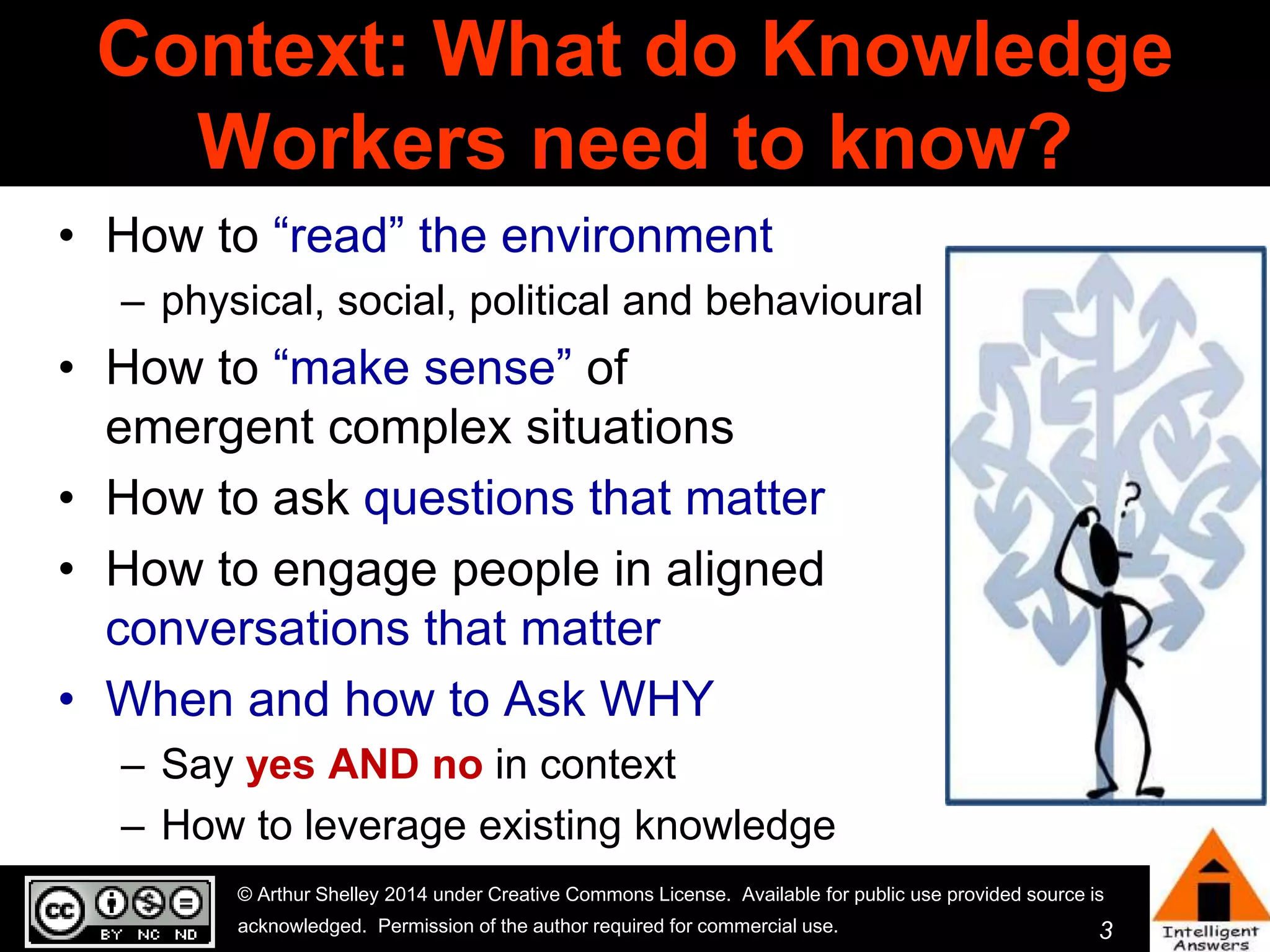
• How to “read” the environment 
– physical, social, political and behavioural 
• How to “make sense” of 
emergent complex situations 
• How to ask questions that matter 
• How to engage people in aligned 
conversations that matter 
• When and how to Ask WHY 
– Say yes AND no in context 
– How to leverage existing knowledge 
© Arthur Shelley 2014 under Creative Commons License. Available for public use provided source is 
acknowledged. Permission of the author required for commercial use.
How do we help build these? 
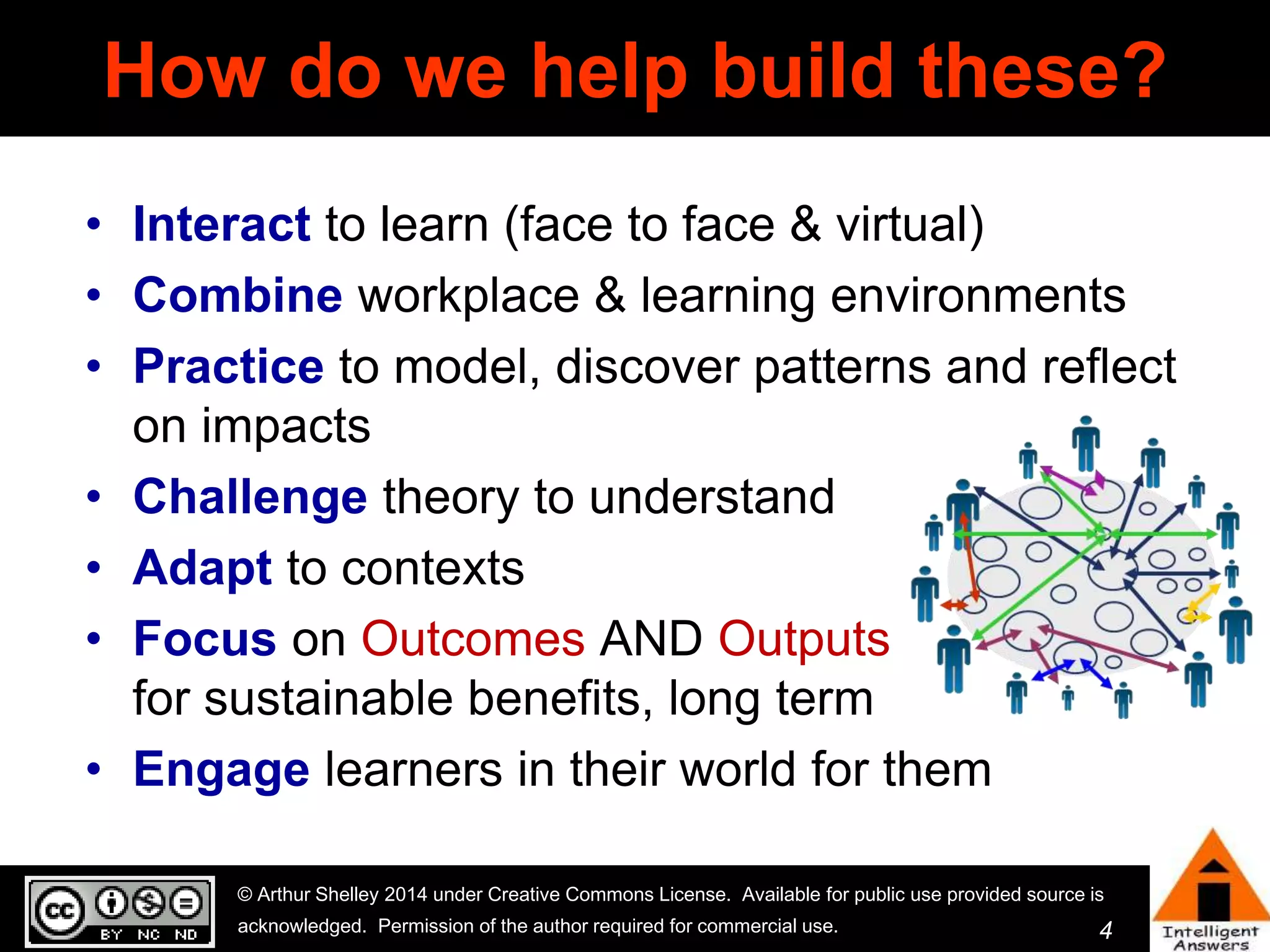
• Interact to learn (face to face & virtual) 
• Combine workplace & learning environments 
• Practice to model, discover patterns and reflect 
4 
on impacts 
• Challenge theory to understand 
• Adapt to contexts 
• Focus on Outcomes AND Outputs 
for sustainable benefits, long term 
• Engage learners in their world for them 
© Arthur Shelley 2014 under Creative Commons License. Available for public use provided source is 
acknowledged. Permission of the author required for commercial use.
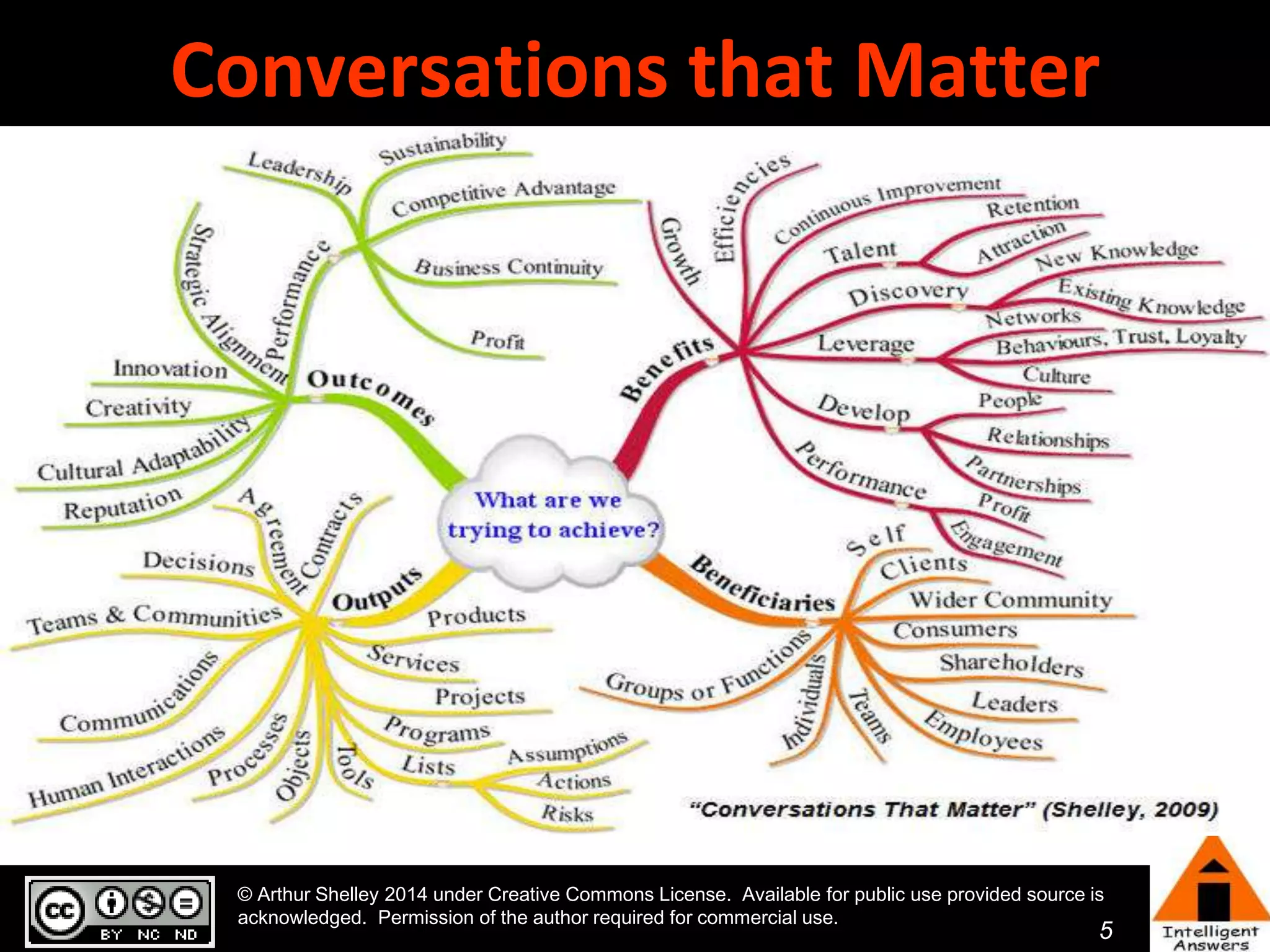
Conversations that Matter 
© Arthur Shelley 2014 under Creative Commons License. Available for public use provided source is 
acknowledged. Permission of the author required for commercial use. 
5
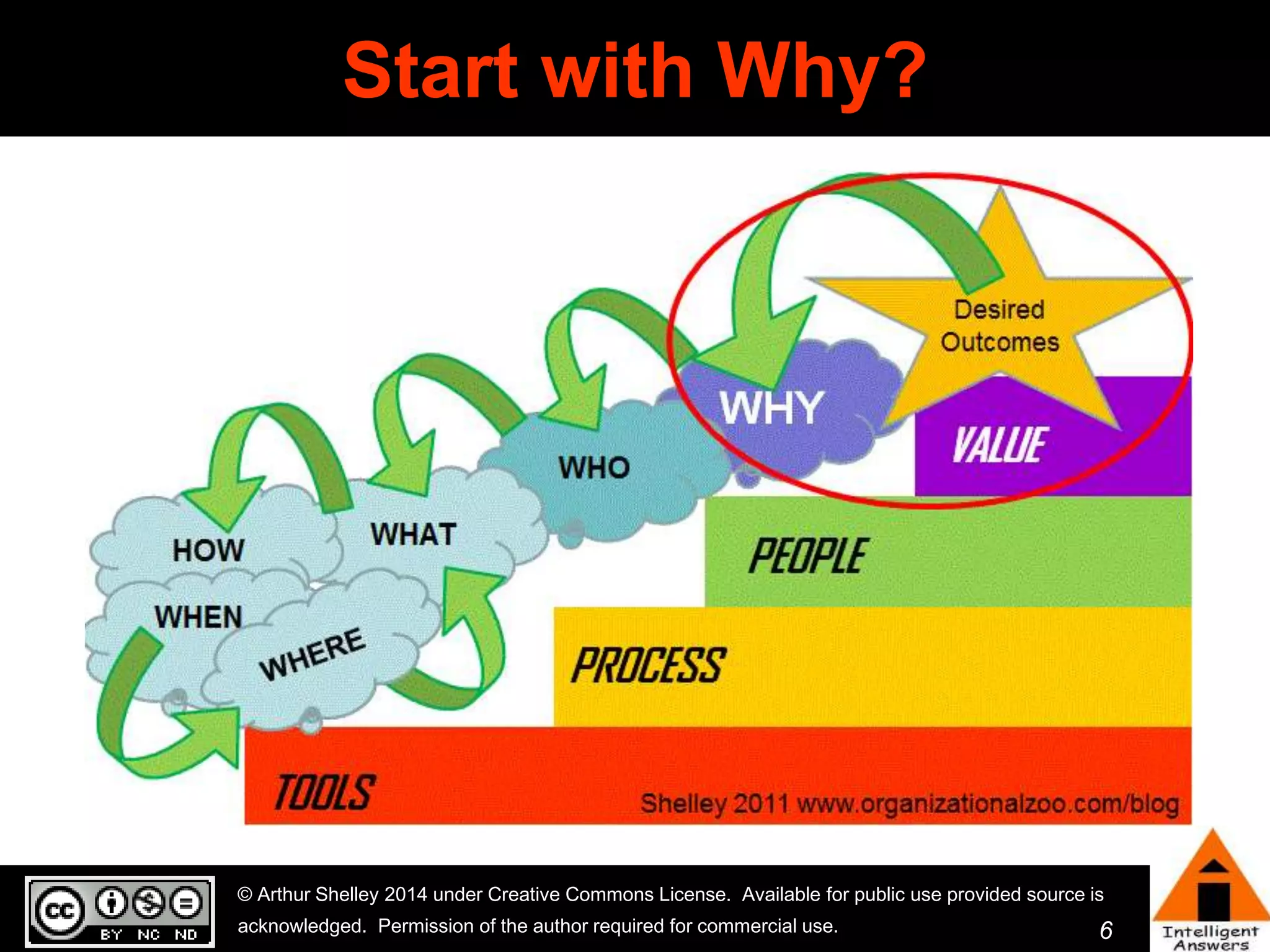
6 
Start with Why? 
© Arthur Shelley 2014 under Creative Commons License. Available for public use provided source is 
acknowledged. Permission of the author required for commercial use.
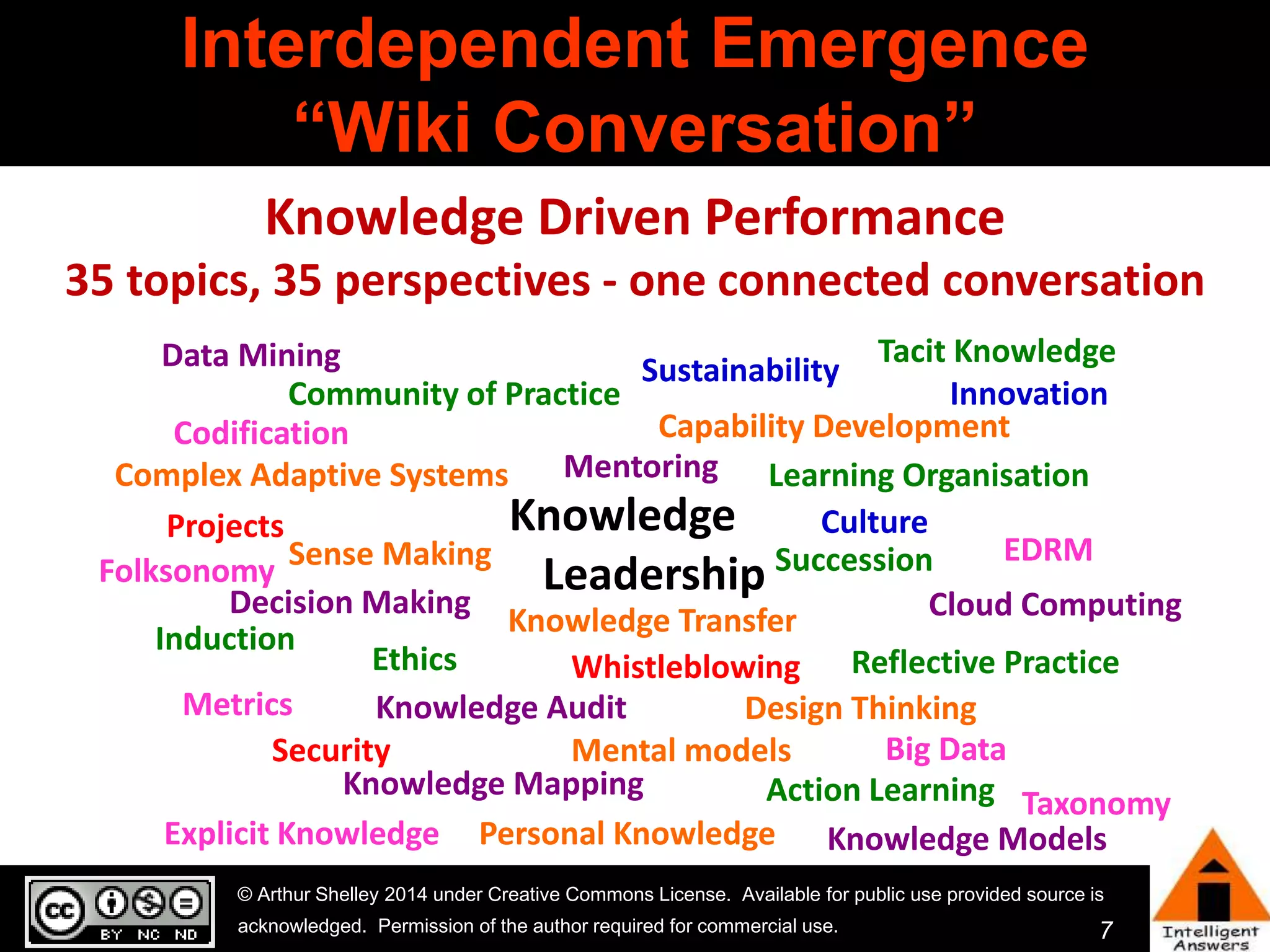
Knowledge Driven Performance 
35 topics, 35 perspectives - one connected conversation 
Tacit Knowledge 
Innovation 
EDRM 
Cloud Computing 
Reflective Practice 
Taxonomy 
Knowledge Models 
7 
Interdependent Emergence 
“Wiki Conversation” 
Sustainability 
Capability Development 
Data Mining 
Community of Practice 
Mentoring 
Knowledge 
Leadership 
Learning Organisation 
Codification 
Complex Adaptive Systems 
Projects 
Sense Making 
Folksonomy 
Decision Making 
Ethics 
Culture 
Succession 
Induction 
Knowledge Transfer 
Whistleblowing 
Design Thinking 
Mental models 
Big Data 
Action Learning 
Knowledge Audit 
Knowledge Mapping 
Personal Knowledge 
Metrics 
Security 
Explicit Knowledge 
© Arthur Shelley 2014 under Creative Commons License. Available for public use provided source is 
acknowledged. Permission of the author required for commercial use.
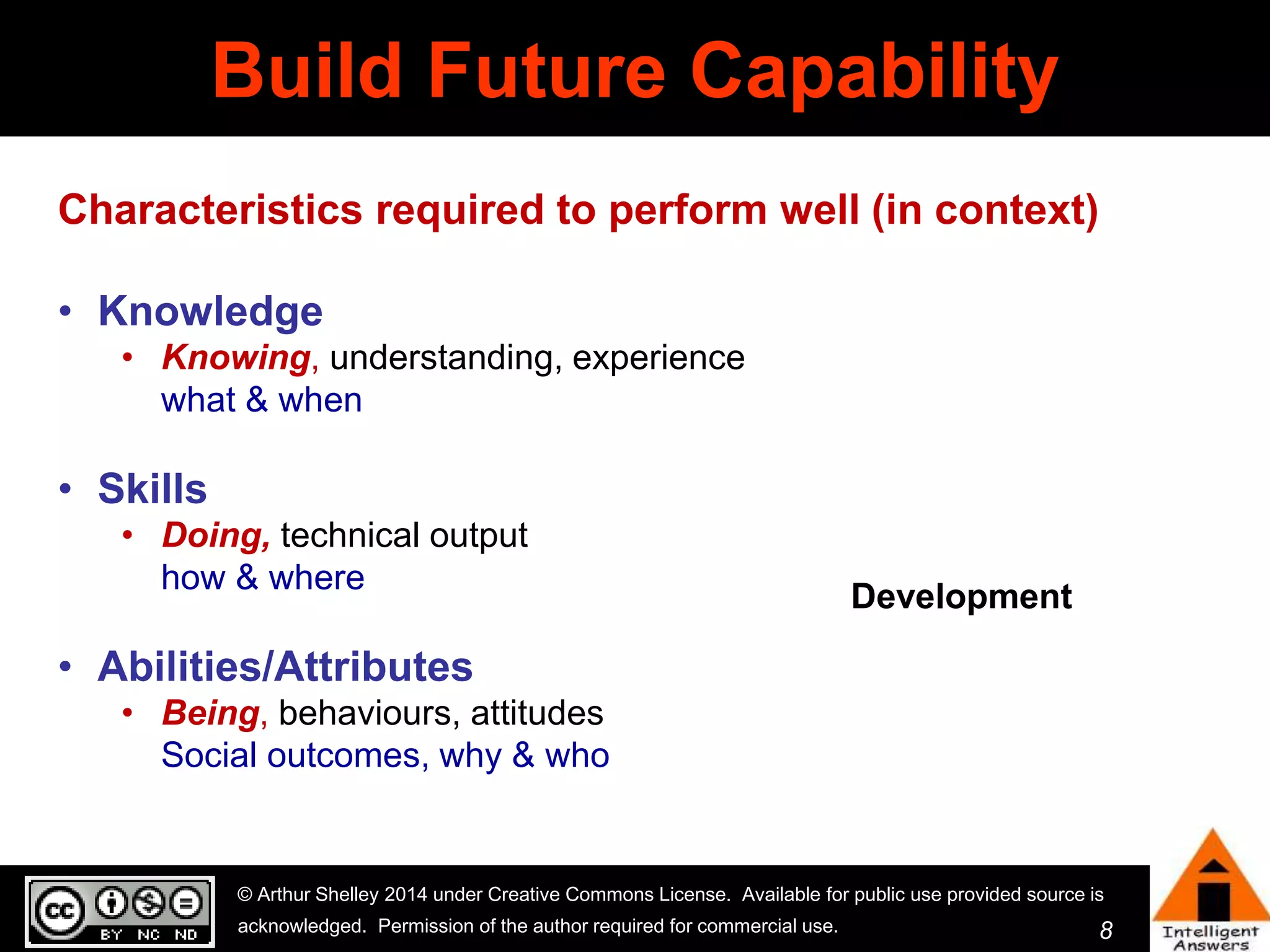
Characteristics required to perform well (in context) 
8 
Build Future Capability 
• Knowledge 
• Knowing, understanding, experience 
what & when 
© Arthur Shelley 2014 under Creative Commons License. Available for public use provided source is 
acknowledged. Permission of the author required for commercial use. 
• Skills 
• Doing, technical output 
how & where 
• Abilities/Attributes 
• Being, behaviours, attitudes 
Social outcomes, why & who 
Development
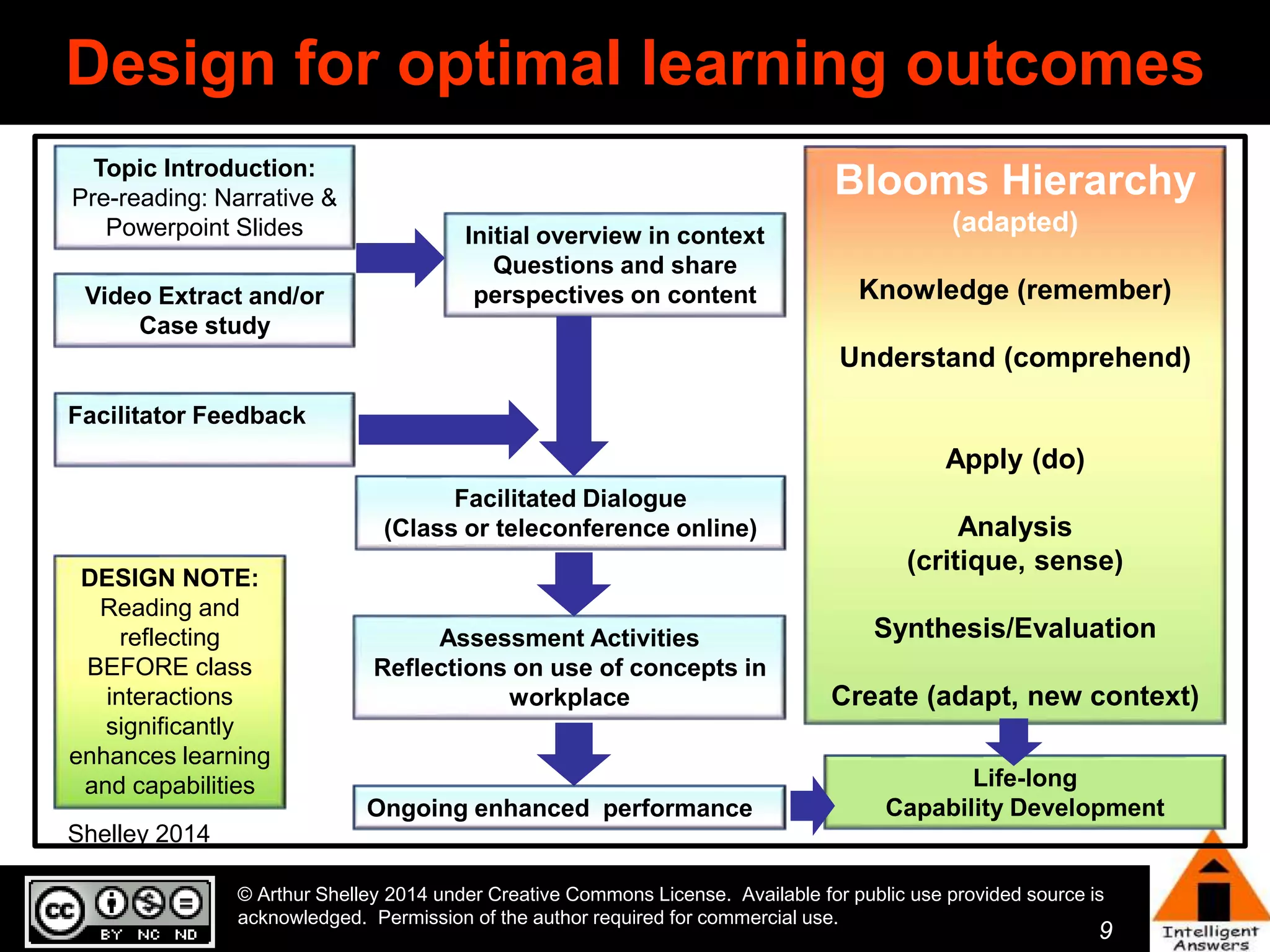
Design for optimal learning outcomes 
9 
9 
Topic Introduction: 
Pre-reading: Narrative & 
Powerpoint Slides Initial overview in context 
Video Extract and/or 
Case study 
Questions and share 
perspectives on content 
Facilitated Dialogue 
(Class or teleconference online) 
Facilitator Feedback 
Assessment Activities 
Reflections on use of concepts in 
workplace 
Blooms Hierarchy 
(adapted) 
Knowledge (remember) 
Understand (comprehend) 
Apply (do) 
Analysis 
(critique, sense) 
Synthesis/Evaluation 
Create (adapt, new context) 
Ongoing enhanced performance 
Life-long 
Capability Development 
DESIGN NOTE: 
Reading and 
reflecting 
BEFORE class 
interactions 
significantly 
enhances learning 
and capabilities 
Shelley 2014 
© Arthur Shelley 2014 under Creative Commons License. Available for public use provided source is 
acknowledged. Permission of the author required for commercial use.
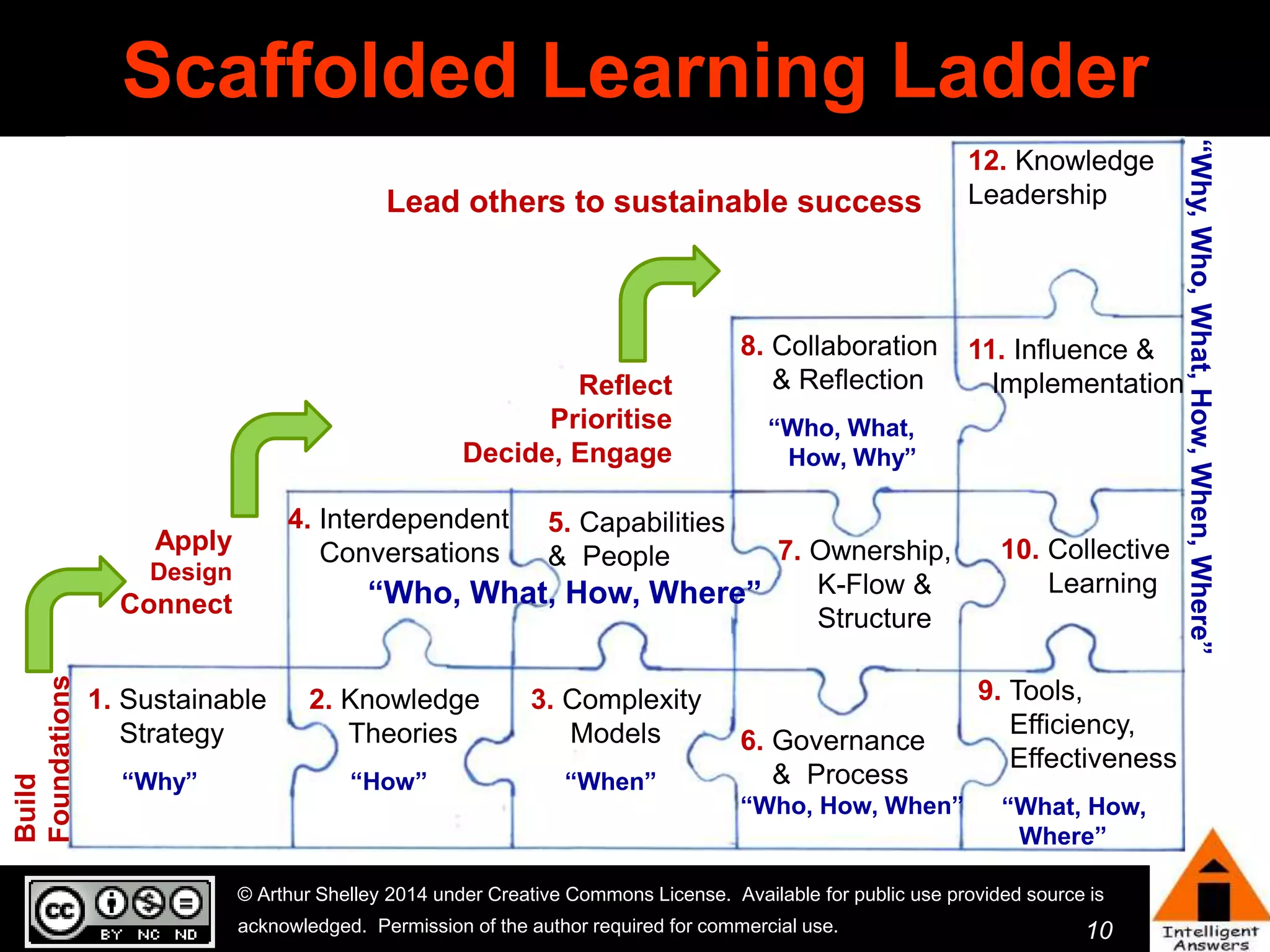
Scaffolded Learning Ladder 
8. Collaboration 
& Reflection 
“Who, What, 
How, Why” 
7. Ownership, 
K-Flow & 
Structure 
12. Knowledge 
Leadership 
11. Influence & 
Implementation 
10. Collective 
Learning 
© Arthur Shelley 2014 under Creative Commons License. Available for public use provided source is 
acknowledged. Permission of the author required for commercial use. 
10 
1. Sustainable 
Strategy 
“Why” 
2. Knowledge 
Theories 
“How” 
3. Complexity 
Models 
“When” 
4. Interdependent 
Conversations 
5. Capabilities 
& People 
6. Governance 
& Process 
“Who, How, When” 
9. Tools, 
Efficiency, 
Effectiveness 
“What, How, 
Where” 
Build 
Foundations 
Apply 
Design 
Connect 
Reflect 
Prioritise 
Decide, Engage 
“Who, What, How, Where” 
“Why, Who, What, How, When, Where” 
Lead others to sustainable success
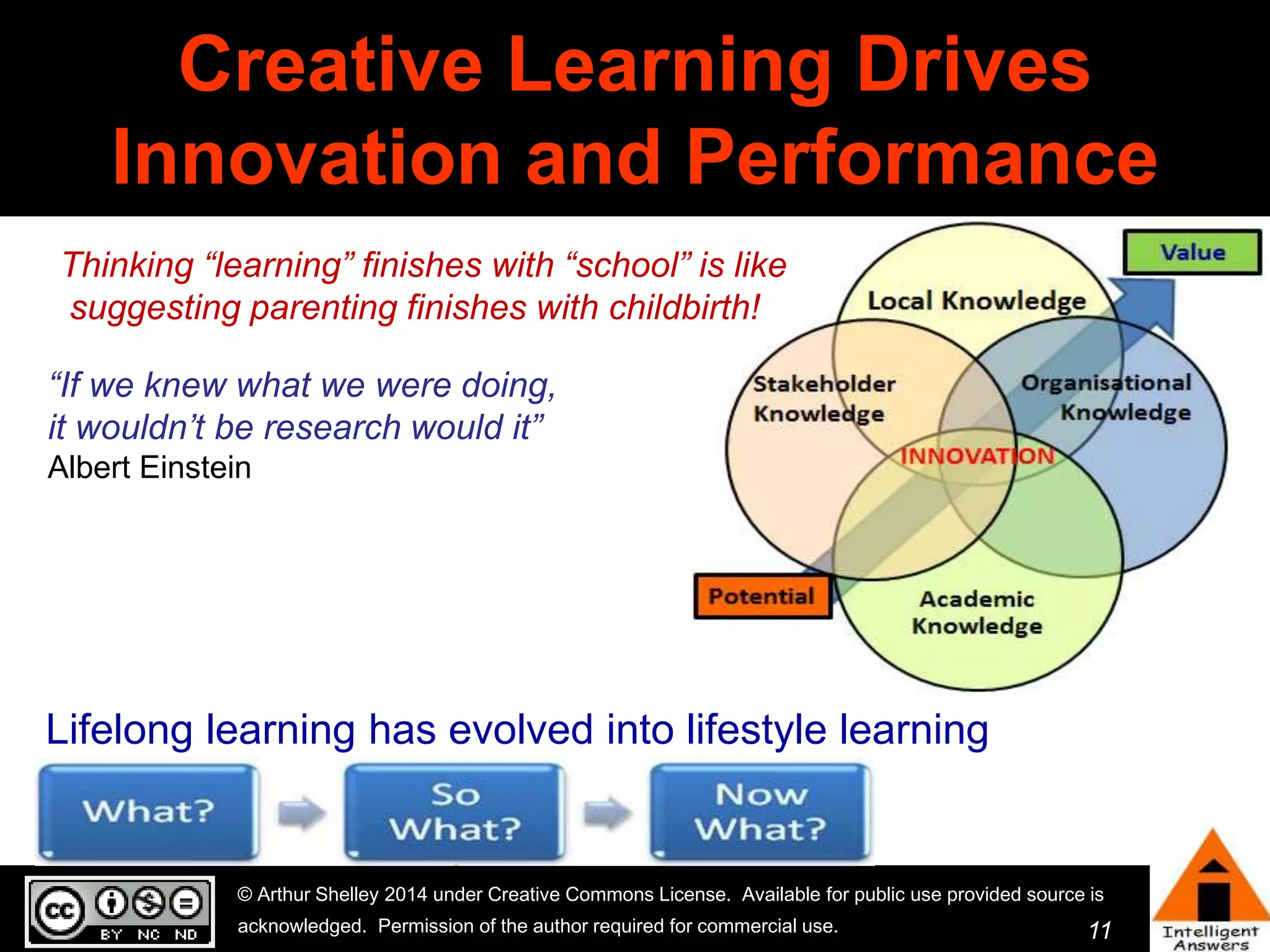
Creative Learning Drives 
Innovation and Performance 
Thinking “learning” finishes with “school” is like 
suggesting parenting finishes with childbirth! 
“If we knew what we were doing, 
it wouldn’t be research would it” 
Albert Einstein 
© Arthur Shelley 2014 under Creative Commons License. Available for public use provided source is 
acknowledged. Permission of the author required for commercial use. 
11 
Lifelong learning has evolved into lifestyle learning
12 
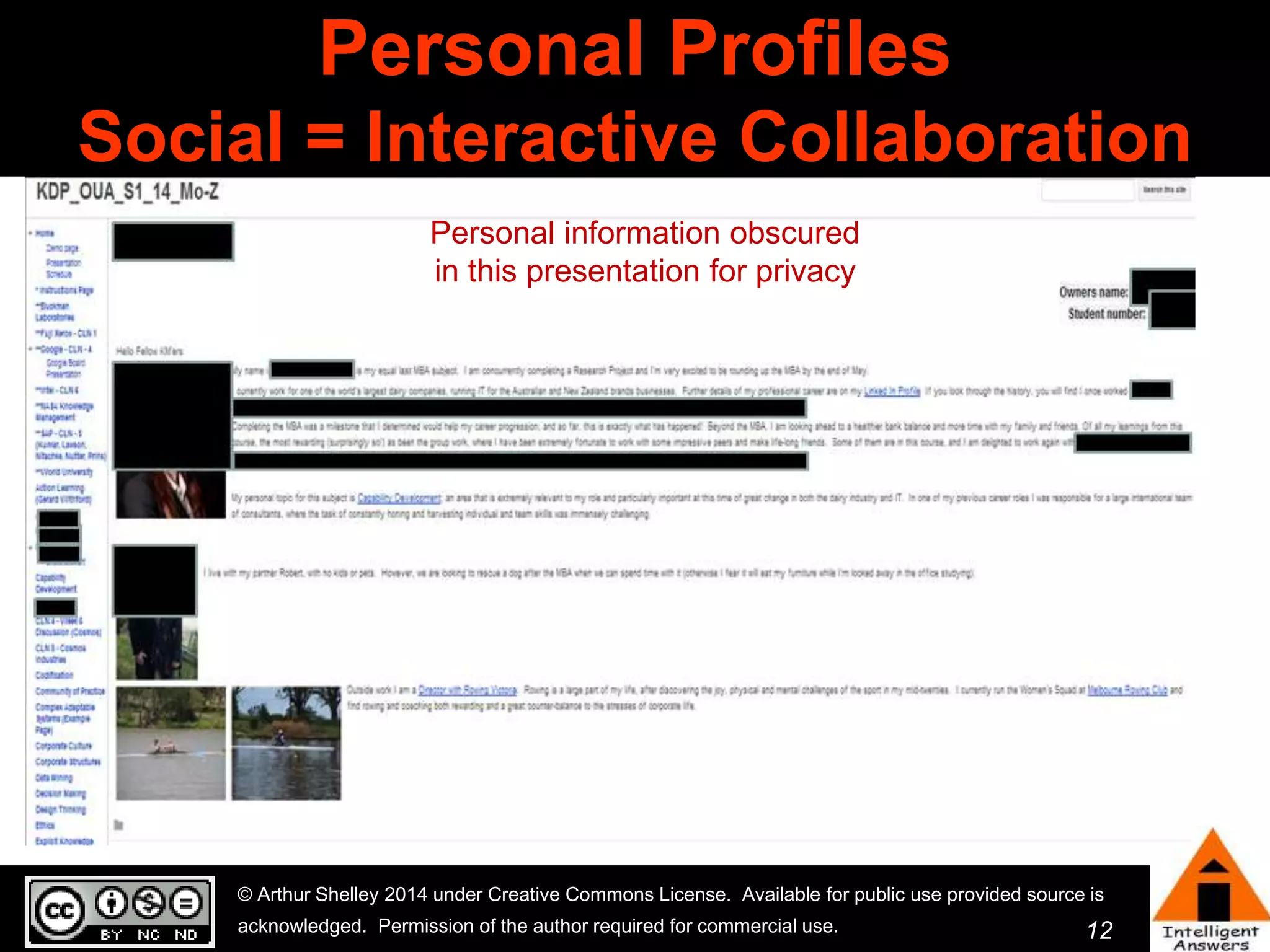
Personal Profiles 
Social = Interactive Collaboration 
Personal information obscured 
in this presentation for privacy 
© Arthur Shelley 2014 under Creative Commons License. Available for public use provided source is 
acknowledged. Permission of the author required for commercial use.
Wiki social learning interactions 
© Arthur Shelley 2014 under Creative Commons License. Available for public use provided source is 
acknowledged. Permission of the author required for commercial use. 
13
14 
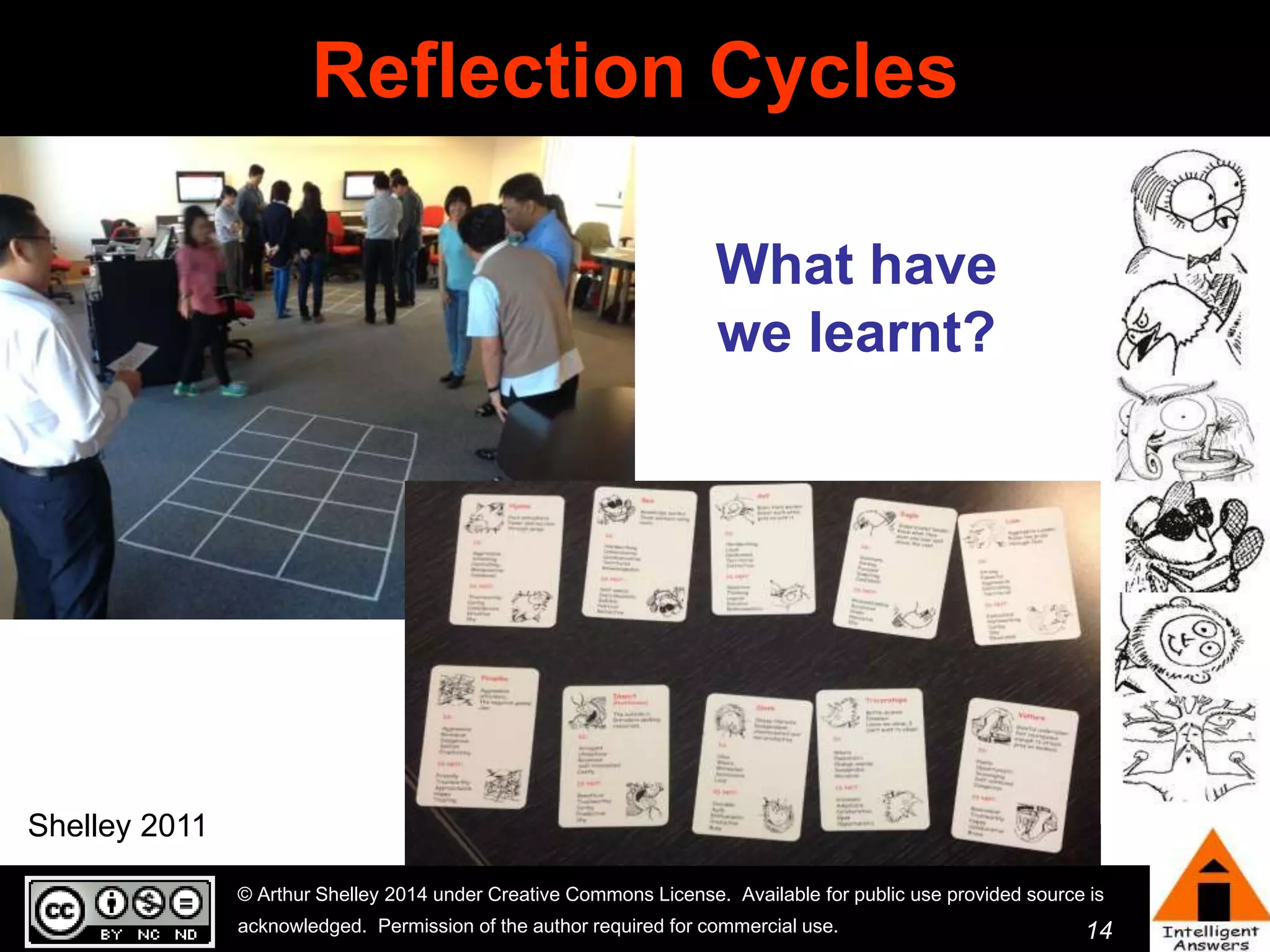
Reflection Cycles 
What have 
we learnt? 
© Arthur Shelley 2014 under Creative Commons License. Available for public use provided source is 
acknowledged. Permission of the author required for commercial use. 
Shelley 2011
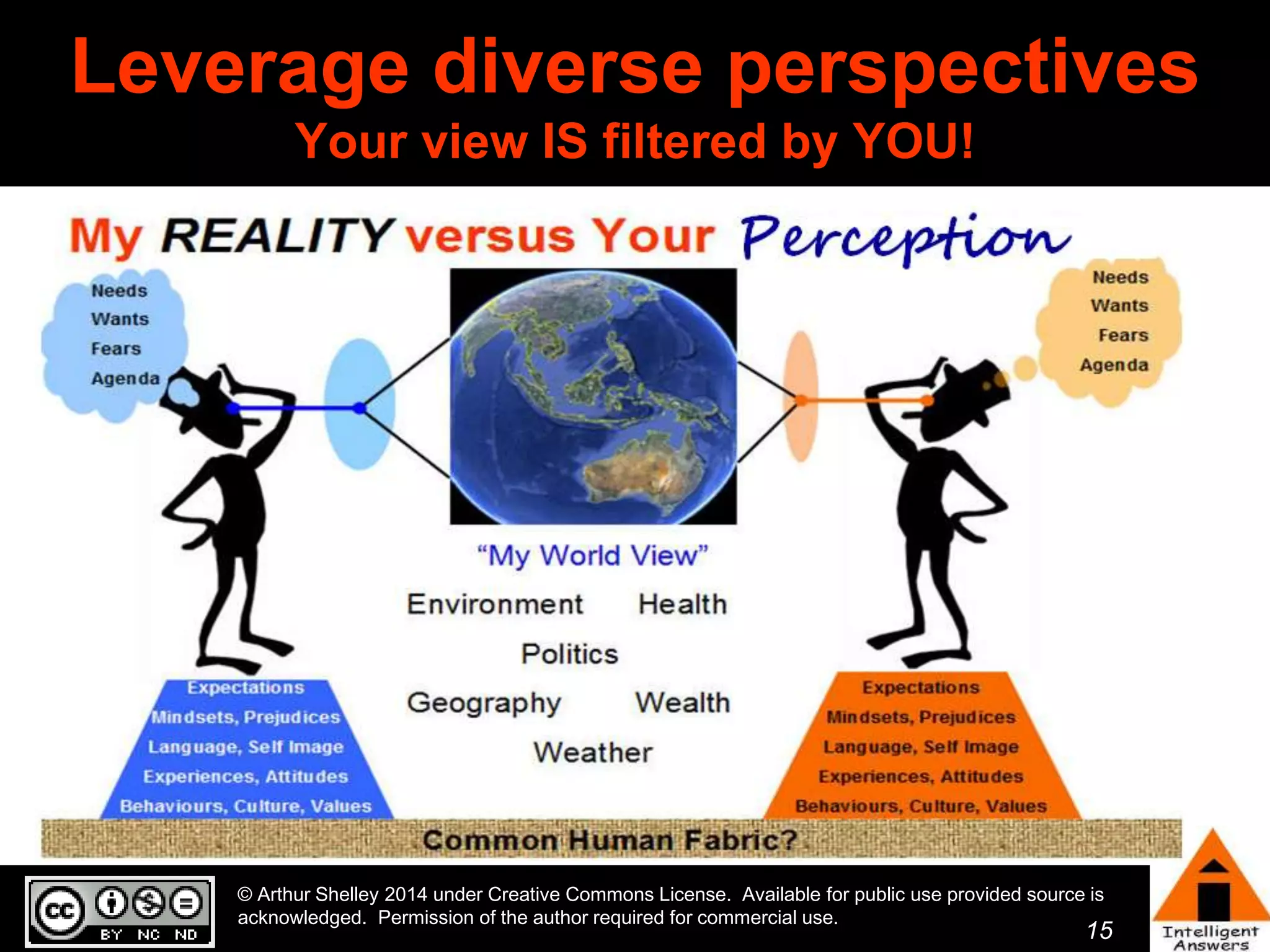
Leverage diverse perspectives 
15 
Your view IS filtered by YOU! 
© Arthur Shelley 2014 under Creative Commons License. Available for public use provided source is 
acknowledged. Permission of the author required for commercial use.
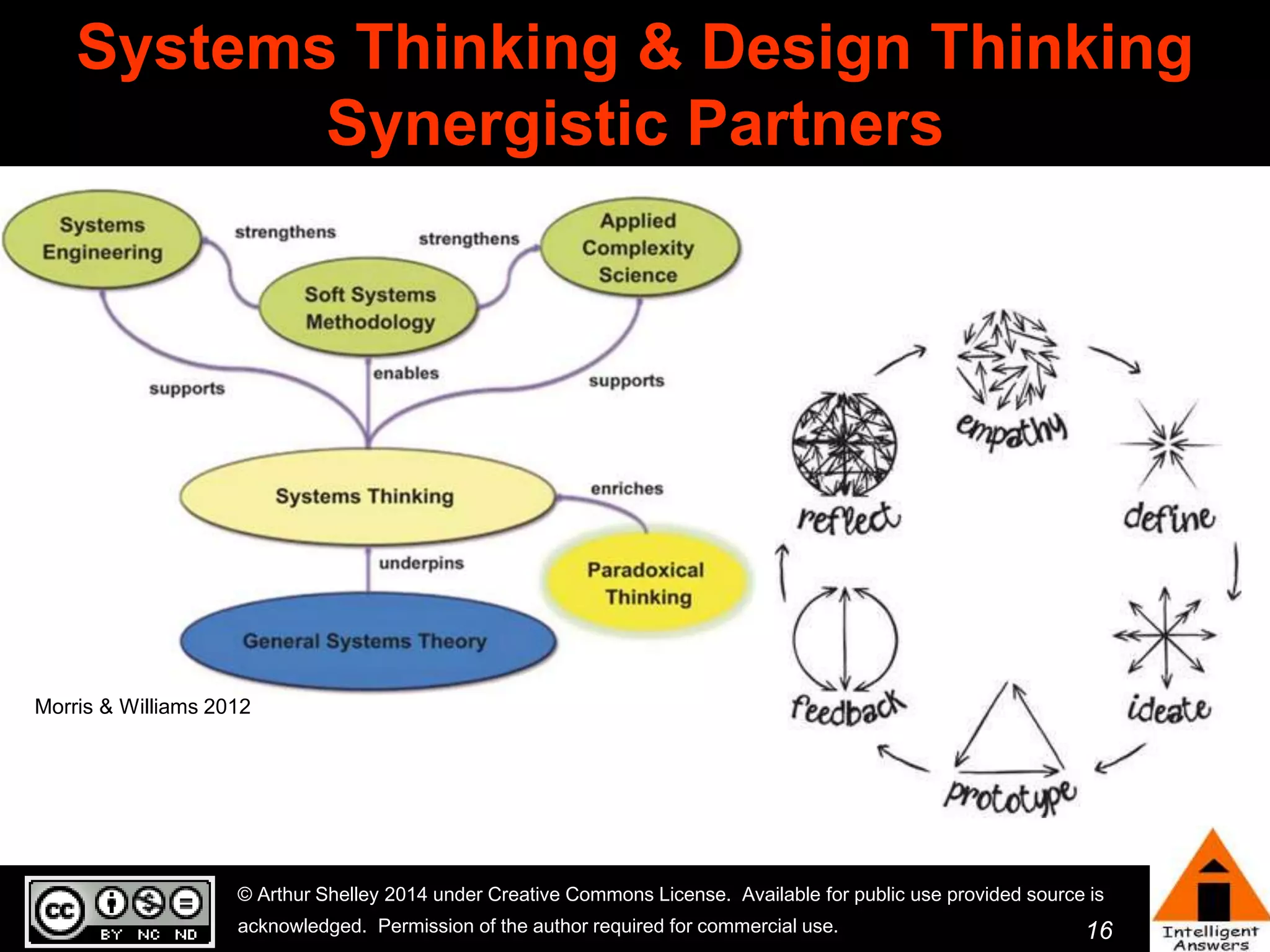
Systems Thinking & Design Thinking 
16 
Synergistic Partners 
Morris & Williams 2012 
© Arthur Shelley 2014 under Creative Commons License. Available for public use provided source is 
acknowledged. Permission of the author required for commercial use.
© Arthur Shelley 2014 under Creative Commons License. Available for public use provided source is 
acknowledged. Permission of the author required for commercial use. 
17 
Triggered Discussion Forums 
to leverage diversity of perspective 
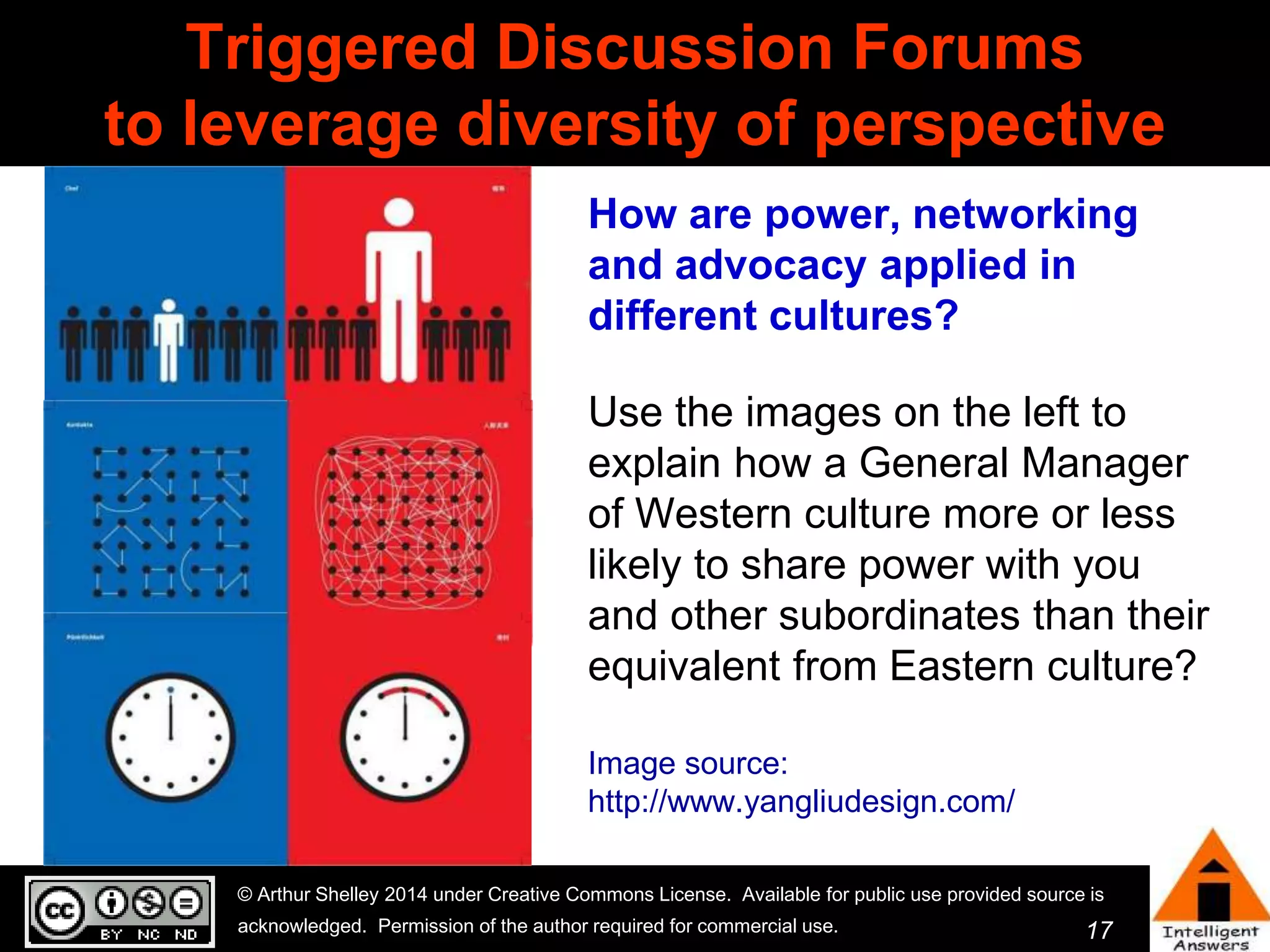
How are power, networking 
and advocacy applied in 
different cultures? 
Use the images on the left to 
explain how a General Manager 
of Western culture more or less 
likely to share power with you 
and other subordinates than their 
equivalent from Eastern culture? 
Image source: 
http://www.yangliudesign.com/ 
17
Case evaluation to explore options 
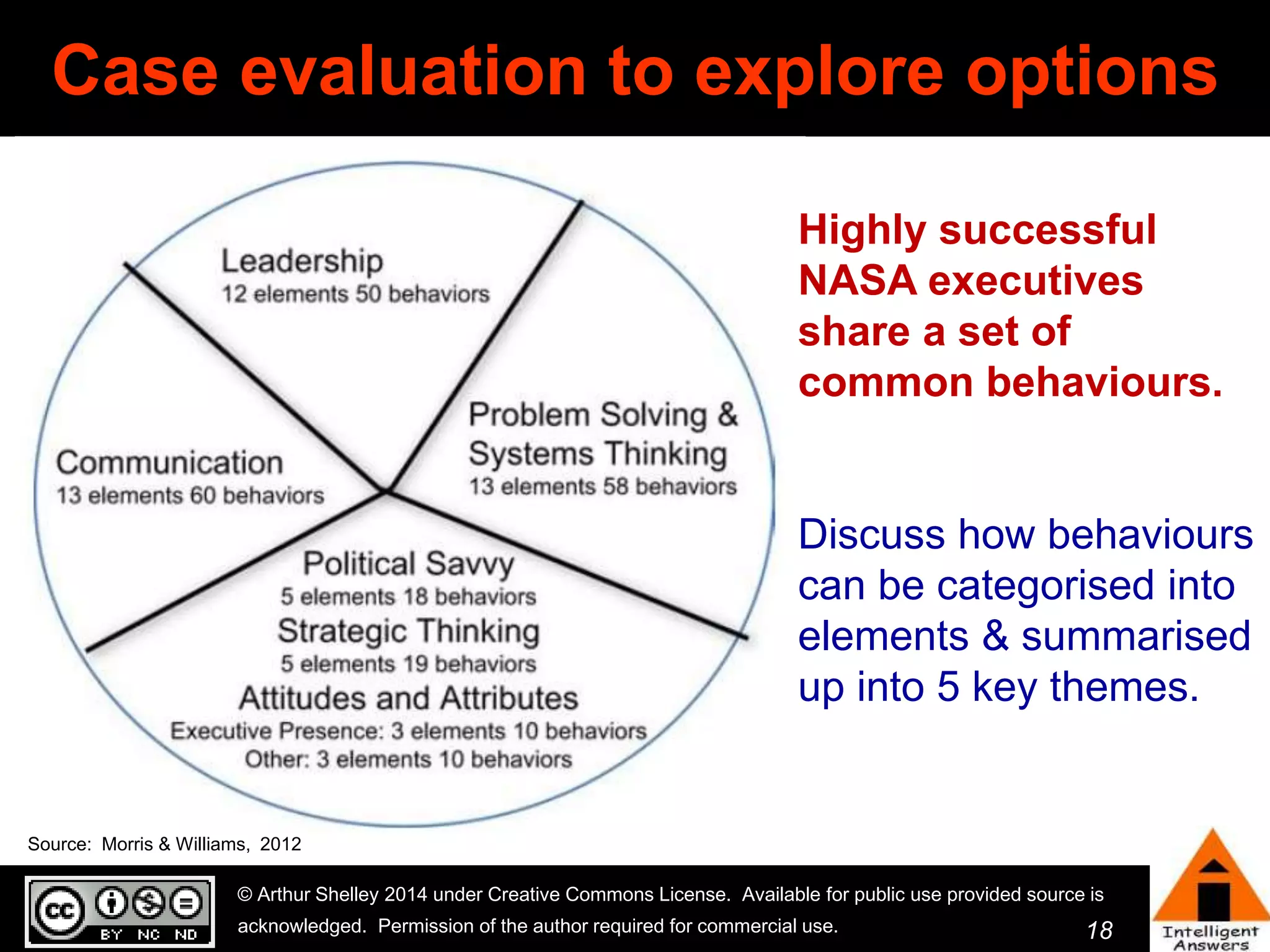
Highly successful 
NASA executives 
share a set of 
common behaviours. 
Discuss how behaviours 
can be categorised into 
elements & summarised 
up into 5 key themes. 
© Arthur Shelley 2014 under Creative Commons License. Available for public use provided source is 
acknowledged. Permission of the author required for commercial use. 
18 
Source: Morris & Williams, 2012
Video to motivate and challenge 
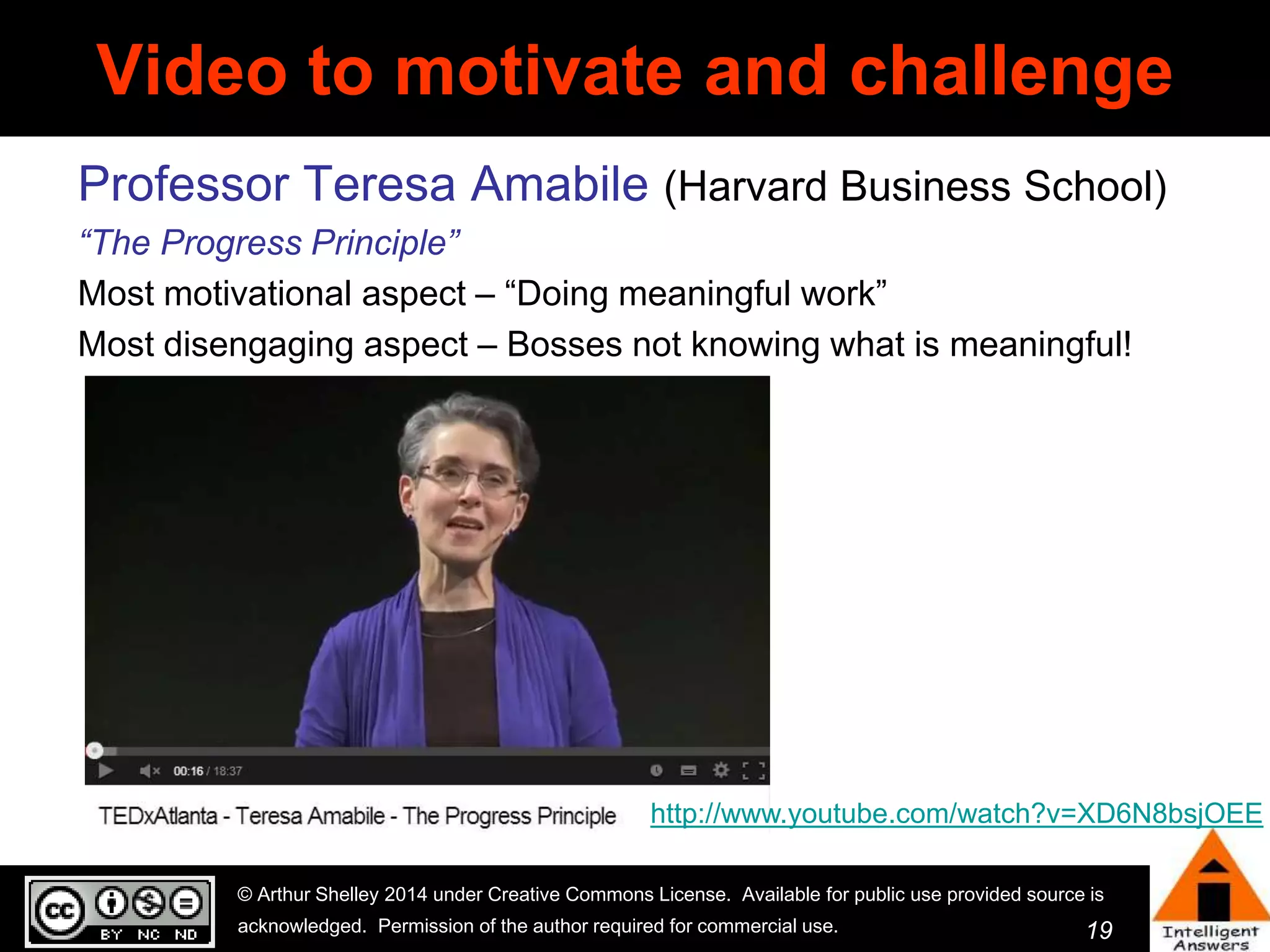
Professor Teresa Amabile (Harvard Business School) 
“The Progress Principle” 
Most motivational aspect – “Doing meaningful work” 
Most disengaging aspect – Bosses not knowing what is meaningful! 
http://www.youtube.com/watch?v=XD6N8bsjOEE 
© Arthur Shelley 2014 under Creative Commons License. Available for public use provided source is 
acknowledged. Permission of the author required for commercial use. 
19
Visualisation to stimulate ideas 
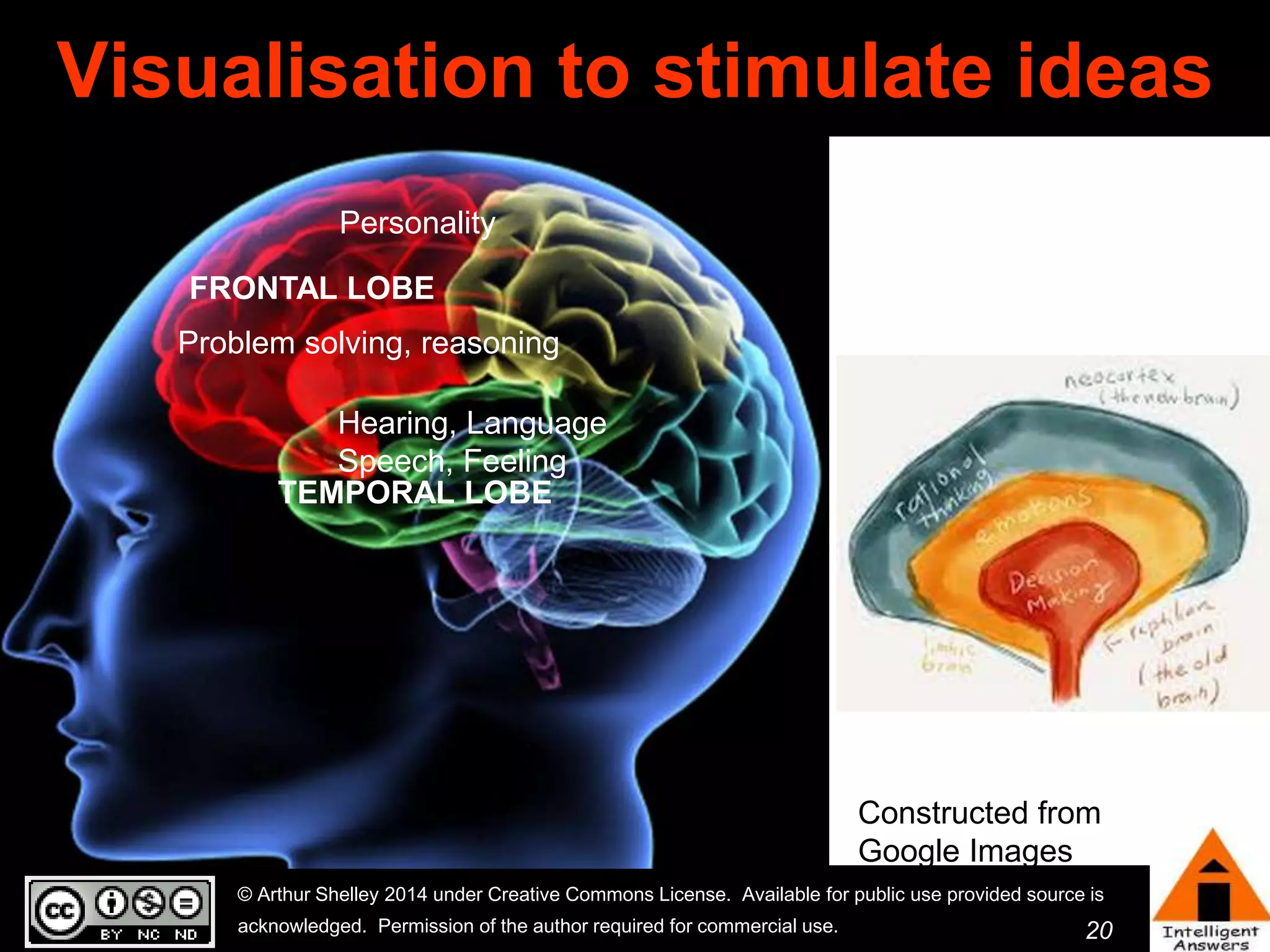
Problem solving, reasoning 
Hearing, Language 
Speech, Feeling 
© Arthur Shelley 2014 under Creative Commons License. Available for public use provided source is 
acknowledged. Permission of the author required for commercial use. 
20 
Personality 
FRONTAL LOBE 
TEMPORAL LOBE 
Constructed from 
Google Images
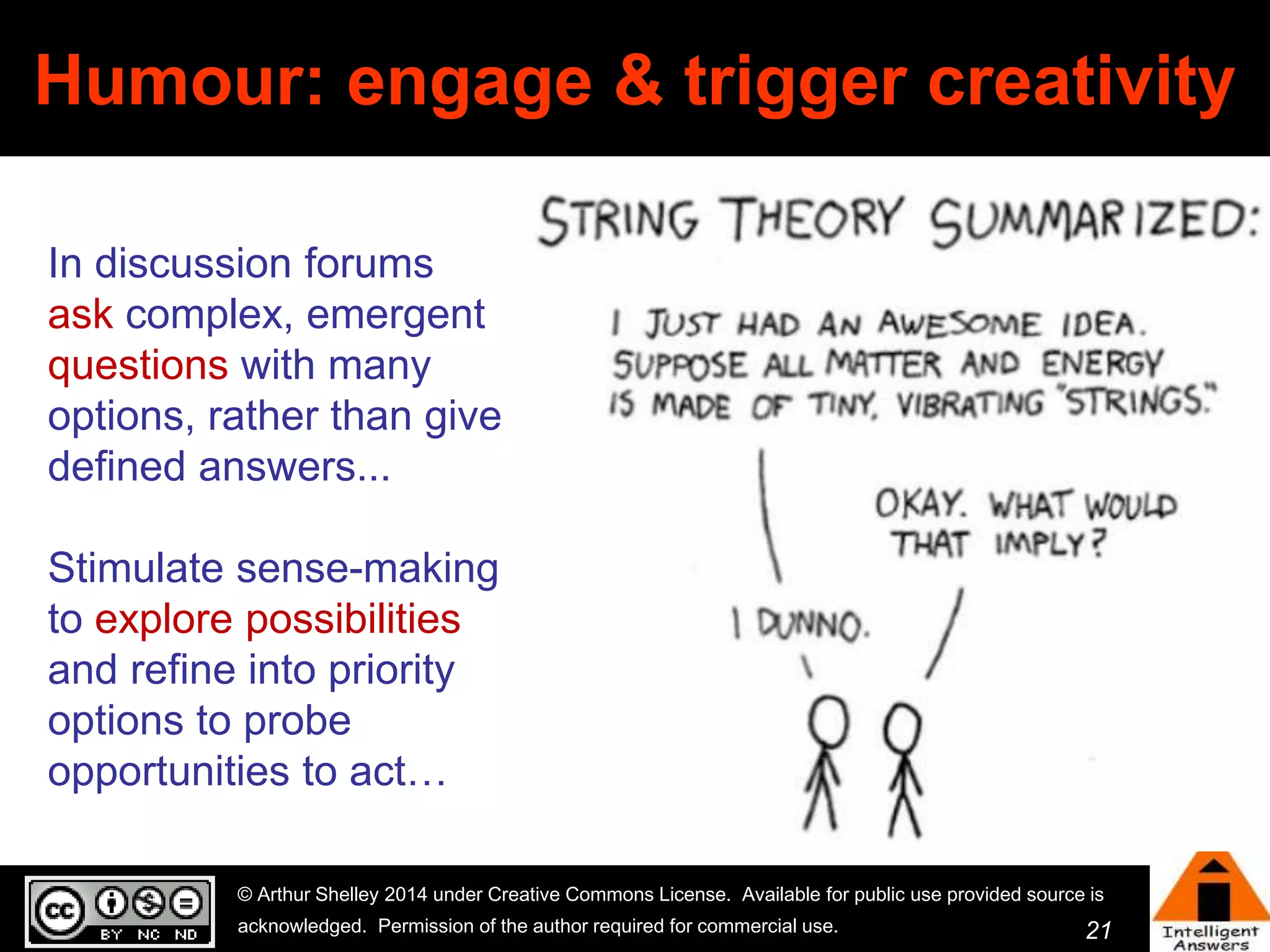
Humour: engage & trigger creativity 
© Arthur Shelley 2014 under Creative Commons License. Available for public use provided source is 
acknowledged. Permission of the author required for commercial use. 
21 
In discussion forums 
ask complex, emergent 
questions with many 
options, rather than give 
defined answers... 
Stimulate sense-making 
to explore possibilities 
and refine into priority 
options to probe 
opportunities to act…
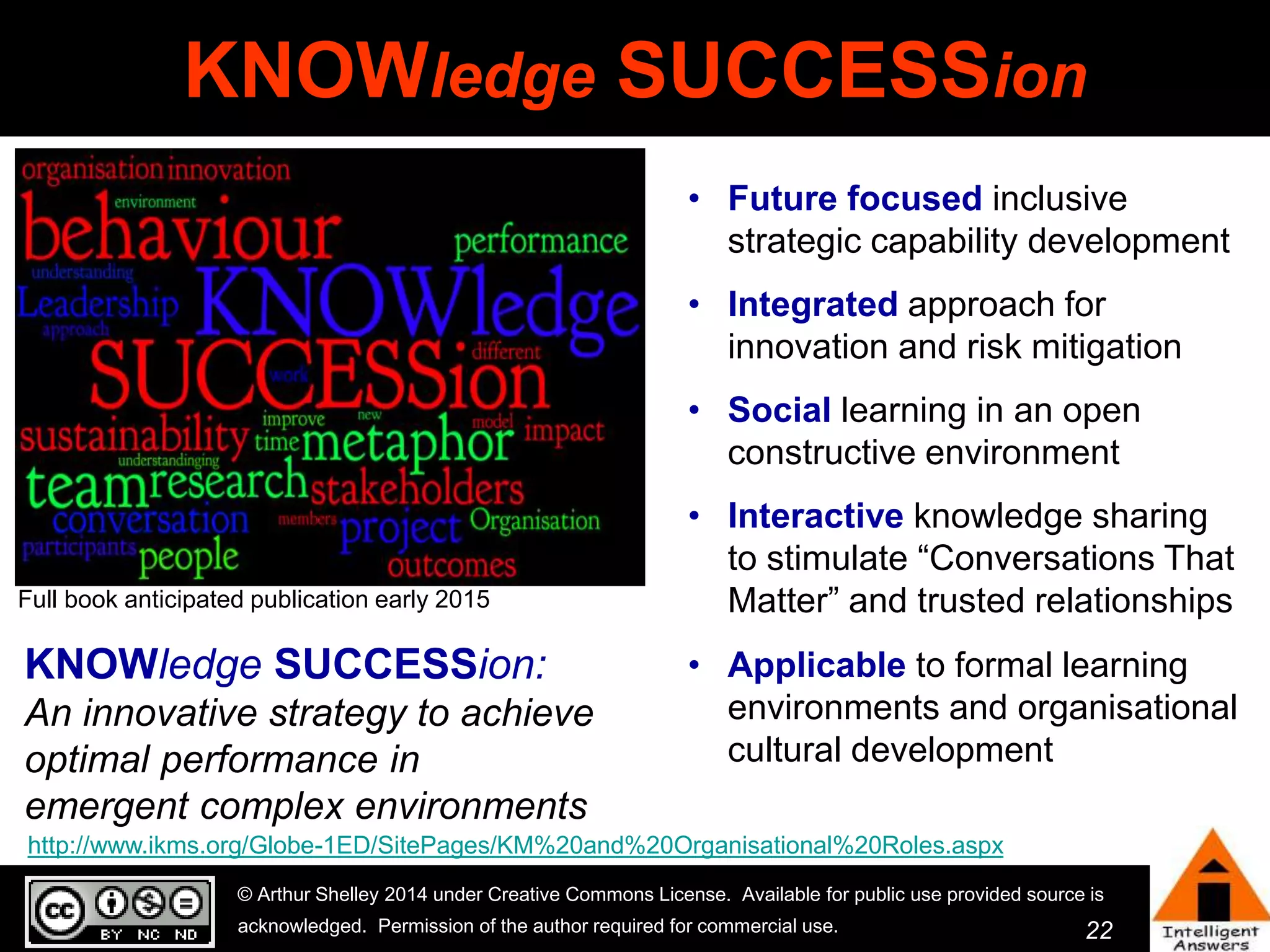
KNOWledge SUCCESSion 
• Future focused inclusive 
strategic capability development 
• Integrated approach for 
innovation and risk mitigation 
• Social learning in an open 
constructive environment 
• Interactive knowledge sharing 
to stimulate “Conversations That 
Matter” and trusted relationships 
• Applicable to formal learning 
environments and organisational 
cultural development 
Full book anticipated publication early 2015 
© Arthur Shelley 2014 under Creative Commons License. Available for public use provided source is 
acknowledged. Permission of the author required for commercial use. 
22 
KNOWledge SUCCESSion: 
An innovative strategy to achieve 
optimal performance in 
emergent complex environments 
http://www.ikms.org/Globe-1ED/SitePages/KM%20and%20Organisational%20Roles.aspx
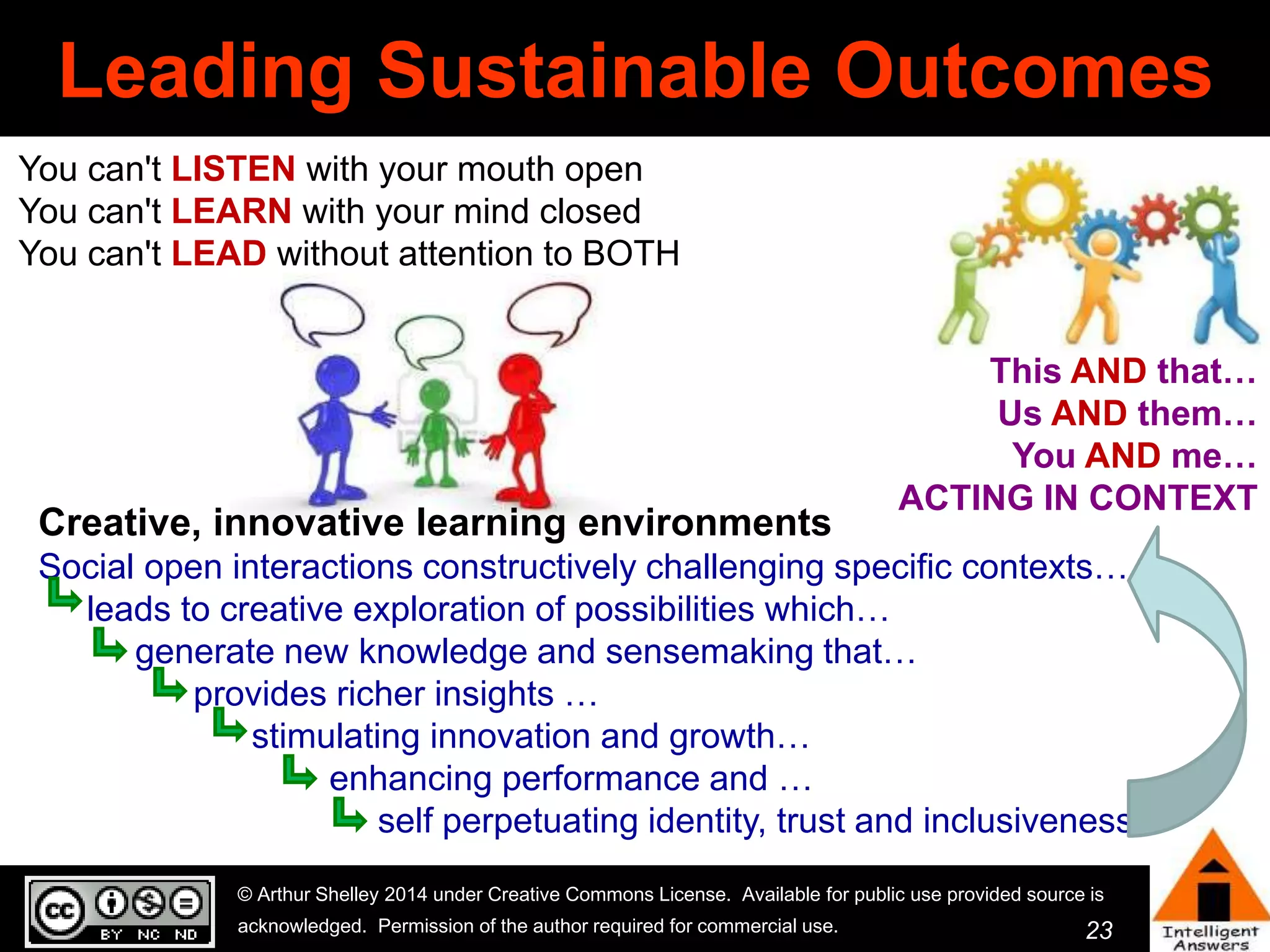
Leading Sustainable Outcomes 
This AND that… 
Us AND them… 
You AND me… 
ACTING IN CONTEXT 
© Arthur Shelley 2014 under Creative Commons License. Available for public use provided source is 
acknowledged. Permission of the author required for commercial use. 
23 
You can't LISTEN with your mouth open 
You can't LEARN with your mind closed 
You can't LEAD without attention to BOTH 
Creative, innovative learning environments 
Social open interactions constructively challenging specific contexts… 
leads to creative exploration of possibilities which… 
generate new knowledge and sensemaking that… 
provides richer insights … 
stimulating innovation and growth… 
enhancing performance and … 
self perpetuating identity, trust and inclusiveness
24 
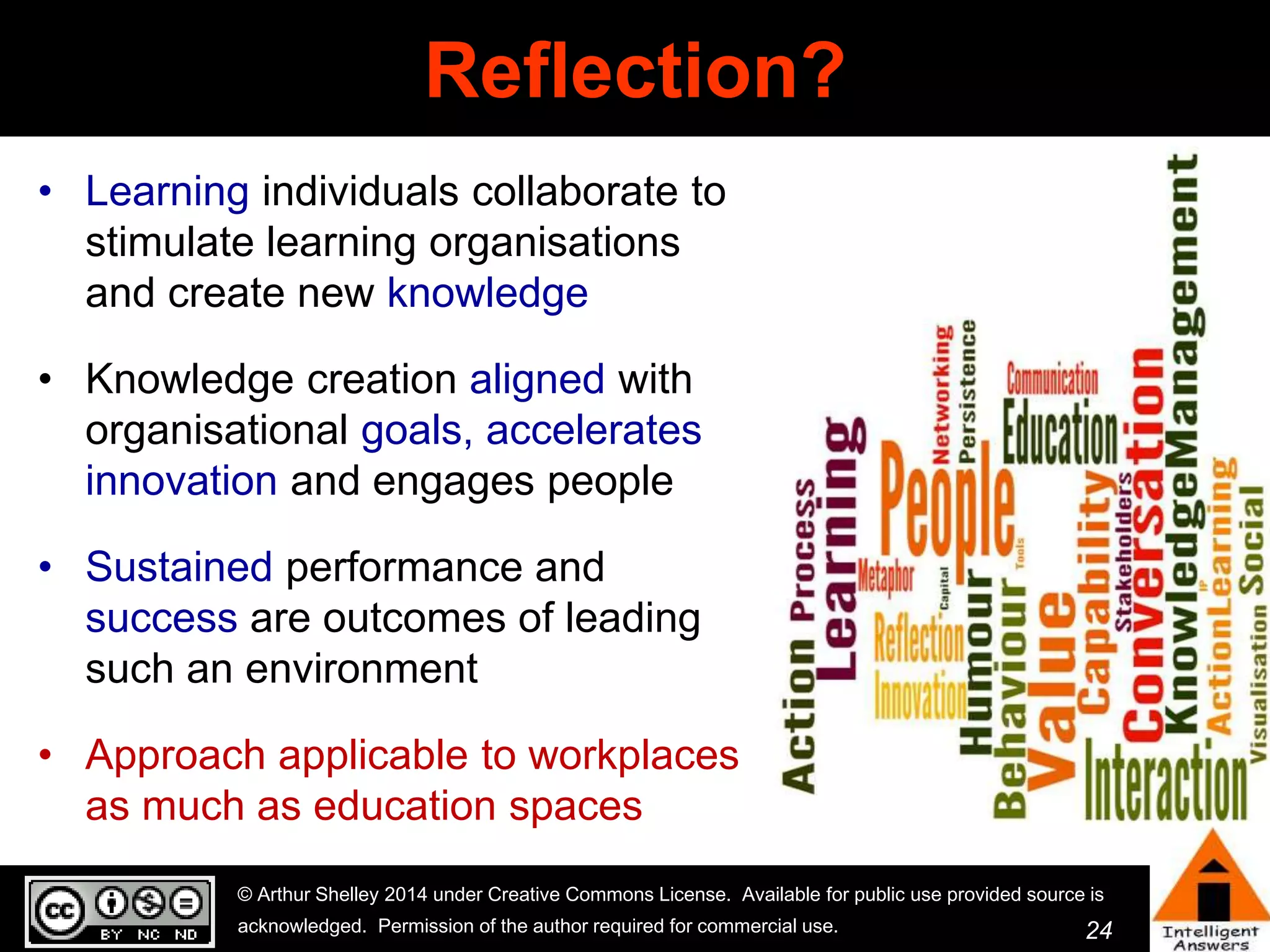
Reflection? 
• Learning individuals collaborate to 
stimulate learning organisations 
and create new knowledge 
• Knowledge creation aligned with 
organisational goals, accelerates 
innovation and engages people 
• Sustained performance and 
success are outcomes of leading 
such an environment 
• Approach applicable to workplaces 
as much as education spaces 
© Arthur Shelley 2014 under Creative Commons License. Available for public use provided source is 
acknowledged. Permission of the author required for commercial use.
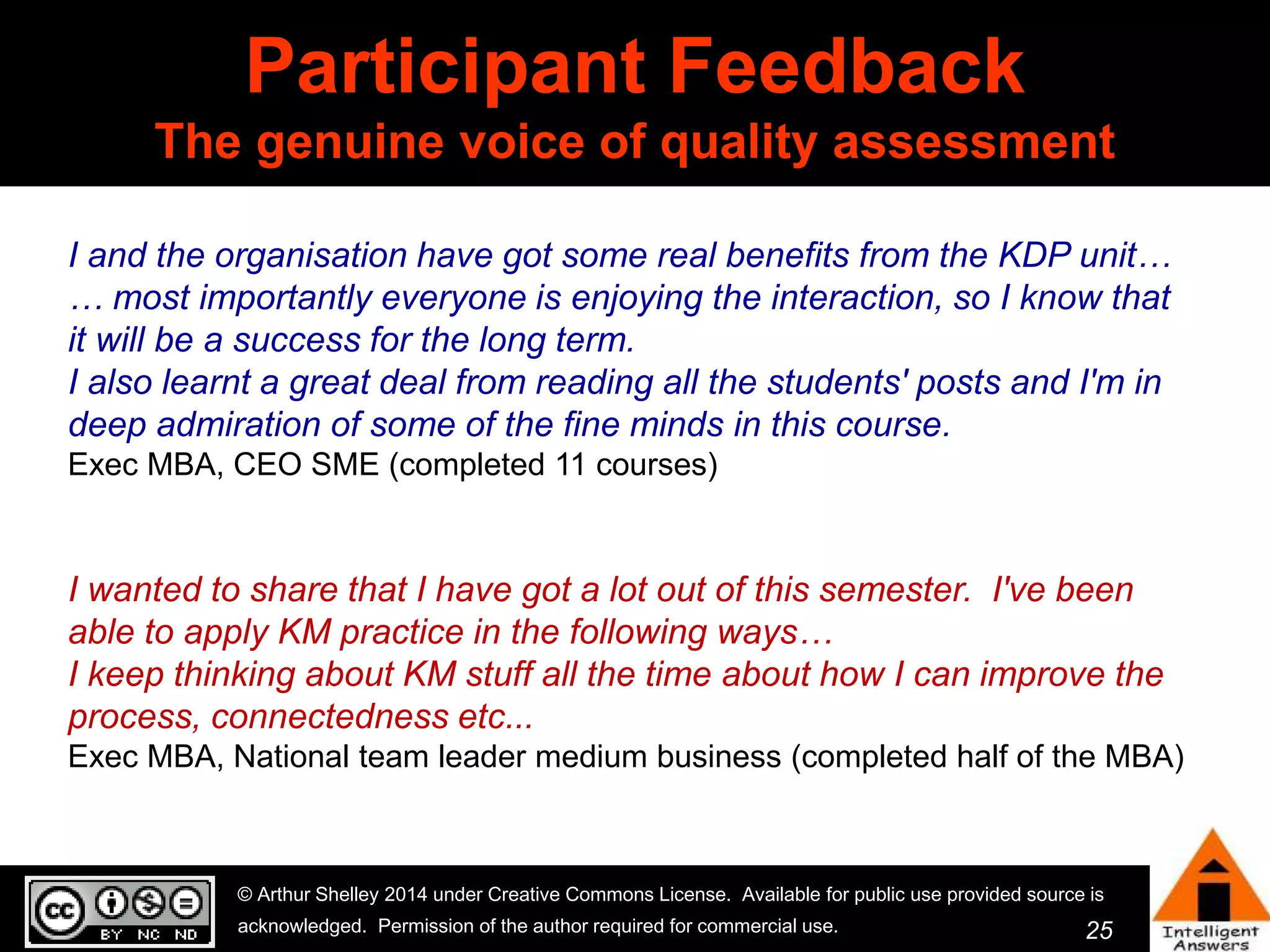
I and the organisation have got some real benefits from the KDP unit… 
… most importantly everyone is enjoying the interaction, so I know that 
it will be a success for the long term. 
I also learnt a great deal from reading all the students' posts and I'm in 
deep admiration of some of the fine minds in this course. 
Exec MBA, CEO SME (completed 11 courses) 
I wanted to share that I have got a lot out of this semester. I've been 
able to apply KM practice in the following ways… 
I keep thinking about KM stuff all the time about how I can improve the 
process, connectedness etc... 
Exec MBA, National team leader medium business (completed half of the MBA) 
25 
Participant Feedback 
The genuine voice of quality assessment 
© Arthur Shelley 2014 under Creative Commons License. Available for public use provided source is 
acknowledged. Permission of the author required for commercial use.
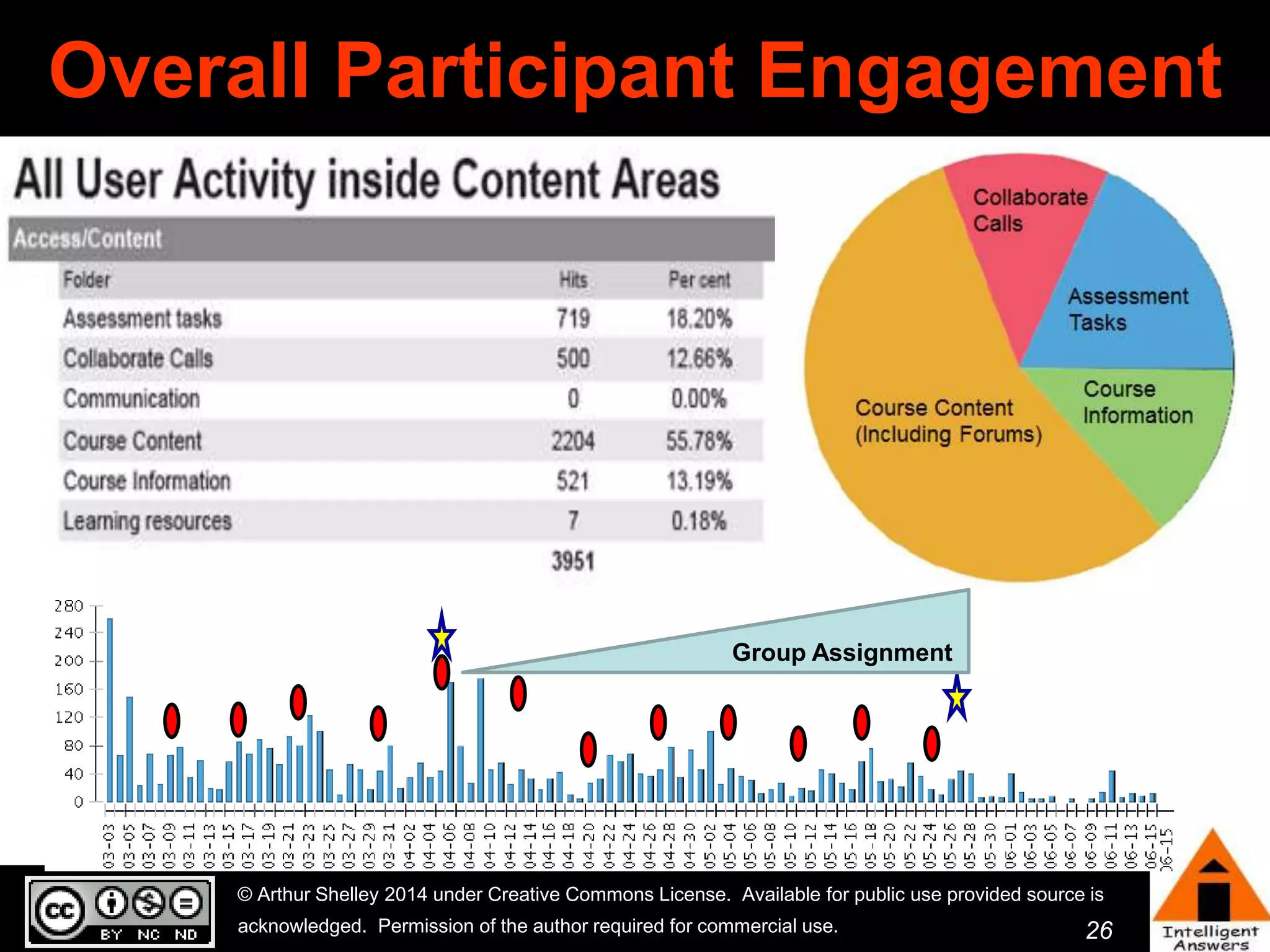
Overall Participant Engagement 
© Arthur Shelley 2014 under Creative Commons License. Available for public use provided source is 
acknowledged. Permission of the author required for commercial use. 
26 
Group Assignment
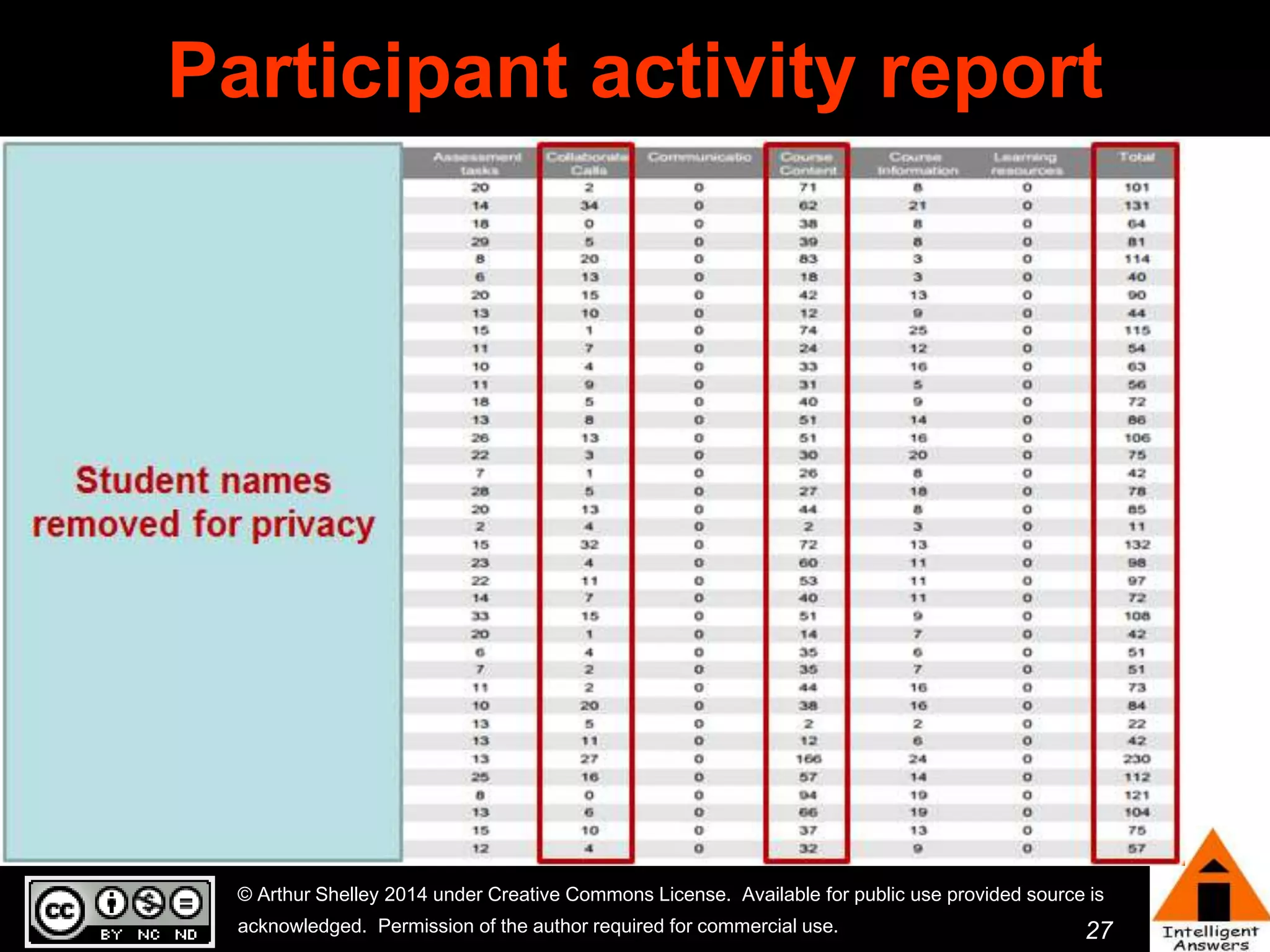
Participant activity report 
© Arthur Shelley 2014 under Creative Commons License. Available for public use provided source is 
acknowledged. Permission of the author required for commercial use. 
27
28 
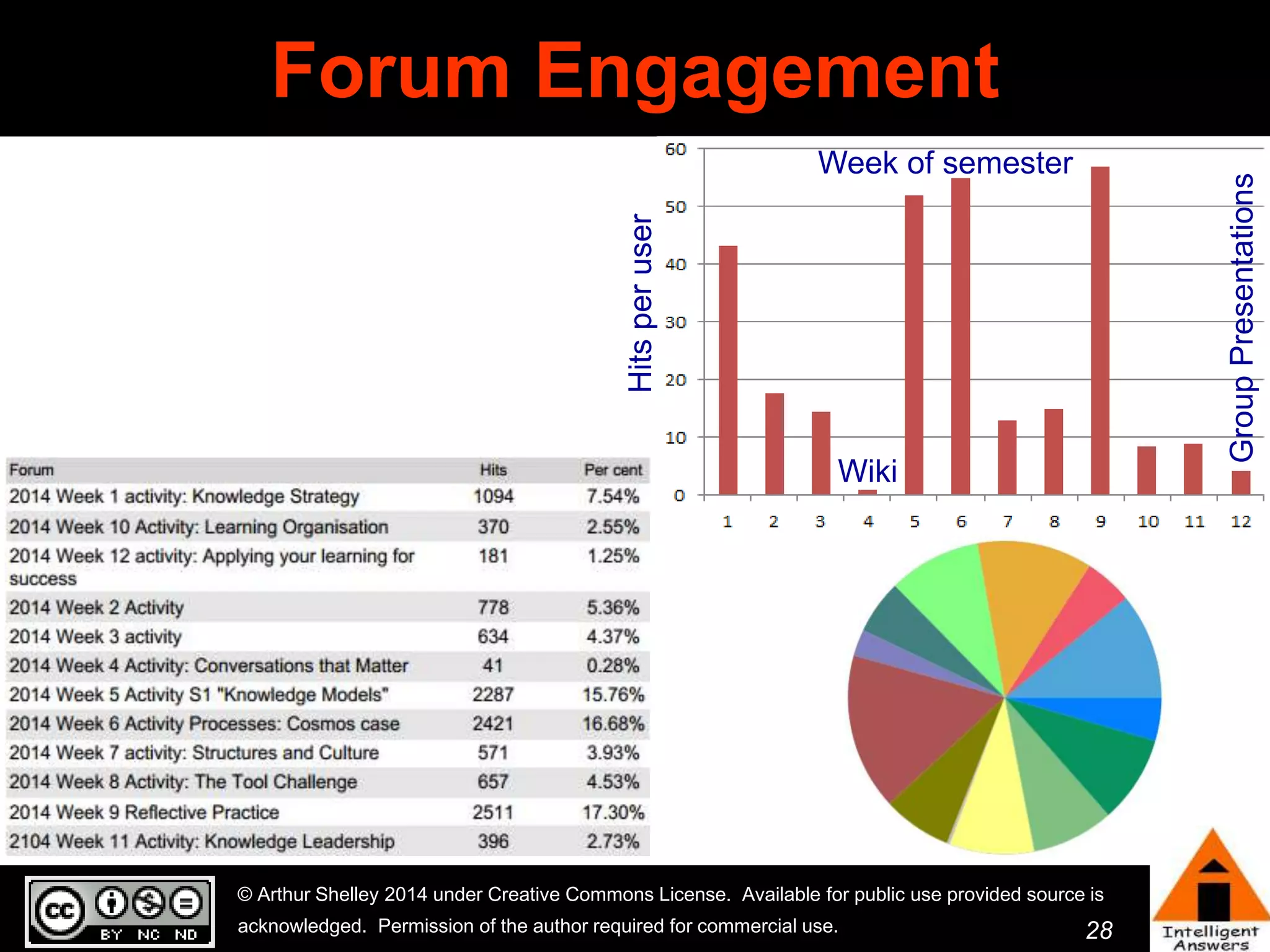
Forum Engagement 
Hits per user 
Week of semester 
Wiki 
© Arthur Shelley 2014 under Creative Commons License. Available for public use provided source is 
acknowledged. Permission of the author required for commercial use. 
Group Presentations
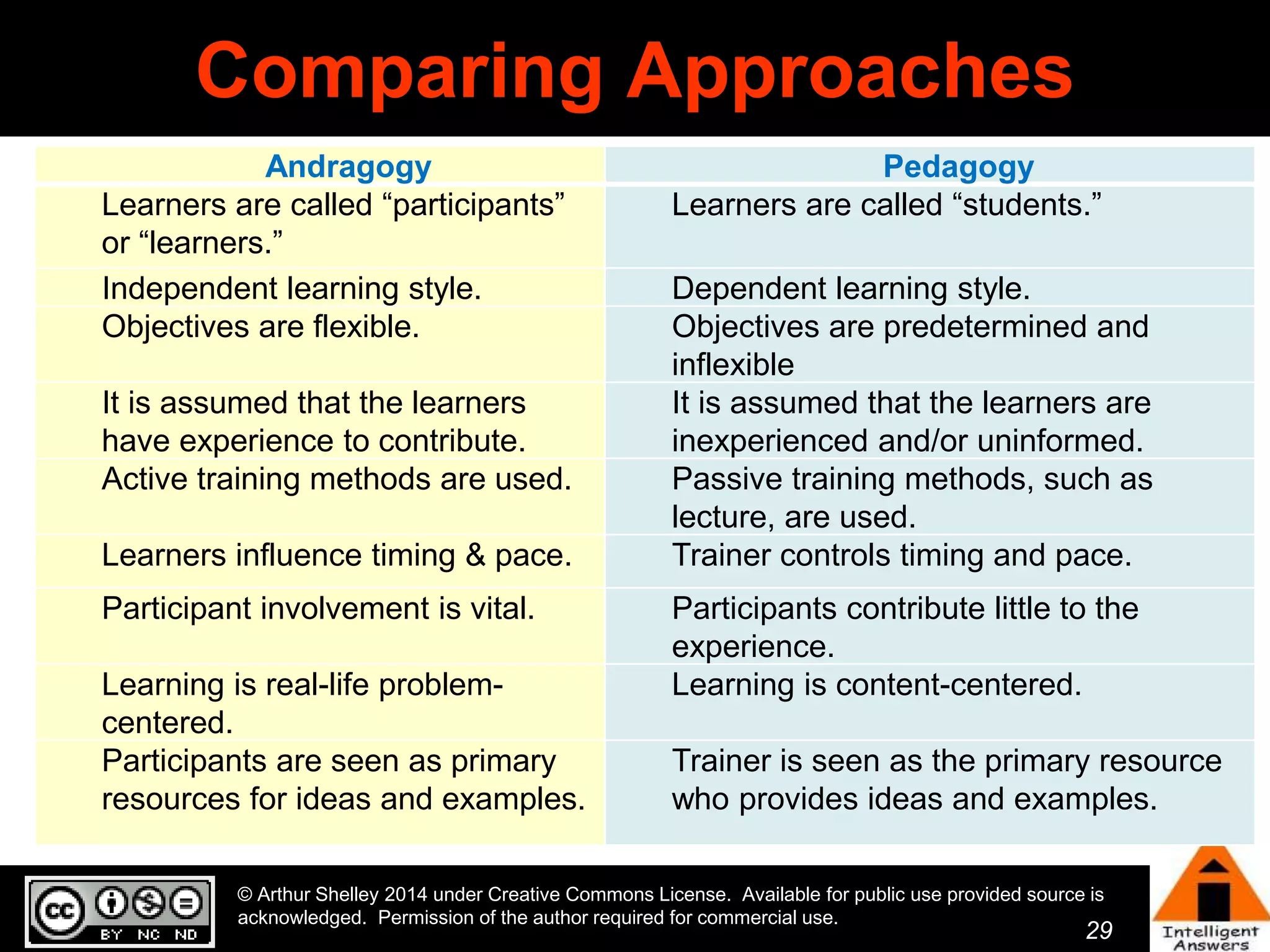
Comparing Approaches 
Andragogy Pedagogy 
29 29 
Learners are called “participants” 
or “learners.” 
Learners are called “students.” 
Independent learning style. Dependent learning style. 
Objectives are flexible. Objectives are predetermined and 
inflexible 
It is assumed that the learners 
have experience to contribute. 
It is assumed that the learners are 
inexperienced and/or uninformed. 
Active training methods are used. Passive training methods, such as 
lecture, are used. 
Learners influence timing & pace. Trainer controls timing and pace. 
Participant involvement is vital. Participants contribute little to the 
experience. 
Learning is real-life problem-centered. 
Learning is content-centered. 
Participants are seen as primary 
resources for ideas and examples. 
Trainer is seen as the primary resource 
who provides ideas and examples. 
© Arthur Shelley 2014 under Creative Commons License. Available for public use provided source is 
acknowledged. Permission of the author required for commercial use.
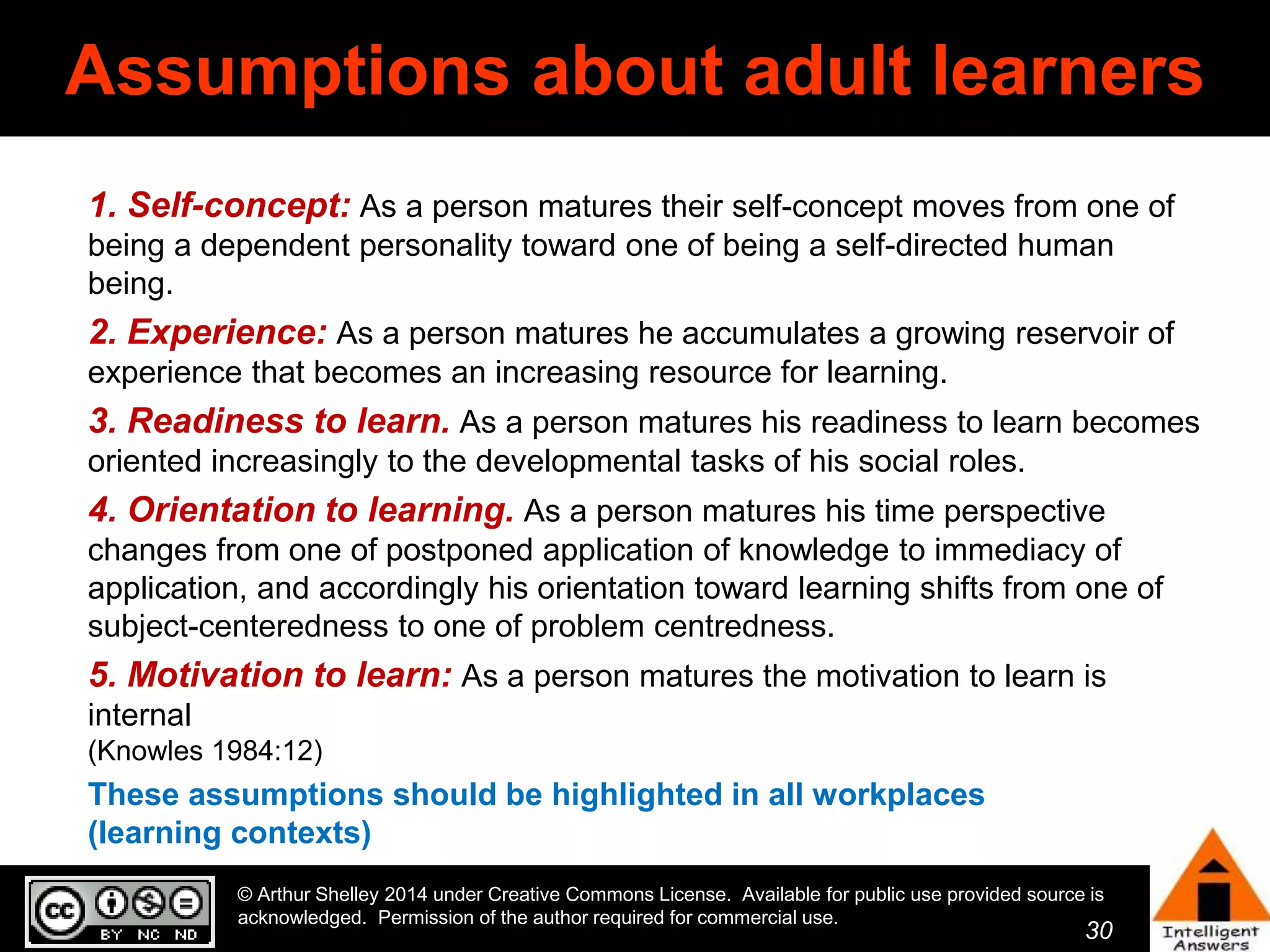
Assumptions about adult learners 
1. Self-concept: As a person matures their self-concept moves from one of 
being a dependent personality toward one of being a self-directed human 
being. 
2. Experience: As a person matures he accumulates a growing reservoir of 
experience that becomes an increasing resource for learning. 
3. Readiness to learn. As a person matures his readiness to learn becomes 
oriented increasingly to the developmental tasks of his social roles. 
4. Orientation to learning. As a person matures his time perspective 
changes from one of postponed application of knowledge to immediacy of 
application, and accordingly his orientation toward learning shifts from one of 
subject-centeredness to one of problem centredness. 
5. Motivation to learn: As a person matures the motivation to learn is 
internal 
(Knowles 1984:12) 
These assumptions should be highlighted in all workplaces 
(learning contexts) 
© Arthur Shelley 2014 under Creative Commons License. Available for public use provided source is 
acknowledged. Permission of the author required for commercial use. 
30 
30
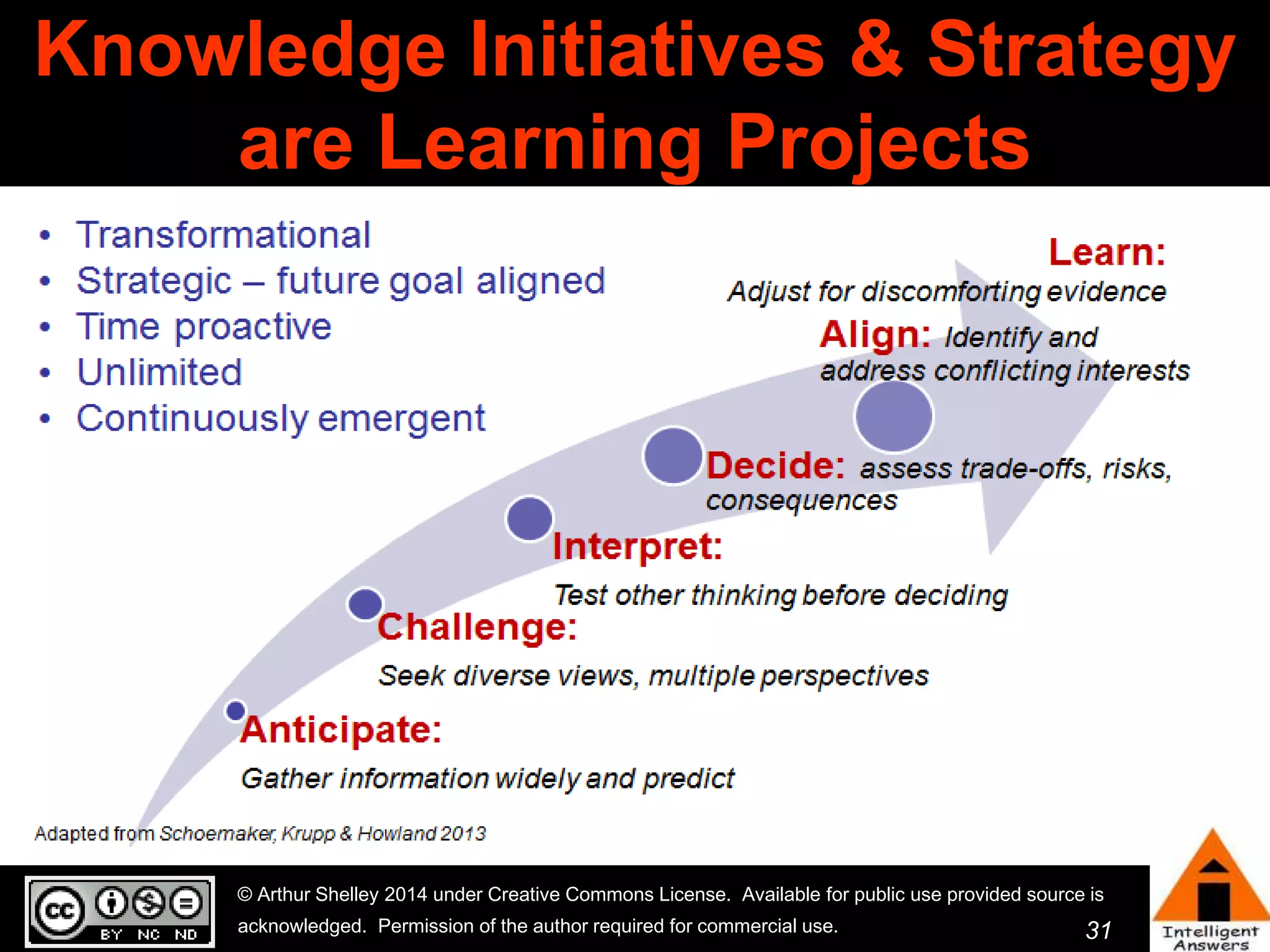
Knowledge Initiatives & Strategy 
31 
are Learning Projects 
© Arthur Shelley 2014 under Creative Commons License. Available for public use provided source is 
acknowledged. Permission of the author required for commercial use.
32 
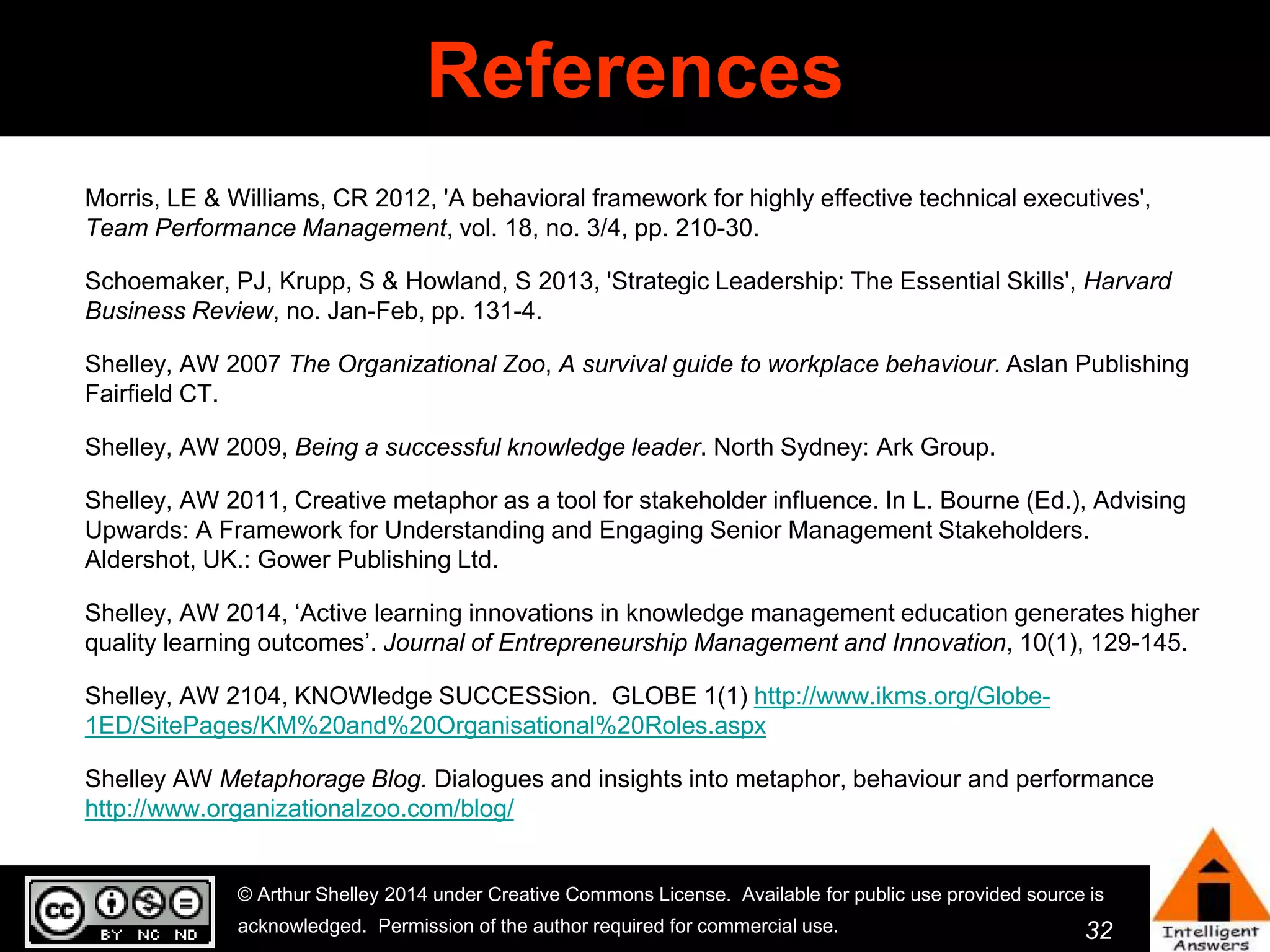
References 
Morris, LE & Williams, CR 2012, 'A behavioral framework for highly effective technical executives', 
Team Performance Management, vol. 18, no. 3/4, pp. 210-30. 
Schoemaker, PJ, Krupp, S & Howland, S 2013, 'Strategic Leadership: The Essential Skills', Harvard 
Business Review, no. Jan-Feb, pp. 131-4. 
Shelley, AW 2007 The Organizational Zoo, A survival guide to workplace behaviour. Aslan Publishing 
Fairfield CT. 
Shelley, AW 2009, Being a successful knowledge leader. North Sydney: Ark Group. 
Shelley, AW 2011, Creative metaphor as a tool for stakeholder influence. In L. Bourne (Ed.), Advising 
Upwards: A Framework for Understanding and Engaging Senior Management Stakeholders. 
Aldershot, UK.: Gower Publishing Ltd. 
Shelley, AW 2014, ‘Active learning innovations in knowledge management education generates higher 
quality learning outcomes’. Journal of Entrepreneurship Management and Innovation, 10(1), 129-145. 
Shelley, AW 2104, KNOWledge SUCCESSion. GLOBE 1(1) http://www.ikms.org/Globe- 
1ED/SitePages/KM%20and%20Organisational%20Roles.aspx 
Shelley AW Metaphorage Blog. Dialogues and insights into metaphor, behaviour and performance 
http://www.organizationalzoo.com/blog/ 
© Arthur Shelley 2014 under Creative Commons License. Available for public use provided source is 
acknowledged. Permission of the author required for commercial use.
33 
Contact 
Arthur Shelley 
arthur@organizationalzoo.com 
FREE behavioural profile 
www.organizationalzoo.com/profiler 
Insights into behaviours 
www.organizationalzoo.com/blog 
www.organizationalzoo.com/ZooTube 
Consulting and mentoring 
www.intelligentanswers.com.au 
Ph +61 413 047 408 
@Metaphorage 
#OrgZoo 
© Arthur Shelley 2014 under Creative Commons License. Available for public use provided source is 
acknowledged. Permission of the author required for commercial use.

Learning as Knowledge Creation and Application for Value

  • 1.
    actKM14 Learning throughknowledge creation © Arthur Shelley 2014 under Creative Commons License. Available for public use provided source is acknowledged. Permission of the author required for commercial use. 1 and application for value Our role as knowledge leaders is to open minds not fill them Dr Arthur Shelley 27th October 2014 “Knowing is not enough; we must apply. Willing is not enough; we must do.” Wolfgang von Goethe (1749 – 1832)
  • 2.
    2 What areour aims? • Challenge how we approach knowledge education • Share why participation in learning interactions is core to knowledge creation and innovation • Explore the impact of interactive learning activities on participation and engagement • Discuss how collaborative engagement generates options • Enhance performance in your environments through knowledge application and creative learning “Learning is not the product of teaching. Learning is the product of the activity of learners.” John Holt Educator © Arthur Shelley 2014 under Creative Commons License. Available for public use provided source is acknowledged. Permission of the author required for commercial use.
  • 3.
    Context: What doKnowledge 3 Workers need to know? • How to “read” the environment – physical, social, political and behavioural • How to “make sense” of emergent complex situations • How to ask questions that matter • How to engage people in aligned conversations that matter • When and how to Ask WHY – Say yes AND no in context – How to leverage existing knowledge © Arthur Shelley 2014 under Creative Commons License. Available for public use provided source is acknowledged. Permission of the author required for commercial use.
  • 4.
    How do wehelp build these? • Interact to learn (face to face & virtual) • Combine workplace & learning environments • Practice to model, discover patterns and reflect 4 on impacts • Challenge theory to understand • Adapt to contexts • Focus on Outcomes AND Outputs for sustainable benefits, long term • Engage learners in their world for them © Arthur Shelley 2014 under Creative Commons License. Available for public use provided source is acknowledged. Permission of the author required for commercial use.
  • 5.
    Conversations that Matter © Arthur Shelley 2014 under Creative Commons License. Available for public use provided source is acknowledged. Permission of the author required for commercial use. 5
  • 6.
    6 Start withWhy? © Arthur Shelley 2014 under Creative Commons License. Available for public use provided source is acknowledged. Permission of the author required for commercial use.
  • 7.
    Knowledge Driven Performance 35 topics, 35 perspectives - one connected conversation Tacit Knowledge Innovation EDRM Cloud Computing Reflective Practice Taxonomy Knowledge Models 7 Interdependent Emergence “Wiki Conversation” Sustainability Capability Development Data Mining Community of Practice Mentoring Knowledge Leadership Learning Organisation Codification Complex Adaptive Systems Projects Sense Making Folksonomy Decision Making Ethics Culture Succession Induction Knowledge Transfer Whistleblowing Design Thinking Mental models Big Data Action Learning Knowledge Audit Knowledge Mapping Personal Knowledge Metrics Security Explicit Knowledge © Arthur Shelley 2014 under Creative Commons License. Available for public use provided source is acknowledged. Permission of the author required for commercial use.
  • 8.
    Characteristics required toperform well (in context) 8 Build Future Capability • Knowledge • Knowing, understanding, experience what & when © Arthur Shelley 2014 under Creative Commons License. Available for public use provided source is acknowledged. Permission of the author required for commercial use. • Skills • Doing, technical output how & where • Abilities/Attributes • Being, behaviours, attitudes Social outcomes, why & who Development
  • 9.
    Design for optimallearning outcomes 9 9 Topic Introduction: Pre-reading: Narrative & Powerpoint Slides Initial overview in context Video Extract and/or Case study Questions and share perspectives on content Facilitated Dialogue (Class or teleconference online) Facilitator Feedback Assessment Activities Reflections on use of concepts in workplace Blooms Hierarchy (adapted) Knowledge (remember) Understand (comprehend) Apply (do) Analysis (critique, sense) Synthesis/Evaluation Create (adapt, new context) Ongoing enhanced performance Life-long Capability Development DESIGN NOTE: Reading and reflecting BEFORE class interactions significantly enhances learning and capabilities Shelley 2014 © Arthur Shelley 2014 under Creative Commons License. Available for public use provided source is acknowledged. Permission of the author required for commercial use.
  • 10.
    Scaffolded Learning Ladder 8. Collaboration & Reflection “Who, What, How, Why” 7. Ownership, K-Flow & Structure 12. Knowledge Leadership 11. Influence & Implementation 10. Collective Learning © Arthur Shelley 2014 under Creative Commons License. Available for public use provided source is acknowledged. Permission of the author required for commercial use. 10 1. Sustainable Strategy “Why” 2. Knowledge Theories “How” 3. Complexity Models “When” 4. Interdependent Conversations 5. Capabilities & People 6. Governance & Process “Who, How, When” 9. Tools, Efficiency, Effectiveness “What, How, Where” Build Foundations Apply Design Connect Reflect Prioritise Decide, Engage “Who, What, How, Where” “Why, Who, What, How, When, Where” Lead others to sustainable success
  • 11.
    Creative Learning Drives Innovation and Performance Thinking “learning” finishes with “school” is like suggesting parenting finishes with childbirth! “If we knew what we were doing, it wouldn’t be research would it” Albert Einstein © Arthur Shelley 2014 under Creative Commons License. Available for public use provided source is acknowledged. Permission of the author required for commercial use. 11 Lifelong learning has evolved into lifestyle learning
  • 12.
    12 Personal Profiles Social = Interactive Collaboration Personal information obscured in this presentation for privacy © Arthur Shelley 2014 under Creative Commons License. Available for public use provided source is acknowledged. Permission of the author required for commercial use.
  • 13.
    Wiki social learninginteractions © Arthur Shelley 2014 under Creative Commons License. Available for public use provided source is acknowledged. Permission of the author required for commercial use. 13
  • 14.
    14 Reflection Cycles What have we learnt? © Arthur Shelley 2014 under Creative Commons License. Available for public use provided source is acknowledged. Permission of the author required for commercial use. Shelley 2011
  • 15.
    Leverage diverse perspectives 15 Your view IS filtered by YOU! © Arthur Shelley 2014 under Creative Commons License. Available for public use provided source is acknowledged. Permission of the author required for commercial use.
  • 16.
    Systems Thinking &Design Thinking 16 Synergistic Partners Morris & Williams 2012 © Arthur Shelley 2014 under Creative Commons License. Available for public use provided source is acknowledged. Permission of the author required for commercial use.
  • 17.
    © Arthur Shelley2014 under Creative Commons License. Available for public use provided source is acknowledged. Permission of the author required for commercial use. 17 Triggered Discussion Forums to leverage diversity of perspective How are power, networking and advocacy applied in different cultures? Use the images on the left to explain how a General Manager of Western culture more or less likely to share power with you and other subordinates than their equivalent from Eastern culture? Image source: http://www.yangliudesign.com/ 17
  • 18.
    Case evaluation toexplore options Highly successful NASA executives share a set of common behaviours. Discuss how behaviours can be categorised into elements & summarised up into 5 key themes. © Arthur Shelley 2014 under Creative Commons License. Available for public use provided source is acknowledged. Permission of the author required for commercial use. 18 Source: Morris & Williams, 2012
  • 19.
    Video to motivateand challenge Professor Teresa Amabile (Harvard Business School) “The Progress Principle” Most motivational aspect – “Doing meaningful work” Most disengaging aspect – Bosses not knowing what is meaningful! http://www.youtube.com/watch?v=XD6N8bsjOEE © Arthur Shelley 2014 under Creative Commons License. Available for public use provided source is acknowledged. Permission of the author required for commercial use. 19
  • 20.
    Visualisation to stimulateideas Problem solving, reasoning Hearing, Language Speech, Feeling © Arthur Shelley 2014 under Creative Commons License. Available for public use provided source is acknowledged. Permission of the author required for commercial use. 20 Personality FRONTAL LOBE TEMPORAL LOBE Constructed from Google Images
  • 21.
    Humour: engage &trigger creativity © Arthur Shelley 2014 under Creative Commons License. Available for public use provided source is acknowledged. Permission of the author required for commercial use. 21 In discussion forums ask complex, emergent questions with many options, rather than give defined answers... Stimulate sense-making to explore possibilities and refine into priority options to probe opportunities to act…
  • 22.
    KNOWledge SUCCESSion •Future focused inclusive strategic capability development • Integrated approach for innovation and risk mitigation • Social learning in an open constructive environment • Interactive knowledge sharing to stimulate “Conversations That Matter” and trusted relationships • Applicable to formal learning environments and organisational cultural development Full book anticipated publication early 2015 © Arthur Shelley 2014 under Creative Commons License. Available for public use provided source is acknowledged. Permission of the author required for commercial use. 22 KNOWledge SUCCESSion: An innovative strategy to achieve optimal performance in emergent complex environments http://www.ikms.org/Globe-1ED/SitePages/KM%20and%20Organisational%20Roles.aspx
  • 23.
    Leading Sustainable Outcomes This AND that… Us AND them… You AND me… ACTING IN CONTEXT © Arthur Shelley 2014 under Creative Commons License. Available for public use provided source is acknowledged. Permission of the author required for commercial use. 23 You can't LISTEN with your mouth open You can't LEARN with your mind closed You can't LEAD without attention to BOTH Creative, innovative learning environments Social open interactions constructively challenging specific contexts… leads to creative exploration of possibilities which… generate new knowledge and sensemaking that… provides richer insights … stimulating innovation and growth… enhancing performance and … self perpetuating identity, trust and inclusiveness
  • 24.
    24 Reflection? •Learning individuals collaborate to stimulate learning organisations and create new knowledge • Knowledge creation aligned with organisational goals, accelerates innovation and engages people • Sustained performance and success are outcomes of leading such an environment • Approach applicable to workplaces as much as education spaces © Arthur Shelley 2014 under Creative Commons License. Available for public use provided source is acknowledged. Permission of the author required for commercial use.
  • 25.
    I and theorganisation have got some real benefits from the KDP unit… … most importantly everyone is enjoying the interaction, so I know that it will be a success for the long term. I also learnt a great deal from reading all the students' posts and I'm in deep admiration of some of the fine minds in this course. Exec MBA, CEO SME (completed 11 courses) I wanted to share that I have got a lot out of this semester. I've been able to apply KM practice in the following ways… I keep thinking about KM stuff all the time about how I can improve the process, connectedness etc... Exec MBA, National team leader medium business (completed half of the MBA) 25 Participant Feedback The genuine voice of quality assessment © Arthur Shelley 2014 under Creative Commons License. Available for public use provided source is acknowledged. Permission of the author required for commercial use.
  • 26.
    Overall Participant Engagement © Arthur Shelley 2014 under Creative Commons License. Available for public use provided source is acknowledged. Permission of the author required for commercial use. 26 Group Assignment
  • 27.
    Participant activity report © Arthur Shelley 2014 under Creative Commons License. Available for public use provided source is acknowledged. Permission of the author required for commercial use. 27
  • 28.
    28 Forum Engagement Hits per user Week of semester Wiki © Arthur Shelley 2014 under Creative Commons License. Available for public use provided source is acknowledged. Permission of the author required for commercial use. Group Presentations
  • 29.
    Comparing Approaches AndragogyPedagogy 29 29 Learners are called “participants” or “learners.” Learners are called “students.” Independent learning style. Dependent learning style. Objectives are flexible. Objectives are predetermined and inflexible It is assumed that the learners have experience to contribute. It is assumed that the learners are inexperienced and/or uninformed. Active training methods are used. Passive training methods, such as lecture, are used. Learners influence timing & pace. Trainer controls timing and pace. Participant involvement is vital. Participants contribute little to the experience. Learning is real-life problem-centered. Learning is content-centered. Participants are seen as primary resources for ideas and examples. Trainer is seen as the primary resource who provides ideas and examples. © Arthur Shelley 2014 under Creative Commons License. Available for public use provided source is acknowledged. Permission of the author required for commercial use.
  • 30.
    Assumptions about adultlearners 1. Self-concept: As a person matures their self-concept moves from one of being a dependent personality toward one of being a self-directed human being. 2. Experience: As a person matures he accumulates a growing reservoir of experience that becomes an increasing resource for learning. 3. Readiness to learn. As a person matures his readiness to learn becomes oriented increasingly to the developmental tasks of his social roles. 4. Orientation to learning. As a person matures his time perspective changes from one of postponed application of knowledge to immediacy of application, and accordingly his orientation toward learning shifts from one of subject-centeredness to one of problem centredness. 5. Motivation to learn: As a person matures the motivation to learn is internal (Knowles 1984:12) These assumptions should be highlighted in all workplaces (learning contexts) © Arthur Shelley 2014 under Creative Commons License. Available for public use provided source is acknowledged. Permission of the author required for commercial use. 30 30
  • 31.
    Knowledge Initiatives &Strategy 31 are Learning Projects © Arthur Shelley 2014 under Creative Commons License. Available for public use provided source is acknowledged. Permission of the author required for commercial use.
  • 32.
    32 References Morris,LE & Williams, CR 2012, 'A behavioral framework for highly effective technical executives', Team Performance Management, vol. 18, no. 3/4, pp. 210-30. Schoemaker, PJ, Krupp, S & Howland, S 2013, 'Strategic Leadership: The Essential Skills', Harvard Business Review, no. Jan-Feb, pp. 131-4. Shelley, AW 2007 The Organizational Zoo, A survival guide to workplace behaviour. Aslan Publishing Fairfield CT. Shelley, AW 2009, Being a successful knowledge leader. North Sydney: Ark Group. Shelley, AW 2011, Creative metaphor as a tool for stakeholder influence. In L. Bourne (Ed.), Advising Upwards: A Framework for Understanding and Engaging Senior Management Stakeholders. Aldershot, UK.: Gower Publishing Ltd. Shelley, AW 2014, ‘Active learning innovations in knowledge management education generates higher quality learning outcomes’. Journal of Entrepreneurship Management and Innovation, 10(1), 129-145. Shelley, AW 2104, KNOWledge SUCCESSion. GLOBE 1(1) http://www.ikms.org/Globe- 1ED/SitePages/KM%20and%20Organisational%20Roles.aspx Shelley AW Metaphorage Blog. Dialogues and insights into metaphor, behaviour and performance http://www.organizationalzoo.com/blog/ © Arthur Shelley 2014 under Creative Commons License. Available for public use provided source is acknowledged. Permission of the author required for commercial use.
  • 33.
    33 Contact ArthurShelley arthur@organizationalzoo.com FREE behavioural profile www.organizationalzoo.com/profiler Insights into behaviours www.organizationalzoo.com/blog www.organizationalzoo.com/ZooTube Consulting and mentoring www.intelligentanswers.com.au Ph +61 413 047 408 @Metaphorage #OrgZoo © Arthur Shelley 2014 under Creative Commons License. Available for public use provided source is acknowledged. Permission of the author required for commercial use.