The AL Set Process
                            ‘Manual’ – Pages 9 - 13
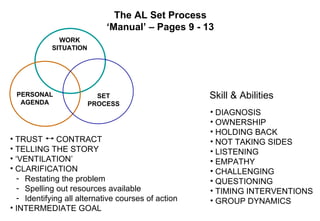
              WORK
            SITUATION


 PERSONAL                 SET                        Skill & Abilities
  AGENDA                PROCESS
                                                     • DIAGNOSIS
                                                     • OWNERSHIP
                                                     • HOLDING BACK
• TRUST        CONTRACT                              • NOT TAKING SIDES
• TELLING THE STORY                                  • LISTENING
• ‘VENTILATION’                                      • EMPATHY
• CLARIFICATION                                      • CHALLENGING
   - Restating the problem                           • QUESTIONING
   - Spelling out resources available                • TIMING INTERVENTIONS
   - Identifying all alternative courses of action   • GROUP DYNAMICS
• INTERMEDIATE GOAL
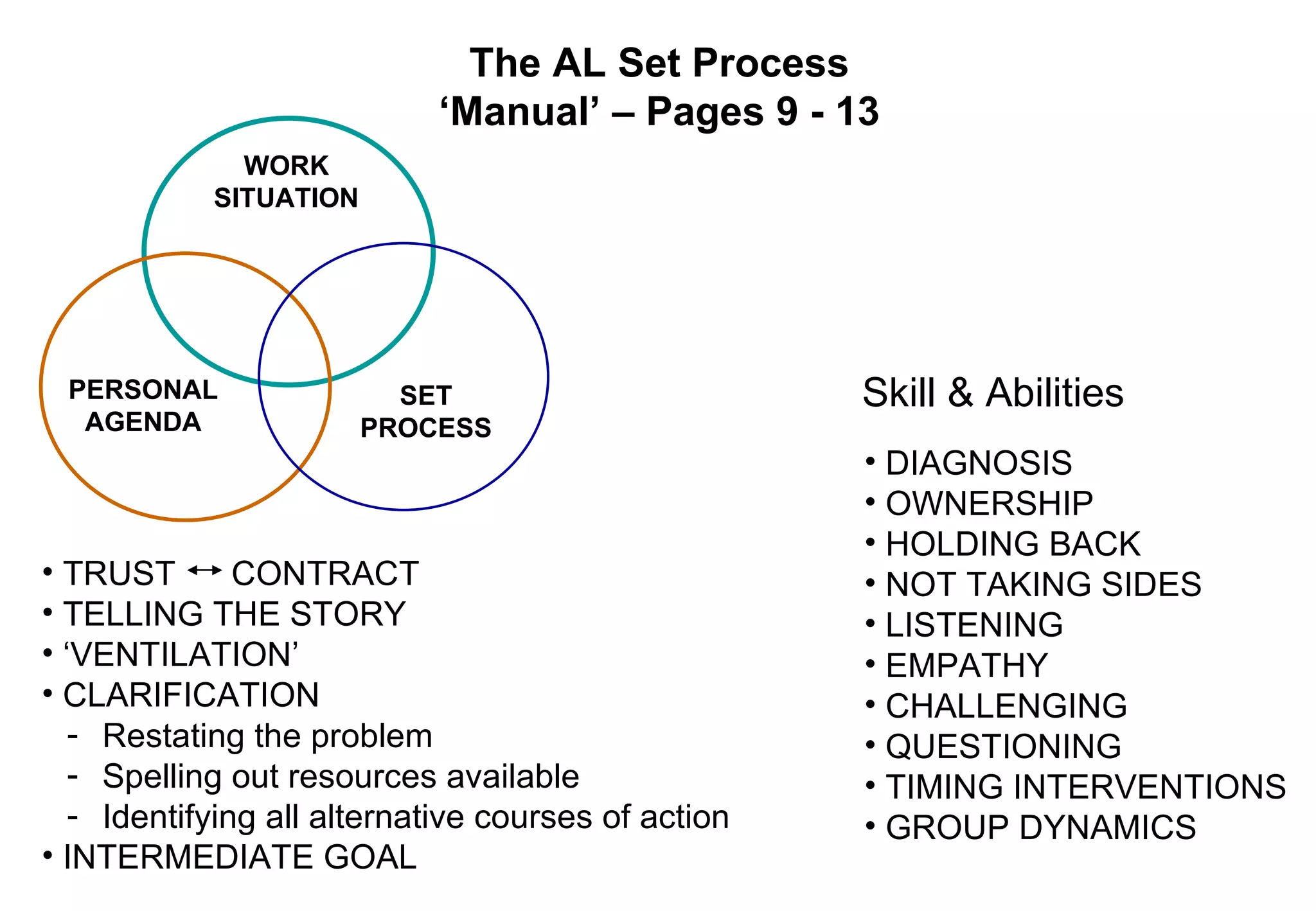
General Helping-Skills Model - (Gerard Egan - The Skilled Helper - 1979 etc.,)
Adapted for use in AL Sets*


                              Options                                   Options                  Agreement


E x p lo r in g                   U n d e r s t a n d in g                               A c t io n


With thanks to Peter O’Neill of the ‘Write Now’ CETL for the idea of the ‘options’ element
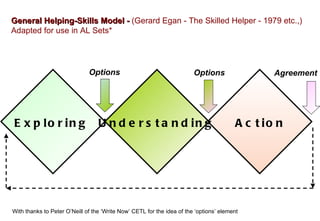
EXACT Goal-Setting (to replace/support SMART goals)


 EXciting                   inspiring, a relief

 Assessable                 measurable

 Challenging                a stretch

 Time framed                3 or 6 months
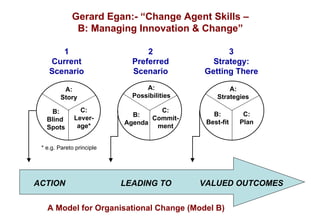
Gerard Egan:- “Change Agent Skills –
              B: Managing Innovation & Change”

       1                         2                 3
    Current                  Preferred         Strategy:
    Scenario                 Scenario        Getting There

         A:                      A:                  A:
        Story                Possibilities       Strategies

     B:         C:                  C:
                             B:                 B:        C:
   Blind      Lever-              Commit-
                           Agenda             Best-fit   Plan
   Spots       age*                ment


 * e.g. Pareto principle


ACTION                     LEADING TO        VALUED OUTCOMES


   A Model for Organisational Change (Model B)
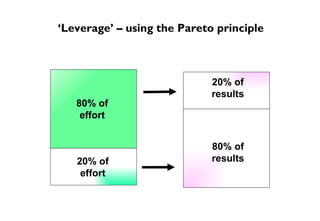
‘Leverage’ – using the Pareto principle


                             20% of
                             results
   80% of
    effort


                             80% of
   20% of                    results
    effort
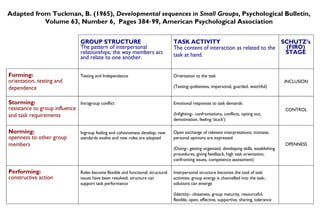
Adapted from Tuckman, B. (1965), Developmental sequences in Small Groups, Psychological Bulletin,
           Volume 63, Number 6, Pages 384‑ 99, American Psychological Association


                                GROUP STRUCTURE                                    TASK ACTIVITY                                SCHUTZ’s
                                The pattern of interpersonal                       The content of interaction as related to the  (FIRO)
                                relationships; the way members act                 task at hand.                                 STAGE
                                and relate to one another.

Forming:                        Testing and Independence                           Orientation to the task
orientation, testing and                                                                                                                         INCLUSION
dependence                                                                         (Testing:-politeness, impersonal, guarded, watchful)


Storming:                       Intragroup conflict                                Emotional responses to task demands
resistance to group influence                                                                                                                    CONTROL
and task requirements                                                              (Infighting:- confrontations, conflicts, opting out,
                                                                                   demotivation, feeling ‘stuck’)

Norming:                        Ingroup feeling and cohesiveness develop; new      Open exchange of relevant interpretations; intimate,
openness to other group         standards evolve and new roles are adopted         personal opinions are expressed
members                                                                                                                                          OPENNESS
                                                                                   (Doing:- getting organised, developing skills, establishing
                                                                                   procedures, giving feedback, high task orientation,
                                                                                   confronting issues, competence assessment)

Performing:                     Roles become flexible and functional; structural   Interpersonal structure becomes the tool of task
constructive action             issues have been resolved; structure can           activities; group energy is channelled into the task;
                                support task performance                           solutions can emerge

                                                                                   (Identity:- closeness, group maturity, resourceful,
                                                                                   flexible, open, effective, supportive, sharing, tolerance
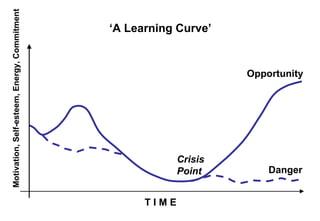
Motivation, Self-esteem, Energy, Commitment
                                              ‘A Learning Curve’


                                                                    Opportunity


                                                           Crisis
                                                           Point        Danger


                                                    TIME

Als slides

  • 1.
    The AL SetProcess ‘Manual’ – Pages 9 - 13 WORK SITUATION PERSONAL SET Skill & Abilities AGENDA PROCESS • DIAGNOSIS • OWNERSHIP • HOLDING BACK • TRUST CONTRACT • NOT TAKING SIDES • TELLING THE STORY • LISTENING • ‘VENTILATION’ • EMPATHY • CLARIFICATION • CHALLENGING - Restating the problem • QUESTIONING - Spelling out resources available • TIMING INTERVENTIONS - Identifying all alternative courses of action • GROUP DYNAMICS • INTERMEDIATE GOAL
  • 2.
    General Helping-Skills Model- (Gerard Egan - The Skilled Helper - 1979 etc.,) Adapted for use in AL Sets* Options Options Agreement E x p lo r in g U n d e r s t a n d in g A c t io n With thanks to Peter O’Neill of the ‘Write Now’ CETL for the idea of the ‘options’ element
  • 3.
    EXACT Goal-Setting (toreplace/support SMART goals) EXciting inspiring, a relief Assessable measurable Challenging a stretch Time framed 3 or 6 months
  • 4.
    Gerard Egan:- “ChangeAgent Skills – B: Managing Innovation & Change” 1 2 3 Current Preferred Strategy: Scenario Scenario Getting There A: A: A: Story Possibilities Strategies B: C: C: B: B: C: Blind Lever- Commit- Agenda Best-fit Plan Spots age* ment * e.g. Pareto principle ACTION LEADING TO VALUED OUTCOMES A Model for Organisational Change (Model B)
  • 5.
    ‘Leverage’ – usingthe Pareto principle 20% of results 80% of effort 80% of 20% of results effort
  • 6.
    Adapted from Tuckman,B. (1965), Developmental sequences in Small Groups, Psychological Bulletin, Volume 63, Number 6, Pages 384‑ 99, American Psychological Association GROUP STRUCTURE TASK ACTIVITY SCHUTZ’s The pattern of interpersonal The content of interaction as related to the (FIRO) relationships; the way members act task at hand. STAGE and relate to one another. Forming: Testing and Independence Orientation to the task orientation, testing and INCLUSION dependence (Testing:-politeness, impersonal, guarded, watchful) Storming: Intragroup conflict Emotional responses to task demands resistance to group influence CONTROL and task requirements (Infighting:- confrontations, conflicts, opting out, demotivation, feeling ‘stuck’) Norming: Ingroup feeling and cohesiveness develop; new Open exchange of relevant interpretations; intimate, openness to other group standards evolve and new roles are adopted personal opinions are expressed members OPENNESS (Doing:- getting organised, developing skills, establishing procedures, giving feedback, high task orientation, confronting issues, competence assessment) Performing: Roles become flexible and functional; structural Interpersonal structure becomes the tool of task constructive action issues have been resolved; structure can activities; group energy is channelled into the task; support task performance solutions can emerge (Identity:- closeness, group maturity, resourceful, flexible, open, effective, supportive, sharing, tolerance
  • 7.
    Motivation, Self-esteem, Energy,Commitment ‘A Learning Curve’ Opportunity Crisis Point Danger TIME