Different breeds of sheep and
their characteristics
Objectives
• To identify different breeds of sheep according
to their characteristics
• To understand the uses that can be obtained
by each different breed types
Definition
• Sheep
– Quadruped
– Ruminant
– Mammal
– Kept as livestock
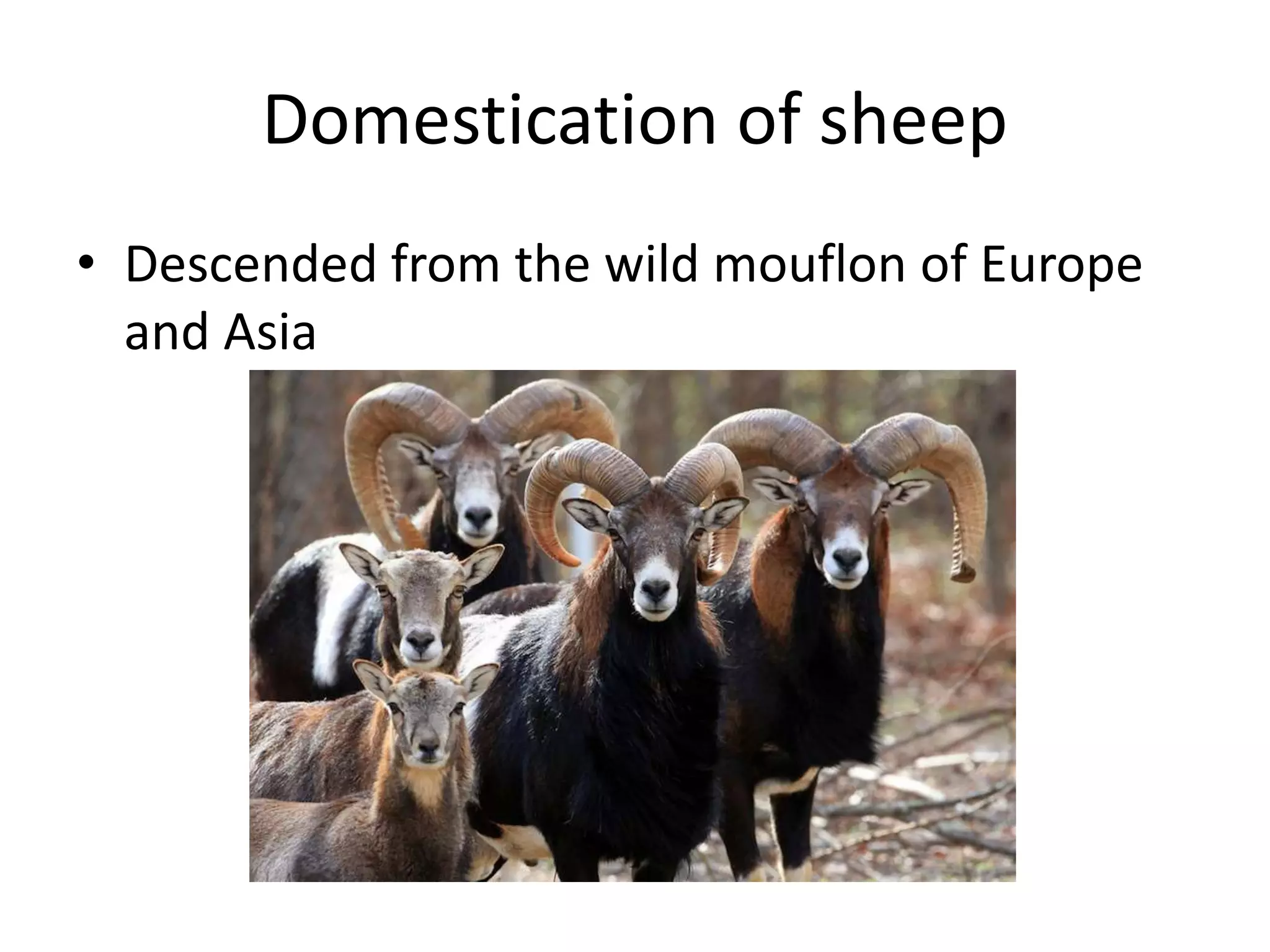
Domestication of sheep
• Descended from the wild mouflon of Europe
and Asia
Scientific classification
• Kingdom – Animalia
• Phylum – Chordata
• Class – Mammalia
• Order – Artiodactyla
• Family – Bovidae
• Sub family – Caprinae
• Genus – Ovis
• Species – O. aries
Parts of the body of a sheep
Digestive system of a sheep
Denture arrangement of sheep
• Two types of teeth
– Milk teeth (20)
– Permanent teeth (32)
• No front teeth on the upper pallet
• Can use to determine the age of sheep
Supracervical
horns
Webbed horns
Homonymous
horns
Polyceterate horns
Types of
horns
Types of wool
• Fine wool types
• Medium wool types
• Long wool types
• Crossbred wool types
• Fur-types
Different breeds
• Jaffna local
• Bikenary
• Bannur
• Red madrus
• Dorset
Jaffna local
• Sheep rearing was based on traditional mixed
crops integration practices and operated
under limited or no input basis.
Morphological features
• Small to medium sized
• Angular body covered with short hair of white,
tan and black colours
• Height
– 64.70cm (ram)
– 62.33cm (ewe)
More about Jaffna local….
• Male : Female (breeding population) = 1:14
• Age at first lambing – 16 months
• Lambing interval – 6-12 months
• Lifetime production per ewe – 7-9 lambs
• People in Jaffna do not consume meat because of
the belief of having allergies from meat, so the
meat is marketed to other parts of country
• When their rearing areas are flooded during rainy
season, they are moved to another place
Purpose of rearing Jaffna local
• Meat
• Faecal material (as biomass)
• Pets (because of the belief of having fortune)
Bikenary
Morphological features
• White body with light brown or black
face
• Small body
• Long face
• Small tubular ears
• Polled
More about Bikenary…
• Purebred or crossbred
• Only lustrous carpet wool-producing breed
• Recently, number of crossbreds are increasing
• Flock size – about 150 in a herd
Bannur
Morphological features
• White body with brown colour head and neck
• Convex face
• Medium drooping ears
• Usually polled
• Short legs
• Short tail
• Coarse wool
More about Bannur…
• Highly demanded for meat
• Adaptable to all types of climates from hot
tropical to cold climates
• Fast growth and excellent feed conversion
ratio
• High twinning percentage
• Produces very good crossbreds with local
goats
Red madras
Morphological features
• Medium sized well built body
• Broad chest
• Reddish brown colour, varied from tan to dark
brown
• Usually polled
• Ears are pendulous
• Tail of medium length
More about Red madras….
• Main breeding time – July to September
• Have excellent feed conversion efficiency
• Native breed of Tamil Nadu in India
• Gives high quality meat and skin
• Flock size – 20-50
Dorset
Morphological features
• White face and body
• Polled
• Curved horned
• Short round ears
• Fully covered with medium length wool
More about Dorset…
• Produces 4-5 labs per year
• Gives strong, white fleece
• Has great weight
– 100-120Kg (ram)
– 70-90 (ewe)
Main products supplied by different
types of sheep
Meat
• Dorset
• Suffolk
• Cheviot
Hair
• Merino
• Rambouillet
Meat and hair
• Montadale
• Kooka
Diseases
• By prions – scrapie
• By virus – foot and mouth disease, sheeppox
• By bacteria – foot rot, fleece rot
• By fungi – facial eczema
• By helminth – flatworms, tapeworms
• Arachnides – ticks, lice, mites
Summary
Characteristics Jaffna
local
Bikenary Bannur Red madras Dorset
Body Medium
sized
Small Medium Medium Large
Build Angular Medium Short Well built Well built
Height 62-64cm
Wool type Fur type Medium
type
Fine type Fur type Medium
type
Main products Meat,
manure
Wool, meat Meat, wool Meat, skin Wool, meat
Reference:-
Livestock Statistics (Sri Lanka)
http://www.daph.gov.lk
Animal Husbandary, G.C.Banerjee

SHEEP BREED PRODUCTION.pdf

  • 1.
    Different breeds ofsheep and their characteristics
  • 2.
    Objectives • To identifydifferent breeds of sheep according to their characteristics • To understand the uses that can be obtained by each different breed types
  • 3.
    Definition • Sheep – Quadruped –Ruminant – Mammal – Kept as livestock
  • 4.
    Domestication of sheep •Descended from the wild mouflon of Europe and Asia
  • 5.
    Scientific classification • Kingdom– Animalia • Phylum – Chordata • Class – Mammalia • Order – Artiodactyla • Family – Bovidae • Sub family – Caprinae • Genus – Ovis • Species – O. aries
  • 6.
    Parts of thebody of a sheep
  • 7.
  • 8.
    Denture arrangement ofsheep • Two types of teeth – Milk teeth (20) – Permanent teeth (32) • No front teeth on the upper pallet • Can use to determine the age of sheep
  • 9.
  • 10.
    Types of wool •Fine wool types • Medium wool types • Long wool types • Crossbred wool types • Fur-types
  • 11.
    Different breeds • Jaffnalocal • Bikenary • Bannur • Red madrus • Dorset
  • 12.
    Jaffna local • Sheeprearing was based on traditional mixed crops integration practices and operated under limited or no input basis.
  • 13.
    Morphological features • Smallto medium sized • Angular body covered with short hair of white, tan and black colours • Height – 64.70cm (ram) – 62.33cm (ewe)
  • 14.
    More about Jaffnalocal…. • Male : Female (breeding population) = 1:14 • Age at first lambing – 16 months • Lambing interval – 6-12 months • Lifetime production per ewe – 7-9 lambs • People in Jaffna do not consume meat because of the belief of having allergies from meat, so the meat is marketed to other parts of country • When their rearing areas are flooded during rainy season, they are moved to another place
  • 15.
    Purpose of rearingJaffna local • Meat • Faecal material (as biomass) • Pets (because of the belief of having fortune)
  • 16.
  • 17.
    Morphological features • Whitebody with light brown or black face • Small body • Long face • Small tubular ears • Polled
  • 18.
    More about Bikenary… •Purebred or crossbred • Only lustrous carpet wool-producing breed • Recently, number of crossbreds are increasing • Flock size – about 150 in a herd
  • 19.
  • 20.
    Morphological features • Whitebody with brown colour head and neck • Convex face • Medium drooping ears • Usually polled • Short legs • Short tail • Coarse wool
  • 21.
    More about Bannur… •Highly demanded for meat • Adaptable to all types of climates from hot tropical to cold climates • Fast growth and excellent feed conversion ratio • High twinning percentage • Produces very good crossbreds with local goats
  • 22.
  • 23.
    Morphological features • Mediumsized well built body • Broad chest • Reddish brown colour, varied from tan to dark brown • Usually polled • Ears are pendulous • Tail of medium length
  • 24.
    More about Redmadras…. • Main breeding time – July to September • Have excellent feed conversion efficiency • Native breed of Tamil Nadu in India • Gives high quality meat and skin • Flock size – 20-50
  • 25.
  • 26.
    Morphological features • Whiteface and body • Polled • Curved horned • Short round ears • Fully covered with medium length wool
  • 27.
    More about Dorset… •Produces 4-5 labs per year • Gives strong, white fleece • Has great weight – 100-120Kg (ram) – 70-90 (ewe)
  • 28.
    Main products suppliedby different types of sheep Meat • Dorset • Suffolk • Cheviot Hair • Merino • Rambouillet Meat and hair • Montadale • Kooka
  • 29.
    Diseases • By prions– scrapie • By virus – foot and mouth disease, sheeppox • By bacteria – foot rot, fleece rot • By fungi – facial eczema • By helminth – flatworms, tapeworms • Arachnides – ticks, lice, mites
  • 30.
    Summary Characteristics Jaffna local Bikenary BannurRed madras Dorset Body Medium sized Small Medium Medium Large Build Angular Medium Short Well built Well built Height 62-64cm Wool type Fur type Medium type Fine type Fur type Medium type Main products Meat, manure Wool, meat Meat, wool Meat, skin Wool, meat
  • 31.
    Reference:- Livestock Statistics (SriLanka) http://www.daph.gov.lk Animal Husbandary, G.C.Banerjee