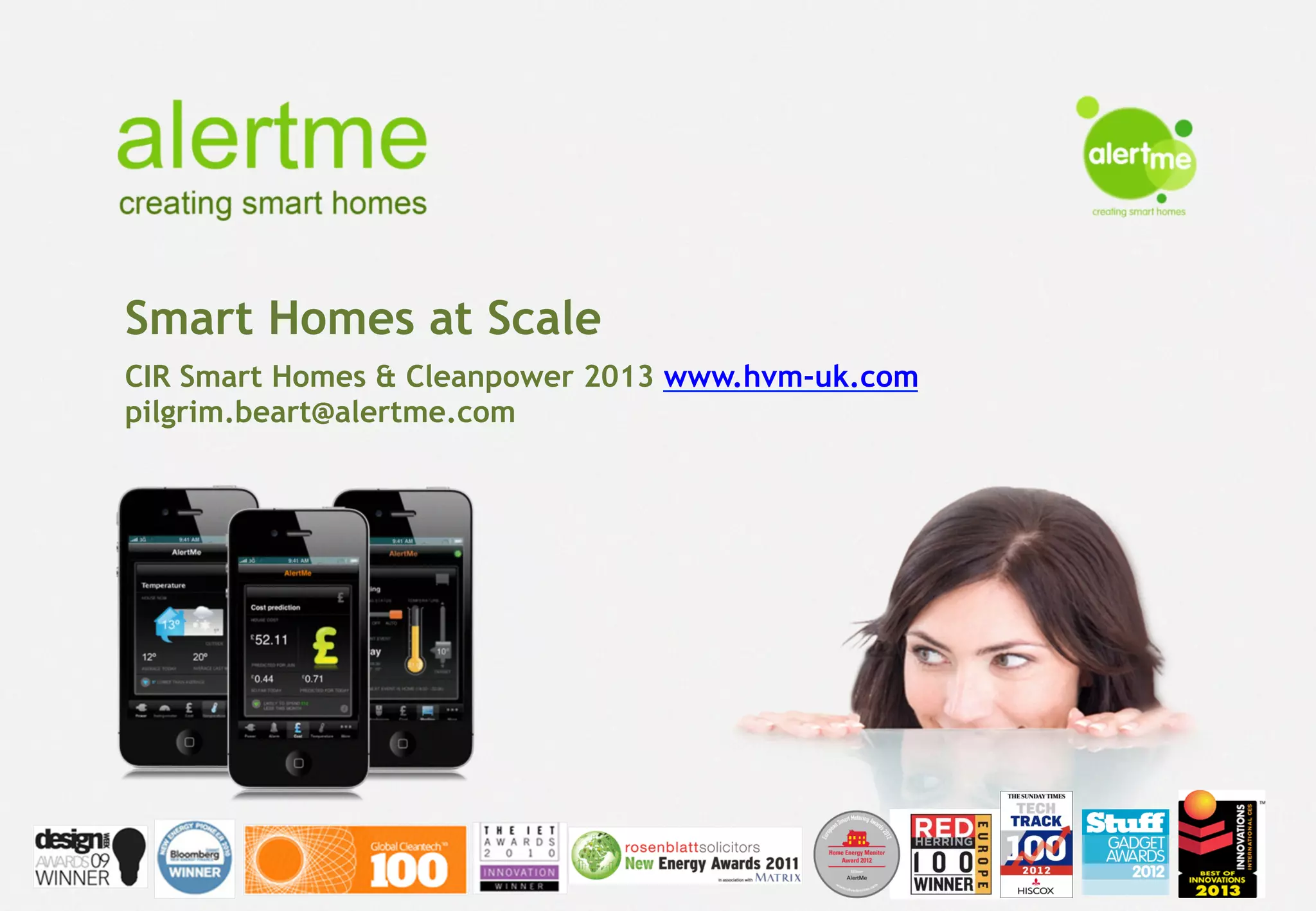
Smart Homes at Scale
CIR Smart Homes & Cleanpower 2013 www.hvm-uk.com
pilgrim.beart@alertme.com
A	
  talk	
  in	
  3	
  parts	
  
•  Smart	
  Energy	
  Report	
  
•  Standards	
  and	
  Openness	
  
•  Home	
  Energy	
  Update	
  
2013:	
  Quick	
  update	
  

…	
  
1.	
  Smart	
  Energy	
  Report
	
  
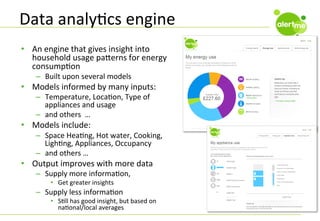
Data	
  analyCcs	
  engine	
  
•  An	
  engine	
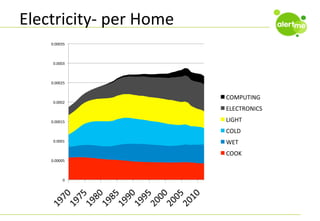
  that	
  gives	
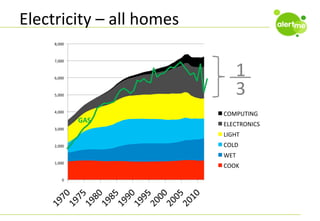
  insight	
  into	
  
household	
  usage	
  paFerns	
  for	
  energy	
  
consumpCon	
  
–  Built	
  upon	
  several	
  models	
  

•  Models	
  informed	
  by	
  many	
  inputs:	
  
–  Temperature,	
  LocaCon,	
  Type	
  of	
  
appliances	
  and	
  usage	
  
–  and	
  others	
  	
  …	
  

•  Models	
  include:	
  

–  Space	
  HeaCng,	
  Hot	
  water,	
  Cooking,	
  
LighCng,	
  Appliances,	
  Occupancy	
  
–  and	
  others	
  …	
  

•  Output	
  improves	
  with	
  more	
  data	
  
–  Supply	
  more	
  informaCon,	
  
•  Get	
  greater	
  insights	
  

–  Supply	
  less	
  informaCon	
  

•  SCll	
  has	
  good	
  insight,	
  but	
  based	
  on	
  
naConal/local	
  averages	
  
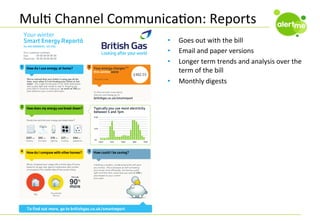
MulC	
  Channel	
  CommunicaCon:	
  Reports	
  
• 
• 
• 
• 


Goes	
  out	
  with	
  the	
  bill	
  
Email	
  and	
  paper	
  versions	
  
Longer	
  term	
  trends	
  and	
  analysis	
  over	
  the	
  
term	
  of	
  the	
  bill	
  
Monthly	
  digests	
  
Personal	
  Energy	
  Insight	
  &	
  Efficiency	
  Advice	
  
2.	
  Standards	
  and	
  Openness
	
  
Standards	
  and	
  Openness	
  
•  As	
  a	
  market	
  matures,	
  there	
  is	
  a	
  sudden	
  “flip”	
  
–  From	
  “no-­‐one	
  to	
  be	
  open	
  to”	
  
–  To	
  “openness	
  is	
  essenCal”	
  

•  Can’t	
  do	
  it	
  all,	
  need	
  ecosystem	
  partners	
  
•  Customers	
  want	
  to	
  have	
  choices	
  
TSB	
  IoT	
  Interoperability	
  Demonstrator	
  
•  £6m	
  project,	
  1	
  year	
  
•  Goal:	
  Break	
  down	
  the	
  verCcal	
  M2M	
  silos!	
  
•  ~40	
  enCCes,	
  most	
  already	
  with	
  verCcal	
  end-­‐to-­‐end	
  
plaborms	
  

1248.io,	
  Aimes	
  Grid	
  Services,	
  AlertMe,	
  Amey,	
  ARM,	
  AvanC,	
  BalfourBeaFy,	
  BRE,	
  
BriCsh	
  Telecom,	
  Carillion,	
  CriCcal	
  Sodware,	
  Ctrl-­‐Shid,	
  EDF,	
  Enlight,	
  ExplorerHQ,	
  
Flexeye,	
  Guildford	
  Borough	
  Council,	
  IBM,	
  Intel,	
  Intellisense.io,	
  Intouch,	
  
LivingPlanIT,	
  London	
  City	
  Airport,	
  Merseyside	
  Transport,	
  Milligan	
  Retail,	
  Neul,	
  
Open	
  Data	
  InsCtute,	
  Placr,	
  SH&BA,	
  Stakeholder	
  Design,	
  Traak,	
  UK	
  Highways	
  
Agency,	
  Westminster	
  City	
  Council,	
  Xively	
  and	
  the	
  UniversiCes	
  of	
  Birmingham,	
  
Cambridge,	
  Lancaster,	
  Surrey,	
  UCL	
  &	
  Open	
  University	
  

•  8	
  clusters	
  with	
  diverse	
  use-­‐cases:	
  
–  Airports	
  
–  Transport	
  logisCcs	
  
–  Schools	
  and	
  Campuses	
  
–  Streets	
  
–  Homes	
  
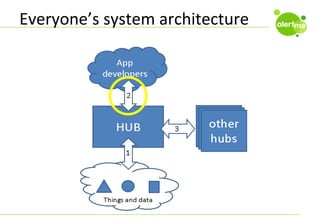
Everyone’s	
  system	
  architecture	
  
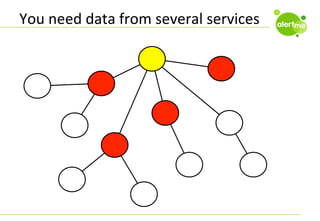
You	
  need	
  data	
  from	
  several	
  services	
  
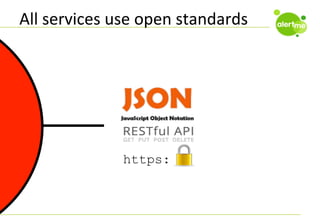
All	
  services	
  use	
  open	
  standards	
  

https:
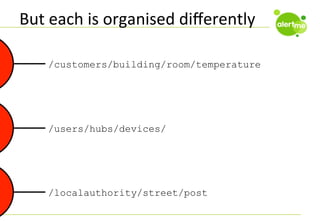
But	
  each	
  is	
  organised	
  differently	
  
/customers/building/room/temperature

/users/hubs/devices/

/localauthority/street/post
So	
  for	
  each	
  service	
  you	
  have	
  to…	
  
•  Read	
  the	
  documentaCon	
  
•  Write	
  code	
  specific	
  to	
  that	
  service	
  
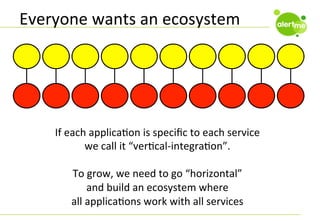
Everyone	
  wants	
  an	
  ecosystem	
  

If	
  each	
  applicaCon	
  is	
  specific	
  to	
  each	
  service	
  
we	
  call	
  it	
  “verCcal-­‐integraCon”.	


To	
  grow,	
  we	
  need	
  to	
  go	
  “horizontal”	
  
and	
  build	
  an	
  ecosystem	
  where	
  
all	
  applicaCons	
  work	
  with	
  all	
  services	
  
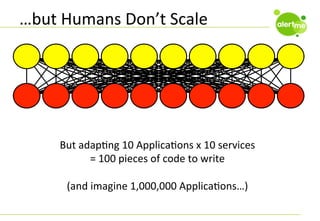
…but	
  Humans	
  Don’t	
  Scale	
  

But	
  adapCng	
  10	
  ApplicaCons	
  x	
  10	
  services	
  
=	
  100	
  pieces	
  of	
  code	
  to	
  write	


(and	
  imagine	
  1,000,000	
  ApplicaCons…)	
  
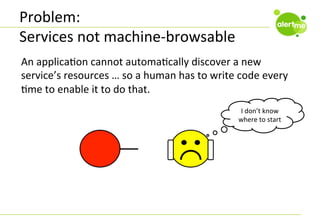
Problem:	
  
Services	
  not	
  machine-­‐browsable	
  
An	
  applicaCon	
  cannot	
  automaCcally	
  discover	
  a	
  new	
  
service’s	
  resources	
  …	
  so	
  a	
  human	
  has	
  to	
  write	
  code	
  every	
  
Cme	
  to	
  enable	
  it	
  to	
  do	
  that.	
  	
  
I	
  don’t	
  know	
  
where	
  to	
  start	
  
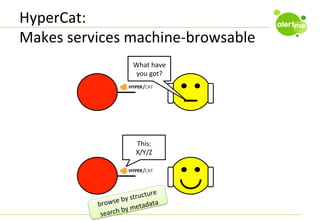
HyperCat:	
  
Makes	
  services	
  machine-­‐browsable	
  
What	
  have	
  
you	
  got?	
  

This:	
  
X/Y/Z	
  

re	
  
structu
	
  by	
  
a	
  
rowse
b
etadat
by	
  m
earch	
  
s
HyperCat:	
  Easier	
  life	
  for	
  everyone	
  
•  Developers	
  

– More	
  data,	
  quicker	
  

•  Service	
  and	
  Data	
  providers	
  
– More	
  customers	
  

•  End-­‐customers	
  
– More	
  choice	
  

•  Ecosystems	
  and	
  markets	
  
– Removes	
  barriers	
  
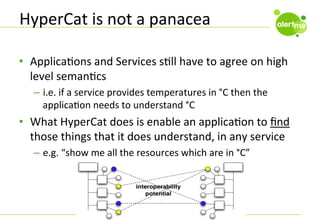
HyperCat	
  is	
  not	
  a	
  panacea	
  
•  ApplicaCons	
  and	
  Services	
  sCll	
  have	
  to	
  agree	
  on	
  high	
  
level	
  semanCcs	
  
–  i.e.	
  if	
  a	
  service	
  provides	
  temperatures	
  in	
  °C	
  then	
  the	
  
applicaCon	
  needs	
  to	
  understand	
  °C	
  

•  What	
  HyperCat	
  does	
  is	
  enable	
  an	
  applicaCon	
  to	
  find	
  
those	
  things	
  that	
  it	
  does	
  understand,	
  in	
  any	
  service	
  
–  e.g.	
  “show	
  me	
  all	
  the	
  resources	
  which	
  are	
  in	
  °C”	
  
Work	
  in	
  progress…	
  
All	
  the	
  things	
  we	
  kicked	
  out	
  of	
  scope!	
  
•  Data	
  formats	
  (SenML)	
  
•  Ontologies	
  (general,	
  and	
  more	
  &	
  more	
  specific)	
  
•  RegistraCon	
  
•  Standard	
  Licenses	
  
•  Key	
  management	
  
•  MoneCsaCon	
  models	
  
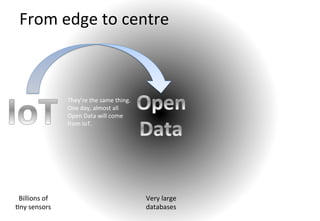
From	
  edge	
  to	
  centre	
  

They’re	
  the	
  same	
  thing.	
  
One	
  day,	
  almost	
  all	
  
Open	
  Data	
  will	
  come	
  
from	
  IoT.	
  

Billions	
  of	
  	
  
Cny	
  sensors	
  

Very	
  large	
  
databases	
  
“Open”	
  
Not	
  (necessarily):	
  
•  Free	
  
•  Public	
  
Means:	
  
•  My	
  service	
  works	
  with	
  your	
  service	
  
•  We	
  can	
  swap	
  providers	
  without	
  a	
  lot	
  of	
  effort	
  
•  Requires	
  less	
  trust	
  
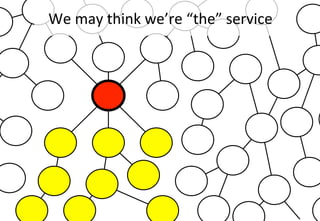
We	
  may	
  think	
  we’re	
  “the”	
  service
	
  
But	
  we’re	
  just	
  another	
  node	
  in	
  the	
  graph
	
  
Smart	
  Meters:	
  T-­‐2	
  years	
  &	
  counCng	
  
Here	
  come:	
  
•  Consumer	
  Access	
  Devices	
  
•  Authorised	
  Third	
  ParCes	
  
3.	
  Home	
  Energy	
  Use	
  Update
	
  
Home	
  appliances	
  &	
  devices	
  

In	
  2009	
  the	
  average	
  household	
  owned	
  11	
  
Cmes	
  more	
  consumer	
  electronics	
  items	
  
than	
  they	
  had	
  in	
  1970,	
  and	
  three	
  and	
  a	
  
half	
  Cmes	
  more	
  than	
  in	
  1990	


[Av	
  home	
  has	
  41	
  appliances	
  today]	
  
Electricity-­‐	
  per	
  Home	
  
0.00035	
  

0.0003	
  

0.00025	
  

0.0002	
  

0.00015	
  

COMPUTING	
  
ELECTRONICS	
  
LIGHT	
  
COLD	
  

0.0001	
  

WET	
  
COOK	
  

0.00005	
  

0	
  
Electricity	
  –	
  all	
  homes	
  
8,000	
  

1	
  
3	
  

7,000	
  

6,000	
  

5,000	
  

4,000	
  

GAS	
  
3,000	
  

2,000	
  

COMPUTING	
  
ELECTRONICS	
  
LIGHT	
  
COLD	
  
WET	
  

1,000	
  

0	
  

COOK	
  
(bubbles-­‐internet)	
  
(bubbles-­‐this	
  mac)	
  
Bill	
  =	
  Price	
  x	
  Usage	
  
•  Energy	
  prices	
  are	
  rising	
  
•  Household	
  bills	
  are	
  rising	
  
–  But	
  slower,	
  and	
  not	
  hugely	
  above	
  inflaCon	
  

•  Because	
  per-­‐house	
  usage	
  is	
  falling	
  
•  SCll	
  a	
  long	
  way	
  to	
  go	
  (up	
  &	
  therefore	
  down!)	
  
•  PoliCcal	
  talk	
  of	
  banishing	
  green	
  taxes…	
  
•  The	
  real	
  issues	
  remain:	
  
–  InsulaCon	
  
–  Gadgets	
  
@pilgrimbeart	
  

AlertMe Beart Smart Homes & Cleanpower 2013 Cambridge, UK via CIR www.hvm-uk.com

  • 1.
    Smart Homes atScale CIR Smart Homes & Cleanpower 2013 www.hvm-uk.com pilgrim.beart@alertme.com
  • 2.
    A  talk  in  3  parts   •  Smart  Energy  Report   •  Standards  and  Openness   •  Home  Energy  Update  
  • 3.
  • 4.
  • 5.
    Data  analyCcs  engine   •  An  engine  that  gives  insight  into   household  usage  paFerns  for  energy   consumpCon   –  Built  upon  several  models   •  Models  informed  by  many  inputs:   –  Temperature,  LocaCon,  Type  of   appliances  and  usage   –  and  others    …   •  Models  include:   –  Space  HeaCng,  Hot  water,  Cooking,   LighCng,  Appliances,  Occupancy   –  and  others  …   •  Output  improves  with  more  data   –  Supply  more  informaCon,   •  Get  greater  insights   –  Supply  less  informaCon   •  SCll  has  good  insight,  but  based  on   naConal/local  averages  
  • 6.
    MulC  Channel  CommunicaCon:  Reports   •  •  •  •    Goes  out  with  the  bill   Email  and  paper  versions   Longer  term  trends  and  analysis  over  the   term  of  the  bill   Monthly  digests  
  • 7.
    Personal  Energy  Insight  &  Efficiency  Advice  
  • 8.
    2.  Standards  and  Openness  
  • 9.
    Standards  and  Openness   •  As  a  market  matures,  there  is  a  sudden  “flip”   –  From  “no-­‐one  to  be  open  to”   –  To  “openness  is  essenCal”   •  Can’t  do  it  all,  need  ecosystem  partners   •  Customers  want  to  have  choices  
  • 10.
    TSB  IoT  Interoperability  Demonstrator   •  £6m  project,  1  year   •  Goal:  Break  down  the  verCcal  M2M  silos!   •  ~40  enCCes,  most  already  with  verCcal  end-­‐to-­‐end   plaborms   1248.io,  Aimes  Grid  Services,  AlertMe,  Amey,  ARM,  AvanC,  BalfourBeaFy,  BRE,   BriCsh  Telecom,  Carillion,  CriCcal  Sodware,  Ctrl-­‐Shid,  EDF,  Enlight,  ExplorerHQ,   Flexeye,  Guildford  Borough  Council,  IBM,  Intel,  Intellisense.io,  Intouch,   LivingPlanIT,  London  City  Airport,  Merseyside  Transport,  Milligan  Retail,  Neul,   Open  Data  InsCtute,  Placr,  SH&BA,  Stakeholder  Design,  Traak,  UK  Highways   Agency,  Westminster  City  Council,  Xively  and  the  UniversiCes  of  Birmingham,   Cambridge,  Lancaster,  Surrey,  UCL  &  Open  University   •  8  clusters  with  diverse  use-­‐cases:   –  Airports   –  Transport  logisCcs   –  Schools  and  Campuses   –  Streets   –  Homes  
  • 11.
  • 13.
    You  need  data  from  several  services  
  • 14.
    All  services  use  open  standards   https:
  • 15.
    But  each  is  organised  differently   /customers/building/room/temperature /users/hubs/devices/ /localauthority/street/post
  • 16.
    So  for  each  service  you  have  to…   •  Read  the  documentaCon   •  Write  code  specific  to  that  service  
  • 17.
    Everyone  wants  an  ecosystem   If  each  applicaCon  is  specific  to  each  service   we  call  it  “verCcal-­‐integraCon”.     To  grow,  we  need  to  go  “horizontal”   and  build  an  ecosystem  where   all  applicaCons  work  with  all  services  
  • 18.
    …but  Humans  Don’t  Scale   But  adapCng  10  ApplicaCons  x  10  services   =  100  pieces  of  code  to  write     (and  imagine  1,000,000  ApplicaCons…)  
  • 19.
    Problem:   Services  not  machine-­‐browsable   An  applicaCon  cannot  automaCcally  discover  a  new   service’s  resources  …  so  a  human  has  to  write  code  every   Cme  to  enable  it  to  do  that.     I  don’t  know   where  to  start  
  • 20.
    HyperCat:   Makes  services  machine-­‐browsable   What  have   you  got?   This:   X/Y/Z   re   structu  by   a   rowse b etadat by  m earch   s
  • 21.
    HyperCat:  Easier  life  for  everyone   •  Developers   – More  data,  quicker   •  Service  and  Data  providers   – More  customers   •  End-­‐customers   – More  choice   •  Ecosystems  and  markets   – Removes  barriers  
  • 22.
    HyperCat  is  not  a  panacea   •  ApplicaCons  and  Services  sCll  have  to  agree  on  high   level  semanCcs   –  i.e.  if  a  service  provides  temperatures  in  °C  then  the   applicaCon  needs  to  understand  °C   •  What  HyperCat  does  is  enable  an  applicaCon  to  find   those  things  that  it  does  understand,  in  any  service   –  e.g.  “show  me  all  the  resources  which  are  in  °C”  
  • 23.
    Work  in  progress…   All  the  things  we  kicked  out  of  scope!   •  Data  formats  (SenML)   •  Ontologies  (general,  and  more  &  more  specific)   •  RegistraCon   •  Standard  Licenses   •  Key  management   •  MoneCsaCon  models  
  • 24.
    From  edge  to  centre   They’re  the  same  thing.   One  day,  almost  all   Open  Data  will  come   from  IoT.   Billions  of     Cny  sensors   Very  large   databases  
  • 25.
    “Open”   Not  (necessarily):   •  Free   •  Public   Means:   •  My  service  works  with  your  service   •  We  can  swap  providers  without  a  lot  of  effort   •  Requires  less  trust  
  • 26.
    We  may  think  we’re  “the”  service  
  • 27.
    But  we’re  just  another  node  in  the  graph  
  • 28.
    Smart  Meters:  T-­‐2  years  &  counCng   Here  come:   •  Consumer  Access  Devices   •  Authorised  Third  ParCes  
  • 29.
    3.  Home  Energy  Use  Update  
  • 30.
    Home  appliances  &  devices   In  2009  the  average  household  owned  11   Cmes  more  consumer  electronics  items   than  they  had  in  1970,  and  three  and  a   half  Cmes  more  than  in  1990     [Av  home  has  41  appliances  today]  
  • 31.
    Electricity-­‐  per  Home   0.00035   0.0003   0.00025   0.0002   0.00015   COMPUTING   ELECTRONICS   LIGHT   COLD   0.0001   WET   COOK   0.00005   0  
  • 32.
    Electricity  –  all  homes   8,000   1   3   7,000   6,000   5,000   4,000   GAS   3,000   2,000   COMPUTING   ELECTRONICS   LIGHT   COLD   WET   1,000   0   COOK  
  • 33.
  • 34.
    Bill  =  Price  x  Usage   •  Energy  prices  are  rising   •  Household  bills  are  rising   –  But  slower,  and  not  hugely  above  inflaCon   •  Because  per-­‐house  usage  is  falling   •  SCll  a  long  way  to  go  (up  &  therefore  down!)   •  PoliCcal  talk  of  banishing  green  taxes…   •  The  real  issues  remain:   –  InsulaCon   –  Gadgets  
  • 35.