Implementation of ELEXON
Generic LED Charge Codes
16/06/2016 – ILP Summit
What will be covered?
Background to the change
Generic LED Charge Codes
Variable Power Switch Regimes
ELEXON Approved?
Constant Light Output
Impact on CMS
Summary
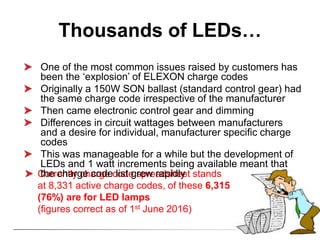
Currently charge code spreadsheet stands
at 8,331 active charge codes, of these 6,315
(76%) are for LED lamps
(figures correct as of 1st June 2016)
Thousands of LEDs…
One of the most common issues raised by customers has
been the ‘explosion’ of ELEXON charge codes
Originally a 150W SON ballast (standard control gear) had
the same charge code irrespective of the manufacturer
Then came electronic control gear and dimming
Differences in circuit wattages between manufacturers
and a desire for individual, manufacturer specific charge
codes
This was manageable for a while but the development of
LEDs and 1 watt increments being available meant that
the charge code list grew rapidly
ELEXON with the assistance of the Unmetered Supplies
User Group (UMSUG), manufacturers and asset
management system providers looked at a range of
options
Key customer desire was a reduction in ‘charge code
proliferation’
Using the charge code spreadsheet itself and filtering not
the issue per se
Setting up the codes in the asset management system
was an issue
Agreed that using the same codes for different
manufacturers was not an issue (40 watts is 40 watts)
Concern over how to check for ELEXON approval
The Solution?
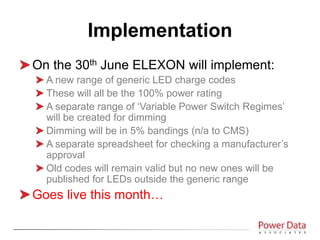
On the 30th June ELEXON will implement:
A new range of generic LED charge codes
These will all be the 100% power rating
A separate range of ‘Variable Power Switch Regimes’
will be created for dimming
Dimming will be in 5% bandings (n/a to CMS)
A separate spreadsheet for checking a manufacturer’s
approval
Old codes will remain valid but no new ones will be
published for LEDs outside the generic range
Goes live this month…
Implementation
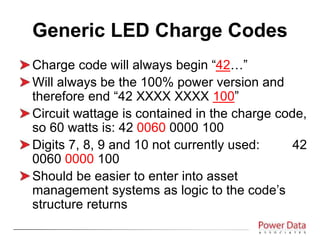
Charge code will always begin “42…”
Will always be the 100% power version and
therefore end “42 XXXX XXXX 100”
Circuit wattage is contained in the charge code,
so 60 watts is: 42 0060 0000 100
Digits 7, 8, 9 and 10 not currently used: 42
0060 0000 100
Should be easier to enter into asset
management systems as logic to the code’s
structure returns
Generic LED Charge Codes
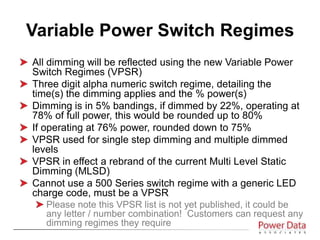
All dimming will be reflected using the new Variable Power
Switch Regimes (VPSR)
Three digit alpha numeric switch regime, detailing the
time(s) the dimming applies and the % power(s)
Dimming is in 5% bandings, if dimmed by 22%, operating at
78% of full power, this would be rounded up to 80%
If operating at 76% power, rounded down to 75%
VPSR used for single step dimming and multiple dimmed
levels
VPSR in effect a rebrand of the current Multi Level Static
Dimming (MLSD)
Cannot use a 500 Series switch regime with a generic LED
charge code, must be a VPSR
Please note this VPSR list is not yet published, it could be
any letter / number combination! Customers can request any
dimming regimes they require
Variable Power Switch Regimes
Number of manufacturers engaging with the charge
code process has dramatically increased in recent
years
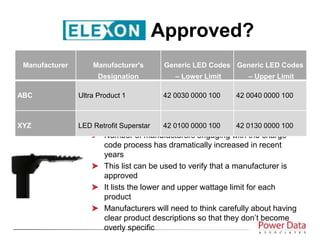
This list can be used to verify that a manufacturer is
approved
It lists the lower and upper wattage limit for each
product
Manufacturers will need to think carefully about having
clear product descriptions so that they don’t become
overly specific
ELEXON Approved?
Manufacturer Manufacturer's
Designation
Generic LED Codes
– Lower Limit
Generic LED Codes
– Upper Limit
ABC Ultra Product 1 42 0030 0000 100 42 0040 0000 100
XYZ LED Retrofit Superstar 42 0100 0000 100 42 0130 0000 100
Using generic codes in the inventory means customers
can no longer use the charge code itself to identify the
manufacturer
May want to add a column to capture that information,
presuming more than one manufacturer is used
Alternatively may want to capture the specific model
number to monitor faults with products, lamp life,
warranty claims, etc…
Identifying the manufacturer
Many
more…
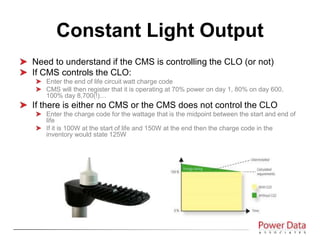
Need to understand if the CMS is controlling the CLO (or not)
If CMS controls the CLO:
Enter the end of life circuit watt charge code
CMS will then register that it is operating at 70% power on day 1, 80% on day 600,
100% day 8,700(!)…
If there is either no CMS or the CMS does not control the CLO
Enter the charge code for the wattage that is the midpoint between the start and end of
life
If it is 100W at the start of life and 150W at the end then the charge code in the
inventory would state 125W
Constant Light Output
For CMS users there is no change
Customers use new generic LED charge codes in
inventories
Continue to use switch regime 999 as before
All dimming / part night switch off events captured by
the CMS event log file in the background
No need for 5% bandings for dimming
Can dim to any % power supported by lamp / driver
Central Management Systems
Generic Charge Codes available from 30th
June
Will greatly reduce number of charge codes
needed
All dimming will be declared using VPSR
Dimming in 5% bandings (unless using CMS)
Existing charge codes / dimming still valid
Consider how to capture manufacturer
information in inventories
Need to understand if the CLO is controlled
by driver or CMS
Summary
James Everley
National Account Manager
07540 528844
James.Everley@PowerDataAssociates.com
www.PowerDataAssociates.com
Thank you for listening…

PLS 2016: Important ELEXON update: implementation of generic LED charge codes

  • 1.
    Implementation of ELEXON GenericLED Charge Codes 16/06/2016 – ILP Summit
  • 2.
    What will becovered? Background to the change Generic LED Charge Codes Variable Power Switch Regimes ELEXON Approved? Constant Light Output Impact on CMS Summary
  • 3.
    Currently charge codespreadsheet stands at 8,331 active charge codes, of these 6,315 (76%) are for LED lamps (figures correct as of 1st June 2016) Thousands of LEDs… One of the most common issues raised by customers has been the ‘explosion’ of ELEXON charge codes Originally a 150W SON ballast (standard control gear) had the same charge code irrespective of the manufacturer Then came electronic control gear and dimming Differences in circuit wattages between manufacturers and a desire for individual, manufacturer specific charge codes This was manageable for a while but the development of LEDs and 1 watt increments being available meant that the charge code list grew rapidly
  • 4.
    ELEXON with theassistance of the Unmetered Supplies User Group (UMSUG), manufacturers and asset management system providers looked at a range of options Key customer desire was a reduction in ‘charge code proliferation’ Using the charge code spreadsheet itself and filtering not the issue per se Setting up the codes in the asset management system was an issue Agreed that using the same codes for different manufacturers was not an issue (40 watts is 40 watts) Concern over how to check for ELEXON approval The Solution?
  • 5.
    On the 30thJune ELEXON will implement: A new range of generic LED charge codes These will all be the 100% power rating A separate range of ‘Variable Power Switch Regimes’ will be created for dimming Dimming will be in 5% bandings (n/a to CMS) A separate spreadsheet for checking a manufacturer’s approval Old codes will remain valid but no new ones will be published for LEDs outside the generic range Goes live this month… Implementation
  • 6.
    Charge code willalways begin “42…” Will always be the 100% power version and therefore end “42 XXXX XXXX 100” Circuit wattage is contained in the charge code, so 60 watts is: 42 0060 0000 100 Digits 7, 8, 9 and 10 not currently used: 42 0060 0000 100 Should be easier to enter into asset management systems as logic to the code’s structure returns Generic LED Charge Codes
  • 7.
    All dimming willbe reflected using the new Variable Power Switch Regimes (VPSR) Three digit alpha numeric switch regime, detailing the time(s) the dimming applies and the % power(s) Dimming is in 5% bandings, if dimmed by 22%, operating at 78% of full power, this would be rounded up to 80% If operating at 76% power, rounded down to 75% VPSR used for single step dimming and multiple dimmed levels VPSR in effect a rebrand of the current Multi Level Static Dimming (MLSD) Cannot use a 500 Series switch regime with a generic LED charge code, must be a VPSR Please note this VPSR list is not yet published, it could be any letter / number combination! Customers can request any dimming regimes they require Variable Power Switch Regimes
  • 8.
    Number of manufacturersengaging with the charge code process has dramatically increased in recent years This list can be used to verify that a manufacturer is approved It lists the lower and upper wattage limit for each product Manufacturers will need to think carefully about having clear product descriptions so that they don’t become overly specific ELEXON Approved? Manufacturer Manufacturer's Designation Generic LED Codes – Lower Limit Generic LED Codes – Upper Limit ABC Ultra Product 1 42 0030 0000 100 42 0040 0000 100 XYZ LED Retrofit Superstar 42 0100 0000 100 42 0130 0000 100
  • 9.
    Using generic codesin the inventory means customers can no longer use the charge code itself to identify the manufacturer May want to add a column to capture that information, presuming more than one manufacturer is used Alternatively may want to capture the specific model number to monitor faults with products, lamp life, warranty claims, etc… Identifying the manufacturer Many more…
  • 10.
    Need to understandif the CMS is controlling the CLO (or not) If CMS controls the CLO: Enter the end of life circuit watt charge code CMS will then register that it is operating at 70% power on day 1, 80% on day 600, 100% day 8,700(!)… If there is either no CMS or the CMS does not control the CLO Enter the charge code for the wattage that is the midpoint between the start and end of life If it is 100W at the start of life and 150W at the end then the charge code in the inventory would state 125W Constant Light Output
  • 11.
    For CMS usersthere is no change Customers use new generic LED charge codes in inventories Continue to use switch regime 999 as before All dimming / part night switch off events captured by the CMS event log file in the background No need for 5% bandings for dimming Can dim to any % power supported by lamp / driver Central Management Systems
  • 12.
    Generic Charge Codesavailable from 30th June Will greatly reduce number of charge codes needed All dimming will be declared using VPSR Dimming in 5% bandings (unless using CMS) Existing charge codes / dimming still valid Consider how to capture manufacturer information in inventories Need to understand if the CLO is controlled by driver or CMS Summary
  • 13.
    James Everley National AccountManager 07540 528844 James.Everley@PowerDataAssociates.com www.PowerDataAssociates.com Thank you for listening…