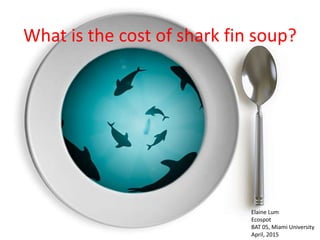
What is the cost of shark fin soup?
Elaine Lum
Ecospot
BAT 05, Miami University
April, 2015
I used to look forward to Chinese banquets so
that I could have shark fin soup.
But then
I discovered the real cost of shark fin soup . . .
Ecological costs
1.7 million
tonnes of
sharks are
caught and
sold a year . . .
(Clarke et al., 2006)
Ecological costs
resulting in at least 50% decline in all shark
species globally (Baum et al., 2003)
Ecological costs
¼ of all shark species are
listed as endangered or
threatened
(Dulvy et al., 2013)
Effect on shark populations
There is 89%
less Atlantic
shark species
compared to 15
years ago
(Edwards, 2006)
Effect on shark populations
97% of reef
sharks have
disappeared in
the Great
Barrier Reef
(Robbins, Hisano,
Connolly, & Choat,
2006)
Why should we care about declines in
shark populations?
As apex predators,
sharks help maintain
balanced populations
of many other marine
species
(Heupel, Knip, Simpfendorfer, &
Dulvy, 2014)
• For example,
overfishing of
sharks in
Chesapeake Bay
resulted in the
overpopulation of
cownose rays
• The rays ate all the
bay scallops and
caused the collapse
of the scallop
fishing industry
(Myers, Baum, Shepherd,
Powers, & Peterson, 2007)
Why should we care about declines in
shark populations?
Ethical costs: shark finning
• Fins are cut
off while
sharks are
alive
• The carcass is
thrown
overboard, to
sink and
slowly die Watch a video about shark finning in the next slide.
Warning! There are graphic images that may be disturbing for
some viewers
Is shark finning legal?
• Shark finning is
regulated in some
countries, including
Canada
• In Canada, shark fins
can only make up 5%
of the total shark
harvest brought inland
• However, this rule can
be exploited as fins do
not have to be
attached to the body
(Godin & Worm, 2010)
Is shark finning legal?
• In some countries, like
Costa Rica, there are
tougher regulations to
ensure that finning
does not occur at sea.
• A video produced by
Randall Arauz sparked
public outcry that led
to tougher laws
requiring that all fins
must still be attached
to sharks brought to
market.
Watch an interview with Randall Arauz in the next slide.
Warning! There are graphic images that may be disturbing for
some viewers
Criminal costs: illegal poaching
• Endangered and
threatened shark species
are deliberately harvested
in illegal fishing
• For example, in Indonesia,
92% of shark species
caught are listed as
endangered
• One such targeted species
is the scalloped
hammerhead shark
(Sembiring et al., 2015)
A new technology to catch shark
poachers: DNA barcoding
• Short pieces of
DNA in shark fins
are used to identify
shark species (Ward,
2009)
• Even DNA from fins
cooked in soup can
be identified (Fields,
Abercrombie, Eng, Feldheim,
& Chapman, 2015)
A new technology to catch shark
poachers: DNA barcoding
• This information can help decide which
species should be protected or have fishing
quotas (Liu, Chan, Lin, Hu, & Chen, 2013)
• This information can also be used to prosecute
illegal sales of protected species (Fields et al., 2015)
Watch a video on DNA barcoding in
the next slide.
Health costs: Bioaccumulation
• Sharks tend to have
higher
concentrations of
toxins because of
their role as apex
predators.
• This is a process
called
bioaccumulation
Health risks in shark fin
• There are non-cancer
health risks due to
bioaccumulation of
Mercury in shark fins
• Eg. autism, infertility,
skin disorders
(Man, Wu, & Wong, 2014)
Health risks in shark fin
• Neurotoxins in
shark fins can
cause brain
degeneration
• Eg. Alzheimer’s
disease
(Mondo et al., 2012)
So what can you do to protect sharks?
What can you do to protect sharks?
• Take the pledge
What can you do to protect sharks?
• Sign a petition to ban shark finning
http://www.stopsharkfinning.net/stop-shark-finning-petitions/
What can you do to protect sharks?
• Write to your Member of Legislative Assembly and
Member of Parliament asking them to ban the
import and sale of shark fins in Canada
Find your MLA:
http://www.leg.bc.ca/mla/3-1-
1.htm
Find your MP:
http://www.parl.gc.ca/parlinfo/compilat
ions/houseofcommons/memberbyposta
lcode.aspx?menu=hoc
What can you do to protect sharks?
• Share this
WildAid
video
featuring
NBA star, Yao
Ming, in the
next slide.
What can you do to protect sharks?
• Upload and share this presentation with
friends and family
What can you do to protect sharks?
• Join the conversation by commenting below
Shark Conservation Organizations
http://www.sharktrust.org/
http://www.seashepherd.org/
http://www.pewtrusts.org/en/archived-projects/shark-alliance
http://sharkangels.org/
http://www.sharksavers.org/en/home/
Together, we can make a difference for
shark conservation!
References
Baum, J. K., Myers, R. A., Kehler, D. G., Worm, B., Harley, S. J., & Doherty, P. A. (2003). Collapse and
conservation of shark populations in the Northwest Atlantic. Science, 5605, 389.
Clarke, S. C., McAllister, M. K., Milner-Gulland, E. J., Kirkwood, G. P., Michielsens, C. G. J., Agnew, D.
J., . . . Shivji, M. S. (2006). Global estimates of shark catches using trade records from
commercial markets. Ecology Letters, 9(10), 1115-1126.
Dulvy, N. K., Fowler, S. L., Musick, J. A., Cavanagh, R. D., Kyne, P. M., Harrison, L. R., . . . White, W. T.
(2013). Extinction risk and conservation of the world's sharks and rays.
Edwards, H. (2006). When predators become prey: the need for international shark conservation
[comments]. Ocean And Coastal Law Journal, 2, 305.
Fields, A. T., Abercrombie, D. L., Eng, R., Feldheim, K., & Chapman, D. D. (2015). A novel mini-DNA
barcoding assay to identify processed fFins from internationally protected shark species. PLoS
ONE, 10(2), 1-10. doi: 10.1371/journal.pone.0114844
Godin, A. C., & Worm, B. (2010). Keeping the lead: How to strengthen shark conservation and
management policies in Canada. Marine Policy, 34(5), 995-1001. doi:
10.1016/j.marpol.2010.02.006
Heupel, M. R., Knip, D. M., Simpfendorfer, C. A., & Dulvy, N. K. (2014). Sizing up the ecological role of
sharks as predators. Marine Ecology Progress Series, 495, 291-298.
Liu, S.-Y. V., Chan, C.-L. C., Lin, O., Hu, C.-S., & Chen, C. A. (2013). DNA barcoding of shark meats
identify species composition and CITES-listed species from the markets in Taiwan. PLoS ONE,
8(11), 1-8. doi: 10.1371/journal.pone.0079373
Man, Y., Wu, S., & Wong, M. (2014). Shark fin, a symbol of wealth and good fortune
may pose health risks: the case of mercury. Environmental Geochemistry &
Health, 36(6), 1015-1027. doi: 10.1007/s10653-014-9598-3
Mondo, K., Hammerschlag, N., Basile, M., Pablo, J., Banack, S. A., & Mash, D. C. (2012).
Cyanobacterial neurotoxin β-N-methylamino-L-alanine (BMAA) in shark fins.
Marine Drugs, 10(6), 509-520. doi: 10.3390/md10020509
Myers, R. A., Baum, J. K., Shepherd, T. D., Powers, S. P., & Peterson, C. H. (2007).
Cascading effects of the loss of apex predatory sharks from a coastal ocean.
Science, 5820, 1846.
Robbins, W. D., Hisano, M., Connolly, S. R., & Choat, J. H. (2006). Ongoing collapse of
coral-reef shark populations. Current Biology, 16(23), 2314-2319.
Sembiring, A., Pertiwi, N. P. D., Mahardini, A., Wulandari, R., Kurniasih, E. M., Kuncoro,
A. W., . . . Mahardika, G. N. (2015). DNA barcoding reveals targeted fisheries for
endangered sharks in Indonesia. Fisheries Research, 164, 130-134. doi:
10.1016/j.fishres.2014.11.003
Ward, R. D. (2009). Shark fin identification through DNA barcoding. Endangered
Species Update, 26(1/2), 3-9.

The Cost of Shark Fin Soup

  • 1.
    What is thecost of shark fin soup? Elaine Lum Ecospot BAT 05, Miami University April, 2015
  • 2.
    I used tolook forward to Chinese banquets so that I could have shark fin soup.
  • 3.
    But then I discoveredthe real cost of shark fin soup . . .
  • 4.
    Ecological costs 1.7 million tonnesof sharks are caught and sold a year . . . (Clarke et al., 2006)
  • 5.
    Ecological costs resulting inat least 50% decline in all shark species globally (Baum et al., 2003)
  • 6.
    Ecological costs ¼ ofall shark species are listed as endangered or threatened (Dulvy et al., 2013)
  • 7.
    Effect on sharkpopulations There is 89% less Atlantic shark species compared to 15 years ago (Edwards, 2006)
  • 8.
    Effect on sharkpopulations 97% of reef sharks have disappeared in the Great Barrier Reef (Robbins, Hisano, Connolly, & Choat, 2006)
  • 9.
    Why should wecare about declines in shark populations? As apex predators, sharks help maintain balanced populations of many other marine species (Heupel, Knip, Simpfendorfer, & Dulvy, 2014)
  • 10.
    • For example, overfishingof sharks in Chesapeake Bay resulted in the overpopulation of cownose rays • The rays ate all the bay scallops and caused the collapse of the scallop fishing industry (Myers, Baum, Shepherd, Powers, & Peterson, 2007) Why should we care about declines in shark populations?
  • 11.
    Ethical costs: sharkfinning • Fins are cut off while sharks are alive • The carcass is thrown overboard, to sink and slowly die Watch a video about shark finning in the next slide. Warning! There are graphic images that may be disturbing for some viewers
  • 12.
    Is shark finninglegal? • Shark finning is regulated in some countries, including Canada • In Canada, shark fins can only make up 5% of the total shark harvest brought inland • However, this rule can be exploited as fins do not have to be attached to the body (Godin & Worm, 2010)
  • 13.
    Is shark finninglegal? • In some countries, like Costa Rica, there are tougher regulations to ensure that finning does not occur at sea. • A video produced by Randall Arauz sparked public outcry that led to tougher laws requiring that all fins must still be attached to sharks brought to market. Watch an interview with Randall Arauz in the next slide. Warning! There are graphic images that may be disturbing for some viewers
  • 14.
    Criminal costs: illegalpoaching • Endangered and threatened shark species are deliberately harvested in illegal fishing • For example, in Indonesia, 92% of shark species caught are listed as endangered • One such targeted species is the scalloped hammerhead shark (Sembiring et al., 2015)
  • 15.
    A new technologyto catch shark poachers: DNA barcoding • Short pieces of DNA in shark fins are used to identify shark species (Ward, 2009) • Even DNA from fins cooked in soup can be identified (Fields, Abercrombie, Eng, Feldheim, & Chapman, 2015)
  • 16.
    A new technologyto catch shark poachers: DNA barcoding • This information can help decide which species should be protected or have fishing quotas (Liu, Chan, Lin, Hu, & Chen, 2013) • This information can also be used to prosecute illegal sales of protected species (Fields et al., 2015) Watch a video on DNA barcoding in the next slide.
  • 17.
    Health costs: Bioaccumulation •Sharks tend to have higher concentrations of toxins because of their role as apex predators. • This is a process called bioaccumulation
  • 18.
    Health risks inshark fin • There are non-cancer health risks due to bioaccumulation of Mercury in shark fins • Eg. autism, infertility, skin disorders (Man, Wu, & Wong, 2014)
  • 19.
    Health risks inshark fin • Neurotoxins in shark fins can cause brain degeneration • Eg. Alzheimer’s disease (Mondo et al., 2012)
  • 20.
    So what canyou do to protect sharks?
  • 21.
    What can youdo to protect sharks? • Take the pledge
  • 22.
    What can youdo to protect sharks? • Sign a petition to ban shark finning http://www.stopsharkfinning.net/stop-shark-finning-petitions/
  • 23.
    What can youdo to protect sharks? • Write to your Member of Legislative Assembly and Member of Parliament asking them to ban the import and sale of shark fins in Canada Find your MLA: http://www.leg.bc.ca/mla/3-1- 1.htm Find your MP: http://www.parl.gc.ca/parlinfo/compilat ions/houseofcommons/memberbyposta lcode.aspx?menu=hoc
  • 24.
    What can youdo to protect sharks? • Share this WildAid video featuring NBA star, Yao Ming, in the next slide.
  • 25.
    What can youdo to protect sharks? • Upload and share this presentation with friends and family
  • 26.
    What can youdo to protect sharks? • Join the conversation by commenting below
  • 27.
  • 28.
    Together, we canmake a difference for shark conservation!
  • 29.
    References Baum, J. K.,Myers, R. A., Kehler, D. G., Worm, B., Harley, S. J., & Doherty, P. A. (2003). Collapse and conservation of shark populations in the Northwest Atlantic. Science, 5605, 389. Clarke, S. C., McAllister, M. K., Milner-Gulland, E. J., Kirkwood, G. P., Michielsens, C. G. J., Agnew, D. J., . . . Shivji, M. S. (2006). Global estimates of shark catches using trade records from commercial markets. Ecology Letters, 9(10), 1115-1126. Dulvy, N. K., Fowler, S. L., Musick, J. A., Cavanagh, R. D., Kyne, P. M., Harrison, L. R., . . . White, W. T. (2013). Extinction risk and conservation of the world's sharks and rays. Edwards, H. (2006). When predators become prey: the need for international shark conservation [comments]. Ocean And Coastal Law Journal, 2, 305. Fields, A. T., Abercrombie, D. L., Eng, R., Feldheim, K., & Chapman, D. D. (2015). A novel mini-DNA barcoding assay to identify processed fFins from internationally protected shark species. PLoS ONE, 10(2), 1-10. doi: 10.1371/journal.pone.0114844 Godin, A. C., & Worm, B. (2010). Keeping the lead: How to strengthen shark conservation and management policies in Canada. Marine Policy, 34(5), 995-1001. doi: 10.1016/j.marpol.2010.02.006 Heupel, M. R., Knip, D. M., Simpfendorfer, C. A., & Dulvy, N. K. (2014). Sizing up the ecological role of sharks as predators. Marine Ecology Progress Series, 495, 291-298. Liu, S.-Y. V., Chan, C.-L. C., Lin, O., Hu, C.-S., & Chen, C. A. (2013). DNA barcoding of shark meats identify species composition and CITES-listed species from the markets in Taiwan. PLoS ONE, 8(11), 1-8. doi: 10.1371/journal.pone.0079373
  • 30.
    Man, Y., Wu,S., & Wong, M. (2014). Shark fin, a symbol of wealth and good fortune may pose health risks: the case of mercury. Environmental Geochemistry & Health, 36(6), 1015-1027. doi: 10.1007/s10653-014-9598-3 Mondo, K., Hammerschlag, N., Basile, M., Pablo, J., Banack, S. A., & Mash, D. C. (2012). Cyanobacterial neurotoxin β-N-methylamino-L-alanine (BMAA) in shark fins. Marine Drugs, 10(6), 509-520. doi: 10.3390/md10020509 Myers, R. A., Baum, J. K., Shepherd, T. D., Powers, S. P., & Peterson, C. H. (2007). Cascading effects of the loss of apex predatory sharks from a coastal ocean. Science, 5820, 1846. Robbins, W. D., Hisano, M., Connolly, S. R., & Choat, J. H. (2006). Ongoing collapse of coral-reef shark populations. Current Biology, 16(23), 2314-2319. Sembiring, A., Pertiwi, N. P. D., Mahardini, A., Wulandari, R., Kurniasih, E. M., Kuncoro, A. W., . . . Mahardika, G. N. (2015). DNA barcoding reveals targeted fisheries for endangered sharks in Indonesia. Fisheries Research, 164, 130-134. doi: 10.1016/j.fishres.2014.11.003 Ward, R. D. (2009). Shark fin identification through DNA barcoding. Endangered Species Update, 26(1/2), 3-9.