Sustaining Aquatic Biodiversity
Part 1—Major Threats
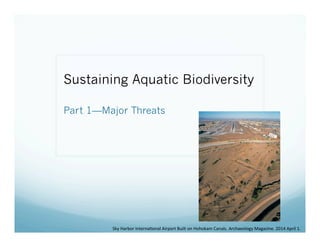
Sky	
  Harbor	
  Interna.onal	
  Airport	
  Built	
  on	
  Hohokam	
  Canals.	
  Archaeology	
  Magazine.	
  2014	
  April	
  1.	
  
Fig.	
  11-­‐1,	
  p.	
  250	
  
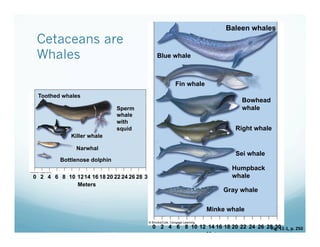
Cetaceans are
Whales
Toothed whales
Sperm
whale
with
squid
Killer whale
Narwhal
Bottlenose dolphin
0 2 4 6 8 10 1214 16 18 20 22 24 26 28 30
Meters
Baleen whales
Blue whale
Fin whale
Bowhead
whale
Right whale
Sei whale
Humpback
whale
Gray whale
Minke whale
0 2 4 6 8 10 12 14 16 18 20 22 24 26 28 30
Meters
Is Protecting Whales a Success Story?
•  Cetaceans are toothed whales and baleen whales
•  8 of 11 major species hunted to commercial extinction by 1975
•  1946 International Whaling Commission (IWC)
•  Quotas based on insufficient data
•  Quotas often ignored
•  1970 U.S.
•  Stopped all commercial whaling
•  Banned all imports of whale products
•  1986 IWC moratorium on commercial whaling
•  Differences in kills—42,480 whales killed in 1970, 1500 killed in
2009
•  Norway, Japan, and Iceland ignore moratorium
Major Threats to Aquatic
Biodiversity?
Aquatic species are threatened by habitat loss,
invasive species, pollution, climate change, and
overexploitation, all made worse by the growth of
the human population.
We Have Much to Learn about
Aquatic Biodiversity
•  Greatest marine biodiversity at
•  Coral reefs
•  Estuaries
•  Deep-ocean floor
•  Biodiversity is higher
•  Near the coast than in the open
sea
•  In the bottom region of the
ocean than the surface region
•  Vampyroteuthis infernalis
Cephalopod	
  of	
  the	
  Week.	
  2014	
  April	
  1.	
  
Fig.	
  8-­‐15,	
  p.	
  181	
  
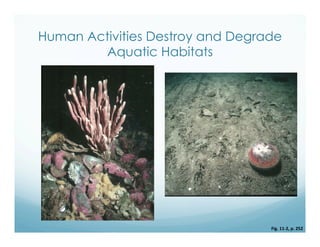
Human Activities Destroy and Degrade
Aquatic Habitats
Fig.	
  11-­‐2,	
  p.	
  252	
  
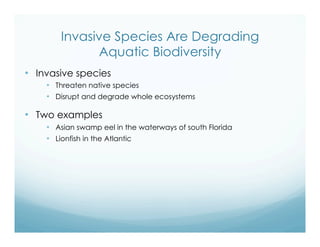
Invasive Species Are Degrading
Aquatic Biodiversity
•  Invasive species
•  Threaten native species
•  Disrupt and degrade whole ecosystems
•  Two examples
•  Asian swamp eel in the waterways of south Florida
•  Lionfish in the Atlantic
Fig.	
  11-­‐3,	
  p.	
  254	
  
“An almost perfectly-designed invasive
species”
Loosestrife and Carp
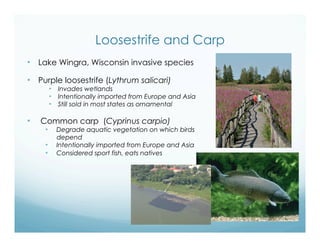
•  Lake Wingra, Wisconsin invasive species
•  Purple loosestrife (Lythrum salicari)
•  Invades wetlands
•  Intentionally imported from Europe and Asia
•  Still sold in most states as ornamental
•   Common carp (Cyprinus carpio)
•  Degrade aquatic vegetation on which birds
depend
•  Intentionally imported from Europe and Asia
•  Considered sport fish, eats natives
Invaders Have Ravaged Lake Victoria
•  Nile perch deliberately introduced, fine food source
•  Loss of biodiversity, for example cichlids
•  Now frequent algal blooms in positive feedback loop
•  Nutrient runoff
•  Spills of untreated sewage
•  Less algae-eating cichlids
Invaders Have Ravaged Lake Victoria
•  Water hyacinth freed from insect predators
•  Blocks sunlight and consumes oxygen
•  Reduces biodiversity in the lake
•  Scientists reduced the problem at strategic locations by
removing the hyacinth and by introducing two weevils (a type of
beetle) that feed on the invasive plant.
Population Growth and Pollution Can
Reduce Aquatic Biodiversity
•  More noise and crowding from humans
•  Nitrates and phosphates, mainly from fertilizers, enter water
•  Toxic pollutants from industrial and urban areas
•  Plastics
•  The "plastisphere" is a term coined by marine biologist Erik Zettler to
describe the creatures who thrive on hard surfaces in water. Before human-
made hard surfaces were everywhere, they would have lived on rocks or
flotsam.
•  The problem with the plastisphere is that it's radically changing the balance
of a sea ecosystem that was once mostly just open ocean creatures.
•   
North Pacific Gyre
•  Most pieces of garbage in the Pacific Gyre are "about the size of
your pinkie fingernail,” according to Scripps Institution marine
biologist Miriam Goldstein.
•  Most are microscopic.
•  What's alarming about them isn't their size, but the sheer amount of
plastic. 
•  Listen to Miriam—http://youtu.be/tFSv2eW7g6E
Climate Change is a
Growing Threat
•  Sea levels rise
•  Aquatic biodiversity threatened
•  Coral reefs
•  Low-lying islands
•  Drown many highly productive coastal wetlands
•  New Orleans, New York City, Maldives
Overfishing and Extinction
•  Marine and freshwater fish are threatened with extinction by
human activities more than any other group of species.
•  A fishprint is the area of ocean needed to sustain the fish
consumption of a person, country, or the world.
•  Commercial extinction means a species is no longer
economically feasible to harvest.
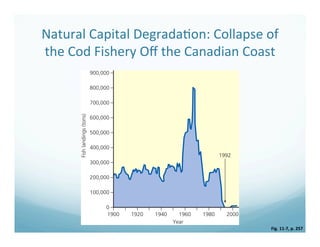
•  Collapse of the Atlantic cod fishery caused a domino effect
•  Fewer larger fish
•  More problems with invasive species
•  Increase in algae and bacteria with fewer predators to eat them
Natural	
  Capital	
  Degrada.on:	
  Collapse	
  of	
  
the	
  Cod	
  Fishery	
  Off	
  the	
  Canadian	
  Coast	
  
Fig.	
  11-­‐7,	
  p.	
  257	
  
Clashing Scientific Views Can Lead to
Cooperation and Progress
•  Ray Hilborn and Boris Worm disagreed about the
long-term prognosis for the world’s fisheries
•  Then the two agreed to work together
•  Developed new research methods and standards
•  Examined maximum sustained yield
•  Reported findings and prognosis in 2009
From Their Paper
Marine ecologists and fisheries scientists often tend to favor contrasting
approaches, and we observe that these schools of thought have
polarized over time. We now recognize this situation as counterproductive
and propose to address this controversy where possible. In the proposed
Working Group we are trying to define common ground among marine
ecologists and fishery scientists by
(1)  developing a unifying terminology and a common analytical framework for
assessing marine fisheries and ecosystem change
(2)  applying this framework to a number of representative marine ecosystems
around the globe
(3)  assessing management successes and failures in order to identify a set
of tools that have been proven to reverse trends of degradation in
marine fish stocks and ecosystems…
The central question we are trying to answer is: how can we merge
contrasting objectives, tools, and scientific criteria among marine ecology,
fisheries science, and management into a unifying framework. We envision
that this group will be acting as a catalyst for joining scientific forces in a
quest to sustain and restore valuable marine resources.
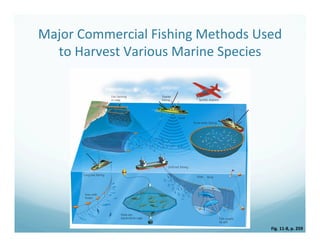
Major	
  Commercial	
  Fishing	
  Methods	
  Used	
  
to	
  Harvest	
  Various	
  Marine	
  Species	
  
Fig.	
  11-­‐8,	
  p.	
  259	
  

Chapter 11 presen part 1

  • 1.
    Sustaining Aquatic Biodiversity Part1—Major Threats Sky  Harbor  Interna.onal  Airport  Built  on  Hohokam  Canals.  Archaeology  Magazine.  2014  April  1.  
  • 2.
    Fig.  11-­‐1,  p.  250   Cetaceans are Whales Toothed whales Sperm whale with squid Killer whale Narwhal Bottlenose dolphin 0 2 4 6 8 10 1214 16 18 20 22 24 26 28 30 Meters Baleen whales Blue whale Fin whale Bowhead whale Right whale Sei whale Humpback whale Gray whale Minke whale 0 2 4 6 8 10 12 14 16 18 20 22 24 26 28 30 Meters
  • 3.
    Is Protecting Whalesa Success Story? •  Cetaceans are toothed whales and baleen whales •  8 of 11 major species hunted to commercial extinction by 1975 •  1946 International Whaling Commission (IWC) •  Quotas based on insufficient data •  Quotas often ignored •  1970 U.S. •  Stopped all commercial whaling •  Banned all imports of whale products •  1986 IWC moratorium on commercial whaling •  Differences in kills—42,480 whales killed in 1970, 1500 killed in 2009 •  Norway, Japan, and Iceland ignore moratorium
  • 4.
    Major Threats toAquatic Biodiversity? Aquatic species are threatened by habitat loss, invasive species, pollution, climate change, and overexploitation, all made worse by the growth of the human population.
  • 5.
    We Have Muchto Learn about Aquatic Biodiversity •  Greatest marine biodiversity at •  Coral reefs •  Estuaries •  Deep-ocean floor •  Biodiversity is higher •  Near the coast than in the open sea •  In the bottom region of the ocean than the surface region •  Vampyroteuthis infernalis Cephalopod  of  the  Week.  2014  April  1.  
  • 6.
  • 7.
    Human Activities Destroyand Degrade Aquatic Habitats Fig.  11-­‐2,  p.  252  
  • 8.
    Invasive Species AreDegrading Aquatic Biodiversity •  Invasive species •  Threaten native species •  Disrupt and degrade whole ecosystems •  Two examples •  Asian swamp eel in the waterways of south Florida •  Lionfish in the Atlantic
  • 9.
    Fig.  11-­‐3,  p.  254   “An almost perfectly-designed invasive species”
  • 10.
    Loosestrife and Carp • Lake Wingra, Wisconsin invasive species •  Purple loosestrife (Lythrum salicari) •  Invades wetlands •  Intentionally imported from Europe and Asia •  Still sold in most states as ornamental •   Common carp (Cyprinus carpio) •  Degrade aquatic vegetation on which birds depend •  Intentionally imported from Europe and Asia •  Considered sport fish, eats natives
  • 11.
    Invaders Have RavagedLake Victoria •  Nile perch deliberately introduced, fine food source •  Loss of biodiversity, for example cichlids •  Now frequent algal blooms in positive feedback loop •  Nutrient runoff •  Spills of untreated sewage •  Less algae-eating cichlids
  • 12.
    Invaders Have RavagedLake Victoria •  Water hyacinth freed from insect predators •  Blocks sunlight and consumes oxygen •  Reduces biodiversity in the lake •  Scientists reduced the problem at strategic locations by removing the hyacinth and by introducing two weevils (a type of beetle) that feed on the invasive plant.
  • 13.
    Population Growth andPollution Can Reduce Aquatic Biodiversity •  More noise and crowding from humans •  Nitrates and phosphates, mainly from fertilizers, enter water •  Toxic pollutants from industrial and urban areas •  Plastics •  The "plastisphere" is a term coined by marine biologist Erik Zettler to describe the creatures who thrive on hard surfaces in water. Before human- made hard surfaces were everywhere, they would have lived on rocks or flotsam. •  The problem with the plastisphere is that it's radically changing the balance of a sea ecosystem that was once mostly just open ocean creatures. •   
  • 14.
    North Pacific Gyre • Most pieces of garbage in the Pacific Gyre are "about the size of your pinkie fingernail,” according to Scripps Institution marine biologist Miriam Goldstein. •  Most are microscopic. •  What's alarming about them isn't their size, but the sheer amount of plastic.  •  Listen to Miriam—http://youtu.be/tFSv2eW7g6E
  • 15.
    Climate Change isa Growing Threat •  Sea levels rise •  Aquatic biodiversity threatened •  Coral reefs •  Low-lying islands •  Drown many highly productive coastal wetlands •  New Orleans, New York City, Maldives
  • 16.
    Overfishing and Extinction • Marine and freshwater fish are threatened with extinction by human activities more than any other group of species. •  A fishprint is the area of ocean needed to sustain the fish consumption of a person, country, or the world. •  Commercial extinction means a species is no longer economically feasible to harvest. •  Collapse of the Atlantic cod fishery caused a domino effect •  Fewer larger fish •  More problems with invasive species •  Increase in algae and bacteria with fewer predators to eat them
  • 17.
    Natural  Capital  Degrada.on:  Collapse  of   the  Cod  Fishery  Off  the  Canadian  Coast   Fig.  11-­‐7,  p.  257  
  • 18.
    Clashing Scientific ViewsCan Lead to Cooperation and Progress •  Ray Hilborn and Boris Worm disagreed about the long-term prognosis for the world’s fisheries •  Then the two agreed to work together •  Developed new research methods and standards •  Examined maximum sustained yield •  Reported findings and prognosis in 2009
  • 19.
    From Their Paper Marineecologists and fisheries scientists often tend to favor contrasting approaches, and we observe that these schools of thought have polarized over time. We now recognize this situation as counterproductive and propose to address this controversy where possible. In the proposed Working Group we are trying to define common ground among marine ecologists and fishery scientists by (1)  developing a unifying terminology and a common analytical framework for assessing marine fisheries and ecosystem change (2)  applying this framework to a number of representative marine ecosystems around the globe (3)  assessing management successes and failures in order to identify a set of tools that have been proven to reverse trends of degradation in marine fish stocks and ecosystems… The central question we are trying to answer is: how can we merge contrasting objectives, tools, and scientific criteria among marine ecology, fisheries science, and management into a unifying framework. We envision that this group will be acting as a catalyst for joining scientific forces in a quest to sustain and restore valuable marine resources.
  • 20.
    Major  Commercial  Fishing  Methods  Used   to  Harvest  Various  Marine  Species   Fig.  11-­‐8,  p.  259