Scalloped Hammerhead Sharks

         By: Hunter Wiese
My Issue
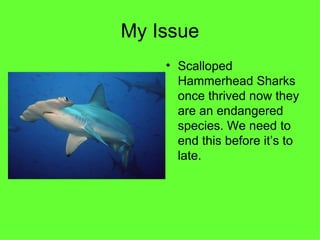
    • Scalloped
      Hammerhead Sharks
      once thrived now they
      are an endangered
      species. We need to
      end this before it’s to
      late.
Why it’s My Issue
• This is my issue because hammerhead
  sharks used to be my favorite kind of
  shark so I decided to learn more.
If It isn’t Stopped…
• If this issue isn’t stopped Scalloped
  Hammerhead Sharks will only be
  something we read about not something
  we see.
About the Scalloped Hammerhead
             Shark
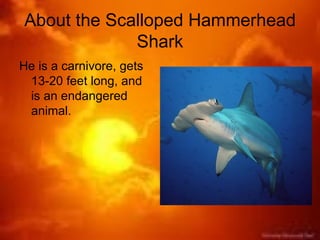
He is a carnivore, gets
 13-20 feet long, and
 is an endangered
 animal.
What They Die For
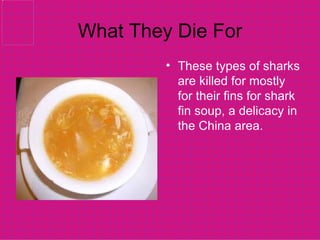
         • These types of sharks
           are killed for mostly
           for their fins for shark
           fin soup, a delicacy in
           the China area.
What the Governments are Doing
            to Help
• The New South Wales Australian, Costa
  Rica, Honduras, and United States
  Governments has passed legislation to
  protect these sharks.
• While this might help the issue there are
  always going to be poachers.
How it Could be Stopped
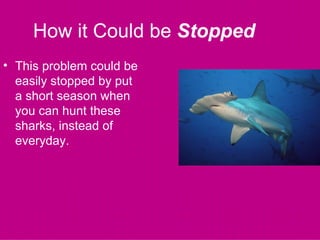
• This problem could be
  easily stopped by put
  a short season when
  you can hunt these
  sharks, instead of
  everyday.
Helpful Organization’s
• The Organizations trying to stop this are
  the World Conservation Union & Humane
  Society International.
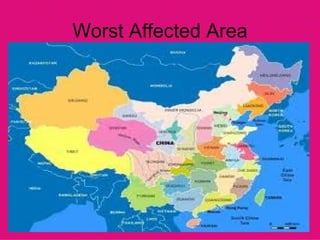
Worst Affected Area
Worse in China
• This issue would be more of a problem in
  the China area because they eat this
  shark as a delicacy over here it’s just
  something to catch for fun.
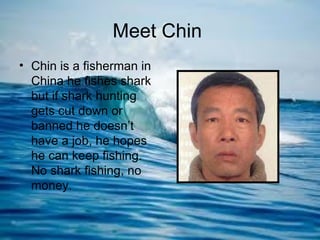
Meet Chin
• Chin is a fisherman in
  China he fishes shark
  but if shark hunting
  gets cut down or
  banned he doesn’t
  have a job, he hopes
  he can keep fishing.
  No shark fishing, no
  money.
What Chin will Lose if he Loses His
               Job.
Conclusion
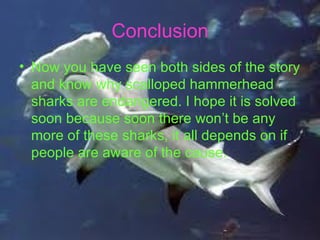
• Now you have seen both sides of the story
  and know why scalloped hammerhead
  sharks are endangered. I hope it is solved
  soon because soon there won’t be any
  more of these sharks, it all depends on if
  people are aware of the cause.
Sources
•   www.Sharkyear.com
•   www.WorldConservationUnion.com
•   www.redorbit.com
•   www.flmnh.ufl.edu
•   www.iucnredlist.org

Scalloped hammerhead sharks

  • 1.
  • 2.
    My Issue • Scalloped Hammerhead Sharks once thrived now they are an endangered species. We need to end this before it’s to late.
  • 3.
    Why it’s MyIssue • This is my issue because hammerhead sharks used to be my favorite kind of shark so I decided to learn more.
  • 4.
    If It isn’tStopped… • If this issue isn’t stopped Scalloped Hammerhead Sharks will only be something we read about not something we see.
  • 5.
    About the ScallopedHammerhead Shark He is a carnivore, gets 13-20 feet long, and is an endangered animal.
  • 6.
    What They DieFor • These types of sharks are killed for mostly for their fins for shark fin soup, a delicacy in the China area.
  • 7.
    What the Governmentsare Doing to Help • The New South Wales Australian, Costa Rica, Honduras, and United States Governments has passed legislation to protect these sharks. • While this might help the issue there are always going to be poachers.
  • 8.
    How it Couldbe Stopped • This problem could be easily stopped by put a short season when you can hunt these sharks, instead of everyday.
  • 9.
    Helpful Organization’s • TheOrganizations trying to stop this are the World Conservation Union & Humane Society International.
  • 10.
  • 11.
    Worse in China •This issue would be more of a problem in the China area because they eat this shark as a delicacy over here it’s just something to catch for fun.
  • 12.
    Meet Chin • Chinis a fisherman in China he fishes shark but if shark hunting gets cut down or banned he doesn’t have a job, he hopes he can keep fishing. No shark fishing, no money.
  • 13.
    What Chin willLose if he Loses His Job.
  • 14.
    Conclusion • Now youhave seen both sides of the story and know why scalloped hammerhead sharks are endangered. I hope it is solved soon because soon there won’t be any more of these sharks, it all depends on if people are aware of the cause.
  • 15.
    Sources • www.Sharkyear.com • www.WorldConservationUnion.com • www.redorbit.com • www.flmnh.ufl.edu • www.iucnredlist.org