AWARE Shark Conservation Diver
Distinctive Specialty Course
- Lesson Guides -
This work is licensed under the Creative Commons Attribution-NonCommercial-NoDerivs 3.0 Unported License.
To view a copy of this license, visit http://creativecommons.org/licenses/by-nc-nd/3.0/
Product No. 72003 (Rev. 09/12) Version 1.02
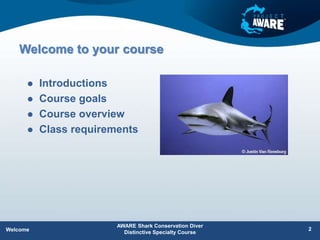
Welcome to your course
 Introductions
 Course goals
 Course overview
 Class requirements
AWARE Shark Conservation Diver
Distinctive Specialty Course
Welcome 2
Click to view the
Sharks in Peril
video
AWARE Shark Conservation Diver
Distinctive Specialty Course
3
We’ll talk about . . .
 Unique physical attributes of sharks
 Conservation status of sharks
 Life history traits that make sharks
vulnerable
 Importance to marine ecosystems
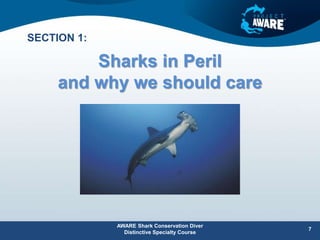
SECTION 1: Sharks in Peril and why we should care
AWARE Shark Conservation Diver
Distinctive Specialty Course
4
Welcome
Continued . . .
SECTION 1
Sharks in Peril
We’ll talk about . . .
 Threats to sharks
 Management strategies to protect
sharks
 Value to local economies
 Misperceptions of sharks
SECTION 2: Managing threats and recognising values
AWARE Shark Conservation Diver
Distinctive Specialty Course
5
Welcome
Continued . . .
SECTION 2
Managing Threats
We’ll talk about . . .
 Personal actions to protect sharks
 Your local sharks
 Responsible environmental
guidelines for diving with sharks
 Join the Project AWARE movement
SECTION 3: Taking action and joining the Project AWARE
movement
AWARE Shark Conservation Diver
Distinctive Specialty Course
6
Welcome
SECTION 3
Taking Action
Sharks in Peril
and why we should care
AWARE Shark Conservation Diver
Distinctive Specialty Course
7
SECTION 1:
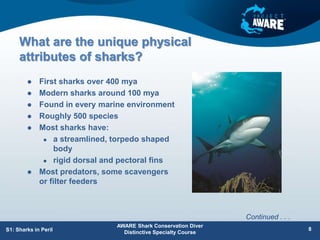
What are the unique physical
attributes of sharks?
 First sharks over 400 mya
 Modern sharks around 100 mya
 Found in every marine environment
 Roughly 500 species
 Most sharks have:
 a streamlined, torpedo shaped
body
 rigid dorsal and pectoral fins
 Most predators, some scavengers
or filter feeders
AWARE Shark Conservation Diver
Distinctive Specialty Course
S1: Sharks in Peril 8
Continued . . .
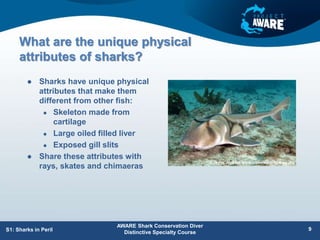
What are the unique physical
attributes of sharks?
 Sharks have unique physical
attributes that make them
different from other fish:
 Skeleton made from
cartilage
 Large oiled filled liver
 Exposed gill slits
 Share these attributes with
rays, skates and chimaeras
AWARE Shark Conservation Diver
Distinctive Specialty Course
S1: Sharks in Peril 9
What is the conservation
status of sharks?
AWARE Shark Conservation Diver
Distinctive Specialty Course
10
S1: Sharks in Peril
Continued . . .
International Union for the Conservation of Nature (IUCN)
Red List Review of 1044 Shark, Ray and Chimaera Species
Critically Endangered 2% Extremely high risk of extinction in the wild
Endangered 4% Very high risk of extinction in the wild
Vulnerable 11% High risk of extinction in the wild
Near Threatened 13%
Close to qualifying or likely to qualify for a threatened
category in the near future
Least Concern 23%
Not qualifying as Threatened including widespread and
abundant species
Data Deficient 47% More information required for assessment
30% of 1044 assessed sharks, rays and chimaeras are Threatened
or Near Threatened with extinction
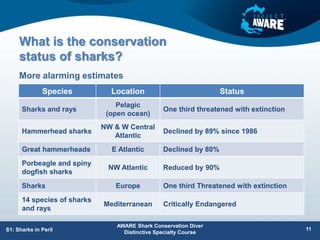
What is the conservation
status of sharks?
 More alarming estimates:
More alarming estimates
AWARE Shark Conservation Diver
Distinctive Specialty Course
11
S1: Sharks in Peril
Species Location Status
Sharks and rays
Pelagic
(open ocean)
One third threatened with extinction
Hammerhead sharks
NW & W Central
Atlantic
Declined by 89% since 1986
Great hammerheads E Atlantic Declined by 80%
Porbeagle and spiny
dogfish sharks
NW Atlantic Reduced by 90%
Sharks Europe One third Threatened with extinction
14 species of sharks
and rays
Mediterranean Critically Endangered
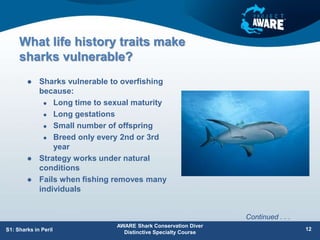
What life history traits make
sharks vulnerable?
 Sharks vulnerable to overfishing
because:
 Long time to sexual maturity
 Long gestations
 Small number of offspring
 Breed only every 2nd or 3rd
year
 Strategy works under natural
conditions
 Fails when fishing removes many
individuals
AWARE Shark Conservation Diver
Distinctive Specialty Course
S1: Sharks in Peril 12
Continued . . .
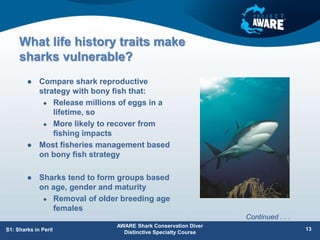
What life history traits make
sharks vulnerable?
 Compare shark reproductive
strategy with bony fish that:
 Release millions of eggs in a
lifetime, so
 More likely to recover from
fishing impacts
 Most fisheries management based
on bony fish strategy
 Sharks tend to form groups based
on age, gender and maturity
 Removal of older breeding age
females
AWARE Shark Conservation Diver
Distinctive Specialty Course
S1: Sharks in Peril 13
Continued . . .
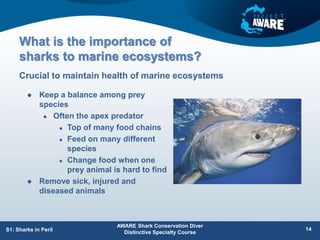
What is the importance of
sharks to marine ecosystems?
 Keep a balance among prey
species
 Often the apex predator
 Top of many food chains
 Feed on many different
species
 Change food when one
prey animal is hard to find
 Remove sick, injured and
diseased animals
Crucial to maintain health of marine ecosystems
AWARE Shark Conservation Diver
Distinctive Specialty Course
14
S1: Sharks in Peril
What is the importance of
sharks to marine ecosystems?
Food chains describe how energy moves among species
AWARE Shark Conservation Diver
Distinctive Specialty Course
15
S1: Sharks in Peril
Small
carnivores
consumed
by large
carnivores
until apex
predators
reached
Herbivores
consumed
by
carnivores
(meat
eaters)
Plants
consumed
by
herbivores
(plant
eaters)
Starts with
plants that
use the
sun’s
energy to
make their
body parts
Continued . . .
What is the importance of
sharks to marine ecosystems?
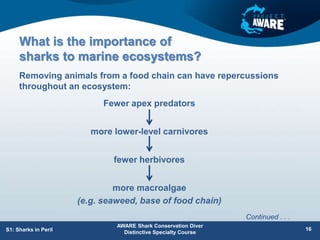
Removing animals from a food chain can have repercussions
throughout an ecosystem:
AWARE Shark Conservation Diver
Distinctive Specialty Course
16
S1: Sharks in Peril
Fewer apex predators
more lower-level carnivores
fewer herbivores
more macroalgae
(e.g. seaweed, base of food chain)
Continued . . .
What is the importance of
sharks to marine ecosystems?
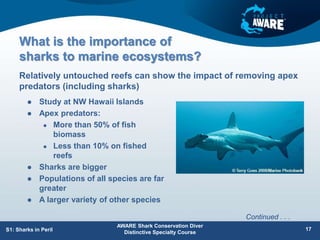
 Study at NW Hawaii Islands
 Apex predators:
 More than 50% of fish
biomass
 Less than 10% on fished
reefs
 Sharks are bigger
 Populations of all species are far
greater
 A larger variety of other species
Relatively untouched reefs can show the impact of removing apex
predators (including sharks)
AWARE Shark Conservation Diver
Distinctive Specialty Course
17
S1: Sharks in Peril
Continued . . .
What is the importance of
sharks to marine ecosystems?
 Prefer to eat in the middle of sea
grass bed
 Stay on outside when sharks
present
 Seagrass beds important habitat for
many species
Sharks found to protect seagrass beds from over-grazing by
dugongs and green sea turtles:
AWARE Shark Conservation Diver
Distinctive Specialty Course
18
S1: Sharks in Peril
Sharks keep marine environments healthy -
Important for all marine animals and for humans!
We’ve talked about
 Unique physical attributes of sharks
 Conservation status of sharks
 Life history traits that make sharks
vulnerable
 Importance to marine ecosystems
SECTION 1: Sharks in Peril and why we should care
AWARE Shark Conservation Diver
Distinctive Specialty Course
19
S1: Sharks in Peril
Any Questions?
Managing threats and
recognising values
AWARE Shark Conservation Diver
Distinctive Specialty Course
20
SECTION 2:
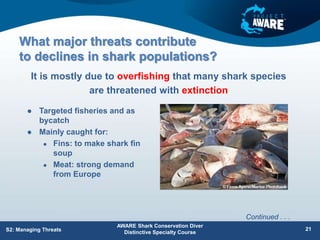
What major threats contribute
to declines in shark populations?
 Targeted fisheries and as
bycatch
 Mainly caught for:
 Fins: to make shark fin
soup
 Meat: strong demand
from Europe
It is mostly due to overfishing that many shark species
are threatened with extinction
AWARE Shark Conservation Diver
Distinctive Specialty Course
21
S2: Managing Threats
Continued . . .
What major threats contribute
to declines in shark populations?
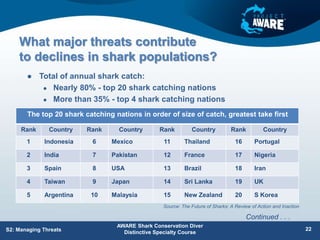
 Total of annual shark catch:
 Nearly 80% - top 20 shark catching nations
 More than 35% - top 4 shark catching nations
AWARE Shark Conservation Diver
Distinctive Specialty Course
S2: Managing Threats 22
The top 20 shark catching nations in order of size of catch, greatest take first
Rank Country Rank Country Rank Country Rank Country
1 Indonesia 6 Mexico 11 Thailand 16 Portugal
2 India 7 Pakistan 12 France 17 Nigeria
3 Spain 8 USA 13 Brazil 18 Iran
4 Taiwan 9 Japan 14 Sri Lanka 19 UK
5 Argentina 10 Malaysia 15 New Zealand 20 S Korea
Source: The Future of Sharks: A Review of Action and Inaction
Continued . . .
Continued . . .
What major threats contribute
to declines in shark populations?
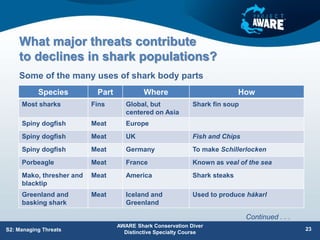
Some of the many uses of shark body parts
AWARE Shark Conservation Diver
Distinctive Specialty Course
23
S2: Managing Threats
Species Part Where How
Most sharks Fins Global, but
centered on Asia
Shark fin soup
Spiny dogfish Meat Europe
Spiny dogfish Meat UK Fish and Chips
Spiny dogfish Meat Germany To make Schillerlocken
Porbeagle Meat France Known as veal of the sea
Mako, thresher and
blacktip
Meat America Shark steaks
Greenland and
basking shark
Meat Iceland and
Greenland
Used to produce hákarl
Continued . . .
What major threats contribute
to declines in shark populations?
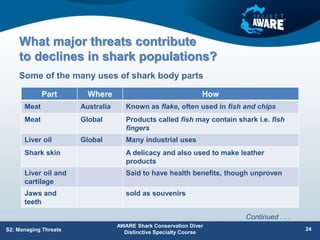
Some of the many uses of shark body parts
AWARE Shark Conservation Diver
Distinctive Specialty Course
24
S2: Managing Threats
Part Where How
Meat Australia Known as flake, often used in fish and chips
Meat Global Products called fish may contain shark i.e. fish
fingers
Liver oil Global Many industrial uses
Shark skin A delicacy and also used to make leather
products
Liver oil and
cartilage
Said to have health benefits, though unproven
Jaws and
teeth
sold as souvenirs
Continued . . .
What major threats contribute
to declines in shark populations?
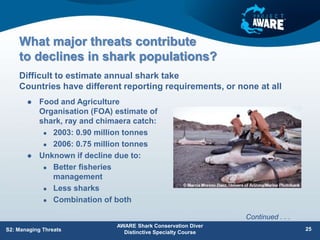
 Food and Agriculture
Organisation (FOA) estimate of
shark, ray and chimaera catch:
 2003: 0.90 million tonnes
 2006: 0.75 million tonnes
 Unknown if decline due to:
 Better fisheries
management
 Less sharks
 Combination of both
Difficult to estimate annual shark take
Countries have different reporting requirements, or none at all
AWARE Shark Conservation Diver
Distinctive Specialty Course
25
S2: Managing Threats
Continued . . .
What major threats contribute
to declines in shark populations?
 Study of shark fin trade records shows FAO figures an
underestimate
 Found annual shark catch to support global shark fin trade to be:
 Between 1.21 to 2.29 million tonnes, with a median of 1.70
million tonnes
 Equivalent to between 26 and 73 million sharks
 Therefore 38 million sharks per year is the best estimate for the
global shark catch
 This figure does not include:
 Sharks killed for domestic fin markets
 Sharks discarded dead at sea
 Sharks killed for their meat only
AWARE Shark Conservation Diver
Distinctive Specialty Course
S2: Managing Threats 26
Continued . . .
What major threats contribute
to declines in shark populations?
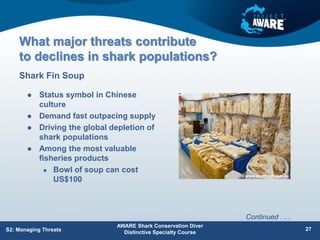
 Status symbol in Chinese
culture
 Demand fast outpacing supply
 Driving the global depletion of
shark populations
 Among the most valuable
fisheries products
 Bowl of soup can cost
US$100
Shark Fin Soup
AWARE Shark Conservation Diver
Distinctive Specialty Course
27
S2: Managing Threats
Continued . . .
What major threats contribute
to declines in shark populations?
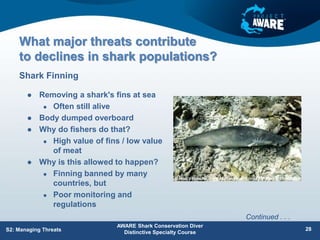
 Removing a shark's fins at sea
 Often still alive
 Body dumped overboard
 Why do fishers do that?
 High value of fins / low value
of meat
 Why is this allowed to happen?
 Finning banned by many
countries, but
 Poor monitoring and
regulations
Shark Finning
AWARE Shark Conservation Diver
Distinctive Specialty Course
28
S2: Managing Threats
Continued . . .
What major threats contribute
to declines in shark populations?
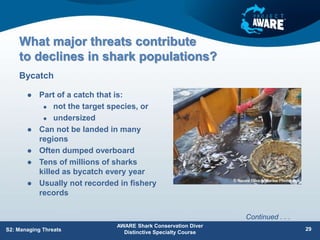
 Part of a catch that is:
 not the target species, or
 undersized
 Can not be landed in many
regions
 Often dumped overboard
 Tens of millions of sharks
killed as bycatch every year
 Usually not recorded in fishery
records
Bycatch
AWARE Shark Conservation Diver
Distinctive Specialty Course
29
S2: Managing Threats
Continued . . .
What major threats contribute
to declines in shark populations?
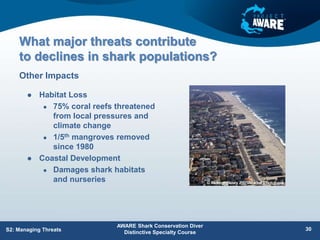
 Habitat Loss
 75% coral reefs threatened
from local pressures and
climate change
 1/5th mangroves removed
since 1980
 Coastal Development
 Damages shark habitats
and nurseries
Other Impacts
AWARE Shark Conservation Diver
Distinctive Specialty Course
30
S2: Managing Threats
What major threats contribute
to declines in shark populations?
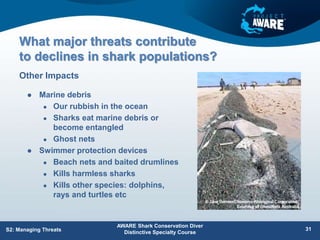
 Marine debris
 Our rubbish in the ocean
 Sharks eat marine debris or
become entangled
 Ghost nets
 Swimmer protection devices
 Beach nets and baited drumlines
 Kills harmless sharks
 Kills other species: dolphins,
rays and turtles etc
Other Impacts
AWARE Shark Conservation Diver
Distinctive Specialty Course
31
S2: Managing Threats
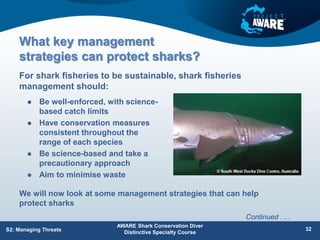
What key management
strategies can protect sharks?
 Be well-enforced, with science-
based catch limits
 Have conservation measures
consistent throughout the
range of each species
 Be science-based and take a
precautionary approach
 Aim to minimise waste
For shark fisheries to be sustainable, shark fisheries
management should:
AWARE Shark Conservation Diver
Distinctive Specialty Course
32
S2: Managing Threats
We will now look at some management strategies that can help
protect sharks
Continued . . .
What key management
strategies can protect sharks?
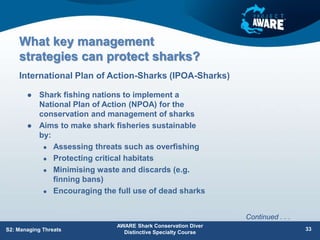
 Shark fishing nations to implement a
National Plan of Action (NPOA) for the
conservation and management of sharks
 Aims to make shark fisheries sustainable
by:
 Assessing threats such as overfishing
 Protecting critical habitats
 Minimising waste and discards (e.g.
finning bans)
 Encouraging the full use of dead sharks
International Plan of Action-Sharks (IPOA-Sharks)
AWARE Shark Conservation Diver
Distinctive Specialty Course
33
S2: Managing Threats
Continued . . .
What key management
strategies can protect sharks?
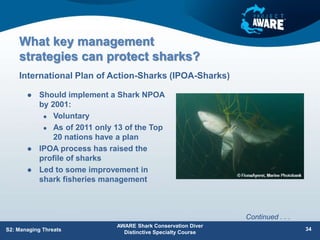
 Should implement a Shark NPOA
by 2001:
 Voluntary
 As of 2011 only 13 of the Top
20 nations have a plan
 IPOA process has raised the
profile of sharks
 Led to some improvement in
shark fisheries management
International Plan of Action-Sharks (IPOA-Sharks)
AWARE Shark Conservation Diver
Distinctive Specialty Course
34
S2: Managing Threats
Continued . . .
What key management
strategies can protect sharks?
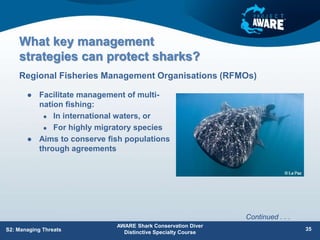
 Facilitate management of multi-
nation fishing:
 In international waters, or
 For highly migratory species
 Aims to conserve fish populations
through agreements
Regional Fisheries Management Organisations (RFMOs)
AWARE Shark Conservation Diver
Distinctive Specialty Course
35
S2: Managing Threats
Continued . . .
What key management
strategies can protect sharks?
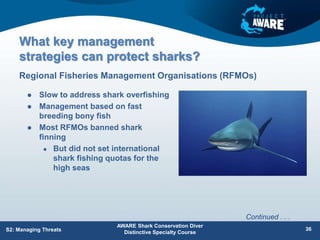
 Slow to address shark overfishing
 Management based on fast
breeding bony fish
 Most RFMOs banned shark
finning
 But did not set international
shark fishing quotas for the
high seas
Regional Fisheries Management Organisations (RFMOs)
AWARE Shark Conservation Diver
Distinctive Specialty Course
36
S2: Managing Threats
Continued . . .
What key management
strategies can protect sharks?
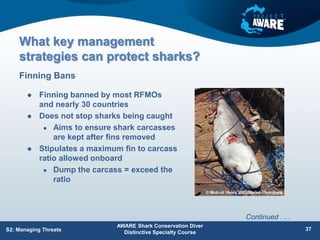
 Finning banned by most RFMOs
and nearly 30 countries
 Does not stop sharks being caught
 Aims to ensure shark carcasses
are kept after fins removed
 Stipulates a maximum fin to carcass
ratio allowed onboard
 Dump the carcass = exceed the
ratio
Finning Bans
AWARE Shark Conservation Diver
Distinctive Specialty Course
37
S2: Managing Threats
Continued . . .
What key management
strategies can protect sharks?
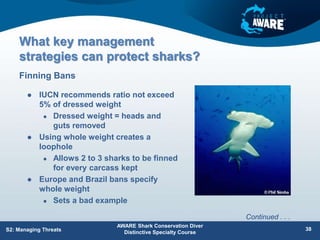
 IUCN recommends ratio not exceed
5% of dressed weight
 Dressed weight = heads and
guts removed
 Using whole weight creates a
loophole
 Allows 2 to 3 sharks to be finned
for every carcass kept
 Europe and Brazil bans specify
whole weight
 Sets a bad example
Finning Bans
AWARE Shark Conservation Diver
Distinctive Specialty Course
38
S2: Managing Threats
Continued . . .
What key management
strategies can protect sharks?
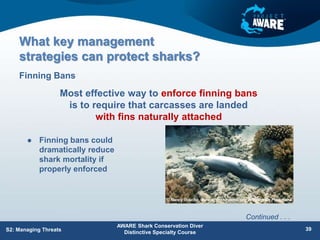
 Finning bans could
dramatically reduce
shark mortality if
properly enforced
Finning Bans
AWARE Shark Conservation Diver
Distinctive Specialty Course
39
S2: Managing Threats
Continued . . .
Most effective way to enforce finning bans
is to require that carcasses are landed
with fins naturally attached
What key management
strategies can protect sharks?
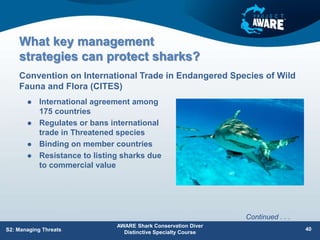
 International agreement among
175 countries
 Regulates or bans international
trade in Threatened species
 Binding on member countries
 Resistance to listing sharks due
to commercial value
Convention on International Trade in Endangered Species of Wild
Fauna and Flora (CITES)
AWARE Shark Conservation Diver
Distinctive Specialty Course
40
S2: Managing Threats
Continued . . .
What key management
strategies can protect sharks?
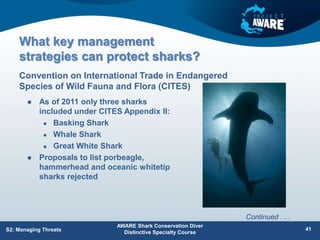
 As of 2011 only three sharks
included under CITES Appendix II:
 Basking Shark
 Whale Shark
 Great White Shark
 Proposals to list porbeagle,
hammerhead and oceanic whitetip
sharks rejected
Convention on International Trade in Endangered
Species of Wild Fauna and Flora (CITES)
AWARE Shark Conservation Diver
Distinctive Specialty Course
41
S2: Managing Threats
Continued . . .
What key management
strategies can protect sharks?
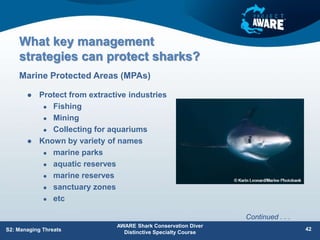
 Protect from extractive industries
 Fishing
 Mining
 Collecting for aquariums
 Known by variety of names
 marine parks
 aquatic reserves
 marine reserves
 sanctuary zones
 etc
Marine Protected Areas (MPAs)
AWARE Shark Conservation Diver
Distinctive Specialty Course
42
S2: Managing Threats
Continued . . .
What key management
strategies can protect sharks?
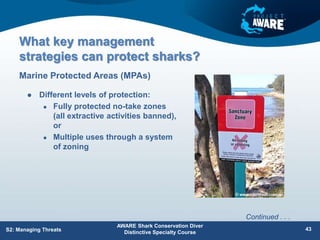
 Different levels of protection:
 Fully protected no-take zones
(all extractive activities banned),
or
 Multiple uses through a system
of zoning
Marine Protected Areas (MPAs)
AWARE Shark Conservation Diver
Distinctive Specialty Course
43
S2: Managing Threats
Continued . . .
What key management
strategies can protect sharks?
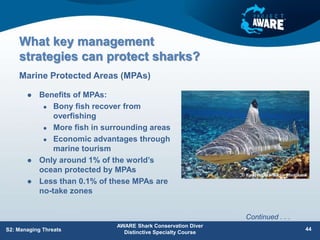
 Benefits of MPAs:
 Bony fish recover from
overfishing
 More fish in surrounding areas
 Economic advantages through
marine tourism
 Only around 1% of the world’s
ocean protected by MPAs
 Less than 0.1% of these MPAs are
no-take zones
Marine Protected Areas (MPAs)
AWARE Shark Conservation Diver
Distinctive Specialty Course
44
S2: Managing Threats
Continued . . .
What key management
strategies can protect sharks?
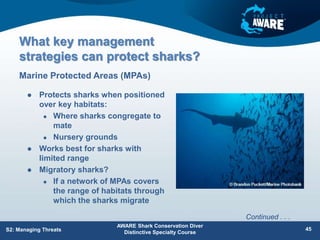
 Protects sharks when positioned
over key habitats:
 Where sharks congregate to
mate
 Nursery grounds
 Works best for sharks with
limited range
 Migratory sharks?
 If a network of MPAs covers
the range of habitats through
which the sharks migrate
Marine Protected Areas (MPAs)
AWARE Shark Conservation Diver
Distinctive Specialty Course
45
S2: Managing Threats
Continued . . .
What key management
strategies can protect sharks?
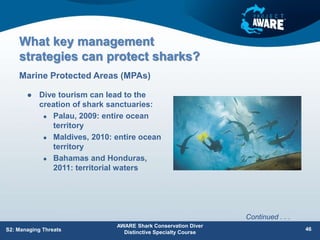
 Dive tourism can lead to the
creation of shark sanctuaries:
 Palau, 2009: entire ocean
territory
 Maldives, 2010: entire ocean
territory
 Bahamas and Honduras,
2011: territorial waters
Marine Protected Areas (MPAs)
AWARE Shark Conservation Diver
Distinctive Specialty Course
46
S2: Managing Threats
Continued . . .
What key management
strategies can protect sharks?
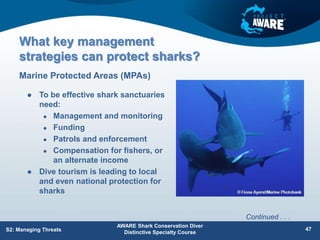
 To be effective shark sanctuaries
need:
 Management and monitoring
 Funding
 Patrols and enforcement
 Compensation for fishers, or
an alternate income
 Dive tourism is leading to local
and even national protection for
sharks
Marine Protected Areas (MPAs)
AWARE Shark Conservation Diver
Distinctive Specialty Course
47
S2: Managing Threats
Continued . . .
What key management
strategies can protect sharks?
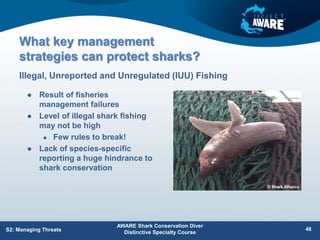
 Result of fisheries
management failures
 Level of illegal shark fishing
may not be high
 Few rules to break!
 Lack of species-specific
reporting a huge hindrance to
shark conservation
Illegal, Unreported and Unregulated (IUU) Fishing
AWARE Shark Conservation Diver
Distinctive Specialty Course
48
S2: Managing Threats
What is the value of sharks
to local economies?
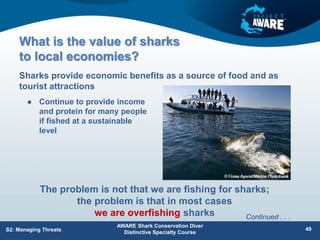
 Continue to provide income
and protein for many people
if fished at a sustainable
level
Sharks provide economic benefits as a source of food and as
tourist attractions
AWARE Shark Conservation Diver
Distinctive Specialty Course
49
S2: Managing Threats
Continued . . .
The problem is not that we are fishing for sharks;
the problem is that in most cases
we are overfishing sharks
What is the value of sharks
to local economies?
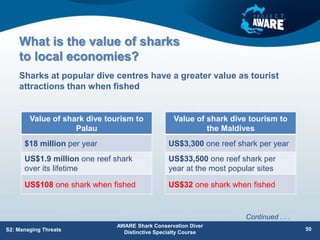
Sharks at popular dive centres have a greater value as tourist
attractions than when fished
AWARE Shark Conservation Diver
Distinctive Specialty Course
50
S2: Managing Threats
Value of shark dive tourism to
Palau
$18 million per year
US$1.9 million one reef shark
over its lifetime
US$108 one shark when fished
Value of shark dive tourism to
the Maldives
US$3,300 one reef shark per year
US$33,500 one reef shark per
year at the most popular sites
US$32 one shark when fished
Continued . . .
What is the value of sharks
to local economies?
AWARE Shark Conservation Diver
Distinctive Specialty Course
S2: Managing Threats 51
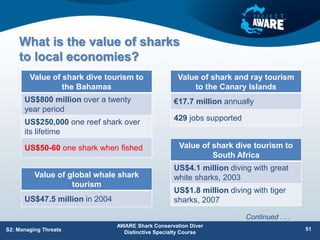
Value of shark dive tourism to
the Bahamas
US$800 million over a twenty
year period
US$250,000 one reef shark over
its lifetime
US$50-60 one shark when fished
Value of global whale shark
tourism
US$47.5 million in 2004
Value of shark and ray tourism
to the Canary Islands
€17.7 million annually
429 jobs supported
Value of shark dive tourism to
South Africa
US$4.1 million diving with great
white sharks, 2003
US$1.8 million diving with tiger
sharks, 2007
Continued . . .
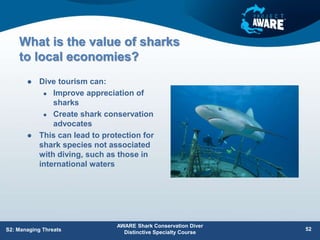
What is the value of sharks
to local economies?
 Dive tourism can:
 Improve appreciation of
sharks
 Create shark conservation
advocates
 This can lead to protection for
shark species not associated
with diving, such as those in
international waters
AWARE Shark Conservation Diver
Distinctive Specialty Course
S2: Managing Threats 52
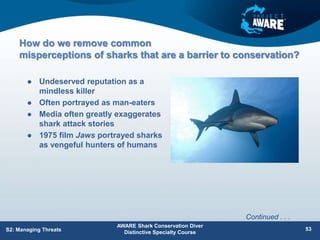
How do we remove common
misperceptions of sharks that are a barrier to conservation?
 Undeserved reputation as a
mindless killer
 Often portrayed as man-eaters
 Media often greatly exaggerates
shark attack stories
 1975 film Jaws portrayed sharks
as vengeful hunters of humans
AWARE Shark Conservation Diver
Distinctive Specialty Course
S2: Managing Threats 53
Continued . . .
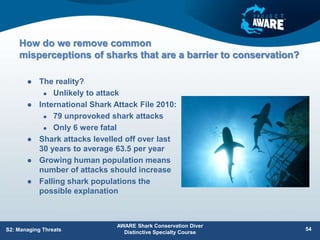
How do we remove common
misperceptions of sharks that are a barrier to conservation?
 The reality?
 Unlikely to attack
 International Shark Attack File 2010:
 79 unprovoked shark attacks
 Only 6 were fatal
 Shark attacks levelled off over last
30 years to average 63.5 per year
 Growing human population means
number of attacks should increase
 Falling shark populations the
possible explanation
AWARE Shark Conservation Diver
Distinctive Specialty Course
S2: Managing Threats 54
How do we remove common
misperceptions of sharks that are a barrier to conservation?
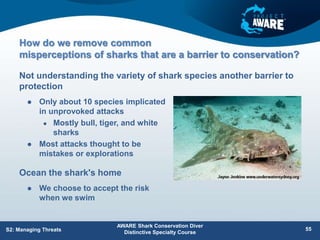
 Only about 10 species implicated
in unprovoked attacks
 Mostly bull, tiger, and white
sharks
 Most attacks thought to be
mistakes or explorations
Not understanding the variety of shark species another barrier to
protection
AWARE Shark Conservation Diver
Distinctive Specialty Course
55
S2: Managing Threats
Ocean the shark's home
 We choose to accept the risk
when we swim
We’ve talked about
 Threats to sharks
 Management strategies to protect
sharks
 Value to local economies
 Misperceptions of sharks
SECTION 2: Managing threats and recognising values
AWARE Shark Conservation Diver
Distinctive Specialty Course
56
S2: Managing Threats
Any Questions?
Taking action and joining the
Project AWARE movement
AWARE Shark Conservation Diver
Distinctive Specialty Course
57
SECTION 3:
What personal actions
can I take to protect sharks?
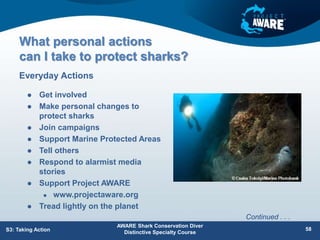
 Get involved
 Make personal changes to
protect sharks
 Join campaigns
 Support Marine Protected Areas
 Tell others
 Respond to alarmist media
stories
 Support Project AWARE
 www.projectaware.org
 Tread lightly on the planet
Everyday Actions
AWARE Shark Conservation Diver
Distinctive Specialty Course
58
S3: Taking Action
Continued . . .
What personal actions
can I take to protect sharks?
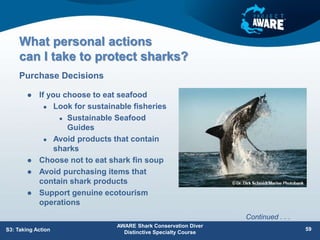
 If you choose to eat seafood
 Look for sustainable fisheries
 Sustainable Seafood
Guides
 Avoid products that contain
sharks
 Choose not to eat shark fin soup
 Avoid purchasing items that
contain shark products
 Support genuine ecotourism
operations
Purchase Decisions
AWARE Shark Conservation Diver
Distinctive Specialty Course
59
S3: Taking Action
Continued . . .
What personal actions
can I take to protect sharks?
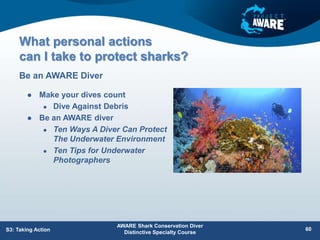
 Make your dives count
 Dive Against Debris
 Be an AWARE diver
 Ten Ways A Diver Can Protect
The Underwater Environment
 Ten Tips for Underwater
Photographers
Be an AWARE Diver
AWARE Shark Conservation Diver
Distinctive Specialty Course
60
S3: Taking Action
What sharks are found in our local area
and what is their conservation status?
AWARE Shark Conservation Diver
Distinctive Specialty Course
61
S3: Taking Action
Continued . . .
What sharks are found in our local area
and what is their conservation status?
AWARE Shark Conservation Diver
Distinctive Specialty Course
62
S3: Taking Action
Environmental Guidelines for
diving with sharks
 Be an AWARE diver
 Do not block their movement by
swimming in front of them, allow
them to move away
 Do not block their exit if they are
inside a cave or overhang
These guidelines will help you minimise your impacts when
diving with sharks
AWARE Shark Conservation Diver
Distinctive Specialty Course
63
S3: Taking Action
 Do not descend on top of
sharks
 Do not get close to sharks
 Be familiar with and follow
local regulations and
protocols
Always seek safety advice from a dive professional familiar with
sharks found at the dive site before diving with sharks
Join the Project AWARE movement
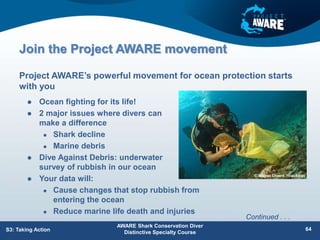
 Ocean fighting for its life!
 2 major issues where divers can
make a difference
 Shark decline
 Marine debris
 Dive Against Debris: underwater
survey of rubbish in our ocean
 Your data will:
 Cause changes that stop rubbish from
entering the ocean
 Reduce marine life death and injuries
Project AWARE’s powerful movement for ocean protection starts
with you
AWARE Shark Conservation Diver
Distinctive Specialty Course
64
S3: Taking Action
Continued . . .
Join the Project AWARE movement
 Dive Centres and AWARE leaders
 Manage local conservation
events
 Report data
 Connect with volunteers
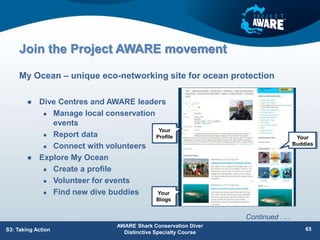
 Explore My Ocean
 Create a profile
 Volunteer for events
 Find new dive buddies
My Ocean – unique eco-networking site for ocean protection
S3: Taking Action
AWARE Shark Conservation Diver
Distinctive Specialty Course
65
Continued . . .
Your
Profile
Your
Blogs
Your
Buddies
Join the Project AWARE movement
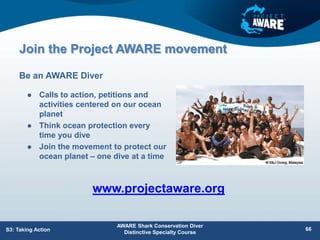
 Calls to action, petitions and
activities centered on our ocean
planet
 Think ocean protection every
time you dive
 Join the movement to protect our
ocean planet – one dive at a time
Be an AWARE Diver
AWARE Shark Conservation Diver
Distinctive Specialty Course
66
S3: Taking Action
www.projectaware.org
We’ve talked about
 Personal actions to protect sharks
 Your local sharks
 Responsible environmental
guidelines for diving with sharks
 Join the Project AWARE movement
SECTION 3: Taking action and joining the Project AWARE
movement
AWARE Shark Conservation Diver
Distinctive Specialty Course
67
S3: Taking Action
Any Questions?
Join the Movement
www.projectaware.org

AWARE_Shark_Conservation_LaG_V1.02_1.ppt

  • 1.
    AWARE Shark ConservationDiver Distinctive Specialty Course - Lesson Guides - This work is licensed under the Creative Commons Attribution-NonCommercial-NoDerivs 3.0 Unported License. To view a copy of this license, visit http://creativecommons.org/licenses/by-nc-nd/3.0/ Product No. 72003 (Rev. 09/12) Version 1.02
  • 2.
    Welcome to yourcourse  Introductions  Course goals  Course overview  Class requirements AWARE Shark Conservation Diver Distinctive Specialty Course Welcome 2
  • 3.
    Click to viewthe Sharks in Peril video AWARE Shark Conservation Diver Distinctive Specialty Course 3
  • 4.
    We’ll talk about. . .  Unique physical attributes of sharks  Conservation status of sharks  Life history traits that make sharks vulnerable  Importance to marine ecosystems SECTION 1: Sharks in Peril and why we should care AWARE Shark Conservation Diver Distinctive Specialty Course 4 Welcome Continued . . . SECTION 1 Sharks in Peril
  • 5.
    We’ll talk about. . .  Threats to sharks  Management strategies to protect sharks  Value to local economies  Misperceptions of sharks SECTION 2: Managing threats and recognising values AWARE Shark Conservation Diver Distinctive Specialty Course 5 Welcome Continued . . . SECTION 2 Managing Threats
  • 6.
    We’ll talk about. . .  Personal actions to protect sharks  Your local sharks  Responsible environmental guidelines for diving with sharks  Join the Project AWARE movement SECTION 3: Taking action and joining the Project AWARE movement AWARE Shark Conservation Diver Distinctive Specialty Course 6 Welcome SECTION 3 Taking Action
  • 7.
    Sharks in Peril andwhy we should care AWARE Shark Conservation Diver Distinctive Specialty Course 7 SECTION 1:
  • 8.
    What are theunique physical attributes of sharks?  First sharks over 400 mya  Modern sharks around 100 mya  Found in every marine environment  Roughly 500 species  Most sharks have:  a streamlined, torpedo shaped body  rigid dorsal and pectoral fins  Most predators, some scavengers or filter feeders AWARE Shark Conservation Diver Distinctive Specialty Course S1: Sharks in Peril 8 Continued . . .
  • 9.
    What are theunique physical attributes of sharks?  Sharks have unique physical attributes that make them different from other fish:  Skeleton made from cartilage  Large oiled filled liver  Exposed gill slits  Share these attributes with rays, skates and chimaeras AWARE Shark Conservation Diver Distinctive Specialty Course S1: Sharks in Peril 9
  • 10.
    What is theconservation status of sharks? AWARE Shark Conservation Diver Distinctive Specialty Course 10 S1: Sharks in Peril Continued . . . International Union for the Conservation of Nature (IUCN) Red List Review of 1044 Shark, Ray and Chimaera Species Critically Endangered 2% Extremely high risk of extinction in the wild Endangered 4% Very high risk of extinction in the wild Vulnerable 11% High risk of extinction in the wild Near Threatened 13% Close to qualifying or likely to qualify for a threatened category in the near future Least Concern 23% Not qualifying as Threatened including widespread and abundant species Data Deficient 47% More information required for assessment 30% of 1044 assessed sharks, rays and chimaeras are Threatened or Near Threatened with extinction
  • 11.
    What is theconservation status of sharks?  More alarming estimates: More alarming estimates AWARE Shark Conservation Diver Distinctive Specialty Course 11 S1: Sharks in Peril Species Location Status Sharks and rays Pelagic (open ocean) One third threatened with extinction Hammerhead sharks NW & W Central Atlantic Declined by 89% since 1986 Great hammerheads E Atlantic Declined by 80% Porbeagle and spiny dogfish sharks NW Atlantic Reduced by 90% Sharks Europe One third Threatened with extinction 14 species of sharks and rays Mediterranean Critically Endangered
  • 12.
    What life historytraits make sharks vulnerable?  Sharks vulnerable to overfishing because:  Long time to sexual maturity  Long gestations  Small number of offspring  Breed only every 2nd or 3rd year  Strategy works under natural conditions  Fails when fishing removes many individuals AWARE Shark Conservation Diver Distinctive Specialty Course S1: Sharks in Peril 12 Continued . . .
  • 13.
    What life historytraits make sharks vulnerable?  Compare shark reproductive strategy with bony fish that:  Release millions of eggs in a lifetime, so  More likely to recover from fishing impacts  Most fisheries management based on bony fish strategy  Sharks tend to form groups based on age, gender and maturity  Removal of older breeding age females AWARE Shark Conservation Diver Distinctive Specialty Course S1: Sharks in Peril 13 Continued . . .
  • 14.
    What is theimportance of sharks to marine ecosystems?  Keep a balance among prey species  Often the apex predator  Top of many food chains  Feed on many different species  Change food when one prey animal is hard to find  Remove sick, injured and diseased animals Crucial to maintain health of marine ecosystems AWARE Shark Conservation Diver Distinctive Specialty Course 14 S1: Sharks in Peril
  • 15.
    What is theimportance of sharks to marine ecosystems? Food chains describe how energy moves among species AWARE Shark Conservation Diver Distinctive Specialty Course 15 S1: Sharks in Peril Small carnivores consumed by large carnivores until apex predators reached Herbivores consumed by carnivores (meat eaters) Plants consumed by herbivores (plant eaters) Starts with plants that use the sun’s energy to make their body parts Continued . . .
  • 16.
    What is theimportance of sharks to marine ecosystems? Removing animals from a food chain can have repercussions throughout an ecosystem: AWARE Shark Conservation Diver Distinctive Specialty Course 16 S1: Sharks in Peril Fewer apex predators more lower-level carnivores fewer herbivores more macroalgae (e.g. seaweed, base of food chain) Continued . . .
  • 17.
    What is theimportance of sharks to marine ecosystems?  Study at NW Hawaii Islands  Apex predators:  More than 50% of fish biomass  Less than 10% on fished reefs  Sharks are bigger  Populations of all species are far greater  A larger variety of other species Relatively untouched reefs can show the impact of removing apex predators (including sharks) AWARE Shark Conservation Diver Distinctive Specialty Course 17 S1: Sharks in Peril Continued . . .
  • 18.
    What is theimportance of sharks to marine ecosystems?  Prefer to eat in the middle of sea grass bed  Stay on outside when sharks present  Seagrass beds important habitat for many species Sharks found to protect seagrass beds from over-grazing by dugongs and green sea turtles: AWARE Shark Conservation Diver Distinctive Specialty Course 18 S1: Sharks in Peril Sharks keep marine environments healthy - Important for all marine animals and for humans!
  • 19.
    We’ve talked about Unique physical attributes of sharks  Conservation status of sharks  Life history traits that make sharks vulnerable  Importance to marine ecosystems SECTION 1: Sharks in Peril and why we should care AWARE Shark Conservation Diver Distinctive Specialty Course 19 S1: Sharks in Peril Any Questions?
  • 20.
    Managing threats and recognisingvalues AWARE Shark Conservation Diver Distinctive Specialty Course 20 SECTION 2:
  • 21.
    What major threatscontribute to declines in shark populations?  Targeted fisheries and as bycatch  Mainly caught for:  Fins: to make shark fin soup  Meat: strong demand from Europe It is mostly due to overfishing that many shark species are threatened with extinction AWARE Shark Conservation Diver Distinctive Specialty Course 21 S2: Managing Threats Continued . . .
  • 22.
    What major threatscontribute to declines in shark populations?  Total of annual shark catch:  Nearly 80% - top 20 shark catching nations  More than 35% - top 4 shark catching nations AWARE Shark Conservation Diver Distinctive Specialty Course S2: Managing Threats 22 The top 20 shark catching nations in order of size of catch, greatest take first Rank Country Rank Country Rank Country Rank Country 1 Indonesia 6 Mexico 11 Thailand 16 Portugal 2 India 7 Pakistan 12 France 17 Nigeria 3 Spain 8 USA 13 Brazil 18 Iran 4 Taiwan 9 Japan 14 Sri Lanka 19 UK 5 Argentina 10 Malaysia 15 New Zealand 20 S Korea Source: The Future of Sharks: A Review of Action and Inaction Continued . . . Continued . . .
  • 23.
    What major threatscontribute to declines in shark populations? Some of the many uses of shark body parts AWARE Shark Conservation Diver Distinctive Specialty Course 23 S2: Managing Threats Species Part Where How Most sharks Fins Global, but centered on Asia Shark fin soup Spiny dogfish Meat Europe Spiny dogfish Meat UK Fish and Chips Spiny dogfish Meat Germany To make Schillerlocken Porbeagle Meat France Known as veal of the sea Mako, thresher and blacktip Meat America Shark steaks Greenland and basking shark Meat Iceland and Greenland Used to produce hákarl Continued . . .
  • 24.
    What major threatscontribute to declines in shark populations? Some of the many uses of shark body parts AWARE Shark Conservation Diver Distinctive Specialty Course 24 S2: Managing Threats Part Where How Meat Australia Known as flake, often used in fish and chips Meat Global Products called fish may contain shark i.e. fish fingers Liver oil Global Many industrial uses Shark skin A delicacy and also used to make leather products Liver oil and cartilage Said to have health benefits, though unproven Jaws and teeth sold as souvenirs Continued . . .
  • 25.
    What major threatscontribute to declines in shark populations?  Food and Agriculture Organisation (FOA) estimate of shark, ray and chimaera catch:  2003: 0.90 million tonnes  2006: 0.75 million tonnes  Unknown if decline due to:  Better fisheries management  Less sharks  Combination of both Difficult to estimate annual shark take Countries have different reporting requirements, or none at all AWARE Shark Conservation Diver Distinctive Specialty Course 25 S2: Managing Threats Continued . . .
  • 26.
    What major threatscontribute to declines in shark populations?  Study of shark fin trade records shows FAO figures an underestimate  Found annual shark catch to support global shark fin trade to be:  Between 1.21 to 2.29 million tonnes, with a median of 1.70 million tonnes  Equivalent to between 26 and 73 million sharks  Therefore 38 million sharks per year is the best estimate for the global shark catch  This figure does not include:  Sharks killed for domestic fin markets  Sharks discarded dead at sea  Sharks killed for their meat only AWARE Shark Conservation Diver Distinctive Specialty Course S2: Managing Threats 26 Continued . . .
  • 27.
    What major threatscontribute to declines in shark populations?  Status symbol in Chinese culture  Demand fast outpacing supply  Driving the global depletion of shark populations  Among the most valuable fisheries products  Bowl of soup can cost US$100 Shark Fin Soup AWARE Shark Conservation Diver Distinctive Specialty Course 27 S2: Managing Threats Continued . . .
  • 28.
    What major threatscontribute to declines in shark populations?  Removing a shark's fins at sea  Often still alive  Body dumped overboard  Why do fishers do that?  High value of fins / low value of meat  Why is this allowed to happen?  Finning banned by many countries, but  Poor monitoring and regulations Shark Finning AWARE Shark Conservation Diver Distinctive Specialty Course 28 S2: Managing Threats Continued . . .
  • 29.
    What major threatscontribute to declines in shark populations?  Part of a catch that is:  not the target species, or  undersized  Can not be landed in many regions  Often dumped overboard  Tens of millions of sharks killed as bycatch every year  Usually not recorded in fishery records Bycatch AWARE Shark Conservation Diver Distinctive Specialty Course 29 S2: Managing Threats Continued . . .
  • 30.
    What major threatscontribute to declines in shark populations?  Habitat Loss  75% coral reefs threatened from local pressures and climate change  1/5th mangroves removed since 1980  Coastal Development  Damages shark habitats and nurseries Other Impacts AWARE Shark Conservation Diver Distinctive Specialty Course 30 S2: Managing Threats
  • 31.
    What major threatscontribute to declines in shark populations?  Marine debris  Our rubbish in the ocean  Sharks eat marine debris or become entangled  Ghost nets  Swimmer protection devices  Beach nets and baited drumlines  Kills harmless sharks  Kills other species: dolphins, rays and turtles etc Other Impacts AWARE Shark Conservation Diver Distinctive Specialty Course 31 S2: Managing Threats
  • 32.
    What key management strategiescan protect sharks?  Be well-enforced, with science- based catch limits  Have conservation measures consistent throughout the range of each species  Be science-based and take a precautionary approach  Aim to minimise waste For shark fisheries to be sustainable, shark fisheries management should: AWARE Shark Conservation Diver Distinctive Specialty Course 32 S2: Managing Threats We will now look at some management strategies that can help protect sharks Continued . . .
  • 33.
    What key management strategiescan protect sharks?  Shark fishing nations to implement a National Plan of Action (NPOA) for the conservation and management of sharks  Aims to make shark fisheries sustainable by:  Assessing threats such as overfishing  Protecting critical habitats  Minimising waste and discards (e.g. finning bans)  Encouraging the full use of dead sharks International Plan of Action-Sharks (IPOA-Sharks) AWARE Shark Conservation Diver Distinctive Specialty Course 33 S2: Managing Threats Continued . . .
  • 34.
    What key management strategiescan protect sharks?  Should implement a Shark NPOA by 2001:  Voluntary  As of 2011 only 13 of the Top 20 nations have a plan  IPOA process has raised the profile of sharks  Led to some improvement in shark fisheries management International Plan of Action-Sharks (IPOA-Sharks) AWARE Shark Conservation Diver Distinctive Specialty Course 34 S2: Managing Threats Continued . . .
  • 35.
    What key management strategiescan protect sharks?  Facilitate management of multi- nation fishing:  In international waters, or  For highly migratory species  Aims to conserve fish populations through agreements Regional Fisheries Management Organisations (RFMOs) AWARE Shark Conservation Diver Distinctive Specialty Course 35 S2: Managing Threats Continued . . .
  • 36.
    What key management strategiescan protect sharks?  Slow to address shark overfishing  Management based on fast breeding bony fish  Most RFMOs banned shark finning  But did not set international shark fishing quotas for the high seas Regional Fisheries Management Organisations (RFMOs) AWARE Shark Conservation Diver Distinctive Specialty Course 36 S2: Managing Threats Continued . . .
  • 37.
    What key management strategiescan protect sharks?  Finning banned by most RFMOs and nearly 30 countries  Does not stop sharks being caught  Aims to ensure shark carcasses are kept after fins removed  Stipulates a maximum fin to carcass ratio allowed onboard  Dump the carcass = exceed the ratio Finning Bans AWARE Shark Conservation Diver Distinctive Specialty Course 37 S2: Managing Threats Continued . . .
  • 38.
    What key management strategiescan protect sharks?  IUCN recommends ratio not exceed 5% of dressed weight  Dressed weight = heads and guts removed  Using whole weight creates a loophole  Allows 2 to 3 sharks to be finned for every carcass kept  Europe and Brazil bans specify whole weight  Sets a bad example Finning Bans AWARE Shark Conservation Diver Distinctive Specialty Course 38 S2: Managing Threats Continued . . .
  • 39.
    What key management strategiescan protect sharks?  Finning bans could dramatically reduce shark mortality if properly enforced Finning Bans AWARE Shark Conservation Diver Distinctive Specialty Course 39 S2: Managing Threats Continued . . . Most effective way to enforce finning bans is to require that carcasses are landed with fins naturally attached
  • 40.
    What key management strategiescan protect sharks?  International agreement among 175 countries  Regulates or bans international trade in Threatened species  Binding on member countries  Resistance to listing sharks due to commercial value Convention on International Trade in Endangered Species of Wild Fauna and Flora (CITES) AWARE Shark Conservation Diver Distinctive Specialty Course 40 S2: Managing Threats Continued . . .
  • 41.
    What key management strategiescan protect sharks?  As of 2011 only three sharks included under CITES Appendix II:  Basking Shark  Whale Shark  Great White Shark  Proposals to list porbeagle, hammerhead and oceanic whitetip sharks rejected Convention on International Trade in Endangered Species of Wild Fauna and Flora (CITES) AWARE Shark Conservation Diver Distinctive Specialty Course 41 S2: Managing Threats Continued . . .
  • 42.
    What key management strategiescan protect sharks?  Protect from extractive industries  Fishing  Mining  Collecting for aquariums  Known by variety of names  marine parks  aquatic reserves  marine reserves  sanctuary zones  etc Marine Protected Areas (MPAs) AWARE Shark Conservation Diver Distinctive Specialty Course 42 S2: Managing Threats Continued . . .
  • 43.
    What key management strategiescan protect sharks?  Different levels of protection:  Fully protected no-take zones (all extractive activities banned), or  Multiple uses through a system of zoning Marine Protected Areas (MPAs) AWARE Shark Conservation Diver Distinctive Specialty Course 43 S2: Managing Threats Continued . . .
  • 44.
    What key management strategiescan protect sharks?  Benefits of MPAs:  Bony fish recover from overfishing  More fish in surrounding areas  Economic advantages through marine tourism  Only around 1% of the world’s ocean protected by MPAs  Less than 0.1% of these MPAs are no-take zones Marine Protected Areas (MPAs) AWARE Shark Conservation Diver Distinctive Specialty Course 44 S2: Managing Threats Continued . . .
  • 45.
    What key management strategiescan protect sharks?  Protects sharks when positioned over key habitats:  Where sharks congregate to mate  Nursery grounds  Works best for sharks with limited range  Migratory sharks?  If a network of MPAs covers the range of habitats through which the sharks migrate Marine Protected Areas (MPAs) AWARE Shark Conservation Diver Distinctive Specialty Course 45 S2: Managing Threats Continued . . .
  • 46.
    What key management strategiescan protect sharks?  Dive tourism can lead to the creation of shark sanctuaries:  Palau, 2009: entire ocean territory  Maldives, 2010: entire ocean territory  Bahamas and Honduras, 2011: territorial waters Marine Protected Areas (MPAs) AWARE Shark Conservation Diver Distinctive Specialty Course 46 S2: Managing Threats Continued . . .
  • 47.
    What key management strategiescan protect sharks?  To be effective shark sanctuaries need:  Management and monitoring  Funding  Patrols and enforcement  Compensation for fishers, or an alternate income  Dive tourism is leading to local and even national protection for sharks Marine Protected Areas (MPAs) AWARE Shark Conservation Diver Distinctive Specialty Course 47 S2: Managing Threats Continued . . .
  • 48.
    What key management strategiescan protect sharks?  Result of fisheries management failures  Level of illegal shark fishing may not be high  Few rules to break!  Lack of species-specific reporting a huge hindrance to shark conservation Illegal, Unreported and Unregulated (IUU) Fishing AWARE Shark Conservation Diver Distinctive Specialty Course 48 S2: Managing Threats
  • 49.
    What is thevalue of sharks to local economies?  Continue to provide income and protein for many people if fished at a sustainable level Sharks provide economic benefits as a source of food and as tourist attractions AWARE Shark Conservation Diver Distinctive Specialty Course 49 S2: Managing Threats Continued . . . The problem is not that we are fishing for sharks; the problem is that in most cases we are overfishing sharks
  • 50.
    What is thevalue of sharks to local economies? Sharks at popular dive centres have a greater value as tourist attractions than when fished AWARE Shark Conservation Diver Distinctive Specialty Course 50 S2: Managing Threats Value of shark dive tourism to Palau $18 million per year US$1.9 million one reef shark over its lifetime US$108 one shark when fished Value of shark dive tourism to the Maldives US$3,300 one reef shark per year US$33,500 one reef shark per year at the most popular sites US$32 one shark when fished Continued . . .
  • 51.
    What is thevalue of sharks to local economies? AWARE Shark Conservation Diver Distinctive Specialty Course S2: Managing Threats 51 Value of shark dive tourism to the Bahamas US$800 million over a twenty year period US$250,000 one reef shark over its lifetime US$50-60 one shark when fished Value of global whale shark tourism US$47.5 million in 2004 Value of shark and ray tourism to the Canary Islands €17.7 million annually 429 jobs supported Value of shark dive tourism to South Africa US$4.1 million diving with great white sharks, 2003 US$1.8 million diving with tiger sharks, 2007 Continued . . .
  • 52.
    What is thevalue of sharks to local economies?  Dive tourism can:  Improve appreciation of sharks  Create shark conservation advocates  This can lead to protection for shark species not associated with diving, such as those in international waters AWARE Shark Conservation Diver Distinctive Specialty Course S2: Managing Threats 52
  • 53.
    How do weremove common misperceptions of sharks that are a barrier to conservation?  Undeserved reputation as a mindless killer  Often portrayed as man-eaters  Media often greatly exaggerates shark attack stories  1975 film Jaws portrayed sharks as vengeful hunters of humans AWARE Shark Conservation Diver Distinctive Specialty Course S2: Managing Threats 53 Continued . . .
  • 54.
    How do weremove common misperceptions of sharks that are a barrier to conservation?  The reality?  Unlikely to attack  International Shark Attack File 2010:  79 unprovoked shark attacks  Only 6 were fatal  Shark attacks levelled off over last 30 years to average 63.5 per year  Growing human population means number of attacks should increase  Falling shark populations the possible explanation AWARE Shark Conservation Diver Distinctive Specialty Course S2: Managing Threats 54
  • 55.
    How do weremove common misperceptions of sharks that are a barrier to conservation?  Only about 10 species implicated in unprovoked attacks  Mostly bull, tiger, and white sharks  Most attacks thought to be mistakes or explorations Not understanding the variety of shark species another barrier to protection AWARE Shark Conservation Diver Distinctive Specialty Course 55 S2: Managing Threats Ocean the shark's home  We choose to accept the risk when we swim
  • 56.
    We’ve talked about Threats to sharks  Management strategies to protect sharks  Value to local economies  Misperceptions of sharks SECTION 2: Managing threats and recognising values AWARE Shark Conservation Diver Distinctive Specialty Course 56 S2: Managing Threats Any Questions?
  • 57.
    Taking action andjoining the Project AWARE movement AWARE Shark Conservation Diver Distinctive Specialty Course 57 SECTION 3:
  • 58.
    What personal actions canI take to protect sharks?  Get involved  Make personal changes to protect sharks  Join campaigns  Support Marine Protected Areas  Tell others  Respond to alarmist media stories  Support Project AWARE  www.projectaware.org  Tread lightly on the planet Everyday Actions AWARE Shark Conservation Diver Distinctive Specialty Course 58 S3: Taking Action Continued . . .
  • 59.
    What personal actions canI take to protect sharks?  If you choose to eat seafood  Look for sustainable fisheries  Sustainable Seafood Guides  Avoid products that contain sharks  Choose not to eat shark fin soup  Avoid purchasing items that contain shark products  Support genuine ecotourism operations Purchase Decisions AWARE Shark Conservation Diver Distinctive Specialty Course 59 S3: Taking Action Continued . . .
  • 60.
    What personal actions canI take to protect sharks?  Make your dives count  Dive Against Debris  Be an AWARE diver  Ten Ways A Diver Can Protect The Underwater Environment  Ten Tips for Underwater Photographers Be an AWARE Diver AWARE Shark Conservation Diver Distinctive Specialty Course 60 S3: Taking Action
  • 61.
    What sharks arefound in our local area and what is their conservation status? AWARE Shark Conservation Diver Distinctive Specialty Course 61 S3: Taking Action Continued . . .
  • 62.
    What sharks arefound in our local area and what is their conservation status? AWARE Shark Conservation Diver Distinctive Specialty Course 62 S3: Taking Action
  • 63.
    Environmental Guidelines for divingwith sharks  Be an AWARE diver  Do not block their movement by swimming in front of them, allow them to move away  Do not block their exit if they are inside a cave or overhang These guidelines will help you minimise your impacts when diving with sharks AWARE Shark Conservation Diver Distinctive Specialty Course 63 S3: Taking Action  Do not descend on top of sharks  Do not get close to sharks  Be familiar with and follow local regulations and protocols Always seek safety advice from a dive professional familiar with sharks found at the dive site before diving with sharks
  • 64.
    Join the ProjectAWARE movement  Ocean fighting for its life!  2 major issues where divers can make a difference  Shark decline  Marine debris  Dive Against Debris: underwater survey of rubbish in our ocean  Your data will:  Cause changes that stop rubbish from entering the ocean  Reduce marine life death and injuries Project AWARE’s powerful movement for ocean protection starts with you AWARE Shark Conservation Diver Distinctive Specialty Course 64 S3: Taking Action Continued . . .
  • 65.
    Join the ProjectAWARE movement  Dive Centres and AWARE leaders  Manage local conservation events  Report data  Connect with volunteers  Explore My Ocean  Create a profile  Volunteer for events  Find new dive buddies My Ocean – unique eco-networking site for ocean protection S3: Taking Action AWARE Shark Conservation Diver Distinctive Specialty Course 65 Continued . . . Your Profile Your Blogs Your Buddies
  • 66.
    Join the ProjectAWARE movement  Calls to action, petitions and activities centered on our ocean planet  Think ocean protection every time you dive  Join the movement to protect our ocean planet – one dive at a time Be an AWARE Diver AWARE Shark Conservation Diver Distinctive Specialty Course 66 S3: Taking Action www.projectaware.org
  • 67.
    We’ve talked about Personal actions to protect sharks  Your local sharks  Responsible environmental guidelines for diving with sharks  Join the Project AWARE movement SECTION 3: Taking action and joining the Project AWARE movement AWARE Shark Conservation Diver Distinctive Specialty Course 67 S3: Taking Action Any Questions?
  • 68.