Learn more
Honed to perfection
Nature ’ s most successful design Control 2/3 ’ s of the planet Have survived 5 major extinctions – have lasted 100 times longer than man Relatively unstudied - we still know very little about them Increasingly important to tourism  –  millions of $ Biology incredibly unique Keep our oceans healthy and bio-diverse Have 7 highly evolved senses Learn quickly & constantly adapting Magnificent predators  to be   respected  and  revered.
Over 500 unique species Whale sharks:  the world ’ s largest fish feeds on plankton (50 feet) Frilled sharks:  one of the oldest and most unusual species Angel sharks:  hide in the sand and are bottom-feeders Dwarf lanternshark:  smallest shark (6 inches) Great White:  perhaps the most famous, and one of the few implicated in attacks on humans Saw sharks:  slender shark with saw-like snout that finds and slashes prey. Long  ‘ barbel ’ s are electro-sensitive to find prey.
 
Sharks are critically important Sharks are the apex predators of almost every ocean habitat At the top of the food chain, sharks keep our oceans healthy They have groomed other species for millions of years and keep them in check Our oceans supply a major source of food and oxygen to us and remove carbon dioxide (global warming gas)
 
Should we fear sharks?
So why do we love to hate sharks? Fear of the unknown  –  vicious, indiscriminate, unpredictable bloodthirsty predators Media feeds us mis-truths building our fears We LOVE our monsters! Of 500 species  –  only 10 have been associated with the rare attacks on humans Our  irrational fear  of  sharks explains our  lack  of  desire to  conserve  them.
 
Fiction Fact Fact
 
Sharks are facing extinction  We are witnessing the first round of ocean extinction Our impact on the ocean in the last 50 years is devastating  –  pollution, overfishing, habitat destruction 90% of some shark species have been destroyed Demand for shark is at an all time high  –  trade goes global  –  and underground Even marine reserves are target of illegal fisheries No species are internationally protected Predators …   ... Or  Prey?
The numbers are haunting Sharks are being chased to extinction because their fins are currently valuable 97 to 99% of regional populations of certain shark species are already gone 23% of all sharks species are endangered (World Conservation Union) 42% of Mediterranean shark species are endangered  Shark  populations are  plummeting
Why should we care? The oceans are the most important ecosystem on the planet That life is kept healthy by sharks: apex predators The oceans - our life support systems - are being destroyed  We are threatening our own source of food and oxygen in an unprecedented way We are (again!) running a large scale experiment on our planet without understanding the implications We  are killing sharks  at an  unsustainable  rate
 
Sharkfinning: sharks’ greatest threat Cruel practice of slicing off fins  –  then dumping fish 95% of fish is wasted  –  fin is most valuable  Millions of tons of shark fin harvested per year  –  and growing  Used as a tasteless ingredient in a social status soup Demand continues to increase while supply plummets World-wide problem fueled by greed  Indiscriminate practice: all ages, sex & species killed Sharks are  disappearing   without  us even  noticing  or  caring
 
Shark fin soup driving demand Shark fin soup is a sign of prosperity and respect in Asia The vitality of the Chinese economy has driven demand for shark fin soup Shark fin soup costs as much as $100 a bowl Shark fins are surpassed in cost only by such foods as some caviar and truffles Dried shark fins cost anywhere from $100 to $300 per pound A single Whale Shark pectoral fin can sell for up to $15,000 The  shark fin market  alone  causes  upwards of  73 million shark deaths  each year
 
Myths that kill sharks MYTH: Sharks fin soup: a sign of prosperity FACT: Prosperity only for the mafia-like trading firms MYTH: Sharks fin soup tastes great FACT: Shark fin has no taste MYTH: Shark cartilage cures arthritis, cancer, HIV FACT: Research indicates it is ineffective & shark products contain high concentrations of highly poisonous mercury MYTH: Sharks don ’ t get sick FACT: Sharks get cancer and tumors
 
Bycatch is a huge problem Bycatch = in fishing, the unintended catch of species other than the ‘target’ species An estimated 50 million sharks are caught as bycatch each year Sharks are 25% of the total catch in the Australia long line tuna and billfish fishery and Fiji long line tuna fishery.  Sharks are 32% of the Hawaii-based long line swordfish catch.
Sharks are especially vulnerable As apex predator, with few natural predators, sharks have evolved with a slow reproduction rate Most species take years to reach sexual maturity (sometimes over 12 years) They raise relatively few pups a year (sometimes only 2) In contrast, bony fish reach sexual maturity in months & lay millions of eggs No other fish is in as much danger of over-exploitation because of the value of shark fins  Highly migratory  –  yet none are protected internationally People don ’ t care about them  –  media influence Lack of data –  we don ’ t know how big the problem is Consumers are largely unaware of the issue – soup translates as “fish wing” in Chinese
 
Life without sharks? Loss of the apex predator can un-cork havoc in the ocean environment Sharks control countless populations of fish species, including other predators Phytoplankton-feeding fish populations are likely to increase and consume more phytoplankton Phytoplankton produces 50-70% of earth ’ s oxygen  More than all the trees and forests and jungles combined What happens to us when our source of oxygen declines? Loss of sharks will have unpredictable impact on our sea food Recent regional reports indicate dramatic and undesirable effects of local destruction of sharks – collapse of the mid-Atlantic scallop fisheries and death of coral reefs in Belize
Changing the mindset … Changing our future.
The best shark conservation tool we have.
Shark angels www.sharkangels.com Join Rob on a new adventure…
Making a Difference
Will we save our sharks? Recent positive media released to counter balance myths Countries instituting national sharkfinning bans Younger Asian generation refusing shark fin soup Education, awareness and compassion is growing Shark tournaments starting to be shunned Local campaigns sprouting Conservation organizations uniting The  movement  is gaining  momentum
 
Shark Savers aim to: Reduce demand for shark fins through education Improve the image of sharks  End the practice of sharkfinning globally  Raise awareness about threats to sharks  Increase global pressure and legislation Be positively oriented  –  conservation and sharks can be cool Promote responsible fishing practices Join us  in the critical fight   to  save ourselves. to  save sharks
The movement is growing … But much work is left to be done.
What you can do Get involved.  Join Shark Savers. Increase your Shark IQ: Learn more about sharks and the issue. Volunteer your time. Start a local campaign to ban shark fin soup. Get in the water with sharks! Dive with them. Increase shark tourism. Encourage everyone you know to see  Sharkwater .  Reduce fishing pressures: eat sensibly. (Use seafood choice cards). Fight for bycatch reduction legislation. Support shark research.
The sharks need your help Become a shark advocate  –  correct misconceptions and promote realistic perceptions. Do not support Yahoo (Alibaba sells shark fins)  –  or any organizations that support sharkfinning or fishing tournaments. Develop a voice. Be heard. Blog, write articles, appeal to your local media outlets. Pressure your local, national and even our international governing bodies to get involved. Combat the myths. Don’t support media outlets that portray sharks erroneously. Protect our reserves: keep illegal shark fishing out of Galapagos and Cocos Islands.
Join our fight to save the sharks www.sharksavers.org


To learn more: Shark Savers : www.sharksavers.org Saving Sharks:  www.savingsharks.com Sea Shepherd : www.seashepherd.org Save Our Seas : www.saveourseas.com WildAid : www.wildaid.org Shark Trust : www.sharktrust.org Shark Alliance : www.sharkalliance.org Conserve Our Ocean Legacy:  ww.oceanlegacy.org Oceana:  www.oceana.org Shark Savers  supports  these  organizations
Save our Sharks NOW.

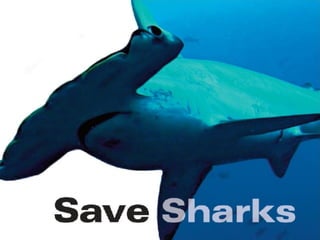
Save Sharks

  • 1.
  • 2.
  • 3.
  • 4.
  • 5.
    Nature ’ smost successful design Control 2/3 ’ s of the planet Have survived 5 major extinctions – have lasted 100 times longer than man Relatively unstudied - we still know very little about them Increasingly important to tourism – millions of $ Biology incredibly unique Keep our oceans healthy and bio-diverse Have 7 highly evolved senses Learn quickly & constantly adapting Magnificent predators to be respected and revered.
  • 6.
    Over 500 uniquespecies Whale sharks: the world ’ s largest fish feeds on plankton (50 feet) Frilled sharks: one of the oldest and most unusual species Angel sharks: hide in the sand and are bottom-feeders Dwarf lanternshark: smallest shark (6 inches) Great White: perhaps the most famous, and one of the few implicated in attacks on humans Saw sharks: slender shark with saw-like snout that finds and slashes prey. Long ‘ barbel ’ s are electro-sensitive to find prey.
  • 7.
  • 8.
    Sharks are criticallyimportant Sharks are the apex predators of almost every ocean habitat At the top of the food chain, sharks keep our oceans healthy They have groomed other species for millions of years and keep them in check Our oceans supply a major source of food and oxygen to us and remove carbon dioxide (global warming gas)
  • 9.
  • 10.
  • 11.
    So why dowe love to hate sharks? Fear of the unknown – vicious, indiscriminate, unpredictable bloodthirsty predators Media feeds us mis-truths building our fears We LOVE our monsters! Of 500 species – only 10 have been associated with the rare attacks on humans Our irrational fear of sharks explains our lack of desire to conserve them.
  • 12.
  • 13.
  • 14.
  • 15.
    Sharks are facingextinction We are witnessing the first round of ocean extinction Our impact on the ocean in the last 50 years is devastating – pollution, overfishing, habitat destruction 90% of some shark species have been destroyed Demand for shark is at an all time high – trade goes global – and underground Even marine reserves are target of illegal fisheries No species are internationally protected Predators … ... Or Prey?
  • 16.
    The numbers arehaunting Sharks are being chased to extinction because their fins are currently valuable 97 to 99% of regional populations of certain shark species are already gone 23% of all sharks species are endangered (World Conservation Union) 42% of Mediterranean shark species are endangered Shark populations are plummeting
  • 17.
    Why should wecare? The oceans are the most important ecosystem on the planet That life is kept healthy by sharks: apex predators The oceans - our life support systems - are being destroyed We are threatening our own source of food and oxygen in an unprecedented way We are (again!) running a large scale experiment on our planet without understanding the implications We are killing sharks at an unsustainable rate
  • 18.
  • 19.
    Sharkfinning: sharks’ greatestthreat Cruel practice of slicing off fins – then dumping fish 95% of fish is wasted – fin is most valuable Millions of tons of shark fin harvested per year – and growing Used as a tasteless ingredient in a social status soup Demand continues to increase while supply plummets World-wide problem fueled by greed Indiscriminate practice: all ages, sex & species killed Sharks are disappearing without us even noticing or caring
  • 20.
  • 21.
    Shark fin soupdriving demand Shark fin soup is a sign of prosperity and respect in Asia The vitality of the Chinese economy has driven demand for shark fin soup Shark fin soup costs as much as $100 a bowl Shark fins are surpassed in cost only by such foods as some caviar and truffles Dried shark fins cost anywhere from $100 to $300 per pound A single Whale Shark pectoral fin can sell for up to $15,000 The shark fin market alone causes upwards of 73 million shark deaths each year
  • 22.
  • 23.
    Myths that killsharks MYTH: Sharks fin soup: a sign of prosperity FACT: Prosperity only for the mafia-like trading firms MYTH: Sharks fin soup tastes great FACT: Shark fin has no taste MYTH: Shark cartilage cures arthritis, cancer, HIV FACT: Research indicates it is ineffective & shark products contain high concentrations of highly poisonous mercury MYTH: Sharks don ’ t get sick FACT: Sharks get cancer and tumors
  • 24.
  • 25.
    Bycatch is ahuge problem Bycatch = in fishing, the unintended catch of species other than the ‘target’ species An estimated 50 million sharks are caught as bycatch each year Sharks are 25% of the total catch in the Australia long line tuna and billfish fishery and Fiji long line tuna fishery. Sharks are 32% of the Hawaii-based long line swordfish catch.
  • 26.
    Sharks are especiallyvulnerable As apex predator, with few natural predators, sharks have evolved with a slow reproduction rate Most species take years to reach sexual maturity (sometimes over 12 years) They raise relatively few pups a year (sometimes only 2) In contrast, bony fish reach sexual maturity in months & lay millions of eggs No other fish is in as much danger of over-exploitation because of the value of shark fins Highly migratory – yet none are protected internationally People don ’ t care about them – media influence Lack of data – we don ’ t know how big the problem is Consumers are largely unaware of the issue – soup translates as “fish wing” in Chinese
  • 27.
  • 28.
    Life without sharks?Loss of the apex predator can un-cork havoc in the ocean environment Sharks control countless populations of fish species, including other predators Phytoplankton-feeding fish populations are likely to increase and consume more phytoplankton Phytoplankton produces 50-70% of earth ’ s oxygen More than all the trees and forests and jungles combined What happens to us when our source of oxygen declines? Loss of sharks will have unpredictable impact on our sea food Recent regional reports indicate dramatic and undesirable effects of local destruction of sharks – collapse of the mid-Atlantic scallop fisheries and death of coral reefs in Belize
  • 29.
    Changing the mindset… Changing our future.
  • 30.
    The best sharkconservation tool we have.
  • 31.
    Shark angels www.sharkangels.comJoin Rob on a new adventure…
  • 32.
  • 33.
    Will we saveour sharks? Recent positive media released to counter balance myths Countries instituting national sharkfinning bans Younger Asian generation refusing shark fin soup Education, awareness and compassion is growing Shark tournaments starting to be shunned Local campaigns sprouting Conservation organizations uniting The movement is gaining momentum
  • 34.
  • 35.
    Shark Savers aimto: Reduce demand for shark fins through education Improve the image of sharks End the practice of sharkfinning globally Raise awareness about threats to sharks Increase global pressure and legislation Be positively oriented – conservation and sharks can be cool Promote responsible fishing practices Join us in the critical fight to save ourselves. to save sharks
  • 36.
    The movement isgrowing … But much work is left to be done.
  • 37.
    What you cando Get involved. Join Shark Savers. Increase your Shark IQ: Learn more about sharks and the issue. Volunteer your time. Start a local campaign to ban shark fin soup. Get in the water with sharks! Dive with them. Increase shark tourism. Encourage everyone you know to see Sharkwater . Reduce fishing pressures: eat sensibly. (Use seafood choice cards). Fight for bycatch reduction legislation. Support shark research.
  • 38.
    The sharks needyour help Become a shark advocate – correct misconceptions and promote realistic perceptions. Do not support Yahoo (Alibaba sells shark fins) – or any organizations that support sharkfinning or fishing tournaments. Develop a voice. Be heard. Blog, write articles, appeal to your local media outlets. Pressure your local, national and even our international governing bodies to get involved. Combat the myths. Don’t support media outlets that portray sharks erroneously. Protect our reserves: keep illegal shark fishing out of Galapagos and Cocos Islands.
  • 39.
    Join our fightto save the sharks www.sharksavers.org
  • 40.
  • 41.
  • 42.
  • 43.
  • 44.
    To learn more:Shark Savers : www.sharksavers.org Saving Sharks: www.savingsharks.com Sea Shepherd : www.seashepherd.org Save Our Seas : www.saveourseas.com WildAid : www.wildaid.org Shark Trust : www.sharktrust.org Shark Alliance : www.sharkalliance.org Conserve Our Ocean Legacy: ww.oceanlegacy.org Oceana: www.oceana.org Shark Savers supports these organizations
  • 45.