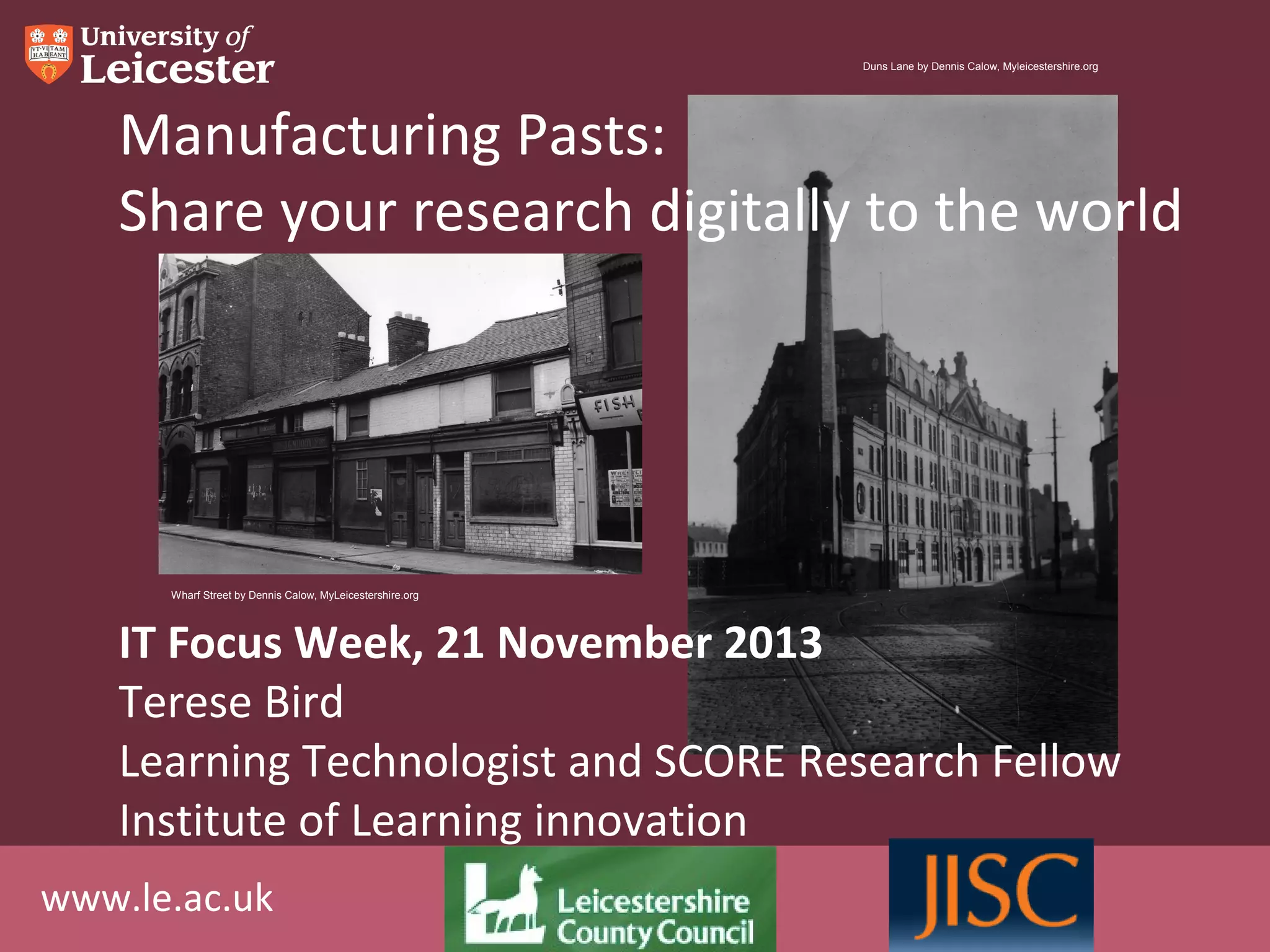
Duns Lane by Dennis Calow, Myleicestershire.org

Manufacturing Pasts:
Share your research digitally to the world

Wharf Street by Dennis Calow, MyLeicestershire.org

IT Focus Week, 21 November 2013
Terese Bird
Learning Technologist and SCORE Research Fellow
Institute of Learning innovation
www.le.ac.uk
What will we talk about?
• What is Manufacturing
Pasts?
• How we shared out the
direct outputs (ContentDM)
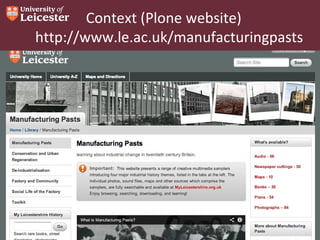
• How we provided context
(Plone)
• How we got the word out
(Social Media)
Photo by esrad on Flickr
Manufacturing Pasts: making the history
accessible
• No historiography of British industrial decline
• Dead zone: 70s – 90s
• Locked away
• Open materials (CC-BY-NC)
• Capture it now
• Not didactic but context
• Accessible
• Text, audio, video, interactive

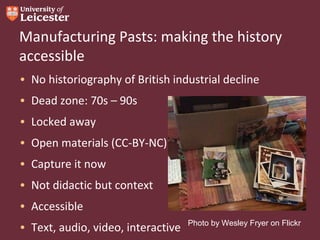
Photo by Wesley Fryer on Flickr
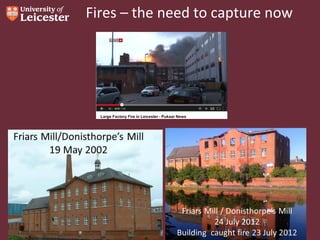
Fires – the need to capture now
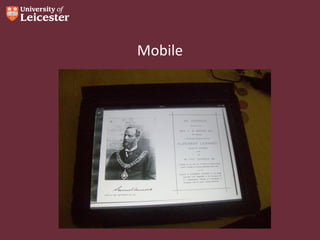
Mobile
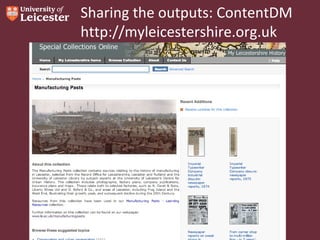
Sharing the outputs: ContentDM
http://myleicestershire.org.uk
Context (Plone website)
http://www.le.ac.uk/manufacturingpasts
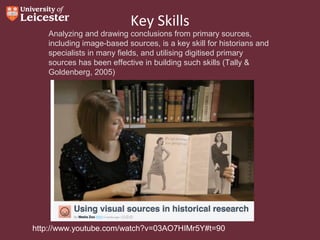
Key Skills

Analyzing and drawing conclusions from primary sources,
including image-based sources, is a key skill for historians and
specialists in many fields, and utilising digitised primary
sources has been effective in building such skills (Tally &
Goldenberg, 2005)

http://www.youtube.com/watch?v=03AO7HIMr5Y#t=90
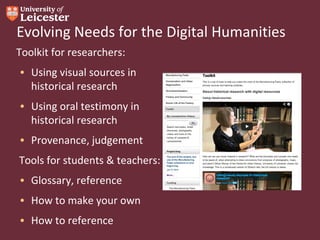
Evolving Needs for the Digital Humanities
Toolkit for researchers:
• Using visual sources in
historical research
• Using oral testimony in
historical research
• Provenance, judgement
Tools for students & teachers:
• Glossary, reference
• How to make your own
• How to reference
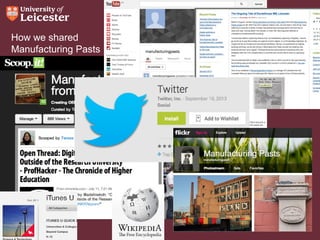
How we shared
Manufacturing Pasts
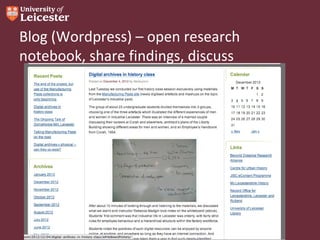
Blog (Wordpress) – open research
notebook, share findings, discuss
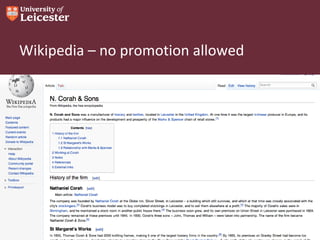
Wikipedia – no promotion allowed
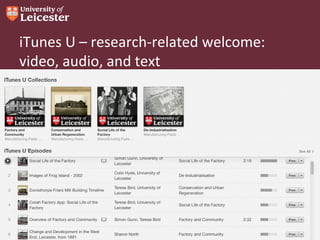
iTunes U – research-related welcome:
video, audio, and text
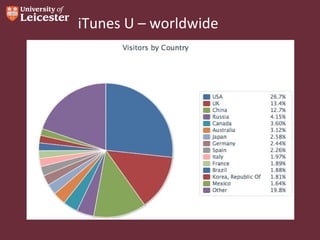
iTunes U – worldwide
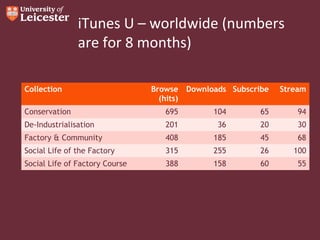
iTunes U – worldwide (numbers
are for 8 months)
Collection

Browse
(hits)

Downloads Subscribe

Stream

Conservation

695

104

65

94

De-Industrialisation

201

36

20

30

Factory & Community

408

185

45

68

Social Life of the Factory

315

255

26

100

Social Life of Factory Course

388

158

60

55
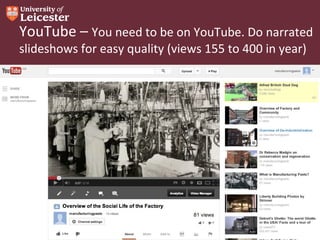
YouTube – You need to be on YouTube. Do narrated
slideshows for easy quality (views 155 to 400 in year)
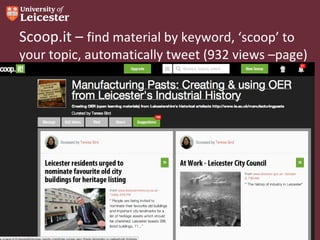
Scoop.it – find material by keyword, ‘scoop’ to

your topic, automatically tweet (932 views –page)
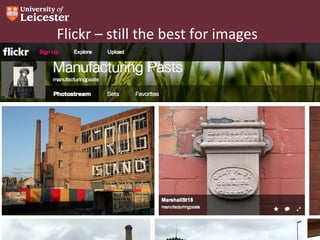
Flickr – still the best for images
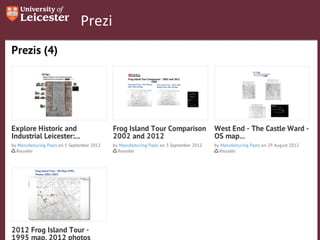
Prezi
The story
so far…

Any
questions?
www.le.ac.uk/manufacturingpasts
These slides on Slideshare tbirdcymru
Twitter: tbirdcymru
References
• Beyond Distance Research Alliance, University of Leicestere. (2010). OTTER: Open,
Transferable and Technology-enabled Educational Resources — University of
Leicester. University of Leicester website. Retrieved March 12, 2012, from
http://www2.le.ac.uk/departments/beyond-distance-researchalliance/projects/otter
• Beyond Distance Research Alliance, University of Leicester. (2011). OSTRICH: OER
Sustainability through Teaching & Research Innovation: Cascading across HEIs —
University of Leicester. University of Leicester website. Retrieved March 12, 2012,
from http://www2.le.ac.uk/departments/beyond-distance-researchalliance/projects/ostrich
• Tally, B., & Goldenberg, L. B. (2005). Fostering Historical Thinking With Digitized
Primary Sources. Journal of Research on Technology in Education, 5191, 1-21.
Retrieved from
http://students.stritch.edu/dlcaven/Article2/DigitizedPrimarySources.pdf
•

Sharing your research with the world

  • 1.
    Duns Lane byDennis Calow, Myleicestershire.org Manufacturing Pasts: Share your research digitally to the world Wharf Street by Dennis Calow, MyLeicestershire.org IT Focus Week, 21 November 2013 Terese Bird Learning Technologist and SCORE Research Fellow Institute of Learning innovation www.le.ac.uk
  • 2.
    What will wetalk about? • What is Manufacturing Pasts? • How we shared out the direct outputs (ContentDM) • How we provided context (Plone) • How we got the word out (Social Media) Photo by esrad on Flickr
  • 3.
    Manufacturing Pasts: makingthe history accessible • No historiography of British industrial decline • Dead zone: 70s – 90s • Locked away • Open materials (CC-BY-NC) • Capture it now • Not didactic but context • Accessible • Text, audio, video, interactive Photo by Wesley Fryer on Flickr
  • 4.
    Fires – theneed to capture now
  • 5.
  • 6.
    Sharing the outputs:ContentDM http://myleicestershire.org.uk
  • 7.
  • 8.
    Key Skills Analyzing anddrawing conclusions from primary sources, including image-based sources, is a key skill for historians and specialists in many fields, and utilising digitised primary sources has been effective in building such skills (Tally & Goldenberg, 2005) http://www.youtube.com/watch?v=03AO7HIMr5Y#t=90
  • 9.
    Evolving Needs forthe Digital Humanities Toolkit for researchers: • Using visual sources in historical research • Using oral testimony in historical research • Provenance, judgement Tools for students & teachers: • Glossary, reference • How to make your own • How to reference
  • 10.
  • 11.
    Blog (Wordpress) –open research notebook, share findings, discuss
  • 12.
    Wikipedia – nopromotion allowed
  • 13.
    iTunes U –research-related welcome: video, audio, and text
  • 14.
    iTunes U –worldwide
  • 15.
    iTunes U –worldwide (numbers are for 8 months) Collection Browse (hits) Downloads Subscribe Stream Conservation 695 104 65 94 De-Industrialisation 201 36 20 30 Factory & Community 408 185 45 68 Social Life of the Factory 315 255 26 100 Social Life of Factory Course 388 158 60 55
  • 16.
    YouTube – Youneed to be on YouTube. Do narrated slideshows for easy quality (views 155 to 400 in year)
  • 17.
    Scoop.it – findmaterial by keyword, ‘scoop’ to your topic, automatically tweet (932 views –page)
  • 18.
    Flickr – stillthe best for images
  • 19.
  • 20.
    The story so far… Any questions? www.le.ac.uk/manufacturingpasts Theseslides on Slideshare tbirdcymru Twitter: tbirdcymru
  • 21.
    References • Beyond DistanceResearch Alliance, University of Leicestere. (2010). OTTER: Open, Transferable and Technology-enabled Educational Resources — University of Leicester. University of Leicester website. Retrieved March 12, 2012, from http://www2.le.ac.uk/departments/beyond-distance-researchalliance/projects/otter • Beyond Distance Research Alliance, University of Leicester. (2011). OSTRICH: OER Sustainability through Teaching & Research Innovation: Cascading across HEIs — University of Leicester. University of Leicester website. Retrieved March 12, 2012, from http://www2.le.ac.uk/departments/beyond-distance-researchalliance/projects/ostrich • Tally, B., & Goldenberg, L. B. (2005). Fostering Historical Thinking With Digitized Primary Sources. Journal of Research on Technology in Education, 5191, 1-21. Retrieved from http://students.stritch.edu/dlcaven/Article2/DigitizedPrimarySources.pdf •

Editor's Notes

  • #4 JISC Content Programme 2011-2013 – digitising material and turning it into openly-licensed learning materials. Find it, digitise it, put it online, with the right license,, and then I was tasked with turning them into learning materials.’Fair to history’
  • #7 Demonstrate Content DM Donisthorpe – ppt – large one
  • #8 Demonstrate – go to Factory and Community Can link in YouTube, Scoop.it, blog, Twitter?
  • #10 Look for connections