Vladimir Lyashev, Mikhail Maksimov, Nikolai Merezhin 
The Institute of Signal Processing and Control Systems Southern Federal University Rostov-on-Don – Taganrog, Russia 
Non-Linear Optimization Scheme for Non-Orthogonal Multiuser Access 
TELFOR – 2014 November 25-27, 2014
Page  2 The Institute of Signal Processing and Control Systems 
Southern Federal University 
Problem Definition 
1 
2 
1 
2 
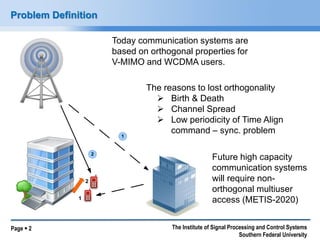
The reasons to lost orthogonality 
 Birth & Death 
 Channel Spread 
 Low periodicity of Time Align 
command – sync. problem 
Future high capacity 
communication systems 
will require non-orthogonal 
multiuser 
access (METIS-2020) 
Today communication systems are 
based on orthogonal properties for 
V-MIMO and WCDMA users.
Page  3 
The Institute of Signal Processing and Control Systems Southern Federal University 
Intra-cell Interference 
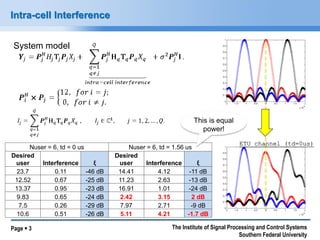
Nuser = 6, td = 0 us 
Nuser = 6, td = 1.56 us 
Desired user 
Interference 
ξ 
Desired user 
Interference 
ξ 
23.7 
0.11 
-46 dB 
14.41 
4.12 
-11 dB 
12.52 
0.67 
-25 dB 
11.23 
2.63 
-13 dB 
13.37 
0.95 
-23 dB 
16.91 
1.01 
-24 dB 
9.83 
0.65 
-24 dB 
2.42 
3.15 
2 dB 
7.5 
0.26 
-29 dB 
7.97 
2.71 
-9 dB 
10.6 
0.51 
-26 dB 
5.11 
4.21 
-1.7 dB 
ETU channel (td=0us) 
System model 
This is equal power!
Page  4 The Institute of Signal Processing and Control Systems 
Southern Federal University 
Mathematical Model and Its Approximation 
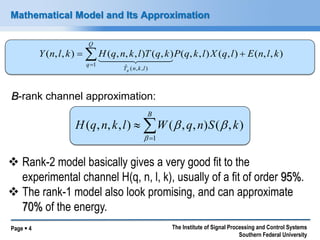
( , , ) ( , , , ) ( , ) ( , , ) ( , ) ( , , ) 
1 
ˆ ( , , ) 
Y n l k H q n k l T q k P q k l X q l E n l k 
Q 
q 
T n k l q 
  
 
 
B-rank channel approximation: 
 
 
 
B 
H q n k l W q n S k 
1 
( , , , ) ( , , ) ( , ) 
 
  
 Rank-2 model basically gives a very good fit to the 
experimental channel H(q, n, l, k), usually of a fit of order 95%. 
 The rank-1 model also look promising, and can approximate 
70% of the energy.
Page  5 
The Institute of Signal Processing and Control Systems Southern Federal University 
Non-linear Optimization Problem Formulation 
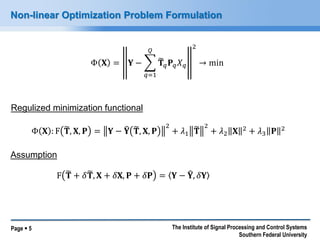
Φ퐗=퐘− 퐓 푞퐏푞푋푞 푄 푞=12→min 
Φ퐗:F퐓 ,퐗,퐏=퐘−퐘 퐓 ,퐗,퐏 2+휆1퐓 2+휆2퐗2+휆3퐏2 
F퐓 +훿퐓 ,퐗+훿퐗,퐏+훿퐏=퐘−퐘 ,훿퐘 
Assumption 
Regulized minimization functional
Page  6 The Institute of Signal Processing and Control Systems 
Southern Federal University 
Tikhonov Regularization in Inverse Problem 
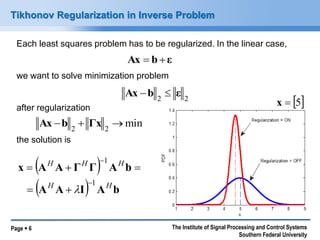
2 2 
Ax b  ε 
Each least squares problem has to be regularized. In the linear case, 
we want to solve minimization problem 
after regularization 
the solution is 
Ax  b ε 
  
A A I A b 
x A A Γ Γ A b 
H H 
H H H 
1 
1 
 
 
  
   
 
min 
2 2 
Ax b  Γx  
x  5
Page  7 
The Institute of Signal Processing and Control Systems Southern Federal University 
Optimization Methods 
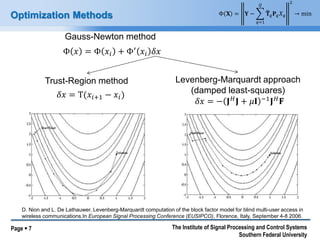
Gauss-Newton method 
Φ푥=Φ푥푖+Φ′푥푖훿푥 
Trust-Region method 
훿푥=T(푥푖+1−푥푖) 
Levenberg-Marquardt approach (damped least-squares) 
훿푥=−퐉퐻퐉+휇퐈−1퐉퐻퐅 
Φ퐗=퐘− 퐓 푞퐏푞푋푞 푄 푞=12→min 
D. Nion and L. De Lathauwer. Levenberg-Marquardt computation of the block factor model for blind multi-user access in wireless communications.In European Signal Processing Conference (EUSIPCO), Florence, Italy, September 4-8 2006.
Page  8 
The Institute of Signal Processing and Control Systems Southern Federal University 
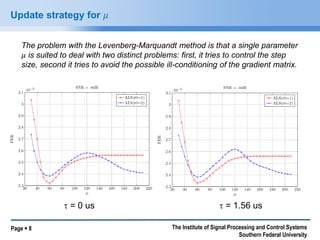
Update strategy for 휇 
t = 1.56 us 
t = 0 us 
The problem with the Levenberg-Marquandt method is that a single parameter 휇 is suited to deal with two distinct problems: first, it tries to control the step size, second it tries to avoid the possible ill-conditioning of the gradient matrix.
Page  9 The Institute of Signal Processing and Control Systems 
Southern Federal University 
Convergence 
0 10 20 30 40 50 
-8 
-7.9 
-7.8 
-7.7 
-7.6 
-7.5 
-7.4 
-7.3 
-7.2 
-7.1 
-7 
Iteration # 
EsN0, dB 
[Convergence] EsN0 for FER=10-2 
the method of gradient descent 
Gauss-Newton 
Gauss-Newton (휇 = 0) 
Gradient descent (휇 → 푖푛푓) 
Fix 휇 = 60 
Adaptive 휇 
If Λ > 0.0, 
푠푒푡 휇 <= 휇 max 
1 
3 
, 1 − 2Λ − 1 3 ; 
Otherwise, 
휇 <= 2휇. 
Λ푖 = Λ푖−1 + 2휇 퐻 − 퐻 푅 
20 iters.
Page  10 The Institute of Signal Processing and Control Systems 
Southern Federal University 
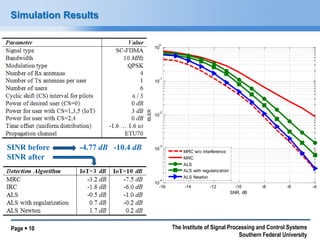
Simulation Results 
-16 -14 -12 -10 -8 -6 -4 
10 
-4 
10 
-3 
10 
-2 
10 
-1 
10 
0 
SNR, dB 
BLER 
MRC w/o interference 
MRC 
ALS 
ALS with regularization 
ALS Newton 
SINR before -4.77 dB -10.4 dB 
SINR after
Page  11 
The Institute of Signal Processing and Control Systems Southern Federal University 
Outlook 
Pilot contamination problem in massive MIMO 
Fast & distributed coherent signal processing 
Joint multiuser detection 
Joint sector/cell 
Adaptive coupling scheme for relaxation based signal processing 
MU-pairing for distributed MIMO System 
Complexity Reduction of Proposed Method 
Conjugate gradients: CG or BiCG 
Decomposition methods: waveform relaxation
Page  12 
The Institute of Signal Processing and Control Systems Southern Federal University 
THE END 
Any questions ? 
Vladimir Lyashev, PhD lyashev@ieee.org

Non-Linear Optimization Scheme for Non-Orthogonal Multiuser Access

  • 1.
    Vladimir Lyashev, MikhailMaksimov, Nikolai Merezhin The Institute of Signal Processing and Control Systems Southern Federal University Rostov-on-Don – Taganrog, Russia Non-Linear Optimization Scheme for Non-Orthogonal Multiuser Access TELFOR – 2014 November 25-27, 2014
  • 2.
    Page  2The Institute of Signal Processing and Control Systems Southern Federal University Problem Definition 1 2 1 2 The reasons to lost orthogonality  Birth & Death  Channel Spread  Low periodicity of Time Align command – sync. problem Future high capacity communication systems will require non-orthogonal multiuser access (METIS-2020) Today communication systems are based on orthogonal properties for V-MIMO and WCDMA users.
  • 3.
    Page  3 The Institute of Signal Processing and Control Systems Southern Federal University Intra-cell Interference Nuser = 6, td = 0 us Nuser = 6, td = 1.56 us Desired user Interference ξ Desired user Interference ξ 23.7 0.11 -46 dB 14.41 4.12 -11 dB 12.52 0.67 -25 dB 11.23 2.63 -13 dB 13.37 0.95 -23 dB 16.91 1.01 -24 dB 9.83 0.65 -24 dB 2.42 3.15 2 dB 7.5 0.26 -29 dB 7.97 2.71 -9 dB 10.6 0.51 -26 dB 5.11 4.21 -1.7 dB ETU channel (td=0us) System model This is equal power!
  • 4.
    Page  4The Institute of Signal Processing and Control Systems Southern Federal University Mathematical Model and Its Approximation ( , , ) ( , , , ) ( , ) ( , , ) ( , ) ( , , ) 1 ˆ ( , , ) Y n l k H q n k l T q k P q k l X q l E n l k Q q T n k l q     B-rank channel approximation:    B H q n k l W q n S k 1 ( , , , ) ( , , ) ( , )     Rank-2 model basically gives a very good fit to the experimental channel H(q, n, l, k), usually of a fit of order 95%.  The rank-1 model also look promising, and can approximate 70% of the energy.
  • 5.
    Page  5 The Institute of Signal Processing and Control Systems Southern Federal University Non-linear Optimization Problem Formulation Φ퐗=퐘− 퐓 푞퐏푞푋푞 푄 푞=12→min Φ퐗:F퐓 ,퐗,퐏=퐘−퐘 퐓 ,퐗,퐏 2+휆1퐓 2+휆2퐗2+휆3퐏2 F퐓 +훿퐓 ,퐗+훿퐗,퐏+훿퐏=퐘−퐘 ,훿퐘 Assumption Regulized minimization functional
  • 6.
    Page  6The Institute of Signal Processing and Control Systems Southern Federal University Tikhonov Regularization in Inverse Problem 2 2 Ax b  ε Each least squares problem has to be regularized. In the linear case, we want to solve minimization problem after regularization the solution is Ax  b ε   A A I A b x A A Γ Γ A b H H H H H 1 1         min 2 2 Ax b  Γx  x  5
  • 7.
    Page  7 The Institute of Signal Processing and Control Systems Southern Federal University Optimization Methods Gauss-Newton method Φ푥=Φ푥푖+Φ′푥푖훿푥 Trust-Region method 훿푥=T(푥푖+1−푥푖) Levenberg-Marquardt approach (damped least-squares) 훿푥=−퐉퐻퐉+휇퐈−1퐉퐻퐅 Φ퐗=퐘− 퐓 푞퐏푞푋푞 푄 푞=12→min D. Nion and L. De Lathauwer. Levenberg-Marquardt computation of the block factor model for blind multi-user access in wireless communications.In European Signal Processing Conference (EUSIPCO), Florence, Italy, September 4-8 2006.
  • 8.
    Page  8 The Institute of Signal Processing and Control Systems Southern Federal University Update strategy for 휇 t = 1.56 us t = 0 us The problem with the Levenberg-Marquandt method is that a single parameter 휇 is suited to deal with two distinct problems: first, it tries to control the step size, second it tries to avoid the possible ill-conditioning of the gradient matrix.
  • 9.
    Page  9The Institute of Signal Processing and Control Systems Southern Federal University Convergence 0 10 20 30 40 50 -8 -7.9 -7.8 -7.7 -7.6 -7.5 -7.4 -7.3 -7.2 -7.1 -7 Iteration # EsN0, dB [Convergence] EsN0 for FER=10-2 the method of gradient descent Gauss-Newton Gauss-Newton (휇 = 0) Gradient descent (휇 → 푖푛푓) Fix 휇 = 60 Adaptive 휇 If Λ > 0.0, 푠푒푡 휇 <= 휇 max 1 3 , 1 − 2Λ − 1 3 ; Otherwise, 휇 <= 2휇. Λ푖 = Λ푖−1 + 2휇 퐻 − 퐻 푅 20 iters.
  • 10.
    Page  10The Institute of Signal Processing and Control Systems Southern Federal University Simulation Results -16 -14 -12 -10 -8 -6 -4 10 -4 10 -3 10 -2 10 -1 10 0 SNR, dB BLER MRC w/o interference MRC ALS ALS with regularization ALS Newton SINR before -4.77 dB -10.4 dB SINR after
  • 11.
    Page  11 The Institute of Signal Processing and Control Systems Southern Federal University Outlook Pilot contamination problem in massive MIMO Fast & distributed coherent signal processing Joint multiuser detection Joint sector/cell Adaptive coupling scheme for relaxation based signal processing MU-pairing for distributed MIMO System Complexity Reduction of Proposed Method Conjugate gradients: CG or BiCG Decomposition methods: waveform relaxation
  • 12.
    Page  12 The Institute of Signal Processing and Control Systems Southern Federal University THE END Any questions ? Vladimir Lyashev, PhD lyashev@ieee.org