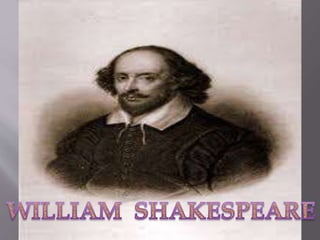
William Shakespeare
 Works & his life –
 How did he do this?
 Genius & training
 Genius – 2 influences – little village of
Stratford, the great city of London.
 Stratford – he learned natural man & his
environment.
 London- artificial man & his unnatural
surroundings.
Life
 Baptized on April 23rd 1564.
 Parents - John Shakespeare , Mary Arden.
 He learnt a little at the grammar school at
Stratford & his ‘real teachers’ were natural
surroundings and people around him.
 Age of 14- his father fell into debt – he
stopped his studies to support his family.
 No evidence of his early occupation.
 1582, he was married to Anne Hathaway – 8
yrs older than him – soon he left his family
and went to London.
 1587 – London – stealing the deer in Sir
Thomas Lucy’s park – Nicholas Rowe in “first
life of Shakespeare” claimed that no evidence
of park in that place.
 1587-1611 – life in London – period of
tremendous literary activity.
 1592- first authentic reference of him –
Greene’s Pamphlet – important position
among the playwrights.
 Started working with other men in London
theaters.
 He revised older plays before writing his own.
 Henry VI – 3 parts – loosely strung English
Chronicle history.
 Titus Andronicus, Richard III – Marlowe &
Shakespeare.
 Soon broke away from his apprenticeship –
Love’s Labour’s Lost, Comedy of Errors, Two
Gentlemen of Verona,
 First English Chronicle plays – Henry VI, Richard
III, Richard II, King John.
 A Midsummer Night’s Dream, Romeo and Juliet.
 Poems – “Venus and Adonis” – dedication to Earl
of Southampton – immense success.
 Invested money – became partners of Globe &
Blackfrairs theaters.
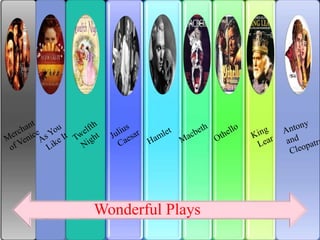
Wonderful Plays
 1597 – his family got released from debt – New
Place- finest house at Stratford.
 Continued to visit his house – in 1611 – returned
to his village from London.
 Coriolanus, Cymbeline, Winter’s Tale, Pericles
– humours.
 1609 – English ship disappeared
 A year later the sailors returned – wrecked in
Bermudas – 10 months with mysterious noises.
 Robinson Crusoe – The Tempest.
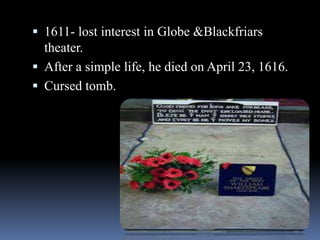
 1611- lost interest in Globe &Blackfriars
theater.
 After a simple life, he died on April 23, 1616.
 Cursed tomb.
Works
 First printed collection of his plays – First Folio
(1623)- actors – Heming & Condell.
 It contained 36 plays.
 Full of typographical errors and uncertain dates
and classifications.
 Four periods
1. Period of early experimentation
2. Period of rapid growth
3. Period of gloom & depression
4. Period of restored serenity.
Period of early experimentation
 1595-Marked by youthfulness & wide
imagination, lavishness of language, rimed
couplets-blank verse.
 Love’s Labour’s Lost
 Two Gentlemen of Verona
 Richard III
Period of rapid growth & development
 Dated from 1595-1600.
 Careful and artistic work, better plot, increase
in knowledge of human nature.
 The Merchant of Venice
 Midsummer Night’s Dream
 As You Like It
 Henry VI
Period of gloom & depression
 Dated from 1600-1607.
 Full maturity of his powers.
 Cause of the sadness is unknown – probably because
of personal experience & political misfortunes of his
friends Essex & Southampton.
 Sonnets
 Twelfth Night
 Hamlet
 Macbeth
 King Lear
 Othello & Julius Caesar
Period of restored serenity
 Last years of poet’s literary works.
 Second period of his experimentation.
 The Winter’s Tale
 The Tempest
Classification - source
 Historical plays:
 Macbeth, King Lear, Julius Caesar.
 Fictional plays:
 Romeo and Juliet, The Merchant of Venice.
 Historical material – Holinshed’s Chronicle of
England, Scotland and Ireland.
 North’s translation of Plutarch’s Lives.
 Love’s Labour’s Lost & Merry Wives of Windsor –
original plot.
 Henry VI, Comedy of Errors, Hamlet, The Tempest
– made over the older plays.
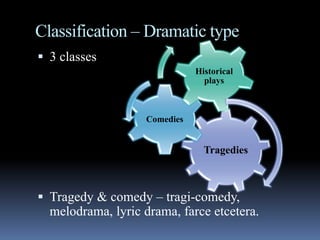
Classification – Dramatic type
 3 classes
 Tragedy & comedy – tragi-comedy,
melodrama, lyric drama, farce etcetera.
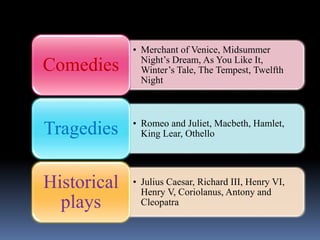
Tragedies
Comedies
Historical
plays
• Merchant of Venice, Midsummer
Night’s Dream, As You Like It,
Winter’s Tale, The Tempest, Twelfth
Night
Comedies
• Romeo and Juliet, Macbeth, Hamlet,
King Lear, OthelloTragedies
• Julius Caesar, Richard III, Henry VI,
Henry V, Coriolanus, Antony and
Cleopatra
Historical
plays
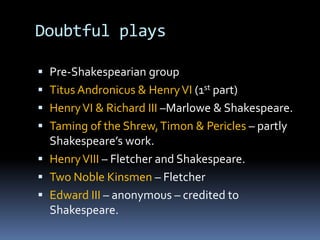
Doubtful plays
 Pre-Shakespearian group
 Titus Andronicus & HenryVI (1st part)
 HenryVI & Richard III –Marlowe & Shakespeare.
 Taming of the Shrew,Timon & Pericles – partly
Shakespeare’s work.
 HenryVIII – Fletcher and Shakespeare.
 Two Noble Kinsmen – Fletcher
 Edward III – anonymous – credited to
Shakespeare.
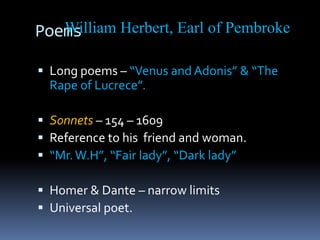
Poems
 Long poems – “Venus and Adonis” & “The
Rape of Lucrece”.
 Sonnets – 154 – 1609
 Reference to his friend and woman.
 “Mr.W.H”, “Fair lady”, “Dark lady”
 Homer & Dante – narrow limits
 Universal poet.
William Herbert, Earl of Pembroke
THANK YOU

Shakespeare

  • 2.
    William Shakespeare  Works& his life –  How did he do this?  Genius & training  Genius – 2 influences – little village of Stratford, the great city of London.  Stratford – he learned natural man & his environment.  London- artificial man & his unnatural surroundings.
  • 3.
    Life  Baptized onApril 23rd 1564.  Parents - John Shakespeare , Mary Arden.  He learnt a little at the grammar school at Stratford & his ‘real teachers’ were natural surroundings and people around him.  Age of 14- his father fell into debt – he stopped his studies to support his family.  No evidence of his early occupation.
  • 4.
     1582, hewas married to Anne Hathaway – 8 yrs older than him – soon he left his family and went to London.  1587 – London – stealing the deer in Sir Thomas Lucy’s park – Nicholas Rowe in “first life of Shakespeare” claimed that no evidence of park in that place.  1587-1611 – life in London – period of tremendous literary activity.
  • 5.
     1592- firstauthentic reference of him – Greene’s Pamphlet – important position among the playwrights.  Started working with other men in London theaters.  He revised older plays before writing his own.  Henry VI – 3 parts – loosely strung English Chronicle history.  Titus Andronicus, Richard III – Marlowe & Shakespeare.
  • 6.
     Soon brokeaway from his apprenticeship – Love’s Labour’s Lost, Comedy of Errors, Two Gentlemen of Verona,  First English Chronicle plays – Henry VI, Richard III, Richard II, King John.  A Midsummer Night’s Dream, Romeo and Juliet.  Poems – “Venus and Adonis” – dedication to Earl of Southampton – immense success.  Invested money – became partners of Globe & Blackfrairs theaters.
  • 7.
  • 8.
     1597 –his family got released from debt – New Place- finest house at Stratford.  Continued to visit his house – in 1611 – returned to his village from London.  Coriolanus, Cymbeline, Winter’s Tale, Pericles – humours.  1609 – English ship disappeared  A year later the sailors returned – wrecked in Bermudas – 10 months with mysterious noises.  Robinson Crusoe – The Tempest.
  • 9.
     1611- lostinterest in Globe &Blackfriars theater.  After a simple life, he died on April 23, 1616.  Cursed tomb.
  • 10.
    Works  First printedcollection of his plays – First Folio (1623)- actors – Heming & Condell.  It contained 36 plays.  Full of typographical errors and uncertain dates and classifications.  Four periods 1. Period of early experimentation 2. Period of rapid growth 3. Period of gloom & depression 4. Period of restored serenity.
  • 11.
    Period of earlyexperimentation  1595-Marked by youthfulness & wide imagination, lavishness of language, rimed couplets-blank verse.  Love’s Labour’s Lost  Two Gentlemen of Verona  Richard III
  • 12.
    Period of rapidgrowth & development  Dated from 1595-1600.  Careful and artistic work, better plot, increase in knowledge of human nature.  The Merchant of Venice  Midsummer Night’s Dream  As You Like It  Henry VI
  • 13.
    Period of gloom& depression  Dated from 1600-1607.  Full maturity of his powers.  Cause of the sadness is unknown – probably because of personal experience & political misfortunes of his friends Essex & Southampton.  Sonnets  Twelfth Night  Hamlet  Macbeth  King Lear  Othello & Julius Caesar
  • 14.
    Period of restoredserenity  Last years of poet’s literary works.  Second period of his experimentation.  The Winter’s Tale  The Tempest
  • 15.
    Classification - source Historical plays:  Macbeth, King Lear, Julius Caesar.  Fictional plays:  Romeo and Juliet, The Merchant of Venice.  Historical material – Holinshed’s Chronicle of England, Scotland and Ireland.  North’s translation of Plutarch’s Lives.  Love’s Labour’s Lost & Merry Wives of Windsor – original plot.  Henry VI, Comedy of Errors, Hamlet, The Tempest – made over the older plays.
  • 16.
    Classification – Dramatictype  3 classes  Tragedy & comedy – tragi-comedy, melodrama, lyric drama, farce etcetera. Tragedies Comedies Historical plays
  • 17.
    • Merchant ofVenice, Midsummer Night’s Dream, As You Like It, Winter’s Tale, The Tempest, Twelfth Night Comedies • Romeo and Juliet, Macbeth, Hamlet, King Lear, OthelloTragedies • Julius Caesar, Richard III, Henry VI, Henry V, Coriolanus, Antony and Cleopatra Historical plays
  • 18.
    Doubtful plays  Pre-Shakespeariangroup  Titus Andronicus & HenryVI (1st part)  HenryVI & Richard III –Marlowe & Shakespeare.  Taming of the Shrew,Timon & Pericles – partly Shakespeare’s work.  HenryVIII – Fletcher and Shakespeare.  Two Noble Kinsmen – Fletcher  Edward III – anonymous – credited to Shakespeare.
  • 19.
    Poems  Long poems– “Venus and Adonis” & “The Rape of Lucrece”.  Sonnets – 154 – 1609  Reference to his friend and woman.  “Mr.W.H”, “Fair lady”, “Dark lady”  Homer & Dante – narrow limits  Universal poet. William Herbert, Earl of Pembroke
  • 20.