Shakespeare: His Lifeand Times
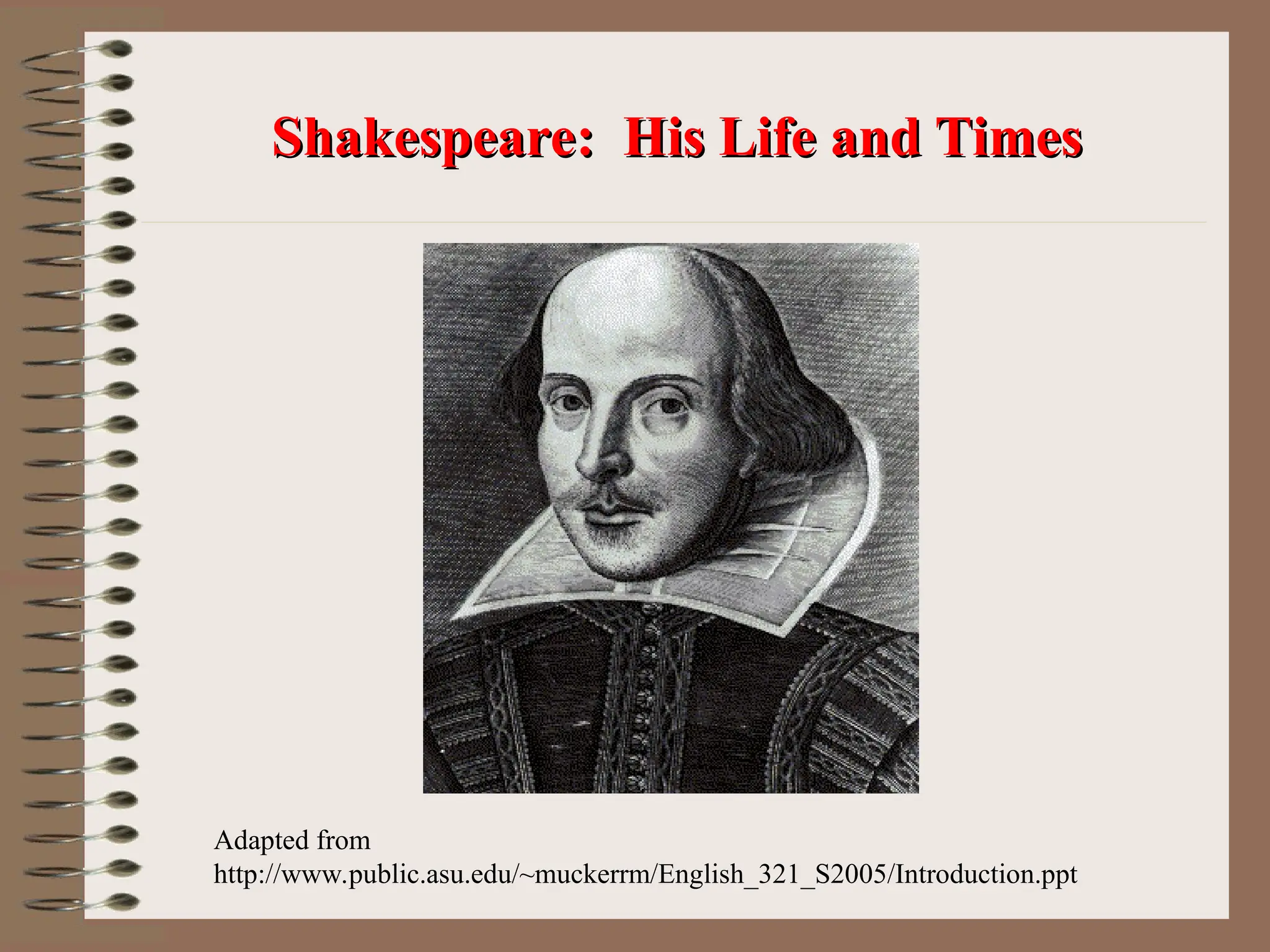
Shakespeare: His Life and Times
Adapted from
http://www.public.asu.edu/~muckerrm/English_321_S2005/Introduction.ppt
2.
Early Life
Early Life
•Born 1564—died 1616
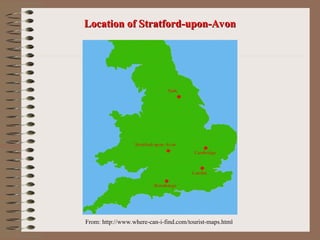
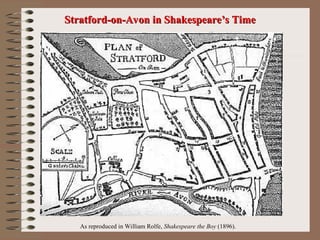
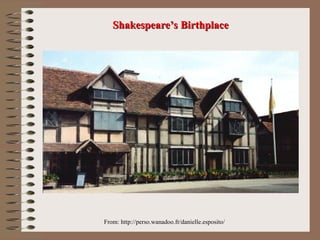
• Stratford-upon-Avon
• Parents: John and Mary Arden
Shakespeare
• Mary—daughter of wealthy landowner
• John—glovemaker, local politician
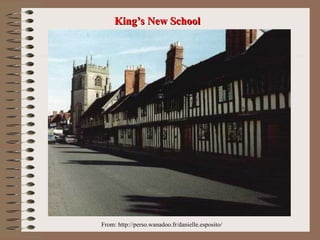
• Probably attendedKing’s New School in Stratford
• His school day was long and rigorous
Educated in:
-Rhetoric
-Logic
-History
-Latin
• Shakespeare dropped out of ‘middle school’ when his
father lost his fortune
Education
Education
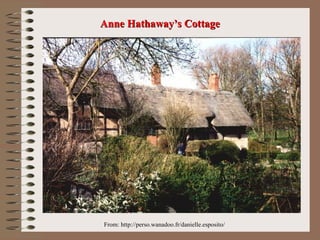
• Married in1582 to Anne Hathaway, who was pregnant at the
time with their first daughter
• Had twins in 1585- Hamnet & Judith
• Hamnet died from the plague at age 11
• Sometime between 1583-1592, he moved to London and
began working in theatre.
• The years 1583-1592 are know as ‘The Lost Years’
• No one know where he was, or what he was doing during
those years
Married Life
Married Life
• Member andlater part-owner of the Lord
Chamberlain’s Men, later called the King’s
Men
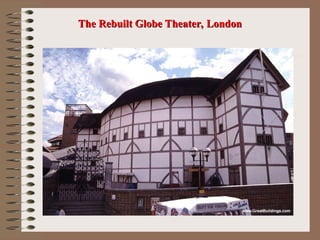
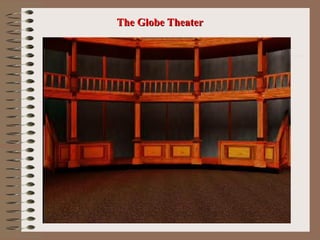
• Globe Theater built in 1599 with Shakespeare
as primary investor
• Burned down in 1613 during one of
Shakespeare’s plays
Theatre Career
Theatre Career
The Plays
The Plays
•38 plays firmly attributed to Shakespeare
• 14 comedies
• 10 histories
• 10 tragedies
• 4 romances
• Possibly wrote three others
• Collaborated on several others
15.
• Two majorpoems
• Venus and Adonis
• Rape of Lucrece
• 154 Sonnets
• Numerous other poems
The Poetry
The Poetry
16.
Shakespeare’s Death
• Shakespearedied on April 23rd
, 1616
• Not exactly sure what he died from
– History says he drank too much wine and ate too
many pickled herrings
• In his will, Shakespeare left money, horses,
stables, etc. to his two sons-in-law
• But only left his wife one thing- the “second-best
bed”
– Was he trying to make a point?
17.
Shakespeare’s Death
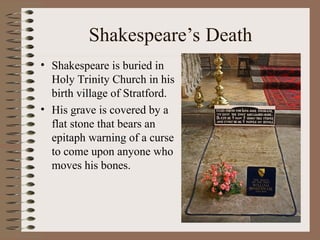
• Shakespeareis buried in
Holy Trinity Church in his
birth village of Stratford.
• His grave is covered by a
flat stone that bears an
epitaph warning of a curse
to come upon anyone who
moves his bones.
18.
Shakespeare’s Language
• Shakespearedid NOT write in “Old English.”
• Old English is the language of Beowulf:
Hwaet! We Gardena in geardagum
Þeodcyninga Þrym gefrunon
Hu ða æÞelingas ellen fremedon!
(Hey! We have heard of the glory of the Spear-
Danes in the old days, the kings of tribes, how
noble princes showed great courage!)
19.
Shakespeare’s Language
• Shakespearedid not write in “Middle English.”
• Middle English is the language of Chaucer, the
Gawain-poet, and Malory:
We redeth oft and findeth y-write—
And this clerkes wele it wite—
Layes that ben in harping
Ben y-founde of ferli thing… (Sir Orfeo)
20.
Shakespeare’s Language
• Shakespearewrote in “Early Modern
English.”
• EME was not very different from
“Modern English,” except that it had some
old holdovers.
21.
Shakespeare’s Language
• Shakespearecoined many words we still use
today:
• Critical
• Majestic
• Dwindle
• And quite a few phrases as well:
• One fell swoop
• Flesh and blood
• Vanish into thin air
See http://www.wordorigins.org/histeng.htm
22.
Shakespeare’s Language
• Amix of old and very new
• Rural and urban words/images
• Understandable by the lowest
peasant and the highest noble
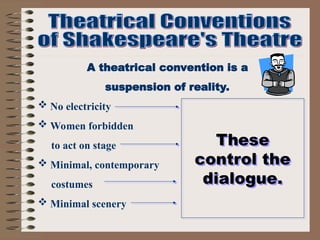
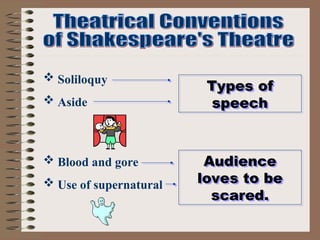
A theatrical conventionis a
suspension of reality.
No electricity
Women forbidden
to act on stage
Minimal, contemporary
costumes
Minimal scenery
These
control the
dialogue.
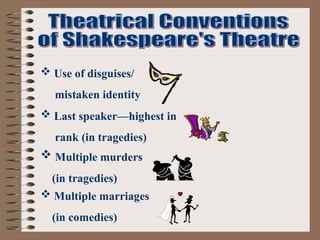
Use ofdisguises/
mistaken identity
Multiple marriages
(in comedies)
Multiple murders
(in tragedies)
Last speaker—highest in
rank (in tragedies)