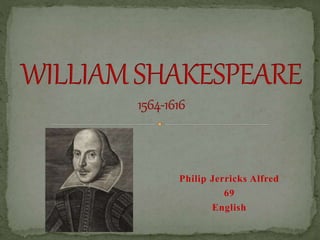
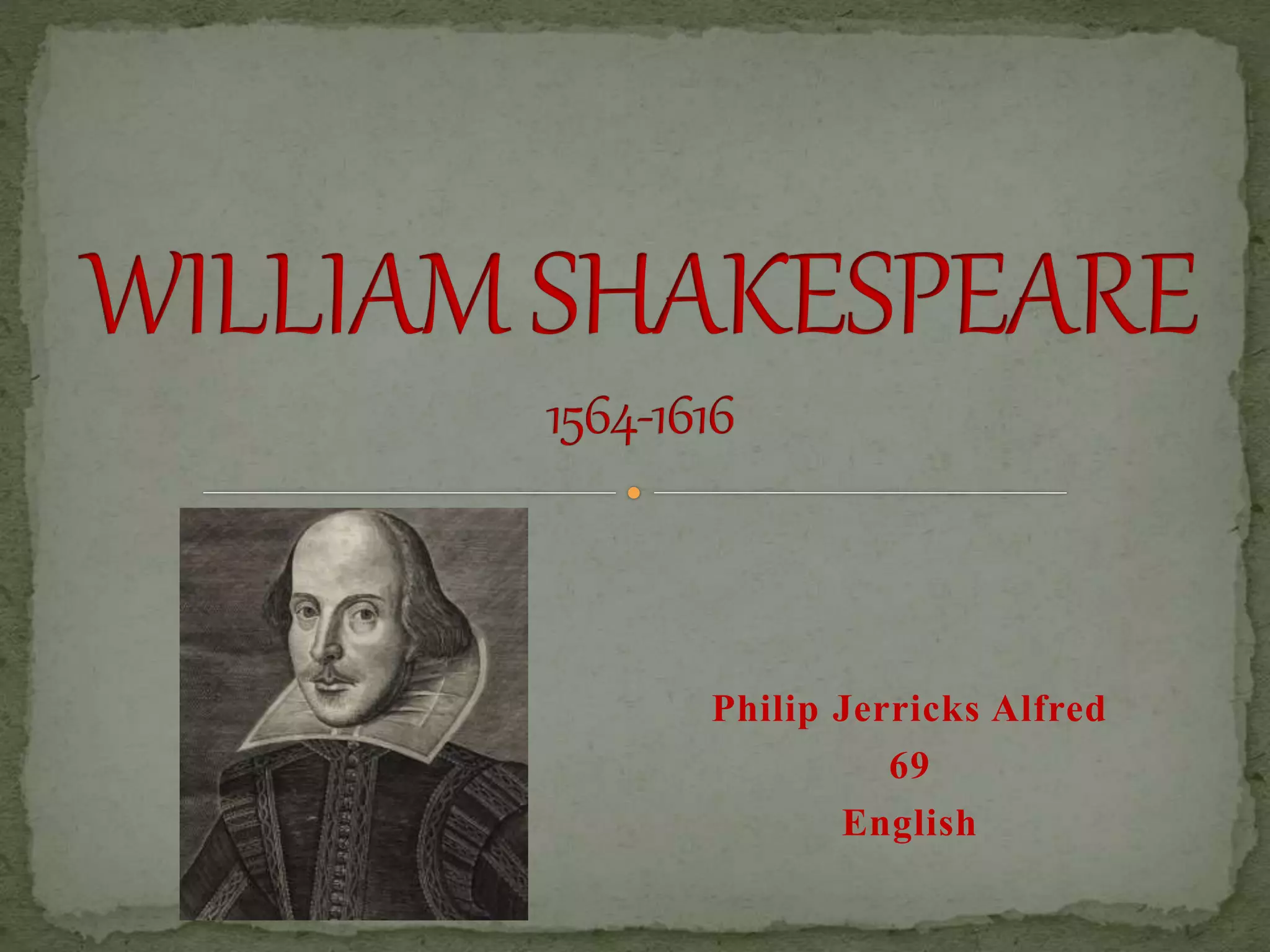
Philip Jerricks Alfred
69
English
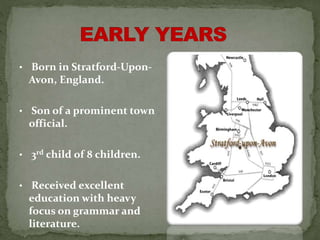
• Born in Stratford-Upon-
Avon, England.
• Son of a prominent town
official.
• 3rd child of 8 children.
• Received excellent
education with heavy
focus on grammar and
literature.
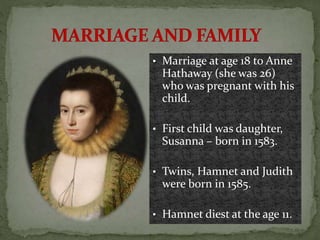
• Marriage at age 18 to Anne
Hathaway (she was 26)
who was pregnant with his
child.
• First child was daughter,
Susanna – born in 1583.
• Twins, Hamnet and Judith
were born in 1585.
• Hamnet diest at the age 11.
The period between 1585 and 1595 is known as the
“Lost Years” because there are no documentary records
of Shakespeare’s activities.
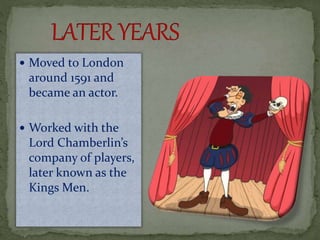
 Moved to London
around 1591 and
became an actor.
 Worked with the
Lord Chamberlin’s
company of players,
later known as the
Kings Men.
 Along with acting, he also wrote some of the most
renowned and studied literature written in the English
Literature.
 Poems – famous for his sonnets
 Plays – Comedies, Tragedies and Histories.
 All’s Well That Ends Well
 As You Like It
 The Comedy of Errors
 Love's Labour's Lost
 Measure for Measure
 The Merchant of Venice
 The Merry Wives of Windsor
 A Midsummer Night's Dream
 Much Ado About Nothing
 The Taming of the Shrew
 The Tempest
 Twelfth Night
 The Two Gentlemen of Verona
 The Winter's Tale
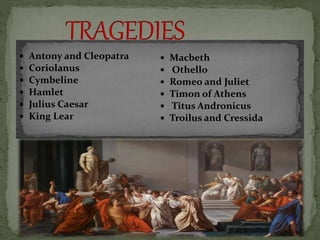
 Antony and Cleopatra
 Coriolanus
 Cymbeline
 Hamlet
 Julius Caesar
 King Lear
 Macbeth
 Othello
 Romeo and Juliet
 Timon of Athens
 Titus Andronicus
 Troilus and Cressida
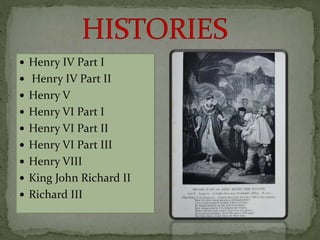
 Henry IV Part I
 Henry IV Part II
 Henry V
 Henry VI Part I
 Henry VI Part II
 Henry VI Part III
 Henry VIII
 King John Richard II
 Richard III
 He wrote 37 very successful plays.
 His vocabulary was so huge – somewhere between
17,000 and 34,000 words!
 The estimated vocabulary of an educated person
today is around 15,000 words.
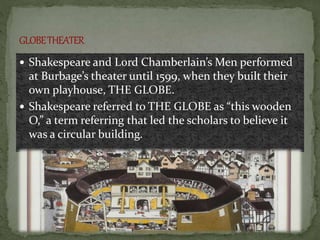
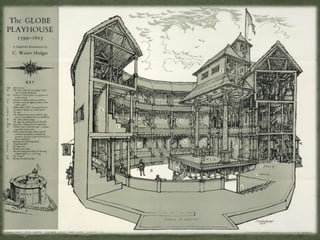
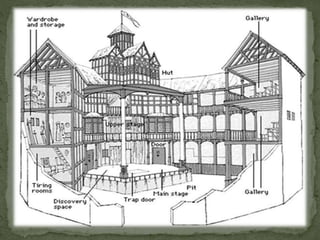
 Shakespeare and Lord Chamberlain’s Men performed
at Burbage’s theater until 1599, when they built their
own playhouse, THE GLOBE.
 Shakespeare referred to THE GLOBE as “this wooden
O,” a term referring that led the scholars to believe it
was a circular building.
 A white flag indicates there is a play today.
 Plays were performed during the day.
 The groundings stood by the stage.
 The wealthy sat in the upper decks.
 Young men dressed up to female roles.
 Attending Shakespeare’s theater was quite different from
attending theater today, which is thought of as very quiet
and austere.
 In Elizabethen England it was a noisy, popular gathering
place for people of all ages and from all walks of life.
 Drinking and eating were permitted in the pit, which often
became very noisy.
 If a spectator did not like a particular character or scene, he
or she would feel free to hiss or boo or even throw anything
he or she might have in hand.
 William Shakespeare returned to Stratford around 1610
where he lived as a country gentleman.
 Wealthy – Owned one of the largest homes in town.
 Died in Stratford in 1616 at the age of 52. His death was a
mystery. It is rumored that he drank too much and
contracted a fever or that he died from a cerebral
hemorrhage.
Shakespeare

Shakespeare

  • 1.
  • 2.
    • Born inStratford-Upon- Avon, England. • Son of a prominent town official. • 3rd child of 8 children. • Received excellent education with heavy focus on grammar and literature.
  • 3.
    • Marriage atage 18 to Anne Hathaway (she was 26) who was pregnant with his child. • First child was daughter, Susanna – born in 1583. • Twins, Hamnet and Judith were born in 1585. • Hamnet diest at the age 11.
  • 4.
    The period between1585 and 1595 is known as the “Lost Years” because there are no documentary records of Shakespeare’s activities.
  • 5.
     Moved toLondon around 1591 and became an actor.  Worked with the Lord Chamberlin’s company of players, later known as the Kings Men.
  • 6.
     Along withacting, he also wrote some of the most renowned and studied literature written in the English Literature.  Poems – famous for his sonnets  Plays – Comedies, Tragedies and Histories.
  • 7.
     All’s WellThat Ends Well  As You Like It  The Comedy of Errors  Love's Labour's Lost  Measure for Measure  The Merchant of Venice  The Merry Wives of Windsor  A Midsummer Night's Dream  Much Ado About Nothing  The Taming of the Shrew  The Tempest  Twelfth Night  The Two Gentlemen of Verona  The Winter's Tale
  • 8.
     Antony andCleopatra  Coriolanus  Cymbeline  Hamlet  Julius Caesar  King Lear  Macbeth  Othello  Romeo and Juliet  Timon of Athens  Titus Andronicus  Troilus and Cressida
  • 9.
     Henry IVPart I  Henry IV Part II  Henry V  Henry VI Part I  Henry VI Part II  Henry VI Part III  Henry VIII  King John Richard II  Richard III
  • 10.
     He wrote37 very successful plays.  His vocabulary was so huge – somewhere between 17,000 and 34,000 words!  The estimated vocabulary of an educated person today is around 15,000 words.
  • 11.
     Shakespeare andLord Chamberlain’s Men performed at Burbage’s theater until 1599, when they built their own playhouse, THE GLOBE.  Shakespeare referred to THE GLOBE as “this wooden O,” a term referring that led the scholars to believe it was a circular building.
  • 13.
     A whiteflag indicates there is a play today.  Plays were performed during the day.  The groundings stood by the stage.  The wealthy sat in the upper decks.  Young men dressed up to female roles.  Attending Shakespeare’s theater was quite different from attending theater today, which is thought of as very quiet and austere.  In Elizabethen England it was a noisy, popular gathering place for people of all ages and from all walks of life.  Drinking and eating were permitted in the pit, which often became very noisy.  If a spectator did not like a particular character or scene, he or she would feel free to hiss or boo or even throw anything he or she might have in hand.
  • 15.
     William Shakespearereturned to Stratford around 1610 where he lived as a country gentleman.  Wealthy – Owned one of the largest homes in town.  Died in Stratford in 1616 at the age of 52. His death was a mystery. It is rumored that he drank too much and contracted a fever or that he died from a cerebral hemorrhage.