
The Stories of IXP Development
and the Way Forward
Che-Hoo Cheng
Infrastructure & Development Director
APNIC
2018-07-20@SGNOG6
Asia Pacific Network Information Centre – APNIC
• APNIC is the Regional Internet Registry administering IP
addresses for the Asia Pacific
• APNIC’s Vision: “A global, open, stable, and secure Internet that
serves the entire Asia Pacific community”
• We achieve this by:
– Serving APNIC Members
– Supporting Regional Internet Development
– Collaborating with the Global Internet Community
How Does Internet Operates?
• Internet is a network of networks, composed of networks of
ISPs and users
• User networks connect to ISPs
• Small ISPs connect to large ISPs
• Various networks (large or small) are interconnected with
one another to form Internet
Autonomous Systems
• A network on Internet is called Autonomous System (AS)
which is represented by AS Number (ASN)
– ASN is unique around the world
• APNIC is in charge of ASN assignment for AP region
– ASN is used together with BGP (Border Gateway Protocol) for
interconnections with multiple networks (or multi-homing)
– Networks having ASNs can be more independent, or portable
• Together with portable IP addresses
What is an Internet eXchange Point (IXP)?
• An IXP is a shared physical network infrastructure over
which various Autonomous Systems can do easy peering
with one another
– One physical connection to IXP can be used for interconnections with
multiple networks
– More cost-effective and scalable
– ASes to be served by IXP include Internet Gateways, Internet Service
Providers (ISPs), Research & Education (R&E) Networks, Cloud
Service Providers, Content Providers and Content Delivery Network
(CDN) Service Providers
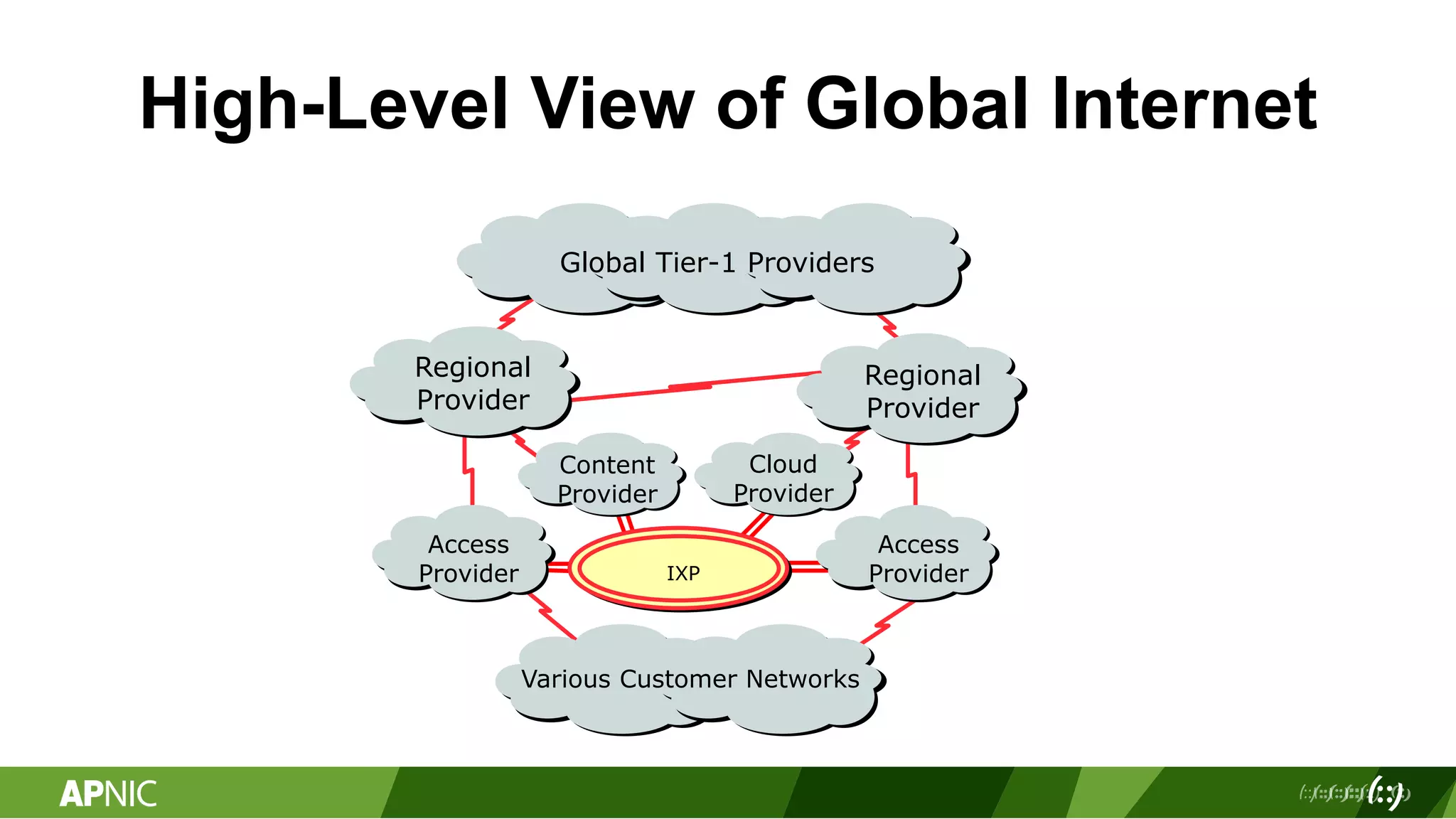
High-Level View of Global Internet
IXPR4
Global Tier-1 Providers
Regional
Provider
Access
Provider
Various Customer Networks
Access
Provider
Regional
Provider
Content
Provider
Cloud
Provider
Benefits of IXP
• One main objective of an IXP is to keep local traffic local
– Important to local Internet development
• Helps bypass 3rd-party network infrastructure for easy interconnection and direct
traffic exchange among participating networks
– Reduced cost – cheaper connectivity
– Enhanced network performance – faster speed
– Reduced latency – lower delay
• Helps encourage development of more local content and local applications
– Helps local data centre business and other businesses
• Everybody is benefited
– The gain for each may be different but all will gain
– At the end, it is the most important that end users or consumers are benefited
• Often considered as Critical Internet Infrastructure locally, regionally or globally
IXPs are Layer-2 Networks
• Switched Ethernet
– One physical connection for interconnections with multiple networks
– Only routers are allowed to connect to the switching fabric directly
• IXP participants can do direct Bilateral Peering (BLPA) over the layer 2
infrastructure anytime
• With Route Server added to the layer 2 infrastructure, IXP participants
can also do Multilateral Peering (MLPA) for easier interconnections
among everybody
– Traffic exchange is not going through the route server but direct
• Those called themselves “IXes” but serving layer-3 services are most
transit providers
Disclaimer
• The next part is more my personal experience and
observations from operating the IXP in HK before joining
APNIC in Apr 2017
– Plus a bit of my additional experience and observations from helping
the development of a few IXPs in the region
• The points to be presented do NOT represent the
viewpoints of APNIC
• Try not to name names as much as possible
• Try to be more interesting and educational
Success Factors of the IXP in HK
• Neutrality
– Helped gain trust from the participants especially the early ones
– But there is no 100% neutrality…
• Competition from another university
– After gaining critical mass, things are much easier
– No need to do sales work at all
• Free Service Initially
– In the first 10 years or so
– Little hesitation for participants to connect
– But cannot be free forever
• Started Early
– Earlier than the incumbent telco starting its ISP business
– They even asked for joining before they launched the service
– History cannot be repeated that easily…
Long-Term Misunderstandings
• Used to mention ”>98% of traffic” a lot
• Government people and general public always think >98%
of external traffic is going through the IXP in HK
– How can that be possibly true?!
– It is just wishful thinking of those people
• But the more accurate wordings should be:
– The IXP in HK helps keep >98% of local traffic local
Other Misunderstandings
• The IXP supports Bilateral Peering since the beginning
– Although it did emphasise Multilateral Peering in the early days
• The IXP is NOT the only IXP in HK
– There are in fact multiple IXPs
• They are mostly commercial
• The IXP is just the earliest and the biggest
– But the other IXPs together are not really small
– Perhaps 70:30
• But the IXP is always the focus
Snowden Nightmare…
• Started from an article of his interview done in HK published at SCMP
on 13 Jun 2013
– Mentioned the name of the university while not mentioned the IXP there…
– But people still thought he was referring to the IXP
• A lot of reporters surrounded the main data centre hoping to find
anomalies
• Grilled by media and politicians for months
• Enhanced physical security measures afterwards
– Stopped all unessential data centre visits
• No findings of anything set up or done by the intelligence agency inside
Vulnerabilities of any IXPs
• Proxy ARP
– Why can’t all router vendors have Proxy ARP disabled as default?
– Cannot stop it totally because of possible human errors
– Can only do regular monitoring by checking the ARP table
– EVPN over VxLAN technology may help but it is not a simple technology
• Unknown Unicast Flooding
– May happen when there is asymmetric routing seen from an IXP
– Can be mitigated by sending proactive ARP check to all active addresses every hour or so
• Shared Buffer over Multiple Switch Ports
– Can cause trouble to multiple connections when there is big congestion on one port
• Unknown to innocent participants which do not have any congestion
– Just be careful when choosing switch models
• Also avoid switch models with small buffer
Port Security Is Important
• The IXP in HK allows just one MAC address per port
(physical or virtual)
– Strictly one IPv4 address, one IPv6 address and one MAC address
per port (physical or virtual)
– Static MAC address for full control
– “Violation Restrict” instead of “Violation Shutdown”
• Minimum protection to the layer-2 broadcast domain
• A few IXPs allow more MAC address per port but still a
small number
Remote Layer-2 Connections to IXP
Are Evil
• Using Fibre Cross-Connect is much easier, with much
fewer issues
• Clear-Channel remote layer-2 circuits with full transparency
are rare
– Unless you are willing to pay more
– Wasting a lot of effort to do trouble-shooting with carriers
• But IXPs cannot afford to not support them
– Unless…
Vulnerabilities of Data Centres?
• Locations are known
– Same for Landing Stations
– Can easily be targets of physical attacks
• How can you better protect the fibre lead-ins and manholes
which are outside of data centres?
Scalability Issue
• IXPs were not supposed to have any packet loss in its infrastructure
– And with very low latency too
• Become an issue when IXP grow beyond one switch
– Due to not enough ports or expanding to multiple sites
• Inter-switch links are the risk
– Over-subscription or not?
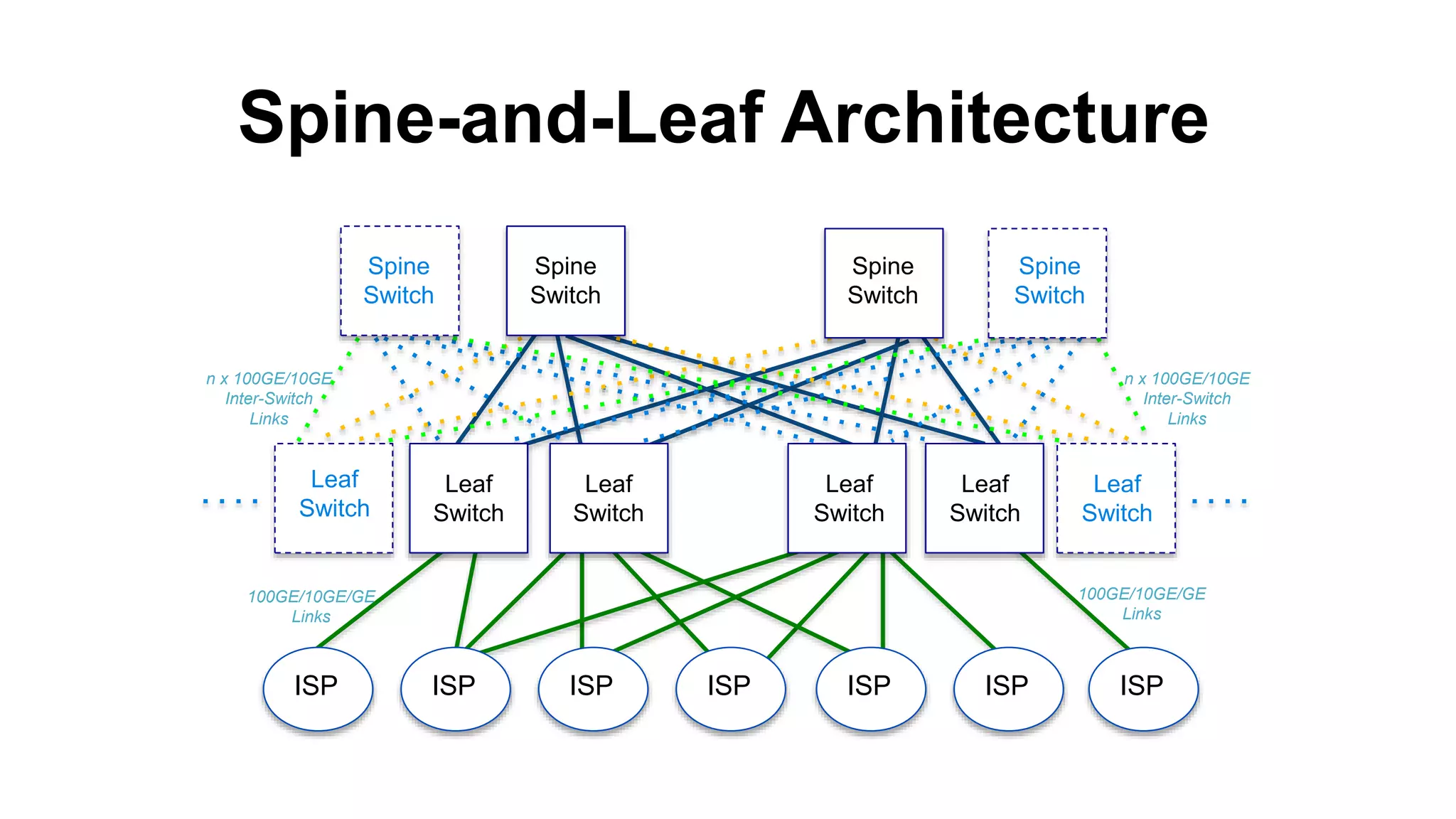
• Spine-and-leaf architecture helps a bit but not for all cases
– Need to determine how much bandwidth from leaf to spine anyway
– Still not ideal if there are adjacent leaf switches at one site
• All traffic among 2 adjacent leaf switches has to go to the spine first?
Spine-and-Leaf Architecture
Spine
Switch
Spine
Switch
Leaf
Switch
Leaf
Switch
Leaf
Switch
n x 100GE/10GE
Inter-Switch
Links
n x 100GE/10GE
Inter-Switch
Links
ISP ISP ISP ISP ISP ISP ISP
Spine
Switch
Spine
Switch
Leaf
Switch
Leaf
Switch
100GE/10GE/GE
Links
100GE/10GE/GE
Links
Leaf
Switch
MRTG of Aggregate Traffic
• It is less sensitive of course
– More an indication of the importance and the growth of an IXP
– Should not neglect the huge difference between showing 5-min data and 1-min data
– Should not neglect what traffic data is included – just the main broadcast domain or what?
• Usually incoming = outgoing
• If incoming > outgoing
– Congestion at at least one port
– May be DDoS attacks
• If outgoing > incoming
– May have Unknown Unicast Flooding
• If sudden drop of large traffic volume
– May have Proxy ARP problem
• Usually happens when change of router / router software / router config
Other Observations from MRTG
• Situation in HK
– Holiday Effect
– Soccer Games Effect
– Typhoon Effect
• Difference of Culture or Practices
– E.g. HK vs Japan
IXPs and Data Centres
• They are natural partners
• Common situation in advanced metro cities
– Multiple IXPs in one Data Centre
– One IXP in multiple Data Centres
• Should be the same layer-2 broadcast domain
– Healthy competition
• Customers have choices
• Also for better resilience
Competition / Comparison among IXPs
• Especially in the same city
• Traffic Volume
– Apple-to-apple?
– 5-min vs 1-min?
– One broadcast domain vs multiple broadcast domains?
– 1Tbps Club…
• Number of ASNs connected
• Number of Ports connected
• Amount of total connected customer bandwidth
IP/ASN Resources for an IXP
• Considered as Critical Infrastructure by APNIC Policy
– Using public IP addresses and ASN is recommended
– IPv4: /24
– IPv6: /48
– ASN: 1 (for route server)
• But IXP may need another network to provide transit
– Own servers such as network management & monitoring
– DNS anycast servers: Authoritative or Cache/Resolving/Recursive
– Shared Content Caches for Participants
– Usually small
IXP Models
• Developed economies vs developing economies
• Non-profit vs commercial
• Subsidized vs self-financed
• Government-led vs industry-led
• No one single model which can suit all situations
• Relative Neutrality is important
Commercial vs Non-Profit
• Commercial set-up is free to do anything
– No need to care about neutrality too much
– IXP is mostly a service to help other business
• Non-profit set-up tends to be more cautious
– Neutrality is more important, at least to the target participants
– Tend to be more independent
– Tend to offer fewer services
IXP across Multiple Cities / Economies
• May not be good for maintaining neutrality
– Considered as competing with participants which have presence in
the same locations
• Especially not good for non-profit IXPs targeting all kinds of
networks or providers
– Those that see competition may not join and it may affect the goal of
“keeping local traffic local”
• Commercial IXPs can take this business risk especially if
this may help their other business
Advanced / Developed Economies
• IXPs are business
– Even for not-for-profit set-up
– Less government involvement
• Multiple IXPs
– Keen competition
• But if they cannot keep intra-economy traffic local, someone
needs to step up
– Government? Industry group?
Developing Economies
• Some do not have any IXPs yet
• Local traffic does not stay local
– A lose-lose situation for everybody
• Starting one IXP is highly recommended
– Better to be non-for-profit set-up
– May need to start with subsidized model
– Help from government is mostly needed
Examples of Pacific Islands
• Far from any other places
• External connectivity is very expensive
– More submarine cables are being built for them
• Small markets because of small population
• Usually just a few ISPs but they may not be interconnected locally
• Local traffic across ISPs usually routed through US or Australia
• Local IXP is very much needed
• Saw immediate benefits on Day 1 of set-up of one Pacific Island IXP
– Much improved latency and high volume of traffic
Politics Involved in Early IXP Development
• Usually larger ISPs like IXP less than smaller ISPs because
smaller ISPs are mostly target customers of larger ISPs
• Larger ISPs refuse to connect to IXP making the value of IXP
lower
• There are multiple possible solutions for that but in any case,
larger ISPs need to collaborate
– Separating access networks from Internet gateway or transit network
• If hurting the goal of “Keeping Local Traffic Local”, then it is lose-
lose to everybody
• Government involvement may help or may hurt the case
Government Funding for IXPs?
• Is it good or bad?
• More needed during infancy stage of IXP development
• But for long-term, it is probably better to have bottom-up
industry-led governance for IXP
– Align with bottom-up multi-stakeholder approach
Steps for IXP Development
• Can be gradual, step by step
• Layer-2 network is the bare minimal
– Can use private IP addresses if small amount of participants
• Public IP addresses next
– Legal entity issue
• Route server(s) with ASN follows
– RPKI consideration
• Other value added services
– DNS: Root / TLDs / Recursive
– Shared Content Caches?
Shared Content Caches?
• A lot of misunderstandings about the use of caches
• A lot of local IXPs want to provide shared caches for their
participants
– Cost recovery is an issue to them though
• Most Content / CDN providers do not quite like this idea
– Little performance gain to end users?
– Out of their control?
– Not cost justified for smaller local IXPs?
IXP Participants
• Unfortunately, a lot of IXP participants do not make the best
use of the IXP(s) they have connected
• IXP Participants without enough knowledge and skills may
disrupt the operations of IXP from time to time
• IXP operators need to do a lot of education or push to their
participants
• So, IXP engineers would be busy and dedicated resources
would be needed
– Volunteering type of operations mode cannot sustain for too long
Myth of Neutrality
• There is NO absolute neutrality
• Different organisation has different perspective of neutrality
– A university?
– A carrier-neutral data centre?
– An IXP?
– A government department?
– A membership-based organisation?
• We can only be “very neutral” for a defined group of companies
or organisations, but not for all…
• But maintaining higher relative neutrality is still good for IXPs
Which Models Can Sustain?
• Subsidized Model
– Government funding may be more reliable
• Model relying on sponsorship and/or volunteers
– Most risky
• Normal business model
– Cannot make big money
– May need to become a value added service
• Membership-based Model
– Proper governance is important
– Most neutral but still need to have good financial model
Threats to Most IXPs
• /Mbps pricing of IP transit bandwidth is dropping continuously
– Partly because of price drop of submarine cable capacity
– /Mbps pricing of IXPs cannot be dropped as fast because of different
cost base
• Equipment cost doesn’t drop a lot especially for high-end switches
• Local loop cost involved for interconnecting multiple sites does not drop as fast
• More and more content caches are being set up inside the
access networks
– But bandwidth is still needed for cache-fill
• Private peering will take away traffic from IXPs
– If traffic volume warrants between any two parties
The Way Forward for IXPs
• It is tough business if you only do IXP business
– Fighting for survival
• Value Added Services
– PNNI over VLANs, GRX, Cloud Exchange, GXP and etc
• Partnership
– Partnering with multiple Data Centres
– Partnering with multiple local loop providers
– Recruit resellers – local & overseas/global
• Expand overseas
– A few European IXPs are doing this
• Merger and Acquisition
– Even non-profit set-up should get ready for this
IXP Development Work of APNIC
• APNIC strongly believes IXPs help Internet development
– That is why we support APIX and related activities
– After all, IXPs serve and benefit APNIC members
– In fact, IXPs need IP addresses and ASNs and are APNIC members themselves
• Do more on helping those developing and under-developed economies
– Especially those which do not have any IXP yet
– Or those which their only IXP is not functioning
• Training and Technical Assistance work primarily
– Not just for IXP operators but also for IXP participants
– Also help talk to major stakeholders to convince them of the benefits of having a
local IXP while maintaining neutrality
– May need help of Community Trainers and Consultants from time to time
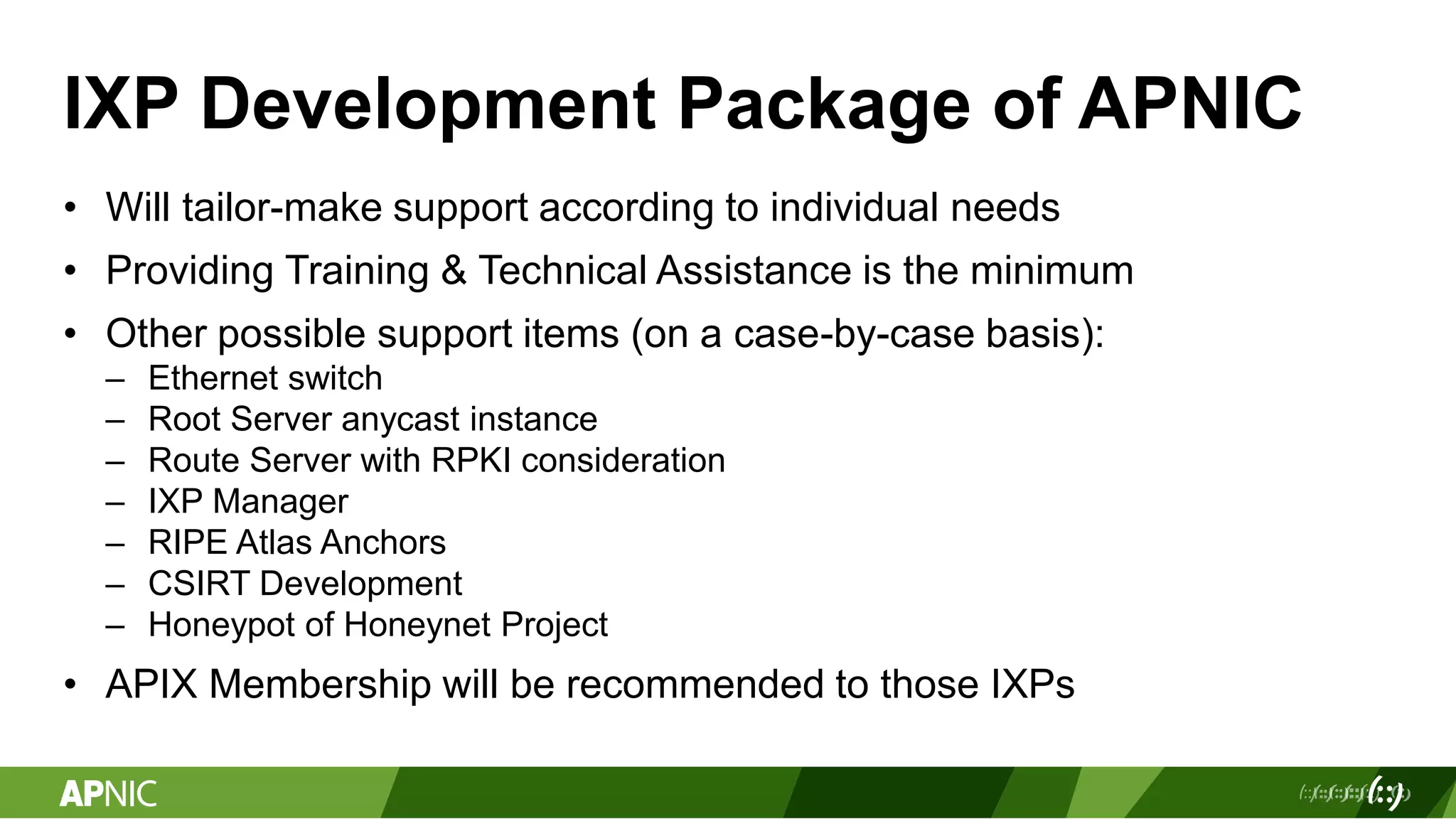
IXP Development Package of APNIC
• Will tailor-make support according to individual needs
• Providing Training & Technical Assistance is the minimum
• Other possible support items (on a case-by-case basis):
– Ethernet switch
– Root Server anycast instance
– Route Server with RPKI consideration
– IXP Manager
– RIPE Atlas Anchors
– CSIRT Development
– Honeypot of Honeynet Project
• APIX Membership will be recommended to those IXPs
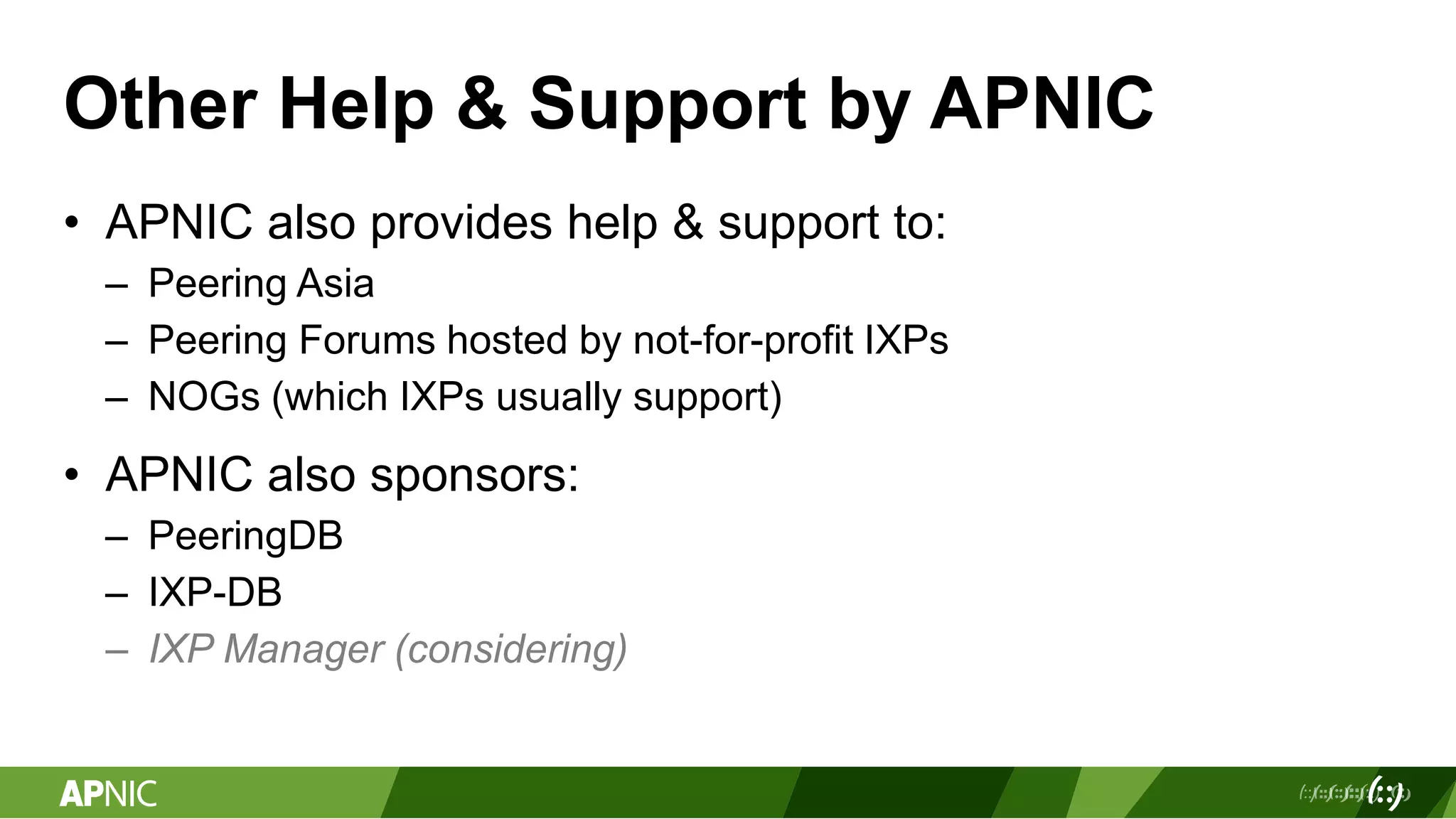
Other Help & Support by APNIC
• APNIC also provides help & support to:
– Peering Asia
– Peering Forums hosted by not-for-profit IXPs
– NOGs (which IXPs usually support)
• APNIC also sponsors:
– PeeringDB
– IXP-DB
– IXP Manager (considering)
SGNOG 6: The stories of IXP development and the way forward

SGNOG 6: The stories of IXP development and the way forward

  • 1.
    The Stories ofIXP Development and the Way Forward Che-Hoo Cheng Infrastructure & Development Director APNIC 2018-07-20@SGNOG6
  • 2.
    Asia Pacific NetworkInformation Centre – APNIC • APNIC is the Regional Internet Registry administering IP addresses for the Asia Pacific • APNIC’s Vision: “A global, open, stable, and secure Internet that serves the entire Asia Pacific community” • We achieve this by: – Serving APNIC Members – Supporting Regional Internet Development – Collaborating with the Global Internet Community
  • 3.
    How Does InternetOperates? • Internet is a network of networks, composed of networks of ISPs and users • User networks connect to ISPs • Small ISPs connect to large ISPs • Various networks (large or small) are interconnected with one another to form Internet
  • 4.
    Autonomous Systems • Anetwork on Internet is called Autonomous System (AS) which is represented by AS Number (ASN) – ASN is unique around the world • APNIC is in charge of ASN assignment for AP region – ASN is used together with BGP (Border Gateway Protocol) for interconnections with multiple networks (or multi-homing) – Networks having ASNs can be more independent, or portable • Together with portable IP addresses
  • 5.
    What is anInternet eXchange Point (IXP)? • An IXP is a shared physical network infrastructure over which various Autonomous Systems can do easy peering with one another – One physical connection to IXP can be used for interconnections with multiple networks – More cost-effective and scalable – ASes to be served by IXP include Internet Gateways, Internet Service Providers (ISPs), Research & Education (R&E) Networks, Cloud Service Providers, Content Providers and Content Delivery Network (CDN) Service Providers
  • 6.
    High-Level View ofGlobal Internet IXPR4 Global Tier-1 Providers Regional Provider Access Provider Various Customer Networks Access Provider Regional Provider Content Provider Cloud Provider
  • 7.
    Benefits of IXP •One main objective of an IXP is to keep local traffic local – Important to local Internet development • Helps bypass 3rd-party network infrastructure for easy interconnection and direct traffic exchange among participating networks – Reduced cost – cheaper connectivity – Enhanced network performance – faster speed – Reduced latency – lower delay • Helps encourage development of more local content and local applications – Helps local data centre business and other businesses • Everybody is benefited – The gain for each may be different but all will gain – At the end, it is the most important that end users or consumers are benefited • Often considered as Critical Internet Infrastructure locally, regionally or globally
  • 8.
    IXPs are Layer-2Networks • Switched Ethernet – One physical connection for interconnections with multiple networks – Only routers are allowed to connect to the switching fabric directly • IXP participants can do direct Bilateral Peering (BLPA) over the layer 2 infrastructure anytime • With Route Server added to the layer 2 infrastructure, IXP participants can also do Multilateral Peering (MLPA) for easier interconnections among everybody – Traffic exchange is not going through the route server but direct • Those called themselves “IXes” but serving layer-3 services are most transit providers
  • 9.
    Disclaimer • The nextpart is more my personal experience and observations from operating the IXP in HK before joining APNIC in Apr 2017 – Plus a bit of my additional experience and observations from helping the development of a few IXPs in the region • The points to be presented do NOT represent the viewpoints of APNIC • Try not to name names as much as possible • Try to be more interesting and educational
  • 10.
    Success Factors ofthe IXP in HK • Neutrality – Helped gain trust from the participants especially the early ones – But there is no 100% neutrality… • Competition from another university – After gaining critical mass, things are much easier – No need to do sales work at all • Free Service Initially – In the first 10 years or so – Little hesitation for participants to connect – But cannot be free forever • Started Early – Earlier than the incumbent telco starting its ISP business – They even asked for joining before they launched the service – History cannot be repeated that easily…
  • 11.
    Long-Term Misunderstandings • Usedto mention ”>98% of traffic” a lot • Government people and general public always think >98% of external traffic is going through the IXP in HK – How can that be possibly true?! – It is just wishful thinking of those people • But the more accurate wordings should be: – The IXP in HK helps keep >98% of local traffic local
  • 12.
    Other Misunderstandings • TheIXP supports Bilateral Peering since the beginning – Although it did emphasise Multilateral Peering in the early days • The IXP is NOT the only IXP in HK – There are in fact multiple IXPs • They are mostly commercial • The IXP is just the earliest and the biggest – But the other IXPs together are not really small – Perhaps 70:30 • But the IXP is always the focus
  • 13.
    Snowden Nightmare… • Startedfrom an article of his interview done in HK published at SCMP on 13 Jun 2013 – Mentioned the name of the university while not mentioned the IXP there… – But people still thought he was referring to the IXP • A lot of reporters surrounded the main data centre hoping to find anomalies • Grilled by media and politicians for months • Enhanced physical security measures afterwards – Stopped all unessential data centre visits • No findings of anything set up or done by the intelligence agency inside
  • 14.
    Vulnerabilities of anyIXPs • Proxy ARP – Why can’t all router vendors have Proxy ARP disabled as default? – Cannot stop it totally because of possible human errors – Can only do regular monitoring by checking the ARP table – EVPN over VxLAN technology may help but it is not a simple technology • Unknown Unicast Flooding – May happen when there is asymmetric routing seen from an IXP – Can be mitigated by sending proactive ARP check to all active addresses every hour or so • Shared Buffer over Multiple Switch Ports – Can cause trouble to multiple connections when there is big congestion on one port • Unknown to innocent participants which do not have any congestion – Just be careful when choosing switch models • Also avoid switch models with small buffer
  • 15.
    Port Security IsImportant • The IXP in HK allows just one MAC address per port (physical or virtual) – Strictly one IPv4 address, one IPv6 address and one MAC address per port (physical or virtual) – Static MAC address for full control – “Violation Restrict” instead of “Violation Shutdown” • Minimum protection to the layer-2 broadcast domain • A few IXPs allow more MAC address per port but still a small number
  • 16.
    Remote Layer-2 Connectionsto IXP Are Evil • Using Fibre Cross-Connect is much easier, with much fewer issues • Clear-Channel remote layer-2 circuits with full transparency are rare – Unless you are willing to pay more – Wasting a lot of effort to do trouble-shooting with carriers • But IXPs cannot afford to not support them – Unless…
  • 17.
    Vulnerabilities of DataCentres? • Locations are known – Same for Landing Stations – Can easily be targets of physical attacks • How can you better protect the fibre lead-ins and manholes which are outside of data centres?
  • 18.
    Scalability Issue • IXPswere not supposed to have any packet loss in its infrastructure – And with very low latency too • Become an issue when IXP grow beyond one switch – Due to not enough ports or expanding to multiple sites • Inter-switch links are the risk – Over-subscription or not? • Spine-and-leaf architecture helps a bit but not for all cases – Need to determine how much bandwidth from leaf to spine anyway – Still not ideal if there are adjacent leaf switches at one site • All traffic among 2 adjacent leaf switches has to go to the spine first?
  • 19.
    Spine-and-Leaf Architecture Spine Switch Spine Switch Leaf Switch Leaf Switch Leaf Switch n x100GE/10GE Inter-Switch Links n x 100GE/10GE Inter-Switch Links ISP ISP ISP ISP ISP ISP ISP Spine Switch Spine Switch Leaf Switch Leaf Switch 100GE/10GE/GE Links 100GE/10GE/GE Links Leaf Switch
  • 20.
    MRTG of AggregateTraffic • It is less sensitive of course – More an indication of the importance and the growth of an IXP – Should not neglect the huge difference between showing 5-min data and 1-min data – Should not neglect what traffic data is included – just the main broadcast domain or what? • Usually incoming = outgoing • If incoming > outgoing – Congestion at at least one port – May be DDoS attacks • If outgoing > incoming – May have Unknown Unicast Flooding • If sudden drop of large traffic volume – May have Proxy ARP problem • Usually happens when change of router / router software / router config
  • 21.
    Other Observations fromMRTG • Situation in HK – Holiday Effect – Soccer Games Effect – Typhoon Effect • Difference of Culture or Practices – E.g. HK vs Japan
  • 22.
    IXPs and DataCentres • They are natural partners • Common situation in advanced metro cities – Multiple IXPs in one Data Centre – One IXP in multiple Data Centres • Should be the same layer-2 broadcast domain – Healthy competition • Customers have choices • Also for better resilience
  • 23.
    Competition / Comparisonamong IXPs • Especially in the same city • Traffic Volume – Apple-to-apple? – 5-min vs 1-min? – One broadcast domain vs multiple broadcast domains? – 1Tbps Club… • Number of ASNs connected • Number of Ports connected • Amount of total connected customer bandwidth
  • 24.
    IP/ASN Resources foran IXP • Considered as Critical Infrastructure by APNIC Policy – Using public IP addresses and ASN is recommended – IPv4: /24 – IPv6: /48 – ASN: 1 (for route server) • But IXP may need another network to provide transit – Own servers such as network management & monitoring – DNS anycast servers: Authoritative or Cache/Resolving/Recursive – Shared Content Caches for Participants – Usually small
  • 25.
    IXP Models • Developedeconomies vs developing economies • Non-profit vs commercial • Subsidized vs self-financed • Government-led vs industry-led • No one single model which can suit all situations • Relative Neutrality is important
  • 26.
    Commercial vs Non-Profit •Commercial set-up is free to do anything – No need to care about neutrality too much – IXP is mostly a service to help other business • Non-profit set-up tends to be more cautious – Neutrality is more important, at least to the target participants – Tend to be more independent – Tend to offer fewer services
  • 27.
    IXP across MultipleCities / Economies • May not be good for maintaining neutrality – Considered as competing with participants which have presence in the same locations • Especially not good for non-profit IXPs targeting all kinds of networks or providers – Those that see competition may not join and it may affect the goal of “keeping local traffic local” • Commercial IXPs can take this business risk especially if this may help their other business
  • 28.
    Advanced / DevelopedEconomies • IXPs are business – Even for not-for-profit set-up – Less government involvement • Multiple IXPs – Keen competition • But if they cannot keep intra-economy traffic local, someone needs to step up – Government? Industry group?
  • 29.
    Developing Economies • Somedo not have any IXPs yet • Local traffic does not stay local – A lose-lose situation for everybody • Starting one IXP is highly recommended – Better to be non-for-profit set-up – May need to start with subsidized model – Help from government is mostly needed
  • 30.
    Examples of PacificIslands • Far from any other places • External connectivity is very expensive – More submarine cables are being built for them • Small markets because of small population • Usually just a few ISPs but they may not be interconnected locally • Local traffic across ISPs usually routed through US or Australia • Local IXP is very much needed • Saw immediate benefits on Day 1 of set-up of one Pacific Island IXP – Much improved latency and high volume of traffic
  • 31.
    Politics Involved inEarly IXP Development • Usually larger ISPs like IXP less than smaller ISPs because smaller ISPs are mostly target customers of larger ISPs • Larger ISPs refuse to connect to IXP making the value of IXP lower • There are multiple possible solutions for that but in any case, larger ISPs need to collaborate – Separating access networks from Internet gateway or transit network • If hurting the goal of “Keeping Local Traffic Local”, then it is lose- lose to everybody • Government involvement may help or may hurt the case
  • 32.
    Government Funding forIXPs? • Is it good or bad? • More needed during infancy stage of IXP development • But for long-term, it is probably better to have bottom-up industry-led governance for IXP – Align with bottom-up multi-stakeholder approach
  • 33.
    Steps for IXPDevelopment • Can be gradual, step by step • Layer-2 network is the bare minimal – Can use private IP addresses if small amount of participants • Public IP addresses next – Legal entity issue • Route server(s) with ASN follows – RPKI consideration • Other value added services – DNS: Root / TLDs / Recursive – Shared Content Caches?
  • 34.
    Shared Content Caches? •A lot of misunderstandings about the use of caches • A lot of local IXPs want to provide shared caches for their participants – Cost recovery is an issue to them though • Most Content / CDN providers do not quite like this idea – Little performance gain to end users? – Out of their control? – Not cost justified for smaller local IXPs?
  • 35.
    IXP Participants • Unfortunately,a lot of IXP participants do not make the best use of the IXP(s) they have connected • IXP Participants without enough knowledge and skills may disrupt the operations of IXP from time to time • IXP operators need to do a lot of education or push to their participants • So, IXP engineers would be busy and dedicated resources would be needed – Volunteering type of operations mode cannot sustain for too long
  • 36.
    Myth of Neutrality •There is NO absolute neutrality • Different organisation has different perspective of neutrality – A university? – A carrier-neutral data centre? – An IXP? – A government department? – A membership-based organisation? • We can only be “very neutral” for a defined group of companies or organisations, but not for all… • But maintaining higher relative neutrality is still good for IXPs
  • 37.
    Which Models CanSustain? • Subsidized Model – Government funding may be more reliable • Model relying on sponsorship and/or volunteers – Most risky • Normal business model – Cannot make big money – May need to become a value added service • Membership-based Model – Proper governance is important – Most neutral but still need to have good financial model
  • 38.
    Threats to MostIXPs • /Mbps pricing of IP transit bandwidth is dropping continuously – Partly because of price drop of submarine cable capacity – /Mbps pricing of IXPs cannot be dropped as fast because of different cost base • Equipment cost doesn’t drop a lot especially for high-end switches • Local loop cost involved for interconnecting multiple sites does not drop as fast • More and more content caches are being set up inside the access networks – But bandwidth is still needed for cache-fill • Private peering will take away traffic from IXPs – If traffic volume warrants between any two parties
  • 39.
    The Way Forwardfor IXPs • It is tough business if you only do IXP business – Fighting for survival • Value Added Services – PNNI over VLANs, GRX, Cloud Exchange, GXP and etc • Partnership – Partnering with multiple Data Centres – Partnering with multiple local loop providers – Recruit resellers – local & overseas/global • Expand overseas – A few European IXPs are doing this • Merger and Acquisition – Even non-profit set-up should get ready for this
  • 40.
    IXP Development Workof APNIC • APNIC strongly believes IXPs help Internet development – That is why we support APIX and related activities – After all, IXPs serve and benefit APNIC members – In fact, IXPs need IP addresses and ASNs and are APNIC members themselves • Do more on helping those developing and under-developed economies – Especially those which do not have any IXP yet – Or those which their only IXP is not functioning • Training and Technical Assistance work primarily – Not just for IXP operators but also for IXP participants – Also help talk to major stakeholders to convince them of the benefits of having a local IXP while maintaining neutrality – May need help of Community Trainers and Consultants from time to time
  • 41.
    IXP Development Packageof APNIC • Will tailor-make support according to individual needs • Providing Training & Technical Assistance is the minimum • Other possible support items (on a case-by-case basis): – Ethernet switch – Root Server anycast instance – Route Server with RPKI consideration – IXP Manager – RIPE Atlas Anchors – CSIRT Development – Honeypot of Honeynet Project • APIX Membership will be recommended to those IXPs
  • 42.
    Other Help &Support by APNIC • APNIC also provides help & support to: – Peering Asia – Peering Forums hosted by not-for-profit IXPs – NOGs (which IXPs usually support) • APNIC also sponsors: – PeeringDB – IXP-DB – IXP Manager (considering)