ANAHAT VIKRAM
ELP-CPM-05
CASE STUDY
GUJRAT INTERNATIONAL
FINANCE TEC-CITY
INTRODUCTION TO THE PROJECT
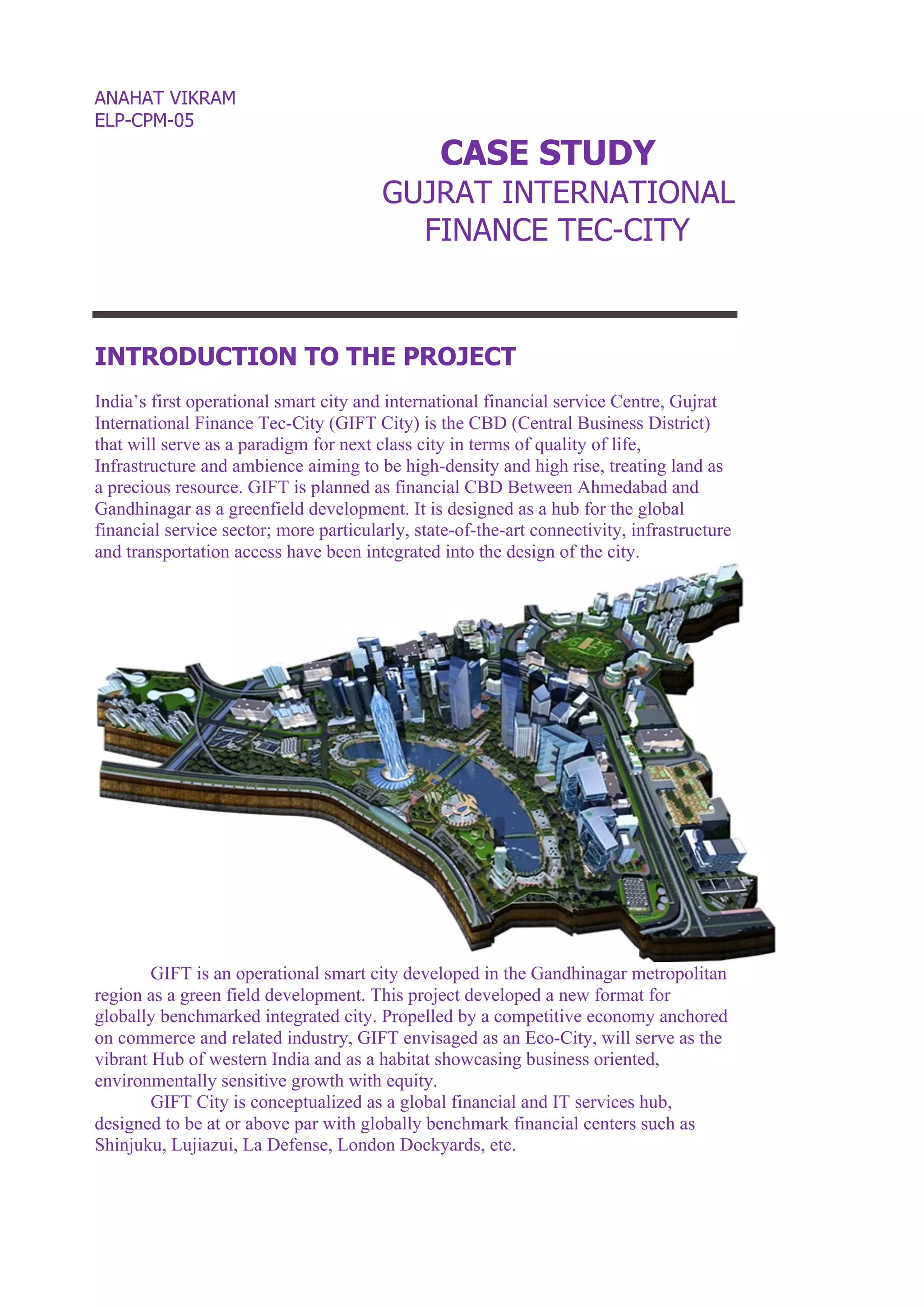
India’s first operational smart city and international financial service Centre, Gujrat
International Finance Tec-City (GIFT City) is the CBD (Central Business District)
that will serve as a paradigm for next class city in terms of quality of life,
Infrastructure and ambience aiming to be high-density and high rise, treating land as
a precious resource. GIFT is planned as financial CBD Between Ahmedabad and
Gandhinagar as a greenfield development. It is designed as a hub for the global
financial service sector; more particularly, state-of-the-art connectivity, infrastructure
and transportation access have been integrated into the design of the city.
GIFT is an operational smart city developed in the Gandhinagar metropolitan
region as a green field development. This project developed a new format for
globally benchmarked integrated city. Propelled by a competitive economy anchored
on commerce and related industry, GIFT envisaged as an Eco-City, will serve as the
vibrant Hub of western India and as a habitat showcasing business oriented,
environmentally sensitive growth with equity.
GIFT City is conceptualized as a global financial and IT services hub,
designed to be at or above par with globally benchmark financial centers such as
Shinjuku, Lujiazui, La Defense, London Dockyards, etc.
2
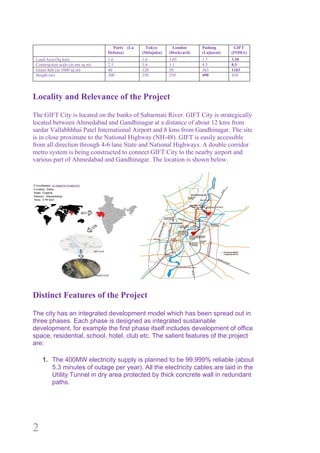
Paris (La
Defense)
Tokyo
(Shinjuku)
London
(Dockyard)
Pudong
(Lujiazui)
GIFT
(INDIA)
Land Area (Sq km) 1.6 1.6 1.05 1.7 3.58
Construction scale (in mn sq m) 2.5 1.6 1.1 4.5 8.5
Green belt (in 1000 sq m) 40 120 50 363 1183
Height (m) 200 250 250 490 410
Locality and Relevance of the Project
The GIFT City is located on the banks of Sabarmati River. GIFT City is strategically
located between Ahmedabad and Gandhinagar at a distance of about 12 kms from
sardar Vallabhbhai Patel International Airport and 8 kms from Gandhinagar. The site
is in close proximate to the National Highway (NH-48). GIFT is easily accessible
from all direction through 4-6 lane State and National Highways. A double corridor
metro system is being constructed to connect GIFT City to the nearby airport and
various part of Ahmedabad and Gandhinagar. The location is shown below.
Distinct Features of the Project
The city has an integrated development model which has been spread out in
three phases. Each phase is designed as integrated sustainable
development, for example the first phase itself includes development of office
space, residential, school, hotel, club etc. The salient features of the project
are:
1. The 400MW electricity supply is planned to be 99.999% reliable (about
5.3 minutes of outage per year). All the electricity cables are laid in the
Utility Tunnel in dry area protected by thick concrete wall in redundant
paths.
3
2. Natural gas is distributed to every house and building via pipes, which
is cheaper and safer than cylinders. Gas supply to the City is done
from the existing gas network of GSPL, the state-owned company for
gas transmission pipelines. Piped natural gas is already in distribution
in the nearby cities of Ahmedabad and Gandhinagar.
3. India's first city-level DCS (district cooling system) is operational at
GIFT City. It reduces the operational cost by 30-40% and avoids the
capital cost of implementing individual air conditioner in each building.
4. All waste in the city are collected and taken to processing plant by
vacuum chutes installed at every floor of all buildings . The waste is
automatically sucked through underground chutes at a high speed of
90 km/h (56 mph), and is being treated through various methods
including Plasma Gasification plasma gasification.
5. GIFT aims at providing a transportation network that ensures
accessibility, easy and fast mobility and accidental free traffic. This is
being achieved by:
A. Using a multimodal mix of transport systems (MRTS/LRTS/BRTS, etc.)
for both intercity transport (to Ahmedabad, Airport, and Gandhinagar)
and intra-city transport.
B. Using a walk-to-work concept as part of urban planning with a nodal
split of 10:90 between private and public transport.
C. Use of electric personal rapid transit systems within the city.
GIFT City will also have its own metro stations and will be connected
to Ahmedabad metro network by March 2024.
Indian Railways railway lines pass the city on the east and west sides; the
closest stations are in Dabhoda and Naroda.
Project Countenances
The idea for GIFT was conceived during the Vibrant Gujarat Global Investor
Summit 2007 and the initial planning was done by East China Architectural
Design & Research Institute (ECADI), which is credited with planning of much
of modern-day Shanghai .GIFT City’s Master Plan is for the 359 hectares
(886 acres) of land area to have approximately ~110 buildings with
~5,800,000 m2
(62,000,000 sq. ft) of built-up area, of which around 67% is
commercial, 22% is for residential and 11% is social facilities. Currently
~190,000 m2
(2,000,000 sq. ft) of commercial space is operational, and
another 280,000 m2
(3,000,000 sq. ft) is under development. As of now an
investment of Rs 10,500 crore has already been committed for GIFT City.
To develop and implement the project, the government of Gujrat through its
undertaking Gujrat Urban Development Company Limited (GUDCL) and
Infrastructure Leasing & Financial Service Limited (IL&FS) have established a
4
50:50 joint venture company, “Gujrat International Finance Tec-City Company
Limited” (GIFTCL).
Gujrat Urban Development Company Limited (GUDCL): GUDCL
facilitates urban development by assisting state government in formulation of
policy, institutional capacity building, project implementation, and in rising
funds from multilateral agencies for urban projects.
Infrastructure Leasing & Financial Services Ltd (IL&FS): Incorporated in
1987 the business architecture of IL&FS focuses on providing services in
development of core infrastructure areas suitably complemented with an
array of financial services. The various businesses are conducted through
subsidiaries with IL&FS being a principal shareholder in each. IL&FS has
catalysed over USD 8 Billion of infrastructure projects and is currently
working on several innovative projects mostly based on PPP format.
Consultants:
1. Design and Architecture – East China Architectural Design &
Research Institute (ECADI) and Fairwood Consultants, India.
2. ICT Advisory Services – British Telecom
3. Market Demand Assessment – Mckinsey & Company
4. Talent Demand Assessment – Hewitt Associates
5. Environmental Assessment – IL&FS Ecosmart Ltd
6. Process Management – IL&FS Infrastructure Development
Corporation Ltd.
7. Power Management – ABB Group
Different Phases of Project
[A] Pre-Construction Phase:
Presenting key of GIFT City to the Prime Minister, Shri Narendra Modi, at the inauguration ceremony of the India
International Exchange in GIFT City
The idea for GIFT was conceived during the Vibrant Gujarat Global Investor
Summit 2007 and the initial planning was done by East China Architectural
Design & Research Institute (ECADI), which is credited with planning of much
of modern-day Shanghai .GIFT City’s Master Plan is for the 359 hectares
(886 acres) of land area to have approximately ~110 buildings with
5
~5,800,000 m2
(62,000,000 sq. ft) of built-up area, of which around 67% is
commercial, 22% is for residential and 11% is social facilities.
§ Government of Gujrat earmarked 886 acres of land for GIFT Project,
out of 886 Acre; 673 Acre of land is in possession of GIFT.
§ IL&FS Township & Urban Asset Limited (ITUAL) has taken 7.77 mn
sq. ft of Built Up Area (BUA) in Phase I of GIFT Project.
§ Inauguration of "GIFT ONE" Gujarat's tallest tower in GIFT City by
Hon'ble Chief Minister Narendra Modi, on 10 January 2013.
§ Foundation stone Laying by Narsee Monjee Education Trust for
Development of School at GIFT, on 15 August 2013.
§ Foundation stone Laying by Smart ICT Pvt Ltd. (consortium led by
TATA Communication) for Development of Tier IV Data Centre at
GIFT, on 15 December 2013.
§ Allotment of total 1.5mn Sq. ft of BUA made to WTC Noida
Development Company Ltd. for development of Gujarat's first World
Trade Centre (WTC) at GIFT City, on 15 February 2014 for
development of commercial offices and residential service apartments.
§ Allotment of 0.2mn Sq. ft of BUA made to State Bank of India (SBI),
India's largest public sector bank for development of their Commercial
Tower at GIFT City, on 15 February 2014.
§ Allotment of 0.25mn Sq. ft of BUA made to Sterling Addlife India Pvt.
Ltd. for development of 200 beds multispecialty Hospital at GIFT City,
on 15 February 2014.
§ Allotment of 0.2mn Sq. ft of BUA made to Global Insurance Services
(India) Ltd. for development of Skill Development & Training Centre at
GIFT City, on 15 February 2014.
§ Allotment of aggregate 0.55mn Sq. ft of BUA made to two developers:
Sangath Infrastructure Pvt. Ltd. & B. U Bhandari Projects for
development of Residential Towers in GIFT City on 10 April 2014 and
14 April 2014 respectively.
§ Foundation Stone Laying by West India Hospitality Limited for
Development of GIFT International Centre (Business Club) at GIFT
City, on 3 October 2014.
§ Allotment of 1.1 mn Sq. ft of BUA made to developer Brigade
Enterprises Ltd. for development of Commercial, Residential, Hotel &
Retail Mall in GIFT SEZ & Non SEZ Area on 9 October 2014.
§ Allotment of 0.25mn Sq. ft of BUA made to developer Hiranandani
Group for development of Commercial Tower in GIFT SEZ Area on 9
October 2014.
§ Allotment made of around 0.5 mn Sq. ft of BUA issued to BSE Brokers'
Forum for development of Commercial Building for members of BSE
Brokers' Forum at GIFT City, on 28 November 2014.
6
[B] Construction Phase:
Phase1: Two commercial towers, each of 28 floors called the GIFT ONE and
GIFT TWO have been finished. Tendering for the next bunch of towers is going
on. This phase will also include building up of basic infrastructure.
Phase2: The second phase construction has already begun and the
Hiranandani Signature building has been built which hosts India International
exchange. The WTC is under construction apart from a couple of buildings as
part of the SEZ. The road connectivity to and in GIFT City has increased with
the construction of new roads.
[C] Current status of Construction:
7
§ Currently 10 buildings are operational .Another 05 buildings are under
construction.
§ GIFT City has already allotted development rights of around 11 Million
sq. feet.
§ Currently approximately 12000 people are working in BFSI & IT & ITeS
sector .
§ A TIA-942 certified TIER IV datacentre is operational in the city with rack
capacity of 900 racks.
§ GIFT City has functional City Command & Control Centre C-4 . This is
an IoT based C-4 where are all public utilities are monitored & managed.
§ Public infrastructure in GIFT CITY is based on concept of 'Predictive
Maintenance'.
§ A world class Corporate Club named ' GIFT Club ' is operational and
very popular in the vicinity.
§ A five star Hotel 'Grand Mercure' by one of the world’s biggest hotel
chain ' Accor Hospitality' is operational in GIFT City with 95 rooms.
§ Currently there are two International Stock Exchanges named 'Indian
International' & 'NSE International' are operational in the city with daily
turnover of approximately 5 billion US$.
§ GIFT City is governed by GUDA ( GIFT Urban Development Authority ).
§ GUDC is designated as Area Development Authority for the GIFT
Project.
§ Phase 1 of development has been completed in the year 2017. Second
phase of development is under progress.
§ Currently there are 10 Telecom operators providing Telecom services
in GIFT City .
§ Investment to the tune of around INR 12,000 /- Crores have been
committed in the GIFT city.
§ Government of India has provisioned for Single regulator for GIFT City
in the annual budget of the year 2020.
§ The major customers in the city are Oracle Inc., TCS , Bank of America
, Cybage , BSE , NSE , MCX , STT ( Singapore Telemedia ), Beefree ,
SBI , Bank of Baorda , Syndicate Bank , LIC , GIC , Bank of India , STPI
( Software Technology Parks of India ) etc.
§ GUDC ( Gujarat Urban Development Corporation ) is developing their
software development centre for various IT companies of Gujarat . This
centre will focus of new innovations in the field of IoT , Analytics , BI and
Robotics .
§ There is an International Bullion Exchange planned in GIFT City in near
future .
§ Major real estate developers in the City are IL&FS , Govt. of Gujarat via
GUDC , Hiranandani , Brigade , Shobha Developers , ATS Savy ,
Prestige group , LIC , SBI , Befree , Janadhar Group , BSE Brokers
forum , Veradian Group etc.
§ The World Trade Centre -GIFT City, is final phase of completion for
financial and allied services. The centre will connect businesses around
343 locations worldwide. The cities
of Pune, Kolkata, Bangalore, Chennai, Kochi, and Mumbai all have
their own WTCs.
8
§ GIFT City's first housing project of affordable housing 'Janmangala' was
inaugurated in the year 2017.The project has around 300 dwellings .
This project provides affordable housing o the people of LIG AND MIG
segment of society working in GIFT City .
§ India's biggest real estate developer Sobha Developer is constructing
premium housing in GIFT City . This will be 32 storied building with world
class amenities.
Challenges and Risks Involved
There	has	been	a	lot	of	action	behind	the	scenes	to	make	Gift	City	work.	The	
Securities	 &	 Exchange	 Board	 of	 India	 (SEBI)	 permitted	 alternate	 investment	
funds	(AIFs),	such	as	private	equity	funds	and	venture	funds,	to	operate	out	of	Gift	
City’s	IFSC.	This	will	give	it	a	boost;	but	new	investors	are	unlikely	to	rush	in,	
unless	 they	 see	 evidence	 of	 a	 genuine	 clean-up.	 Here	 is	 what	 the	 Gujarat	
government	needs	to	do	to	make	the	GIFT	City	work:	
		
1.	It	needs	to	start	by	separating	infrastructure	development	(find	a	new	partner	
to	replace	IL&FS)	from	IFSC.	It	should	also	take	back	control	of	some	of	the	land	
rights	and	development	rights	that	it	has	relinquished	to	IL&FS,	before	it	finds	a	
new	partner.	
		
2.	If	the	IL&FS	board	could	be	sacked,	one	wonders	what	is	stopping	the	Gujarat	
government	from	doing	the	same	with	the	messed-up	GIFT	City’s	as	well	as	IFSC’s	
boards	and	put	in	place	a	transparent	and	credible	management.	This	is	especially	
important	in	view	of	some	serious	allegations	made	by	Mr	Anjaria	in	a	public	
interest	litigation	(PIL),	after	being	removed	as	independent	director	and	head	of	
GIFT	City’s	audit	committee	for	refusing	to	ratify	questionable	decisions	of	the	
board.	
		
3.	 If	 the	 Gujarat	 government	 intends	 to	 attract	 global	 investment,	 it	 needs	 to	
address	the	issues	raised	by	Mr	Anjaria’s	PIL	and	persuade	him	to	withdraw	it	
and	re-start	on	a	clean	slate.	
		
4.	Mr	Anjaria	has	asked	for	an	investigation	into	the	Gift	City’s	contracts	by	the	
Serious	 Frauds	 Investigation	 Office	 (SFIO).	 While	 the	 Central	 government	 has	
addressed	this	by	ordering	a	wide-ranging	SFIO	investigation	into	IL&FS,	it	has	to	
demonstrate	its	seriousness	by	changing	the	Gift	City	management.	The	PIL	has	
some	 serious	 charges,	 with	 evidence,	 against	 Dipesh	 Shah,	 chairman	 of	 IFSC,	
including	falsification	of	minutes	of	meetings.	Ajay	Pandey,	managing	director	of	
GIFT	City,	also	remains	in	place	in	spite	of	the	false	and	defamatory	allegations	
made	 against	 Mr	 Anjaria	 in	 an	advertorial	 in	 the	Business	 Standard.	 (The	
newspaper	later	published	a	long	rejoinder	by	Mr	Anjaria).		
		
5.	GIFT	City	and	IFSC	need	to	be	brought	under	the	ambit	of	the	Comptroller	and	
Auditor	General	(CAG)	of	India	and	the	Right	to	Information	Act	(RTI),	since	there
9
is	 a	 substantial	 investment	 by	 the	 state	 in	 terms	 of	 land	 value.	 This	 was	
deliberately	obfuscated	in	the	50:50	joint	venture	(JV)	with	IL&FS.		
		
6.	In	May	2012,	the	state	government	received	an	extensive	report	from	GIFT	
City’s	 audit	 committee,	 documenting	 irregularities	 and	 defaults	 by	 IL&FS’s	
entities.	 Subsequently,	 more	 facts	 and	 details	 have	 been	 provided	 to	 the	
government	by	gathering	information	under	RTI.	All	these	must	be	handed	over	
to	the	SFIO	for	its	investigation	and	action.			
		
		
7.	IL&FS	was	initially	sold	7.77	million	sq.	ft	of	development	rights	at	a	discount	
to	 the	 price	 set	 by	 the	 board	 of	 directors	 for	 other	 investors.	 The	 value	 was	
estimated	at	Rs550	crore	and	50%	of	the	amount	(or	Rs225crore)	had	not	been	
paid	until	2016.	This	is	a	direct	default	of	GIFT	City	to	the	state	government.	How	
IL&FS	 persuaded	 the	 government	 to	 sell	 its	 development	 rights,	 when	 it	 was	
already	the	promoter,	manager	and	developer	of	the	project,	is	itself	an	issue	
needs	SFIO	investigation,	since	it	is	a	misappropriation	of	public	funds.	
		
8.	GIFT	City’s	deal	with	the	Gujarat	government	was	that	land	would	be	leased	to	
it	at	Re1/	acre	for	99	years.	The	revenue	department,	through	a	formal	resolution,	
had	 ensured	 that	 land-related	 profits	 will	 accrue	 to	 the	 state,	 if	 development	
rights	 granted	 by	 it	 were	 sold	 at	 a	 commercial	 price.	 Over	 16	 million	 sq	 ft	 of	
development	rights	have	been	sold	by	Gift	City/IL&FS	at	commercial	rates	(over	
Rs5,000/sq.	ft),	amounting	to	at	least	Rs.8,000	crore.	A	part	of	this	profit	has	to	
be	returned	to	the	Gujarat	government.	An	RTI	query	reveals	that	this	had	not	
been	paid	at	least	until	2016,	and	is	unlikely	to	have	been	paid	afterwards,	when	
IL&FS	was	already	facing	liquidity	issues.		
		
9.	As	per	the	JV	contract,	GIFT	City	itself	has	to	pay	the	Gujarat	government	1%	of	
the	 income	 from	 sale	 of	 development	 rights	 as	 a	 premium.	 Since	 the	 value	 of	
development	 rights	 sold	 are	 approximately	 Rs.8,000	 crore,	 payment	 of	 Rs.80	
crore	or	so	is	due;	this	has	not	been	paid.		
		
Clearly,	the	acquisition	of	the	IL&FS’s	stake	in	Gift	City	is	not	as	simple	as	it	seems.	
The	real	challenge	is	to	clean	it	up	and	demonstrate	that	this	global	smart	city	and	
international	financial	centre	are	viable	propositions.	Otherwise,	it	will	only	be	a	
bailout	of	IL&FS	paid	for	by	the	people	of	Gujarat.	
	
Risk Management Policy of the “GIFT Group”.	
The main objective of this policy is to ensure sustainable business growth with
stability and to promote a pro-active approach in reporting, evaluating and resolving
risks associated with the business. In order to achieve the key objective, the policy
establishes a structured and disciplined approach to Risk Management, in order to
guide decisions on risk related issues. The specific objectives of the Risk
Management Policy are:
10
1. To ensure that all the current and future material risk exposures of the
company are identified, assessed, quantified, appropriately mitigated and
managed.
2. To establish a framework for the company’s risk management process and
to ensure GIFT Group implementation
3. To ensure systematic and uniform assessment of risks related with the
project.
4. To enable compliance with appropriate regulations, wherever applicable,
through the adoption of best practices.
5. To assure business growth with financial stability.
Advanced Construction Technologies
[A] Green Building Initiatives
Green Building (also known as sustainable building) refers to both a structure and the
using of processes that are environmentally responsible and resource efficient
throughout a buildings life cycle: from design, construction, operation, maintenance,
renovation, and demolition.
It also has incorporated green and sustainability measures in terms of :
a. reduction of wastage of energy, which will result in reduced energy bills,
b. Construction of sky gardens or roof-top gardens,
c. Increase in usage of non-conventional energy sources such as solar power, and
also rain water harvesting,
d. Planning and design according to climate,
e. Other Green Building parameters such as structural design efficiency, materials
efficiency, materials efficiency, indoor environmental quality enhancement,
operations & maintenance optimization and waste reduction.
Another important aspect, which GIFT has implemented is the installation of district
cooling system, which is a system of distributing heat generated in a centralized
location for residential and commercial heating requirements, such as space heating
and water heating. The heat is obtained from burning of fossil fuels, but increasing use
of biomass, geothermal heating, and central solar heating is also being done. It has also
been observed that district heating with combined heat and power is the cheapest way
of cutting carbon emissions, and has one of the lowest carbon footprints of all fossil
fuel generation plants.
Landscaping
Over 34% of the land area in GIFT has been utilized as green and open spaces. This
has resulted in the major landscaping of those areas which is ecologically and
aesthetically matured. Planting of evergreen , flowering trees, columnar spread trees,
ground-cover or lawn area, and continuous shrub masses, as well as the construction
of landscape terraces, has also been done to Accenture views where desirable.
11
The efficiency are to be acquired by cooling systems and solar plants. The cooling
systems facilitates in less energy consumption, more reliability, less impact on
environment. A 10 MW solar plant has been installed within the city on pilot study.
Many more plants of such capacities will be installed in near possible future as the
city develops.
As far as sustainability is concerned, GIFT reflects a sophisticated planning approach
to ensure integration of Environmental concerns and Green Buildings, optimum
usage of energy, water and construction materials. The project regenerates the area as
high-quality, mixed use district of commercial, residential and open space facilities
that optimize land and real estate values.
In this case study, we have seen the various methods and technologies which have
been implemented and utilised in GIFT for the sustainable development of this
project. Due to its efforts, GIFT has been presented with multiple awards and
honours, such as “Smart City of the Future” b Cisco Technology Awards, 2014 and
many others. GIFT stands as a model for successful sustainable development of
industrial and commercial areas, and it will be seen in the future as a model, based on
which the development of the other smart cities will take place.
Fig. Intelligent Building in GIFT
[B] Water Supply and Sewerage Systems
The water requirement for the GIFT city is 20 MGD. The water sources from which
GIFT draws its water are ;
(a) Narmada Main Canal,
12
(b) Recycling and reuse of waste water, and
(c) Rainwater Harvesting. This has resulted in the city receiving 24x7 water supply.
The concept of “zero discharge city” has been implemented, in which the waste
water is treated and reused, which results in maximum utilization of water.
GIFT City, the emerging financial hub in Gujarat, India, is developing 92
million square feet of mixed-use space over 886 acres. Gujarat International
Finance Tec-City placed all utilities in a tunnel accessible to material handling
and maintenance vehicles. At 15,000-by-7.6-by-6.2 meters, the tunnel will
carry 50 million litters per day of treated water, 200,000 tons of cooling water,
750 megawatts of power supply, and 280 million tons of solid waste.
Solution
Aligned as sidewalks along road carriageways, the INR 3.15 billion tunnel
crossed beneath dozens of junctions with roads, utility plants, and drainage
and sewerage. Bentley MXROAD was used to prepare a tunnel section
template, which automatically provided the transition in alignment when the
section changed from sidewalk-level to lower level.
Outcome
Using Bentley MXROAD for the tunnel alignment, plan, and profile saved time
in the planning and engineering phases. The plan and profile aided in the
calculation of quantities for civil works. Overall, Bentley products saved 1,500
man-hours and INR 900 million.
Software
In addition to Bentley MXROAD, STAAD. Pro was used for 3D structural
analysis, and Water GEMS was used for modelling of the distribution
network. Bentley software allowed for multidisciplinary integration, including
infrastructure planning; geotechnical investigations; structural analysis; civil,
mechanical, and electrical engineering; piping and instrumentation; and urban
design, landscape, and architecture.
OUTCOME/FACTS:
§ Gujarat envisioned a “digging-free city” where roads will not be
excavated to access utilities.
13
§ Templates of the tunnel sections with lowered levels were prepared to
overcome design issues at these junctions.
§ Phase 1 alignment of the utility tunnel resolved 35 junctions where the
tunnel was lowered and brought back to the sidewalk level.
§ In addition to the tunnel sections, Bentley MXROAD was used to plan
all roads for GIFT City.
[C] Solid Waste Management
The projected waste quantity of GIFT is 488 TPD. It aims at minimizing the impact
on environment, human intervention, space requirement, and less impact on health
hazard. The GIFT city has automatic collection and transportation system. In this
computer controlled system, the waste is being thrown into the disposal chute, and
the waste is sucked through pipes at speed of 90 km/hr. The Plasma Gasification
Technology is used for the waste treatment. This helps in;
§ Automated Waste Collection System (AWS) through chute system
§ Minimum Human Intervention
§ Minimize space requirement
§ Minimize impact on health
§ Waste sucked through pipes at a speed of 90 km/hr
§ Waste Treatment through Plasma Technology
14
Automatic Collection and Transportation System
[D] Transportation
The transportation is planned in such a way that it will encourage the reduction of
greenhouse gas emissions from the vehicles in GIFT. It aims at zero accidents.
Transport Philosophy
GIFT City aims at a transit oriented development based on walk to work approach,
pedestrian friendly infrastructure with zero fatal accidents, easy and fast mobility with
minimum conflicts and efficient public transport systems which reduce the per capita
energy basket. In accordance to the various activities envisaged for GIFT, the mandate
is not only to provide connectivity, but also to cater to the daily demand as well as that
of the peak hour with an objective to achieve higher share of public transport. The
transport infrastructure in GIFT City has been planned to achieve this objective. Multi-
Level Parking (MLP) lots have been proposed at strategic locations in the GIFT City.
To enhance the mobility in the GIFT City, various facilities such as underpasses,
elevated covered walkways with travellators have been planned for pedestrian comfort
and safety. Activity nodes have been integrated with the pedestrian network to enhance
the walking experience. The public transport system is being integrated effectively
connecting Ahmedabad and Gandhinagar.
Pedestrian facilities
Pedestrian walkways will be developed keeping in mind pedestrian safety and
comfort. Street furniture will be included and activity centres introduced at nodes for
making walking a safe and comfortable experience. Shady trees and comfortable
ergonomic seating arrangements will be made. Level differences will be minimized
for comfort of the elderly.
15
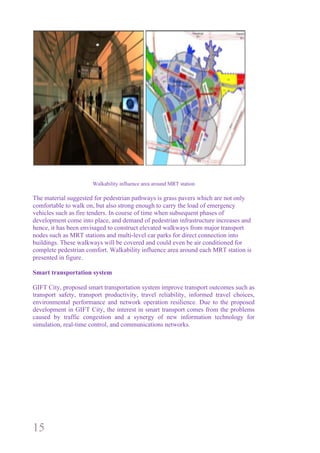
Walkability influence area around MRT station
The material suggested for pedestrian pathways is grass pavers which are not only
comfortable to walk on, but also strong enough to carry the load of emergency
vehicles such as fire tenders. In course of time when subsequent phases of
development come into place, and demand of pedestrian infrastructure increases and
hence, it has been envisaged to construct elevated walkways from major transport
nodes such as MRT stations and multi-level car parks for direct connection into
buildings. These walkways will be covered and could even be air conditioned for
complete pedestrian comfort. Walkability influence area around each MRT station is
presented in figure.
Smart transportation system
GIFT City, proposed smart transportation system improve transport outcomes such as
transport safety, transport productivity, travel reliability, informed travel choices,
environmental performance and network operation resilience. Due to the proposed
development in GIFT City, the interest in smart transport comes from the problems
caused by traffic congestion and a synergy of new information technology for
simulation, real-time control, and communications networks.
16
From smart transport consideration it would include advanced traveller information
system for communicating the information through variable message signs etc; security
and surveillance system; intelligent parking management system to operating the
parking areas; advanced public transport system to operate the MRT and BRT by
sharing the information with the end users. The gambit of smart transport also includes
automatic vehicle location and tracking, real time travel response etc. All the required
provisions to facilitate smart transport applications in GIFT City are considered in the
planning stage and itself and incorporated in the design stage for successful
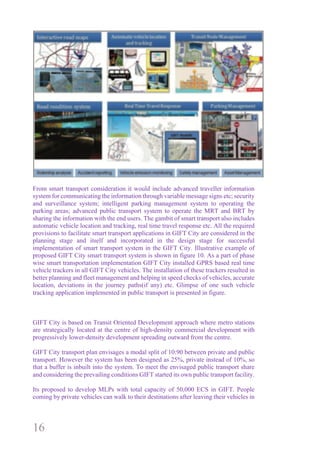
implementation of smart transport system in the GIFT City. Illustrative example of
proposed GIFT City smart transport system is shown in figure 10. As a part of phase
wise smart transportation implementation GIFT City installed GPRS based real time
vehicle trackers in all GIFT City vehicles. The installation of these trackers resulted in
better planning and fleet management and helping in speed checks of vehicles, accurate
location, deviations in the journey paths(if any) etc. Glimpse of one such vehicle
tracking application implemented in public transport is presented in figure.
GIFT City is based on Transit Oriented Development approach where metro stations
are strategically located at the centre of high-density commercial development with
progressively lower-density development spreading outward from the centre.
GIFT City transport plan envisages a modal split of 10:90 between private and public
transport. However the system has been designed as 25%, private instead of 10%, so
that a buffer is inbuilt into the system. To meet the envisaged public transport share
and considering the prevailing conditions GIFT started its own public transport facility.
Its proposed to develop MLPs with total capacity of 50,000 ECS in GIFT. People
coming by private vehicles can walk to their destinations after leaving their vehicles in
17
these MLPs which are located strategically near the entry points on either side of the
road.
Proposed smart transportation applications in GIFT City improve transport outcomes
such as transport safety, transport productivity, travel reliability, informed travel
choices, environmental performance and network operation resilience
GIFT City transport master plan addresses the needs of all users of GIFT City, thereby
it can be called as "User- Centred Smart Transport System" and its makes it possible
for all GIFT City users to enjoy a world class life style in this vibrant Global City.
Conclusions
§ As far as sustainability is concerned, GIFT reflects a sophisticated planning
approach to ensure irrigation of Environmental concern and Green buildings,
optimum uses of energy, water and construction materials.
§ The project regenerates the area as high quality, mixed use district of
commercial, residential and open space facility that optimize land and real
estate values.
§ Various methods and technologies which have been implemented and utilized
in GIFT for sustainable development of project.
§ GIFT stand as a model of for successful sustainable development of industrial
and commercial areas, and it will be seen in the future as a model, based on
which the development of other smart cities will take place.
Learnings
§ Energy Efficient System
§ Strategic location
§ High quality and reliable service
§ Transport oriented development
References
§ Institutional Investor Sponsored Report,2009
§ Regional Best practice seminar paper
§ “GIFT- A Smart City A Global Financial Hub”, Esri India, Dec,2014
§ GIFT Gujrat official website www.giftgujrat.in
§ Article – Times Of India 10-01-2013
§ Setting up of water and sewage treatment plant at “GIFT-City”, Vibrant Gujrat,
8th
Global summit, Urban Development, Government of Gujrat, 10th
Jan, 2017
18

1. Case study report GIFT CITY Assignment 01.pdf

  • 1.
    ANAHAT VIKRAM ELP-CPM-05 CASE STUDY GUJRATINTERNATIONAL FINANCE TEC-CITY INTRODUCTION TO THE PROJECT India’s first operational smart city and international financial service Centre, Gujrat International Finance Tec-City (GIFT City) is the CBD (Central Business District) that will serve as a paradigm for next class city in terms of quality of life, Infrastructure and ambience aiming to be high-density and high rise, treating land as a precious resource. GIFT is planned as financial CBD Between Ahmedabad and Gandhinagar as a greenfield development. It is designed as a hub for the global financial service sector; more particularly, state-of-the-art connectivity, infrastructure and transportation access have been integrated into the design of the city. GIFT is an operational smart city developed in the Gandhinagar metropolitan region as a green field development. This project developed a new format for globally benchmarked integrated city. Propelled by a competitive economy anchored on commerce and related industry, GIFT envisaged as an Eco-City, will serve as the vibrant Hub of western India and as a habitat showcasing business oriented, environmentally sensitive growth with equity. GIFT City is conceptualized as a global financial and IT services hub, designed to be at or above par with globally benchmark financial centers such as Shinjuku, Lujiazui, La Defense, London Dockyards, etc.
  • 2.
    2 Paris (La Defense) Tokyo (Shinjuku) London (Dockyard) Pudong (Lujiazui) GIFT (INDIA) Land Area(Sq km) 1.6 1.6 1.05 1.7 3.58 Construction scale (in mn sq m) 2.5 1.6 1.1 4.5 8.5 Green belt (in 1000 sq m) 40 120 50 363 1183 Height (m) 200 250 250 490 410 Locality and Relevance of the Project The GIFT City is located on the banks of Sabarmati River. GIFT City is strategically located between Ahmedabad and Gandhinagar at a distance of about 12 kms from sardar Vallabhbhai Patel International Airport and 8 kms from Gandhinagar. The site is in close proximate to the National Highway (NH-48). GIFT is easily accessible from all direction through 4-6 lane State and National Highways. A double corridor metro system is being constructed to connect GIFT City to the nearby airport and various part of Ahmedabad and Gandhinagar. The location is shown below. Distinct Features of the Project The city has an integrated development model which has been spread out in three phases. Each phase is designed as integrated sustainable development, for example the first phase itself includes development of office space, residential, school, hotel, club etc. The salient features of the project are: 1. The 400MW electricity supply is planned to be 99.999% reliable (about 5.3 minutes of outage per year). All the electricity cables are laid in the Utility Tunnel in dry area protected by thick concrete wall in redundant paths.
  • 3.
    3 2. Natural gasis distributed to every house and building via pipes, which is cheaper and safer than cylinders. Gas supply to the City is done from the existing gas network of GSPL, the state-owned company for gas transmission pipelines. Piped natural gas is already in distribution in the nearby cities of Ahmedabad and Gandhinagar. 3. India's first city-level DCS (district cooling system) is operational at GIFT City. It reduces the operational cost by 30-40% and avoids the capital cost of implementing individual air conditioner in each building. 4. All waste in the city are collected and taken to processing plant by vacuum chutes installed at every floor of all buildings . The waste is automatically sucked through underground chutes at a high speed of 90 km/h (56 mph), and is being treated through various methods including Plasma Gasification plasma gasification. 5. GIFT aims at providing a transportation network that ensures accessibility, easy and fast mobility and accidental free traffic. This is being achieved by: A. Using a multimodal mix of transport systems (MRTS/LRTS/BRTS, etc.) for both intercity transport (to Ahmedabad, Airport, and Gandhinagar) and intra-city transport. B. Using a walk-to-work concept as part of urban planning with a nodal split of 10:90 between private and public transport. C. Use of electric personal rapid transit systems within the city. GIFT City will also have its own metro stations and will be connected to Ahmedabad metro network by March 2024. Indian Railways railway lines pass the city on the east and west sides; the closest stations are in Dabhoda and Naroda. Project Countenances The idea for GIFT was conceived during the Vibrant Gujarat Global Investor Summit 2007 and the initial planning was done by East China Architectural Design & Research Institute (ECADI), which is credited with planning of much of modern-day Shanghai .GIFT City’s Master Plan is for the 359 hectares (886 acres) of land area to have approximately ~110 buildings with ~5,800,000 m2 (62,000,000 sq. ft) of built-up area, of which around 67% is commercial, 22% is for residential and 11% is social facilities. Currently ~190,000 m2 (2,000,000 sq. ft) of commercial space is operational, and another 280,000 m2 (3,000,000 sq. ft) is under development. As of now an investment of Rs 10,500 crore has already been committed for GIFT City. To develop and implement the project, the government of Gujrat through its undertaking Gujrat Urban Development Company Limited (GUDCL) and Infrastructure Leasing & Financial Service Limited (IL&FS) have established a
  • 4.
    4 50:50 joint venturecompany, “Gujrat International Finance Tec-City Company Limited” (GIFTCL). Gujrat Urban Development Company Limited (GUDCL): GUDCL facilitates urban development by assisting state government in formulation of policy, institutional capacity building, project implementation, and in rising funds from multilateral agencies for urban projects. Infrastructure Leasing & Financial Services Ltd (IL&FS): Incorporated in 1987 the business architecture of IL&FS focuses on providing services in development of core infrastructure areas suitably complemented with an array of financial services. The various businesses are conducted through subsidiaries with IL&FS being a principal shareholder in each. IL&FS has catalysed over USD 8 Billion of infrastructure projects and is currently working on several innovative projects mostly based on PPP format. Consultants: 1. Design and Architecture – East China Architectural Design & Research Institute (ECADI) and Fairwood Consultants, India. 2. ICT Advisory Services – British Telecom 3. Market Demand Assessment – Mckinsey & Company 4. Talent Demand Assessment – Hewitt Associates 5. Environmental Assessment – IL&FS Ecosmart Ltd 6. Process Management – IL&FS Infrastructure Development Corporation Ltd. 7. Power Management – ABB Group Different Phases of Project [A] Pre-Construction Phase: Presenting key of GIFT City to the Prime Minister, Shri Narendra Modi, at the inauguration ceremony of the India International Exchange in GIFT City The idea for GIFT was conceived during the Vibrant Gujarat Global Investor Summit 2007 and the initial planning was done by East China Architectural Design & Research Institute (ECADI), which is credited with planning of much of modern-day Shanghai .GIFT City’s Master Plan is for the 359 hectares (886 acres) of land area to have approximately ~110 buildings with
  • 5.
    5 ~5,800,000 m2 (62,000,000 sq.ft) of built-up area, of which around 67% is commercial, 22% is for residential and 11% is social facilities. § Government of Gujrat earmarked 886 acres of land for GIFT Project, out of 886 Acre; 673 Acre of land is in possession of GIFT. § IL&FS Township & Urban Asset Limited (ITUAL) has taken 7.77 mn sq. ft of Built Up Area (BUA) in Phase I of GIFT Project. § Inauguration of "GIFT ONE" Gujarat's tallest tower in GIFT City by Hon'ble Chief Minister Narendra Modi, on 10 January 2013. § Foundation stone Laying by Narsee Monjee Education Trust for Development of School at GIFT, on 15 August 2013. § Foundation stone Laying by Smart ICT Pvt Ltd. (consortium led by TATA Communication) for Development of Tier IV Data Centre at GIFT, on 15 December 2013. § Allotment of total 1.5mn Sq. ft of BUA made to WTC Noida Development Company Ltd. for development of Gujarat's first World Trade Centre (WTC) at GIFT City, on 15 February 2014 for development of commercial offices and residential service apartments. § Allotment of 0.2mn Sq. ft of BUA made to State Bank of India (SBI), India's largest public sector bank for development of their Commercial Tower at GIFT City, on 15 February 2014. § Allotment of 0.25mn Sq. ft of BUA made to Sterling Addlife India Pvt. Ltd. for development of 200 beds multispecialty Hospital at GIFT City, on 15 February 2014. § Allotment of 0.2mn Sq. ft of BUA made to Global Insurance Services (India) Ltd. for development of Skill Development & Training Centre at GIFT City, on 15 February 2014. § Allotment of aggregate 0.55mn Sq. ft of BUA made to two developers: Sangath Infrastructure Pvt. Ltd. & B. U Bhandari Projects for development of Residential Towers in GIFT City on 10 April 2014 and 14 April 2014 respectively. § Foundation Stone Laying by West India Hospitality Limited for Development of GIFT International Centre (Business Club) at GIFT City, on 3 October 2014. § Allotment of 1.1 mn Sq. ft of BUA made to developer Brigade Enterprises Ltd. for development of Commercial, Residential, Hotel & Retail Mall in GIFT SEZ & Non SEZ Area on 9 October 2014. § Allotment of 0.25mn Sq. ft of BUA made to developer Hiranandani Group for development of Commercial Tower in GIFT SEZ Area on 9 October 2014. § Allotment made of around 0.5 mn Sq. ft of BUA issued to BSE Brokers' Forum for development of Commercial Building for members of BSE Brokers' Forum at GIFT City, on 28 November 2014.
  • 6.
    6 [B] Construction Phase: Phase1:Two commercial towers, each of 28 floors called the GIFT ONE and GIFT TWO have been finished. Tendering for the next bunch of towers is going on. This phase will also include building up of basic infrastructure. Phase2: The second phase construction has already begun and the Hiranandani Signature building has been built which hosts India International exchange. The WTC is under construction apart from a couple of buildings as part of the SEZ. The road connectivity to and in GIFT City has increased with the construction of new roads. [C] Current status of Construction:
  • 7.
    7 § Currently 10buildings are operational .Another 05 buildings are under construction. § GIFT City has already allotted development rights of around 11 Million sq. feet. § Currently approximately 12000 people are working in BFSI & IT & ITeS sector . § A TIA-942 certified TIER IV datacentre is operational in the city with rack capacity of 900 racks. § GIFT City has functional City Command & Control Centre C-4 . This is an IoT based C-4 where are all public utilities are monitored & managed. § Public infrastructure in GIFT CITY is based on concept of 'Predictive Maintenance'. § A world class Corporate Club named ' GIFT Club ' is operational and very popular in the vicinity. § A five star Hotel 'Grand Mercure' by one of the world’s biggest hotel chain ' Accor Hospitality' is operational in GIFT City with 95 rooms. § Currently there are two International Stock Exchanges named 'Indian International' & 'NSE International' are operational in the city with daily turnover of approximately 5 billion US$. § GIFT City is governed by GUDA ( GIFT Urban Development Authority ). § GUDC is designated as Area Development Authority for the GIFT Project. § Phase 1 of development has been completed in the year 2017. Second phase of development is under progress. § Currently there are 10 Telecom operators providing Telecom services in GIFT City . § Investment to the tune of around INR 12,000 /- Crores have been committed in the GIFT city. § Government of India has provisioned for Single regulator for GIFT City in the annual budget of the year 2020. § The major customers in the city are Oracle Inc., TCS , Bank of America , Cybage , BSE , NSE , MCX , STT ( Singapore Telemedia ), Beefree , SBI , Bank of Baorda , Syndicate Bank , LIC , GIC , Bank of India , STPI ( Software Technology Parks of India ) etc. § GUDC ( Gujarat Urban Development Corporation ) is developing their software development centre for various IT companies of Gujarat . This centre will focus of new innovations in the field of IoT , Analytics , BI and Robotics . § There is an International Bullion Exchange planned in GIFT City in near future . § Major real estate developers in the City are IL&FS , Govt. of Gujarat via GUDC , Hiranandani , Brigade , Shobha Developers , ATS Savy , Prestige group , LIC , SBI , Befree , Janadhar Group , BSE Brokers forum , Veradian Group etc. § The World Trade Centre -GIFT City, is final phase of completion for financial and allied services. The centre will connect businesses around 343 locations worldwide. The cities of Pune, Kolkata, Bangalore, Chennai, Kochi, and Mumbai all have their own WTCs.
  • 8.
    8 § GIFT City'sfirst housing project of affordable housing 'Janmangala' was inaugurated in the year 2017.The project has around 300 dwellings . This project provides affordable housing o the people of LIG AND MIG segment of society working in GIFT City . § India's biggest real estate developer Sobha Developer is constructing premium housing in GIFT City . This will be 32 storied building with world class amenities. Challenges and Risks Involved There has been a lot of action behind the scenes to make Gift City work. The Securities & Exchange Board of India (SEBI) permitted alternate investment funds (AIFs), such as private equity funds and venture funds, to operate out of Gift City’s IFSC. This will give it a boost; but new investors are unlikely to rush in, unless they see evidence of a genuine clean-up. Here is what the Gujarat government needs to do to make the GIFT City work: 1. It needs to start by separating infrastructure development (find a new partner to replace IL&FS) from IFSC. It should also take back control of some of the land rights and development rights that it has relinquished to IL&FS, before it finds a new partner. 2. If the IL&FS board could be sacked, one wonders what is stopping the Gujarat government from doing the same with the messed-up GIFT City’s as well as IFSC’s boards and put in place a transparent and credible management. This is especially important in view of some serious allegations made by Mr Anjaria in a public interest litigation (PIL), after being removed as independent director and head of GIFT City’s audit committee for refusing to ratify questionable decisions of the board. 3. If the Gujarat government intends to attract global investment, it needs to address the issues raised by Mr Anjaria’s PIL and persuade him to withdraw it and re-start on a clean slate. 4. Mr Anjaria has asked for an investigation into the Gift City’s contracts by the Serious Frauds Investigation Office (SFIO). While the Central government has addressed this by ordering a wide-ranging SFIO investigation into IL&FS, it has to demonstrate its seriousness by changing the Gift City management. The PIL has some serious charges, with evidence, against Dipesh Shah, chairman of IFSC, including falsification of minutes of meetings. Ajay Pandey, managing director of GIFT City, also remains in place in spite of the false and defamatory allegations made against Mr Anjaria in an advertorial in the Business Standard. (The newspaper later published a long rejoinder by Mr Anjaria). 5. GIFT City and IFSC need to be brought under the ambit of the Comptroller and Auditor General (CAG) of India and the Right to Information Act (RTI), since there
  • 9.
    9 is a substantial investment by the state in terms of land value. This was deliberately obfuscated in the 50:50 joint venture (JV) with IL&FS. 6. In May 2012, the state government received an extensive report from GIFT City’s audit committee, documenting irregularities and defaults by IL&FS’s entities. Subsequently, more facts and details have been provided to the government by gathering information under RTI. All these must be handed over to the SFIO for its investigation and action. 7. IL&FS was initially sold 7.77 million sq. ft of development rights at a discount to the price set by the board of directors for other investors. The value was estimated at Rs550 crore and 50% of the amount (or Rs225crore) had not been paid until 2016. This is a direct default of GIFT City to the state government. How IL&FS persuaded the government to sell its development rights, when it was already the promoter, manager and developer of the project, is itself an issue needs SFIO investigation, since it is a misappropriation of public funds. 8. GIFT City’s deal with the Gujarat government was that land would be leased to it at Re1/ acre for 99 years. The revenue department, through a formal resolution, had ensured that land-related profits will accrue to the state, if development rights granted by it were sold at a commercial price. Over 16 million sq ft of development rights have been sold by Gift City/IL&FS at commercial rates (over Rs5,000/sq. ft), amounting to at least Rs.8,000 crore. A part of this profit has to be returned to the Gujarat government. An RTI query reveals that this had not been paid at least until 2016, and is unlikely to have been paid afterwards, when IL&FS was already facing liquidity issues. 9. As per the JV contract, GIFT City itself has to pay the Gujarat government 1% of the income from sale of development rights as a premium. Since the value of development rights sold are approximately Rs.8,000 crore, payment of Rs.80 crore or so is due; this has not been paid. Clearly, the acquisition of the IL&FS’s stake in Gift City is not as simple as it seems. The real challenge is to clean it up and demonstrate that this global smart city and international financial centre are viable propositions. Otherwise, it will only be a bailout of IL&FS paid for by the people of Gujarat. Risk Management Policy of the “GIFT Group”. The main objective of this policy is to ensure sustainable business growth with stability and to promote a pro-active approach in reporting, evaluating and resolving risks associated with the business. In order to achieve the key objective, the policy establishes a structured and disciplined approach to Risk Management, in order to guide decisions on risk related issues. The specific objectives of the Risk Management Policy are:
  • 10.
    10 1. To ensurethat all the current and future material risk exposures of the company are identified, assessed, quantified, appropriately mitigated and managed. 2. To establish a framework for the company’s risk management process and to ensure GIFT Group implementation 3. To ensure systematic and uniform assessment of risks related with the project. 4. To enable compliance with appropriate regulations, wherever applicable, through the adoption of best practices. 5. To assure business growth with financial stability. Advanced Construction Technologies [A] Green Building Initiatives Green Building (also known as sustainable building) refers to both a structure and the using of processes that are environmentally responsible and resource efficient throughout a buildings life cycle: from design, construction, operation, maintenance, renovation, and demolition. It also has incorporated green and sustainability measures in terms of : a. reduction of wastage of energy, which will result in reduced energy bills, b. Construction of sky gardens or roof-top gardens, c. Increase in usage of non-conventional energy sources such as solar power, and also rain water harvesting, d. Planning and design according to climate, e. Other Green Building parameters such as structural design efficiency, materials efficiency, materials efficiency, indoor environmental quality enhancement, operations & maintenance optimization and waste reduction. Another important aspect, which GIFT has implemented is the installation of district cooling system, which is a system of distributing heat generated in a centralized location for residential and commercial heating requirements, such as space heating and water heating. The heat is obtained from burning of fossil fuels, but increasing use of biomass, geothermal heating, and central solar heating is also being done. It has also been observed that district heating with combined heat and power is the cheapest way of cutting carbon emissions, and has one of the lowest carbon footprints of all fossil fuel generation plants. Landscaping Over 34% of the land area in GIFT has been utilized as green and open spaces. This has resulted in the major landscaping of those areas which is ecologically and aesthetically matured. Planting of evergreen , flowering trees, columnar spread trees, ground-cover or lawn area, and continuous shrub masses, as well as the construction of landscape terraces, has also been done to Accenture views where desirable.
  • 11.
    11 The efficiency areto be acquired by cooling systems and solar plants. The cooling systems facilitates in less energy consumption, more reliability, less impact on environment. A 10 MW solar plant has been installed within the city on pilot study. Many more plants of such capacities will be installed in near possible future as the city develops. As far as sustainability is concerned, GIFT reflects a sophisticated planning approach to ensure integration of Environmental concerns and Green Buildings, optimum usage of energy, water and construction materials. The project regenerates the area as high-quality, mixed use district of commercial, residential and open space facilities that optimize land and real estate values. In this case study, we have seen the various methods and technologies which have been implemented and utilised in GIFT for the sustainable development of this project. Due to its efforts, GIFT has been presented with multiple awards and honours, such as “Smart City of the Future” b Cisco Technology Awards, 2014 and many others. GIFT stands as a model for successful sustainable development of industrial and commercial areas, and it will be seen in the future as a model, based on which the development of the other smart cities will take place. Fig. Intelligent Building in GIFT [B] Water Supply and Sewerage Systems The water requirement for the GIFT city is 20 MGD. The water sources from which GIFT draws its water are ; (a) Narmada Main Canal,
  • 12.
    12 (b) Recycling andreuse of waste water, and (c) Rainwater Harvesting. This has resulted in the city receiving 24x7 water supply. The concept of “zero discharge city” has been implemented, in which the waste water is treated and reused, which results in maximum utilization of water. GIFT City, the emerging financial hub in Gujarat, India, is developing 92 million square feet of mixed-use space over 886 acres. Gujarat International Finance Tec-City placed all utilities in a tunnel accessible to material handling and maintenance vehicles. At 15,000-by-7.6-by-6.2 meters, the tunnel will carry 50 million litters per day of treated water, 200,000 tons of cooling water, 750 megawatts of power supply, and 280 million tons of solid waste. Solution Aligned as sidewalks along road carriageways, the INR 3.15 billion tunnel crossed beneath dozens of junctions with roads, utility plants, and drainage and sewerage. Bentley MXROAD was used to prepare a tunnel section template, which automatically provided the transition in alignment when the section changed from sidewalk-level to lower level. Outcome Using Bentley MXROAD for the tunnel alignment, plan, and profile saved time in the planning and engineering phases. The plan and profile aided in the calculation of quantities for civil works. Overall, Bentley products saved 1,500 man-hours and INR 900 million. Software In addition to Bentley MXROAD, STAAD. Pro was used for 3D structural analysis, and Water GEMS was used for modelling of the distribution network. Bentley software allowed for multidisciplinary integration, including infrastructure planning; geotechnical investigations; structural analysis; civil, mechanical, and electrical engineering; piping and instrumentation; and urban design, landscape, and architecture. OUTCOME/FACTS: § Gujarat envisioned a “digging-free city” where roads will not be excavated to access utilities.
  • 13.
    13 § Templates ofthe tunnel sections with lowered levels were prepared to overcome design issues at these junctions. § Phase 1 alignment of the utility tunnel resolved 35 junctions where the tunnel was lowered and brought back to the sidewalk level. § In addition to the tunnel sections, Bentley MXROAD was used to plan all roads for GIFT City. [C] Solid Waste Management The projected waste quantity of GIFT is 488 TPD. It aims at minimizing the impact on environment, human intervention, space requirement, and less impact on health hazard. The GIFT city has automatic collection and transportation system. In this computer controlled system, the waste is being thrown into the disposal chute, and the waste is sucked through pipes at speed of 90 km/hr. The Plasma Gasification Technology is used for the waste treatment. This helps in; § Automated Waste Collection System (AWS) through chute system § Minimum Human Intervention § Minimize space requirement § Minimize impact on health § Waste sucked through pipes at a speed of 90 km/hr § Waste Treatment through Plasma Technology
  • 14.
    14 Automatic Collection andTransportation System [D] Transportation The transportation is planned in such a way that it will encourage the reduction of greenhouse gas emissions from the vehicles in GIFT. It aims at zero accidents. Transport Philosophy GIFT City aims at a transit oriented development based on walk to work approach, pedestrian friendly infrastructure with zero fatal accidents, easy and fast mobility with minimum conflicts and efficient public transport systems which reduce the per capita energy basket. In accordance to the various activities envisaged for GIFT, the mandate is not only to provide connectivity, but also to cater to the daily demand as well as that of the peak hour with an objective to achieve higher share of public transport. The transport infrastructure in GIFT City has been planned to achieve this objective. Multi- Level Parking (MLP) lots have been proposed at strategic locations in the GIFT City. To enhance the mobility in the GIFT City, various facilities such as underpasses, elevated covered walkways with travellators have been planned for pedestrian comfort and safety. Activity nodes have been integrated with the pedestrian network to enhance the walking experience. The public transport system is being integrated effectively connecting Ahmedabad and Gandhinagar. Pedestrian facilities Pedestrian walkways will be developed keeping in mind pedestrian safety and comfort. Street furniture will be included and activity centres introduced at nodes for making walking a safe and comfortable experience. Shady trees and comfortable ergonomic seating arrangements will be made. Level differences will be minimized for comfort of the elderly.
  • 15.
    15 Walkability influence areaaround MRT station The material suggested for pedestrian pathways is grass pavers which are not only comfortable to walk on, but also strong enough to carry the load of emergency vehicles such as fire tenders. In course of time when subsequent phases of development come into place, and demand of pedestrian infrastructure increases and hence, it has been envisaged to construct elevated walkways from major transport nodes such as MRT stations and multi-level car parks for direct connection into buildings. These walkways will be covered and could even be air conditioned for complete pedestrian comfort. Walkability influence area around each MRT station is presented in figure. Smart transportation system GIFT City, proposed smart transportation system improve transport outcomes such as transport safety, transport productivity, travel reliability, informed travel choices, environmental performance and network operation resilience. Due to the proposed development in GIFT City, the interest in smart transport comes from the problems caused by traffic congestion and a synergy of new information technology for simulation, real-time control, and communications networks.
  • 16.
    16 From smart transportconsideration it would include advanced traveller information system for communicating the information through variable message signs etc; security and surveillance system; intelligent parking management system to operating the parking areas; advanced public transport system to operate the MRT and BRT by sharing the information with the end users. The gambit of smart transport also includes automatic vehicle location and tracking, real time travel response etc. All the required provisions to facilitate smart transport applications in GIFT City are considered in the planning stage and itself and incorporated in the design stage for successful implementation of smart transport system in the GIFT City. Illustrative example of proposed GIFT City smart transport system is shown in figure 10. As a part of phase wise smart transportation implementation GIFT City installed GPRS based real time vehicle trackers in all GIFT City vehicles. The installation of these trackers resulted in better planning and fleet management and helping in speed checks of vehicles, accurate location, deviations in the journey paths(if any) etc. Glimpse of one such vehicle tracking application implemented in public transport is presented in figure. GIFT City is based on Transit Oriented Development approach where metro stations are strategically located at the centre of high-density commercial development with progressively lower-density development spreading outward from the centre. GIFT City transport plan envisages a modal split of 10:90 between private and public transport. However the system has been designed as 25%, private instead of 10%, so that a buffer is inbuilt into the system. To meet the envisaged public transport share and considering the prevailing conditions GIFT started its own public transport facility. Its proposed to develop MLPs with total capacity of 50,000 ECS in GIFT. People coming by private vehicles can walk to their destinations after leaving their vehicles in
  • 17.
    17 these MLPs whichare located strategically near the entry points on either side of the road. Proposed smart transportation applications in GIFT City improve transport outcomes such as transport safety, transport productivity, travel reliability, informed travel choices, environmental performance and network operation resilience GIFT City transport master plan addresses the needs of all users of GIFT City, thereby it can be called as "User- Centred Smart Transport System" and its makes it possible for all GIFT City users to enjoy a world class life style in this vibrant Global City. Conclusions § As far as sustainability is concerned, GIFT reflects a sophisticated planning approach to ensure irrigation of Environmental concern and Green buildings, optimum uses of energy, water and construction materials. § The project regenerates the area as high quality, mixed use district of commercial, residential and open space facility that optimize land and real estate values. § Various methods and technologies which have been implemented and utilized in GIFT for sustainable development of project. § GIFT stand as a model of for successful sustainable development of industrial and commercial areas, and it will be seen in the future as a model, based on which the development of other smart cities will take place. Learnings § Energy Efficient System § Strategic location § High quality and reliable service § Transport oriented development References § Institutional Investor Sponsored Report,2009 § Regional Best practice seminar paper § “GIFT- A Smart City A Global Financial Hub”, Esri India, Dec,2014 § GIFT Gujrat official website www.giftgujrat.in § Article – Times Of India 10-01-2013 § Setting up of water and sewage treatment plant at “GIFT-City”, Vibrant Gujrat, 8th Global summit, Urban Development, Government of Gujrat, 10th Jan, 2017
  • 18.