Critical Media 
How we 
know what 
we know?
Critical Media 
Firstly lets explore the different types of 
media: Old media. 
• Print media 
• Motion pictures 
• Sound recordings 
• Broadcast media 
Which could include cave drawings, 
speech, smoke signals, letters, books 
(Ott & Mack, 2014).
New media 
• Internet 
• Mobile phones 
• Social networking 
• Digital television 
• E-books 
• Photography
Old media 
Historically mass media was not very 
portable. 
• If you wanted to see a film, you had 
to go to the theater. 
• The size and weight of books made 
mobility limited, you had to carry 
then around and transport them to 
various countries (Ott & Mack, 2014).
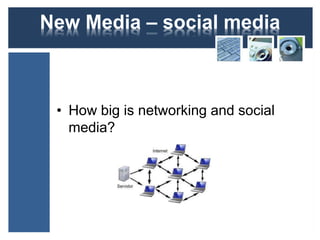
New Media – social media 
• How big is networking and social 
media?
Social Media Today 
• In one day 700,000 people will join 
Facebook. 
• Facebook uses share, like and tag 1 
billion pieces of information a day. 
• The virtual game Farmville will sell 1 
million in digital farming equipment 
in a day. 
• 65 Million users access facebook 
through their phones.
Social Media Today 
• In one day 900,000 iphones and 
160,000 android devices will be sold. 
• Twitter has 64 million tweets a day. 
• Utube Is the second most used 
search engine in the world. 
• Utube has 24 hours of video 
uploaded every minute.
The power of the media 
- What impact does it have on our daily 
lives?
Before television, radio was the way everyone found 
out what was happening in the rest of the world. 
This was highlighted in World War II 
ORT AND IT HAS BEEN ARGUED THAT IT WAS THE NAZIS 
WHO PIONEERED THE USE OF WHAT WAS STILL A 
RELATIVELY NEW TECHNOLOGY. A FEW MONTHS AFTER 
THE BREAK OUT OF WORLD WAR II, GERMAN
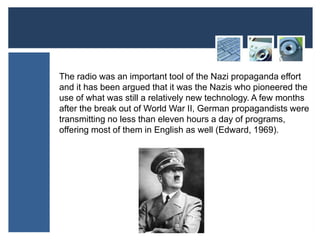
The radio was an important tool of the Nazi propaganda effort 
and it has been argued that it was the Nazis who pioneered the 
use of what was still a relatively new technology. A few months 
after the break out of World War II, German propagandists were 
transmitting no less than eleven hours a day of programs, 
offering most of them in English as well (Edward, 1969).
On Sunday, October 30, 1938, millions of radio listeners 
were shocked when radio news alerts announced the arrival 
of Martians. They panicked when they learned of the 
Martians' ferocious and seemingly unstoppable attack on 
Earth. Many ran out of their homes screaming while others 
packed up their cars and fled. 
Though what the radio listeners heard was a portion of 
Orson Welles' adaptation of the well-known book, War of the 
Worlds by H. G. Wells, many of the listeners believed what 
they heard on the radio was real (Rosenburg, 2014).
If you were watching the news and 
the presenter said a major world war 
had just broken out - would you 
doubt it?
The power of the media 
Gender issues 
• In the 1960’s Betty Friedan looked at 
what women’s magazines were 
telling woman. They reinforced 
traditional gender differences and 
inequalities (Mendes and Carter, 
2008).
The power of the media 
Gender issues 
• Television portrayed women in a 
narrow range of roles which tend to 
revolve around domestic settings 
and as subordinate (Tuchman, 
1978).
Racial Issues 
• Information technology has 
traditionally been the instrument of 
the powerful. Newspapers, radio, 
television ad the internet are used 
worldwide to incite racial and ethnic 
hatred and justifies the denial of 
human rights to millions of poor 
people ( Njubi, 2007).
Racial Issues 
• Films from the United States ad 
Europe demonized Africans and 
justified colonial oppression (Njubi, 
2007). 
• Radio stations controlled by colonial 
governments promoted white 
supremacy by disseminating racist 
propaganda (Njubi, 2007).
Racial Issues 
“In the 21st century the capacity to 
communicate will almost certainly be a 
human right” 
Nelson Mandela 
(Njubi, 2007).
What I know 
• There are some things we know 
through someone or something such 
as a parent or friend, teacher, 
museum, textbook, photograph, film, 
television, or on the internet. 
• This type of information is 
MEDIATED meaning it has come to 
us via some indirect channel or 
medium (Ott & Mack, 2014).
What I know 
Therefore the majority of what I know 
is mediated?
Critical Media 
• Karl R. Popper (1962) said we must 
gain and differentiate knowledge by 
testing solutions to problems. He 
called this method as critical, 
because scholars questioned the 
works of others (Fuchs, 2011). 
We can do the same with media?
Information overload and 
discernment? 
‘The vast banks of knowledge, 
information and databases on virtually 
any topic that are available to anyone, 
anytime anywhere – mean there is a 
critical need to develop skills with which 
to discern misinformation, disinformation, 
truth from fiction, trustworthy from 
unauthenticated information’ (Burbules & 
Callister, 2000).
The good news 
Power can work both ways 
The media are not only structures of 
domination and fields for the exertion 
of domination but also potential tools 
that are used for struggling against 
domination and organizing and 
communicating protest (Fuch, 2011).
Critical Media 
So how can I be critical? 
Analyze the information presented in 
the media and ask: 
Who has created this piece of media 
information and what is the agenda (if any)? 
What political, cultural and social viewpoint 
is the creator coming from? 
Who stands to benefit from this information? 
What potentially is the other viewpoint?
References 
• A day in the life of social media by DBACH Healthcare retrieved from 
https://www.youtube.com/watch?v=iReY3W9ZkLU 
• Burbles, N., & Callister, T. (2000). Watch IT: The risky promises and 
promising risks of new information technologies in education. Found in 
Luke, C. (2007). As seen on TV or was that my phone? New media 
literacy. Policy Futures in Education. Volume 5 (1), p 50 -58. 
• Chester, Edward (1969). Radio, Television, and American Politics. Sheed 
and Ward: New York. p. 342. 
• Fuchs, C. (2011). Routledge advances in sociology: Foundations of 
critical media and information studies. Florence, USA: Routledge. 
• Mendes, K., & Carter, C. (2008). Feminist and gender media studies: A 
critical overview. Sociology Compass 2 (6), p 1701 – 1718. 
• Njubi, F. (2007). Critical arts: South-North cultural and media studies. 
Retrieved from www.tandfonline.com/loi/rcrc20
References 
• Ott, B., & Mack, R. (2014). Critical media studies: An introduction. Second 
Edition. John Wiley and sons. 
• Rosenburg, J. (2014). War of the worlds radio broadcast causes panic. 
Retrieved from 
http://history1900s.about.com/od/1930s/a/warofworlds.htm 
• Tuchman. (1978). The symbolic annihilation of women by the mass 
media. New York: Oxford University Press.

Critical media

  • 1.
    Critical Media Howwe know what we know?
  • 2.
    Critical Media Firstlylets explore the different types of media: Old media. • Print media • Motion pictures • Sound recordings • Broadcast media Which could include cave drawings, speech, smoke signals, letters, books (Ott & Mack, 2014).
  • 3.
    New media •Internet • Mobile phones • Social networking • Digital television • E-books • Photography
  • 4.
    Old media Historicallymass media was not very portable. • If you wanted to see a film, you had to go to the theater. • The size and weight of books made mobility limited, you had to carry then around and transport them to various countries (Ott & Mack, 2014).
  • 5.
    New Media –social media • How big is networking and social media?
  • 6.
    Social Media Today • In one day 700,000 people will join Facebook. • Facebook uses share, like and tag 1 billion pieces of information a day. • The virtual game Farmville will sell 1 million in digital farming equipment in a day. • 65 Million users access facebook through their phones.
  • 7.
    Social Media Today • In one day 900,000 iphones and 160,000 android devices will be sold. • Twitter has 64 million tweets a day. • Utube Is the second most used search engine in the world. • Utube has 24 hours of video uploaded every minute.
  • 8.
    The power ofthe media - What impact does it have on our daily lives?
  • 9.
    Before television, radiowas the way everyone found out what was happening in the rest of the world. This was highlighted in World War II ORT AND IT HAS BEEN ARGUED THAT IT WAS THE NAZIS WHO PIONEERED THE USE OF WHAT WAS STILL A RELATIVELY NEW TECHNOLOGY. A FEW MONTHS AFTER THE BREAK OUT OF WORLD WAR II, GERMAN
  • 10.
    The radio wasan important tool of the Nazi propaganda effort and it has been argued that it was the Nazis who pioneered the use of what was still a relatively new technology. A few months after the break out of World War II, German propagandists were transmitting no less than eleven hours a day of programs, offering most of them in English as well (Edward, 1969).
  • 11.
    On Sunday, October30, 1938, millions of radio listeners were shocked when radio news alerts announced the arrival of Martians. They panicked when they learned of the Martians' ferocious and seemingly unstoppable attack on Earth. Many ran out of their homes screaming while others packed up their cars and fled. Though what the radio listeners heard was a portion of Orson Welles' adaptation of the well-known book, War of the Worlds by H. G. Wells, many of the listeners believed what they heard on the radio was real (Rosenburg, 2014).
  • 12.
    If you werewatching the news and the presenter said a major world war had just broken out - would you doubt it?
  • 13.
    The power ofthe media Gender issues • In the 1960’s Betty Friedan looked at what women’s magazines were telling woman. They reinforced traditional gender differences and inequalities (Mendes and Carter, 2008).
  • 14.
    The power ofthe media Gender issues • Television portrayed women in a narrow range of roles which tend to revolve around domestic settings and as subordinate (Tuchman, 1978).
  • 15.
    Racial Issues •Information technology has traditionally been the instrument of the powerful. Newspapers, radio, television ad the internet are used worldwide to incite racial and ethnic hatred and justifies the denial of human rights to millions of poor people ( Njubi, 2007).
  • 16.
    Racial Issues •Films from the United States ad Europe demonized Africans and justified colonial oppression (Njubi, 2007). • Radio stations controlled by colonial governments promoted white supremacy by disseminating racist propaganda (Njubi, 2007).
  • 17.
    Racial Issues “Inthe 21st century the capacity to communicate will almost certainly be a human right” Nelson Mandela (Njubi, 2007).
  • 18.
    What I know • There are some things we know through someone or something such as a parent or friend, teacher, museum, textbook, photograph, film, television, or on the internet. • This type of information is MEDIATED meaning it has come to us via some indirect channel or medium (Ott & Mack, 2014).
  • 19.
    What I know Therefore the majority of what I know is mediated?
  • 20.
    Critical Media •Karl R. Popper (1962) said we must gain and differentiate knowledge by testing solutions to problems. He called this method as critical, because scholars questioned the works of others (Fuchs, 2011). We can do the same with media?
  • 21.
    Information overload and discernment? ‘The vast banks of knowledge, information and databases on virtually any topic that are available to anyone, anytime anywhere – mean there is a critical need to develop skills with which to discern misinformation, disinformation, truth from fiction, trustworthy from unauthenticated information’ (Burbules & Callister, 2000).
  • 22.
    The good news Power can work both ways The media are not only structures of domination and fields for the exertion of domination but also potential tools that are used for struggling against domination and organizing and communicating protest (Fuch, 2011).
  • 23.
    Critical Media Sohow can I be critical? Analyze the information presented in the media and ask: Who has created this piece of media information and what is the agenda (if any)? What political, cultural and social viewpoint is the creator coming from? Who stands to benefit from this information? What potentially is the other viewpoint?
  • 24.
    References • Aday in the life of social media by DBACH Healthcare retrieved from https://www.youtube.com/watch?v=iReY3W9ZkLU • Burbles, N., & Callister, T. (2000). Watch IT: The risky promises and promising risks of new information technologies in education. Found in Luke, C. (2007). As seen on TV or was that my phone? New media literacy. Policy Futures in Education. Volume 5 (1), p 50 -58. • Chester, Edward (1969). Radio, Television, and American Politics. Sheed and Ward: New York. p. 342. • Fuchs, C. (2011). Routledge advances in sociology: Foundations of critical media and information studies. Florence, USA: Routledge. • Mendes, K., & Carter, C. (2008). Feminist and gender media studies: A critical overview. Sociology Compass 2 (6), p 1701 – 1718. • Njubi, F. (2007). Critical arts: South-North cultural and media studies. Retrieved from www.tandfonline.com/loi/rcrc20
  • 25.
    References • Ott,B., & Mack, R. (2014). Critical media studies: An introduction. Second Edition. John Wiley and sons. • Rosenburg, J. (2014). War of the worlds radio broadcast causes panic. Retrieved from http://history1900s.about.com/od/1930s/a/warofworlds.htm • Tuchman. (1978). The symbolic annihilation of women by the mass media. New York: Oxford University Press.