



FAMILY
   CHAPTER 7

ASHLEY DELONG
• Most people experience family
  at a deeply personal level

• Many people’s most intense
  interpersonal exchanges occur
  within a family setting

• Family is a social institution that
  genders its members

• Organized by gendered lines by
  other social forces

• Gender study in communication
  can not be done without
  studying the communication
  within a family
GENDER ROLES
REFERS TO FEMININE AND MASCULINE SOCIAL EXPECTATIONS
          IN A FAMILY BASED ON A PERSONS SEX
GENDER ROLE SOCIALIZATION LARGELY TAKES PLACE
WITHIN FAMILIES, MAINLY VIA PARENTAL MODELING AND
             PARENT-CHILD INTERACTION
“FAMILY IS USUALLY THE FIRST SOURCE OF INFORMATION

ABOUT GENDER AND ONE OF THE MOST INFLUENTIAL. IT IS THE

  PRIMARY PLACE WHERE MANY PEOPLE ARE TAUGHT THAT

 WOMEN AND MEN ARE ESSENTIALLY DIFFERENT AND HENCE

   SHOULD HAVE DIFFERENT AND/OR UNEQUAL ROLES.”
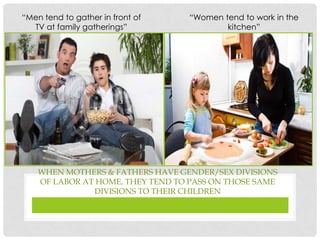
“Men tend to gather in front of   “Women tend to work in the
  TV at family gatherings”                kitchen”


    WHEN MOTHERS & FATHERS HAVE GENDER/SEX DIVISIONS
    OF LABOR AT HOME, THEY TEND TO PASS ON THOSE SAME
               DIVISIONS TO THEIR CHILDREN
WHAT IS AN
INSTITUTION?   • Established patterns of behavior
                 with a particular and recognized
                 purpose, institutions include
                 specific participants who share
                 expectations and act in specific
                 roles, with rights and duties
                 attached to them.
EXTERNAL CHARACTERISTICS OF AN INSTITUTION


1. Institutions are complex and intersecting: No institution
   operates in isolation from others.

2. All institutions influence and are influenced by the institution
   of gender. “Gender is present in the processes, practices,
   images, & ideologies, & distribution of power in various
   sectors of social life.”

3. Institutions are often intertwined with the state/government.
   Government can order particular practices in law and
   enforce those practices.
FAMILY AS SOCIAL INSTITUTION

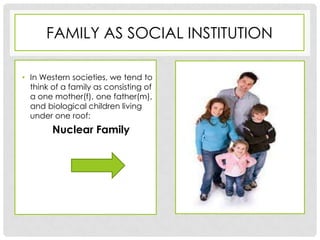
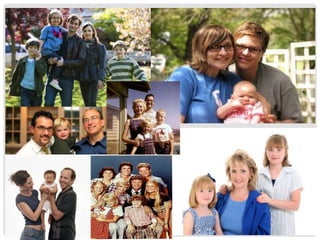
• In Western societies, we tend to
  think of a family as consisting of
  a one mother(f), one father(m),
  and biological children living
  under one roof:
        Nuclear Family
FAMILY AS SOCIAL INSTITUTION

• The Textbook family(nuclear) reveals how family as an
  institution is influenced by social interactions and the idea of
  what is considered appropriate behavior within society.

• Being part of a family is central part of a persons identity.

• The nuclear family ideal, organizes people within a family and
  systemizes families In relation to one another: Better or Worse.

• Although it is assumed that the nuclear family is ideal it is in
  fact not the most common family dynamic.
“THE NUCLEAR FAMILY, THE ELUSIVE
             TRADITIONAL FAMILY”

• 38% of marriages end in divorce

• 75% of divorced persons remarry with a 60% chance of
  divorce

• 30% of homes are headed by a single adult

• 30% of children will at some point live in a blended
  family.

• Historians can not point to a specific time when the
  “nuclear family” was ever predominant.
FAMILY IDEALS OF THE 17 & 1800’S

• Stereotypical notions of             • Although many families could
  masculinity and femininity as well     not live on one mans salary alone
  as the concept of nuclear family       , domesticity became a norm for
  came about in the 1800’s during        judging a women's worth.
  the Industrial Revolution.           • Middle and upper class white
• Prior to the 1700’s families work      women depicted “true
  was shared across the sexes.           womanhood”, pure, pious,
• Through the progression of the         domestic, and submissive.
  industrial revolution brought        • Poor white & black women could
  about the concept of manliness,        not attain the ideal “true
  based on a mans ability to             womanhood” because of class
  support his family on his income       and race.
  alone.                               • Regardless of this, the ideal still
                                         held power over them and
                                         society deemed them bad
                                         women.
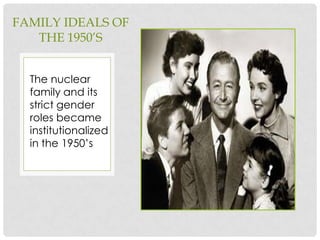
FAMILY IDEALS OF
   THE 1950’S


  The nuclear
  family and its
  strict gender
  roles became
  institutionalized
  in the 1950’s
ECONOMIC GROWTH AND POPULAR MEDIA
   REPRESENTATIONS ENABLED AND
 NORMALIZED THE MALE WAGE EARNER.
IN EACH SHOW, THE FAMILY WAS A WHITE, MIDDLE CLASS, HETEROSEXUAL,
  MARRIED, MIDDLE-AGED COUPLE WITH CHILDREN, LIVING IN A SUBURBAN
ENVIRONMENT. THE FATHER WAS THE SOLE WAGE EARNER AND THE MOTHER DID
  NOT WORK OUTSIDE OF THE HOME, SHE WAS THE NURTURER WITH MILK AND
 COOKIES FOR THE CHILDREN AND DINNER AND DRINKS READY FOR WHEN THE
                HUSBAND RETURNED HOME. FROM WORK.
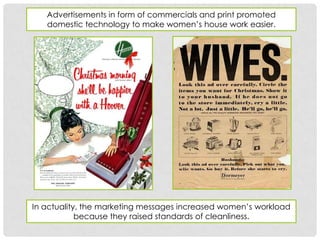
Advertisements in form of commercials and print promoted
   domestic technology to make women’s house work easier.


In actuality, the marketing messages increased women’s workload
            because they raised standards of cleanliness.
INTERLOCKING INSTITUTIONS


Families can only be understood in
                                               What Walker means by this is that the
relation to the broader social context or
what is considered to be in the public         way a family works or functions is

domain because the “broader social             directly related to the social systems of
systems and structures impinge on              the outside world.
everyday family life, reproducing inside
families in the divisions that exist outside
of them.” -Alexis Walker
“IF GENDER/SEX DIVISIONS APPEAR IN THE
WORKPLACE, THEY LIKELY WILL APPEAR IN FAMILIES
             AND VICE VERSA.”


• Myth: The nuclear family is self sufficient


• Reality: Extended family, work, religion, schools,

 social services, media, and law influence it.
• Politics and law Establish and    • The institution of work and
  authenticate the ideal family       family intersect through the
  through repeated use of the         reoccurring issue of domestic
  slogan family values.               labor. Discussion of gender/sex
                                      in family communication
• In the 1990’s this slogan           produces household services
  referred to the heterosexual        as well as gender.
  married couple with children
  living in one home guided by      • Imbalanced housework
  Christian values.                   distribution between men and
                                      women is one of the clearest
• The US congress people use the      indicators of inequitable
  idea of the “nuclear family” in     gender roles.
  debates over welfare. Putting
  negative value towards families
  who do not fit the model.
Psychologist Francine Deutsch’s
                    study shows 5 communication
                    strategies men use to resists
                    sharing household duties.
 Surveys shows
     that in
 heterosexual       1. Passive resistance
  relationships
wives still spend   2. Pretending to be incompetent
between 5 and
13.5 hours more
                    3. Praising spouse for her skills
 a week doing
housework than
    husbands        4. Applying lower standards when
                       doing work, whereby person who
                       cares more about standards takes
                       over the task at hand.

                    5. Denial by exaggerating their own
                       contributions.
COMPULSORY HETEROSEXUALITY
THE ASSUMPTION THAT ONLY ONE LEGITIMATE WAY OF LOVING
     AND ONE LEGITIMATE FORM OF FAMILY IS POSSIBLE.
FAMILY CONSTRUCTS/CONSTRAINS GENDER


Research focus on nuclear family       Social Learning & Modeling
• Researchers are not exempt         • Children’s gender identities
  from the influences of the ideal     come from their parental
  nuclear family.                      model
• The functionalist view of family   • Social learning is often
  argued social order was              unconscious, yet children
  dependent upon a “natural            observe and internalize certain
  sexual division of labor” in the     behaviors.
  family.                            • Children will most likely model
• Research predominantly               behaviors of those they admire,
  focused on White, U.S., middle       they are observe and are often
  class, heterosexual couples.         rewarded for the following
                                       behavior.
SOCIAL LEARNING & MODELING

• Research shows that heterosexual couples’ perception of what is fair
  tend to be sex biased.

• Even if parents tell their children that work should be shared equally,
  when women do more domestic labor than men, children tend to learn
  what the observe rather than what they are told.

• Research has examined whether having a gay or lesbian parent
  negatively affects children's gender identity development and there is no
  evidence that gay/lesbian parents differ systematically from children of
  heterosexual parents.

• There is no evidence that children of gay or lesbian parents are confused
  or uncertain about their gender identity.

• Less research exists, however it shows that the majority of children from
  gay/lesbian parents grow up to identify as heterosexuals.
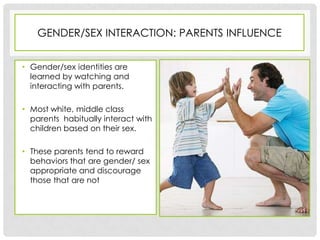
GENDER/SEX INTERACTION: PARENTS INFLUENCE


• Gender/sex identities are
  learned by watching and
  interacting with parents.

• Most white, middle class
  parents habitually interact with
  children based on their sex.

• These parents tend to reward
  behaviors that are gender/ sex
  appropriate and discourage
  those that are not
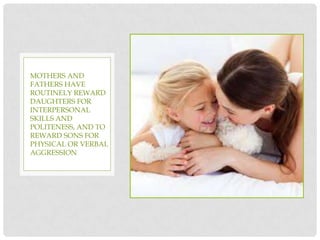
MOTHERS AND
FATHERS HAVE
ROUTINELY REWARD
DAUGHTERS FOR
INTERPERSONAL
SKILLS AND
POLITENESS, AND TO
REWARD SONS FOR
PHYSICAL OR VERBAL
AGGRESSION
GENDER/SEX INTERACTION:
            CHILDREN’S INFLUENCE

• Children do play an active role in constructing their gender.

• One study showed adolescent and teen children may actively select
  gendered interactions with their parents. The study found that the
  sons studied were more likely to be withdrawn in conversations with
  their mothers than daughters with their mothers.

• The gender schema theory says that children acquire a gender
  identity between 2 and 3. From this point on they use that gender
  identity to choose stimuli that seems consistent with the chosen
  identity.

• Very little research has been done on how siblings influence one
  another's gender identity.
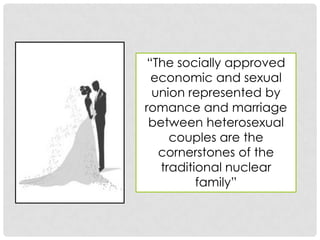
“The socially approved
                  economic and sexual
ADULT FRIENDS
AND LOVERS        union represented by
                romance and marriage
                 between heterosexual
                     couples are the
                   cornerstones of the
                   traditional nuclear
                          family”
ADULT FRIENDS AND LOVERS

• Regardless of race, class, or     • The ideological power of
  sexual orientation, people are      heterosexual romance can
  socialized to want marriage.        devalue other relationships such
                                      as friendship.
• Children grow up playing bride
  and groom.                        • Friendships, unlike marriages,
                                      receive no legal, political,
• The media and wedding industry      religious, or other institutional
  encourages people to spend          support.
  more than $40 billion a year on
  weddings.                         • Cross-sex friendships are often
                                      seen as a threat to dating and
• Marriage remains a primary way      marriage relationships.
  in which women can raise their
  socioeconomic status.             • Same sex platonic friendship is
                                      seen as more socially
                                      acceptable
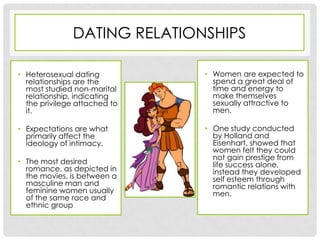
DATING RELATIONSHIPS

• Heterosexual dating         • Women are expected to
  relationships are the         spend a great deal of
  most studied non-marital      time and energy to
  relationship, indicating      make themselves
  the privilege attached to     sexually attractive to
  it.                           men.

• Expectations are what       • One study conducted
  primarily affect the          by Holland and
  ideology of intimacy.         Eisenhart, showed that
                                women felt they could
                                not gain prestige from
• The most desired              life success alone,
  romance, as depicted in       instead they developed
  the movies, is between a      self esteem through
  masculine man and             romantic relations with
  feminine women usually        men.
  of the same race and
  ethnic group
DATING RELATIONSHIPS

“Perhaps no other aspect of dating escalation reflects
  gender scripts as fully as first sexual involvement,
   particularly sexual intercourse.” S. Metts (2006)

• Heterosexual Dating Norms:
Primarily men initiate dates and physical intimacy.
Women take primary responsibility for maintaining the relationship.

• Heterosexual men who show sensitivity, which is considered feminine
  are thought of unusual.
MARITAL COMMUNICATION

• Marital communication is the most studied interpersonal
  relationship.
• Distinctive sex differences endorse the presumption that
  domestic labor and relationship work is women’s work, and
  claims that men are not good listeners and cannot do or
  value talk as much as women.
• Demand/withdrawl pattern: partner who wants the most
  change demands and the one who resists change
  withdraws.


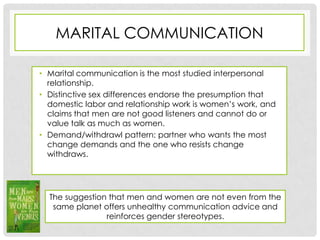
  The suggestion that men and women are not even from the
   same planet offers unhealthy communication advice and
                reinforces gender stereotypes.
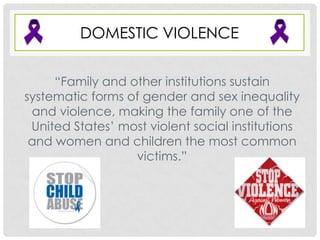
DOMESTIC VIOLENCE


     “Family and other institutions sustain
systematic forms of gender and sex inequality
 and violence, making the family one of the
 United States’ most violent social institutions
 and women and children the most common
                  victims.”
• Every day 4 children in the US dies as a result of
  abuse and neglect in a family.
• 4 women are murdered every day in the US by their
  husbands/boyfriends.
• Women are 10 times more likely to be victims of
  domestic violence then men.
• 4 million children a year in the US are abused or
  neglected by parents.
• 1 in 4 women reports having been raped or
  physically assaulted by an intimate partner this is
  true of the US and globally.
“A VARIETY OF FAMILY FORMS CAN PROVIDE A SAFE HAVEN
 WHERE THE MEMBERS FEEL LOVED, A CCEPTED, A ND A RE
      ABLE TO GROW TO THEIR FULLEST POTENTIAL .”


       Emancipatory Families
EMANCIPATORY FAMILIES

• Kyle Kostelecky believes we     • Engaged fatherhood not only
  spend more time as parents        benefits children and mothers,
  trying to create clear gender     but studies have found a
  roles which are actually          positive relationship between
  destructive, than trying to       involved parenting and a
  create more flexible gender       father’s psychological well-
  roles that are liberatory and     being, confidence, and self-
  responsive to each persons        esteem.
  individuality.                  • Parenting and family are
• Gender tolerance needs to be      defined by more than the
  taught                            particular people involved in a
• An example of a flexible          specific family. Social and
  gender role in a family is        cultural expectations inform
  engaged fatherhood.               the way each does family and
                                    parenthood.
CONCLUSION

The common theme of this chapter seems to be expectations. A lot of how
 we parent and interact comes from various interlocking institutions. These
  institutions are formed by social systems and what we consider to be the
norms. A lot of peoples interactions and parenting skills comes from what is
    expected of them, what is the norm for doing so. As humans we learn
 through social learning a modeling. We model after one another learning
             what is normal and expected within our social system.

Family cms 498

  • 1.
    FAMILY CHAPTER 7 ASHLEY DELONG
  • 2.
    • Most peopleexperience family at a deeply personal level • Many people’s most intense interpersonal exchanges occur within a family setting • Family is a social institution that genders its members • Organized by gendered lines by other social forces • Gender study in communication can not be done without studying the communication within a family
  • 3.
    GENDER ROLES REFERS TOFEMININE AND MASCULINE SOCIAL EXPECTATIONS IN A FAMILY BASED ON A PERSONS SEX
  • 4.
    GENDER ROLE SOCIALIZATIONLARGELY TAKES PLACE WITHIN FAMILIES, MAINLY VIA PARENTAL MODELING AND PARENT-CHILD INTERACTION
  • 5.
    “FAMILY IS USUALLYTHE FIRST SOURCE OF INFORMATION ABOUT GENDER AND ONE OF THE MOST INFLUENTIAL. IT IS THE PRIMARY PLACE WHERE MANY PEOPLE ARE TAUGHT THAT WOMEN AND MEN ARE ESSENTIALLY DIFFERENT AND HENCE SHOULD HAVE DIFFERENT AND/OR UNEQUAL ROLES.”
  • 6.
    “Men tend togather in front of “Women tend to work in the TV at family gatherings” kitchen” WHEN MOTHERS & FATHERS HAVE GENDER/SEX DIVISIONS OF LABOR AT HOME, THEY TEND TO PASS ON THOSE SAME DIVISIONS TO THEIR CHILDREN
  • 7.
    WHAT IS AN INSTITUTION? • Established patterns of behavior with a particular and recognized purpose, institutions include specific participants who share expectations and act in specific roles, with rights and duties attached to them.
  • 8.
    EXTERNAL CHARACTERISTICS OFAN INSTITUTION 1. Institutions are complex and intersecting: No institution operates in isolation from others. 2. All institutions influence and are influenced by the institution of gender. “Gender is present in the processes, practices, images, & ideologies, & distribution of power in various sectors of social life.” 3. Institutions are often intertwined with the state/government. Government can order particular practices in law and enforce those practices.
  • 9.
    FAMILY AS SOCIALINSTITUTION • In Western societies, we tend to think of a family as consisting of a one mother(f), one father(m), and biological children living under one roof: Nuclear Family
  • 10.
    FAMILY AS SOCIALINSTITUTION • The Textbook family(nuclear) reveals how family as an institution is influenced by social interactions and the idea of what is considered appropriate behavior within society. • Being part of a family is central part of a persons identity. • The nuclear family ideal, organizes people within a family and systemizes families In relation to one another: Better or Worse. • Although it is assumed that the nuclear family is ideal it is in fact not the most common family dynamic.
  • 11.
    “THE NUCLEAR FAMILY,THE ELUSIVE TRADITIONAL FAMILY” • 38% of marriages end in divorce • 75% of divorced persons remarry with a 60% chance of divorce • 30% of homes are headed by a single adult • 30% of children will at some point live in a blended family. • Historians can not point to a specific time when the “nuclear family” was ever predominant.
  • 13.
    FAMILY IDEALS OFTHE 17 & 1800’S • Stereotypical notions of • Although many families could masculinity and femininity as well not live on one mans salary alone as the concept of nuclear family , domesticity became a norm for came about in the 1800’s during judging a women's worth. the Industrial Revolution. • Middle and upper class white • Prior to the 1700’s families work women depicted “true was shared across the sexes. womanhood”, pure, pious, • Through the progression of the domestic, and submissive. industrial revolution brought • Poor white & black women could about the concept of manliness, not attain the ideal “true based on a mans ability to womanhood” because of class support his family on his income and race. alone. • Regardless of this, the ideal still held power over them and society deemed them bad women.
  • 14.
    FAMILY IDEALS OF THE 1950’S The nuclear family and its strict gender roles became institutionalized in the 1950’s
  • 15.
    ECONOMIC GROWTH ANDPOPULAR MEDIA REPRESENTATIONS ENABLED AND NORMALIZED THE MALE WAGE EARNER.
  • 16.
    IN EACH SHOW,THE FAMILY WAS A WHITE, MIDDLE CLASS, HETEROSEXUAL, MARRIED, MIDDLE-AGED COUPLE WITH CHILDREN, LIVING IN A SUBURBAN ENVIRONMENT. THE FATHER WAS THE SOLE WAGE EARNER AND THE MOTHER DID NOT WORK OUTSIDE OF THE HOME, SHE WAS THE NURTURER WITH MILK AND COOKIES FOR THE CHILDREN AND DINNER AND DRINKS READY FOR WHEN THE HUSBAND RETURNED HOME. FROM WORK.
  • 17.
    Advertisements in formof commercials and print promoted domestic technology to make women’s house work easier. In actuality, the marketing messages increased women’s workload because they raised standards of cleanliness.
  • 18.
    INTERLOCKING INSTITUTIONS Families canonly be understood in What Walker means by this is that the relation to the broader social context or what is considered to be in the public way a family works or functions is domain because the “broader social directly related to the social systems of systems and structures impinge on the outside world. everyday family life, reproducing inside families in the divisions that exist outside of them.” -Alexis Walker
  • 19.
    “IF GENDER/SEX DIVISIONSAPPEAR IN THE WORKPLACE, THEY LIKELY WILL APPEAR IN FAMILIES AND VICE VERSA.” • Myth: The nuclear family is self sufficient • Reality: Extended family, work, religion, schools, social services, media, and law influence it.
  • 20.
    • Politics andlaw Establish and • The institution of work and authenticate the ideal family family intersect through the through repeated use of the reoccurring issue of domestic slogan family values. labor. Discussion of gender/sex in family communication • In the 1990’s this slogan produces household services referred to the heterosexual as well as gender. married couple with children living in one home guided by • Imbalanced housework Christian values. distribution between men and women is one of the clearest • The US congress people use the indicators of inequitable idea of the “nuclear family” in gender roles. debates over welfare. Putting negative value towards families who do not fit the model.
  • 21.
    Psychologist Francine Deutsch’s study shows 5 communication strategies men use to resists sharing household duties. Surveys shows that in heterosexual 1. Passive resistance relationships wives still spend 2. Pretending to be incompetent between 5 and 13.5 hours more 3. Praising spouse for her skills a week doing housework than husbands 4. Applying lower standards when doing work, whereby person who cares more about standards takes over the task at hand. 5. Denial by exaggerating their own contributions.
  • 22.
    COMPULSORY HETEROSEXUALITY THE ASSUMPTIONTHAT ONLY ONE LEGITIMATE WAY OF LOVING AND ONE LEGITIMATE FORM OF FAMILY IS POSSIBLE.
  • 23.
    FAMILY CONSTRUCTS/CONSTRAINS GENDER Researchfocus on nuclear family Social Learning & Modeling • Researchers are not exempt • Children’s gender identities from the influences of the ideal come from their parental nuclear family. model • The functionalist view of family • Social learning is often argued social order was unconscious, yet children dependent upon a “natural observe and internalize certain sexual division of labor” in the behaviors. family. • Children will most likely model • Research predominantly behaviors of those they admire, focused on White, U.S., middle they are observe and are often class, heterosexual couples. rewarded for the following behavior.
  • 24.
    SOCIAL LEARNING &MODELING • Research shows that heterosexual couples’ perception of what is fair tend to be sex biased. • Even if parents tell their children that work should be shared equally, when women do more domestic labor than men, children tend to learn what the observe rather than what they are told. • Research has examined whether having a gay or lesbian parent negatively affects children's gender identity development and there is no evidence that gay/lesbian parents differ systematically from children of heterosexual parents. • There is no evidence that children of gay or lesbian parents are confused or uncertain about their gender identity. • Less research exists, however it shows that the majority of children from gay/lesbian parents grow up to identify as heterosexuals.
  • 25.
    GENDER/SEX INTERACTION: PARENTSINFLUENCE • Gender/sex identities are learned by watching and interacting with parents. • Most white, middle class parents habitually interact with children based on their sex. • These parents tend to reward behaviors that are gender/ sex appropriate and discourage those that are not
  • 26.
    MOTHERS AND FATHERS HAVE ROUTINELYREWARD DAUGHTERS FOR INTERPERSONAL SKILLS AND POLITENESS, AND TO REWARD SONS FOR PHYSICAL OR VERBAL AGGRESSION
  • 27.
    GENDER/SEX INTERACTION: CHILDREN’S INFLUENCE • Children do play an active role in constructing their gender. • One study showed adolescent and teen children may actively select gendered interactions with their parents. The study found that the sons studied were more likely to be withdrawn in conversations with their mothers than daughters with their mothers. • The gender schema theory says that children acquire a gender identity between 2 and 3. From this point on they use that gender identity to choose stimuli that seems consistent with the chosen identity. • Very little research has been done on how siblings influence one another's gender identity.
  • 28.
    “The socially approved economic and sexual ADULT FRIENDS AND LOVERS union represented by romance and marriage between heterosexual couples are the cornerstones of the traditional nuclear family”
  • 29.
    ADULT FRIENDS ANDLOVERS • Regardless of race, class, or • The ideological power of sexual orientation, people are heterosexual romance can socialized to want marriage. devalue other relationships such as friendship. • Children grow up playing bride and groom. • Friendships, unlike marriages, receive no legal, political, • The media and wedding industry religious, or other institutional encourages people to spend support. more than $40 billion a year on weddings. • Cross-sex friendships are often seen as a threat to dating and • Marriage remains a primary way marriage relationships. in which women can raise their socioeconomic status. • Same sex platonic friendship is seen as more socially acceptable
  • 30.
    DATING RELATIONSHIPS • Heterosexualdating • Women are expected to relationships are the spend a great deal of most studied non-marital time and energy to relationship, indicating make themselves the privilege attached to sexually attractive to it. men. • Expectations are what • One study conducted primarily affect the by Holland and ideology of intimacy. Eisenhart, showed that women felt they could not gain prestige from • The most desired life success alone, romance, as depicted in instead they developed the movies, is between a self esteem through masculine man and romantic relations with feminine women usually men. of the same race and ethnic group
  • 31.
    DATING RELATIONSHIPS “Perhaps noother aspect of dating escalation reflects gender scripts as fully as first sexual involvement, particularly sexual intercourse.” S. Metts (2006) • Heterosexual Dating Norms: Primarily men initiate dates and physical intimacy. Women take primary responsibility for maintaining the relationship. • Heterosexual men who show sensitivity, which is considered feminine are thought of unusual.
  • 32.
    MARITAL COMMUNICATION • Maritalcommunication is the most studied interpersonal relationship. • Distinctive sex differences endorse the presumption that domestic labor and relationship work is women’s work, and claims that men are not good listeners and cannot do or value talk as much as women. • Demand/withdrawl pattern: partner who wants the most change demands and the one who resists change withdraws. The suggestion that men and women are not even from the same planet offers unhealthy communication advice and reinforces gender stereotypes.
  • 33.
    DOMESTIC VIOLENCE “Family and other institutions sustain systematic forms of gender and sex inequality and violence, making the family one of the United States’ most violent social institutions and women and children the most common victims.”
  • 34.
    • Every day4 children in the US dies as a result of abuse and neglect in a family. • 4 women are murdered every day in the US by their husbands/boyfriends. • Women are 10 times more likely to be victims of domestic violence then men. • 4 million children a year in the US are abused or neglected by parents. • 1 in 4 women reports having been raped or physically assaulted by an intimate partner this is true of the US and globally.
  • 35.
    “A VARIETY OFFAMILY FORMS CAN PROVIDE A SAFE HAVEN WHERE THE MEMBERS FEEL LOVED, A CCEPTED, A ND A RE ABLE TO GROW TO THEIR FULLEST POTENTIAL .” Emancipatory Families
  • 36.
    EMANCIPATORY FAMILIES • KyleKostelecky believes we • Engaged fatherhood not only spend more time as parents benefits children and mothers, trying to create clear gender but studies have found a roles which are actually positive relationship between destructive, than trying to involved parenting and a create more flexible gender father’s psychological well- roles that are liberatory and being, confidence, and self- responsive to each persons esteem. individuality. • Parenting and family are • Gender tolerance needs to be defined by more than the taught particular people involved in a • An example of a flexible specific family. Social and gender role in a family is cultural expectations inform engaged fatherhood. the way each does family and parenthood.
  • 37.
    CONCLUSION The common themeof this chapter seems to be expectations. A lot of how we parent and interact comes from various interlocking institutions. These institutions are formed by social systems and what we consider to be the norms. A lot of peoples interactions and parenting skills comes from what is expected of them, what is the norm for doing so. As humans we learn through social learning a modeling. We model after one another learning what is normal and expected within our social system.