CH:3 Design andConstruction of Sewers
1) Shape of Sewers
Most common section is circular for closed sewer.
Other non-circular section may be used for open and closed sewers.
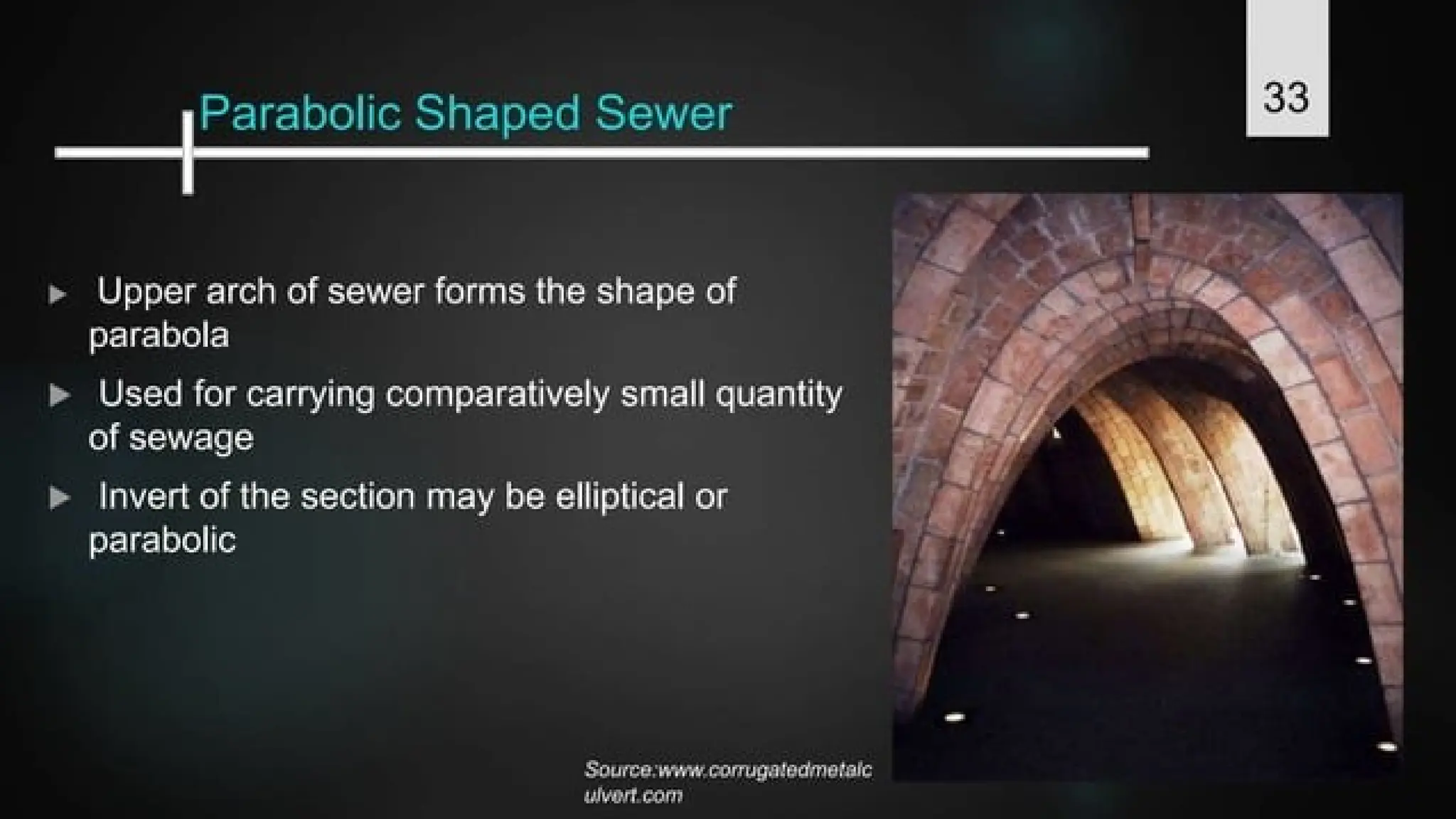
Parabolic shape is used generally in the unlimited drains to carry storm water
Shape of sewer section should be selected in such a way that it should
Develop self-cleansing velocity in minimum or dry weather flow
Have sufficient free board during maximum discharge
Easy in cleaning and maintenance
Structurally safe and stable
Shape of sewer can be classified as:
i. Circular sewer
ii. Non-circular sewer
2.
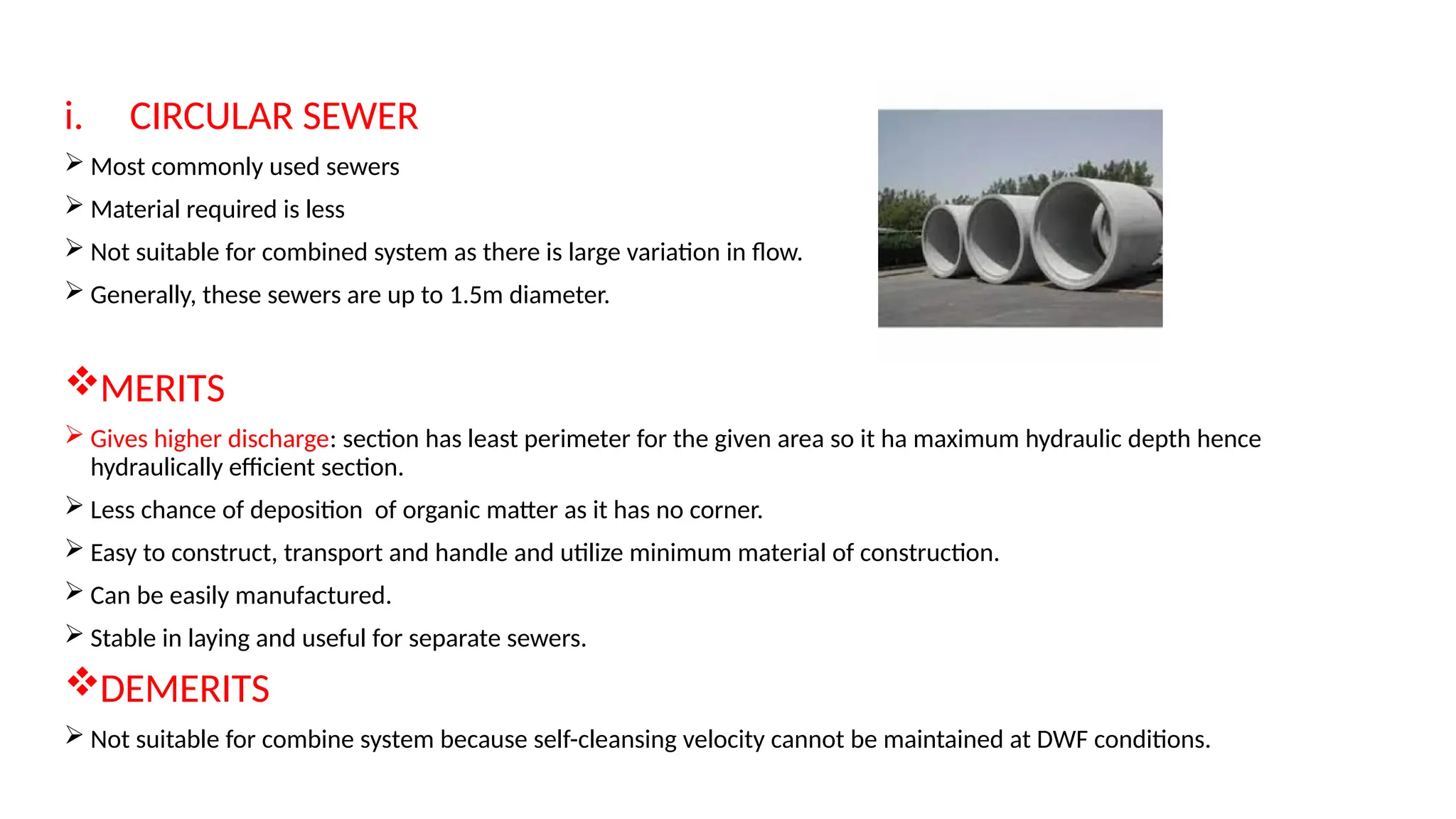
i. CIRCULAR SEWER
Most commonly used sewers
Material required is less
Not suitable for combined system as there is large variation in flow.
Generally, these sewers are up to 1.5m diameter.
MERITS
Gives higher discharge: section has least perimeter for the given area so it ha maximum hydraulic depth hence
hydraulically efficient section.
Less chance of deposition of organic matter as it has no corner.
Easy to construct, transport and handle and utilize minimum material of construction.
Can be easily manufactured.
Stable in laying and useful for separate sewers.
DEMERITS
Not suitable for combine system because self-cleansing velocity cannot be maintained at DWF conditions.
3.
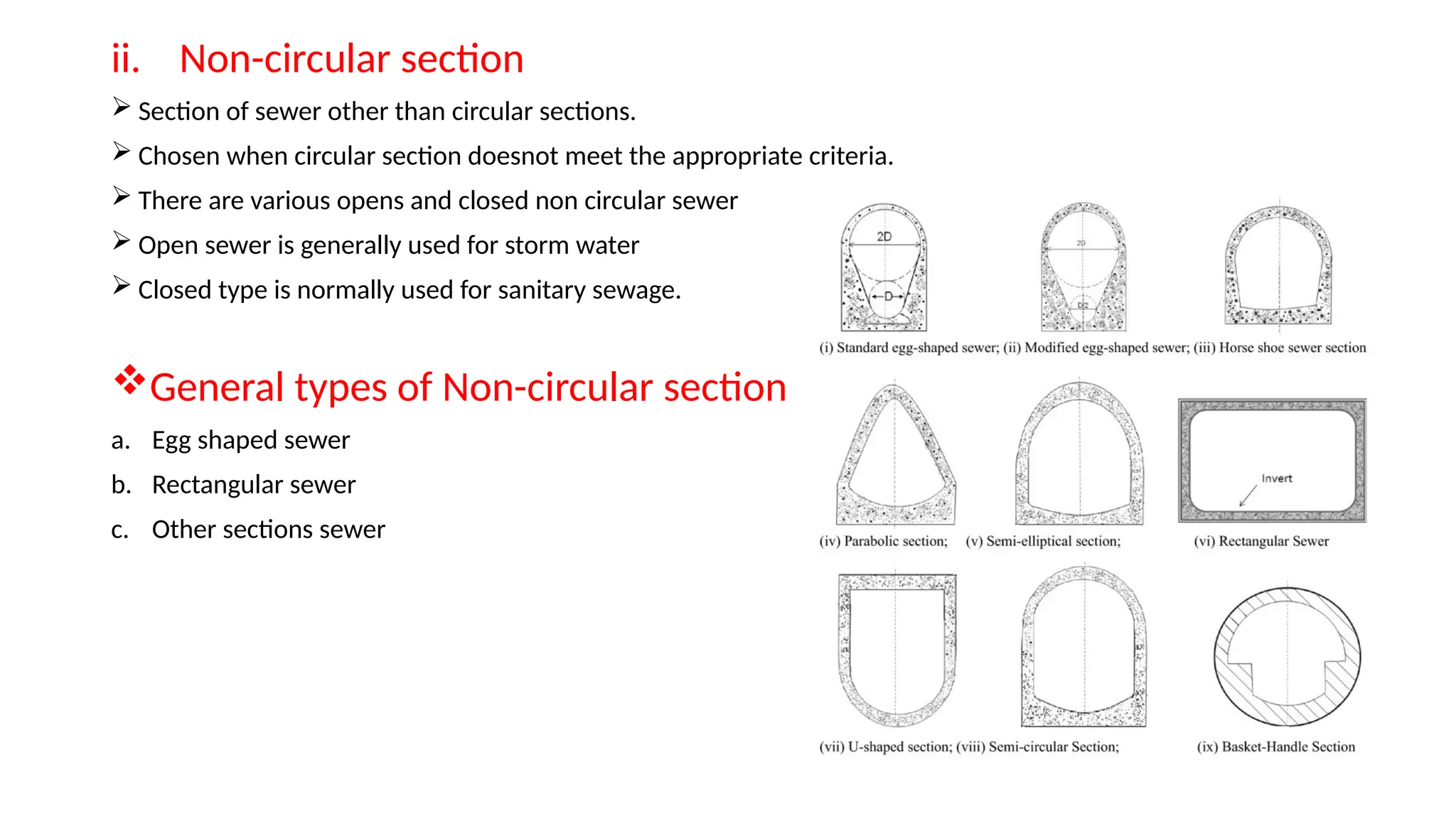
ii. Non-circular section
Section of sewer other than circular sections.
Chosen when circular section doesnot meet the appropriate criteria.
There are various opens and closed non circular sewer
Open sewer is generally used for storm water
Closed type is normally used for sanitary sewage.
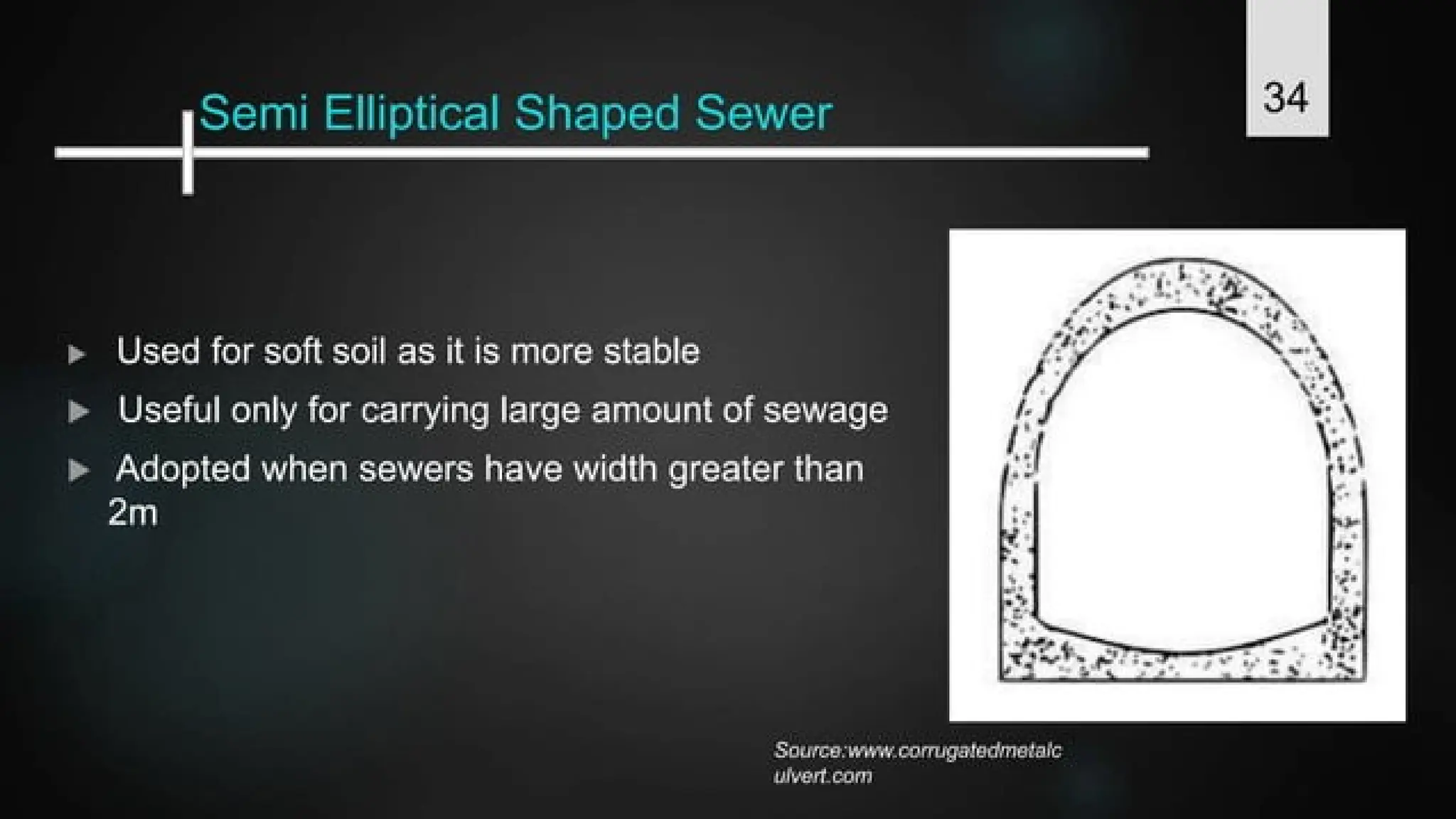
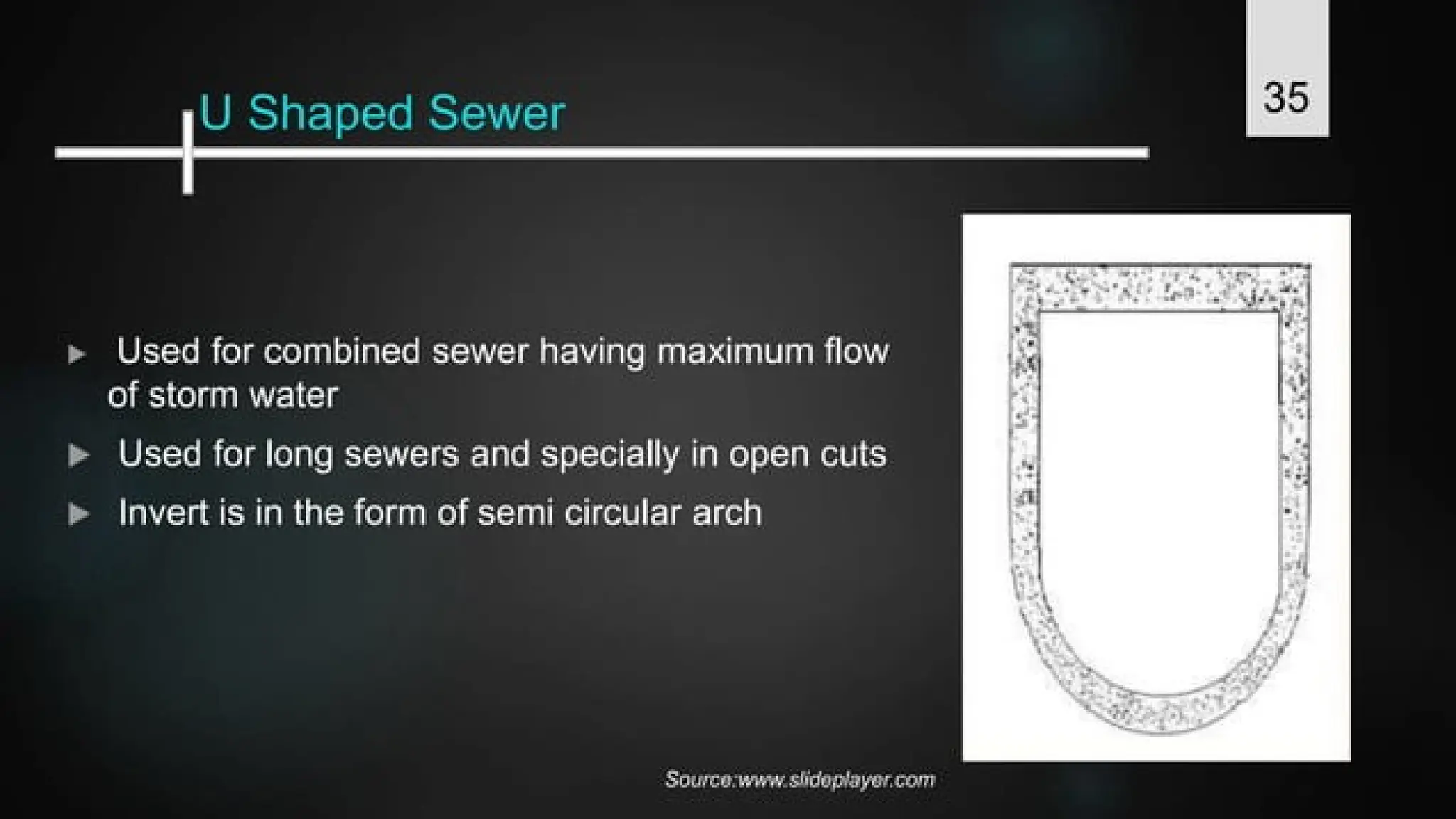
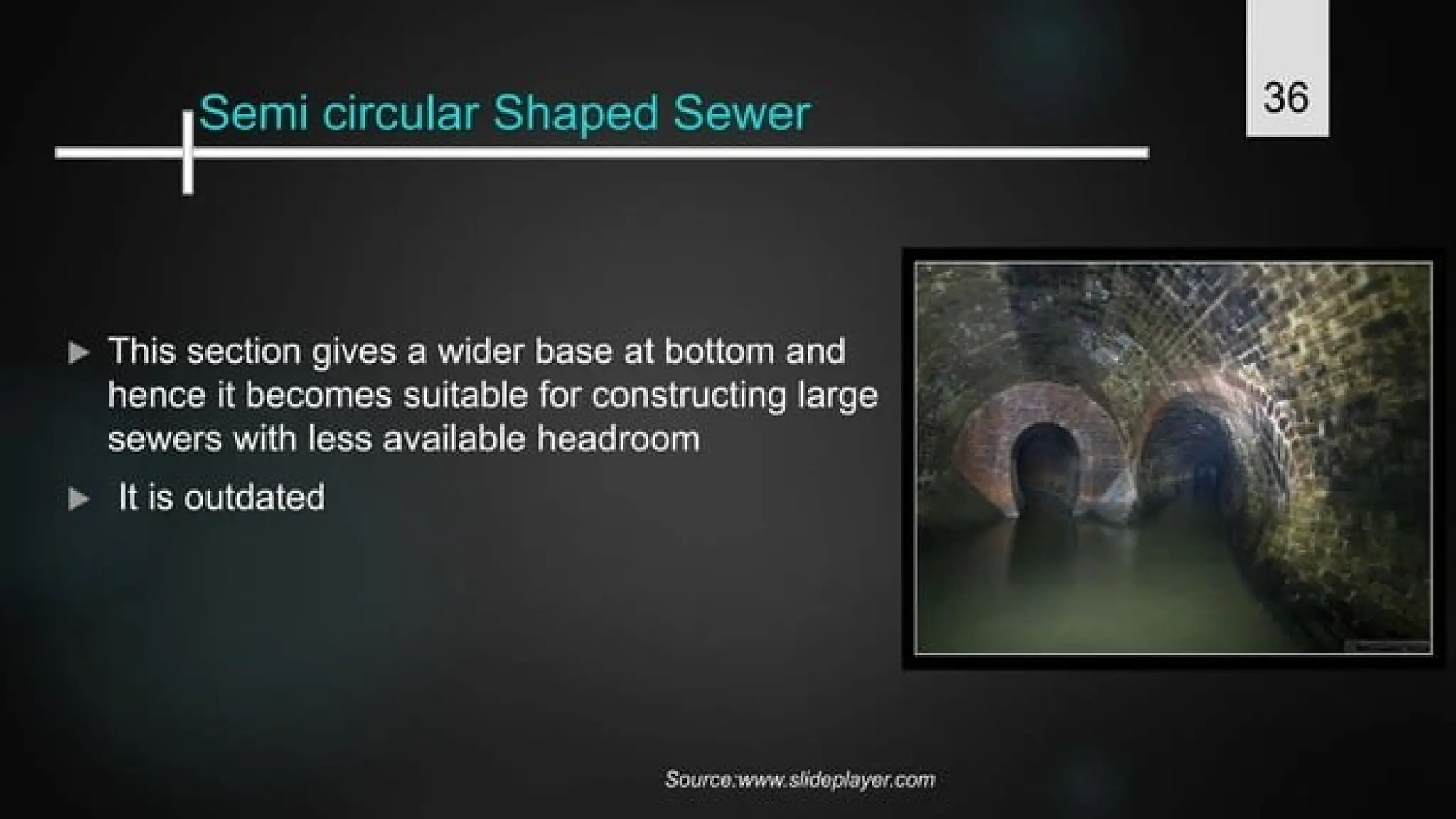
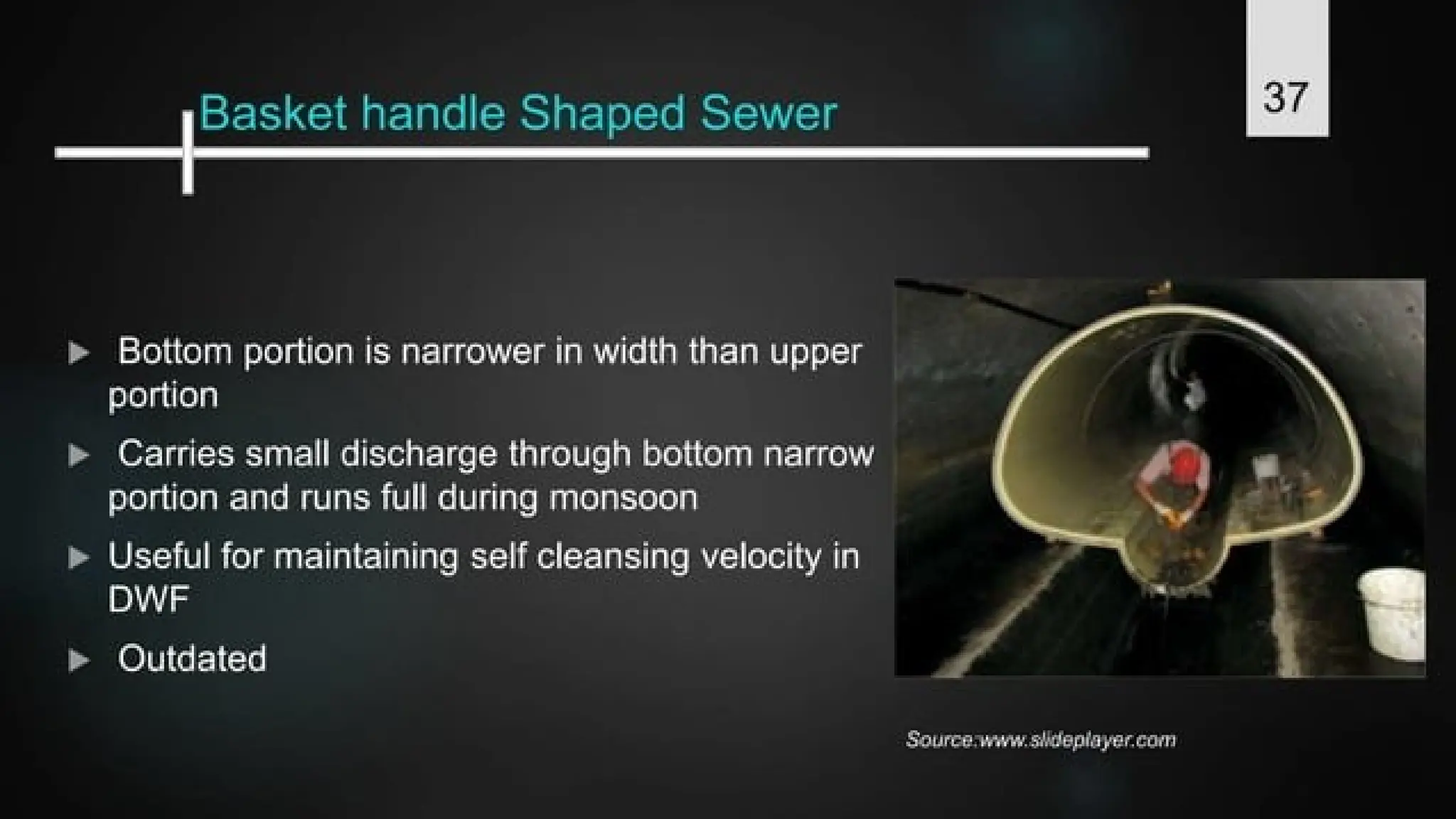
General types of Non-circular section
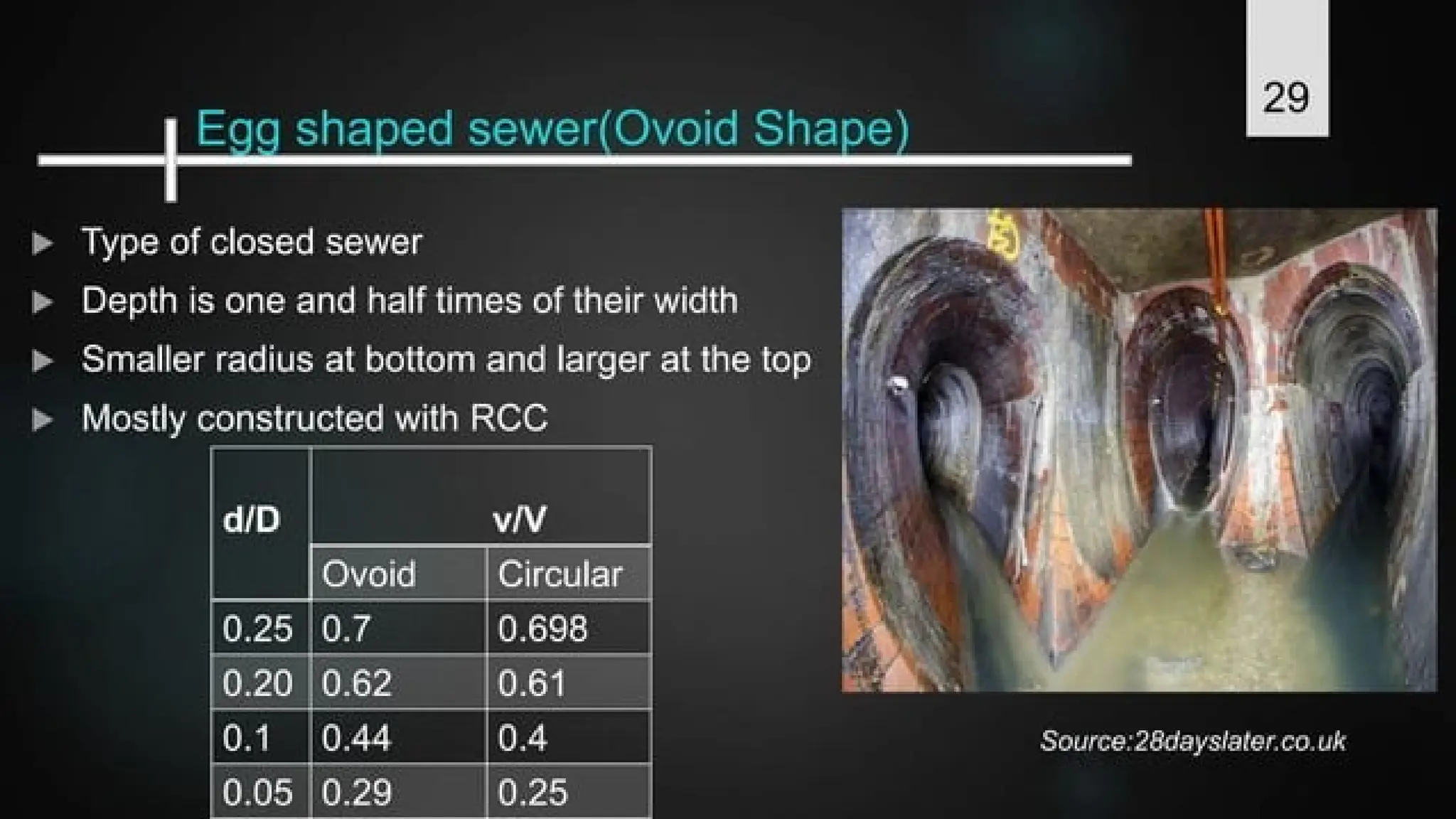
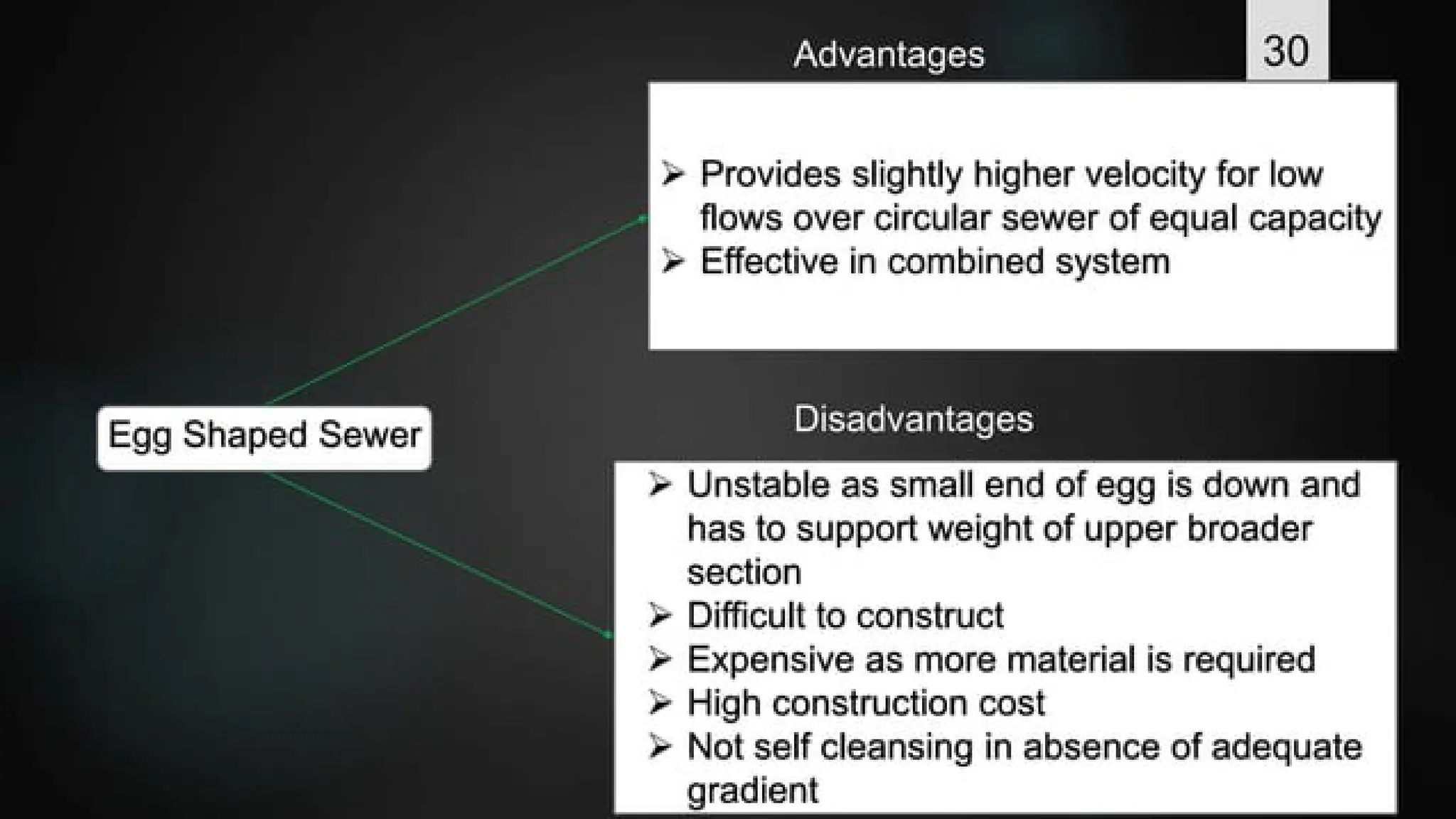
a. Egg shaped sewer
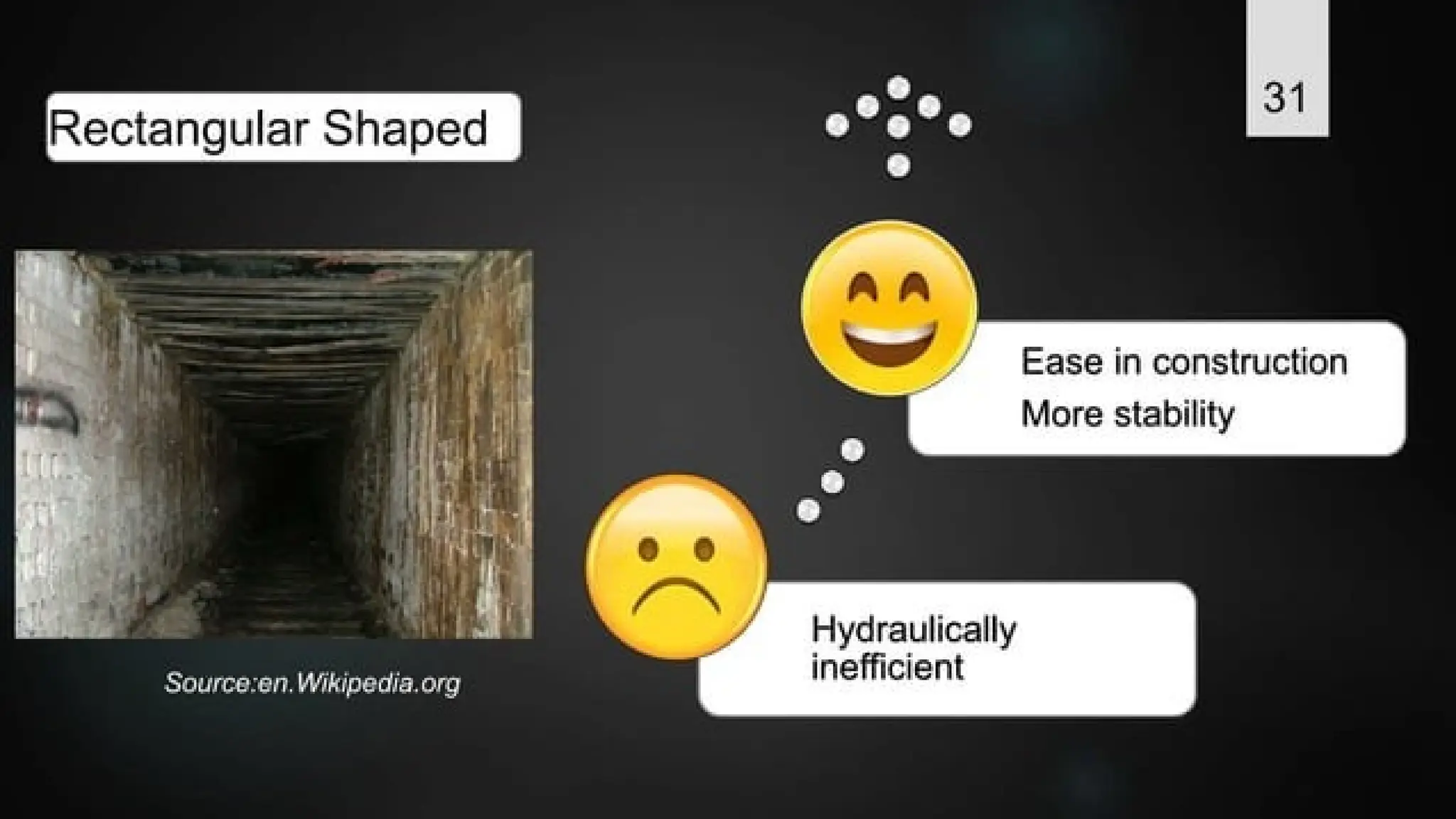
b. Rectangular sewer
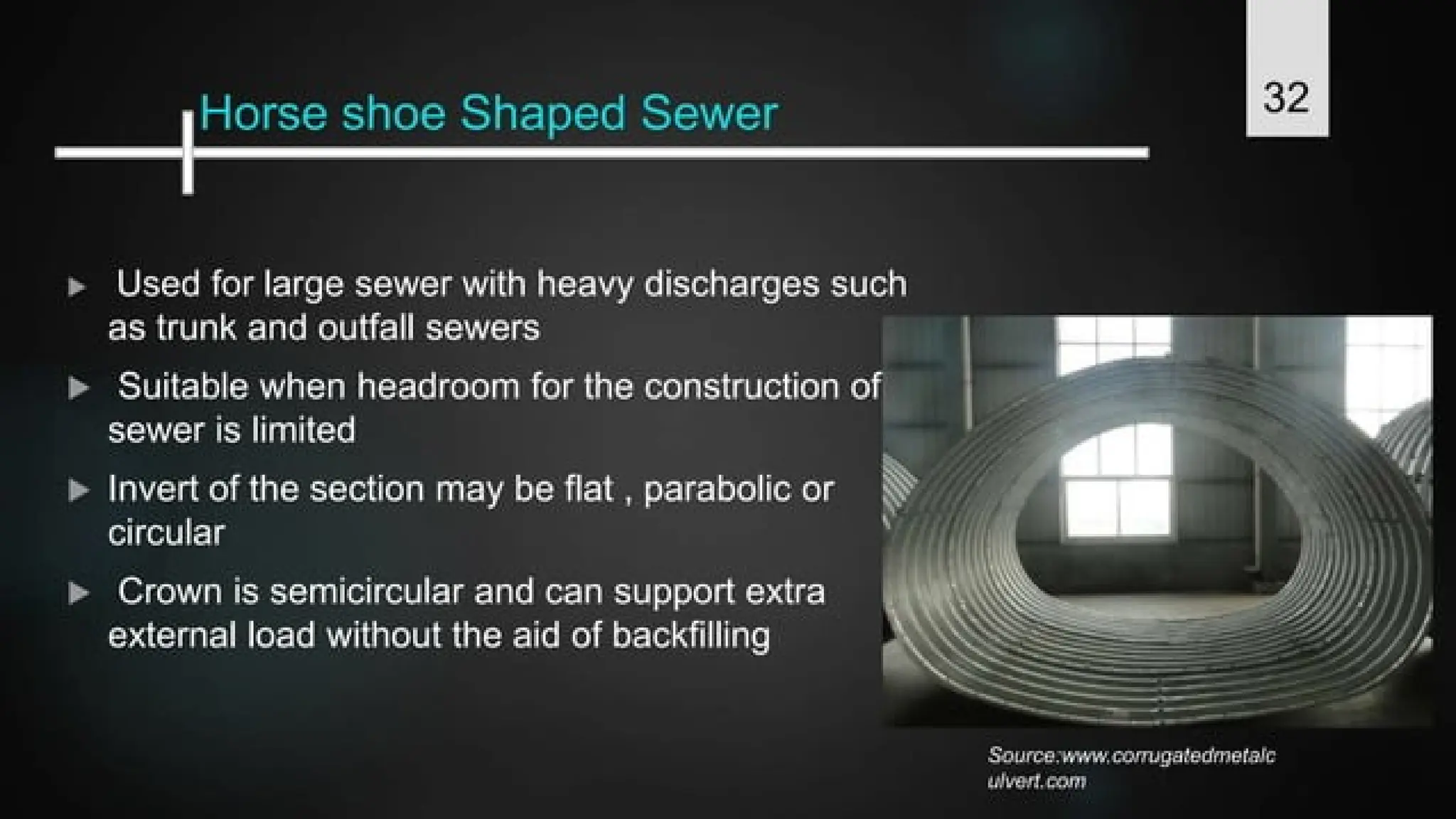
c. Other sections sewer
13.
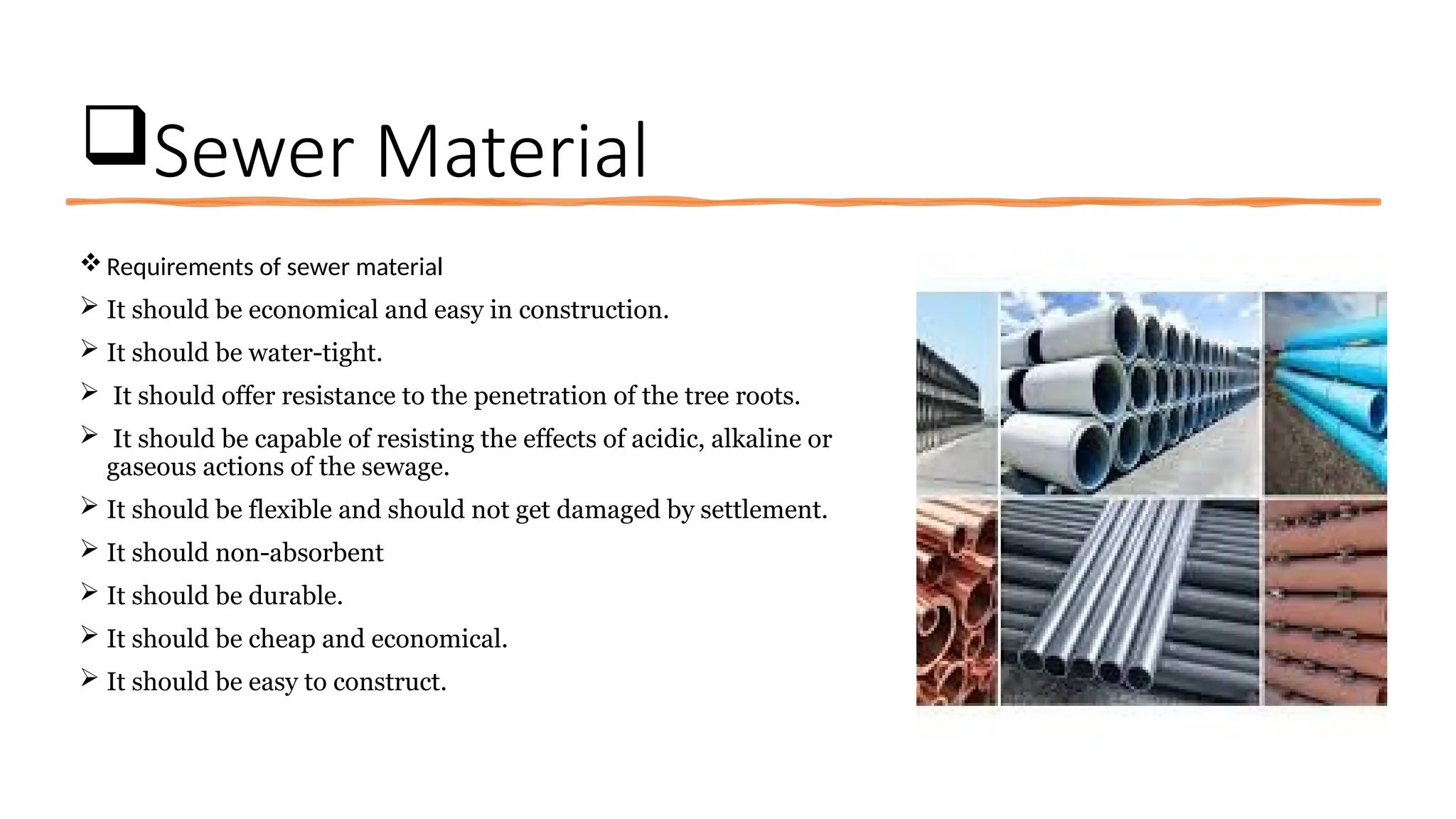
Sewer Material
Requirements ofsewer material
It should be economical and easy in construction.
It should be water-tight.
It should offer resistance to the penetration of the tree roots.
It should be capable of resisting the effects of acidic, alkaline or
gaseous actions of the sewage.
It should be flexible and should not get damaged by settlement.
It should non-absorbent
It should be durable.
It should be cheap and economical.
It should be easy to construct.
14.
Types Of SewerMaterials
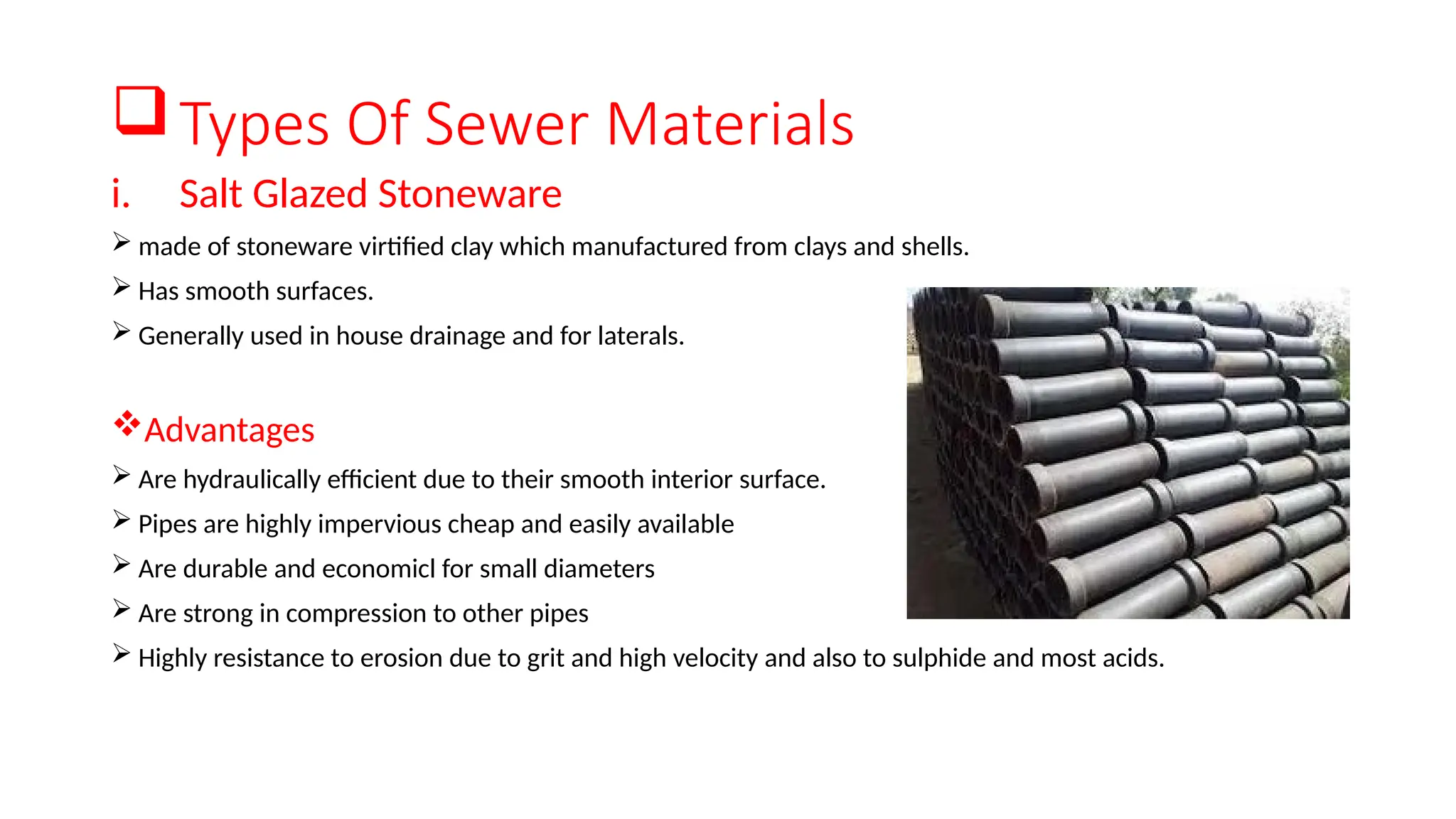
i. Salt Glazed Stoneware
made of stoneware virtified clay which manufactured from clays and shells.
Has smooth surfaces.
Generally used in house drainage and for laterals.
Advantages
Are hydraulically efficient due to their smooth interior surface.
Pipes are highly impervious cheap and easily available
Are durable and economicl for small diameters
Are strong in compression to other pipes
Highly resistance to erosion due to grit and high velocity and also to sulphide and most acids.
15.
Disadvantage
Are heavy,bulky and brittle so difficult to transport, handling and laying
Pipes are individually, small pipes so require large number of joints
Pipes cannot be used as pressure pipe since these pipe weak in tension.
Very weak in tension
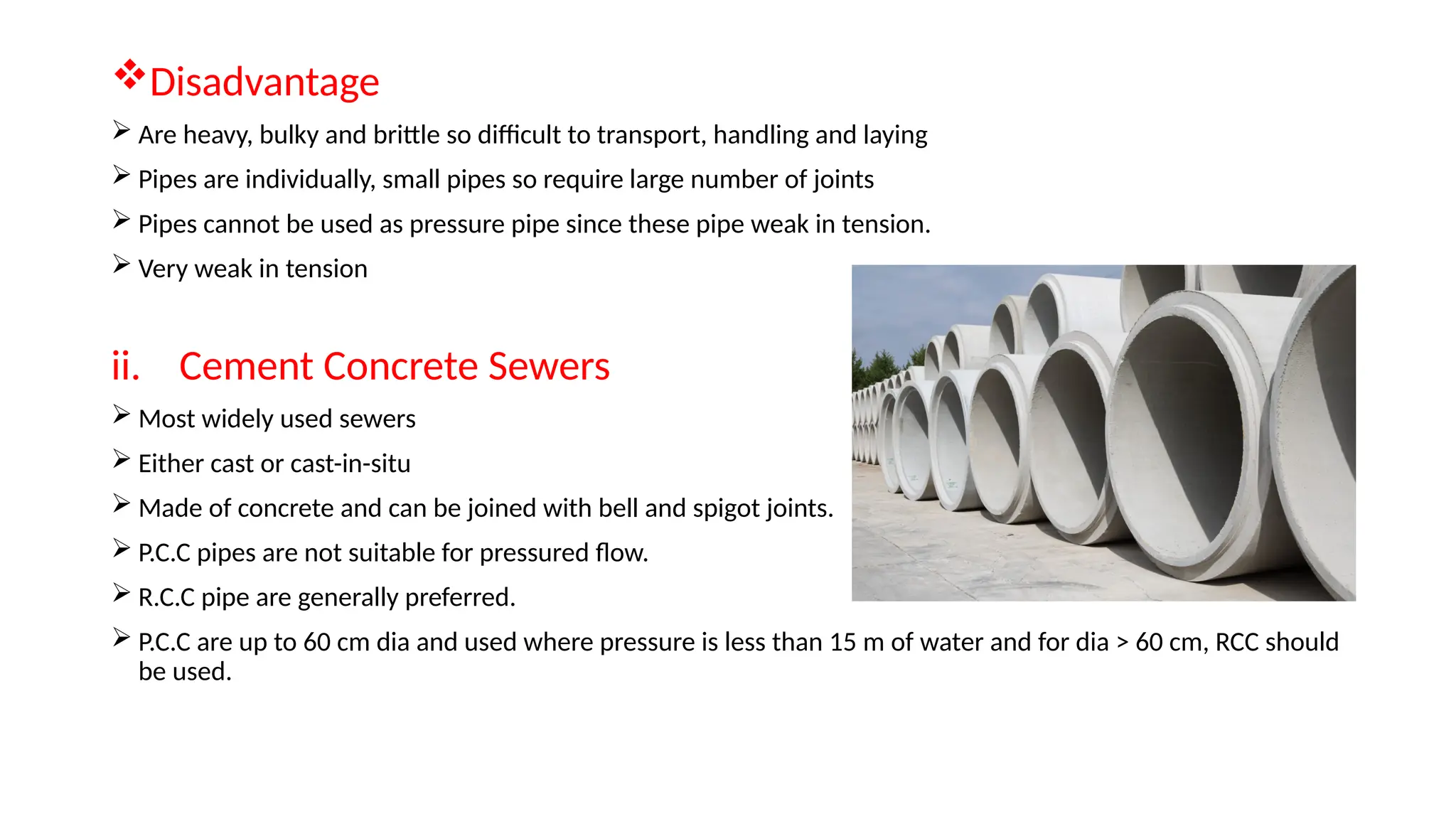
ii. Cement Concrete Sewers
Most widely used sewers
Either cast or cast-in-situ
Made of concrete and can be joined with bell and spigot joints.
P.C.C pipes are not suitable for pressured flow.
R.C.C pipe are generally preferred.
P.C.C are up to 60 cm dia and used where pressure is less than 15 m of water and for dia > 60 cm, RCC should
be used.
16.
Advantages
Strong enoughto withstand external and internal pressure and can be designed for any strength.
High resistance to erosion and abrasion
Economic
Can be used in place, where ground water table is much higher.
Available in different size
Constructed in site in required shape and size as well as in factory.
Economical for medium and large size hence heavily used in factory.
Least thermal expansion, its maintenance cost is low and can be laid under water.
Disadvantages
Difficult in transportation if precast are used as they are heavy to handle
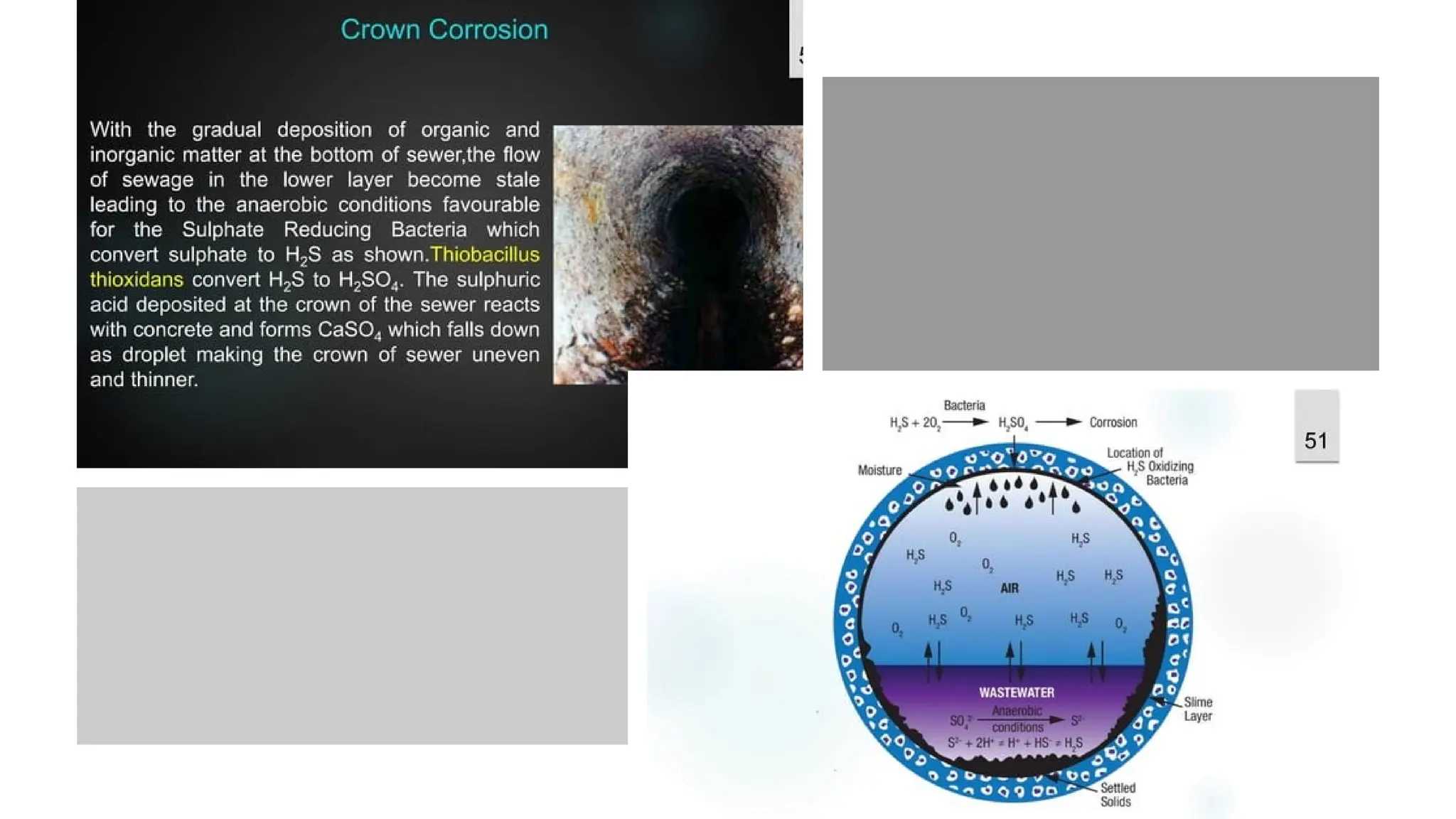
May be affected by acids and alkali and salty waters but major disadvantages is that it most liable to crown
crossion.
Intial cost is high
Difficult to join so liable to leak due to porosity and difficult to repair.
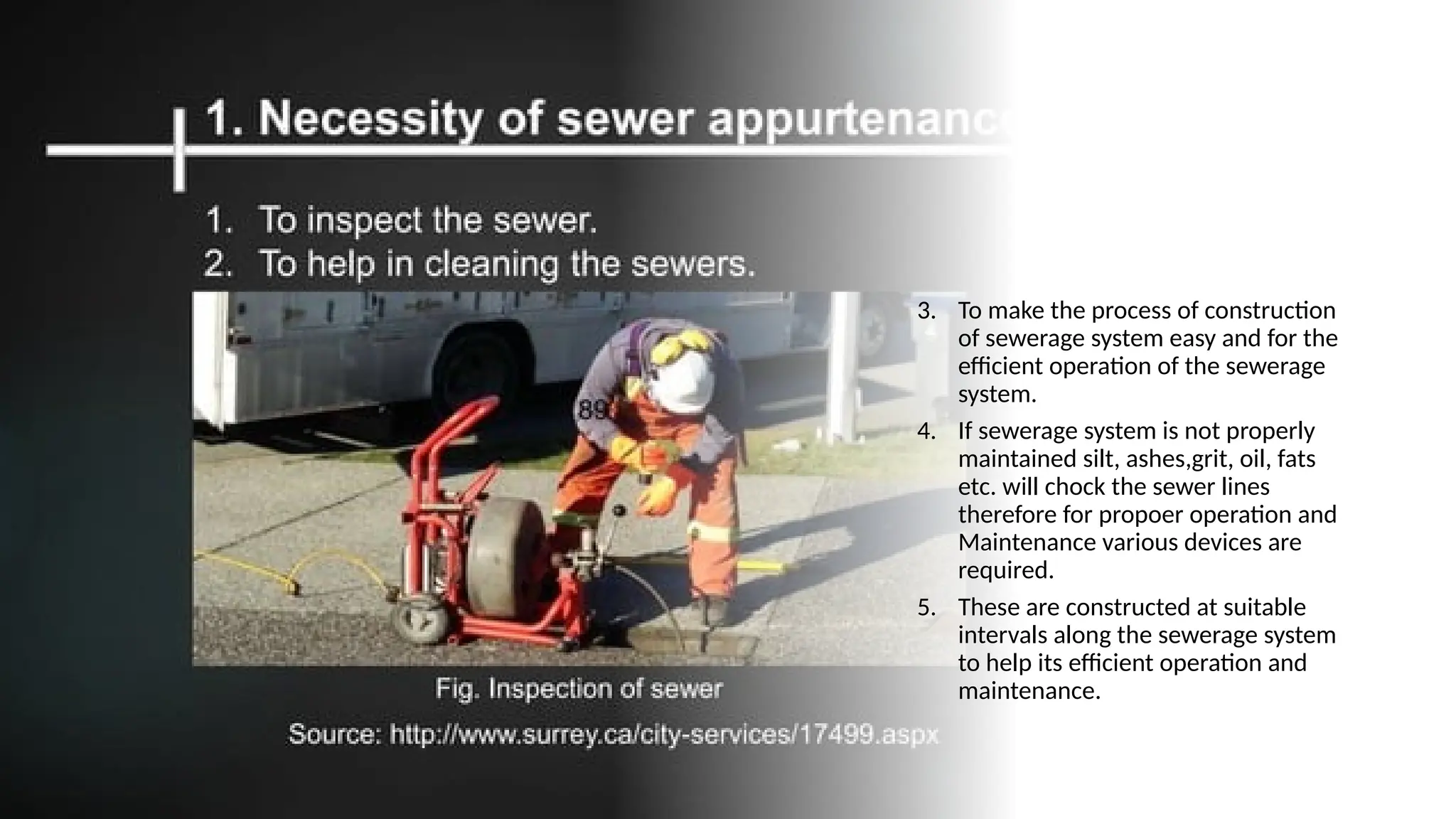
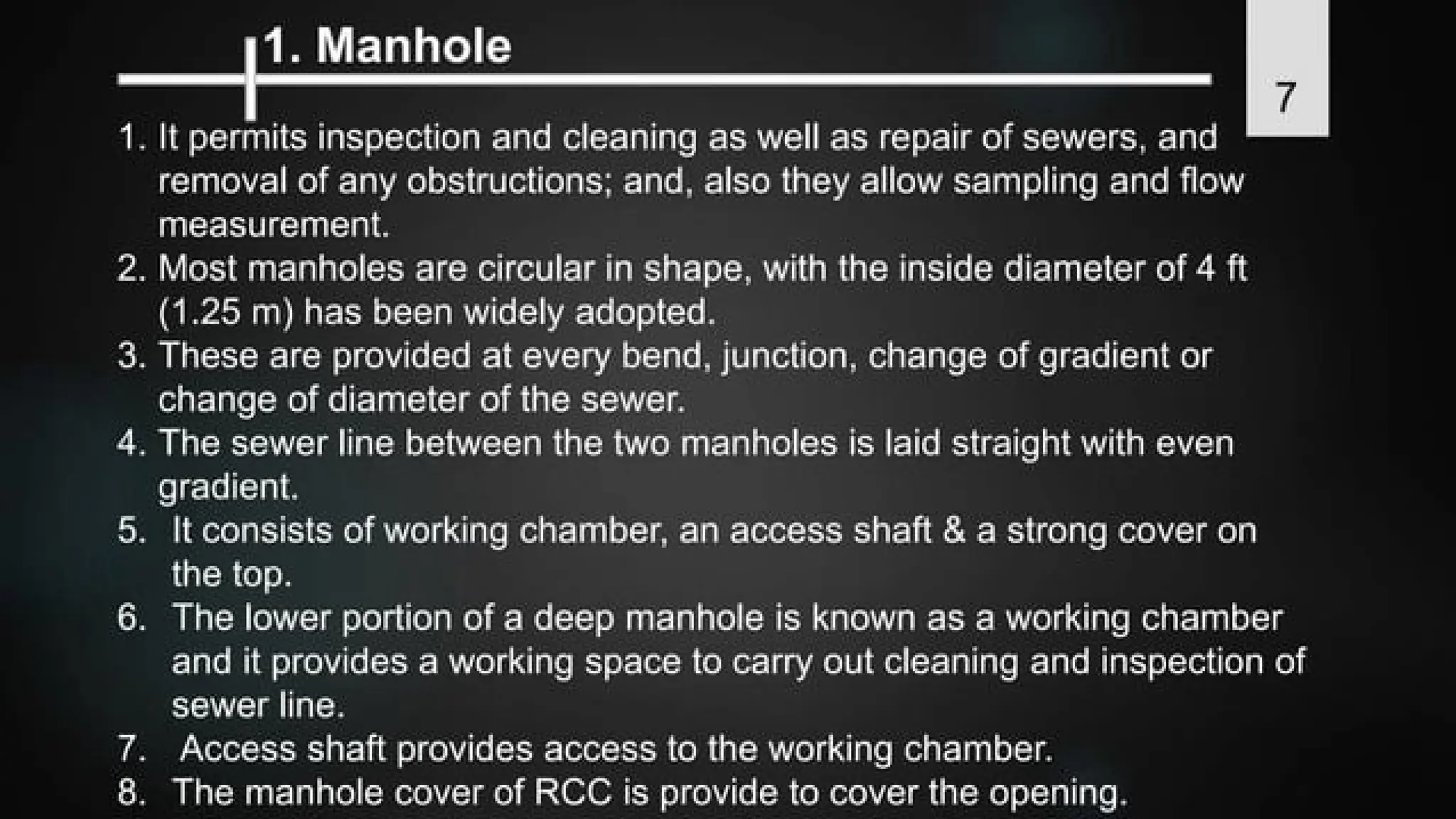
3. To makethe process of construction
of sewerage system easy and for the
efficient operation of the sewerage
system.
4. If sewerage system is not properly
maintained silt, ashes,grit, oil, fats
etc. will chock the sewer lines
therefore for propoer operation and
Maintenance various devices are
required.
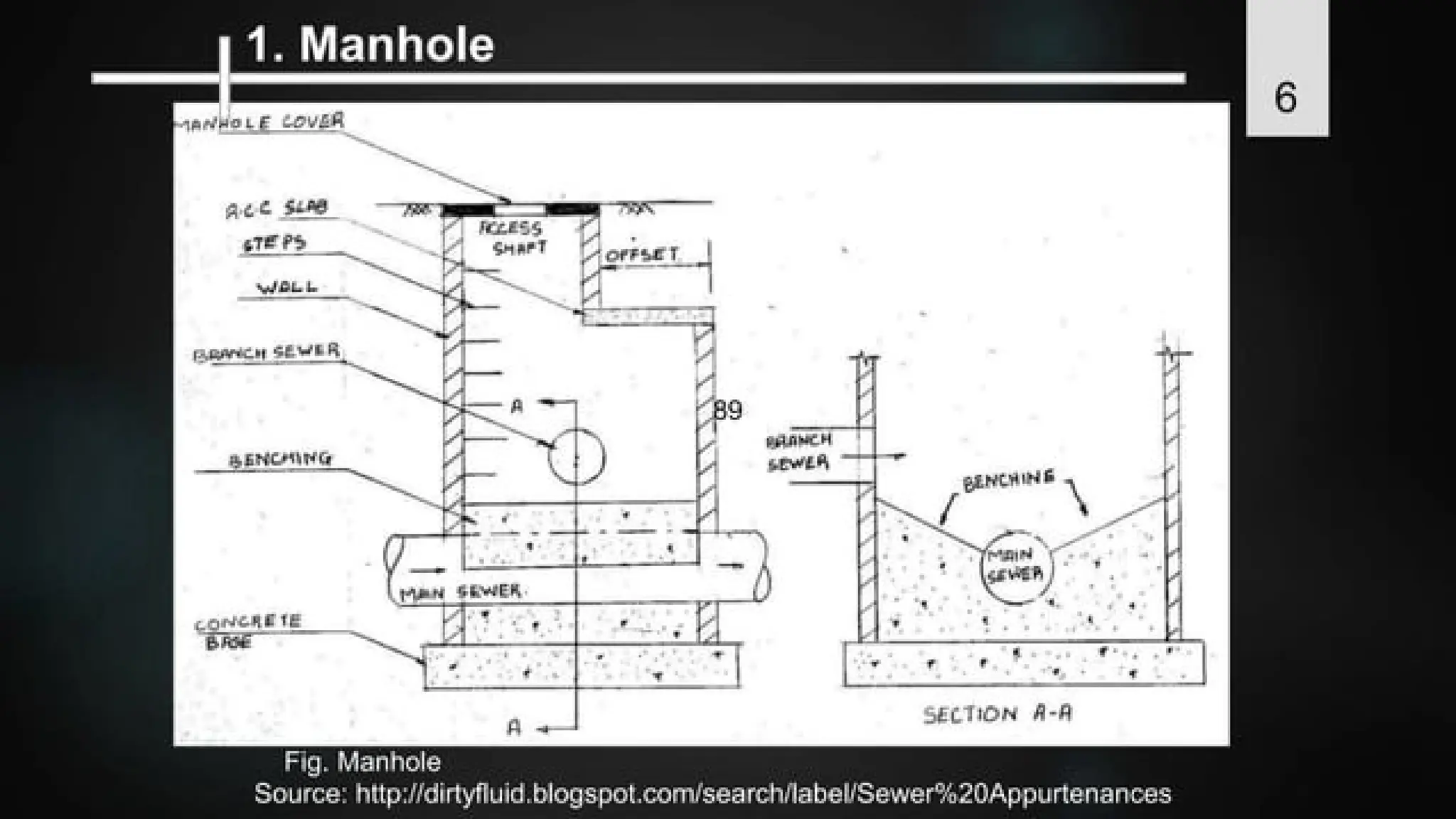
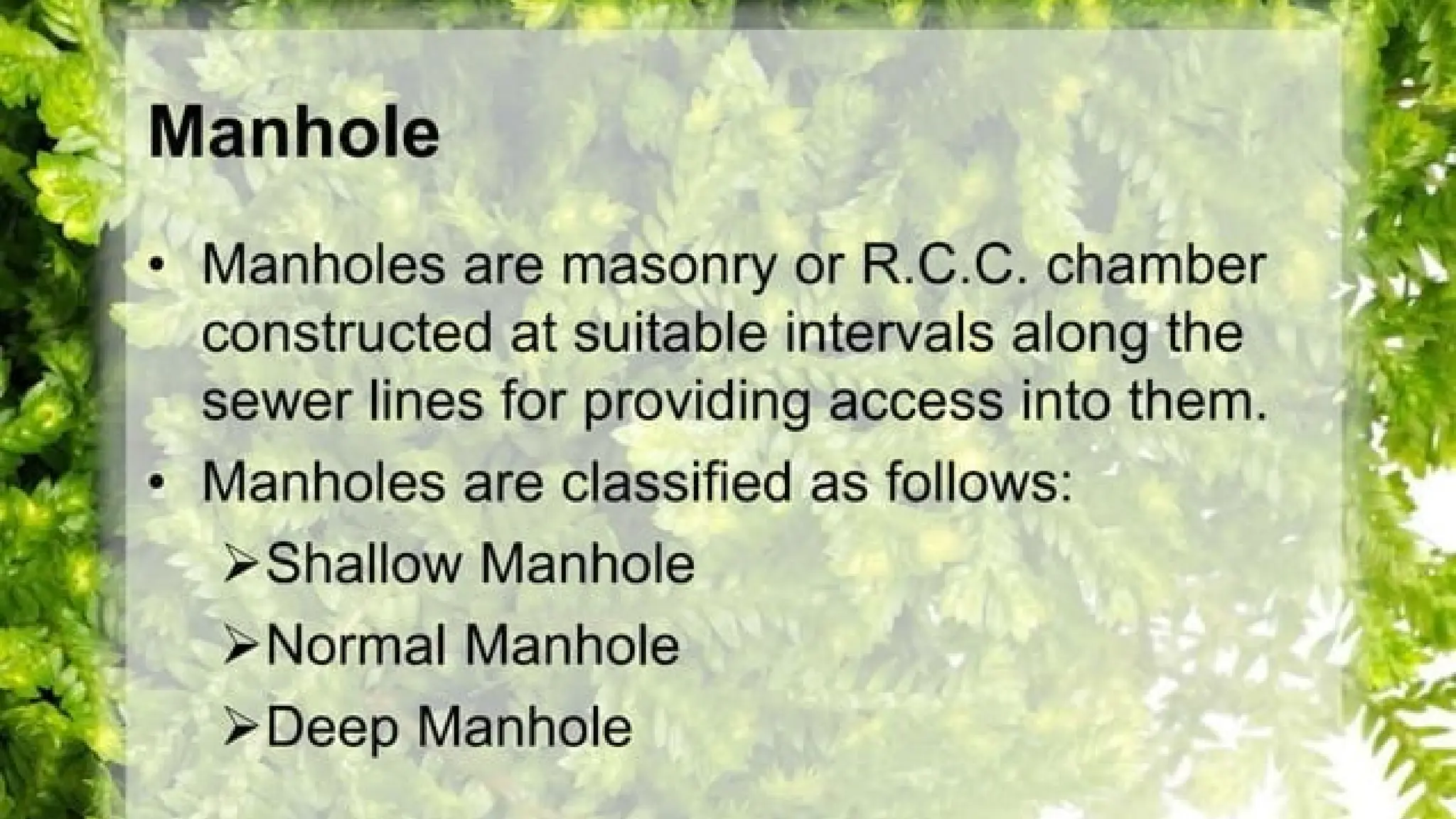
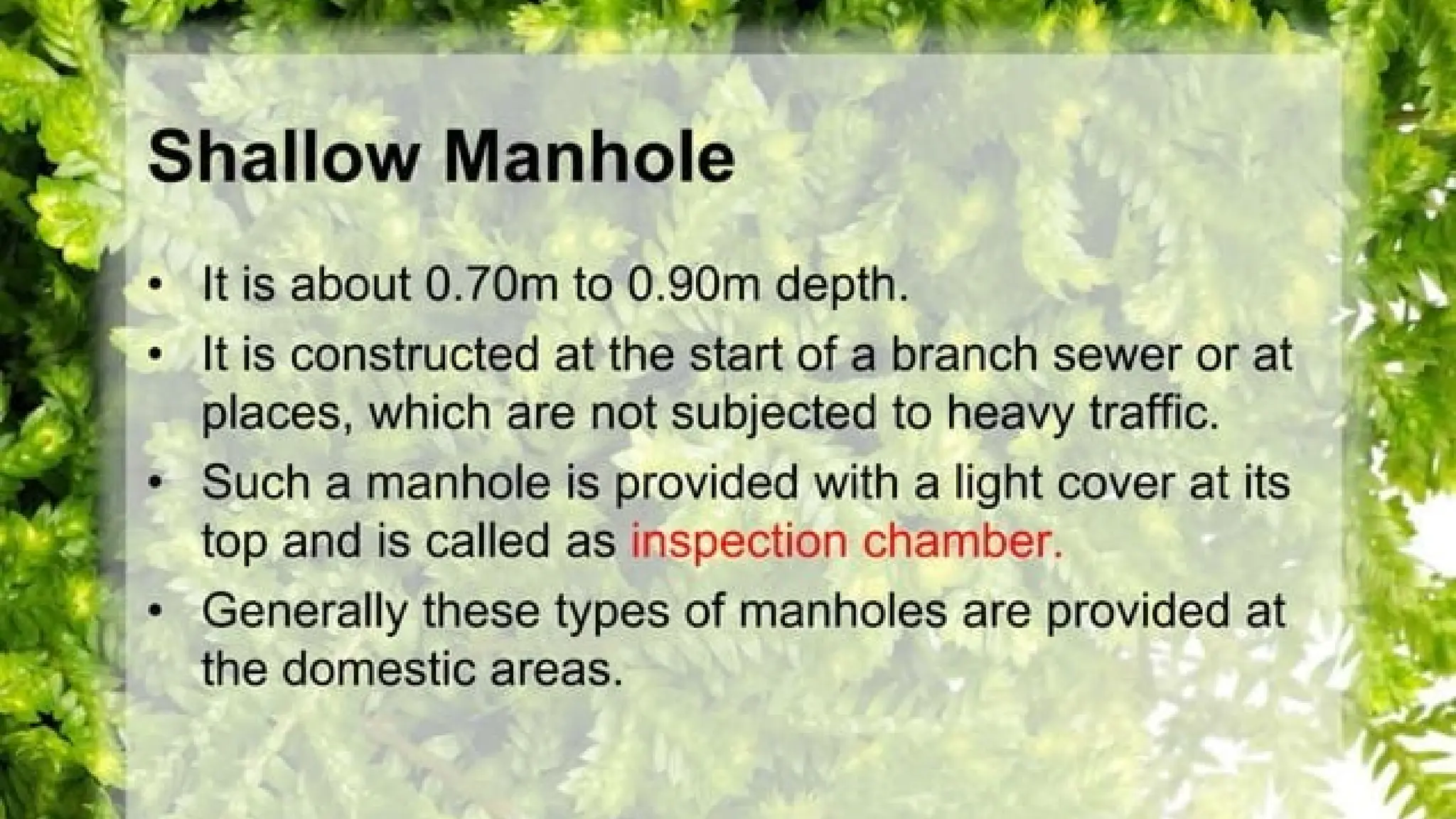
5. These are constructed at suitable
intervals along the sewerage system
to help its efficient operation and
maintenance.
49.
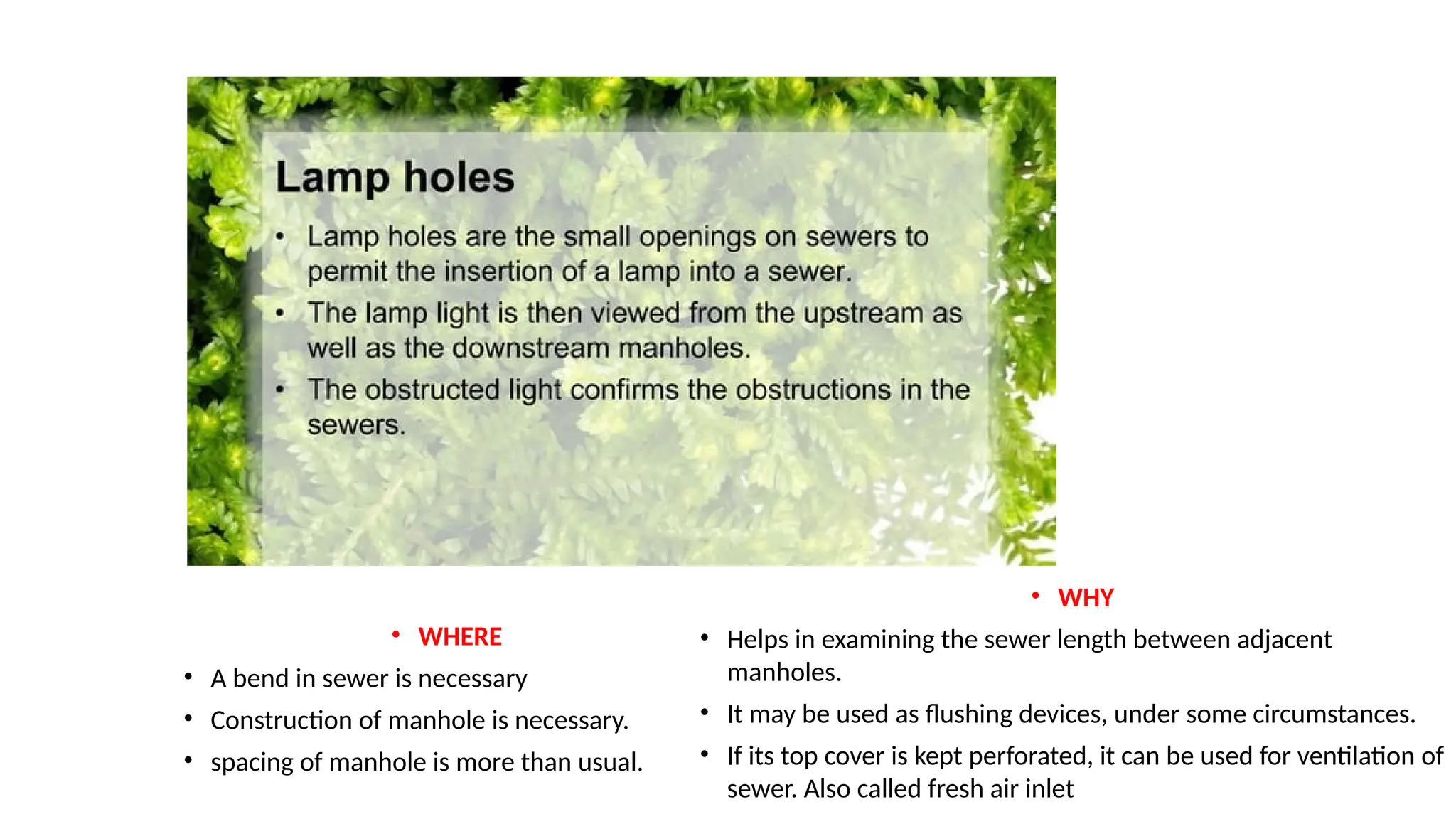
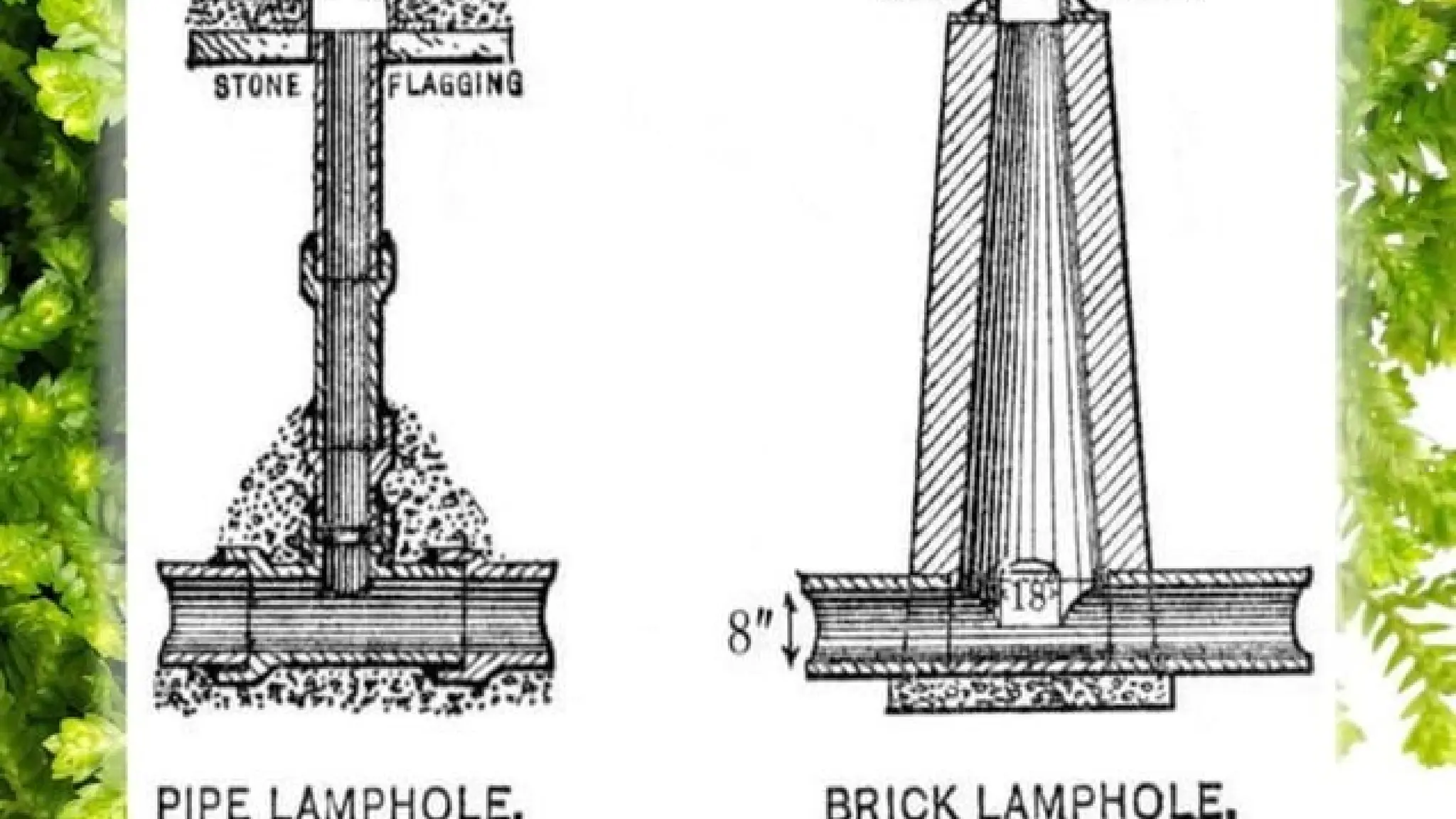
• WHERE
• Abend in sewer is necessary
• Construction of manhole is necessary.
• spacing of manhole is more than usual.
• WHY
• Helps in examining the sewer length between adjacent
manholes.
• It may be used as flushing devices, under some circumstances.
• If its top cover is kept perforated, it can be used for ventilation of
sewer. Also called fresh air inlet
53.
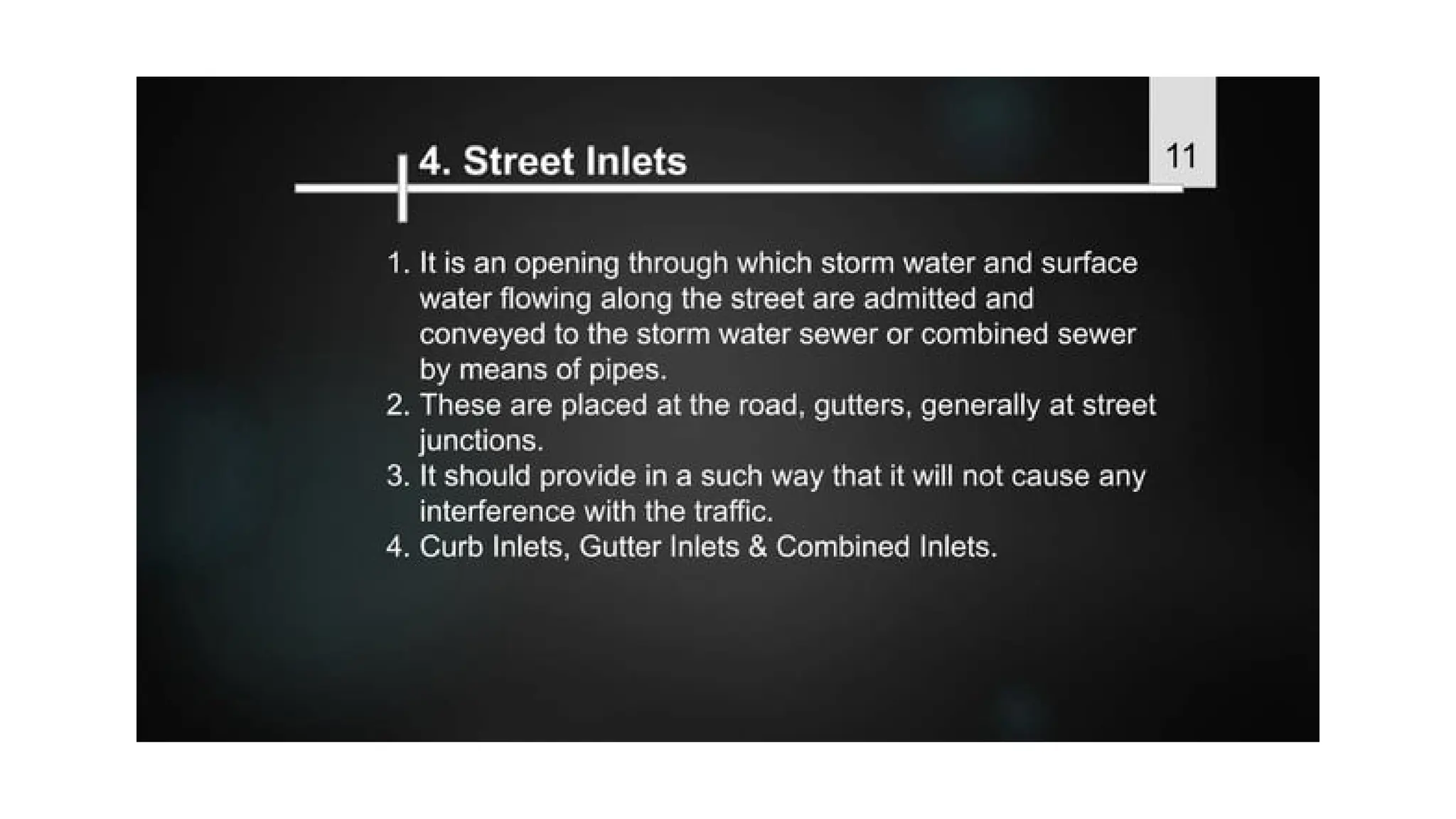
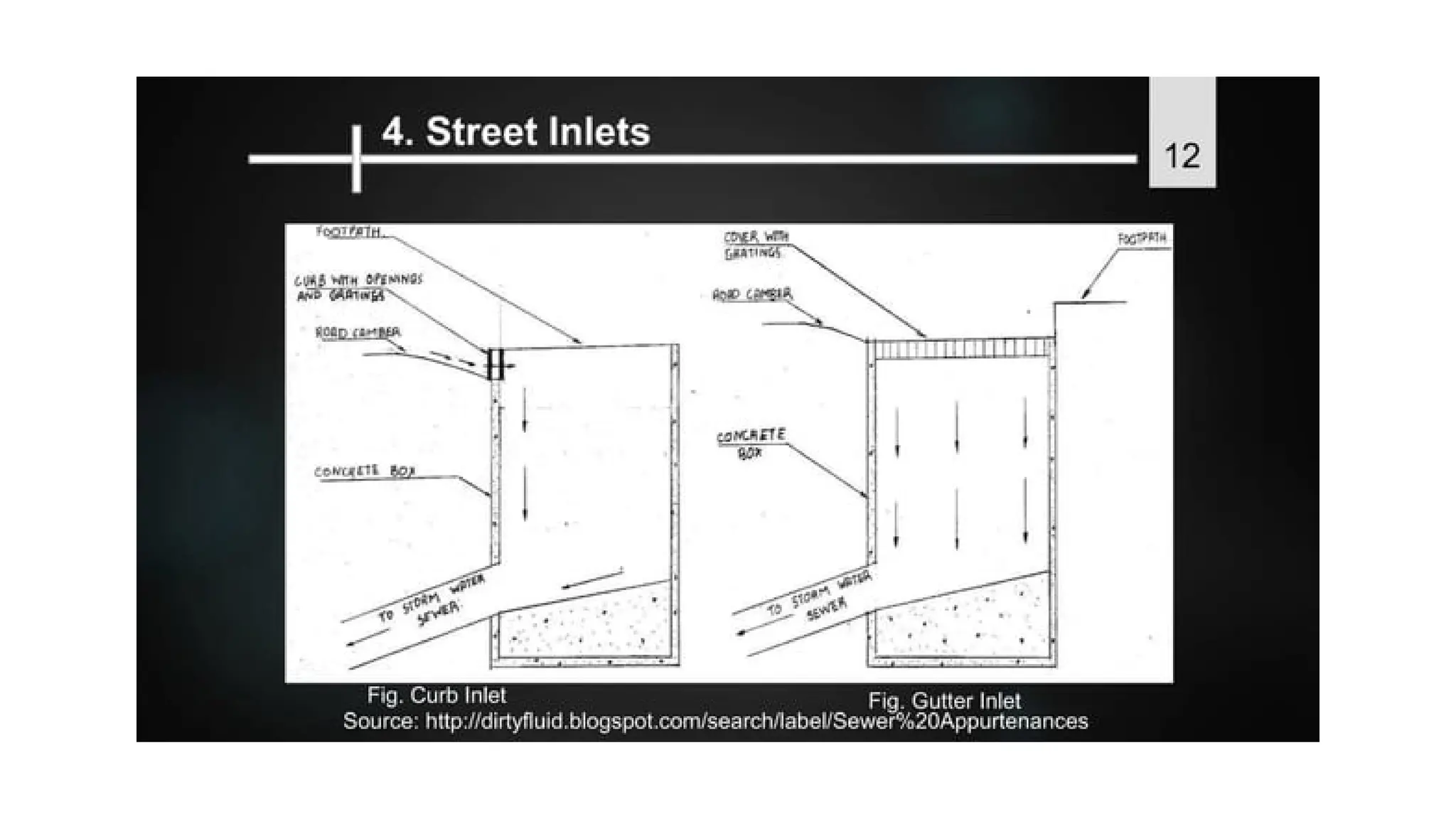
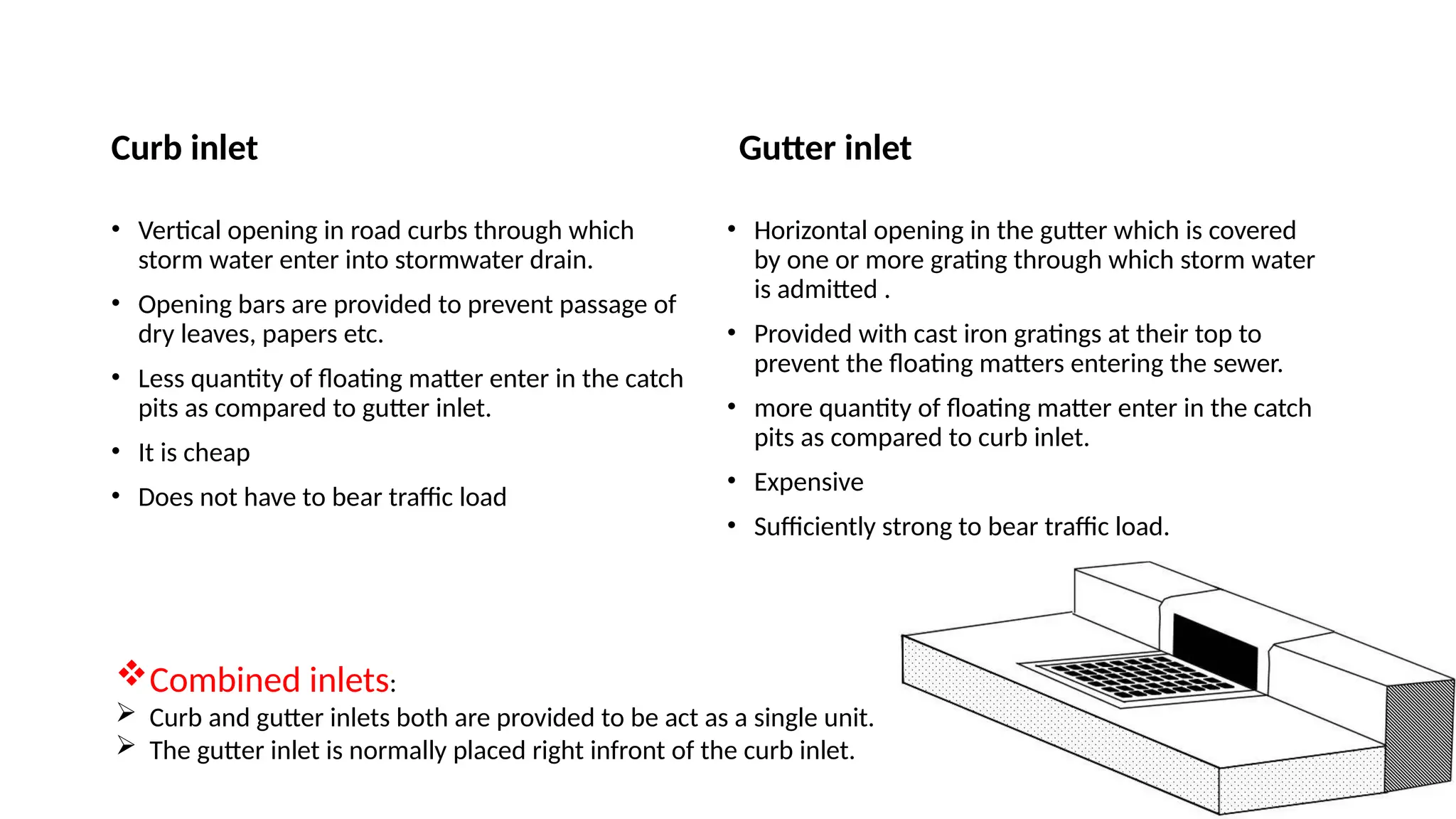
Curb inlet
• Verticalopening in road curbs through which
storm water enter into stormwater drain.
• Opening bars are provided to prevent passage of
dry leaves, papers etc.
• Less quantity of floating matter enter in the catch
pits as compared to gutter inlet.
• It is cheap
• Does not have to bear traffic load
Gutter inlet
• Horizontal opening in the gutter which is covered
by one or more grating through which storm water
is admitted .
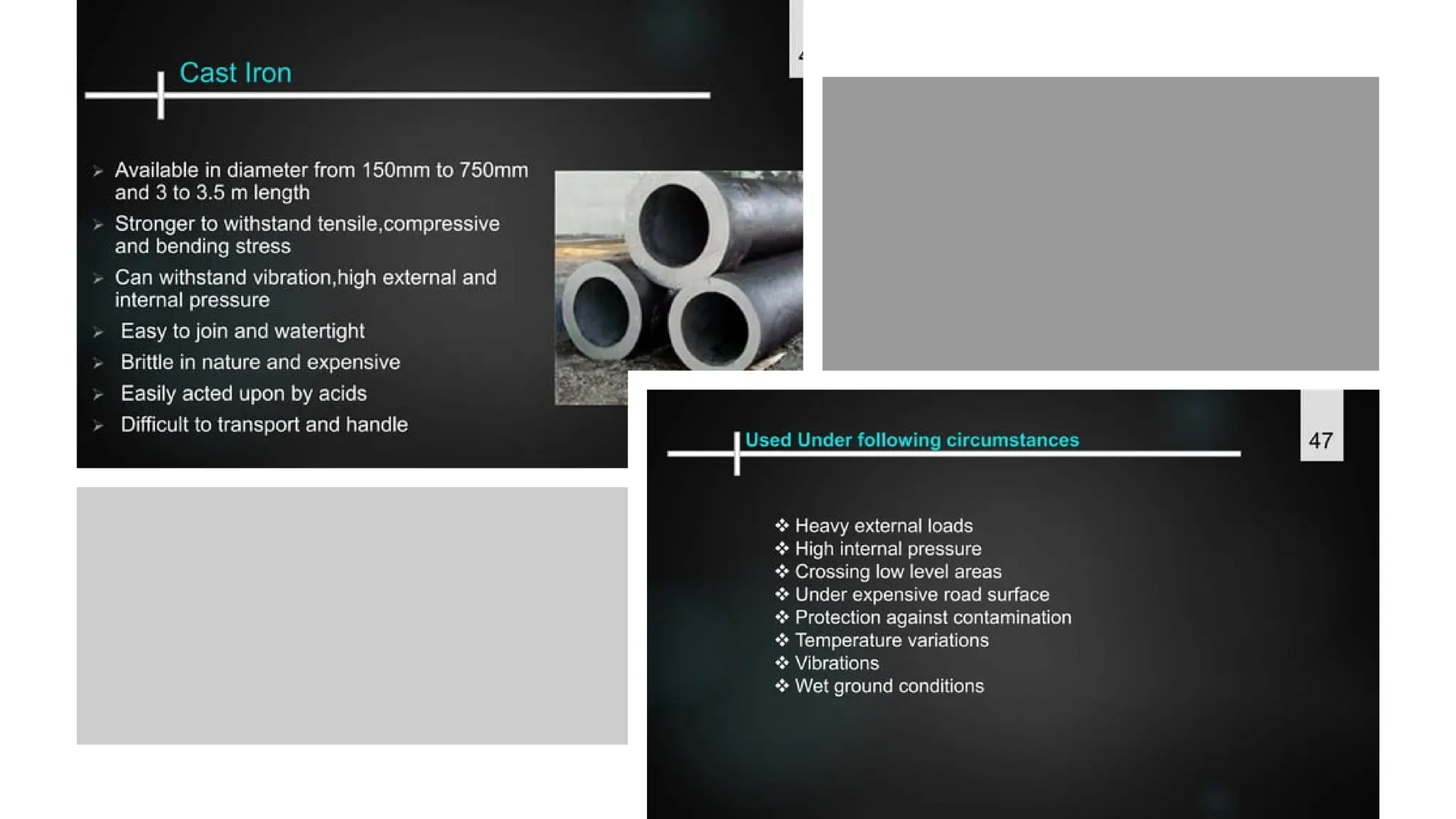
• Provided with cast iron gratings at their top to
prevent the floating matters entering the sewer.
• more quantity of floating matter enter in the catch
pits as compared to curb inlet.
• Expensive
• Sufficiently strong to bear traffic load.
Combined inlets:
Curb and gutter inlets both are provided to be act as a single unit.
The gutter inlet is normally placed right infront of the curb inlet.
54.
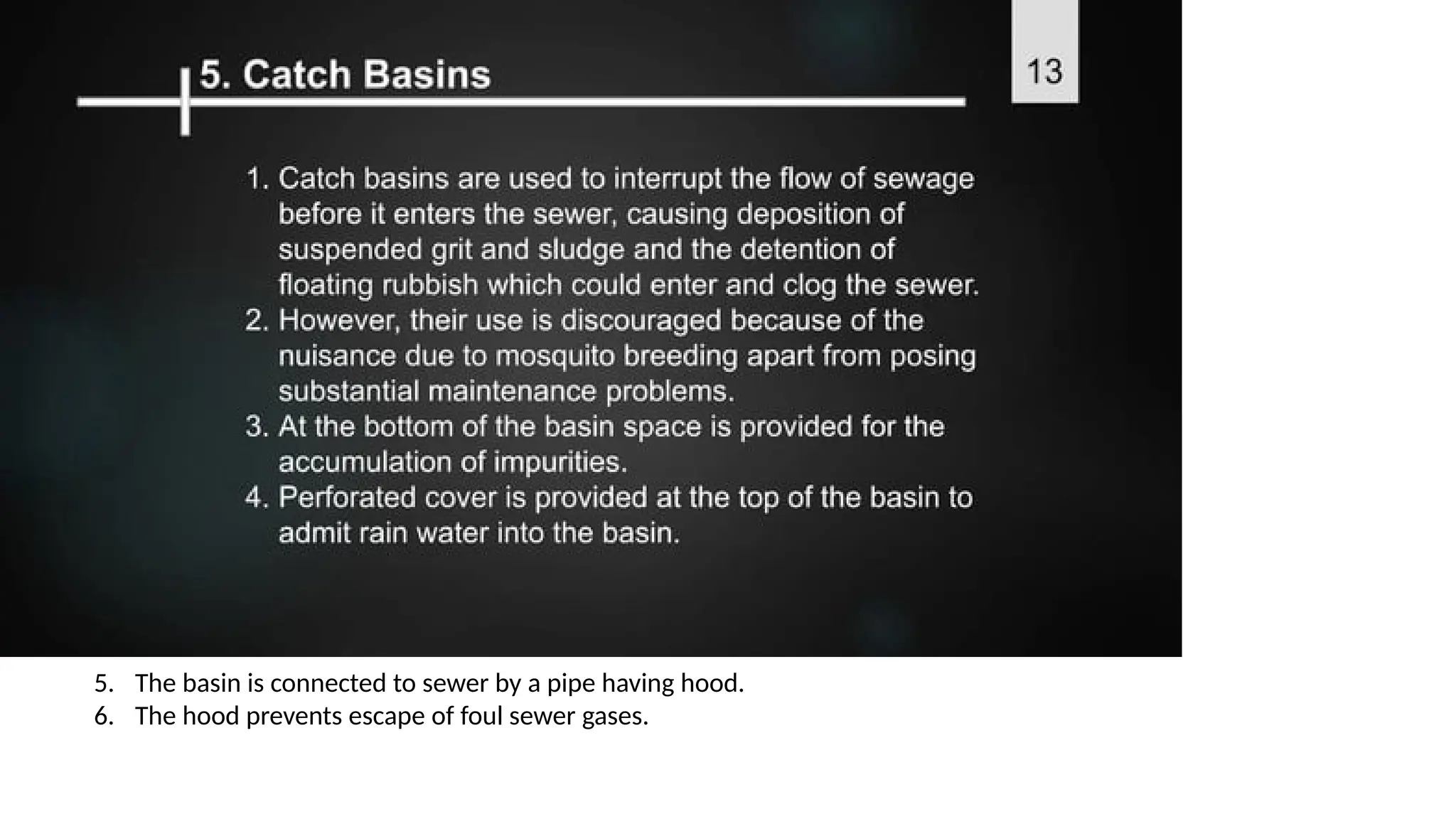
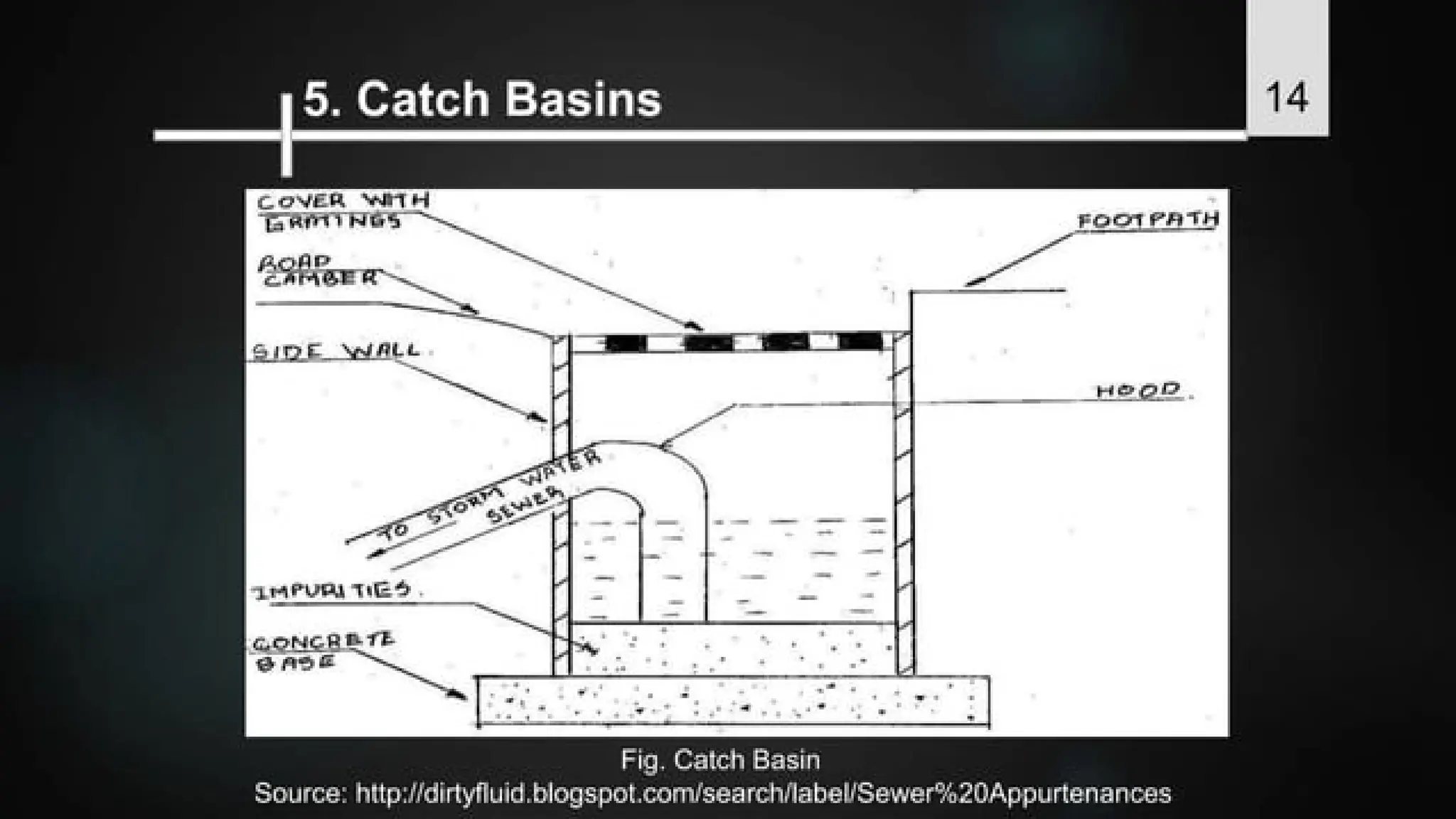
5. The basinis connected to sewer by a pipe having hood.
6. The hood prevents escape of foul sewer gases.
57.
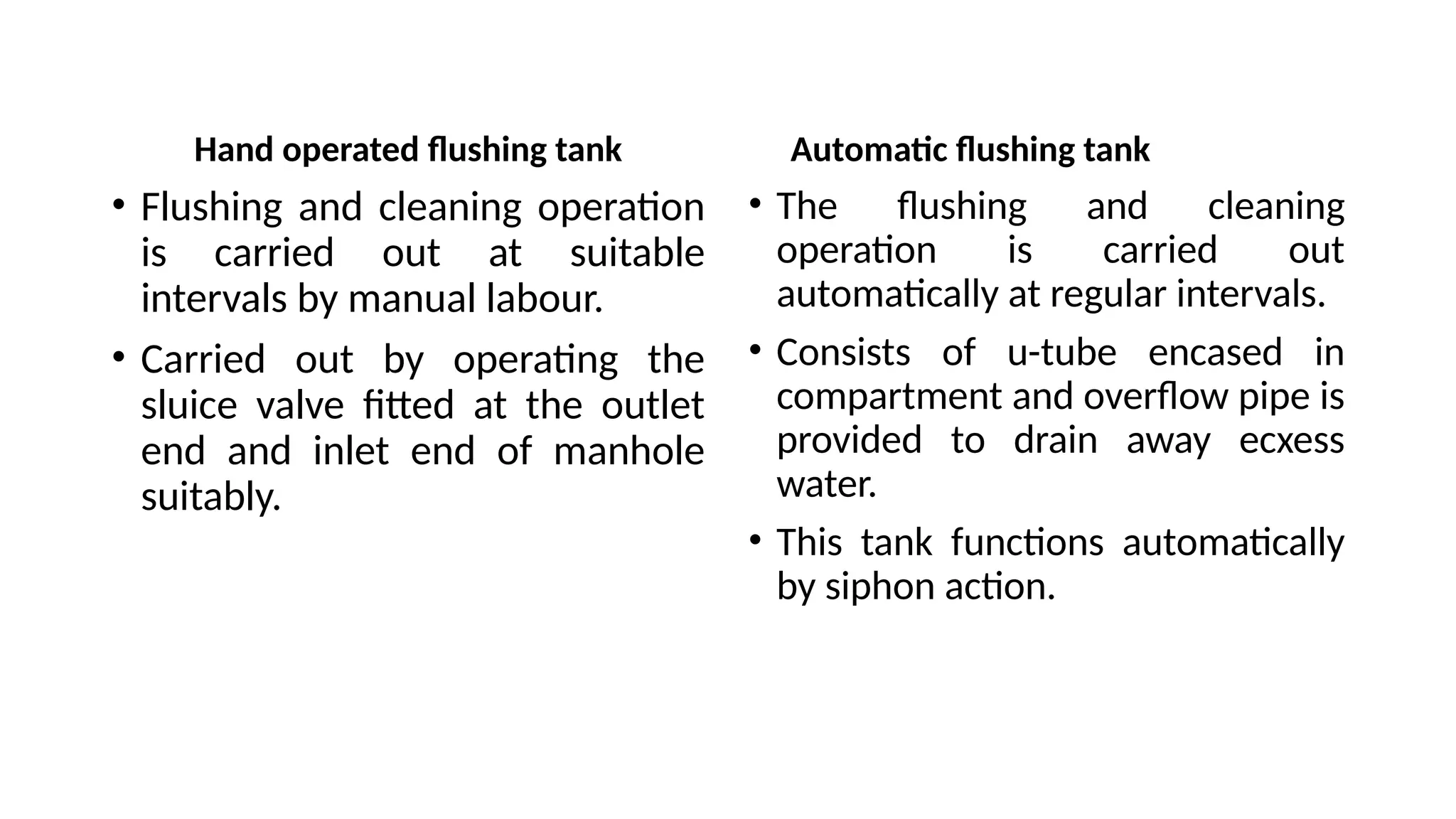
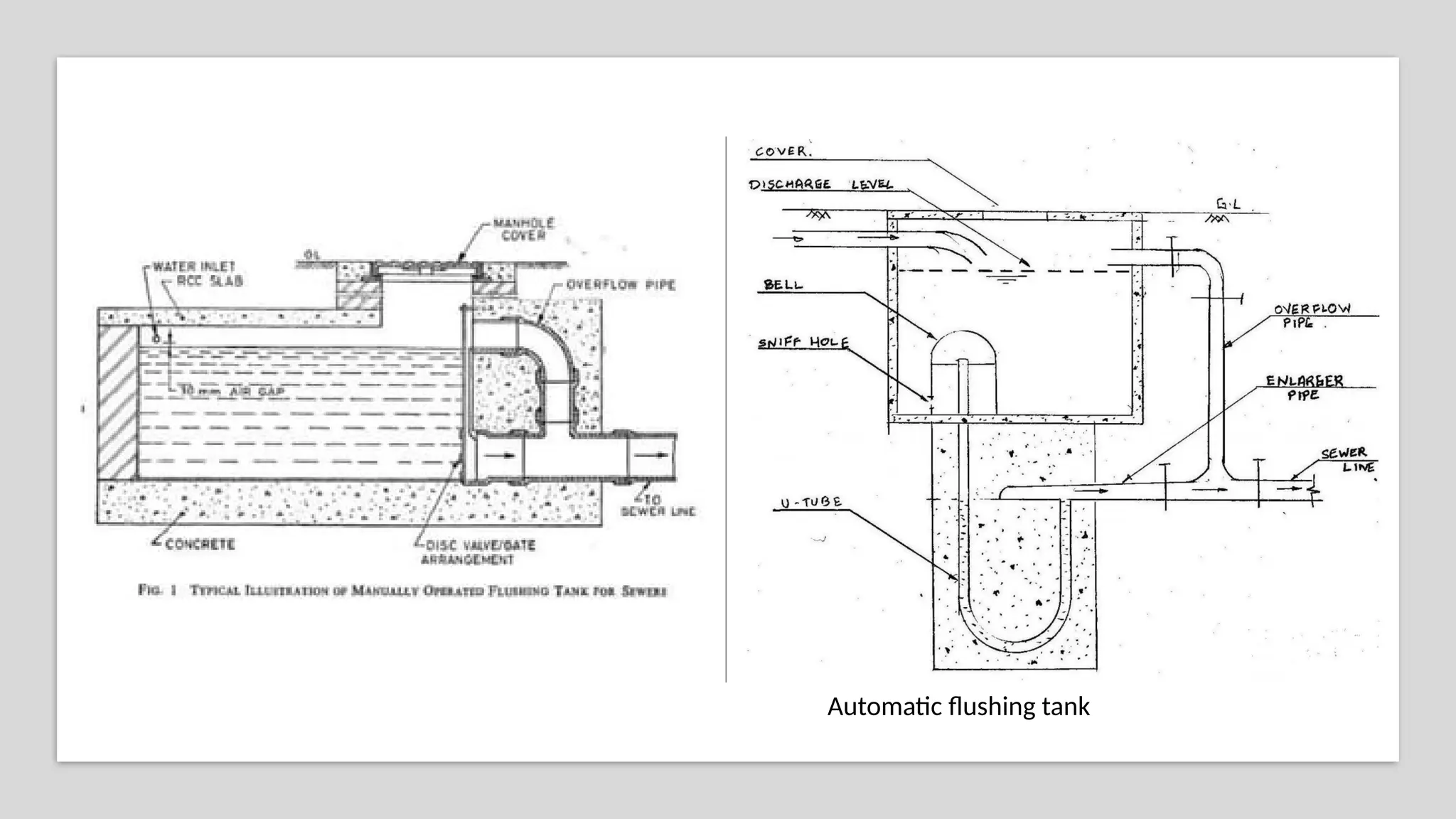
Hand operated flushingtank
• Flushing and cleaning operation
is carried out at suitable
intervals by manual labour.
• Carried out by operating the
sluice valve fitted at the outlet
end and inlet end of manhole
suitably.
• The flushing and cleaning
operation is carried out
automatically at regular intervals.
• Consists of u-tube encased in
compartment and overflow pipe is
provided to drain away ecxess
water.
• This tank functions automatically
by siphon action.
Automatic flushing tank


![Sewer appurtenances [recovered]](https://cdn.slidesharecdn.com/ss_thumbnails/sewerappurtenancesrecovered-180318135220-thumbnail.jpg?width=640&height=640&fit=bounds)


