APPURTENANCES
SEASON SHAKYA
075BAR045
PLUMBINGAPPURTENANCES
• Plumbing appurtenance means a manufactured device or prefabricated assembly
of component parts which is an adjunct to the basic piping system and plumbing
fixtures.
• An appurtenance does not demand additional water supply, nor does it add any
discharge load to a fixture or the drain system.
• It is presumed that the appurtenance performs some useful function in the
operation, maintenance, servicing, economy, or safety of the plumbing system.
USES OF APPURTENANCES
• The main purpose of water supply appurtenances is to make the distribution of
water easy and effective.
• To avoid wastage and leakage of water.
• To change the direction of flow of water in pipe line.
• To make the efficient use of water.
• To control the flow of water in opposite direction in pipe.
• To regulate the flow of water.
REQUIREMENTS
• It should be strong.
• It should be durable.
• It should be economical.
• It should have resistance to corrosion.
• It should have resistance to internal pressure of water.
• It should be easy to remove & repair.
• It should not affected by chemicals, acids.
TYPES OF APPURTENANCES
• Valves
• Manholes
• Fire Hydrants
• Water Meters
VALVES
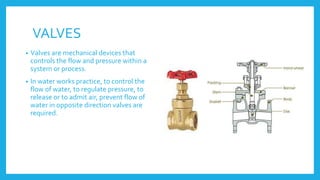
• Valves are mechanical devices that
controls the flow and pressure within a
system or process.
• In water works practice, to control the
flow of water, to regulate pressure, to
release or to admit air, prevent flow of
water in opposite direction valves are
required.
FUNCTIONS OFVALVES
• Stopping and starting flow
• Reduce or increase a flow
• Controlling the direction of flow
• Regulating a flow or process pressure
• Relieve a pipe system of a certain pressure
TYPES OFVALVES
• GATEVALVES
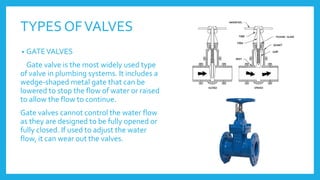
Gate valve is the most widely used type
of valve in plumbing systems. It includes a
wedge-shaped metal gate that can be
lowered to stop the flow of water or raised
to allow the flow to continue.
Gate valves cannot control the water flow
as they are designed to be fully opened or
fully closed. If used to adjust the water
flow, it can wear out the valves.
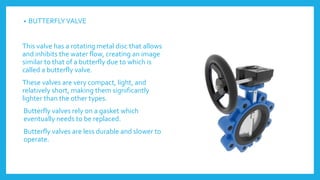
• BUTTERFLYVALVE
This valve has a rotating metal disc that allows
and inhibits the water flow, creating an image
similar to that of a butterfly due to which is
called a butterfly valve.
These valves are very compact, light, and
relatively short, making them significantly
lighter than the other types.
Butterfly valves rely on a gasket which
eventually needs to be replaced.
Butterfly valves are less durable and slower to
operate.
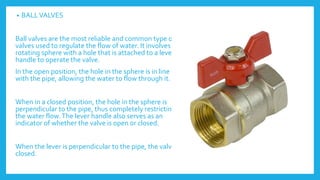
• BALLVALVES
Ball valves are the most reliable and common type of
valves used to regulate the flow of water. It involves a
rotating sphere with a hole that is attached to a lever
handle to operate the valve.
In the open position, the hole in the sphere is in line
with the pipe, allowing the water to flow through it.
When in a closed position, the hole in the sphere is
perpendicular to the pipe, thus completely restricting
the water flow.The lever handle also serves as an
indicator of whether the valve is open or closed.
When the lever is perpendicular to the pipe, the valve is
closed.
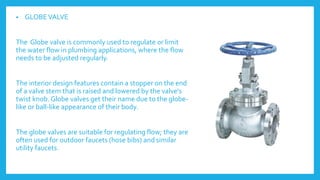
• GLOBEVALVE
The Globe valve is commonly used to regulate or limit
the water flow in plumbing applications, where the flow
needs to be adjusted regularly.
The interior design features contain a stopper on the end
of a valve stem that is raised and lowered by the valve's
twist knob. Globe valves get their name due to the globe-
like or ball-like appearance of their body.
The globe valves are suitable for regulating flow; they are
often used for outdoor faucets (hose bibs) and similar
utility faucets.
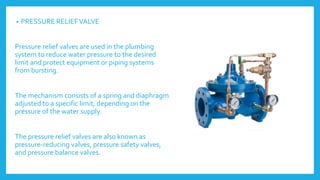
• PRESSURE RELIEFVALVE
Pressure relief valves are used in the plumbing
system to reduce water pressure to the desired
limit and protect equipment or piping systems
from bursting.
The mechanism consists of a spring and diaphragm
adjusted to a specific limit, depending on the
pressure of the water supply.
The pressure relief valves are also known as
pressure-reducing valves, pressure safety valves,
and pressure balance valves.
MANHOLES
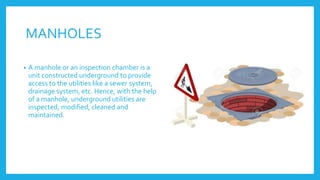
• A manhole or an inspection chamber is a
unit constructed underground to provide
access to the utilities like a sewer system,
drainage system, etc. Hence, with the help
of a manhole, underground utilities are
inspected, modified, cleaned and
maintained.
Purpose of Manhole
• To perform inspection, cleaning, and
removal of any obstruction present in the
sewage line.
• The joining of sewers, the change of
direction or the alignment of sewers can
be performed with the help of manhole.
• These have a perforated cover which
helps the foul gases to escape. Hence it is
a good means of ventilation for the
underground sewage system.
• Manholes help to lay the sewer line in the
conventional lengths.
FEATURES OF MANHOLE
• The main parts of a manhole are the
chamber or ring and theVertical Circular
Pipe.The vertical circular pipe is available in
varying depth and sizes.These pipes are
used to access the inspection joints in the
system.
• Manholes are mainly positioned 0.5m away
from the curb lines of the road. Mostly it is
constructed such that it is away from the
wheel line of the traffic.
• The cover of a manhole is a plug that
protects the manhole from any
unauthorized access.The covers used for
manholes can be either rectangular, square
or circular in shape.The material of cover
can be precast concrete, composite material
or any glass-reinforced plastic material.
• The provision for access through the
manhole is performed through steps. If the
depth of the manhole is less than 1 m, a step
ladder is constructed. If the depth of the
manhole is greater than 2.5m, a regular
ladder is fitted. Now modern manholes do
not demand physical entry.
The three main types of manhole depending on the depth are:
• Shallow Manhole
A shallow manhole has a depth ranging between 75 to 90 cm.These are constructed
at the start of a branch sewer or in an area where there is not much traffic.The
shallow manhole is provided with a light cover called as the inspection chamber.
• Normal Manhole
These are provided at the sewer line with a heavy cover on its top. It has a depth of
150cm. Normal manhole takes a square shape.
• Deep Manhole
Deep manhole is provided at a depth greater than 150cm with a very heavy cover at its
top.The size can be increased and the facility for going down is also increased.
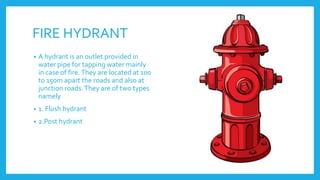
FIRE HYDRANT
• A hydrant is an outlet provided in
water pipe for tapping water mainly
in case of fire.They are located at 100
to 150m apart the roads and also at
junction roads.They are of two types
namely
• 1. Flush hydrant
• 2.Post hydrant
REQUIREMENTSOF A GOOD FIRE
HYDRANT
• Should be cheap.
• Easy to connect with hose or motor pump.
• Easily detachable and reliable.
• It should function properly and should not go out of order during operation.
• It should permit undisturbed flow of water when being fully opened.
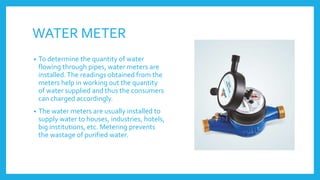
WATER METER
• To determine the quantity of water
flowing through pipes, water meters are
installed.The readings obtained from the
meters help in working out the quantity
of water supplied and thus the consumers
can charged accordingly.
• The water meters are usually installed to
supply water to houses, industries, hotels,
big institutions, etc. Metering prevents
the wastage of purified water.
REQUIREMENTSOF GOOD METER
• It should not offer any resistance to the flow of water.
• It should measure the discharge up to 2% accuracy.
• All its parts should be of non-corrosive alloy.
• It can be easily maintained and repaired.
• It should be economical.
• It should have screen on its inlet side, to exclude the clay, silt, grit, etc.
• It should be capable of registering even small quantity of flow of water.
CLASSIFICATION
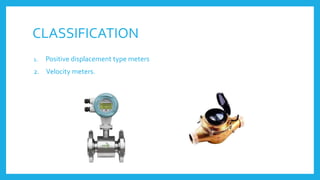
1. Positive displacement type meters
2. Velocity meters.
THANKYOU

APPURTENANCES.pptx

  • 1.
  • 2.
    PLUMBINGAPPURTENANCES • Plumbing appurtenancemeans a manufactured device or prefabricated assembly of component parts which is an adjunct to the basic piping system and plumbing fixtures. • An appurtenance does not demand additional water supply, nor does it add any discharge load to a fixture or the drain system. • It is presumed that the appurtenance performs some useful function in the operation, maintenance, servicing, economy, or safety of the plumbing system.
  • 3.
    USES OF APPURTENANCES •The main purpose of water supply appurtenances is to make the distribution of water easy and effective. • To avoid wastage and leakage of water. • To change the direction of flow of water in pipe line. • To make the efficient use of water. • To control the flow of water in opposite direction in pipe. • To regulate the flow of water.
  • 4.
    REQUIREMENTS • It shouldbe strong. • It should be durable. • It should be economical. • It should have resistance to corrosion. • It should have resistance to internal pressure of water. • It should be easy to remove & repair. • It should not affected by chemicals, acids.
  • 5.
    TYPES OF APPURTENANCES •Valves • Manholes • Fire Hydrants • Water Meters
  • 6.
    VALVES • Valves aremechanical devices that controls the flow and pressure within a system or process. • In water works practice, to control the flow of water, to regulate pressure, to release or to admit air, prevent flow of water in opposite direction valves are required.
  • 7.
    FUNCTIONS OFVALVES • Stoppingand starting flow • Reduce or increase a flow • Controlling the direction of flow • Regulating a flow or process pressure • Relieve a pipe system of a certain pressure
  • 8.
    TYPES OFVALVES • GATEVALVES Gatevalve is the most widely used type of valve in plumbing systems. It includes a wedge-shaped metal gate that can be lowered to stop the flow of water or raised to allow the flow to continue. Gate valves cannot control the water flow as they are designed to be fully opened or fully closed. If used to adjust the water flow, it can wear out the valves.
  • 9.
    • BUTTERFLYVALVE This valvehas a rotating metal disc that allows and inhibits the water flow, creating an image similar to that of a butterfly due to which is called a butterfly valve. These valves are very compact, light, and relatively short, making them significantly lighter than the other types. Butterfly valves rely on a gasket which eventually needs to be replaced. Butterfly valves are less durable and slower to operate.
  • 10.
    • BALLVALVES Ball valvesare the most reliable and common type of valves used to regulate the flow of water. It involves a rotating sphere with a hole that is attached to a lever handle to operate the valve. In the open position, the hole in the sphere is in line with the pipe, allowing the water to flow through it. When in a closed position, the hole in the sphere is perpendicular to the pipe, thus completely restricting the water flow.The lever handle also serves as an indicator of whether the valve is open or closed. When the lever is perpendicular to the pipe, the valve is closed.
  • 11.
    • GLOBEVALVE The Globevalve is commonly used to regulate or limit the water flow in plumbing applications, where the flow needs to be adjusted regularly. The interior design features contain a stopper on the end of a valve stem that is raised and lowered by the valve's twist knob. Globe valves get their name due to the globe- like or ball-like appearance of their body. The globe valves are suitable for regulating flow; they are often used for outdoor faucets (hose bibs) and similar utility faucets.
  • 12.
    • PRESSURE RELIEFVALVE Pressurerelief valves are used in the plumbing system to reduce water pressure to the desired limit and protect equipment or piping systems from bursting. The mechanism consists of a spring and diaphragm adjusted to a specific limit, depending on the pressure of the water supply. The pressure relief valves are also known as pressure-reducing valves, pressure safety valves, and pressure balance valves.
  • 13.
    MANHOLES • A manholeor an inspection chamber is a unit constructed underground to provide access to the utilities like a sewer system, drainage system, etc. Hence, with the help of a manhole, underground utilities are inspected, modified, cleaned and maintained.
  • 14.
    Purpose of Manhole •To perform inspection, cleaning, and removal of any obstruction present in the sewage line. • The joining of sewers, the change of direction or the alignment of sewers can be performed with the help of manhole. • These have a perforated cover which helps the foul gases to escape. Hence it is a good means of ventilation for the underground sewage system. • Manholes help to lay the sewer line in the conventional lengths.
  • 15.
    FEATURES OF MANHOLE •The main parts of a manhole are the chamber or ring and theVertical Circular Pipe.The vertical circular pipe is available in varying depth and sizes.These pipes are used to access the inspection joints in the system. • Manholes are mainly positioned 0.5m away from the curb lines of the road. Mostly it is constructed such that it is away from the wheel line of the traffic.
  • 16.
    • The coverof a manhole is a plug that protects the manhole from any unauthorized access.The covers used for manholes can be either rectangular, square or circular in shape.The material of cover can be precast concrete, composite material or any glass-reinforced plastic material. • The provision for access through the manhole is performed through steps. If the depth of the manhole is less than 1 m, a step ladder is constructed. If the depth of the manhole is greater than 2.5m, a regular ladder is fitted. Now modern manholes do not demand physical entry.
  • 17.
    The three maintypes of manhole depending on the depth are: • Shallow Manhole A shallow manhole has a depth ranging between 75 to 90 cm.These are constructed at the start of a branch sewer or in an area where there is not much traffic.The shallow manhole is provided with a light cover called as the inspection chamber. • Normal Manhole These are provided at the sewer line with a heavy cover on its top. It has a depth of 150cm. Normal manhole takes a square shape. • Deep Manhole Deep manhole is provided at a depth greater than 150cm with a very heavy cover at its top.The size can be increased and the facility for going down is also increased.
  • 18.
    FIRE HYDRANT • Ahydrant is an outlet provided in water pipe for tapping water mainly in case of fire.They are located at 100 to 150m apart the roads and also at junction roads.They are of two types namely • 1. Flush hydrant • 2.Post hydrant
  • 19.
    REQUIREMENTSOF A GOODFIRE HYDRANT • Should be cheap. • Easy to connect with hose or motor pump. • Easily detachable and reliable. • It should function properly and should not go out of order during operation. • It should permit undisturbed flow of water when being fully opened.
  • 20.
    WATER METER • Todetermine the quantity of water flowing through pipes, water meters are installed.The readings obtained from the meters help in working out the quantity of water supplied and thus the consumers can charged accordingly. • The water meters are usually installed to supply water to houses, industries, hotels, big institutions, etc. Metering prevents the wastage of purified water.
  • 21.
    REQUIREMENTSOF GOOD METER •It should not offer any resistance to the flow of water. • It should measure the discharge up to 2% accuracy. • All its parts should be of non-corrosive alloy. • It can be easily maintained and repaired. • It should be economical. • It should have screen on its inlet side, to exclude the clay, silt, grit, etc. • It should be capable of registering even small quantity of flow of water.
  • 22.
    CLASSIFICATION 1. Positive displacementtype meters 2. Velocity meters.
  • 23.