Contents 
1. EXPERIMENT NO. 1:.......................................................................................................1
2. EXPERIMENT NO. 2:.......................................................................................................3
3. EXPERIMENT NO. 3:.......................................................................................................6
4. EXPERIMENT NO. 4:.....................................................................................................10
5. EXPERIMENT NO. 5:.....................................................................................................12
6. EXPERIMENT NO. 6:.....................................................................................................15
7. EXPERIMENT NO. 7:.....................................................................................................16
8. EXPERIMENT NO. 8:.....................................................................................................21
9. EXPERIMENT NO. 9:.....................................................................................................24
10. EXPERIMENT NO. 10:...................................................................................................25
11. EXPERIMENT NO. 11:...................................................................................................26
12. EXPERIMENT NO. 12:...................................................................................................28
Plain and Reinforced Concrete I Experiment No. 1
1
1. EXPERIMENT NO. 1:
Standard Test Method For The Determination Of The Normal Consistency
Of The Hydraulic Cement.
Code: ASTM C 187-04
SCOPE & SIGNIFICANCE:
It is used to find out the percentage of water at which the standard consistency is
achieved. This known amount of water is then used in making the cement paste for the other
tests like;
i. Initial setting time
ii. Final setting time
iii. Soundness test
APPARATUS:
• Reference Masses and Devices for Determining Mass
• VICAT Apparatus
• Plunger with 10mm diameter and 50mm length
• Glass graduates (200mL or 250mL capacity)
• Spatula
• Glass plate trowel
RELATED THEORY:
CONSISTENCY
The thickness or the viscosity of the cement paste is called consistency.
CEMENT PASTE
The viscous mass obtained by mixing cement with water is known as cement paste.
STANDARD PASTE
It is the cement paste for which the 10mm diameter plunger in a standard VICAT test
penetrates to such an extent that its distance from the bottom is 5-7mm.
STANDARD/NORMAL CONSISTENCY
It is the thickness or the viscosity of the standard paste and is expressed as the
percentage of weight of water.
VICAT APPARATUS
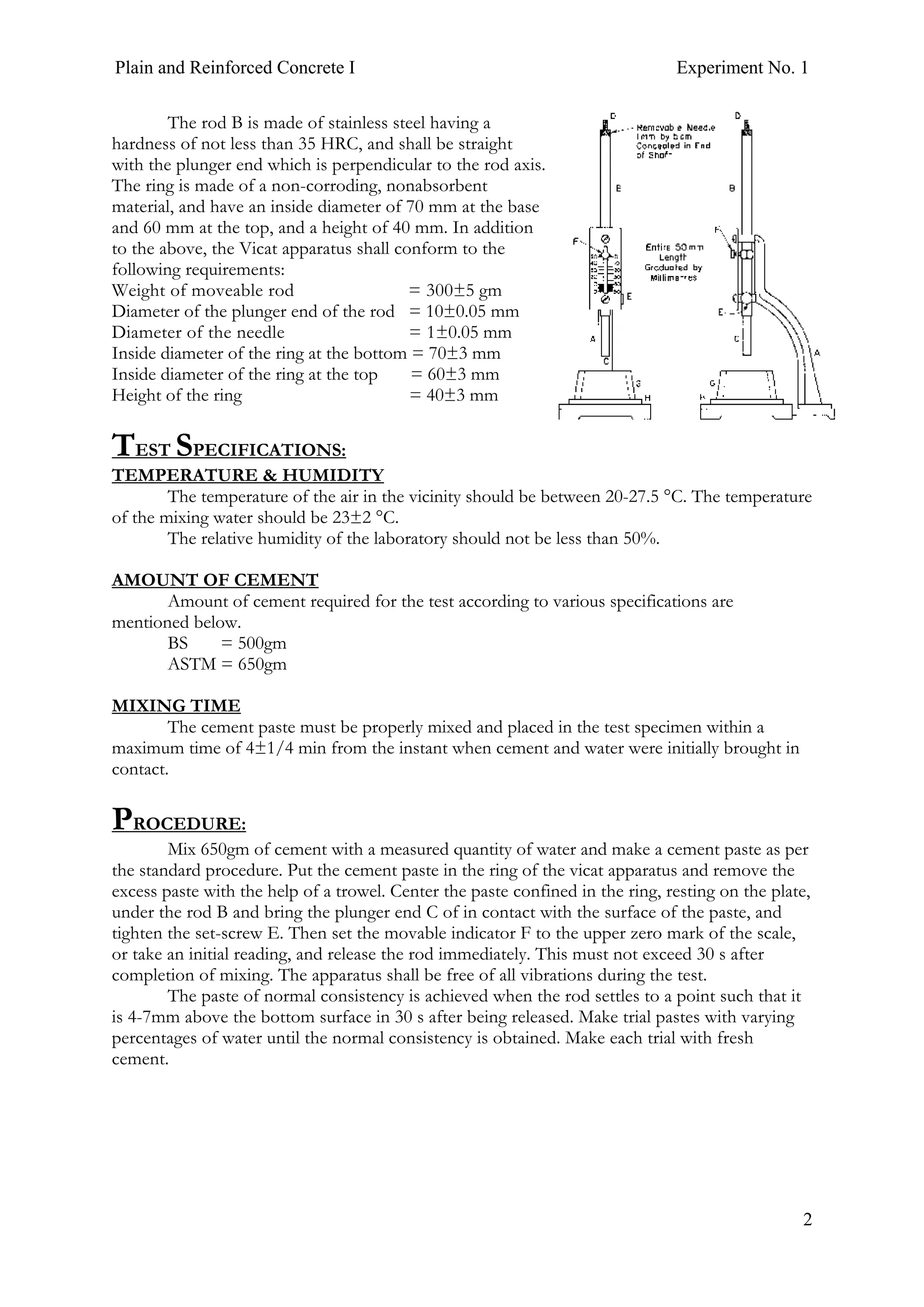
The Vicat apparatus consists of a frame A (Fig.) bearing a movable rod B, weighing 300
g, one end C, the plunger end, being 10 mm in diameter for a distance of at least 50 mm, and
the other end have a removable needle D, 1 mm in diameter and 50 mm in length. The rod B is
reversible, and can be held in any desired position by a set screw E, and has an adjustable
indicator F, which moves over a scale (graduated in millimeters) attached to the frame A. The
paste is held in a rigid conical ring G, resting on a plane non-absorptive square base plate H,
about 100 mm on each side.
Plain and Reinforced Concrete I Experiment No. 1
2
The rod B is made of stainless steel having a
hardness of not less than 35 HRC, and shall be straight
with the plunger end which is perpendicular to the rod axis.
The ring is made of a non-corroding, nonabsorbent
material, and have an inside diameter of 70 mm at the base
and 60 mm at the top, and a height of 40 mm. In addition
to the above, the Vicat apparatus shall conform to the
following requirements:
Weight of moveable rod = 300±5 gm
Diameter of the plunger end of the rod = 10±0.05 mm
Diameter of the needle = 1±0.05 mm
Inside diameter of the ring at the bottom = 70±3 mm
Inside diameter of the ring at the top = 60±3 mm
Height of the ring = 40±3 mm
TEST SPECIFICATIONS:
TEMPERATURE & HUMIDITY
The temperature of the air in the vicinity should be between 20-27.5 °C. The temperature
of the mixing water should be 23±2 °C.
The relative humidity of the laboratory should not be less than 50%.
AMOUNT OF CEMENT
Amount of cement required for the test according to various specifications are
mentioned below.
BS = 500gm
ASTM = 650gm
MIXING TIME
The cement paste must be properly mixed and placed in the test specimen within a
maximum time of 4±1/4 min from the instant when cement and water were initially brought in
contact.
PROCEDURE:
Mix 650gm of cement with a measured quantity of water and make a cement paste as per
the standard procedure. Put the cement paste in the ring of the vicat apparatus and remove the
excess paste with the help of a trowel. Center the paste confined in the ring, resting on the plate,
under the rod B and bring the plunger end C of in contact with the surface of the paste, and
tighten the set-screw E. Then set the movable indicator F to the upper zero mark of the scale,
or take an initial reading, and release the rod immediately. This must not exceed 30 s after
completion of mixing. The apparatus shall be free of all vibrations during the test.
The paste of normal consistency is achieved when the rod settles to a point such that it
is 4-7mm above the bottom surface in 30 s after being released. Make trial pastes with varying
percentages of water until the normal consistency is obtained. Make each trial with fresh
cement.
Plain and Reinforced Concrete I Experiment No. 2
3
2. EXPERIMENT NO. 2:
Standard Test Method For The Determination Of The Initial And Final
Setting Time Of The Hydraulic Cement By Vicat Needle Apparatus.
Code: ASTM C 191-04b
SCOPE & SIGNIFICANCE:
This test method is used to determine the time of setting of the hydraulic cement by
Vicat needle apparatus.
The knowledge of the setting time of the cement is always helpful in deciding the time
duration to mix, transport, place and compact the concrete effectively.
We always prefer a larger initial setting time so that we can mix, transport and place the
concrete easily. According to ASTM specifications, the initial setting time shall not be less than
30min but in the field we prefer an initial setting time not less than 45min.
A smaller value of the final setting time is always preferred in order to avoid large
expenditures on the formwork. According to most of the specifications, the final setting time
shall not be greater than 10hrs and shall not be less than ( 90 + 1.2 x (initial setting time) ) min.
i.e. ( 90 + 1.2 x (initial setting time) ) min < final setting time < 10hrs
APPARATUS:
• Vicat apparatus
• Needle of 1mm2
cross-section and 50mm length (for initial setting time)
• Plunger with 1mm smaller needle and 5mm outer diameter (for final setting time)
• Flat trowel
• Reference Masses and Devices for Determining Mass
• Spatula
• Graduated cylinders
RELATED THEORY:
SETTING
In the setting process very little chemical reaction takes place. It only includes the shape
acquisition due to evaporation of water. During the setting process the cement remains in the
fluid or the semi-fluid state and there is very little or no gain in strength. Finer the cement
particles more will be the hydration and therefore it will lead to quick settlement.
HARDENING
Hardening is the rate of gain of strength due to the chemical reaction. It also refers to
the strength of the concrete after a specified interval of time.
INITIAL SETTING TIME
Plain and Reinforced Concrete I Experiment No. 2
4
The time elapsed between the initial contact of cement and water and the time when a
1mm2
cross-section needle gives a reading between 4-7mm from the bottom in a standard Vicat
apparatus is known as initial setting time of that particular cement paste.
FINAL SETTING TIME
It is the time elapsed between the initial contact of cement and water and the time when
the smaller needle (1mm2
cross-section and 1mm deep) completely penetrates into the paste and
the outer metal attachment of 5mm diameter does not leave an impression on the cement paste.
According to specifications;
Maximum final setting time = 10hrs
Minimum final setting time = [90 + 1.2 (initial setting time)] min
TEST SPECIFICATIONS:
NEEDLE SIZES
1- For Initial Setting Time
1mm x 1mm cross-section
50mm length
2- For Final Setting Time
1mm2
cross-section and 1mm deep inner needle
5mm diameter outer metal attachment
MIXING WATER
Portable water is satisfactory for the routine tests.
TEMPERATURE & HUMIDITY
The temperature of the air in the vicinity should be between 23±3 °C. The temperature
of the mixing water should be 23±2 °C.
The relative humidity of the laboratory should not be less than 50%.
AMOUNT OF CEMENT
Amount of cement required for the test according to various specifications are
mentioned below.
BS = 500gm
ASTM = 650gm
Plain and Reinforced Concrete I Experiment No. 2
5
PROCEDURE:
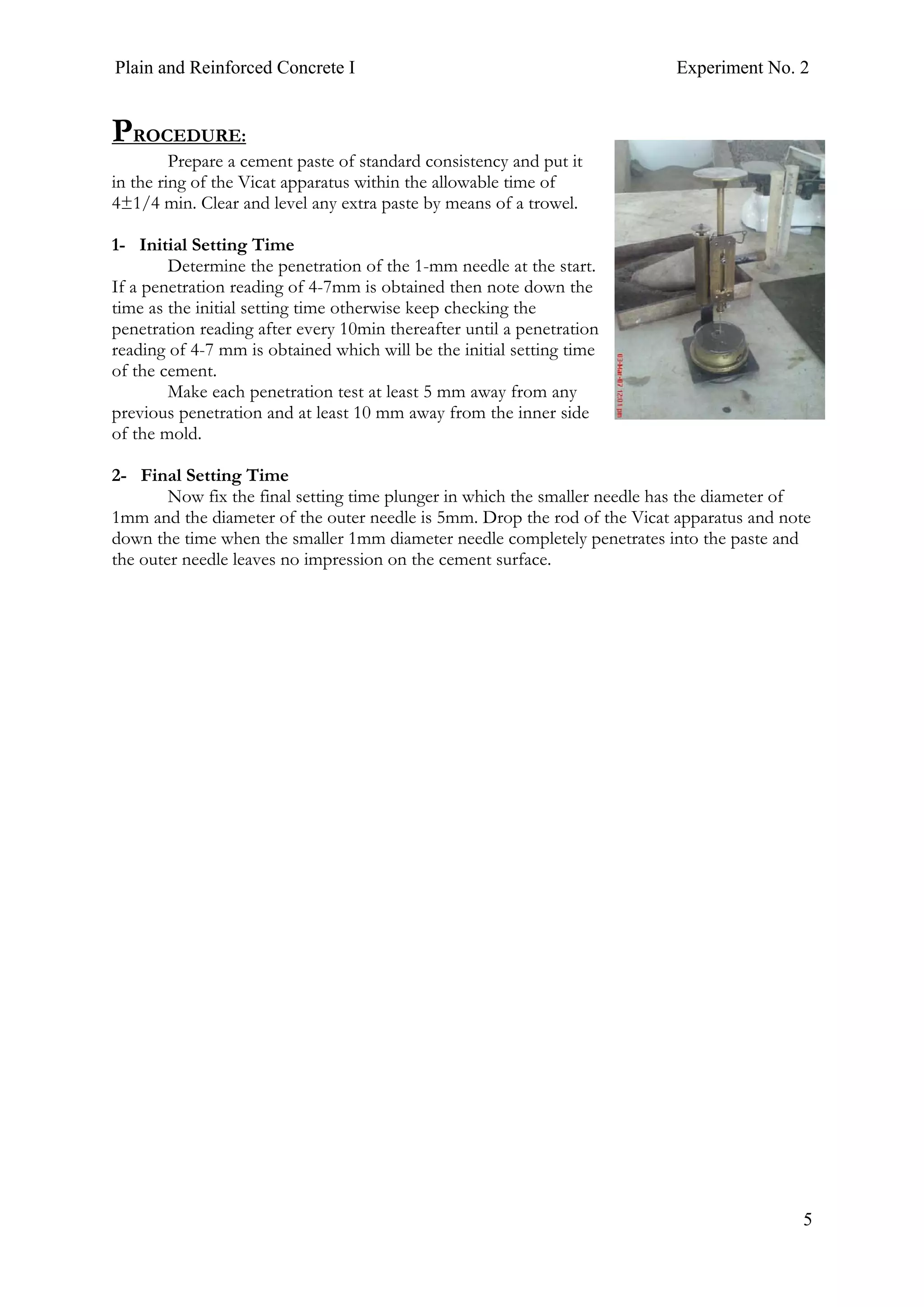
Prepare a cement paste of standard consistency and put it
in the ring of the Vicat apparatus within the allowable time of
4±1/4 min. Clear and level any extra paste by means of a trowel.
1- Initial Setting Time
Determine the penetration of the 1-mm needle at the start.
If a penetration reading of 4-7mm is obtained then note down the
time as the initial setting time otherwise keep checking the
penetration reading after every 10min thereafter until a penetration
reading of 4-7 mm is obtained which will be the initial setting time
of the cement.
Make each penetration test at least 5 mm away from any
previous penetration and at least 10 mm away from the inner side
of the mold.
2- Final Setting Time
Now fix the final setting time plunger in which the smaller needle has the diameter of
1mm and the diameter of the outer needle is 5mm. Drop the rod of the Vicat apparatus and note
down the time when the smaller 1mm diameter needle completely penetrates into the paste and
the outer needle leaves no impression on the cement surface.
Plain and Reinforced Concrete I Experiment No. 3
6
ModulusFineness
1
AreaSurface ∝
3. EXPERIMENT NO. 3:
Determination Of The Fineness Modulus Of The Coarse And Fine
Aggregate From Different Sources.
Code: ASTM C-316-05, for coarse materials (i.e. > 15μm)
ASTM C-117-05, for fine materials (i.e. < 15μm)
SCOPE & SIGNIFICANCE:
This test method is used to determine the fineness modulus of the given fine grained
specimen.
The information obtained from fineness modulus is helpful in the following ways;
1- Fineness modulus tells us directly whether the material is well-graded or gap-
graded.
2- Fineness modulus gives us an overall idea whether the material is fine or coarse.
3- It also indicates the surface area of the particles.
Lower the surface area of the aggregate, the required amount of fresh cement
paste to cover the aggregate particles will be less and thus less water is required.
4- Larger value of FM is preferred for fine
aggregates. For a good fine aggregate,
the FM should be between 2.3 and 3.1
(ASTM Range for fine aggregates).
APPARATUS:
• Standard set of sieves
• Sieve shaker
• Sample of the aggregate
RELATED THEORY:
FINENESS MODULUS
It is the cumulative percentage retained on standard sieve 150μm and above divided by
100.
It is a single factor or an empirical number which we get from the results of sieve
analysis. The value of FM will not change if we add sieves above.
SIEVE ANALYSIS
It is the operation of dividing the aggregate into various fractions, each consisting of
particles of same size.
OR
It is the operation of determining the particle size distribution of the given specimen.
Plain and Reinforced Concrete I Experiment No. 3
7
The standard approach is to designate the sieve sizes by nominal aperture sizes in mm or
μm (micron).
1 mm = 1000 μm (micron)
Notes:
i- 5 mm is the dividing line between coarse and fine aggregate.
ii- Well graded coarse aggregates of large size will reduce shrinkage of concrete by 50%.
FUNCTIONS OF SIEVE ANALYSIS
Sieve analysis is performed on coarse and fine aggregates in order to check their
gradation. This gradation gives an indirect measure if the workability and average particle size.
SET OF SIEVES
The set of sieves used for the process of sieve analysis can be categorized as;
a- Coarse Aggregates
Standard Non-Standard
75mm (3 ”)
63mm
50mm
37.5mm (1½ ”)
25mm
19mm (3/4 ”)
9.5mm (3/8 ”)
4.75mm (3/16 ”)
2.36mm (3/32 ”)
Pan
Note: For sieves with openings 4.75mm & larger, the quantity retained in kg shall not exceed
the product of
2.5 x sieve opening (mm) x effective sieving area (mm2
)
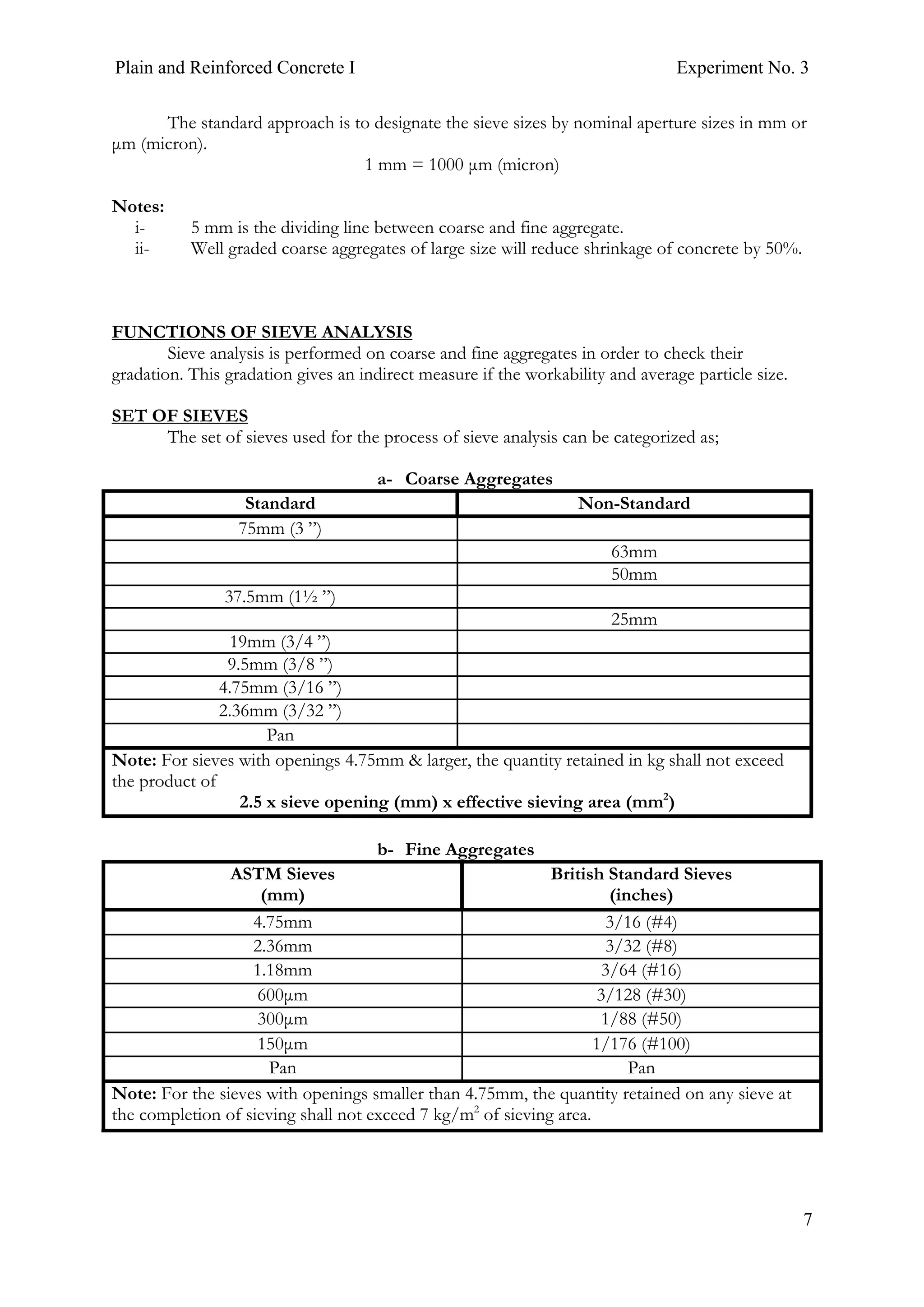
b- Fine Aggregates
ASTM Sieves
(mm)
British Standard Sieves
(inches)
4.75mm 3/16 (#4)
2.36mm 3/32 (#8)
1.18mm 3/64 (#16)
600μm 3/128 (#30)
300μm 1/88 (#50)
150μm 1/176 (#100)
Pan Pan
Note: For the sieves with openings smaller than 4.75mm, the quantity retained on any sieve at
the completion of sieving shall not exceed 7 kg/m2
of sieving area.
Plain and Reinforced Concrete I Experiment No. 3
8
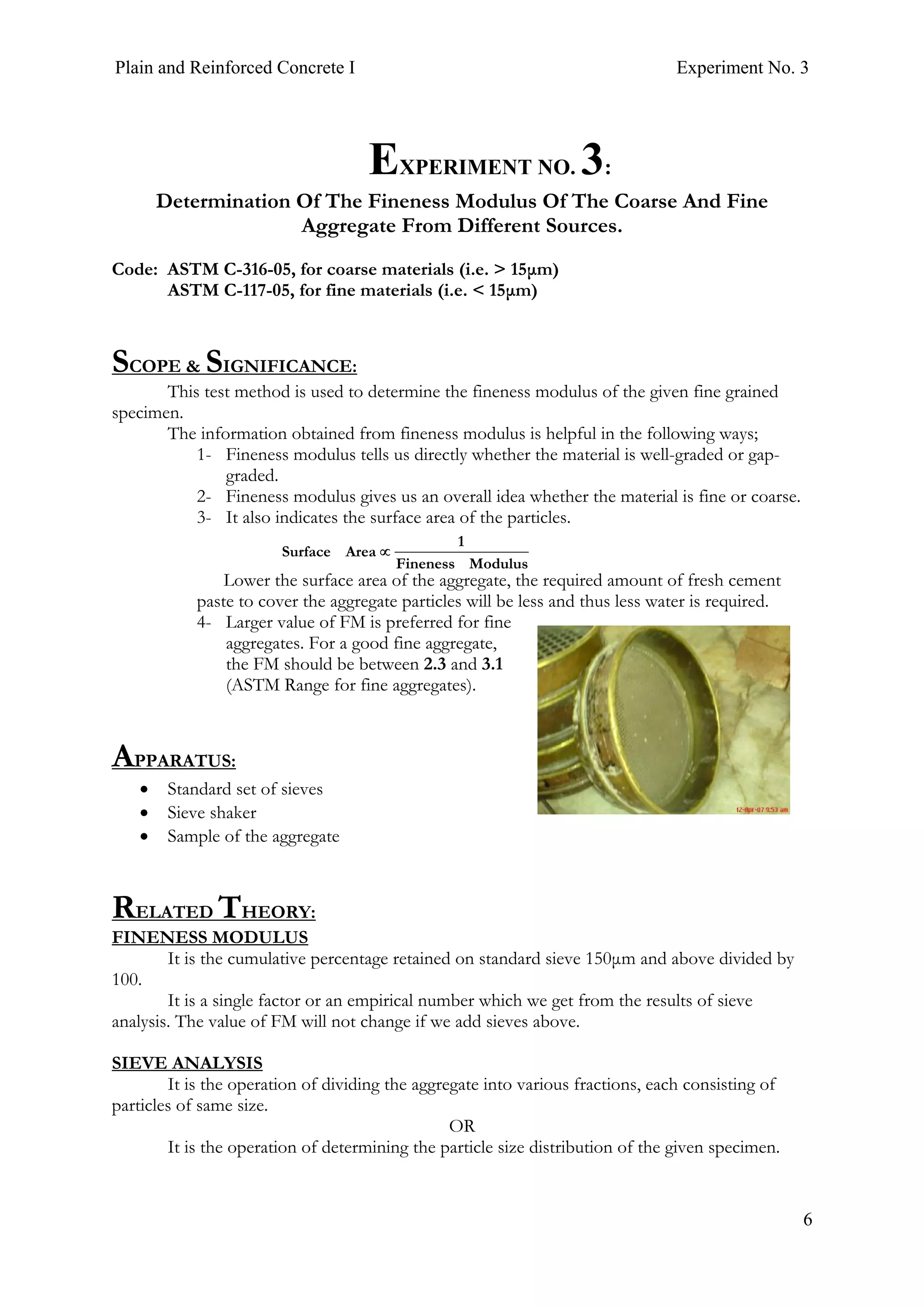
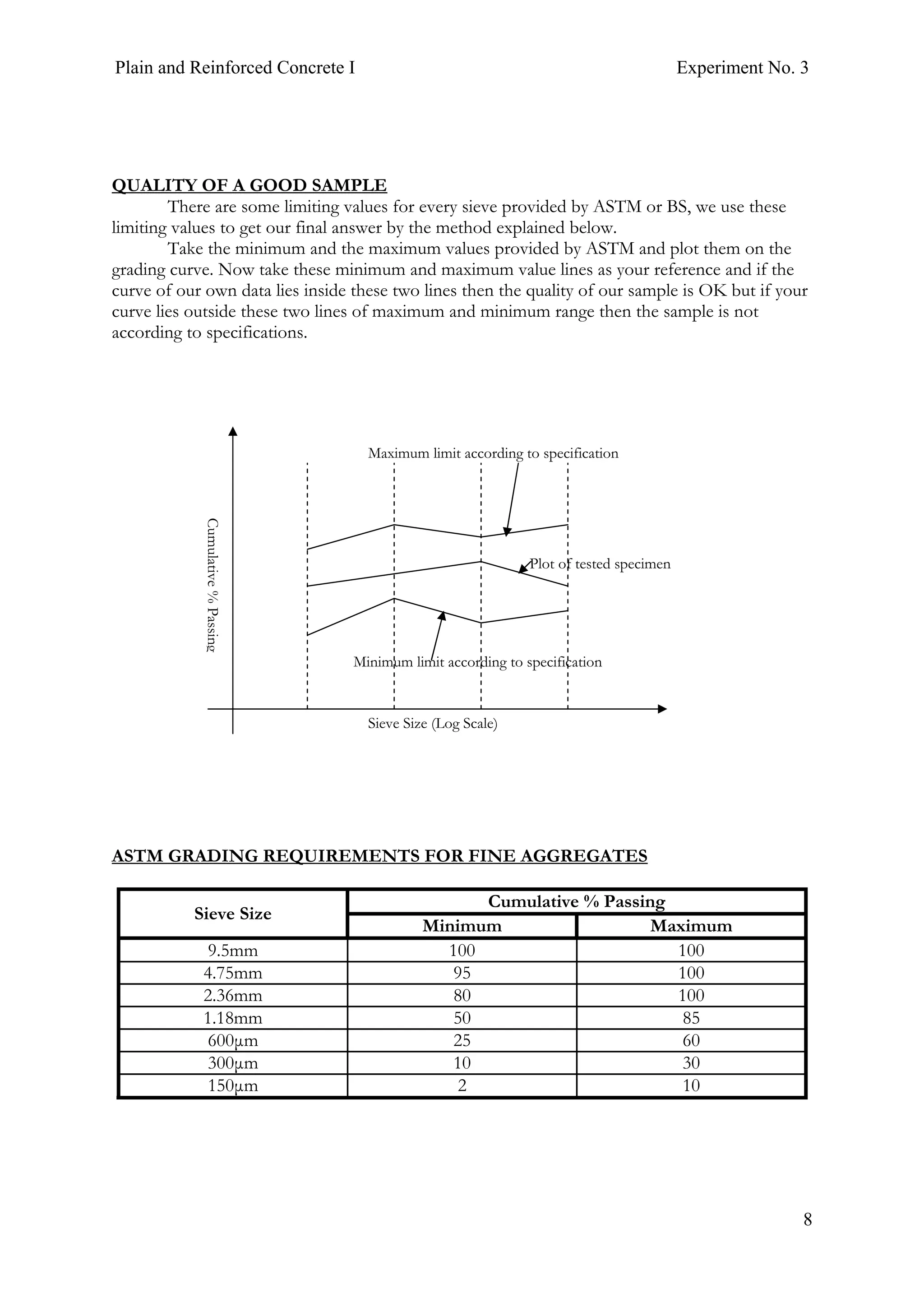
QUALITY OF A GOOD SAMPLE
There are some limiting values for every sieve provided by ASTM or BS, we use these
limiting values to get our final answer by the method explained below.
Take the minimum and the maximum values provided by ASTM and plot them on the
grading curve. Now take these minimum and maximum value lines as your reference and if the
curve of our own data lies inside these two lines then the quality of our sample is OK but if your
curve lies outside these two lines of maximum and minimum range then the sample is not
according to specifications.
ASTM GRADING REQUIREMENTS FOR FINE AGGREGATES
Sieve Size
Cumulative % Passing
Minimum Maximum
9.5mm 100 100
4.75mm 95 100
2.36mm 80 100
1.18mm 50 85
600μm 25 60
300μm 10 30
150μm 2 10
Maximum limit according to specification
Minimum limit according to specification
Plot of tested specimen
Sieve Size (Log Scale)
Cumulative%Passing
Plain and Reinforced Concrete I Experiment No. 3
9
PROCEDURE:
Take 2 kg of the oven-dried sample. The sample should be perfectly dry because if there
is some moisture content present then the particles will stick together and will not pass through
the sieves.
Temperature of the oven = 110±5 °C
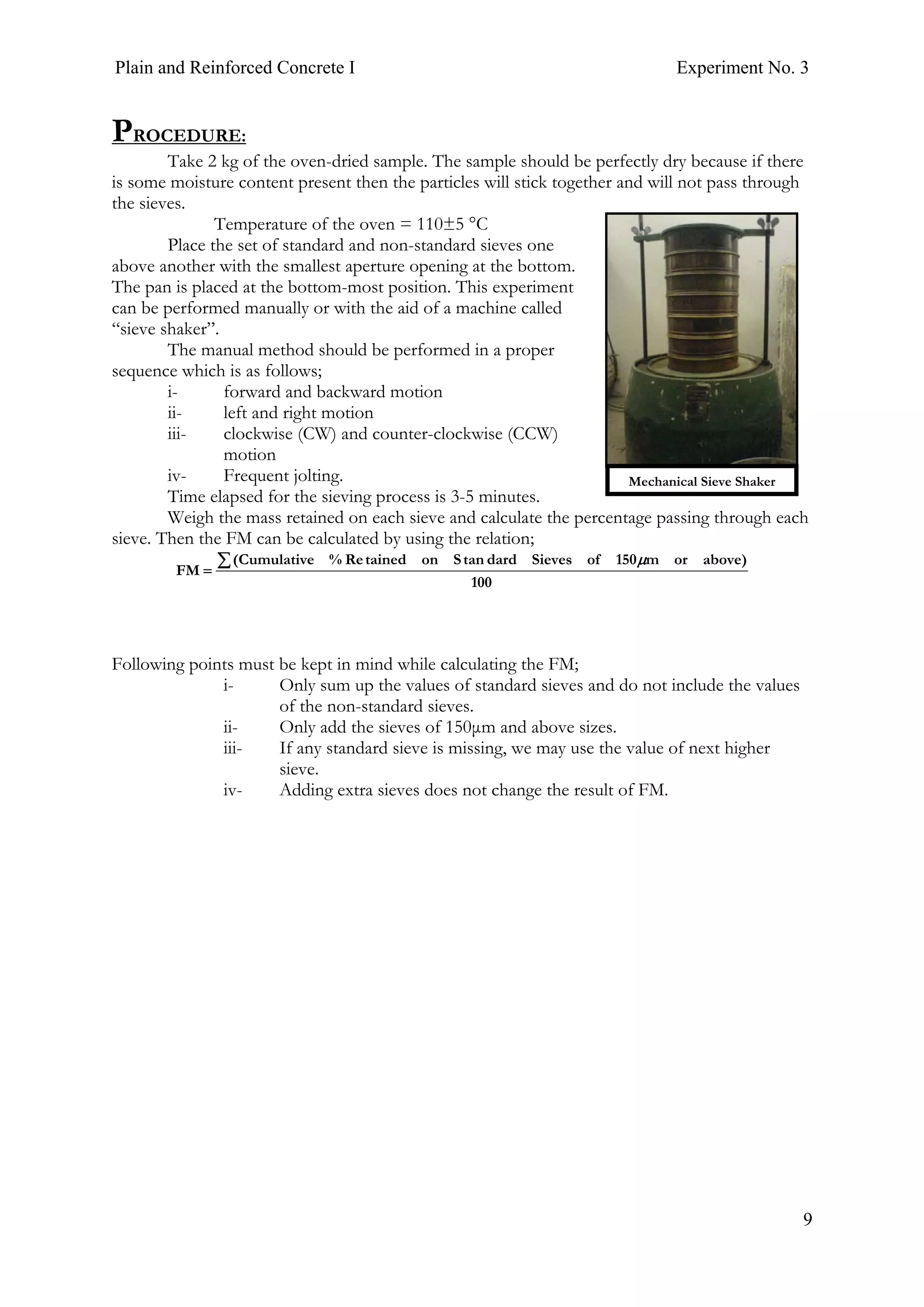
Place the set of standard and non-standard sieves one
above another with the smallest aperture opening at the bottom.
The pan is placed at the bottom-most position. This experiment
can be performed manually or with the aid of a machine called
“sieve shaker”.
The manual method should be performed in a proper
sequence which is as follows;
i- forward and backward motion
ii- left and right motion
iii- clockwise (CW) and counter-clockwise (CCW)
motion
iv- Frequent jolting.
Time elapsed for the sieving process is 3-5 minutes.
Weigh the mass retained on each sieve and calculate the percentage passing through each
sieve. Then the FM can be calculated by using the relation;
100
)aboveorm150ofSievesdardtanSontainedRe%Cumulative(
FM
∑=
μ
Following points must be kept in mind while calculating the FM;
i- Only sum up the values of standard sieves and do not include the values
of the non-standard sieves.
ii- Only add the sieves of 150μm and above sizes.
iii- If any standard sieve is missing, we may use the value of next higher
sieve.
iv- Adding extra sieves does not change the result of FM.
Mechanical Sieve Shaker
Plain and Reinforced Concrete I Experiment No. 4
10
4. EXPERIMENT NO. 4:
Standard Test Method For The Determination Of Bulk Density (I.E. Unit
Weight And The Voids In Aggregates).
Code: ASTM C-29/C-29M
SCOPE & SIGNIFICANCE:
This test method is used to determine the bulk density of the given fine grained
specimen.
During the concrete mix design, when the aggregate is to be batched by volume or by
weight, then it becomes necessary to know the mass of the aggregates that will fill the container
of unit volume. If we know the bulk density of the aggregate material then we can easily
determine the mass required to fill a unit volume container.
Bulk density also indicates the percentage of voids present in the aggregate material. This
percentage of voids affects the grading of the aggregates which is important in high strength
concrete.
Bulk density also indicates the compactive effort required to compact the concrete.
RELATED THEORY:
BULK DENSITY
It is the mass of the unit volume of bulk aggregate material.
The term volume includes the volume of the individual particles and the volume of the
voids between the particles.
Bulk density is used in weight and volume batching.
VOIDS
It is the space between the individual particles in a unit volume of the aggregate mass and
is not occupied by the solid mineral matter.
Voids within the particles, either permeable or impermeable are not included in the voids
for the determination of bulk density by this method.
ABSOLUTE DENSITY
It is the mass per unit volume of the individual particles only.
FACTS ABOUT BULK DENSITY
Bulk density depends upon how densely the aggregate is packed. It also depends upon
the size, distribution and shape of the particles. If the particles are of the same size, then it can
be packed to a limited extent but when the smaller particles are added, the voids get filled with
them and thus the bulk density increases.
For a coarse aggregate, a higher bulk density means that there are few voids which are to
be filled by the fine aggregate and cement. Thus bulk density also depends upon the degree of
packing.
Plain and Reinforced Concrete I Experiment No. 4
11
APPARATUS:
• Balance
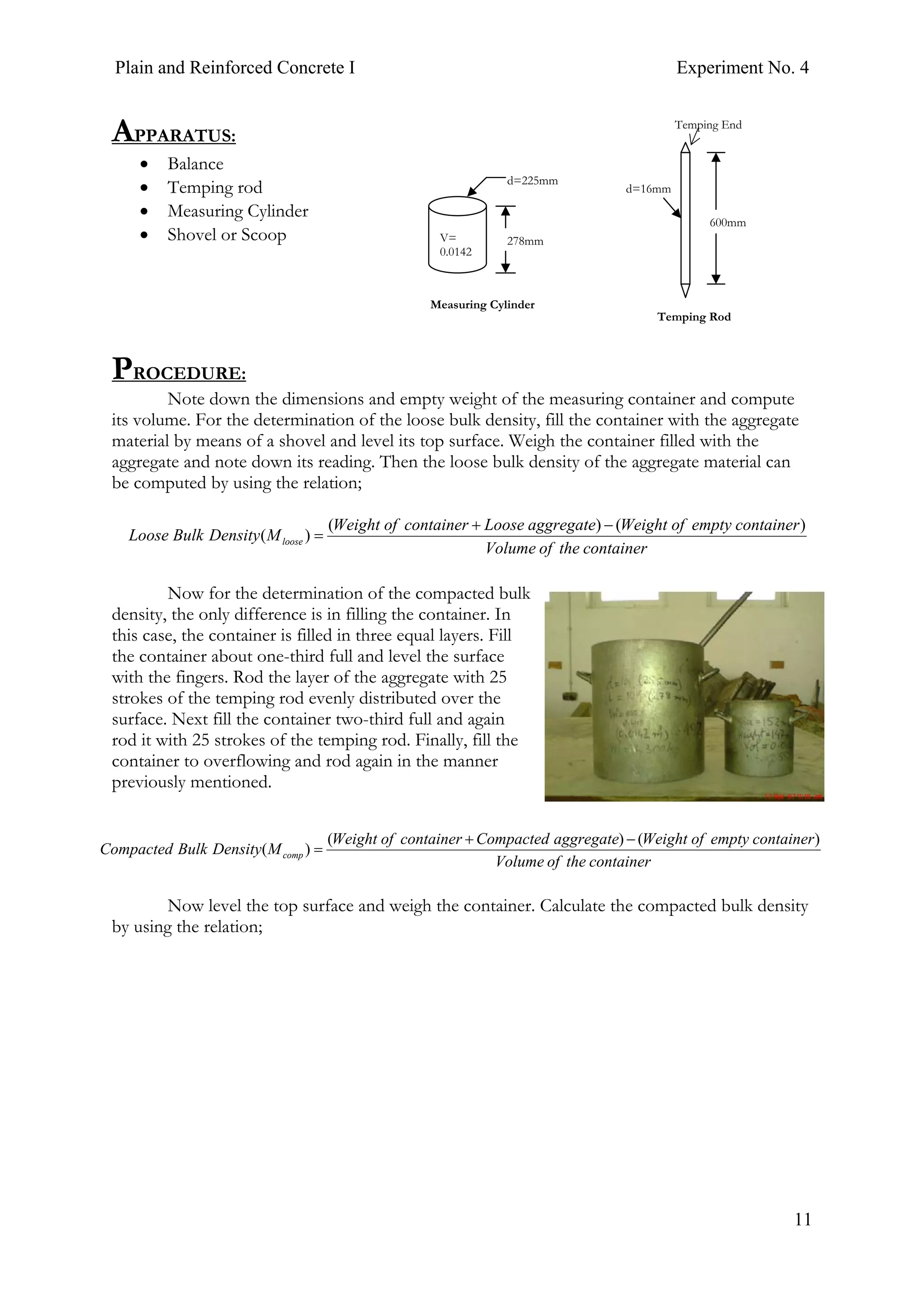
• Temping rod
• Measuring Cylinder
• Shovel or Scoop
PROCEDURE:
Note down the dimensions and empty weight of the measuring container and compute
its volume. For the determination of the loose bulk density, fill the container with the aggregate
material by means of a shovel and level its top surface. Weigh the container filled with the
aggregate and note down its reading. Then the loose bulk density of the aggregate material can
be computed by using the relation;
Now for the determination of the compacted bulk
density, the only difference is in filling the container. In
this case, the container is filled in three equal layers. Fill
the container about one-third full and level the surface
with the fingers. Rod the layer of the aggregate with 25
strokes of the temping rod evenly distributed over the
surface. Next fill the container two-third full and again
rod it with 25 strokes of the temping rod. Finally, fill the
container to overflowing and rod again in the manner
previously mentioned.
Now level the top surface and weigh the container. Calculate the compacted bulk density
by using the relation;
600mm
d=16mm
Temping End
Temping Rod
278mm
d=225mm
V=
0.0142
Measuring Cylinder
containertheofVolume
containeremptyofWeightaggregateLoosecontainerofWeight
MDensityBulkLoose loose
)()(
)(
−+
=
containertheofVolume
containeremptyofWeightaggregateCompactedcontainerofWeight
MDensityBulkCompacted comp
)()(
)(
−+
=
Plain and Reinforced Concrete I Experiment No. 5
12
5. EXPERIMENT NO. 5:
Standard Test Method For The Determination Of Relative Density (I.E.
Specific Gravity) And Water Absorption Of The Coarse Aggregates.
Code: ASTM C-127-04
SCOPE & SIGNIFICANCE:
In this test method we determine the relative density (i.e. specific gravity) and the water
absorption of the coarse aggregates.
The information obtained from specific gravity is helpful in the following ways;
1- The knowledge of the specific gravity is important for the concrete technologist
to determine the properties of concrete made from such aggregates.
2- It is used for the calculation of the volume occupied by the aggregates in various
mixtures.
3- The pores at the surface of the particles affect the bond between the aggregate
and the cement paste and thus influence the concrete strength.
4- Normally it is assumed that at the time of setting of concrete, the aggregate is in
the saturated and surface dry condition. If the aggregate is to be batched in the
dry condition, then it is assumed that sufficient amount of water will be absorbed
from the mix to bring the aggregate in the saturated condition. If an additional
amount of water is not added as a cover for the absorbed water, the loss of
workability is resulted.
Limitation
The limitation of the test is that, it can not be used for the light weight aggregates.
RELATED THEORY:
AGGREGATES
Aggregates may be classified as;
i- Coarse Aggregates
ii- Fine Aggregates
COARSE AGGREGATES
Any material which is retained on BS sieve #4 (ASTM sieve 4.75mm) is known as coarse
aggregate.
FINE AGGREGATES
Any material which is passing BS sieve #4 (ASTM sieve 4.75mm) is known as fine
aggregate.
TYPES OF CRUSH AVAILABLE IN PAKISTAN
1- SARGODHA CRUSH
Plain and Reinforced Concrete I Experiment No. 5
13
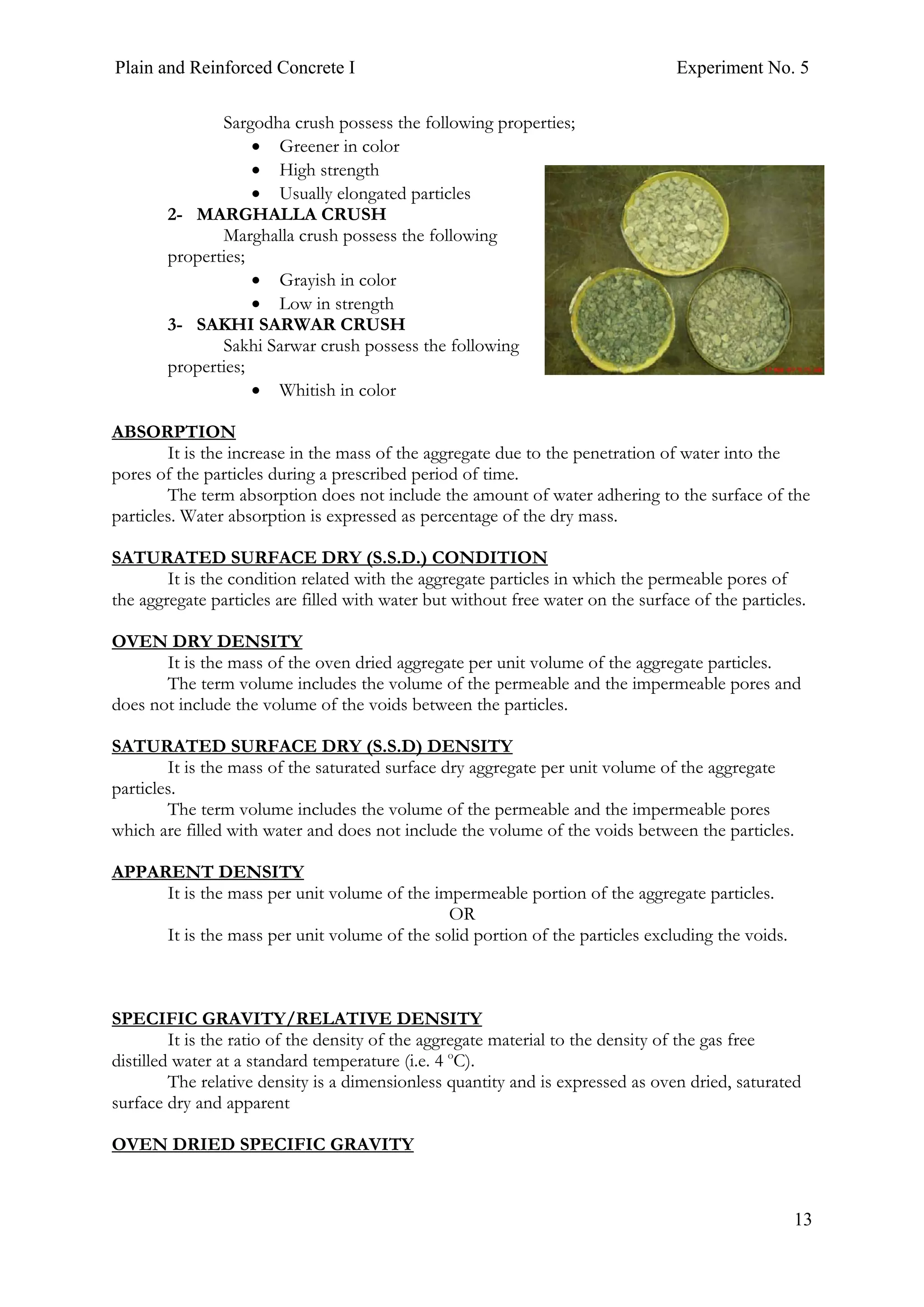
Sargodha crush possess the following properties;
• Greener in color
• High strength
• Usually elongated particles
2- MARGHALLA CRUSH
Marghalla crush possess the following
properties;
• Grayish in color
• Low in strength
3- SAKHI SARWAR CRUSH
Sakhi Sarwar crush possess the following
properties;
• Whitish in color
ABSORPTION
It is the increase in the mass of the aggregate due to the penetration of water into the
pores of the particles during a prescribed period of time.
The term absorption does not include the amount of water adhering to the surface of the
particles. Water absorption is expressed as percentage of the dry mass.
SATURATED SURFACE DRY (S.S.D.) CONDITION
It is the condition related with the aggregate particles in which the permeable pores of
the aggregate particles are filled with water but without free water on the surface of the particles.
OVEN DRY DENSITY
It is the mass of the oven dried aggregate per unit volume of the aggregate particles.
The term volume includes the volume of the permeable and the impermeable pores and
does not include the volume of the voids between the particles.
SATURATED SURFACE DRY (S.S.D) DENSITY
It is the mass of the saturated surface dry aggregate per unit volume of the aggregate
particles.
The term volume includes the volume of the permeable and the impermeable pores
which are filled with water and does not include the volume of the voids between the particles.
APPARENT DENSITY
It is the mass per unit volume of the impermeable portion of the aggregate particles.
OR
It is the mass per unit volume of the solid portion of the particles excluding the voids.
SPECIFIC GRAVITY/RELATIVE DENSITY
It is the ratio of the density of the aggregate material to the density of the gas free
distilled water at a standard temperature (i.e. 4 o
C).
The relative density is a dimensionless quantity and is expressed as oven dried, saturated
surface dry and apparent
OVEN DRIED SPECIFIC GRAVITY
Plain and Reinforced Concrete I Experiment No. 5
14
It is the ratio of the oven dried density of the aggregate to the density of the gas free
distilled water at a standard temperature (i.e. 4 o
C).
SATURATED SURFACE DRY SPECIFIC GRAVITY
It is the ratio of the saturated surface dry density of the aggregate to the density of the
gas free distilled water at a standard temperature (i.e. 4 o
C).
APPARENT SPECIFIC GRAVITY
It is the ratio of the apparent density of the aggregate to the density of the gas free
distilled water at a standard temperature (i.e. 4 o
C).
APPARATUS:
• Balance
• Sample container
• Water tank
• Sieves
• Oven
PROCEDURE:
The sample of the aggregate is immersed in water for 24hrs to essentially fill all the pores.
Remove the test sample from the water and roll it in a large absorbent cloth until all visible
films of water are removed. Wipe the larger particles individually. A moving stream of air is
permitted to assist in the drying operation. Take care to avoid evaporation of water from
aggregate pores during the surface-drying operation. Determine the mass of the test sample in
the saturated surface-dry condition. Record this and all subsequent masses to the nearest 0.5 g
or 0.05 % of the sample mass, whichever is greater.
In order to calculate the volume of the aggregate, immediately place the saturated-
surface-dry test sample in the sample container and determine its apparent mass in water at
23±2.0 °C. Take care to remove all entrapped air before determining its mass by shaking the
container while immersed. The difference between the mass in air and the mass when the
sample is immersed in water equals the mass of water displaced by the sample. This mass of
water equals the volume of water displaced because
ρwater = mwater x Vwater
mwater = Vwater (ρwater=1 gm/cm3
)
Vwater = Vaggregate
Dry the test sample in the oven to constant mass at a temperature of 110±5 °C, cool in
air at room temperature 1 to 3 h, or until the aggregate has cooled to a temperature that is
comfortable to handle (approximately 50 °C), and determine the mass in order to calculate the
oven specific gravity of the specimen.
Plain and Reinforced Concrete I Experiment No. 6
15
6. EXPERIMENT NO. 6:
Determination Of The Aggregate Impact Value Of Different Coarse
Aggregate Samples.
SCOPE & SIGNIFICANCE:
The aggregate impact value gives a relative measure of the toughness or the resistance of
aggregate sudden shock or impact is not proportional to the resistance to a slowly applied
compressive load.
APPARATUS:
• Coarse aggregate from various sources
• Impact testing machine
• Spanner
• Balance
TEST SPECIFICATIONS:
The test sample shall consist of aggregates the whole of which passes through ½ in B.S.
test sieve and is retained on a 3/8 in B.S. test sieve. The aggregate comprising the test sample
shall be dried in an oven for a period of four hours at a temperature of 100-110 °C and cooled.
The measure (cup) shall be filled about one-third full with the aggregate and gives 25 tamping
rod. A further similar quantity of aggregate shall be added and a further 25 tamping given to the
second and tot the last layer 25 tamping shall again be given and the surplus aggregate struck off
using the tamping rod as a straight-edge. The net weight of aggregate in the measure shall be
determined to the nearest gram (weight A) and this weight shall be used for the duplicate test on
the same material.
PROCEDURE:
The impact machine shall test without wedging or packing upon the level plate, block or
floor, so that it is rigid and hammer guide columns are vertical.
The cup shall be fixed firmly in position on the base of the machine and the whole of the test
sample placed in it and compacted by a single tamping of 25 strokes of the tamping rod.
The hammer shall be raised until its lower face is 15 in. above from the upper surface of
the aggregate in the cup, and allowed to fall freely on the aggregate. The test sample shall be
subjected to a total 15 such blows each being delivered at an interval of not less than one second.
The crushed aggregate shall then be removed from the cup and the whole of it sieved on No. 7
B.S. sieve until no further significant amount passes in one minute. The fraction passing the sieve
shall be weighted to an accuracy of 0.1 gram (weight B). Te fraction retained on the sieve shall
also be weighed (weight C), and if the total weight B + C is less than the initial weight (weight A)
by more than 1 gm the result shall be discarded and a fresh test made. Two tests shall be made.
CALCULATIONS
The ratio of the weight of fines formed to the total sample weight in each test shall be
expressed as a percentage, the result being recorded to the first decimal place.
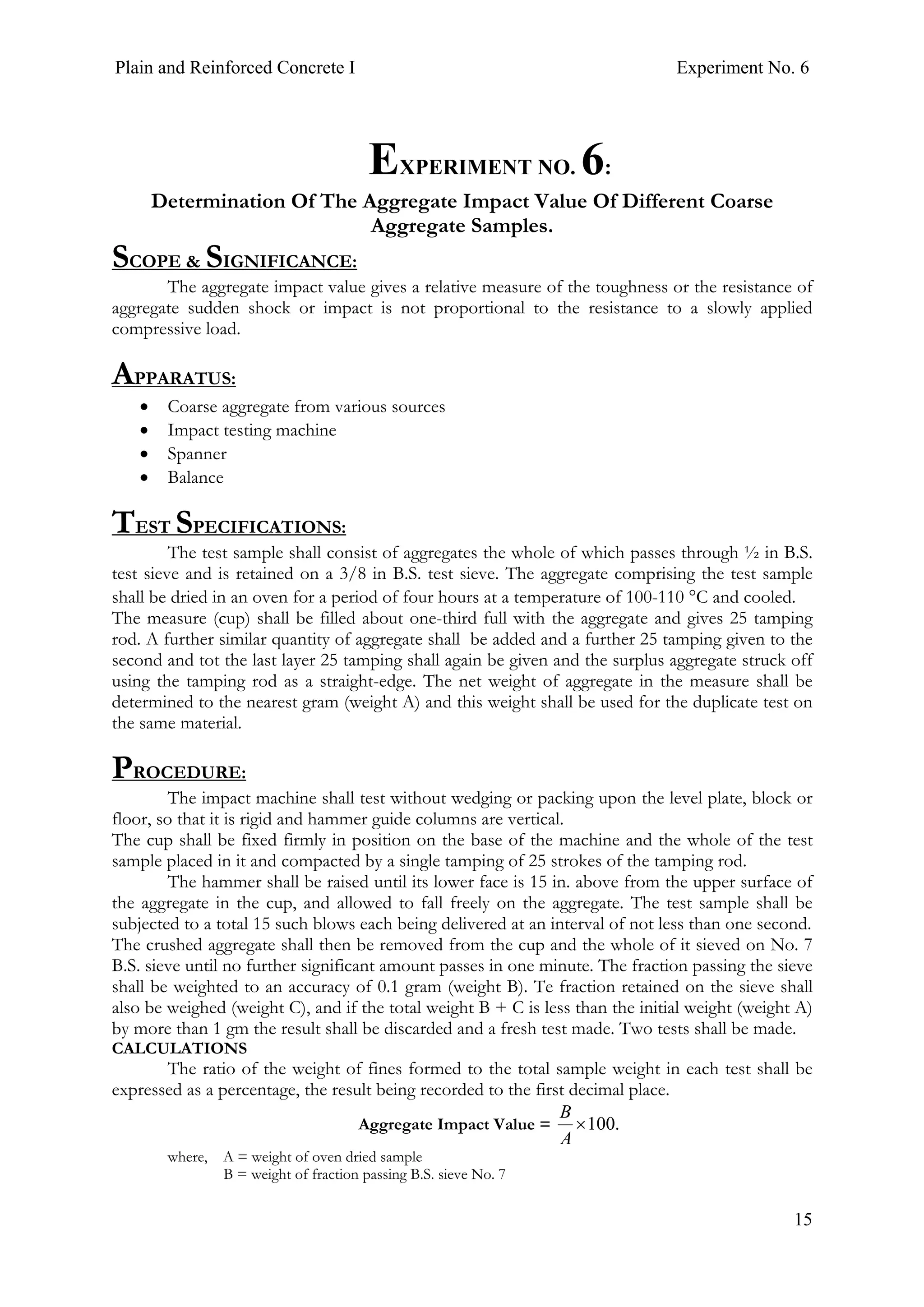
Aggregate Impact Value = .100×
A
B
where, A = weight of oven dried sample
B = weight of fraction passing B.S. sieve No. 7
Plain and Reinforced Concrete I Experiment No. 7
16
7. EXPERIMENT NO. 7:
Standard Test Method For The Flexural Strength Of Concrete Using Simple
Beam With Third-Point Loading.
Code: ASTM C 78-02
SCOPE & SIGNIFICANCE:
• This test method is used to determine the flexural strength of specimens prepared and
cured in accordance with the specifications. Results are calculated and reported as the
modulus of rupture.
• The strength determined will vary where there are differences in specimen size,
preparation, moisture condition, curing, or where the beam has been molded or swayed
to size.
• The results of this test method may be used to determine compliance with specifications
or as a basis for proportioning, mixing and placement operations. It is used in testing
concrete for the construction of slabs and pavements.
• The modulus of rupture is also used as an indirect measure of the tensile strength of
concrete.
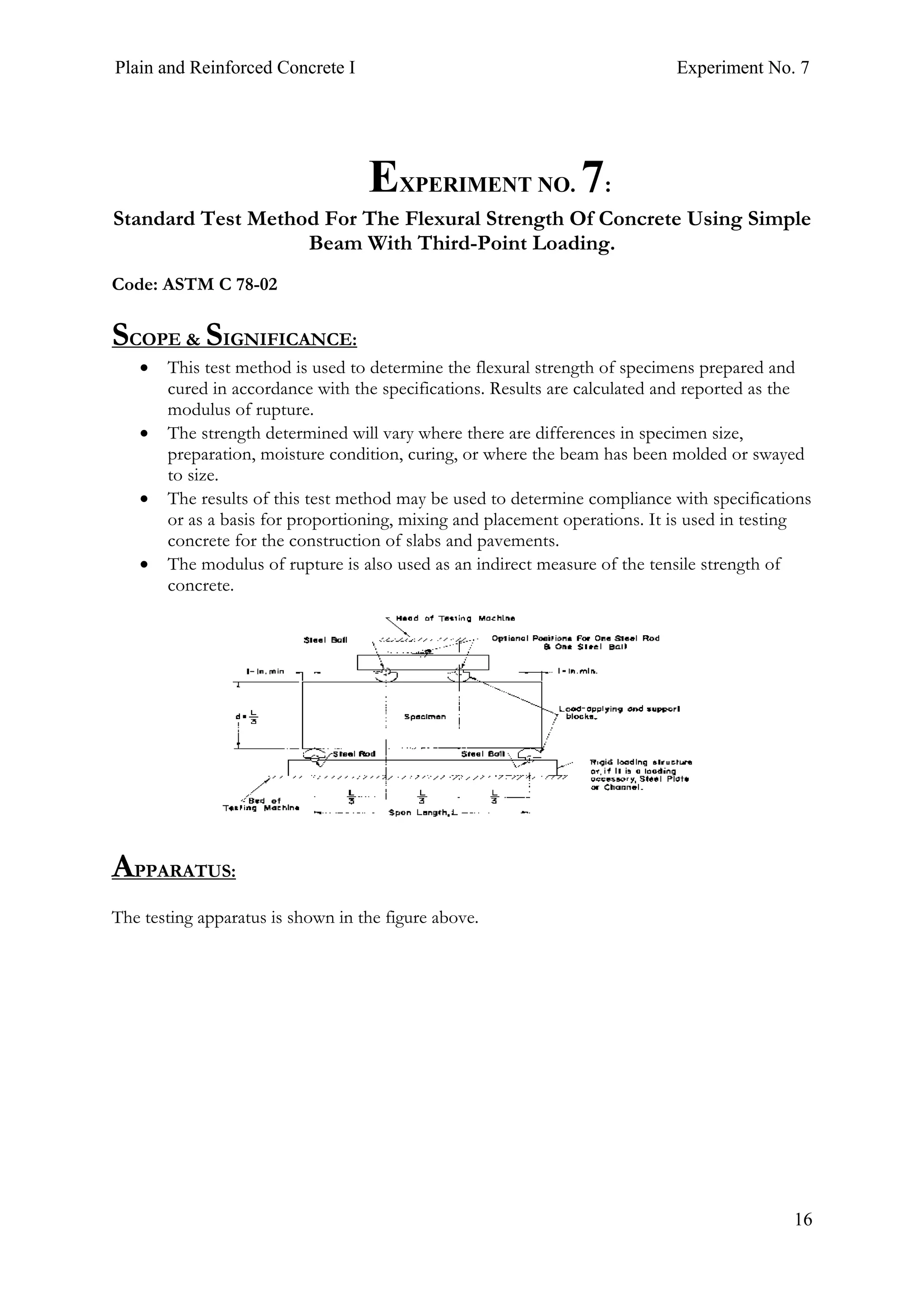
APPARATUS:
The testing apparatus is shown in the figure above.
Plain and Reinforced Concrete I Experiment No. 7
17
RELATED THEORY:
DIFFICULTIES IN DETERMINING TENSILE STRENGTH OF CONCRETE:
There are considerable experimental difficulties in determining the true tensile strength of
concrete. In direct tension test following are the difficulties:
1. When concrete is gripped by the machine it may be crushed due the large stress
concentration at the grip.
2. Concrete samples of different sizes and diameters show large variation in results.
3. If there are some voids in sample the test may show very small strength.
4. If there is some initial misalignment in fixing the sample the results are not accurate.
TESTS FOR TENSILE STRENGTH OF CONCRETE:
Following tests are used to determine the tensile strength of concrete.
• Split Cylinder Test
• Double Punch Test
• Modulus of Rupture Test
MODULUS OF RUPTURE:
In a flexural test on a plane concrete specimen, the maximum tensile stress reached at the
bottom fiber of a standard size prism (beam) under predefined loading type is called modulus of
rupture.
TYPE/SIZE OF THE SPECIMEN FOR THE TEST:
The specimen used is a prism, square in cross-section and having a certain length. There
are two standard sizes of the specimen that can be used for specified aggregate sizes.
1- 150 x 150 x 750 (mm)
2- 100 x 100 x 510 (mm)
The size (150 x 150 x750 mm) can be used for all sizes of the aggregate particles.
The size (100 x 100 x 510 mm) can only be used for the aggregate sizes less than
25mm.We are using this size for our test.
Notes:
• ASTM follows the Foot Pound System.
• BS follows/uses the SI System.
AVERAGE VALUE OF MOR (fr):
There are some relationships which relate fr with compressive strength of concrete
fr = 0.69 √ fc’
fc’ and fr are in MPa
ACI code gives formulae for fr
fr = 0.5 √ fc’ (ACI code for Strength Calculation)
fr = 0.625 √ fc’ (ACI code for Deflection Control)
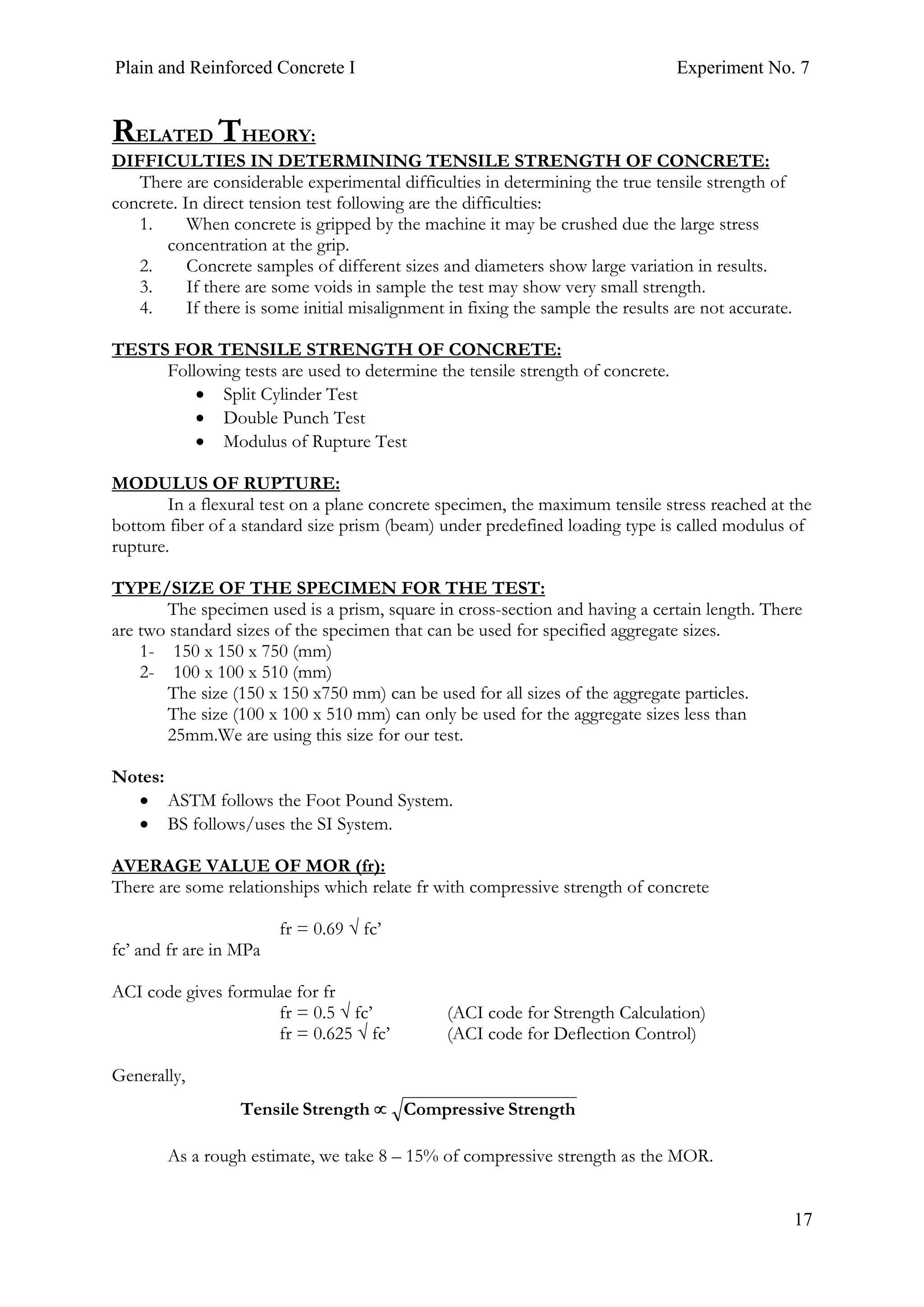
Generally,
As a rough estimate, we take 8 – 15% of compressive strength as the MOR.
StrengtheCompressivStrengthTensile ∝
Plain and Reinforced Concrete I Experiment No. 7
18
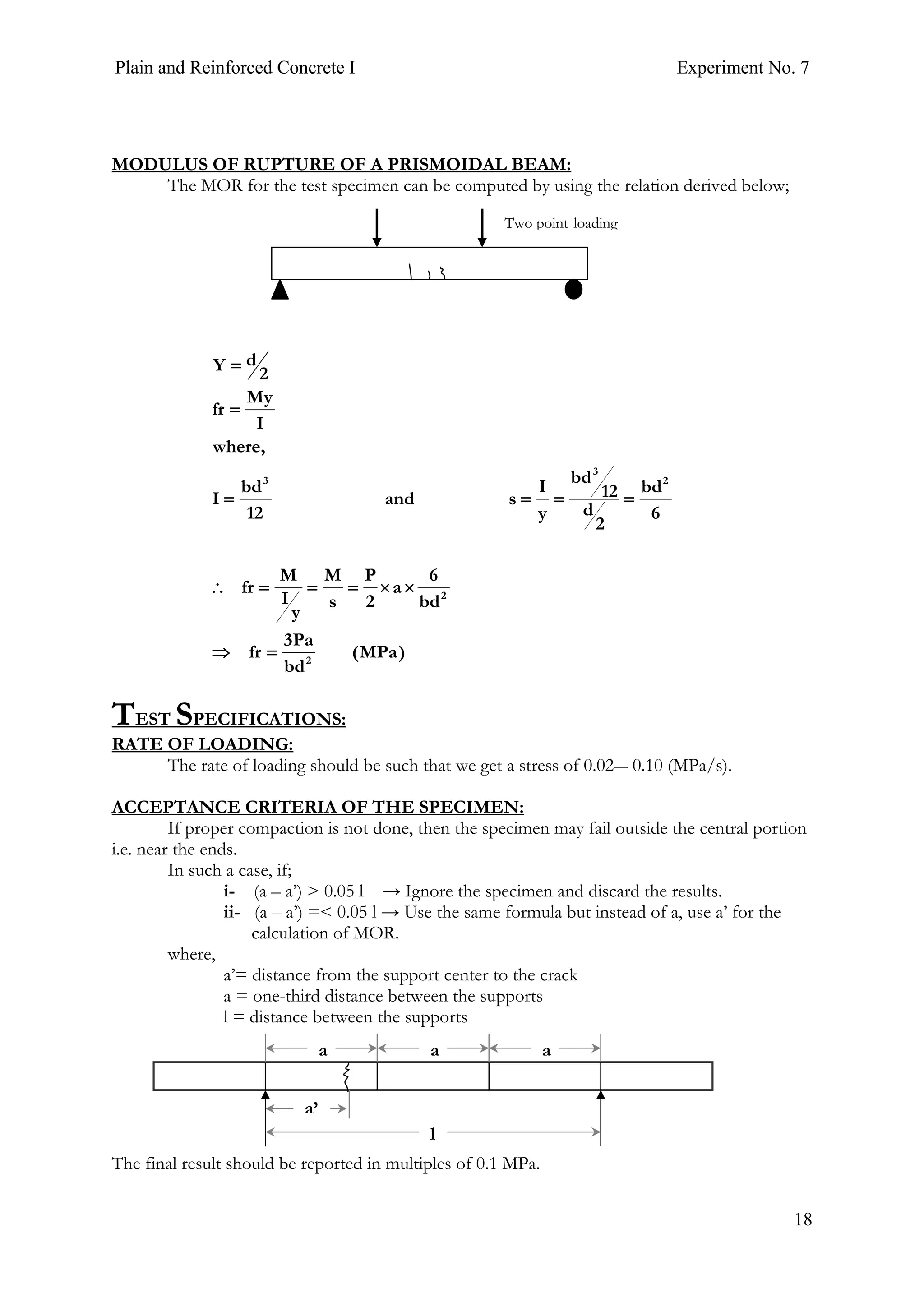
MODULUS OF RUPTURE OF A PRISMOIDAL BEAM:
The MOR for the test specimen can be computed by using the relation derived below;
TEST SPECIFICATIONS:
RATE OF LOADING:
The rate of loading should be such that we get a stress of 0.02― 0.10 (MPa/s).
ACCEPTANCE CRITERIA OF THE SPECIMEN:
If proper compaction is not done, then the specimen may fail outside the central portion
i.e. near the ends.
In such a case, if;
i- (a – a’) > 0.05 l → Ignore the specimen and discard the results.
ii- (a – a’) =< 0.05 l → Use the same formula but instead of a, use a’ for the
calculation of MOR.
where,
a’= distance from the support center to the crack
a = one-third distance between the supports
l = distance between the supports
The final result should be reported in multiples of 0.1 MPa.
)MPa(
bd
Pa3
fr
bd
6
a
2
P
s
M
y
I
M
fr
6
bd
2
d
12
bd
y
I
sand
12
bd
I
,where
I
My
fr
2
dY
2
2
2
3
3
=⇒
××===∴
====
=
=
Two point loading
l
a’
a aa
Plain and Reinforced Concrete I Experiment No. 7
19
SIZE OF THE SPECIMEN:
The specimen used is a prism of 100 x 100 (mm) square in cross-section and
having a length of 510mm.
Thus the dimensions of the specimen are;
100 x 100 x 510 (mm)
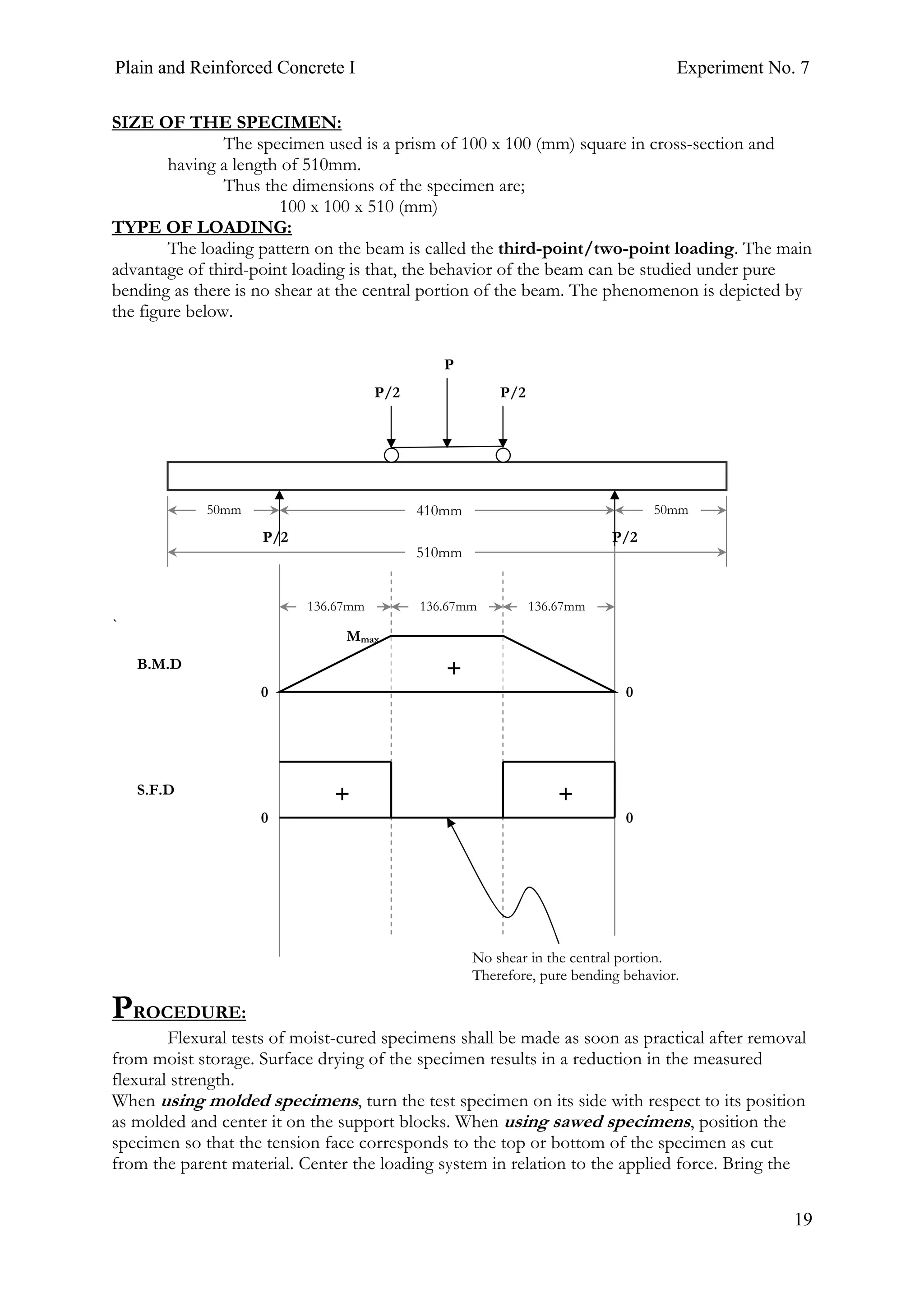
TYPE OF LOADING:
The loading pattern on the beam is called the third-point/two-point loading. The main
advantage of third-point loading is that, the behavior of the beam can be studied under pure
bending as there is no shear at the central portion of the beam. The phenomenon is depicted by
the figure below.
`
PROCEDURE:
Flexural tests of moist-cured specimens shall be made as soon as practical after removal
from moist storage. Surface drying of the specimen results in a reduction in the measured
flexural strength.
When using molded specimens, turn the test specimen on its side with respect to its position
as molded and center it on the support blocks. When using sawed specimens, position the
specimen so that the tension face corresponds to the top or bottom of the specimen as cut
from the parent material. Center the loading system in relation to the applied force. Bring the
510mm
136.67mm
410mm 50mm50mm
P
P/2P/2
P/2P/2
136.67mm 136.67mm
Mmax
0 0
0 0
B.M.D
S.F.D
No shear in the central portion.
Therefore, pure bending behavior.
++
+
Plain and Reinforced Concrete I Experiment No. 7
20
load-applying blocks in contact with the surface of the specimen at the third points and apply a
load of between 3 and 6 % of the estimated ultimate load.
Grind, cap, or use leather shims on the specimen contact surface to eliminate any gap in
excess of 0.004 in. (0.10 mm) in width. Gaps in excess of 0.015 in. (0.38 mm) shall be
eliminated only by capping or grinding. Grinding of lateral surfaces should be minimized in as
much as grinding may change the physical characteristics of the specimens. Capping shall be in
accordance with the applicable sections of Practice C 617.
Load the specimen continuously and without shock. The load shall be applied at a
constant rate to the breaking point. Apply the load at a rate that constantly increases the
extreme fiber stress between 125 and 175 psi/min (0.86 and 1.21 MPa/min) until rupture
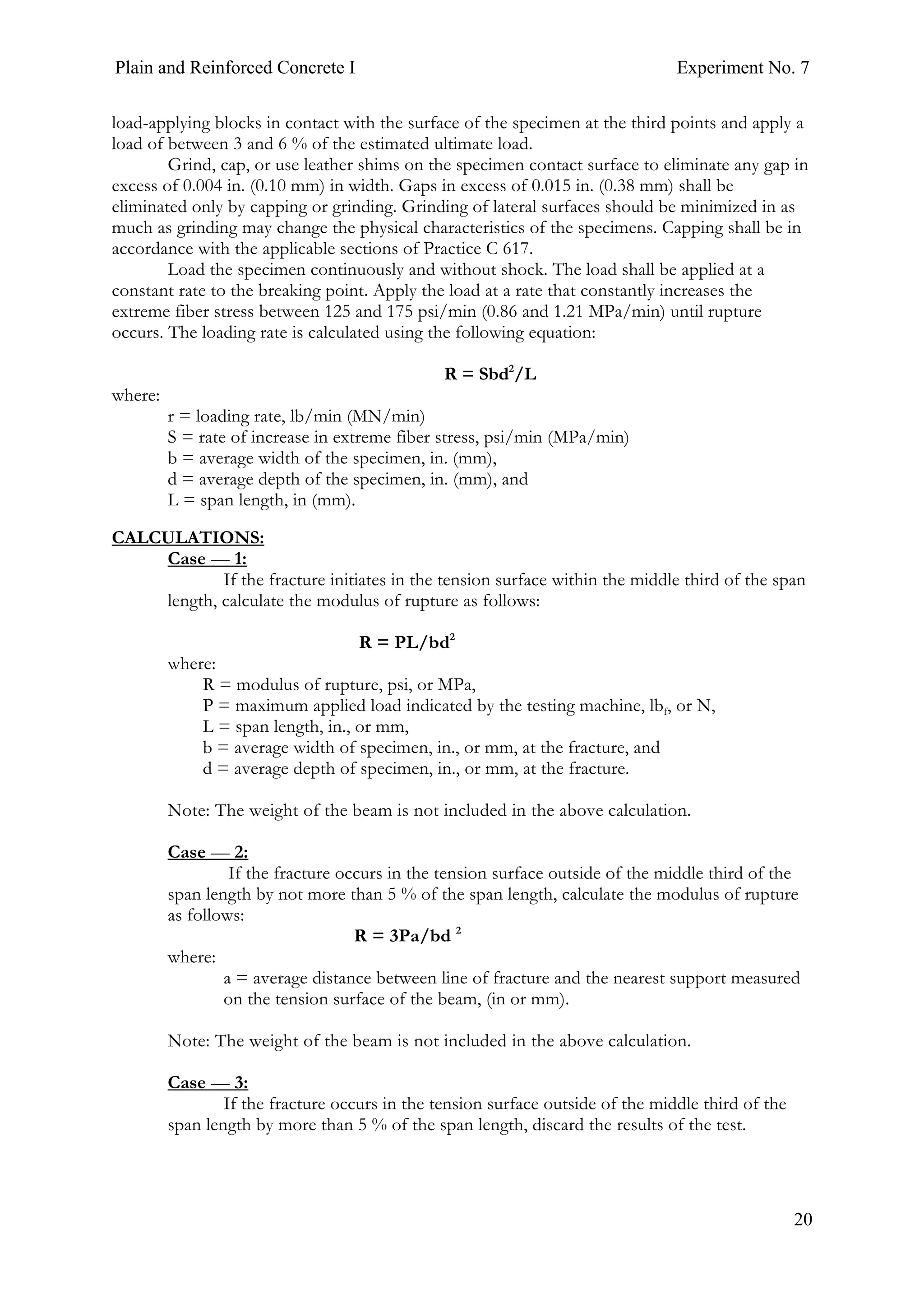
occurs. The loading rate is calculated using the following equation:
R = Sbd2
/L
where:
r = loading rate, lb/min (MN/min)
S = rate of increase in extreme fiber stress, psi/min (MPa/min)
b = average width of the specimen, in. (mm),
d = average depth of the specimen, in. (mm), and
L = span length, in (mm).
CALCULATIONS:
Case — 1:
If the fracture initiates in the tension surface within the middle third of the span
length, calculate the modulus of rupture as follows:
R = PL/bd2
where:
R = modulus of rupture, psi, or MPa,
P = maximum applied load indicated by the testing machine, lbf, or N,
L = span length, in., or mm,
b = average width of specimen, in., or mm, at the fracture, and
d = average depth of specimen, in., or mm, at the fracture.
Note: The weight of the beam is not included in the above calculation.
Case — 2:
If the fracture occurs in the tension surface outside of the middle third of the
span length by not more than 5 % of the span length, calculate the modulus of rupture
as follows:
R = 3Pa/bd 2
where:
a = average distance between line of fracture and the nearest support measured
on the tension surface of the beam, (in or mm).
Note: The weight of the beam is not included in the above calculation.
Case — 3:
If the fracture occurs in the tension surface outside of the middle third of the
span length by more than 5 % of the span length, discard the results of the test.
Plain and Reinforced Concrete I Experiment No. 8
21
8. EXPERIMENT NO. 8:
Standard Test Method For The Determination Of The Splitting Tensile
Strength Of Cylindrical Concrete Specimen.
Code: ASTM C 496/C 496 M-04
SCOPE & SIGNIFICANCE:
This test method is used for the determination of splitting tensile strength of cylindrical
concrete specimen.
Splitting tensile strength is helpful for the following purposes;
1- Splitting tensile strength is generally greater than the direct tensile strength
and lower than the flexural strength (modulus of rupture).
2- Splitting tensile strength is used in the design of structural light weight
concrete members to evaluate the shear resistance provided by concrete and to
determine the development length of the reinforcement.
where,
T = Splitting tensile strength (to be reported in 0.05 MPa multiples)
P = Applied load
l = length of the specimen (mm)
d = Diameter of the specimen (mm)
APPARATUS:
• Testing Machine
• Supplementary Bearing Bar Or Plates (If the diameter or the largest dimension of the upper
bearing face or the lower bearing block is less than the
length of the cylinder to be tested, a supplementary bearing
bar or plate of machined steel shall be used. The bar or
plate shall be manner that the load will be applied over the
specimen.)
• Bearing Strips (Two bearing strips of nominal 1 /8 in [3.2 mm] thick
plywood, free of imperfections, approximately 1 in. [25
mm] wide, and of a length equal to, or slightly longer than,
that of the specimen shall be provided for each specimen.
The bearing strips shall be placed between the specimen
and both the upper and lower bearing blocks of the testing
machine or between the specimen and supplemental bars or
plates, when used (see 5.2). Bearing strips shall not be
reused.)
ld
P2
T
π
=
Plain and Reinforced Concrete I Experiment No. 8
22
TEST SPECIFICATIONS:
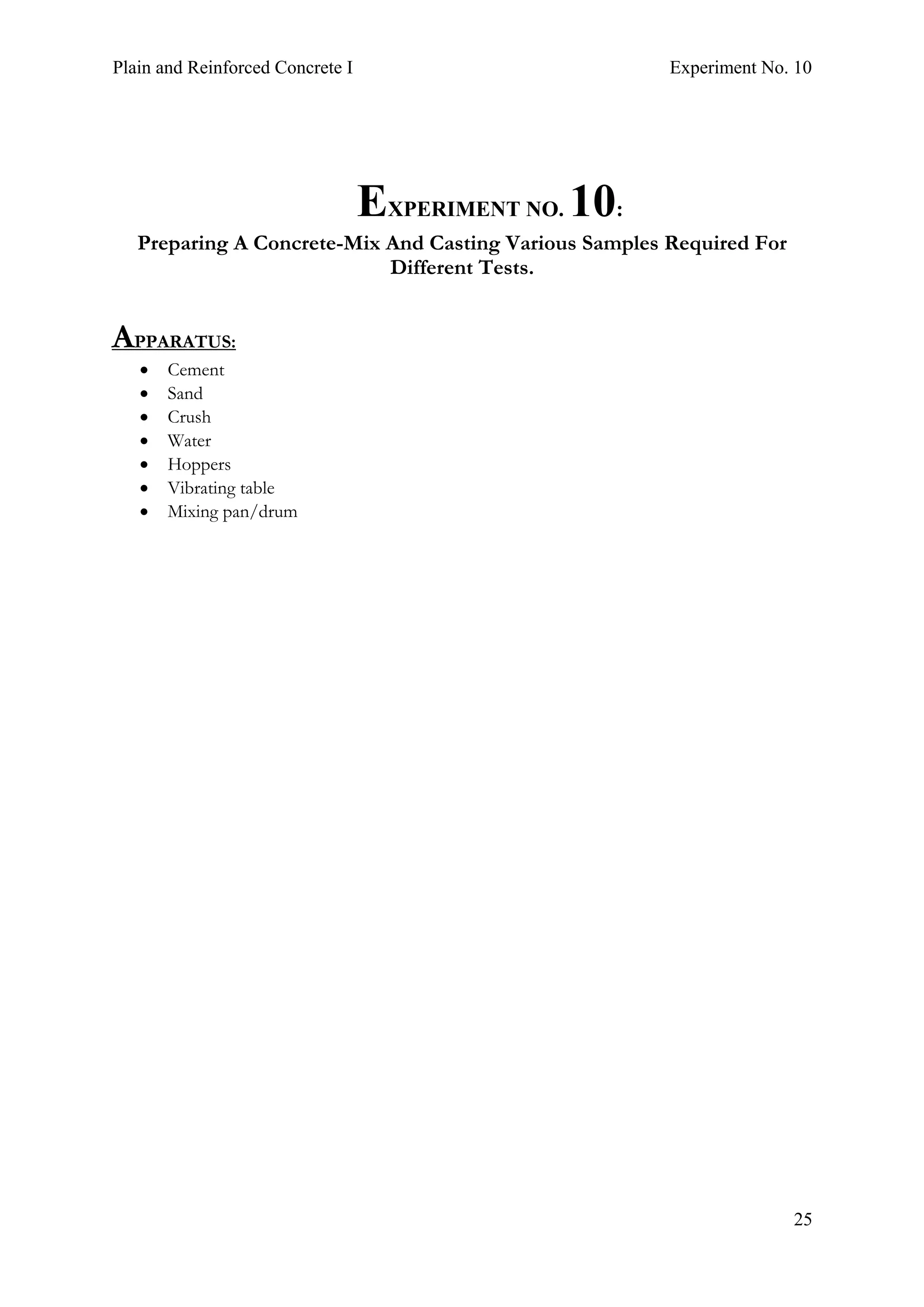
SIZE OF THE SPECIMEN
The specimen is a cylinder of 150mm diameter and 300mm height.
Determine the diameter to the nearest 0.25mm by averaging the three diameters.
Determine the length to the nearest 2mm by averaging at least two lengths.
SIZE OF BEARING STRIPS
According to ASTM specifications, the bearing strips should be 3.2mm thick and 25mm
wide. There is no restriction on their length.
RATE OF LOADING
The rate of loading should be such that a stress of
0.7 – 1.4 MPa/min is produced.
PROCEDURE:
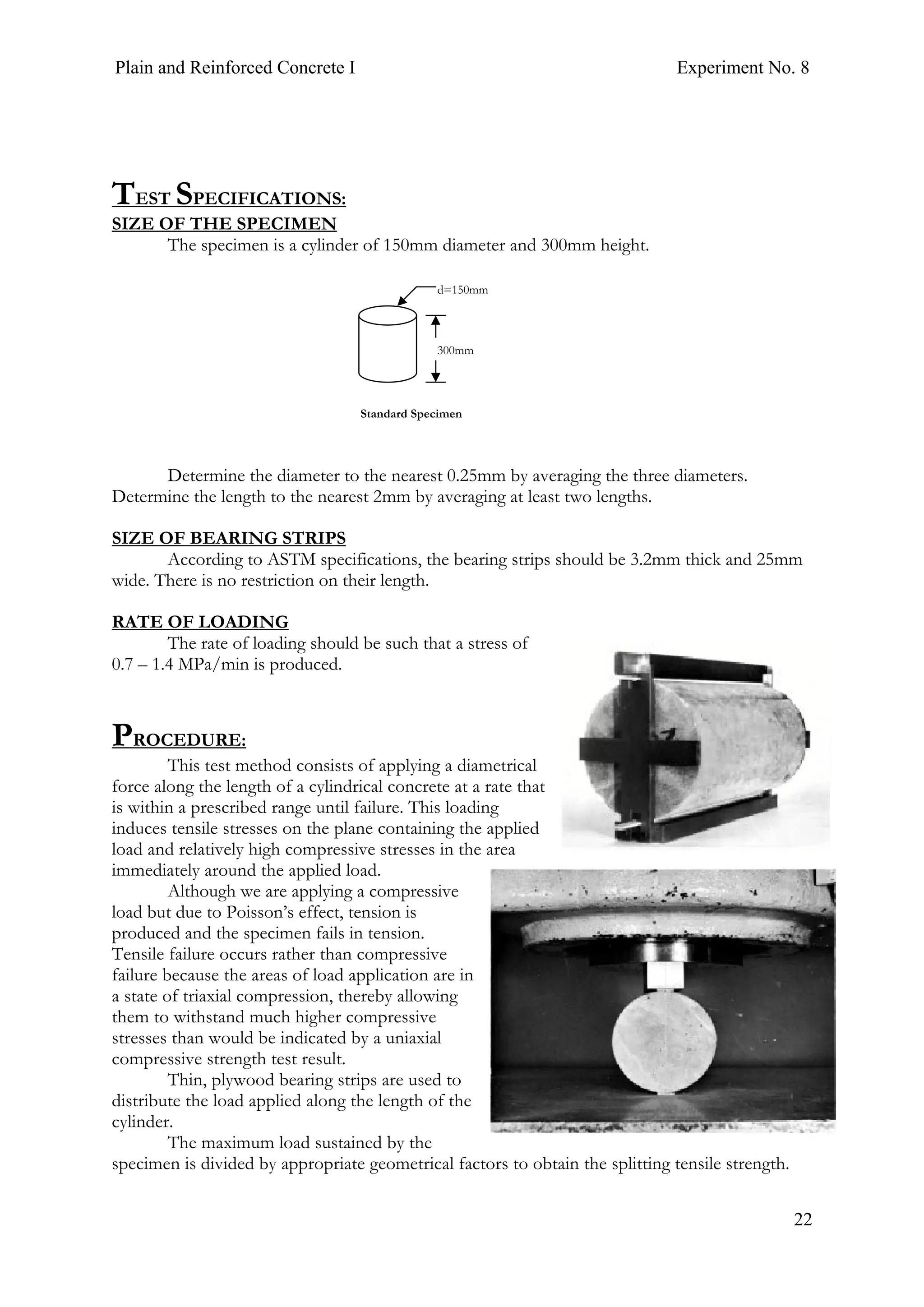
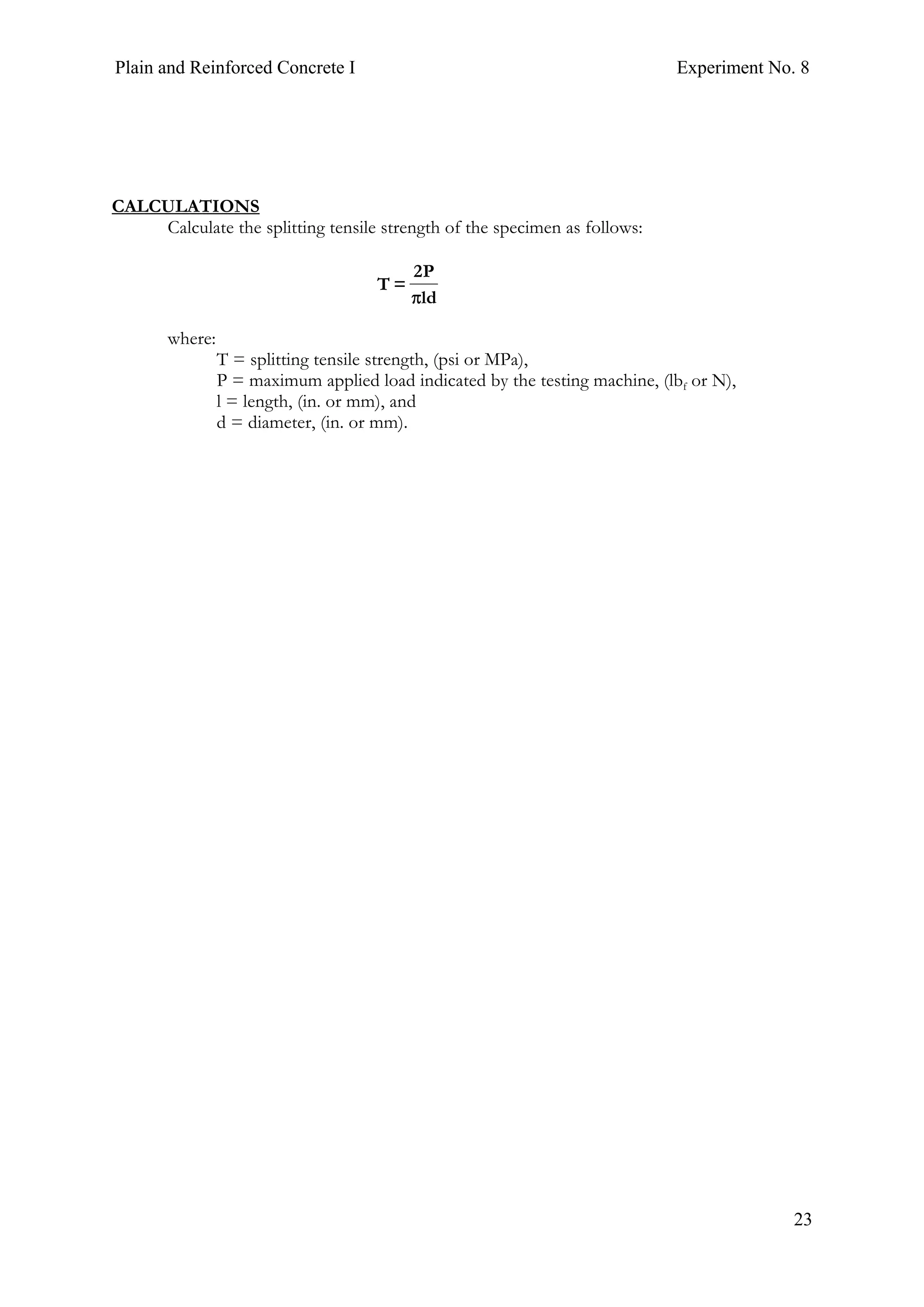
This test method consists of applying a diametrical
force along the length of a cylindrical concrete at a rate that
is within a prescribed range until failure. This loading
induces tensile stresses on the plane containing the applied
load and relatively high compressive stresses in the area
immediately around the applied load.
Although we are applying a compressive
load but due to Poisson’s effect, tension is
produced and the specimen fails in tension.
Tensile failure occurs rather than compressive
failure because the areas of load application are in
a state of triaxial compression, thereby allowing
them to withstand much higher compressive
stresses than would be indicated by a uniaxial
compressive strength test result.
Thin, plywood bearing strips are used to
distribute the load applied along the length of the
cylinder.
The maximum load sustained by the
specimen is divided by appropriate geometrical factors to obtain the splitting tensile strength.
300mm
d=150mm
Standard Specimen
Plain and Reinforced Concrete I Experiment No. 8
23
CALCULATIONS
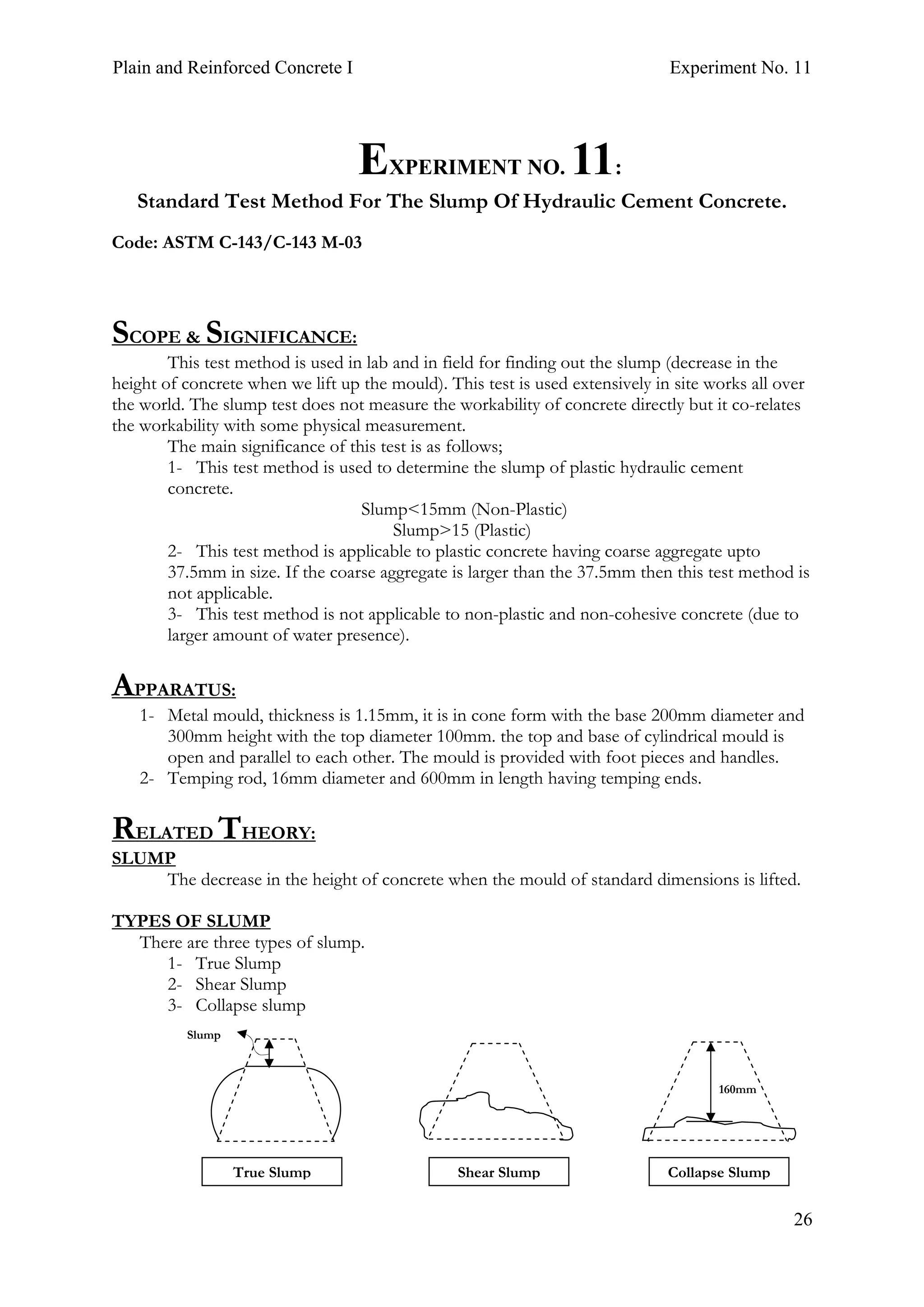
Calculate the splitting tensile strength of the specimen as follows:
ld
P2
=T
π
where:
T = splitting tensile strength, (psi or MPa),
P = maximum applied load indicated by the testing machine, (lbf or N),
l = length, (in. or mm), and
d = diameter, (in. or mm).
Plain and Reinforced Concrete I Experiment No. 9
24
9. EXPERIMENT NO. 9:
Determination Of The Tensile Strength Of Concrete By Double Punch
Test. (Non-Standard Test)
APPARATUS:
• Testing Machine
• Testing Samples
• Punches (2 in number, to be placed at the top and bottom of the sample)
TEST SPECIFICATIONS:
SIZE OF THE SPECIMEN
The specimen is a cylinder of 150mm diameter and 150mm height.
PROCEDURE:
It is an indirect method in which we determine the tensile strength
of concrete based on the theory of perfect plasticity.
In this test a concrete cylinder is placed vertically between the
loading platens of the machine and is compressed by two steel punches
placed parallel to the top and bottom end surfaces.
The sample splits across many vertical diametrical planes radiating
from central axis.
Samples should be placed under wet conditions for 24 hours and
later on in a curing tank for 28 days.
CALCULATION
The tensile strength can be computed as;
ft = Q / [Π (1.2bH - a2
)]
where,
Q = Crushing Load
H
Q
Q
2b
2a
150mm
d=150mm
Specimen
Plain and Reinforced Concrete I Experiment No. 10
25
10.EXPERIMENT NO. 10:
Preparing A Concrete-Mix And Casting Various Samples Required For
Different Tests.
APPARATUS:
• Cement
• Sand
• Crush
• Water
• Hoppers
• Vibrating table
• Mixing pan/drum
Plain and Reinforced Concrete I Experiment No. 11
26
11.EXPERIMENT NO. 11:
Standard Test Method For The Slump Of Hydraulic Cement Concrete.
Code: ASTM C-143/C-143 M-03
SCOPE & SIGNIFICANCE:
This test method is used in lab and in field for finding out the slump (decrease in the
height of concrete when we lift up the mould). This test is used extensively in site works all over
the world. The slump test does not measure the workability of concrete directly but it co-relates
the workability with some physical measurement.
The main significance of this test is as follows;
1- This test method is used to determine the slump of plastic hydraulic cement
concrete.
Slump<15mm (Non-Plastic)
Slump>15 (Plastic)
2- This test method is applicable to plastic concrete having coarse aggregate upto
37.5mm in size. If the coarse aggregate is larger than the 37.5mm then this test method is
not applicable.
3- This test method is not applicable to non-plastic and non-cohesive concrete (due to
larger amount of water presence).
APPARATUS:
1- Metal mould, thickness is 1.15mm, it is in cone form with the base 200mm diameter and
300mm height with the top diameter 100mm. the top and base of cylindrical mould is
open and parallel to each other. The mould is provided with foot pieces and handles.
2- Temping rod, 16mm diameter and 600mm in length having temping ends.
RELATED THEORY:
SLUMP
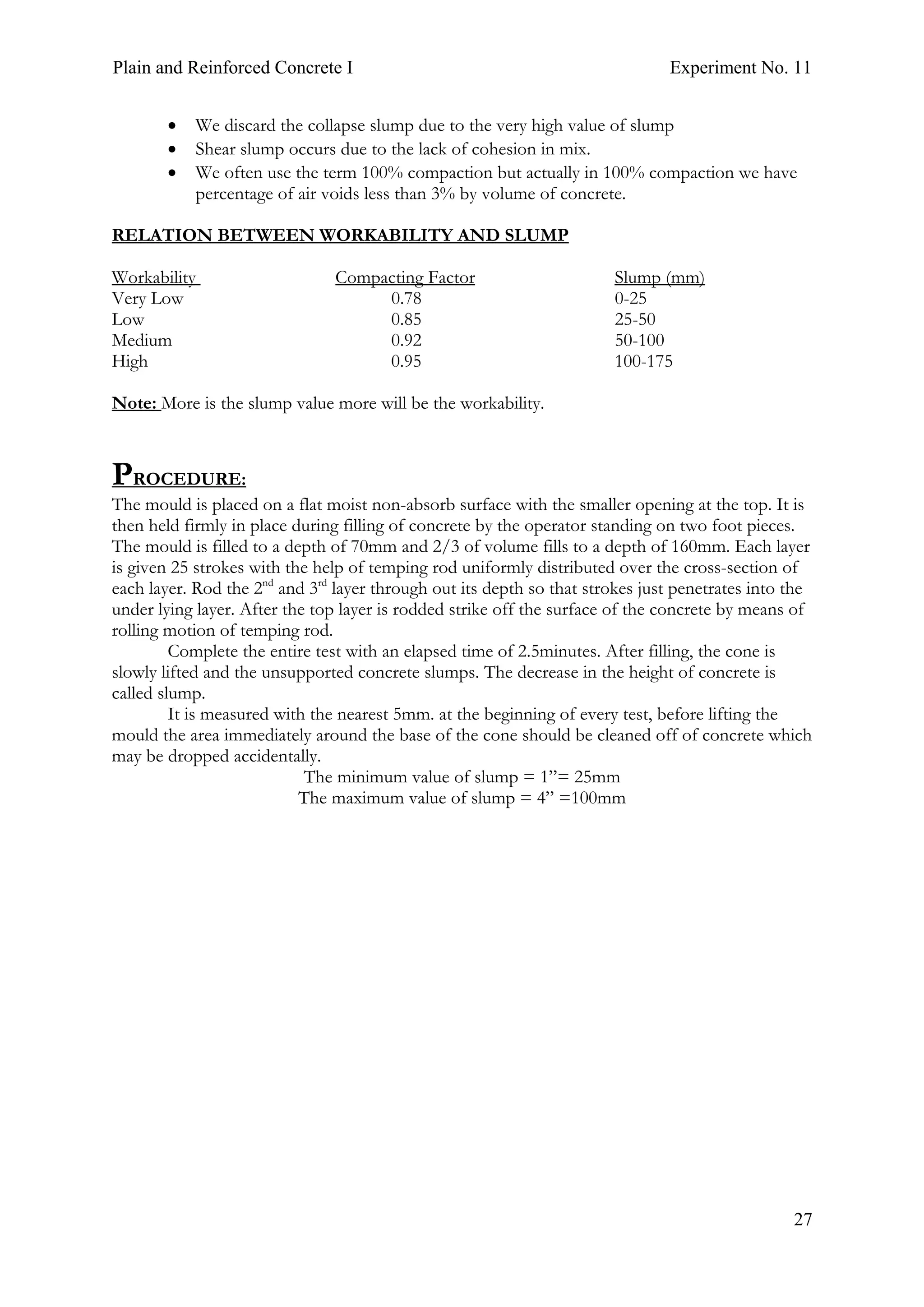
The decrease in the height of concrete when the mould of standard dimensions is lifted.
TYPES OF SLUMP
There are three types of slump.
1- True Slump
2- Shear Slump
3- Collapse slump
Slump
160mm
True Slump Shear Slump Collapse Slump
Plain and Reinforced Concrete I Experiment No. 11
27
• We discard the collapse slump due to the very high value of slump
• Shear slump occurs due to the lack of cohesion in mix.
• We often use the term 100% compaction but actually in 100% compaction we have
percentage of air voids less than 3% by volume of concrete.
RELATION BETWEEN WORKABILITY AND SLUMP
Workability Compacting Factor Slump (mm)
Very Low 0.78 0-25
Low 0.85 25-50
Medium 0.92 50-100
High 0.95 100-175
Note: More is the slump value more will be the workability.
PROCEDURE:
The mould is placed on a flat moist non-absorb surface with the smaller opening at the top. It is
then held firmly in place during filling of concrete by the operator standing on two foot pieces.
The mould is filled to a depth of 70mm and 2/3 of volume fills to a depth of 160mm. Each layer
is given 25 strokes with the help of temping rod uniformly distributed over the cross-section of
each layer. Rod the 2nd
and 3rd
layer through out its depth so that strokes just penetrates into the
under lying layer. After the top layer is rodded strike off the surface of the concrete by means of
rolling motion of temping rod.
Complete the entire test with an elapsed time of 2.5minutes. After filling, the cone is
slowly lifted and the unsupported concrete slumps. The decrease in the height of concrete is
called slump.
It is measured with the nearest 5mm. at the beginning of every test, before lifting the
mould the area immediately around the base of the cone should be cleaned off of concrete which
may be dropped accidentally.
The minimum value of slump = 1”= 25mm
The maximum value of slump = 4” =100mm
Plain and Reinforced Concrete I Experiment No. 12
28
12.EXPERIMENT NO. 12:
To Perform The Compacting Factor Test.
SCOPE & SIGNIFICANCE:
This test also gives the workability of concrete indirectly. This test is appropriate for
concrete with the maximum aggregate size of 40mm.
APPARATUS:
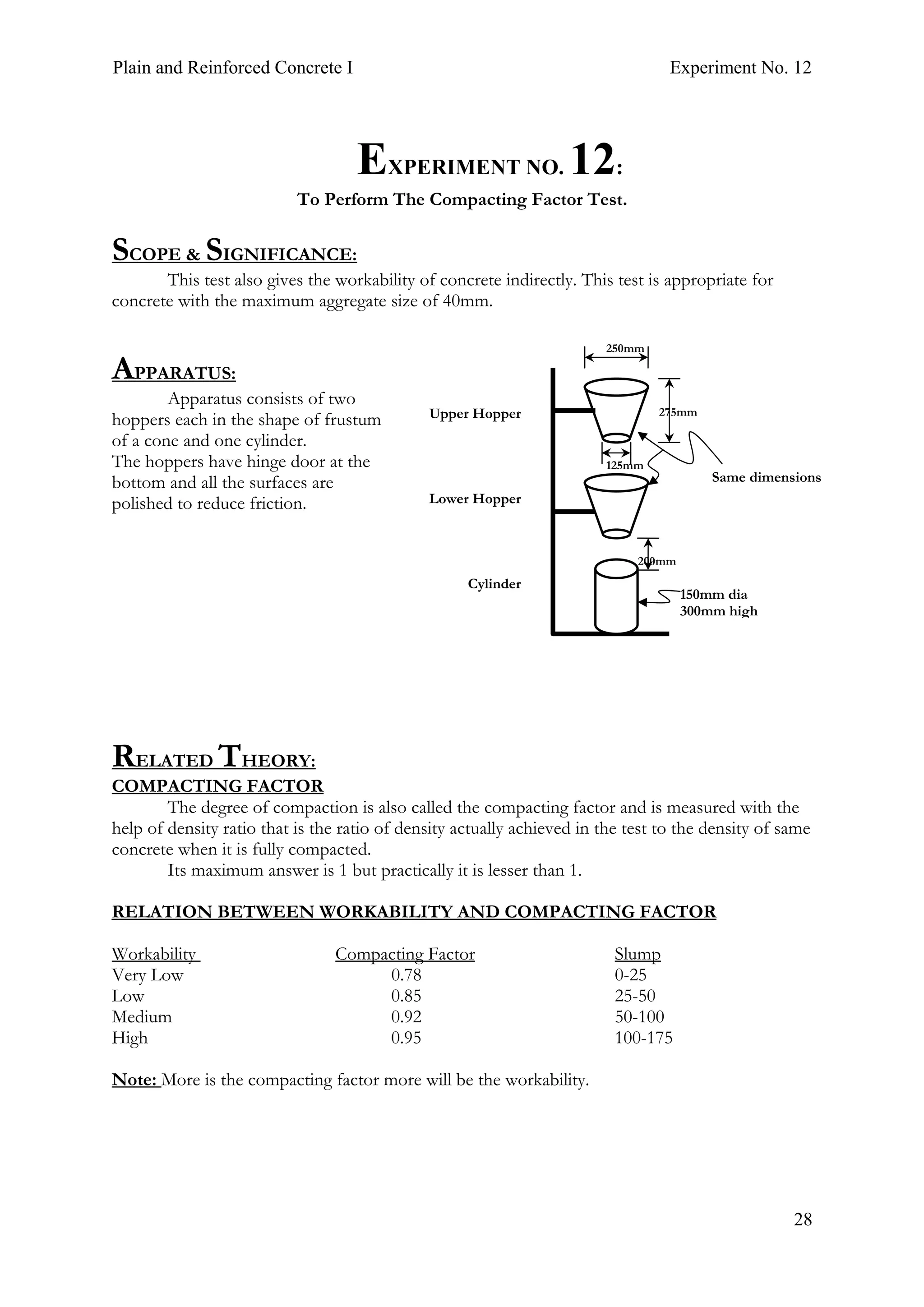
Apparatus consists of two
hoppers each in the shape of frustum
of a cone and one cylinder.
The hoppers have hinge door at the
bottom and all the surfaces are
polished to reduce friction.
RELATED THEORY:
COMPACTING FACTOR
The degree of compaction is also called the compacting factor and is measured with the
help of density ratio that is the ratio of density actually achieved in the test to the density of same
concrete when it is fully compacted.
Its maximum answer is 1 but practically it is lesser than 1.
RELATION BETWEEN WORKABILITY AND COMPACTING FACTOR
Workability Compacting Factor Slump
Very Low 0.78 0-25
Low 0.85 25-50
Medium 0.92 50-100
High 0.95 100-175
Note: More is the compacting factor more will be the workability.
250mm
125mm
275mm
200mm
150mm dia
300mm high
Same dimensions
Upper Hopper
Lower Hopper
Cylinder
Plain and Reinforced Concrete I Experiment No. 12
29
PROCEDURE:
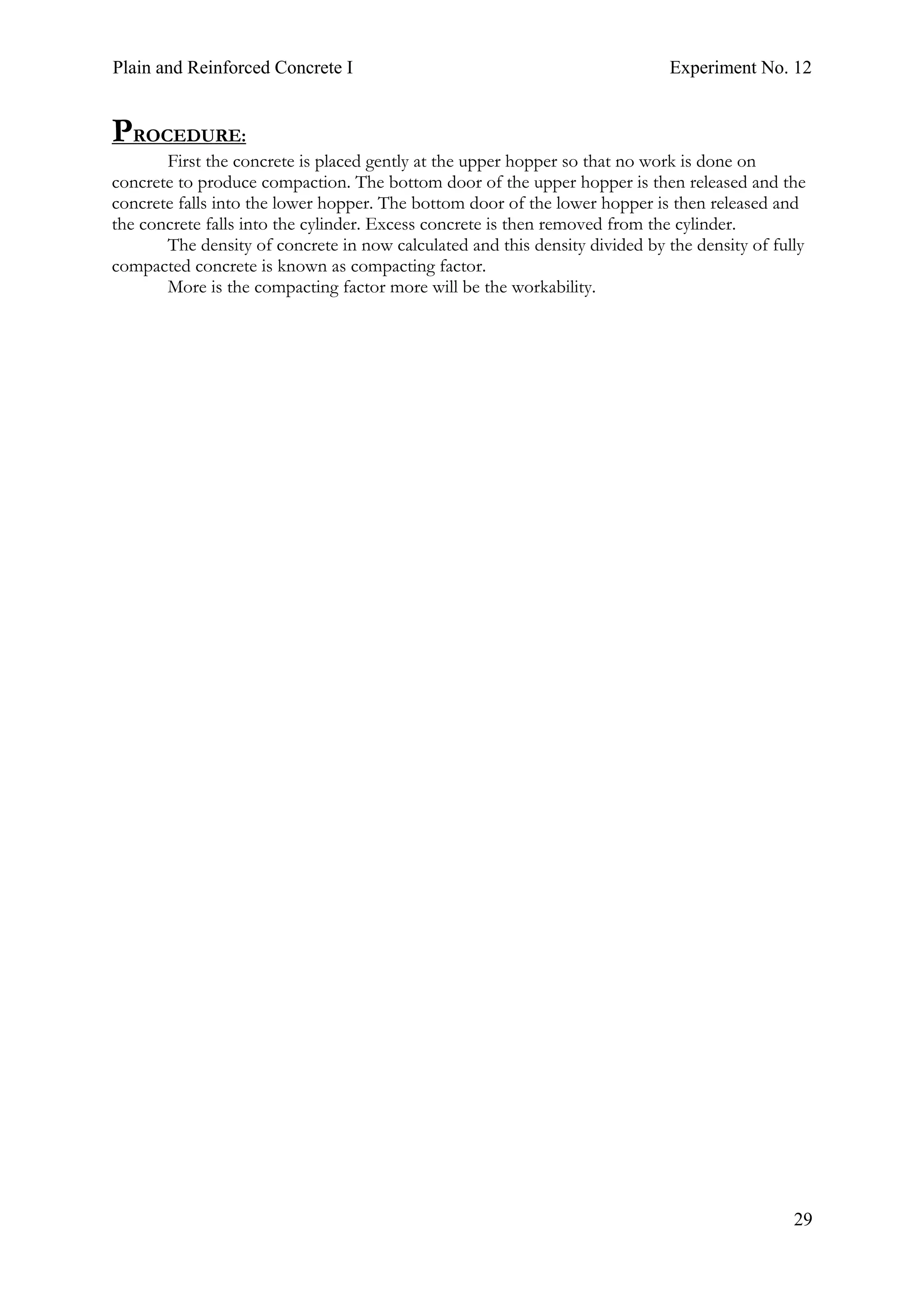
First the concrete is placed gently at the upper hopper so that no work is done on
concrete to produce compaction. The bottom door of the upper hopper is then released and the
concrete falls into the lower hopper. The bottom door of the lower hopper is then released and
the concrete falls into the cylinder. Excess concrete is then removed from the cylinder.
The density of concrete in now calculated and this density divided by the density of fully
compacted concrete is known as compacting factor.
More is the compacting factor more will be the workability.

PLAIN AND REINFORCED CONRETE (LAB MANUAL)

  • 2.
      Contents  1. EXPERIMENT NO.1:.......................................................................................................1 2. EXPERIMENT NO. 2:.......................................................................................................3 3. EXPERIMENT NO. 3:.......................................................................................................6 4. EXPERIMENT NO. 4:.....................................................................................................10 5. EXPERIMENT NO. 5:.....................................................................................................12 6. EXPERIMENT NO. 6:.....................................................................................................15 7. EXPERIMENT NO. 7:.....................................................................................................16 8. EXPERIMENT NO. 8:.....................................................................................................21 9. EXPERIMENT NO. 9:.....................................................................................................24 10. EXPERIMENT NO. 10:...................................................................................................25 11. EXPERIMENT NO. 11:...................................................................................................26 12. EXPERIMENT NO. 12:...................................................................................................28
  • 3.
    Plain and ReinforcedConcrete I Experiment No. 1 1 1. EXPERIMENT NO. 1: Standard Test Method For The Determination Of The Normal Consistency Of The Hydraulic Cement. Code: ASTM C 187-04 SCOPE & SIGNIFICANCE: It is used to find out the percentage of water at which the standard consistency is achieved. This known amount of water is then used in making the cement paste for the other tests like; i. Initial setting time ii. Final setting time iii. Soundness test APPARATUS: • Reference Masses and Devices for Determining Mass • VICAT Apparatus • Plunger with 10mm diameter and 50mm length • Glass graduates (200mL or 250mL capacity) • Spatula • Glass plate trowel RELATED THEORY: CONSISTENCY The thickness or the viscosity of the cement paste is called consistency. CEMENT PASTE The viscous mass obtained by mixing cement with water is known as cement paste. STANDARD PASTE It is the cement paste for which the 10mm diameter plunger in a standard VICAT test penetrates to such an extent that its distance from the bottom is 5-7mm. STANDARD/NORMAL CONSISTENCY It is the thickness or the viscosity of the standard paste and is expressed as the percentage of weight of water. VICAT APPARATUS The Vicat apparatus consists of a frame A (Fig.) bearing a movable rod B, weighing 300 g, one end C, the plunger end, being 10 mm in diameter for a distance of at least 50 mm, and the other end have a removable needle D, 1 mm in diameter and 50 mm in length. The rod B is reversible, and can be held in any desired position by a set screw E, and has an adjustable indicator F, which moves over a scale (graduated in millimeters) attached to the frame A. The paste is held in a rigid conical ring G, resting on a plane non-absorptive square base plate H, about 100 mm on each side.
  • 4.
    Plain and ReinforcedConcrete I Experiment No. 1 2 The rod B is made of stainless steel having a hardness of not less than 35 HRC, and shall be straight with the plunger end which is perpendicular to the rod axis. The ring is made of a non-corroding, nonabsorbent material, and have an inside diameter of 70 mm at the base and 60 mm at the top, and a height of 40 mm. In addition to the above, the Vicat apparatus shall conform to the following requirements: Weight of moveable rod = 300±5 gm Diameter of the plunger end of the rod = 10±0.05 mm Diameter of the needle = 1±0.05 mm Inside diameter of the ring at the bottom = 70±3 mm Inside diameter of the ring at the top = 60±3 mm Height of the ring = 40±3 mm TEST SPECIFICATIONS: TEMPERATURE & HUMIDITY The temperature of the air in the vicinity should be between 20-27.5 °C. The temperature of the mixing water should be 23±2 °C. The relative humidity of the laboratory should not be less than 50%. AMOUNT OF CEMENT Amount of cement required for the test according to various specifications are mentioned below. BS = 500gm ASTM = 650gm MIXING TIME The cement paste must be properly mixed and placed in the test specimen within a maximum time of 4±1/4 min from the instant when cement and water were initially brought in contact. PROCEDURE: Mix 650gm of cement with a measured quantity of water and make a cement paste as per the standard procedure. Put the cement paste in the ring of the vicat apparatus and remove the excess paste with the help of a trowel. Center the paste confined in the ring, resting on the plate, under the rod B and bring the plunger end C of in contact with the surface of the paste, and tighten the set-screw E. Then set the movable indicator F to the upper zero mark of the scale, or take an initial reading, and release the rod immediately. This must not exceed 30 s after completion of mixing. The apparatus shall be free of all vibrations during the test. The paste of normal consistency is achieved when the rod settles to a point such that it is 4-7mm above the bottom surface in 30 s after being released. Make trial pastes with varying percentages of water until the normal consistency is obtained. Make each trial with fresh cement.
  • 5.
    Plain and ReinforcedConcrete I Experiment No. 2 3 2. EXPERIMENT NO. 2: Standard Test Method For The Determination Of The Initial And Final Setting Time Of The Hydraulic Cement By Vicat Needle Apparatus. Code: ASTM C 191-04b SCOPE & SIGNIFICANCE: This test method is used to determine the time of setting of the hydraulic cement by Vicat needle apparatus. The knowledge of the setting time of the cement is always helpful in deciding the time duration to mix, transport, place and compact the concrete effectively. We always prefer a larger initial setting time so that we can mix, transport and place the concrete easily. According to ASTM specifications, the initial setting time shall not be less than 30min but in the field we prefer an initial setting time not less than 45min. A smaller value of the final setting time is always preferred in order to avoid large expenditures on the formwork. According to most of the specifications, the final setting time shall not be greater than 10hrs and shall not be less than ( 90 + 1.2 x (initial setting time) ) min. i.e. ( 90 + 1.2 x (initial setting time) ) min < final setting time < 10hrs APPARATUS: • Vicat apparatus • Needle of 1mm2 cross-section and 50mm length (for initial setting time) • Plunger with 1mm smaller needle and 5mm outer diameter (for final setting time) • Flat trowel • Reference Masses and Devices for Determining Mass • Spatula • Graduated cylinders RELATED THEORY: SETTING In the setting process very little chemical reaction takes place. It only includes the shape acquisition due to evaporation of water. During the setting process the cement remains in the fluid or the semi-fluid state and there is very little or no gain in strength. Finer the cement particles more will be the hydration and therefore it will lead to quick settlement. HARDENING Hardening is the rate of gain of strength due to the chemical reaction. It also refers to the strength of the concrete after a specified interval of time. INITIAL SETTING TIME
  • 6.
    Plain and ReinforcedConcrete I Experiment No. 2 4 The time elapsed between the initial contact of cement and water and the time when a 1mm2 cross-section needle gives a reading between 4-7mm from the bottom in a standard Vicat apparatus is known as initial setting time of that particular cement paste. FINAL SETTING TIME It is the time elapsed between the initial contact of cement and water and the time when the smaller needle (1mm2 cross-section and 1mm deep) completely penetrates into the paste and the outer metal attachment of 5mm diameter does not leave an impression on the cement paste. According to specifications; Maximum final setting time = 10hrs Minimum final setting time = [90 + 1.2 (initial setting time)] min TEST SPECIFICATIONS: NEEDLE SIZES 1- For Initial Setting Time 1mm x 1mm cross-section 50mm length 2- For Final Setting Time 1mm2 cross-section and 1mm deep inner needle 5mm diameter outer metal attachment MIXING WATER Portable water is satisfactory for the routine tests. TEMPERATURE & HUMIDITY The temperature of the air in the vicinity should be between 23±3 °C. The temperature of the mixing water should be 23±2 °C. The relative humidity of the laboratory should not be less than 50%. AMOUNT OF CEMENT Amount of cement required for the test according to various specifications are mentioned below. BS = 500gm ASTM = 650gm
  • 7.
    Plain and ReinforcedConcrete I Experiment No. 2 5 PROCEDURE: Prepare a cement paste of standard consistency and put it in the ring of the Vicat apparatus within the allowable time of 4±1/4 min. Clear and level any extra paste by means of a trowel. 1- Initial Setting Time Determine the penetration of the 1-mm needle at the start. If a penetration reading of 4-7mm is obtained then note down the time as the initial setting time otherwise keep checking the penetration reading after every 10min thereafter until a penetration reading of 4-7 mm is obtained which will be the initial setting time of the cement. Make each penetration test at least 5 mm away from any previous penetration and at least 10 mm away from the inner side of the mold. 2- Final Setting Time Now fix the final setting time plunger in which the smaller needle has the diameter of 1mm and the diameter of the outer needle is 5mm. Drop the rod of the Vicat apparatus and note down the time when the smaller 1mm diameter needle completely penetrates into the paste and the outer needle leaves no impression on the cement surface.
  • 8.
    Plain and ReinforcedConcrete I Experiment No. 3 6 ModulusFineness 1 AreaSurface ∝ 3. EXPERIMENT NO. 3: Determination Of The Fineness Modulus Of The Coarse And Fine Aggregate From Different Sources. Code: ASTM C-316-05, for coarse materials (i.e. > 15μm) ASTM C-117-05, for fine materials (i.e. < 15μm) SCOPE & SIGNIFICANCE: This test method is used to determine the fineness modulus of the given fine grained specimen. The information obtained from fineness modulus is helpful in the following ways; 1- Fineness modulus tells us directly whether the material is well-graded or gap- graded. 2- Fineness modulus gives us an overall idea whether the material is fine or coarse. 3- It also indicates the surface area of the particles. Lower the surface area of the aggregate, the required amount of fresh cement paste to cover the aggregate particles will be less and thus less water is required. 4- Larger value of FM is preferred for fine aggregates. For a good fine aggregate, the FM should be between 2.3 and 3.1 (ASTM Range for fine aggregates). APPARATUS: • Standard set of sieves • Sieve shaker • Sample of the aggregate RELATED THEORY: FINENESS MODULUS It is the cumulative percentage retained on standard sieve 150μm and above divided by 100. It is a single factor or an empirical number which we get from the results of sieve analysis. The value of FM will not change if we add sieves above. SIEVE ANALYSIS It is the operation of dividing the aggregate into various fractions, each consisting of particles of same size. OR It is the operation of determining the particle size distribution of the given specimen.
  • 9.
    Plain and ReinforcedConcrete I Experiment No. 3 7 The standard approach is to designate the sieve sizes by nominal aperture sizes in mm or μm (micron). 1 mm = 1000 μm (micron) Notes: i- 5 mm is the dividing line between coarse and fine aggregate. ii- Well graded coarse aggregates of large size will reduce shrinkage of concrete by 50%. FUNCTIONS OF SIEVE ANALYSIS Sieve analysis is performed on coarse and fine aggregates in order to check their gradation. This gradation gives an indirect measure if the workability and average particle size. SET OF SIEVES The set of sieves used for the process of sieve analysis can be categorized as; a- Coarse Aggregates Standard Non-Standard 75mm (3 ”) 63mm 50mm 37.5mm (1½ ”) 25mm 19mm (3/4 ”) 9.5mm (3/8 ”) 4.75mm (3/16 ”) 2.36mm (3/32 ”) Pan Note: For sieves with openings 4.75mm & larger, the quantity retained in kg shall not exceed the product of 2.5 x sieve opening (mm) x effective sieving area (mm2 ) b- Fine Aggregates ASTM Sieves (mm) British Standard Sieves (inches) 4.75mm 3/16 (#4) 2.36mm 3/32 (#8) 1.18mm 3/64 (#16) 600μm 3/128 (#30) 300μm 1/88 (#50) 150μm 1/176 (#100) Pan Pan Note: For the sieves with openings smaller than 4.75mm, the quantity retained on any sieve at the completion of sieving shall not exceed 7 kg/m2 of sieving area.
  • 10.
    Plain and ReinforcedConcrete I Experiment No. 3 8 QUALITY OF A GOOD SAMPLE There are some limiting values for every sieve provided by ASTM or BS, we use these limiting values to get our final answer by the method explained below. Take the minimum and the maximum values provided by ASTM and plot them on the grading curve. Now take these minimum and maximum value lines as your reference and if the curve of our own data lies inside these two lines then the quality of our sample is OK but if your curve lies outside these two lines of maximum and minimum range then the sample is not according to specifications. ASTM GRADING REQUIREMENTS FOR FINE AGGREGATES Sieve Size Cumulative % Passing Minimum Maximum 9.5mm 100 100 4.75mm 95 100 2.36mm 80 100 1.18mm 50 85 600μm 25 60 300μm 10 30 150μm 2 10 Maximum limit according to specification Minimum limit according to specification Plot of tested specimen Sieve Size (Log Scale) Cumulative%Passing
  • 11.
    Plain and ReinforcedConcrete I Experiment No. 3 9 PROCEDURE: Take 2 kg of the oven-dried sample. The sample should be perfectly dry because if there is some moisture content present then the particles will stick together and will not pass through the sieves. Temperature of the oven = 110±5 °C Place the set of standard and non-standard sieves one above another with the smallest aperture opening at the bottom. The pan is placed at the bottom-most position. This experiment can be performed manually or with the aid of a machine called “sieve shaker”. The manual method should be performed in a proper sequence which is as follows; i- forward and backward motion ii- left and right motion iii- clockwise (CW) and counter-clockwise (CCW) motion iv- Frequent jolting. Time elapsed for the sieving process is 3-5 minutes. Weigh the mass retained on each sieve and calculate the percentage passing through each sieve. Then the FM can be calculated by using the relation; 100 )aboveorm150ofSievesdardtanSontainedRe%Cumulative( FM ∑= μ Following points must be kept in mind while calculating the FM; i- Only sum up the values of standard sieves and do not include the values of the non-standard sieves. ii- Only add the sieves of 150μm and above sizes. iii- If any standard sieve is missing, we may use the value of next higher sieve. iv- Adding extra sieves does not change the result of FM. Mechanical Sieve Shaker
  • 12.
    Plain and ReinforcedConcrete I Experiment No. 4 10 4. EXPERIMENT NO. 4: Standard Test Method For The Determination Of Bulk Density (I.E. Unit Weight And The Voids In Aggregates). Code: ASTM C-29/C-29M SCOPE & SIGNIFICANCE: This test method is used to determine the bulk density of the given fine grained specimen. During the concrete mix design, when the aggregate is to be batched by volume or by weight, then it becomes necessary to know the mass of the aggregates that will fill the container of unit volume. If we know the bulk density of the aggregate material then we can easily determine the mass required to fill a unit volume container. Bulk density also indicates the percentage of voids present in the aggregate material. This percentage of voids affects the grading of the aggregates which is important in high strength concrete. Bulk density also indicates the compactive effort required to compact the concrete. RELATED THEORY: BULK DENSITY It is the mass of the unit volume of bulk aggregate material. The term volume includes the volume of the individual particles and the volume of the voids between the particles. Bulk density is used in weight and volume batching. VOIDS It is the space between the individual particles in a unit volume of the aggregate mass and is not occupied by the solid mineral matter. Voids within the particles, either permeable or impermeable are not included in the voids for the determination of bulk density by this method. ABSOLUTE DENSITY It is the mass per unit volume of the individual particles only. FACTS ABOUT BULK DENSITY Bulk density depends upon how densely the aggregate is packed. It also depends upon the size, distribution and shape of the particles. If the particles are of the same size, then it can be packed to a limited extent but when the smaller particles are added, the voids get filled with them and thus the bulk density increases. For a coarse aggregate, a higher bulk density means that there are few voids which are to be filled by the fine aggregate and cement. Thus bulk density also depends upon the degree of packing.
  • 13.
    Plain and ReinforcedConcrete I Experiment No. 4 11 APPARATUS: • Balance • Temping rod • Measuring Cylinder • Shovel or Scoop PROCEDURE: Note down the dimensions and empty weight of the measuring container and compute its volume. For the determination of the loose bulk density, fill the container with the aggregate material by means of a shovel and level its top surface. Weigh the container filled with the aggregate and note down its reading. Then the loose bulk density of the aggregate material can be computed by using the relation; Now for the determination of the compacted bulk density, the only difference is in filling the container. In this case, the container is filled in three equal layers. Fill the container about one-third full and level the surface with the fingers. Rod the layer of the aggregate with 25 strokes of the temping rod evenly distributed over the surface. Next fill the container two-third full and again rod it with 25 strokes of the temping rod. Finally, fill the container to overflowing and rod again in the manner previously mentioned. Now level the top surface and weigh the container. Calculate the compacted bulk density by using the relation; 600mm d=16mm Temping End Temping Rod 278mm d=225mm V= 0.0142 Measuring Cylinder containertheofVolume containeremptyofWeightaggregateLoosecontainerofWeight MDensityBulkLoose loose )()( )( −+ = containertheofVolume containeremptyofWeightaggregateCompactedcontainerofWeight MDensityBulkCompacted comp )()( )( −+ =
  • 14.
    Plain and ReinforcedConcrete I Experiment No. 5 12 5. EXPERIMENT NO. 5: Standard Test Method For The Determination Of Relative Density (I.E. Specific Gravity) And Water Absorption Of The Coarse Aggregates. Code: ASTM C-127-04 SCOPE & SIGNIFICANCE: In this test method we determine the relative density (i.e. specific gravity) and the water absorption of the coarse aggregates. The information obtained from specific gravity is helpful in the following ways; 1- The knowledge of the specific gravity is important for the concrete technologist to determine the properties of concrete made from such aggregates. 2- It is used for the calculation of the volume occupied by the aggregates in various mixtures. 3- The pores at the surface of the particles affect the bond between the aggregate and the cement paste and thus influence the concrete strength. 4- Normally it is assumed that at the time of setting of concrete, the aggregate is in the saturated and surface dry condition. If the aggregate is to be batched in the dry condition, then it is assumed that sufficient amount of water will be absorbed from the mix to bring the aggregate in the saturated condition. If an additional amount of water is not added as a cover for the absorbed water, the loss of workability is resulted. Limitation The limitation of the test is that, it can not be used for the light weight aggregates. RELATED THEORY: AGGREGATES Aggregates may be classified as; i- Coarse Aggregates ii- Fine Aggregates COARSE AGGREGATES Any material which is retained on BS sieve #4 (ASTM sieve 4.75mm) is known as coarse aggregate. FINE AGGREGATES Any material which is passing BS sieve #4 (ASTM sieve 4.75mm) is known as fine aggregate. TYPES OF CRUSH AVAILABLE IN PAKISTAN 1- SARGODHA CRUSH
  • 15.
    Plain and ReinforcedConcrete I Experiment No. 5 13 Sargodha crush possess the following properties; • Greener in color • High strength • Usually elongated particles 2- MARGHALLA CRUSH Marghalla crush possess the following properties; • Grayish in color • Low in strength 3- SAKHI SARWAR CRUSH Sakhi Sarwar crush possess the following properties; • Whitish in color ABSORPTION It is the increase in the mass of the aggregate due to the penetration of water into the pores of the particles during a prescribed period of time. The term absorption does not include the amount of water adhering to the surface of the particles. Water absorption is expressed as percentage of the dry mass. SATURATED SURFACE DRY (S.S.D.) CONDITION It is the condition related with the aggregate particles in which the permeable pores of the aggregate particles are filled with water but without free water on the surface of the particles. OVEN DRY DENSITY It is the mass of the oven dried aggregate per unit volume of the aggregate particles. The term volume includes the volume of the permeable and the impermeable pores and does not include the volume of the voids between the particles. SATURATED SURFACE DRY (S.S.D) DENSITY It is the mass of the saturated surface dry aggregate per unit volume of the aggregate particles. The term volume includes the volume of the permeable and the impermeable pores which are filled with water and does not include the volume of the voids between the particles. APPARENT DENSITY It is the mass per unit volume of the impermeable portion of the aggregate particles. OR It is the mass per unit volume of the solid portion of the particles excluding the voids. SPECIFIC GRAVITY/RELATIVE DENSITY It is the ratio of the density of the aggregate material to the density of the gas free distilled water at a standard temperature (i.e. 4 o C). The relative density is a dimensionless quantity and is expressed as oven dried, saturated surface dry and apparent OVEN DRIED SPECIFIC GRAVITY
  • 16.
    Plain and ReinforcedConcrete I Experiment No. 5 14 It is the ratio of the oven dried density of the aggregate to the density of the gas free distilled water at a standard temperature (i.e. 4 o C). SATURATED SURFACE DRY SPECIFIC GRAVITY It is the ratio of the saturated surface dry density of the aggregate to the density of the gas free distilled water at a standard temperature (i.e. 4 o C). APPARENT SPECIFIC GRAVITY It is the ratio of the apparent density of the aggregate to the density of the gas free distilled water at a standard temperature (i.e. 4 o C). APPARATUS: • Balance • Sample container • Water tank • Sieves • Oven PROCEDURE: The sample of the aggregate is immersed in water for 24hrs to essentially fill all the pores. Remove the test sample from the water and roll it in a large absorbent cloth until all visible films of water are removed. Wipe the larger particles individually. A moving stream of air is permitted to assist in the drying operation. Take care to avoid evaporation of water from aggregate pores during the surface-drying operation. Determine the mass of the test sample in the saturated surface-dry condition. Record this and all subsequent masses to the nearest 0.5 g or 0.05 % of the sample mass, whichever is greater. In order to calculate the volume of the aggregate, immediately place the saturated- surface-dry test sample in the sample container and determine its apparent mass in water at 23±2.0 °C. Take care to remove all entrapped air before determining its mass by shaking the container while immersed. The difference between the mass in air and the mass when the sample is immersed in water equals the mass of water displaced by the sample. This mass of water equals the volume of water displaced because ρwater = mwater x Vwater mwater = Vwater (ρwater=1 gm/cm3 ) Vwater = Vaggregate Dry the test sample in the oven to constant mass at a temperature of 110±5 °C, cool in air at room temperature 1 to 3 h, or until the aggregate has cooled to a temperature that is comfortable to handle (approximately 50 °C), and determine the mass in order to calculate the oven specific gravity of the specimen.
  • 17.
    Plain and ReinforcedConcrete I Experiment No. 6 15 6. EXPERIMENT NO. 6: Determination Of The Aggregate Impact Value Of Different Coarse Aggregate Samples. SCOPE & SIGNIFICANCE: The aggregate impact value gives a relative measure of the toughness or the resistance of aggregate sudden shock or impact is not proportional to the resistance to a slowly applied compressive load. APPARATUS: • Coarse aggregate from various sources • Impact testing machine • Spanner • Balance TEST SPECIFICATIONS: The test sample shall consist of aggregates the whole of which passes through ½ in B.S. test sieve and is retained on a 3/8 in B.S. test sieve. The aggregate comprising the test sample shall be dried in an oven for a period of four hours at a temperature of 100-110 °C and cooled. The measure (cup) shall be filled about one-third full with the aggregate and gives 25 tamping rod. A further similar quantity of aggregate shall be added and a further 25 tamping given to the second and tot the last layer 25 tamping shall again be given and the surplus aggregate struck off using the tamping rod as a straight-edge. The net weight of aggregate in the measure shall be determined to the nearest gram (weight A) and this weight shall be used for the duplicate test on the same material. PROCEDURE: The impact machine shall test without wedging or packing upon the level plate, block or floor, so that it is rigid and hammer guide columns are vertical. The cup shall be fixed firmly in position on the base of the machine and the whole of the test sample placed in it and compacted by a single tamping of 25 strokes of the tamping rod. The hammer shall be raised until its lower face is 15 in. above from the upper surface of the aggregate in the cup, and allowed to fall freely on the aggregate. The test sample shall be subjected to a total 15 such blows each being delivered at an interval of not less than one second. The crushed aggregate shall then be removed from the cup and the whole of it sieved on No. 7 B.S. sieve until no further significant amount passes in one minute. The fraction passing the sieve shall be weighted to an accuracy of 0.1 gram (weight B). Te fraction retained on the sieve shall also be weighed (weight C), and if the total weight B + C is less than the initial weight (weight A) by more than 1 gm the result shall be discarded and a fresh test made. Two tests shall be made. CALCULATIONS The ratio of the weight of fines formed to the total sample weight in each test shall be expressed as a percentage, the result being recorded to the first decimal place. Aggregate Impact Value = .100× A B where, A = weight of oven dried sample B = weight of fraction passing B.S. sieve No. 7
  • 18.
    Plain and ReinforcedConcrete I Experiment No. 7 16 7. EXPERIMENT NO. 7: Standard Test Method For The Flexural Strength Of Concrete Using Simple Beam With Third-Point Loading. Code: ASTM C 78-02 SCOPE & SIGNIFICANCE: • This test method is used to determine the flexural strength of specimens prepared and cured in accordance with the specifications. Results are calculated and reported as the modulus of rupture. • The strength determined will vary where there are differences in specimen size, preparation, moisture condition, curing, or where the beam has been molded or swayed to size. • The results of this test method may be used to determine compliance with specifications or as a basis for proportioning, mixing and placement operations. It is used in testing concrete for the construction of slabs and pavements. • The modulus of rupture is also used as an indirect measure of the tensile strength of concrete. APPARATUS: The testing apparatus is shown in the figure above.
  • 19.
    Plain and ReinforcedConcrete I Experiment No. 7 17 RELATED THEORY: DIFFICULTIES IN DETERMINING TENSILE STRENGTH OF CONCRETE: There are considerable experimental difficulties in determining the true tensile strength of concrete. In direct tension test following are the difficulties: 1. When concrete is gripped by the machine it may be crushed due the large stress concentration at the grip. 2. Concrete samples of different sizes and diameters show large variation in results. 3. If there are some voids in sample the test may show very small strength. 4. If there is some initial misalignment in fixing the sample the results are not accurate. TESTS FOR TENSILE STRENGTH OF CONCRETE: Following tests are used to determine the tensile strength of concrete. • Split Cylinder Test • Double Punch Test • Modulus of Rupture Test MODULUS OF RUPTURE: In a flexural test on a plane concrete specimen, the maximum tensile stress reached at the bottom fiber of a standard size prism (beam) under predefined loading type is called modulus of rupture. TYPE/SIZE OF THE SPECIMEN FOR THE TEST: The specimen used is a prism, square in cross-section and having a certain length. There are two standard sizes of the specimen that can be used for specified aggregate sizes. 1- 150 x 150 x 750 (mm) 2- 100 x 100 x 510 (mm) The size (150 x 150 x750 mm) can be used for all sizes of the aggregate particles. The size (100 x 100 x 510 mm) can only be used for the aggregate sizes less than 25mm.We are using this size for our test. Notes: • ASTM follows the Foot Pound System. • BS follows/uses the SI System. AVERAGE VALUE OF MOR (fr): There are some relationships which relate fr with compressive strength of concrete fr = 0.69 √ fc’ fc’ and fr are in MPa ACI code gives formulae for fr fr = 0.5 √ fc’ (ACI code for Strength Calculation) fr = 0.625 √ fc’ (ACI code for Deflection Control) Generally, As a rough estimate, we take 8 – 15% of compressive strength as the MOR. StrengtheCompressivStrengthTensile ∝
  • 20.
    Plain and ReinforcedConcrete I Experiment No. 7 18 MODULUS OF RUPTURE OF A PRISMOIDAL BEAM: The MOR for the test specimen can be computed by using the relation derived below; TEST SPECIFICATIONS: RATE OF LOADING: The rate of loading should be such that we get a stress of 0.02― 0.10 (MPa/s). ACCEPTANCE CRITERIA OF THE SPECIMEN: If proper compaction is not done, then the specimen may fail outside the central portion i.e. near the ends. In such a case, if; i- (a – a’) > 0.05 l → Ignore the specimen and discard the results. ii- (a – a’) =< 0.05 l → Use the same formula but instead of a, use a’ for the calculation of MOR. where, a’= distance from the support center to the crack a = one-third distance between the supports l = distance between the supports The final result should be reported in multiples of 0.1 MPa. )MPa( bd Pa3 fr bd 6 a 2 P s M y I M fr 6 bd 2 d 12 bd y I sand 12 bd I ,where I My fr 2 dY 2 2 2 3 3 =⇒ ××===∴ ==== = = Two point loading l a’ a aa
  • 21.
    Plain and ReinforcedConcrete I Experiment No. 7 19 SIZE OF THE SPECIMEN: The specimen used is a prism of 100 x 100 (mm) square in cross-section and having a length of 510mm. Thus the dimensions of the specimen are; 100 x 100 x 510 (mm) TYPE OF LOADING: The loading pattern on the beam is called the third-point/two-point loading. The main advantage of third-point loading is that, the behavior of the beam can be studied under pure bending as there is no shear at the central portion of the beam. The phenomenon is depicted by the figure below. ` PROCEDURE: Flexural tests of moist-cured specimens shall be made as soon as practical after removal from moist storage. Surface drying of the specimen results in a reduction in the measured flexural strength. When using molded specimens, turn the test specimen on its side with respect to its position as molded and center it on the support blocks. When using sawed specimens, position the specimen so that the tension face corresponds to the top or bottom of the specimen as cut from the parent material. Center the loading system in relation to the applied force. Bring the 510mm 136.67mm 410mm 50mm50mm P P/2P/2 P/2P/2 136.67mm 136.67mm Mmax 0 0 0 0 B.M.D S.F.D No shear in the central portion. Therefore, pure bending behavior. ++ +
  • 22.
    Plain and ReinforcedConcrete I Experiment No. 7 20 load-applying blocks in contact with the surface of the specimen at the third points and apply a load of between 3 and 6 % of the estimated ultimate load. Grind, cap, or use leather shims on the specimen contact surface to eliminate any gap in excess of 0.004 in. (0.10 mm) in width. Gaps in excess of 0.015 in. (0.38 mm) shall be eliminated only by capping or grinding. Grinding of lateral surfaces should be minimized in as much as grinding may change the physical characteristics of the specimens. Capping shall be in accordance with the applicable sections of Practice C 617. Load the specimen continuously and without shock. The load shall be applied at a constant rate to the breaking point. Apply the load at a rate that constantly increases the extreme fiber stress between 125 and 175 psi/min (0.86 and 1.21 MPa/min) until rupture occurs. The loading rate is calculated using the following equation: R = Sbd2 /L where: r = loading rate, lb/min (MN/min) S = rate of increase in extreme fiber stress, psi/min (MPa/min) b = average width of the specimen, in. (mm), d = average depth of the specimen, in. (mm), and L = span length, in (mm). CALCULATIONS: Case — 1: If the fracture initiates in the tension surface within the middle third of the span length, calculate the modulus of rupture as follows: R = PL/bd2 where: R = modulus of rupture, psi, or MPa, P = maximum applied load indicated by the testing machine, lbf, or N, L = span length, in., or mm, b = average width of specimen, in., or mm, at the fracture, and d = average depth of specimen, in., or mm, at the fracture. Note: The weight of the beam is not included in the above calculation. Case — 2: If the fracture occurs in the tension surface outside of the middle third of the span length by not more than 5 % of the span length, calculate the modulus of rupture as follows: R = 3Pa/bd 2 where: a = average distance between line of fracture and the nearest support measured on the tension surface of the beam, (in or mm). Note: The weight of the beam is not included in the above calculation. Case — 3: If the fracture occurs in the tension surface outside of the middle third of the span length by more than 5 % of the span length, discard the results of the test.
  • 23.
    Plain and ReinforcedConcrete I Experiment No. 8 21 8. EXPERIMENT NO. 8: Standard Test Method For The Determination Of The Splitting Tensile Strength Of Cylindrical Concrete Specimen. Code: ASTM C 496/C 496 M-04 SCOPE & SIGNIFICANCE: This test method is used for the determination of splitting tensile strength of cylindrical concrete specimen. Splitting tensile strength is helpful for the following purposes; 1- Splitting tensile strength is generally greater than the direct tensile strength and lower than the flexural strength (modulus of rupture). 2- Splitting tensile strength is used in the design of structural light weight concrete members to evaluate the shear resistance provided by concrete and to determine the development length of the reinforcement. where, T = Splitting tensile strength (to be reported in 0.05 MPa multiples) P = Applied load l = length of the specimen (mm) d = Diameter of the specimen (mm) APPARATUS: • Testing Machine • Supplementary Bearing Bar Or Plates (If the diameter or the largest dimension of the upper bearing face or the lower bearing block is less than the length of the cylinder to be tested, a supplementary bearing bar or plate of machined steel shall be used. The bar or plate shall be manner that the load will be applied over the specimen.) • Bearing Strips (Two bearing strips of nominal 1 /8 in [3.2 mm] thick plywood, free of imperfections, approximately 1 in. [25 mm] wide, and of a length equal to, or slightly longer than, that of the specimen shall be provided for each specimen. The bearing strips shall be placed between the specimen and both the upper and lower bearing blocks of the testing machine or between the specimen and supplemental bars or plates, when used (see 5.2). Bearing strips shall not be reused.) ld P2 T π =
  • 24.
    Plain and ReinforcedConcrete I Experiment No. 8 22 TEST SPECIFICATIONS: SIZE OF THE SPECIMEN The specimen is a cylinder of 150mm diameter and 300mm height. Determine the diameter to the nearest 0.25mm by averaging the three diameters. Determine the length to the nearest 2mm by averaging at least two lengths. SIZE OF BEARING STRIPS According to ASTM specifications, the bearing strips should be 3.2mm thick and 25mm wide. There is no restriction on their length. RATE OF LOADING The rate of loading should be such that a stress of 0.7 – 1.4 MPa/min is produced. PROCEDURE: This test method consists of applying a diametrical force along the length of a cylindrical concrete at a rate that is within a prescribed range until failure. This loading induces tensile stresses on the plane containing the applied load and relatively high compressive stresses in the area immediately around the applied load. Although we are applying a compressive load but due to Poisson’s effect, tension is produced and the specimen fails in tension. Tensile failure occurs rather than compressive failure because the areas of load application are in a state of triaxial compression, thereby allowing them to withstand much higher compressive stresses than would be indicated by a uniaxial compressive strength test result. Thin, plywood bearing strips are used to distribute the load applied along the length of the cylinder. The maximum load sustained by the specimen is divided by appropriate geometrical factors to obtain the splitting tensile strength. 300mm d=150mm Standard Specimen
  • 25.
    Plain and ReinforcedConcrete I Experiment No. 8 23 CALCULATIONS Calculate the splitting tensile strength of the specimen as follows: ld P2 =T π where: T = splitting tensile strength, (psi or MPa), P = maximum applied load indicated by the testing machine, (lbf or N), l = length, (in. or mm), and d = diameter, (in. or mm).
  • 26.
    Plain and ReinforcedConcrete I Experiment No. 9 24 9. EXPERIMENT NO. 9: Determination Of The Tensile Strength Of Concrete By Double Punch Test. (Non-Standard Test) APPARATUS: • Testing Machine • Testing Samples • Punches (2 in number, to be placed at the top and bottom of the sample) TEST SPECIFICATIONS: SIZE OF THE SPECIMEN The specimen is a cylinder of 150mm diameter and 150mm height. PROCEDURE: It is an indirect method in which we determine the tensile strength of concrete based on the theory of perfect plasticity. In this test a concrete cylinder is placed vertically between the loading platens of the machine and is compressed by two steel punches placed parallel to the top and bottom end surfaces. The sample splits across many vertical diametrical planes radiating from central axis. Samples should be placed under wet conditions for 24 hours and later on in a curing tank for 28 days. CALCULATION The tensile strength can be computed as; ft = Q / [Π (1.2bH - a2 )] where, Q = Crushing Load H Q Q 2b 2a 150mm d=150mm Specimen
  • 27.
    Plain and ReinforcedConcrete I Experiment No. 10 25 10.EXPERIMENT NO. 10: Preparing A Concrete-Mix And Casting Various Samples Required For Different Tests. APPARATUS: • Cement • Sand • Crush • Water • Hoppers • Vibrating table • Mixing pan/drum
  • 28.
    Plain and ReinforcedConcrete I Experiment No. 11 26 11.EXPERIMENT NO. 11: Standard Test Method For The Slump Of Hydraulic Cement Concrete. Code: ASTM C-143/C-143 M-03 SCOPE & SIGNIFICANCE: This test method is used in lab and in field for finding out the slump (decrease in the height of concrete when we lift up the mould). This test is used extensively in site works all over the world. The slump test does not measure the workability of concrete directly but it co-relates the workability with some physical measurement. The main significance of this test is as follows; 1- This test method is used to determine the slump of plastic hydraulic cement concrete. Slump<15mm (Non-Plastic) Slump>15 (Plastic) 2- This test method is applicable to plastic concrete having coarse aggregate upto 37.5mm in size. If the coarse aggregate is larger than the 37.5mm then this test method is not applicable. 3- This test method is not applicable to non-plastic and non-cohesive concrete (due to larger amount of water presence). APPARATUS: 1- Metal mould, thickness is 1.15mm, it is in cone form with the base 200mm diameter and 300mm height with the top diameter 100mm. the top and base of cylindrical mould is open and parallel to each other. The mould is provided with foot pieces and handles. 2- Temping rod, 16mm diameter and 600mm in length having temping ends. RELATED THEORY: SLUMP The decrease in the height of concrete when the mould of standard dimensions is lifted. TYPES OF SLUMP There are three types of slump. 1- True Slump 2- Shear Slump 3- Collapse slump Slump 160mm True Slump Shear Slump Collapse Slump
  • 29.
    Plain and ReinforcedConcrete I Experiment No. 11 27 • We discard the collapse slump due to the very high value of slump • Shear slump occurs due to the lack of cohesion in mix. • We often use the term 100% compaction but actually in 100% compaction we have percentage of air voids less than 3% by volume of concrete. RELATION BETWEEN WORKABILITY AND SLUMP Workability Compacting Factor Slump (mm) Very Low 0.78 0-25 Low 0.85 25-50 Medium 0.92 50-100 High 0.95 100-175 Note: More is the slump value more will be the workability. PROCEDURE: The mould is placed on a flat moist non-absorb surface with the smaller opening at the top. It is then held firmly in place during filling of concrete by the operator standing on two foot pieces. The mould is filled to a depth of 70mm and 2/3 of volume fills to a depth of 160mm. Each layer is given 25 strokes with the help of temping rod uniformly distributed over the cross-section of each layer. Rod the 2nd and 3rd layer through out its depth so that strokes just penetrates into the under lying layer. After the top layer is rodded strike off the surface of the concrete by means of rolling motion of temping rod. Complete the entire test with an elapsed time of 2.5minutes. After filling, the cone is slowly lifted and the unsupported concrete slumps. The decrease in the height of concrete is called slump. It is measured with the nearest 5mm. at the beginning of every test, before lifting the mould the area immediately around the base of the cone should be cleaned off of concrete which may be dropped accidentally. The minimum value of slump = 1”= 25mm The maximum value of slump = 4” =100mm
  • 30.
    Plain and ReinforcedConcrete I Experiment No. 12 28 12.EXPERIMENT NO. 12: To Perform The Compacting Factor Test. SCOPE & SIGNIFICANCE: This test also gives the workability of concrete indirectly. This test is appropriate for concrete with the maximum aggregate size of 40mm. APPARATUS: Apparatus consists of two hoppers each in the shape of frustum of a cone and one cylinder. The hoppers have hinge door at the bottom and all the surfaces are polished to reduce friction. RELATED THEORY: COMPACTING FACTOR The degree of compaction is also called the compacting factor and is measured with the help of density ratio that is the ratio of density actually achieved in the test to the density of same concrete when it is fully compacted. Its maximum answer is 1 but practically it is lesser than 1. RELATION BETWEEN WORKABILITY AND COMPACTING FACTOR Workability Compacting Factor Slump Very Low 0.78 0-25 Low 0.85 25-50 Medium 0.92 50-100 High 0.95 100-175 Note: More is the compacting factor more will be the workability. 250mm 125mm 275mm 200mm 150mm dia 300mm high Same dimensions Upper Hopper Lower Hopper Cylinder
  • 31.
    Plain and ReinforcedConcrete I Experiment No. 12 29 PROCEDURE: First the concrete is placed gently at the upper hopper so that no work is done on concrete to produce compaction. The bottom door of the upper hopper is then released and the concrete falls into the lower hopper. The bottom door of the lower hopper is then released and the concrete falls into the cylinder. Excess concrete is then removed from the cylinder. The density of concrete in now calculated and this density divided by the density of fully compacted concrete is known as compacting factor. More is the compacting factor more will be the workability.