 Brainstorm the “spots” in your current or your
 past neighborhood that you will always
 remember. Make a list.
 Time
 Place
 Circumstances
“If a piece of literature does not create the
  setting for us, if it seems to occur in a no-
  place no-time or in a vague-place fuzzy-time,
  we cannot experience it, or else we must
  experience that vagueness itself as crucial to
  the action.” – Janet Burroway
 description
 Your routine, your neighborhood, your take
  on home, history, climate, and the cosmos is
  unique, like your voice, and inseperable from
  your voice.
 Create your vision for your reader.
 Although imagery has earned a bad wrap
  because of overuse, this is the time to employ
  it.
 Seriously.
 Find the fine details.
 Remember that setting says a great deal
  about the people in your story.
 Of Mice and Men would not be the same if it
  had not taken place on a ranch in the times of
  the Great Depression. Right?
 Setting often begins a piece, for the very
  good reason that this is the first thing we
  register in life.
 When we enter a place, we take it in as a
  panorama.
 Pretend you’re a camera and give your
  reader the big picture with words.
 Definition:
   the emotional atmosphere in a text.
 You make your reader feel something when
  you establish a mood.
 Can be established by setting
 Usually contains some element of time and
  weather: wet or dry, dark or light, winter or
  summer, calm or storm, etc.
 See packet.
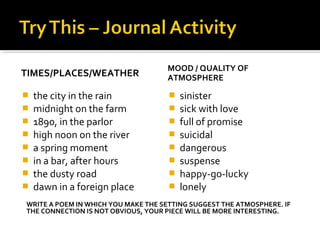
MOOD / QUALITY OF
TIMES/PLACES/WEATHER                ATMOSPHERE

   the city in the rain                sinister
   midnight on the farm                sick with love
   1890, in the parlor                 full of promise
   high noon on the river              suicidal
   a spring moment                     dangerous
   in a bar, after hours               suspense
   the dusty road                      happy-go-lucky
   dawn in a foreign place             lonely
WRITE A POEM IN WHICH YOU MAKE THE SETTING SUGGEST THE ATMOSPHERE. IF
THE CONNECTION IS NOT OBVIOUS, YOUR PIECE WILL BE MORE INTERESTING.
   Select one of the spots on the list you made in your
    Quick Write today. You’re going to tell the story of
    that spot.
   Complete the T-chart for one of the moments.
   Then, use Google Drive to type a piece (you choose
    the form) that took place there and:
     has a clear setting and establishes mood
     shows a story (i.e. don’t tell us what happened… use
      imagery!)
     shows why the place has a special place in your heart.

Cw setting1213

  • 1.
     Brainstorm the“spots” in your current or your past neighborhood that you will always remember. Make a list.
  • 4.
  • 5.
    “If a pieceof literature does not create the setting for us, if it seems to occur in a no- place no-time or in a vague-place fuzzy-time, we cannot experience it, or else we must experience that vagueness itself as crucial to the action.” – Janet Burroway
  • 7.
  • 9.
     Your routine,your neighborhood, your take on home, history, climate, and the cosmos is unique, like your voice, and inseperable from your voice.  Create your vision for your reader.
  • 10.
     Although imageryhas earned a bad wrap because of overuse, this is the time to employ it.  Seriously.  Find the fine details.
  • 11.
     Remember thatsetting says a great deal about the people in your story.  Of Mice and Men would not be the same if it had not taken place on a ranch in the times of the Great Depression. Right?
  • 12.
     Setting oftenbegins a piece, for the very good reason that this is the first thing we register in life.  When we enter a place, we take it in as a panorama.  Pretend you’re a camera and give your reader the big picture with words.
  • 13.
     Definition:  the emotional atmosphere in a text.  You make your reader feel something when you establish a mood.  Can be established by setting  Usually contains some element of time and weather: wet or dry, dark or light, winter or summer, calm or storm, etc.
  • 14.
  • 15.
    MOOD / QUALITYOF TIMES/PLACES/WEATHER ATMOSPHERE  the city in the rain  sinister  midnight on the farm  sick with love  1890, in the parlor  full of promise  high noon on the river  suicidal  a spring moment  dangerous  in a bar, after hours  suspense  the dusty road  happy-go-lucky  dawn in a foreign place  lonely WRITE A POEM IN WHICH YOU MAKE THE SETTING SUGGEST THE ATMOSPHERE. IF THE CONNECTION IS NOT OBVIOUS, YOUR PIECE WILL BE MORE INTERESTING.
  • 16.
    Select one of the spots on the list you made in your Quick Write today. You’re going to tell the story of that spot.  Complete the T-chart for one of the moments.  Then, use Google Drive to type a piece (you choose the form) that took place there and:  has a clear setting and establishes mood  shows a story (i.e. don’t tell us what happened… use imagery!)  shows why the place has a special place in your heart.