Stylistic analysis
•Setting
•Plot
• Theme
•Narration
•Characters
Stylistic analysis
1. Summarize the plot (a one-sentence description)
2. Identify the message
3. Setting
4. Type of narration
5. Description of the author's style
6. Description of characters through their
language
7. Stylistic devices and their functions in the text
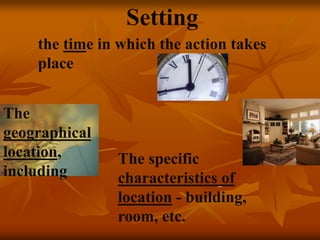
Setting
the time in which the action takes
place
The specific
characteristics of
location - building,
room, etc.
The
geographical
location,
including
Setting
can help in the portrayal of characters.
“I write this sitting in the kitchen
sink. That is, my feet are in it; the
rest of me is on the draining-
board."
“I capture the Castle”
by Dodie Smith
Setting
can establish the atmosphere of a work.
It was a dark and stormy
night…
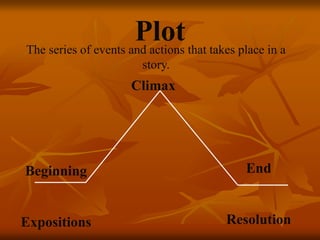
Plot
The series of events and actions that takes place in a
story.
Beginning
Expositions
Climax
End
Resolution
Elements of Plot
Conflict
•Man VS Man
•Man VS Nature
•Man VS Society
•Man VS Himself
The Theme / Message
.
•is the central idea, the purpose of a
work
•some insight into the human nature
or society
• the moral lesson (perhaps)
•stands clear only through the overall
analysis
Narration
 Author’s narrative: omniscient (= all-
knowing) point of view
 Entrusted narrative:
a) the story is told from the point of view of
one of the characters who uses the 1st person
pronoun “I.”
b) the story is told from the point of view of
one of the characters who uses the 3d person.
Fiction Elements
•Dialogue (speech characteristics)
•Interior monologue
•Stream-of-consciousness
•Author’s remarks
Fiction Elements: Structure
Foreshadowing: early clues about what will happen later in a
piece of fiction
Chronological: starts at the beginning and moves through
time.
Flashback: starts in the present and then goes back to the past.
Circular or Anticipatory: starts in the present, flashes back to
the past, and returns to the present at the conclusion.
Panel: same story told from different viewpoints.
Style: Level of Complexity
 mostly simple sentence structure or varies the
sentence structures (simple, compound, complex
sentences);
 simple vocabulary or higher-level word choices
 dialogue
 figurative language (similes, metaphors,
onomatopoeia, personification, symbolism)
 level of detail (detailed or schematic)
 descriptive / too wordy / too flowery / too confusing
or “convoluted”
 means to visualize the images, to understand the
concepts, to build suspense
TONE
 is the author’s attitude toward the
subject.
 can be recognized by the
language/word choices the author
uses.
TONE
 Bitter
 Serious
 Witty
 Playful
 Tender
 Mysterious
 Suspenseful
 Nonchalant
 Angry
 Detached
 Poignant
 Compassionate
 Sympathetic
 Humorous
Tone : “A Gift in His Shoes”
Donovan and Larry were early for baseball practice.
They decided to run up and down the bleachers to
exercise before the rest of the team arrived. Larry
was first to the top. He whispered to Donovan,
“Look over there.” He pointed to a man sleeping
on the highest, narrow bench of the bleachers. His
pants and shirt were faded, worn, and too large for
his thin frame. One big toe stuck out of a huge hole
in his sock. His scraped-up shoes sat a few feet
away. Donovan whispered, “We should help him
out. Let’s hide something good in his shoes. Then,
when he wakes up, he will have a nice surprise.”
Tone: “A Gift in His Shoes”
How would you describe the tone of this
passage?
a. Angry
b. Detached
c. Sympathetic
Evidence: help him out, something good, a nice
surprise
MOOD
MOOD is the overall feelings or
emotions that are created IN THE
READER.
Authors “move” their readers’ moods
through their choice of words and level
of detail.
MOOD
 Cheerful
 Relieved
 Gloomy
 Bleak
 Uncertain
 Bittersweet
 Relaxed
 Confused
 Hopeless
 Tense
MOOD EXAMPLE
During the holidays, my mother's house
glittered with decorations and hummed with
preparations. We ate cookies and drank cider
while we helped her wrap bright packages
and trim the tree. We felt warm and excited,
listening to Christmas carols and even
singing along sometimes. We would tease
each other about our terrible voices and then
sing even louder.
Mood: content, happy ("warm, excited, glittered”)
MOOD EXAMPLE
After New Year's the time came to put all the
decorations away and settle in for the long,
cold winter. The house seemed to sigh as we
boxed up its finery. The tree was dry and
brittle, and now waited forlornly by the side
of the road to be picked up.
Mood: dreary, depressed. ("cold, sigh, brittle,
forlornly“)
Types of Characters
•Round Character: convincing, true to life and
have many character traits.
•Dynamic Character: undergoes some type of
change in story because of something that happens
to them.
•Flat Character: stereotyped, shallow, often
symbolic. They have one or two personality traits.
•Static Character: does not change in the course of
the story
Characters
Protagonist -the main character
in a literary work (usually
positive).
Antagonist - the character who
opposes the protagonist.
Methods of Characterization
• direct- “he was an old man…”
• characters’ thoughts, words, and actions
• reactions/comments of other characters
• character’s physical appearance
• characters’ thoughts
Symbolism
A symbol represents an idea, quality, or
concept larger than itself.
A Journey
can symbolize
life.
Black can
represent evil or
death.
Water may represent
a new beginning.
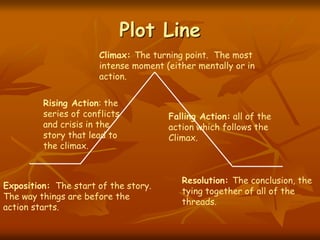
Plot Line
Exposition: The start of the story.
The way things are before the
action starts.
Rising Action: the
series of conflicts
and crisis in the
story that lead to
the climax.
Climax: The turning point. The most
intense moment (either mentally or in
action.
Falling Action: all of the
action which follows the
Climax.
Resolution: The conclusion, the
tying together of all of the
threads.

Stylistic Analysis Plot, Theme, Settins .ppt

  • 1.
  • 2.
    Stylistic analysis 1. Summarizethe plot (a one-sentence description) 2. Identify the message 3. Setting 4. Type of narration 5. Description of the author's style 6. Description of characters through their language 7. Stylistic devices and their functions in the text
  • 3.
    Setting the time inwhich the action takes place The specific characteristics of location - building, room, etc. The geographical location, including
  • 4.
    Setting can help inthe portrayal of characters. “I write this sitting in the kitchen sink. That is, my feet are in it; the rest of me is on the draining- board." “I capture the Castle” by Dodie Smith
  • 5.
    Setting can establish theatmosphere of a work. It was a dark and stormy night…
  • 6.
    Plot The series ofevents and actions that takes place in a story. Beginning Expositions Climax End Resolution
  • 7.
    Elements of Plot Conflict •ManVS Man •Man VS Nature •Man VS Society •Man VS Himself
  • 8.
    The Theme /Message . •is the central idea, the purpose of a work •some insight into the human nature or society • the moral lesson (perhaps) •stands clear only through the overall analysis
  • 9.
    Narration  Author’s narrative:omniscient (= all- knowing) point of view  Entrusted narrative: a) the story is told from the point of view of one of the characters who uses the 1st person pronoun “I.” b) the story is told from the point of view of one of the characters who uses the 3d person.
  • 10.
    Fiction Elements •Dialogue (speechcharacteristics) •Interior monologue •Stream-of-consciousness •Author’s remarks
  • 11.
    Fiction Elements: Structure Foreshadowing:early clues about what will happen later in a piece of fiction Chronological: starts at the beginning and moves through time. Flashback: starts in the present and then goes back to the past. Circular or Anticipatory: starts in the present, flashes back to the past, and returns to the present at the conclusion. Panel: same story told from different viewpoints.
  • 12.
    Style: Level ofComplexity  mostly simple sentence structure or varies the sentence structures (simple, compound, complex sentences);  simple vocabulary or higher-level word choices  dialogue  figurative language (similes, metaphors, onomatopoeia, personification, symbolism)  level of detail (detailed or schematic)  descriptive / too wordy / too flowery / too confusing or “convoluted”  means to visualize the images, to understand the concepts, to build suspense
  • 13.
    TONE  is theauthor’s attitude toward the subject.  can be recognized by the language/word choices the author uses.
  • 14.
    TONE  Bitter  Serious Witty  Playful  Tender  Mysterious  Suspenseful  Nonchalant  Angry  Detached  Poignant  Compassionate  Sympathetic  Humorous
  • 15.
    Tone : “AGift in His Shoes” Donovan and Larry were early for baseball practice. They decided to run up and down the bleachers to exercise before the rest of the team arrived. Larry was first to the top. He whispered to Donovan, “Look over there.” He pointed to a man sleeping on the highest, narrow bench of the bleachers. His pants and shirt were faded, worn, and too large for his thin frame. One big toe stuck out of a huge hole in his sock. His scraped-up shoes sat a few feet away. Donovan whispered, “We should help him out. Let’s hide something good in his shoes. Then, when he wakes up, he will have a nice surprise.”
  • 16.
    Tone: “A Giftin His Shoes” How would you describe the tone of this passage? a. Angry b. Detached c. Sympathetic Evidence: help him out, something good, a nice surprise
  • 17.
    MOOD MOOD is theoverall feelings or emotions that are created IN THE READER. Authors “move” their readers’ moods through their choice of words and level of detail.
  • 18.
    MOOD  Cheerful  Relieved Gloomy  Bleak  Uncertain  Bittersweet  Relaxed  Confused  Hopeless  Tense
  • 19.
    MOOD EXAMPLE During theholidays, my mother's house glittered with decorations and hummed with preparations. We ate cookies and drank cider while we helped her wrap bright packages and trim the tree. We felt warm and excited, listening to Christmas carols and even singing along sometimes. We would tease each other about our terrible voices and then sing even louder. Mood: content, happy ("warm, excited, glittered”)
  • 20.
    MOOD EXAMPLE After NewYear's the time came to put all the decorations away and settle in for the long, cold winter. The house seemed to sigh as we boxed up its finery. The tree was dry and brittle, and now waited forlornly by the side of the road to be picked up. Mood: dreary, depressed. ("cold, sigh, brittle, forlornly“)
  • 21.
    Types of Characters •RoundCharacter: convincing, true to life and have many character traits. •Dynamic Character: undergoes some type of change in story because of something that happens to them. •Flat Character: stereotyped, shallow, often symbolic. They have one or two personality traits. •Static Character: does not change in the course of the story
  • 22.
    Characters Protagonist -the maincharacter in a literary work (usually positive). Antagonist - the character who opposes the protagonist.
  • 23.
    Methods of Characterization •direct- “he was an old man…” • characters’ thoughts, words, and actions • reactions/comments of other characters • character’s physical appearance • characters’ thoughts
  • 24.
    Symbolism A symbol representsan idea, quality, or concept larger than itself. A Journey can symbolize life. Black can represent evil or death. Water may represent a new beginning.
  • 25.
    Plot Line Exposition: Thestart of the story. The way things are before the action starts. Rising Action: the series of conflicts and crisis in the story that lead to the climax. Climax: The turning point. The most intense moment (either mentally or in action. Falling Action: all of the action which follows the Climax. Resolution: The conclusion, the tying together of all of the threads.