Dr. Laurie J. Raymundo
University of Guam Marine
Laboratory
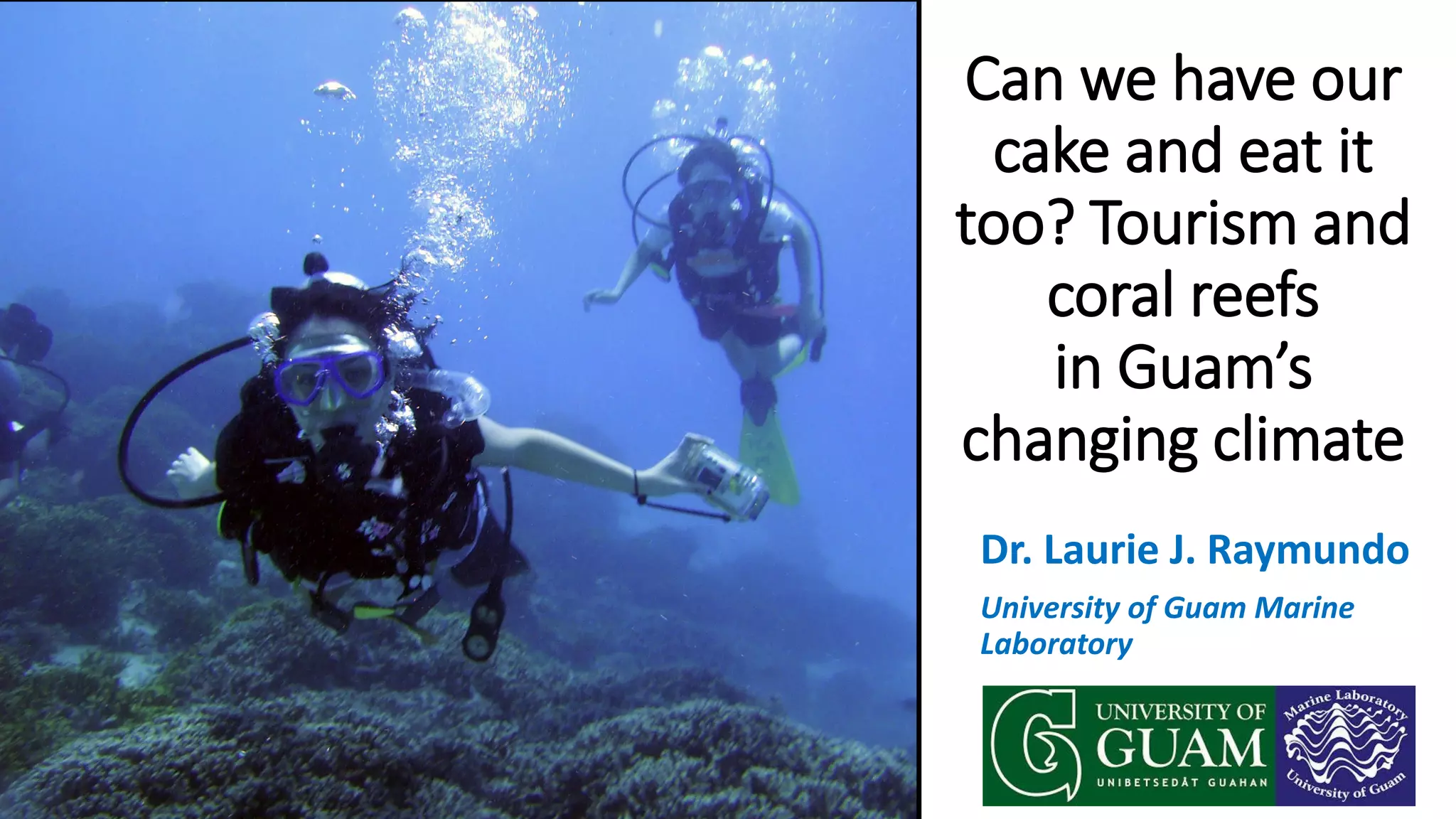
Can we have our
cake and eat it
too? Tourism and
coral reefs
in Guam’s
changing climate
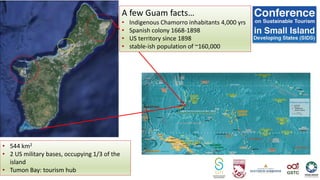
A few Guam facts…
• Indigenous Chamorro inhabitants 4,000 yrs
• Spanish colony 1668-1898
• US territory since 1898
• stable-ish population of ~160,000
• 544 km2
• 2 US military bases, occupying 1/3 of the
island
• Tumon Bay: tourism hub
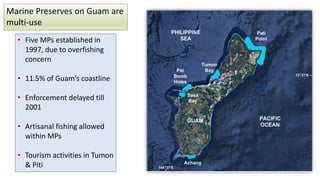
• Five MPs established in
1997, due to overfishing
concern
• 11.5% of Guam’s coastline
• Enforcement delayed till
2001
• Artisanal fishing allowed
within MPs
• Tourism activities in Tumon
& Piti
Marine Preserves on Guam are
multi-use
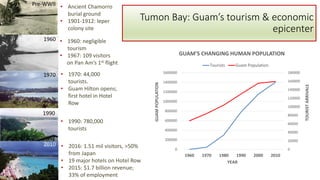
Tumon Bay: Guam’s tourism & economic
epicenter
1960
1970
1990
0
20000
40000
60000
80000
100000
120000
140000
160000
180000
0
200000
400000
600000
800000
1000000
1200000
1400000
1600000
1960 1970 1980 1990 2000 2010
TOURISTARRIVALS
GUAMPOPULATION
YEAR
GUAM’S CHANGING HUMAN POPULATION
Tourists Guam Population
2010
Pre-WWII
• 1960: negligible
tourism
• 1967: 109 visitors
on Pan Am’s 1st flight
• 2016: 1.51 mil visitors, >50%
from Japan
• 19 major hotels on Hotel Row
• 2015: $1.7 billion revenue;
33% of employment
• 1970: 44,000
tourists.
• Guam Hilton opens;
first hotel in Hotel
Row
• 1990: 780,000
tourists
• Ancient Chamorro
burial ground
• 1901-1912: leper
colony site
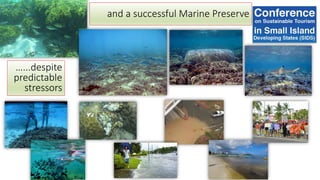
and a successful Marine Preserve
…...despite
predictable
stressors
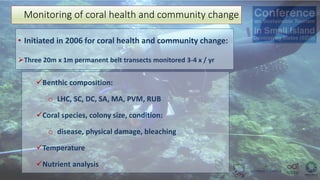
• Initiated in 2006 for coral health and community change:
➢Three 20m x 1m permanent belt transects monitored 3-4 x / yr
Monitoring of coral health and community change
✓Benthic composition:
o LHC, SC, DC, SA, MA, PVM, RUB
✓Coral species, colony size, condition:
o disease, physical damage, bleaching
✓Temperature
✓Nutrient analysis
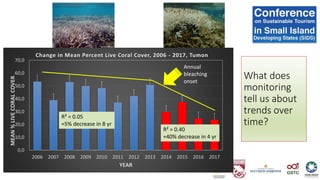
What does
monitoring
tell us about
trends over
time?
0,0
10,0
20,0
30,0
40,0
50,0
60,0
70,0
2006 2007 2008 2009 2010 2011 2012 2013 2014 2015 2016 2017
MEAN%LIVECORALCOVER
YEAR
Change in Mean Percent Live Coral Cover, 2006 - 2017, Tumon
R² = 0.05
=5% decrease in 8 yr
R² = 0.40
=40% decrease in 4 yr
Annual
bleaching
onset
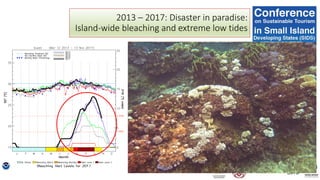
2013 – 2017: Disaster in paradise:
Island-wide bleaching and extreme low tides
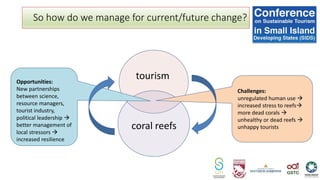
So how do we manage for current/future change?
tourism
coral reefs
Challenges:
unregulated human use 
increased stress to reefs
more dead corals 
unhealthy or dead reefs 
unhappy tourists
Opportunities:
New partnerships
between science,
resource managers,
tourist industry,
political leadership 
better management of
local stressors 
increased resilience
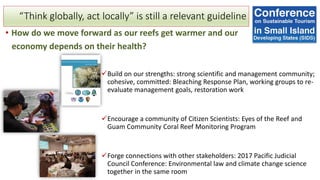
“Think globally, act locally” is still a relevant guideline
• How do we move forward as our reefs get warmer and our
economy depends on their health?
✓Build on our strengths: strong scientific and management community;
cohesive, committed: Bleaching Response Plan, working groups to re-
evaluate management goals, restoration work
✓Encourage a community of Citizen Scientists: Eyes of the Reef and
Guam Community Coral Reef Monitoring Program
✓Forge connections with other stakeholders: 2017 Pacific Judicial
Council Conference: Environmental law and climate change science
together in the same room
Dangkulu na Si Yu’os Ma’åse
• Dave Burdick
• Val Brown
• Whitney Hoot
• Ashton Williams
• Val Lapacek
• Allison Miller
• Roxanna Miller
• Travis Reynolds
• National Oceanographic
& Atmospheric Administration
• Guam Bureau of Statistics and Plans
• University of Guam Marine Laboratory
• Pacific Islands Climate Science Center

Session4 02 Laurie Raymundo

  • 1.
    Dr. Laurie J.Raymundo University of Guam Marine Laboratory Can we have our cake and eat it too? Tourism and coral reefs in Guam’s changing climate
  • 2.
    A few Guamfacts… • Indigenous Chamorro inhabitants 4,000 yrs • Spanish colony 1668-1898 • US territory since 1898 • stable-ish population of ~160,000 • 544 km2 • 2 US military bases, occupying 1/3 of the island • Tumon Bay: tourism hub
  • 3.
    • Five MPsestablished in 1997, due to overfishing concern • 11.5% of Guam’s coastline • Enforcement delayed till 2001 • Artisanal fishing allowed within MPs • Tourism activities in Tumon & Piti Marine Preserves on Guam are multi-use
  • 4.
    Tumon Bay: Guam’stourism & economic epicenter 1960 1970 1990 0 20000 40000 60000 80000 100000 120000 140000 160000 180000 0 200000 400000 600000 800000 1000000 1200000 1400000 1600000 1960 1970 1980 1990 2000 2010 TOURISTARRIVALS GUAMPOPULATION YEAR GUAM’S CHANGING HUMAN POPULATION Tourists Guam Population 2010 Pre-WWII • 1960: negligible tourism • 1967: 109 visitors on Pan Am’s 1st flight • 2016: 1.51 mil visitors, >50% from Japan • 19 major hotels on Hotel Row • 2015: $1.7 billion revenue; 33% of employment • 1970: 44,000 tourists. • Guam Hilton opens; first hotel in Hotel Row • 1990: 780,000 tourists • Ancient Chamorro burial ground • 1901-1912: leper colony site
  • 5.
    and a successfulMarine Preserve …...despite predictable stressors
  • 6.
    • Initiated in2006 for coral health and community change: ➢Three 20m x 1m permanent belt transects monitored 3-4 x / yr Monitoring of coral health and community change ✓Benthic composition: o LHC, SC, DC, SA, MA, PVM, RUB ✓Coral species, colony size, condition: o disease, physical damage, bleaching ✓Temperature ✓Nutrient analysis
  • 7.
    What does monitoring tell usabout trends over time? 0,0 10,0 20,0 30,0 40,0 50,0 60,0 70,0 2006 2007 2008 2009 2010 2011 2012 2013 2014 2015 2016 2017 MEAN%LIVECORALCOVER YEAR Change in Mean Percent Live Coral Cover, 2006 - 2017, Tumon R² = 0.05 =5% decrease in 8 yr R² = 0.40 =40% decrease in 4 yr Annual bleaching onset
  • 8.
    2013 – 2017:Disaster in paradise: Island-wide bleaching and extreme low tides
  • 9.
    So how dowe manage for current/future change? tourism coral reefs Challenges: unregulated human use  increased stress to reefs more dead corals  unhealthy or dead reefs  unhappy tourists Opportunities: New partnerships between science, resource managers, tourist industry, political leadership  better management of local stressors  increased resilience
  • 10.
    “Think globally, actlocally” is still a relevant guideline • How do we move forward as our reefs get warmer and our economy depends on their health? ✓Build on our strengths: strong scientific and management community; cohesive, committed: Bleaching Response Plan, working groups to re- evaluate management goals, restoration work ✓Encourage a community of Citizen Scientists: Eyes of the Reef and Guam Community Coral Reef Monitoring Program ✓Forge connections with other stakeholders: 2017 Pacific Judicial Council Conference: Environmental law and climate change science together in the same room
  • 11.
    Dangkulu na SiYu’os Ma’åse • Dave Burdick • Val Brown • Whitney Hoot • Ashton Williams • Val Lapacek • Allison Miller • Roxanna Miller • Travis Reynolds • National Oceanographic & Atmospheric Administration • Guam Bureau of Statistics and Plans • University of Guam Marine Laboratory • Pacific Islands Climate Science Center