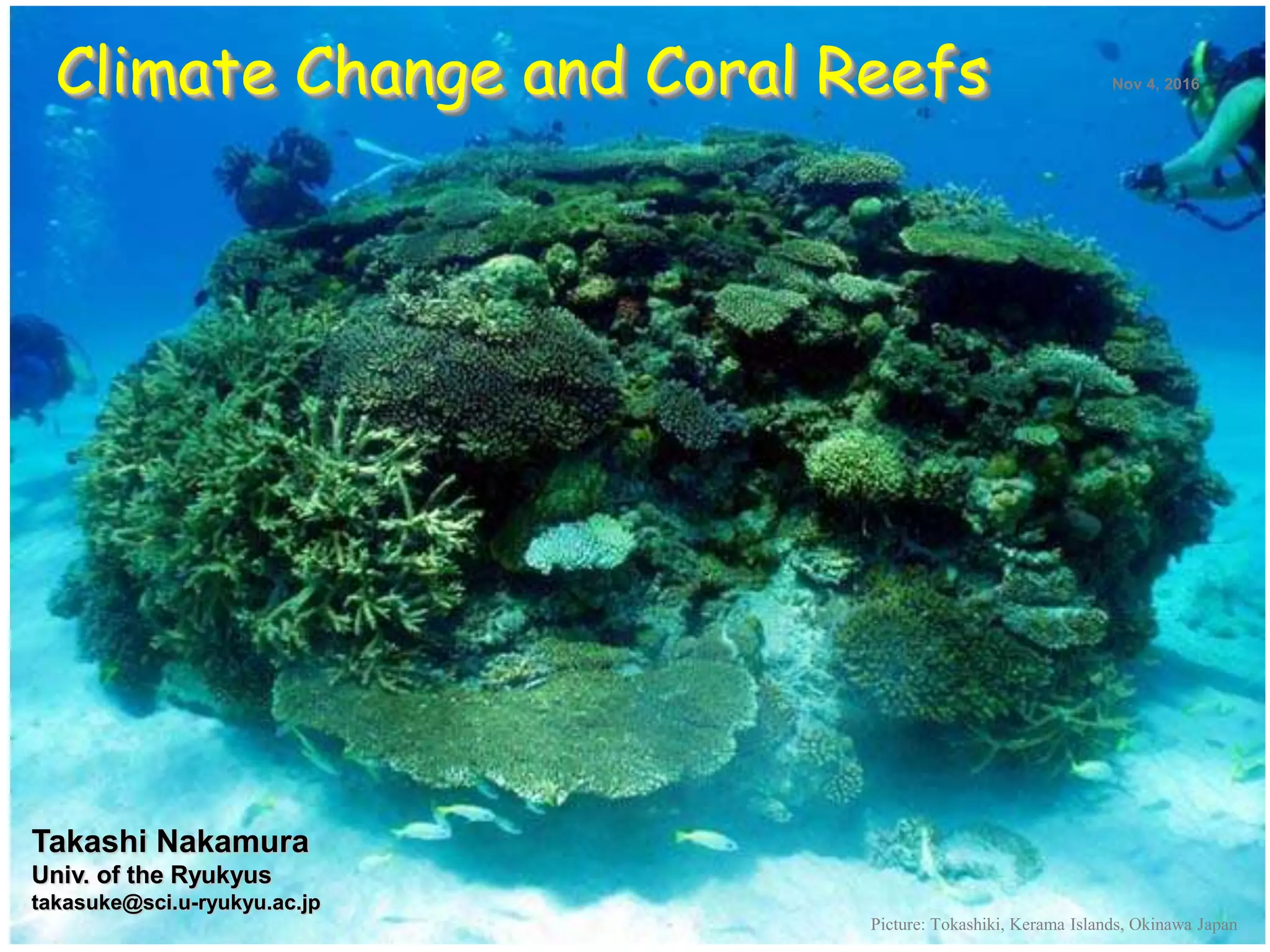
Picture: Tokashiki, Kerama Islands, Okinawa Japan
Climate Change and Coral Reefs Nov 4, 2016
Takashi Nakamura
Univ. of the Ryukyus
takasuke@sci.u-ryukyu.ac.jp
Outline
1. Basics of corals
2. Climate change as the threat to corals
“Coral bleaching”
3. Local threats
4. Possible solutions
Basics of corals
Biology & ecology
Class:
AnthozoaClass Scyphozoa
Jerry fish
Semaeostomeae
Coronatae
Phylum: Cnidaria
Subclass
Octocorallia
Soft coral
Alcyonacea
Pink coral
Tube coral
Stolonifera
Blue coral
Heriopora
Subclass:
Hexactinia
Sea anemone
Actiniaria
Zoantharia
Class
Hydrozoa
Anthomedusae
Fire coral
Milleporidae
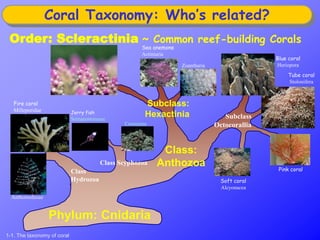
Order: Scleractinia ~ Common reef-building Corals
Coral Taxonomy: Who’s related?
1-1. The taxonomy of coral
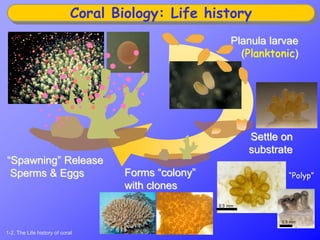
Planula larvae
(Planktonic)
Coral Biology: Life history
Settle on
substrate
0.5 mm
“Polyp”
0.5 mm
Forms “colony”
with clones
“Spawning” Release
Sperms & Eggs
1-2. The Life history of coral
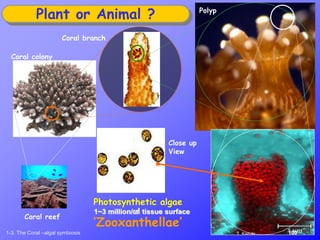
Coral colony
Coral branch
Plant or Animal ?
Coral reef
Polyp
Close up
View
T. Kamiki 100
Photosynthetic algae
‘Zooxanthellae’
1-3. The Coral –algal symbiosis
1~3 million/㎠ tissue surface
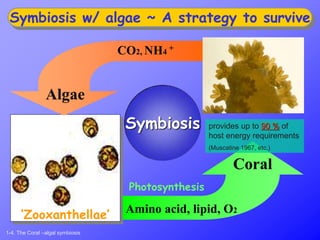
Symbiosis
Amino acid, lipid, O2
Photosynthesis
Coral
CO2, NH4 +
Algae
Symbiosis w/ algae ~ A strategy to survive
1-4. The Coral –algal symbiosis
‘Zooxanthellae’
‘Coral’
provides up to 90 % of
host energy requirements
(Muscatine 1967, etc.)
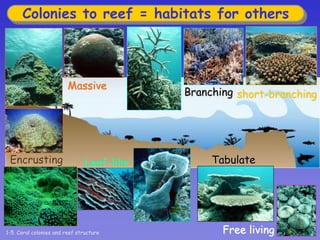
Colonies to reef = habitats for others
Leaf-likeEncrusting
short-branching
Free living
Tabulate
Branching
Massive
1-5. Coral colonies and reef structure
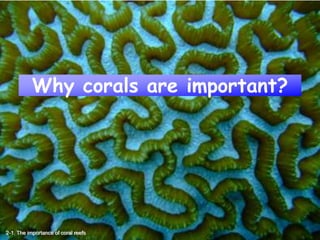
Why corals are important?
2-1. The importance of coral reefs
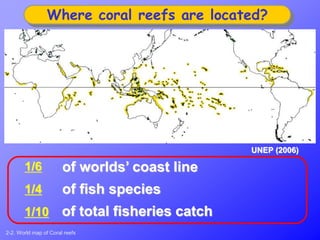
of worlds’ coast line
of fish species
of total fisheries catch
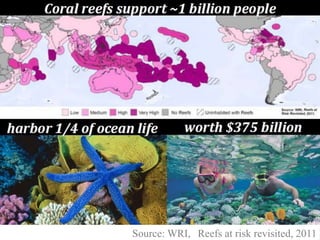
1/6
1/4
1/10
Where coral reefs are located?
UNEP (2006)
2-2. World map of Coral reefs
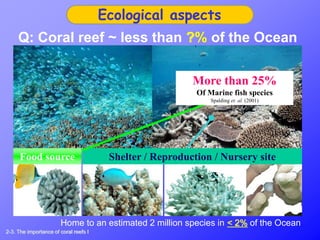
Ecological aspects
Q: Coral reef ~ less than ?% of the Ocean
Shelter / Reproduction / Nursery siteFood source
More than 25%
Of Marine fish species
Spalding et. al. (2001)
Home to an estimated 2 million species in < 2% of the Ocean
2-3. The importance of coral reefs I
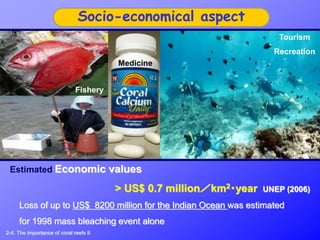
Tourism
Recreation
Estimated Economic values
> US$ 0.7 million/km2・year UNEP (2006)
Fishery
Socio-economical aspect
Medicine
Loss of up to US$ 8200 million for the Indian Ocean was estimated
for 1998 mass bleaching event alone
2-4. The importance of coral reefs II
Source: WRI, Reefs at risk revisited, 2011
Climate change as the threat to corals
“Coral bleaching”
Greatest threats to coral reef ecosystem
induced by environmental stresses
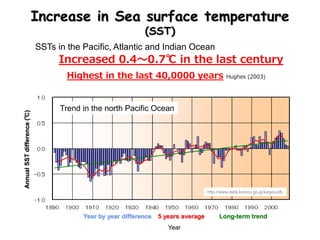
Increase in Sea surface temperature
(SST)
SSTs in the Pacific, Atlantic and Indian Ocean
Highest in the last 40,0000 years Hughes (2003)
Increased 0.4~0.7℃ in the last century
Trend in the north Pacific Ocean
http://www.data.kishou.go.jp/kaiyou/db
Year by year difference 5 years average Long-term trend
AnnualSSTdifference(℃)
Year
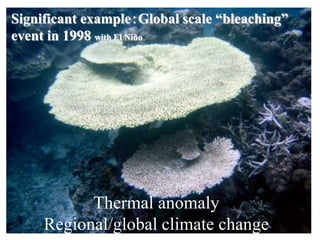
Significant example:Global scale “bleaching”
event in 1998 with El Niño
Thermal anomaly
Regional/global climate change
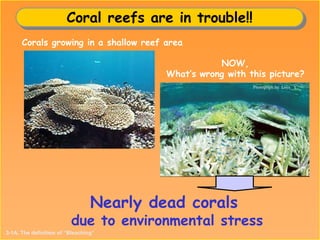
Corals growing in a shallow reef area
NOW,
What’s wrong with this picture?
Photograph by Loya Y .
Nearly dead corals
due to environmental stress
Coral reefs are in trouble!!
3-1A. The definition of “Bleaching”
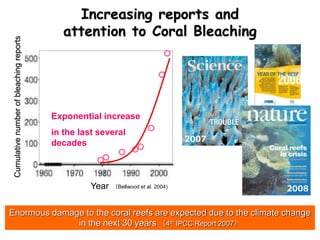
2007
2008
Enormous damage to the coral reefs are expected due to the climate change
in the next 30 years (4th IPCC Report 2007)
(Bellwood et al. 2004)
Exponential increase
in the last several
decades
Year
Increasing reports and
attention to Coral Bleaching
Cumulativenumberofbleachingreports
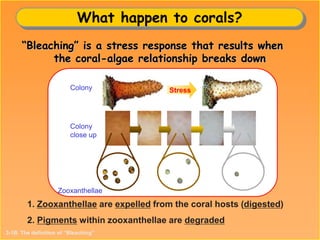
1. Zooxanthellae are expelled from the coral hosts (digested)
2. Pigments within zooxanthellae are degraded
What happen to corals?
“Bleaching” is a stress response that results when
the coral-algae relationship breaks down
StressColony
Colony
close up
Zooxanthellae
3-1B. The definition of “Bleaching”
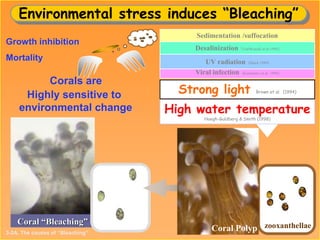
Environmental stress induces “Bleaching”
Coral “Bleaching” zooxanthellae
Strong light Brown et al. (1994)
High water temperature
Hoegh-Guldberg & Smith (1998)
Viral infection (Kushmaro et al. 1996)
UV radiation (Shick 1989)
Sedimentation /suffocation
Desalinization (VanWoesik et al.1995)
Growth inhibition
Mortality
Corals are
Highly sensitive to
environmental change
Coral Polyp3-2A. The causes of “Bleaching”
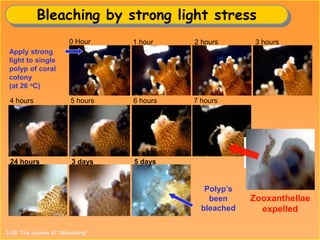
1 hour 2 hours 3 hours
4 hours 5 hours 6 hours 7 hours
0 Hour
Apply strong
light to single
polyp of coral
colony
(at 26 oC)
24 hours 3 days 5 days
Polyp’s
been
bleached
Zooxanthellae
expelled
Bleaching by strong light stress
3-2B. The causes of “Bleaching”
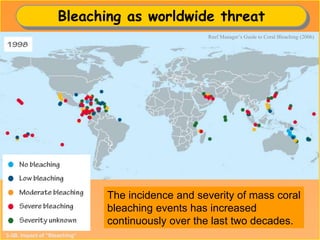
Bleaching as worldwide threat
Reef Manager’s Guide to Coral Bleaching (2006)
3-3B. Impact of “Bleaching”
The incidence and severity of mass coral
bleaching events has increased
continuously over the last two decades.
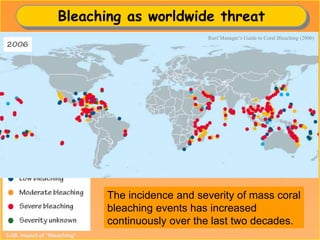
Bleaching as worldwide threat
3-3B. Impact of “Bleaching”
The incidence and severity of mass coral
bleaching events has increased
continuously over the last two decades.
Reef Manager’s Guide to Coral Bleaching (2006)
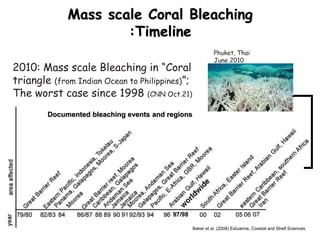
Baker et al. (2008) Estuarine, Coastal and Shelf Sciences
Documented bleaching events and regions
Mass scale Coral Bleaching
:Timeline
Phuket, Thai
June 2010
2010: Mass scale Bleaching in “Coral
triangle (from Indian Ocean to Philippines)”;
The worst case since 1998 (CNN Oct.21)
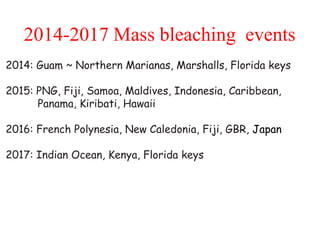
2014-2017 Mass bleaching events
2014: Guam ~ Northern Marianas, Marshalls, Florida keys
2015: PNG, Fiji, Samoa, Maldives, Indonesia, Caribbean,
Panama, Kiribati, Hawaii
2016: French Polynesia, New Caledonia, Fiji, GBR, Japan
2017: Indian Ocean, Kenya, Florida keys
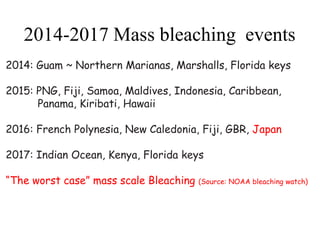
2014-2017 Mass bleaching events
2014: Guam ~ Northern Marianas, Marshalls, Florida keys
2015: PNG, Fiji, Samoa, Maldives, Indonesia, Caribbean,
Panama, Kiribati, Hawaii
2016: French Polynesia, New Caledonia, Fiji, GBR, Japan
2017: Indian Ocean, Kenya, Florida keys
“The worst case” mass scale Bleaching (Source: NOAA bleaching watch)
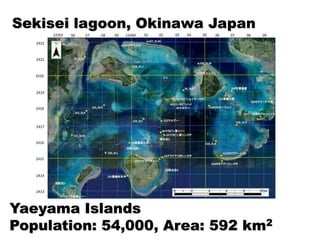
Sekisei lagoon, Okinawa Japan
Yaeyama Islands
Population: 54,000, Area: 592 km2
NOAA (2016)
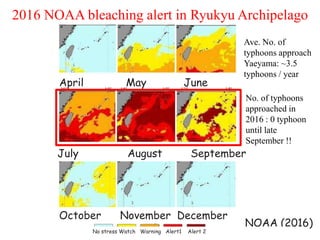
April May June
July August September
October November December
No stress Watch Warning Alert1 Alert 2
2016 NOAA bleaching alert in Ryukyu Archipelago
Ave. No. of
typhoons approach
Yaeyama: ~3.5
typhoons / year
No. of typhoons
approached in
2016 : 0 typhoon
until late
September !!
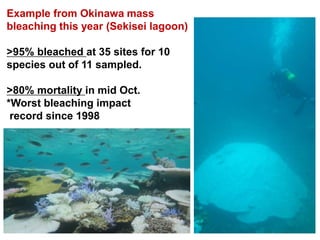
Example from Okinawa mass
bleaching this year (Sekisei lagoon)
>95% bleached at 35 sites for 10
species out of 11 sampled.
>80% mortality in mid Oct.
*Worst bleaching impact
record since 1998
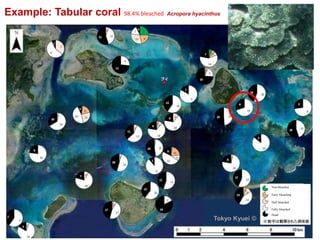
Example: Tabular coral 98.4% bleached Acropora hyacinthus
Tokyo Kyuei ©
Non-bleached
Early bleaching
Half bleached
Fully bleached
Dead
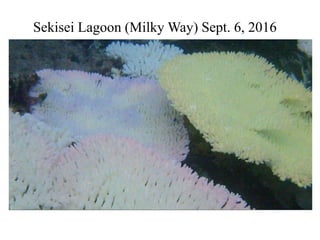
Sekisei Lagoon (Milky Way) Sept. 6, 2016
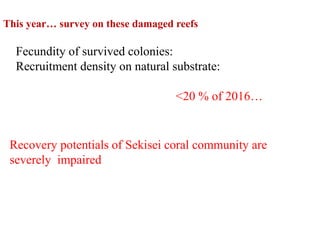
This year… survey on these damaged reefs
Fecundity of survived colonies:
Recruitment density on natural substrate:
<20 % of 2016…
Recovery potentials of Sekisei coral community are
severely impaired
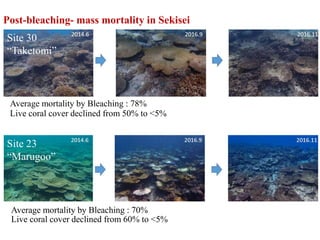
Post-bleaching- mass mortality in Sekisei
Live coral cover declined from 60% to <5%
Average mortality by Bleaching : 70%
Live coral cover declined from 50% to <5%
Average mortality by Bleaching : 78%
Site 23
“Marugoo”
Site 30
“Taketomi”
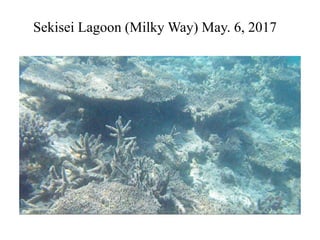
Sekisei Lagoon (Milky Way) May. 6, 2017
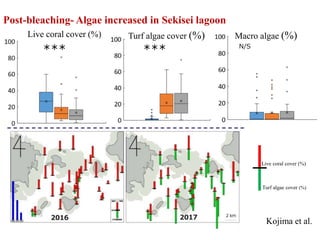
Post-bleaching- Algae increased in Sekisei lagoon
Live coral cover (%)
Kojima et al.
Turf algae cover (%) Macro algae (%)
*** *** N/S
Live coral cover (%)
Turf algae cover (%)
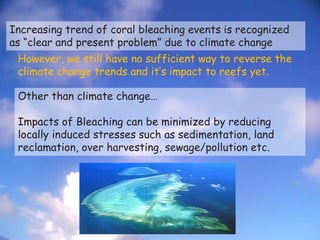
Increasing trend of coral bleaching events is recognized
as “clear and present problem” due to climate change
Other than climate change…
Impacts of Bleaching can be minimized by reducing
locally induced stresses such as sedimentation, land
reclamation, over harvesting, sewage/pollution etc.
However, we still have no sufficient way to reverse the
climate change trends and it’s impact to reefs yet.
Local threats:
Lower resilience
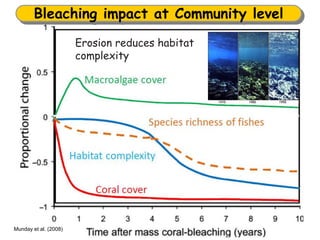
Munday et al. (2008)
Bleaching impact at Community level
Erosion reduces habitat
complexity
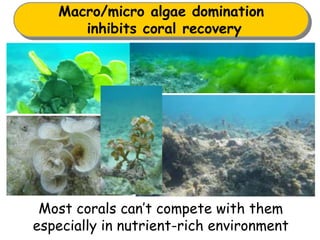
Most corals can’t compete with them
especially in nutrient-rich environment
Macro/micro algae domination
inhibits coral recovery
How long will it last?
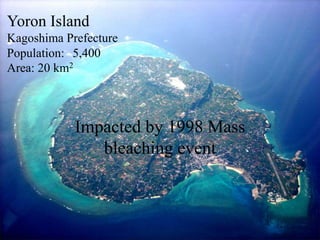
Yoron Island
Kagoshima Prefecture
Population: 5,400
Area: 20 km2
Impacted by 1998 Mass
bleaching event
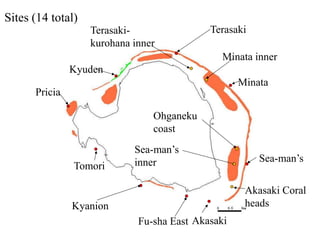
Kyuden
TerasakiTerasaki-
kurohana inner
Minata
Minata inner
Akasaki Coral
heads
Akasaki
Kyanion
Tomori
Pricia
Sea-man’s
inner Sea-man’s
Ohganeku
coast
Sites (14 total)
Fu-sha East
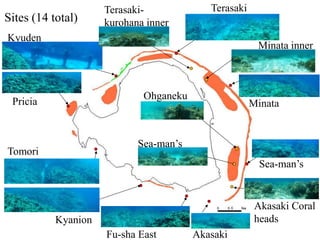
Kyuden
TerasakiTerasaki-
kurohana inner
Minata
Minata inner
Akasaki Coral
heads
Akasaki
Kyanion
Tomori
Pricia
Sea-man’s
inner
Sea-man’s
Ohganeku
coast
Sites (14 total)
Fu-sha East
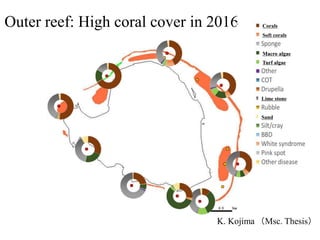
Outer reef: High coral cover in 2016 Corals
Soft corals
Macro algae
Turf algae
Lime stone
Sand
K. Kojima (Msc. Thesis)
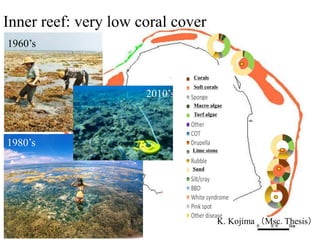
1960’s
1980’s
Inner reef: very low coral cover
Corals
Soft corals
Macro algae
Turf algae
Lime stone
Sand
2010’s
K. Kojima (Msc. Thesis)
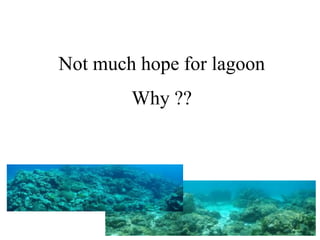
Why ??
Not much hope for lagoon
What we should worry?
“What we might overlooked in the field?”
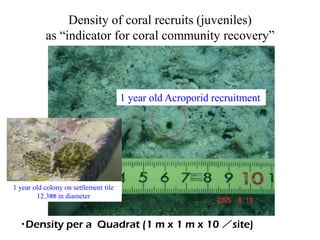
Density of coral recruits (juveniles)
as “indicator for coral community recovery”
1 year old Acroporid recruitment
・Density per a Quadrat (1 m x 1 m x 10 /site)
1 year old colony on settlement tile
12.3㎜ in diameter
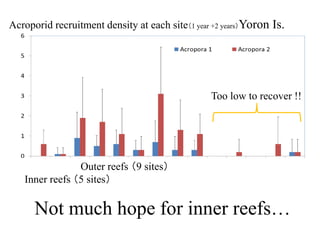
Acroporid recruitment density at each site(1 year +2 years)Yoron Is.
Too low to recover !!
Outer reefs (9 sites)
Inner reefs (5 sites)
Not much hope for inner reefs…
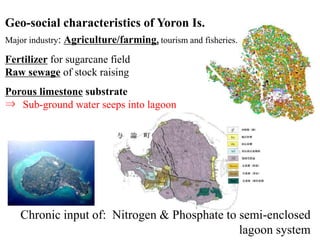
Fertilizer for sugarcane field
Raw sewage of stock raising
Porous limestone substrate
⇒ Sub-ground water seeps into lagoon
Chronic input of: Nitrogen & Phosphate to semi-enclosed
lagoon system
Geo-social characteristics of Yoron Is.
Major industry: Agriculture/farming, tourism and fisheries.
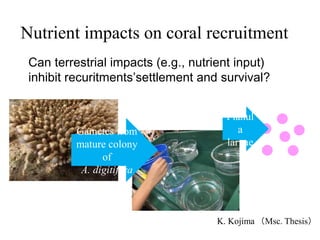
Nutrient impacts on coral recruitment
Planul
a
larvae
Gametes from
mature colony
of
A. digitifera
Can terrestrial impacts (e.g., nutrient input)
inhibit recuritments’settlement and survival?
K. Kojima (Msc. Thesis)
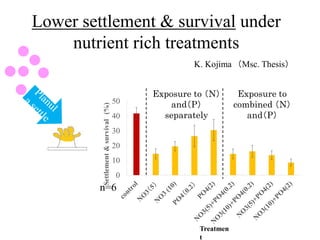
Lower settlement & survival under
nutrient rich treatments
n=6
0
10
20
30
40
50
Settlement&survival(%)
Exposure to
combined (N)
and(P)
Treatmen
t
Exposure to (N)
and(P)
separately
K. Kojima (Msc. Thesis)
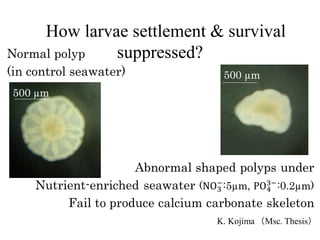
How larvae settlement & survival
suppressed?Normal polyp
(in control seawater)
500 µm
500 µm
K. Kojima (Msc. Thesis)
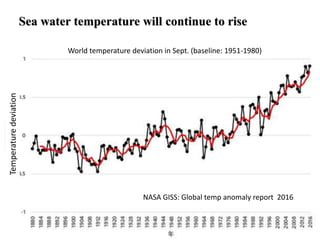
NASA GISS: Global temp anomaly report 2016
Sea water temperature will continue to rise
World temperature deviation in Sept. (baseline: 1951-1980)
Temperaturedeviation
Global warming…
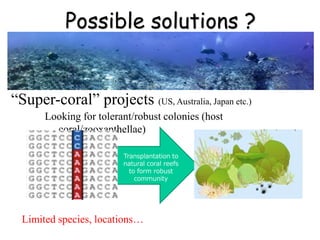
Possible solutions ?
Looking for tolerant/robust colonies (host
coral/zooxanthellae)
“Super-coral” projects (US, Australia, Japan etc.)
Transplantation to
natural coral reefs
to form robust
community
Limited species, locations…
Permeable substrate (carbonate
limestone)
Corals
Thermal
exchangers
Sub-cooler water (saltwater) conditioning Project
Impermeable layer
Permeable
Formation
(Limestone)
Heat
PumpUnderground
seawater
(cooler !!)
Possible solutions ?
Geo-engineering approach
Corals Corals
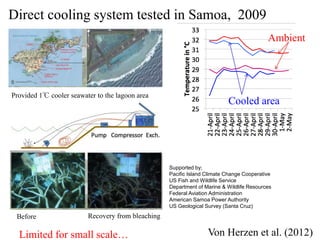
Direct cooling system tested in Samoa, 2009
Provided 1℃ cooler seawater to the lagoon area
Before Recovery from bleaching
Von Herzen et al. (2012)
Supported by;
Pacific Island Climate Change Cooperative
US Fish and Wildlife Service
Department of Marine & Wildlife Resources
Federal Aviation Administration
American Samoa Power Authority
US Geological Survey (Santa Cruz)
Cooled area
Ambient
Limited for small scale…
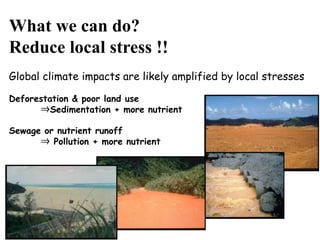
What we can do?
Reduce local stress !!
Global climate impacts are likely amplified by local stresses
Deforestation & poor land use
⇒Sedimentation + more nutrient
Sewage or nutrient runoff
⇒ Pollution + more nutrient
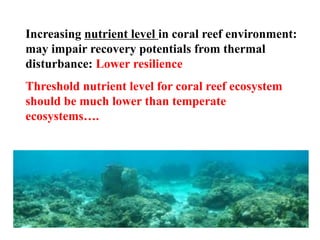
Increasing nutrient level in coral reef environment:
may impair recovery potentials from thermal
disturbance: Lower resilience
Threshold nutrient level for coral reef ecosystem
should be much lower than temperate
ecosystems….
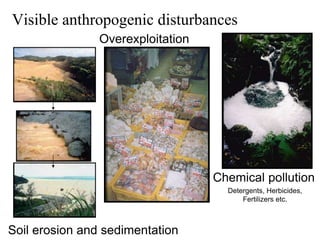
Soil erosion and sedimentation
Chemical pollution
Detergents, Herbicides,
Fertilizers etc.
Overexploitation
Visible anthropogenic disturbances
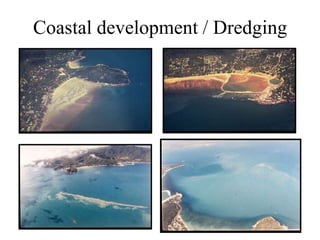
Coastal development / Dredging
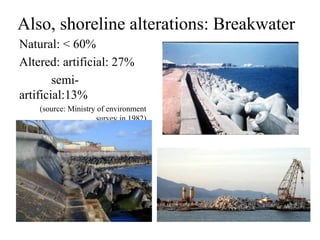
Also, shoreline alterations: Breakwater
Natural: < 60%
Altered: artificial: 27%
semi-
artificial:13%
(source: Ministry of environment
survey in 1982)
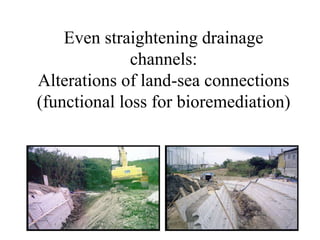
Even straightening drainage
channels:
Alterations of land-sea connections
(functional loss for bioremediation)
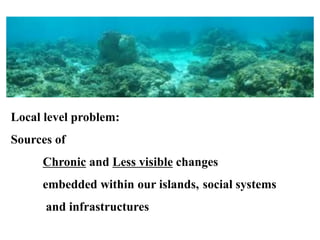
Local level problem:
Sources of
Chronic and Less visible changes
embedded within our islands, social systems
and infrastructures
Human disturbances can be realized as;
Visible phenomena
(Technically) Detectable factors
Can we really tackle the problems ?
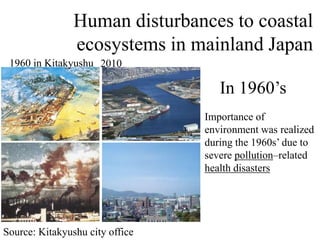
1960 in Kitakyushu 2010
Importance of
environment was realized
during the 1960s’ due to
severe pollution–related
health disasters
In 1960’s
Source: Kitakyushu city office
Human disturbances to coastal
ecosystems in mainland Japan
What about coasts in subtropical islands?
Human disturbances can also be realized as;
Visible phenomena
(Technically) Detectable factors
Human disturbances to coastal
ecosystems in Subtropics
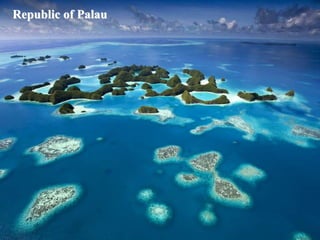
Republic of Palau
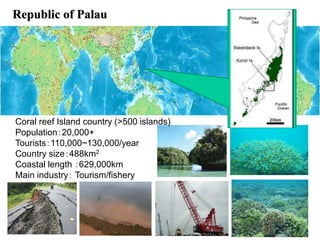
Republic of Palau
Coral reef Island country (>500 islands)
Population:20,000+
Tourists:110,000~130,000/year
Country size:488km2
Coastal length :629,000km
Main industry: Tourism/fishery
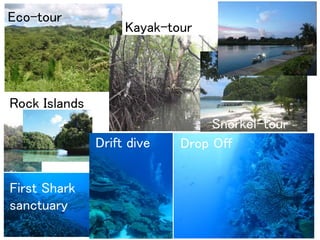
Eco-tour
Kayak-tour
Snorkel-tour
Drop Off
First Shark
sanctuary
Rock Islands
Drift dive
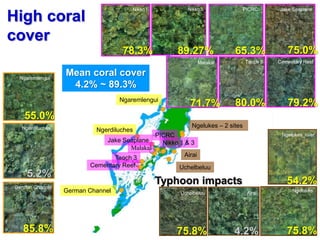
High coral
cover
Mean coral cover
4.2% ~ 89.3%
German Channel
Ngaremlengui
Ngerdiluches
Ngaremlengui
Ngerdiluches
German Channel
55.0%
5.2%
85.8%
Ngelukes – 2 sites
Airai
Uchelbeluu
Uchelbeluu Airai
Ngelukes
Ngelukes_river
75.8% 75.8%
54.2%
4.2%
Nikko 1 & 3
Malakal
Taoch 3
Cementary Reef
Jake Seaplane
PICRC
PICRCNikko3Nikko1 Jake Seaplane
Malakal Taoch 3 Cementary Reef
89.27%78.3% 65.3% 75.0%
71.7% 80.0% 79.2%
Typhoon impacts
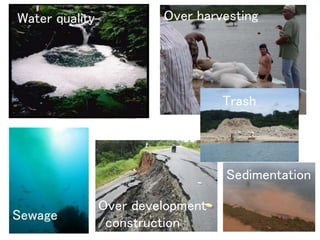
Water quality Over harvesting
Trash
Sedimentation
Over development
/construction
Sewage
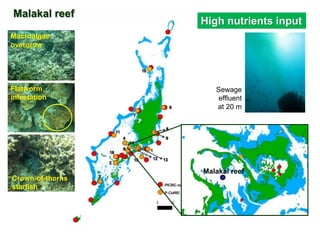
Malakal reef
Sewage
effluent
at 20 m
High nutrients input
Flatworm
infestation
Crown-of-thorns
starfish
Macroalgae
overgrow
Malakal reef
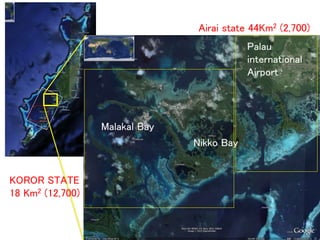
Local Impacts (Sewage)
KOROR STATE
18 Km2 (12,700)
Airai state 44Km2 (2,700)
Palau
international
Airport
Malakal Bay
Nikko Bay
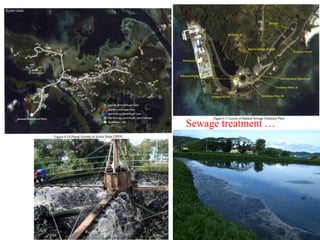
Sewage treatment …
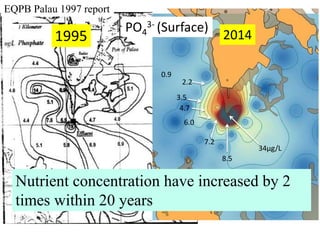
2.2
3.5
2.2
3.5
4.7
6.0
7.2
8.5
34μg/L
1995 2014
PO4
3- (Surface)
0.9
0.0
Nutrient concentration have increased by 2
times within 20 years
EQPB Palau 1997 report
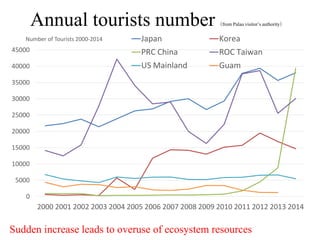
Sudden increase leads to overuse of ecosystem resources
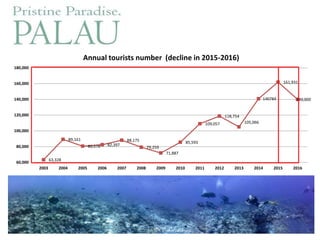
Annual tourists number (from Palau visitor’s authority)
0
5000
10000
15000
20000
25000
30000
35000
40000
45000
2000 2001 2002 2003 2004 2005 2006 2007 2008 2009 2010 2011 2012 2013 2014
Number of Tourists 2000-2014 Japan Korea
PRC China ROC Taiwan
US Mainland Guam
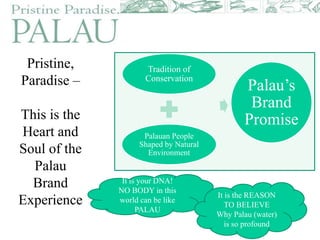
Pristine,
Paradise –
This is the
Heart and
Soul of the
Palau
Brand
Experience
Tradition of
Conservation
Palauan People
Shaped by Natural
Environment
Palau’s
Brand
Promise
It is your DNA!
NO BODY in this
world can be like
PALAU
It is the REASON
TO BELIEVE
Why Palau (water)
is so profound
63,328
89,161
80,578 82,397
88,175
79,259
71,887
85,593
109,057
118,754
105,066
140784
161,931
140,000
60,000
80,000
100,000
120,000
140,000
160,000
180,000
2003 2004 2005 2006 2007 2008 2009 2010 2011 2012 2013 2014 2015 2016
Annual tourists number (decline in 2015-2016)
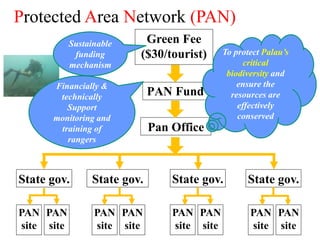
PAN Fund
Pan Office
Green Fee
($30/tourist)
State gov. State gov. State gov.State gov.
PAN
site
PAN
site
PAN
site
PAN
site
PAN
site
PAN
site
PAN
site
PAN
site
To protect Palau’s
critical
biodiversity and
ensure the
resources are
effectively
conserved
Sustainable
funding
mechanism
Protected Area Network (PAN)
Financially &
technically
Support
monitoring and
training of
rangers
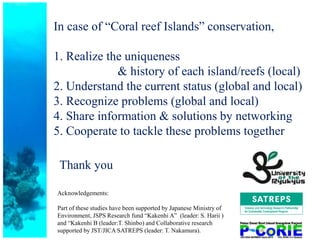
In case of “Coral reef Islands” conservation,
1. Realize the uniqueness
& history of each island/reefs (local)
2. Understand the current status (global and local)
3. Recognize problems (global and local)
4. Share information & solutions by networking
5. Cooperate to tackle these problems together
Acknowledgements:
Part of these studies have been supported by Japanese Ministry of
Environment, JSPS Research fund “Kakenhi A” (leader: S. Harii )
and “Kakenhi B (leader:T. Shinbo) and Collaborative research
supported by JST/JICA SATREPS (leader: T. Nakamura).
Thank you
Thank you for your attention
ありがとうございました
Arigato-gozaimasi-ta

Climate Change and Coral Reefs

  • 1.
    Picture: Tokashiki, KeramaIslands, Okinawa Japan Climate Change and Coral Reefs Nov 4, 2016 Takashi Nakamura Univ. of the Ryukyus takasuke@sci.u-ryukyu.ac.jp
  • 2.
    Outline 1. Basics ofcorals 2. Climate change as the threat to corals “Coral bleaching” 3. Local threats 4. Possible solutions
  • 3.
  • 4.
    Class: AnthozoaClass Scyphozoa Jerry fish Semaeostomeae Coronatae Phylum:Cnidaria Subclass Octocorallia Soft coral Alcyonacea Pink coral Tube coral Stolonifera Blue coral Heriopora Subclass: Hexactinia Sea anemone Actiniaria Zoantharia Class Hydrozoa Anthomedusae Fire coral Milleporidae Order: Scleractinia ~ Common reef-building Corals Coral Taxonomy: Who’s related? 1-1. The taxonomy of coral
  • 5.
    Planula larvae (Planktonic) Coral Biology:Life history Settle on substrate 0.5 mm “Polyp” 0.5 mm Forms “colony” with clones “Spawning” Release Sperms & Eggs 1-2. The Life history of coral
  • 6.
    Coral colony Coral branch Plantor Animal ? Coral reef Polyp Close up View T. Kamiki 100 Photosynthetic algae ‘Zooxanthellae’ 1-3. The Coral –algal symbiosis 1~3 million/㎠ tissue surface
  • 7.
    Symbiosis Amino acid, lipid,O2 Photosynthesis Coral CO2, NH4 + Algae Symbiosis w/ algae ~ A strategy to survive 1-4. The Coral –algal symbiosis ‘Zooxanthellae’ ‘Coral’ provides up to 90 % of host energy requirements (Muscatine 1967, etc.)
  • 8.
    Colonies to reef= habitats for others Leaf-likeEncrusting short-branching Free living Tabulate Branching Massive 1-5. Coral colonies and reef structure
  • 9.
    Why corals areimportant? 2-1. The importance of coral reefs
  • 10.
    of worlds’ coastline of fish species of total fisheries catch 1/6 1/4 1/10 Where coral reefs are located? UNEP (2006) 2-2. World map of Coral reefs
  • 11.
    Ecological aspects Q: Coralreef ~ less than ?% of the Ocean Shelter / Reproduction / Nursery siteFood source More than 25% Of Marine fish species Spalding et. al. (2001) Home to an estimated 2 million species in < 2% of the Ocean 2-3. The importance of coral reefs I
  • 12.
    Tourism Recreation Estimated Economic values >US$ 0.7 million/km2・year UNEP (2006) Fishery Socio-economical aspect Medicine Loss of up to US$ 8200 million for the Indian Ocean was estimated for 1998 mass bleaching event alone 2-4. The importance of coral reefs II
  • 13.
    Source: WRI, Reefsat risk revisited, 2011
  • 14.
    Climate change asthe threat to corals
  • 15.
    “Coral bleaching” Greatest threatsto coral reef ecosystem induced by environmental stresses
  • 16.
    Increase in Seasurface temperature (SST) SSTs in the Pacific, Atlantic and Indian Ocean Highest in the last 40,0000 years Hughes (2003) Increased 0.4~0.7℃ in the last century Trend in the north Pacific Ocean http://www.data.kishou.go.jp/kaiyou/db Year by year difference 5 years average Long-term trend AnnualSSTdifference(℃) Year
  • 17.
    Significant example:Global scale“bleaching” event in 1998 with El Niño Thermal anomaly Regional/global climate change
  • 18.
    Corals growing ina shallow reef area NOW, What’s wrong with this picture? Photograph by Loya Y . Nearly dead corals due to environmental stress Coral reefs are in trouble!! 3-1A. The definition of “Bleaching”
  • 19.
    2007 2008 Enormous damage tothe coral reefs are expected due to the climate change in the next 30 years (4th IPCC Report 2007) (Bellwood et al. 2004) Exponential increase in the last several decades Year Increasing reports and attention to Coral Bleaching Cumulativenumberofbleachingreports
  • 20.
    1. Zooxanthellae areexpelled from the coral hosts (digested) 2. Pigments within zooxanthellae are degraded What happen to corals? “Bleaching” is a stress response that results when the coral-algae relationship breaks down StressColony Colony close up Zooxanthellae 3-1B. The definition of “Bleaching”
  • 21.
    Environmental stress induces“Bleaching” Coral “Bleaching” zooxanthellae Strong light Brown et al. (1994) High water temperature Hoegh-Guldberg & Smith (1998) Viral infection (Kushmaro et al. 1996) UV radiation (Shick 1989) Sedimentation /suffocation Desalinization (VanWoesik et al.1995) Growth inhibition Mortality Corals are Highly sensitive to environmental change Coral Polyp3-2A. The causes of “Bleaching”
  • 22.
    1 hour 2hours 3 hours 4 hours 5 hours 6 hours 7 hours 0 Hour Apply strong light to single polyp of coral colony (at 26 oC) 24 hours 3 days 5 days Polyp’s been bleached Zooxanthellae expelled Bleaching by strong light stress 3-2B. The causes of “Bleaching”
  • 23.
    Bleaching as worldwidethreat Reef Manager’s Guide to Coral Bleaching (2006) 3-3B. Impact of “Bleaching” The incidence and severity of mass coral bleaching events has increased continuously over the last two decades.
  • 24.
    Bleaching as worldwidethreat 3-3B. Impact of “Bleaching” The incidence and severity of mass coral bleaching events has increased continuously over the last two decades. Reef Manager’s Guide to Coral Bleaching (2006)
  • 25.
    Baker et al.(2008) Estuarine, Coastal and Shelf Sciences Documented bleaching events and regions Mass scale Coral Bleaching :Timeline Phuket, Thai June 2010 2010: Mass scale Bleaching in “Coral triangle (from Indian Ocean to Philippines)”; The worst case since 1998 (CNN Oct.21)
  • 26.
    2014-2017 Mass bleachingevents 2014: Guam ~ Northern Marianas, Marshalls, Florida keys 2015: PNG, Fiji, Samoa, Maldives, Indonesia, Caribbean, Panama, Kiribati, Hawaii 2016: French Polynesia, New Caledonia, Fiji, GBR, Japan 2017: Indian Ocean, Kenya, Florida keys
  • 27.
    2014-2017 Mass bleachingevents 2014: Guam ~ Northern Marianas, Marshalls, Florida keys 2015: PNG, Fiji, Samoa, Maldives, Indonesia, Caribbean, Panama, Kiribati, Hawaii 2016: French Polynesia, New Caledonia, Fiji, GBR, Japan 2017: Indian Ocean, Kenya, Florida keys “The worst case” mass scale Bleaching (Source: NOAA bleaching watch)
  • 28.
    Sekisei lagoon, OkinawaJapan Yaeyama Islands Population: 54,000, Area: 592 km2
  • 29.
    NOAA (2016) April MayJune July August September October November December No stress Watch Warning Alert1 Alert 2 2016 NOAA bleaching alert in Ryukyu Archipelago Ave. No. of typhoons approach Yaeyama: ~3.5 typhoons / year No. of typhoons approached in 2016 : 0 typhoon until late September !!
  • 30.
    Example from Okinawamass bleaching this year (Sekisei lagoon) >95% bleached at 35 sites for 10 species out of 11 sampled. >80% mortality in mid Oct. *Worst bleaching impact record since 1998
  • 31.
    Example: Tabular coral98.4% bleached Acropora hyacinthus Tokyo Kyuei © Non-bleached Early bleaching Half bleached Fully bleached Dead
  • 32.
    Sekisei Lagoon (MilkyWay) Sept. 6, 2016
  • 33.
    This year… surveyon these damaged reefs Fecundity of survived colonies: Recruitment density on natural substrate: <20 % of 2016… Recovery potentials of Sekisei coral community are severely impaired
  • 34.
    Post-bleaching- mass mortalityin Sekisei Live coral cover declined from 60% to <5% Average mortality by Bleaching : 70% Live coral cover declined from 50% to <5% Average mortality by Bleaching : 78% Site 23 “Marugoo” Site 30 “Taketomi”
  • 35.
    Sekisei Lagoon (MilkyWay) May. 6, 2017
  • 36.
    Post-bleaching- Algae increasedin Sekisei lagoon Live coral cover (%) Kojima et al. Turf algae cover (%) Macro algae (%) *** *** N/S Live coral cover (%) Turf algae cover (%)
  • 37.
    Increasing trend ofcoral bleaching events is recognized as “clear and present problem” due to climate change Other than climate change… Impacts of Bleaching can be minimized by reducing locally induced stresses such as sedimentation, land reclamation, over harvesting, sewage/pollution etc. However, we still have no sufficient way to reverse the climate change trends and it’s impact to reefs yet.
  • 38.
  • 39.
    Munday et al.(2008) Bleaching impact at Community level Erosion reduces habitat complexity
  • 40.
    Most corals can’tcompete with them especially in nutrient-rich environment Macro/micro algae domination inhibits coral recovery
  • 41.
    How long willit last?
  • 42.
    Yoron Island Kagoshima Prefecture Population:5,400 Area: 20 km2 Impacted by 1998 Mass bleaching event
  • 43.
    Kyuden TerasakiTerasaki- kurohana inner Minata Minata inner AkasakiCoral heads Akasaki Kyanion Tomori Pricia Sea-man’s inner Sea-man’s Ohganeku coast Sites (14 total) Fu-sha East
  • 44.
    Kyuden TerasakiTerasaki- kurohana inner Minata Minata inner AkasakiCoral heads Akasaki Kyanion Tomori Pricia Sea-man’s inner Sea-man’s Ohganeku coast Sites (14 total) Fu-sha East
  • 45.
    Outer reef: Highcoral cover in 2016 Corals Soft corals Macro algae Turf algae Lime stone Sand K. Kojima (Msc. Thesis)
  • 46.
    1960’s 1980’s Inner reef: verylow coral cover Corals Soft corals Macro algae Turf algae Lime stone Sand 2010’s K. Kojima (Msc. Thesis)
  • 47.
    Why ?? Not muchhope for lagoon
  • 48.
    What we shouldworry? “What we might overlooked in the field?”
  • 49.
    Density of coralrecruits (juveniles) as “indicator for coral community recovery” 1 year old Acroporid recruitment ・Density per a Quadrat (1 m x 1 m x 10 /site) 1 year old colony on settlement tile 12.3㎜ in diameter
  • 50.
    Acroporid recruitment densityat each site(1 year +2 years)Yoron Is. Too low to recover !! Outer reefs (9 sites) Inner reefs (5 sites) Not much hope for inner reefs…
  • 51.
    Fertilizer for sugarcanefield Raw sewage of stock raising Porous limestone substrate ⇒ Sub-ground water seeps into lagoon Chronic input of: Nitrogen & Phosphate to semi-enclosed lagoon system Geo-social characteristics of Yoron Is. Major industry: Agriculture/farming, tourism and fisheries.
  • 52.
    Nutrient impacts oncoral recruitment Planul a larvae Gametes from mature colony of A. digitifera Can terrestrial impacts (e.g., nutrient input) inhibit recuritments’settlement and survival? K. Kojima (Msc. Thesis)
  • 53.
    Lower settlement &survival under nutrient rich treatments n=6 0 10 20 30 40 50 Settlement&survival(%) Exposure to combined (N) and(P) Treatmen t Exposure to (N) and(P) separately K. Kojima (Msc. Thesis)
  • 54.
    How larvae settlement& survival suppressed?Normal polyp (in control seawater) 500 µm 500 µm K. Kojima (Msc. Thesis)
  • 55.
    NASA GISS: Globaltemp anomaly report 2016 Sea water temperature will continue to rise World temperature deviation in Sept. (baseline: 1951-1980) Temperaturedeviation
  • 56.
  • 57.
    Possible solutions ? Lookingfor tolerant/robust colonies (host coral/zooxanthellae) “Super-coral” projects (US, Australia, Japan etc.) Transplantation to natural coral reefs to form robust community Limited species, locations…
  • 58.
    Permeable substrate (carbonate limestone) Corals Thermal exchangers Sub-coolerwater (saltwater) conditioning Project Impermeable layer Permeable Formation (Limestone) Heat PumpUnderground seawater (cooler !!) Possible solutions ? Geo-engineering approach Corals Corals
  • 59.
    Direct cooling systemtested in Samoa, 2009 Provided 1℃ cooler seawater to the lagoon area Before Recovery from bleaching Von Herzen et al. (2012) Supported by; Pacific Island Climate Change Cooperative US Fish and Wildlife Service Department of Marine & Wildlife Resources Federal Aviation Administration American Samoa Power Authority US Geological Survey (Santa Cruz) Cooled area Ambient Limited for small scale…
  • 60.
    What we cando? Reduce local stress !! Global climate impacts are likely amplified by local stresses Deforestation & poor land use ⇒Sedimentation + more nutrient Sewage or nutrient runoff ⇒ Pollution + more nutrient
  • 61.
    Increasing nutrient levelin coral reef environment: may impair recovery potentials from thermal disturbance: Lower resilience Threshold nutrient level for coral reef ecosystem should be much lower than temperate ecosystems….
  • 62.
    Soil erosion andsedimentation Chemical pollution Detergents, Herbicides, Fertilizers etc. Overexploitation Visible anthropogenic disturbances
  • 63.
  • 64.
    Also, shoreline alterations:Breakwater Natural: < 60% Altered: artificial: 27% semi- artificial:13% (source: Ministry of environment survey in 1982)
  • 65.
    Even straightening drainage channels: Alterationsof land-sea connections (functional loss for bioremediation)
  • 66.
    Local level problem: Sourcesof Chronic and Less visible changes embedded within our islands, social systems and infrastructures
  • 67.
    Human disturbances canbe realized as; Visible phenomena (Technically) Detectable factors Can we really tackle the problems ?
  • 68.
    1960 in Kitakyushu2010 Importance of environment was realized during the 1960s’ due to severe pollution–related health disasters In 1960’s Source: Kitakyushu city office Human disturbances to coastal ecosystems in mainland Japan
  • 69.
    What about coastsin subtropical islands? Human disturbances can also be realized as; Visible phenomena (Technically) Detectable factors Human disturbances to coastal ecosystems in Subtropics
  • 70.
  • 71.
    Republic of Palau Coralreef Island country (>500 islands) Population:20,000+ Tourists:110,000~130,000/year Country size:488km2 Coastal length :629,000km Main industry: Tourism/fishery
  • 72.
  • 73.
    High coral cover Mean coralcover 4.2% ~ 89.3% German Channel Ngaremlengui Ngerdiluches Ngaremlengui Ngerdiluches German Channel 55.0% 5.2% 85.8% Ngelukes – 2 sites Airai Uchelbeluu Uchelbeluu Airai Ngelukes Ngelukes_river 75.8% 75.8% 54.2% 4.2% Nikko 1 & 3 Malakal Taoch 3 Cementary Reef Jake Seaplane PICRC PICRCNikko3Nikko1 Jake Seaplane Malakal Taoch 3 Cementary Reef 89.27%78.3% 65.3% 75.0% 71.7% 80.0% 79.2% Typhoon impacts
  • 74.
    Water quality Overharvesting Trash Sedimentation Over development /construction Sewage
  • 75.
    Malakal reef Sewage effluent at 20m High nutrients input Flatworm infestation Crown-of-thorns starfish Macroalgae overgrow Malakal reef
  • 76.
    Local Impacts (Sewage) KORORSTATE 18 Km2 (12,700) Airai state 44Km2 (2,700) Palau international Airport Malakal Bay Nikko Bay
  • 77.
  • 78.
    2.2 3.5 2.2 3.5 4.7 6.0 7.2 8.5 34μg/L 1995 2014 PO4 3- (Surface) 0.9 0.0 Nutrientconcentration have increased by 2 times within 20 years EQPB Palau 1997 report
  • 79.
    Sudden increase leadsto overuse of ecosystem resources Annual tourists number (from Palau visitor’s authority) 0 5000 10000 15000 20000 25000 30000 35000 40000 45000 2000 2001 2002 2003 2004 2005 2006 2007 2008 2009 2010 2011 2012 2013 2014 Number of Tourists 2000-2014 Japan Korea PRC China ROC Taiwan US Mainland Guam
  • 81.
    Pristine, Paradise – This isthe Heart and Soul of the Palau Brand Experience Tradition of Conservation Palauan People Shaped by Natural Environment Palau’s Brand Promise It is your DNA! NO BODY in this world can be like PALAU It is the REASON TO BELIEVE Why Palau (water) is so profound
  • 82.
  • 83.
    PAN Fund Pan Office GreenFee ($30/tourist) State gov. State gov. State gov.State gov. PAN site PAN site PAN site PAN site PAN site PAN site PAN site PAN site To protect Palau’s critical biodiversity and ensure the resources are effectively conserved Sustainable funding mechanism Protected Area Network (PAN) Financially & technically Support monitoring and training of rangers
  • 84.
    In case of“Coral reef Islands” conservation, 1. Realize the uniqueness & history of each island/reefs (local) 2. Understand the current status (global and local) 3. Recognize problems (global and local) 4. Share information & solutions by networking 5. Cooperate to tackle these problems together Acknowledgements: Part of these studies have been supported by Japanese Ministry of Environment, JSPS Research fund “Kakenhi A” (leader: S. Harii ) and “Kakenhi B (leader:T. Shinbo) and Collaborative research supported by JST/JICA SATREPS (leader: T. Nakamura). Thank you
  • 85.
    Thank you foryour attention ありがとうございました Arigato-gozaimasi-ta