Benefits and Costs Experienced by Communities
living next to Amboseli National Park and
Kimana Conservancy in Kenya
Dr. Margaret Wachu Gichuhi
Research Fellow (Environment &
Climate Change)
Email: mgichuhi@jkuat.ac.ke
Jomo Kenyatta University of Agriculture
and Technology, P.O BOX 62000-
00200,Nairobi,Kenya.
• 8% of Kenya’s biodiversity is conserved through National Parks (NP), Reserves and
Sanctuaries
• Conservation areas serve as;
breeding grounds, wildlife dispersal areas and corridors
protected area buffer zones, eco-tourism and recreation facilities
habitats for wildlife and endemic species, education and research
• Communities’ negative perception of conservation areas is due to human-wildlife
conflicts and the need to share resources equitably
• Amboseli National Park and Kimana Community Conservancy are located in Rift
Valley Province, Loitokitok District, Kenya
Burning Issue: Linking Conservation to
Community Benefits
• Swamps and riverine areas are suitable for agriculture; the range is suitable for wildlife and
pastoralism
• Kimana area has been used by the Maasai pastoral community to graze their livestock on a
communal basis
• Non-maasai migrants have permanent agricultural fields around the Ranch’s important
wetland areas leading to conflict over water
• The aim is to assess the benefits of involving community members in the management of
Amboseli National Park and Kimana Conservancy
• The specific objectives are; to analyze the public benefits and costs associated with the
conservation area
• Secondly, to assess the degree of community involvement in conservation management
Contd.
• Primary data comprised questionnaires and interviews for household surveys
• Questionnaires for household surveys were close-ended and with checklist options
• Direct observations were used to clarify information from the respondents
• Most households falling within the buffer zones were interviewed
• Random and purposeful sampling was used to identify and select respondents
• Purposeful sampling was used where a population was represented by a cluster
• Secondary data was also used
• Sample size ; Kothari (2004), Amboseli NP (n = 577, n=40, sample size used), Kimana (n =
642.6 n=34, sample size used
• Data analysis: data was analyzed using the Statistical Package for the Social Sciences
(SPSS 9.0)
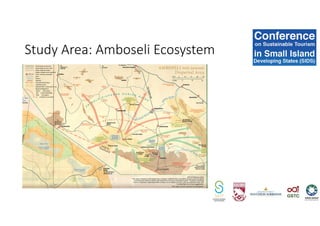
Study Area: Amboseli Ecosystem
• The process of data analysis involved checking of erroneous data and making corrections
• Variable types were defined, coded data was transformed and frequency tables created
• Data was checked using frequency counts, descriptive statistics and measures of
associations and relationships
• Pearson’s correlation was used to measure how variables or rank orders are related
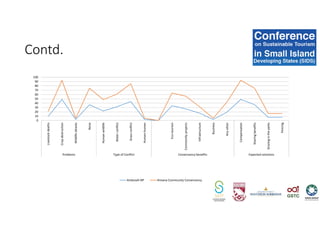
• 34% of respondents living next to Amboseli National Park and 32% of the respondents
next to Kimana preferred livestock keeping
• 48% of the respondents living next to Amboseli and 50% living next to Kimana owned
land individually
• 68% of the respondents living next to Amboseli and 68% living next to Kimana indicated
that resources were not well distributed
• 34% of the respondents living next to Amboseli Park and 35% living next to
Kimana indicated a reduction in forest cover
• 49% in Amboseli and 44% of the respondents in Kimana experienced crop
destruction from wild animals.
• 34% of the respondents living next to Amboseli and 29% in Kimana identified eco-
tourism as the main conservation benefit
• 48% and 43% of the respondents living next to Amboseli NP and Kimana
identified compensation as the best solutions to human - wildlife conflicts
Contd.
• Conservancy benefits and expected solutions has a significant correlation (r = .141,
P < 0.000, n = 659) at (0.05level) and at 95% confidence level
• Type of conflict and conservation benefits has a correlation of (r = 0.201, P < 0.000,
n = 659) at 0.05 level
• There is a symbiotic relationship between communities and benefits from
conservation areas where there are no conflicts
• An increase in conservancy benefits such as eco-tourism, community projects and
infrastructure changes community’s perception to Wildlife conservation
• Type of wild animal attacks and conservation benefits has a negative correlation of
(r = -0.118, P < 0.000, n = 659) at 0.05 level
Contd.
Contd.
0
10
20
30
40
50
60
70
80
90
100
Livestockdeaths
Cropdestruction
Wildlifeattacks
None
Human-wildlife
Waterconflict
Grassconflict
Human-human
Eco-tourism
Communityprojects
Infrastructure
Business
Anyother
Compensation
Sharingbenefits
Grazingintheparks
Fencing
Problems Type of Conflict Conservancy benefits Expected solutions
Amboseli NP Kimana Community Conservancy
• Socio-economic and socio-cultural aspects influenced community’s livelihoods and use of
available resources
• Benefits received by communities were eco-tourism, community projects, infrastructure
development and business activities
• Communities that practiced livestock keeping and owned conservancies received more
benefits and experienced minimal human – wildlife conflicts
• Communities should benefit economically from conservation areas
• Frequent stakeholder consultations with communities to improve the governance of
resources and increase appreciation of wildlife resources
• Conflict resolution measures i.e sharing of resources to improve the ratings of
conservation areas by the communities
• Education awareness programs and management plans should be fully
implemented
• Local communities should be involved in the decision making process.
• Resource inventories for biodiversity should be updated frequently
• Inspiration:
The wildlife conservation areas will benefit from community appreciation of
wildlife resources leading to improved conservation
Contd.
• Policies on land uses in ASALS to incorporate community
conservancies for sustainable use of rangelands
• Research on Marine parks and reserves to assess the resources,
impacts and community involvement in conservation
• Integrate climate mitigation and adaptation strategies in resource use
and conservation

Session6 02 Margaret Wachu Gichuhi

  • 1.
    Benefits and CostsExperienced by Communities living next to Amboseli National Park and Kimana Conservancy in Kenya Dr. Margaret Wachu Gichuhi Research Fellow (Environment & Climate Change) Email: mgichuhi@jkuat.ac.ke Jomo Kenyatta University of Agriculture and Technology, P.O BOX 62000- 00200,Nairobi,Kenya.
  • 2.
    • 8% ofKenya’s biodiversity is conserved through National Parks (NP), Reserves and Sanctuaries • Conservation areas serve as; breeding grounds, wildlife dispersal areas and corridors protected area buffer zones, eco-tourism and recreation facilities habitats for wildlife and endemic species, education and research • Communities’ negative perception of conservation areas is due to human-wildlife conflicts and the need to share resources equitably • Amboseli National Park and Kimana Community Conservancy are located in Rift Valley Province, Loitokitok District, Kenya Burning Issue: Linking Conservation to Community Benefits
  • 3.
    • Swamps andriverine areas are suitable for agriculture; the range is suitable for wildlife and pastoralism • Kimana area has been used by the Maasai pastoral community to graze their livestock on a communal basis • Non-maasai migrants have permanent agricultural fields around the Ranch’s important wetland areas leading to conflict over water • The aim is to assess the benefits of involving community members in the management of Amboseli National Park and Kimana Conservancy • The specific objectives are; to analyze the public benefits and costs associated with the conservation area • Secondly, to assess the degree of community involvement in conservation management Contd.
  • 4.
    • Primary datacomprised questionnaires and interviews for household surveys • Questionnaires for household surveys were close-ended and with checklist options • Direct observations were used to clarify information from the respondents • Most households falling within the buffer zones were interviewed • Random and purposeful sampling was used to identify and select respondents • Purposeful sampling was used where a population was represented by a cluster • Secondary data was also used • Sample size ; Kothari (2004), Amboseli NP (n = 577, n=40, sample size used), Kimana (n = 642.6 n=34, sample size used • Data analysis: data was analyzed using the Statistical Package for the Social Sciences (SPSS 9.0)
  • 5.
  • 6.
    • The processof data analysis involved checking of erroneous data and making corrections • Variable types were defined, coded data was transformed and frequency tables created • Data was checked using frequency counts, descriptive statistics and measures of associations and relationships • Pearson’s correlation was used to measure how variables or rank orders are related • 34% of respondents living next to Amboseli National Park and 32% of the respondents next to Kimana preferred livestock keeping • 48% of the respondents living next to Amboseli and 50% living next to Kimana owned land individually • 68% of the respondents living next to Amboseli and 68% living next to Kimana indicated that resources were not well distributed
  • 7.
    • 34% ofthe respondents living next to Amboseli Park and 35% living next to Kimana indicated a reduction in forest cover • 49% in Amboseli and 44% of the respondents in Kimana experienced crop destruction from wild animals. • 34% of the respondents living next to Amboseli and 29% in Kimana identified eco- tourism as the main conservation benefit • 48% and 43% of the respondents living next to Amboseli NP and Kimana identified compensation as the best solutions to human - wildlife conflicts Contd.
  • 8.
    • Conservancy benefitsand expected solutions has a significant correlation (r = .141, P < 0.000, n = 659) at (0.05level) and at 95% confidence level • Type of conflict and conservation benefits has a correlation of (r = 0.201, P < 0.000, n = 659) at 0.05 level • There is a symbiotic relationship between communities and benefits from conservation areas where there are no conflicts • An increase in conservancy benefits such as eco-tourism, community projects and infrastructure changes community’s perception to Wildlife conservation • Type of wild animal attacks and conservation benefits has a negative correlation of (r = -0.118, P < 0.000, n = 659) at 0.05 level Contd.
  • 9.
  • 10.
    • Socio-economic andsocio-cultural aspects influenced community’s livelihoods and use of available resources • Benefits received by communities were eco-tourism, community projects, infrastructure development and business activities • Communities that practiced livestock keeping and owned conservancies received more benefits and experienced minimal human – wildlife conflicts • Communities should benefit economically from conservation areas • Frequent stakeholder consultations with communities to improve the governance of resources and increase appreciation of wildlife resources
  • 11.
    • Conflict resolutionmeasures i.e sharing of resources to improve the ratings of conservation areas by the communities • Education awareness programs and management plans should be fully implemented • Local communities should be involved in the decision making process. • Resource inventories for biodiversity should be updated frequently • Inspiration: The wildlife conservation areas will benefit from community appreciation of wildlife resources leading to improved conservation Contd.
  • 12.
    • Policies onland uses in ASALS to incorporate community conservancies for sustainable use of rangelands • Research on Marine parks and reserves to assess the resources, impacts and community involvement in conservation • Integrate climate mitigation and adaptation strategies in resource use and conservation