The Hunting Ban & Its Aftermath:
Poverty & Biodiversity
Joseph E. Mbaiwa, PhD
University of Botswana
Okavango Research Institute
Private Bag 285
Maun, Botswana
• Global participation in hunting as a tourism activity has been on the
decline since the recent past (MacKay & Campbell, 2004).
• This is partly because of an increase in opposition to hunting as a
legitimate activity and attacks by anti-hunting groups (Baker 1997;
MacKay & Campbell 2004).
• Opponents of hunting argue that the killing of animals is not only
immoral and abhorrent, but also that hunting by tourists will result in
the extinction of even more animal species (Baker, 1997).
Burning Issue
• Animal rights and welfare groups also oppose hunting due to a
fundamental rejection of the concept of “killing animals for sport” (Finch,
2004).
• Conversely, proponents of hunting argue that hunting is controlled, has
more financial benefits than photographic tourism, and that selective
hunting of overpopulated herds is a form of culling that is imperative to
biodiversity conservation (Baker, 1997).
• The discussion concerning trophy hunting is polarized, with animal rights
groups and protectionists on one side, and hunters and pragmatic
conservationists on the other (Hutton & Leader-Williams, 2003; Loveridge
et al., 2006).
Burning Issue
• This polarization is exacerbated by a lack of reliable data on the impact of trophy
hunting on wildlife conservation.
• Most of the information on trophy hunting especially in Africa occurs in
unpublished grey literature. The discussion of hunting in the popular media is
sometimes emotive than based on any scientific data.
• Negative articles about hunting include: ‘‘Lions face new threat: They’re rich,
Americans and they’ve got guns’’ (The Guardian [UK], November 2001),
‘‘Slaughter on safari’’ (Mail on Sunday [UK], 2 April 2006) and ‘‘Clamp down on
eco-thugs’’ (Mail & Guardian [South Africa] May 2006).
Burning Issue
• Likewise, some pro-hunting activists make sweeping statements concerning the
positive role of hunting in conservation such as the suggestion that ‘‘without
hunting wildlife would disappear’’ without providing genuine contributions to
conservation (Baldus & Cauldwell, 2004).
• There is a lack of consensus among conservation NGOs and some African
governments (notably Kenya) over the acceptability and effectiveness of
“hunting as a conservation tool” (Wilkie & Carpenter, 1999; Mayaka et al.,
2004).
• Botswana is one of the few African countries still endowed with a variety of
natural resources, of which wildlife are a major component.
Burning Issue
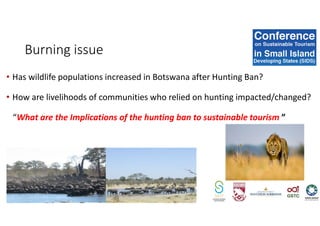
• Has wildlife populations increased in Botswana after Hunting Ban?
• How are livelihoods of communities who relied on hunting impacted/changed?
“What are the Implications of the hunting ban to sustainable tourism ”
Burning issue
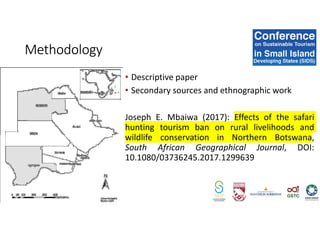
• Descriptive paper

• Secondary sources and ethnographic work
Joseph E. Mbaiwa (2017): Effects of the safari
hunting tourism ban on rural livelihoods and
wildlife conservation in Northern Botswana,
South African Geographical Journal, DOI:
10.1080/03736245.2017.1299639
Methodology
“Hunting ban caused 200 job losses”….
The recent hunting ban of January 2014 by the MEWT has left
community trusts in the Ngamiland district bankrupt.
According to officials Trusts have already lost money amounting to P7
million in the last twelve months because of the hunting ban. They also
explain that close to 200 jobs have been lost as a result of the ban, and
there are fears that more retrenchments could come.
Findings …. The Weekendpost..22 Dec 2014
• A report prepared by the Ngamiland trusts indicate that:
Mababe Zokotsama Community Development Trust had an income
drop from P3.5 million to P500 000 - and shedding around 30 jobs;
Sankoyo Tshwaragano Management Trust’s income dropped from
P3.5 million to P1.8 million, experiencing 35 job losses;
Okavango Kopano Mokoro Community Trust’s income fell from P4.8
million to P2.5 million and about 40 people lost their jobs.
Seronga/Gudigwa, Phuduhudu and Xaixai experienced job losses
totaling to about 80 jobs.
Findings – CBNRM Forum (2014)
Ecosurv (2014) reports that in the Boteti are, the following resulted:
a) social: 4800 livelihoods affected; loss of meat supply from hunting
and photographic in marginal areas has not replaced lost jobs;
b) Economic: in excess of P40 million lost annually (over 6 months) by
communities; in excess of 600 jobs lost;
Findings - Ecosurv (2014)
Findings – Revenue & Job Looses
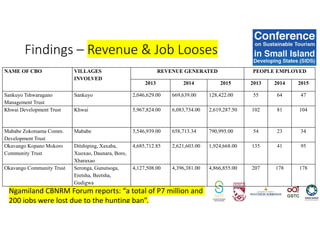
Ngamiland CBNRM Forum reports: “a total of P7 million and
200 jobs were lost due to the hunting ban”.
NAME OF CBO VILLAGES
INVOLVED
REVENUE GENERATED PEOPLE EMPLOYED
2013 2014 2015 2013 2014 2015
Sankuyo Tshwaragano
Management Trust
Sankuyo 2,046,629.00 669,639.00 128,422.00 55 64 47
Khwai Development Trust Khwai 5,967,824.00 6,083,734.00 2,619,287.50 102 81 104
Mababe Zokotsama Comm.
Development Trust
Mababe 3,546,939.00 658,713.34 790,995.00 54 23 34
Okavango Kopano Mokoro
Community Trust
Ditshiping, Xaxaba,
Xuoxao, Daunara, Boro,
Xharaxao
4,685,712.85 2,621,603.00 1,924,668.00 135 41 95
Okavango Community Trust Seronga, Gunutsoga,
Eretsha, Beetsha,
Gudigwa
4,127,508.00 4,396,381.00 4,866,855.00 207 178 178
• DWNP reports that “Problem Animal control conflicts recorded nationwide
rose to 6,770 in 2014 from 4,361 in 2012”
• Local communities even in some CBNRM communities are developing
negative attitudes towards conservation .
• Resource conflicts added to resource degradation since local people felt not
obliged to conserve resources which they do not derive any benefits from.
Findings – Increased Conflicts
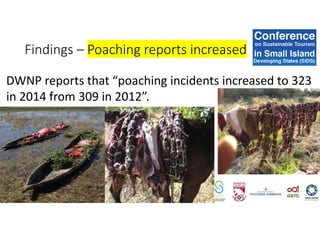
DWNP reports that “poaching incidents increased to 323
in 2014 from 309 in 2012”.
Findings – Poaching reports increased
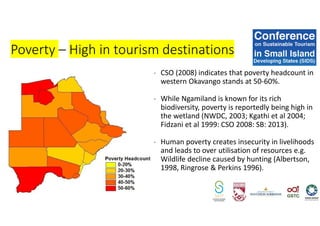
- CSO (2008) indicates that poverty headcount in
western Okavango stands at 50-60%.
- While Ngamiland is known for its rich
biodiversity, poverty is reportedly being high in
the wetland (NWDC, 2003; Kgathi et al 2004;
Fidzani et al 1999: CSO 2008: SB: 2013).
- Human poverty creates insecurity in livelihoods
and leads to over utilisation of resources e.g.
Wildlife decline caused by hunting (Albertson,
1998, Ringrose & Perkins 1996).
Poverty – High in tourism destinations
• Chambers (1986) notes that poverty is…………is also an enemy of the environment.
• Chambers argues that in many parts of the world, growing numbers of poor people have
inevitably led to the degradation of the environment each day just to make ends meet.
• Poverty thus result in a constant conflict between local people & government over
natural resources – this leads to resource degradation.
• It is unlikely, therefore, that people living in poverty to promote conservation…………..!!!
• ……..identity…sense of place….and personal history are important for any people……..
• Hunting defines the lives of people in that particular area….
Implications – environmental degradation
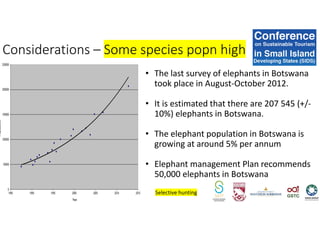
• The last survey of elephants in Botswana
took place in August-October 2012.
• It is estimated that there are 207 545 (+/-
10%) elephants in Botswana.
• The elephant population in Botswana is
growing at around 5% per annum
• Elephant management Plan recommends
50,000 elephants in Botswana
Considerations – Some species popn high
Selective hunting
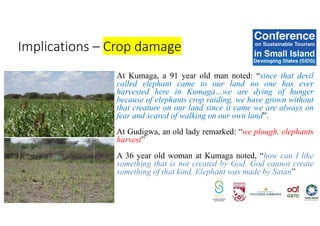
At Kumaga, a 91 year old man noted: “since that devil
called elephant came to our land no one has ever
harvested here in Kumaga…we are dying of hunger
because of elephants crop raiding, we have grown without
that creature on our land since it came we are always on
fear and scared of walking on our own land”.
At Gudigwa, an old lady remarked: “we plough, elephants
harvest”
A 36 year old woman at Kumaga noted, “how can I like
something that is not created by God. God cannot create
something of that kind. Elephant was made by Satan”
Implications – Crop damage
• Kenya banned hunting in 1977. Between 1977 and 1996, Kenya
experienced a 40% decline in wildlife populations, both within and outside
of its national parks (Scott, 2013).
• Kenya's wildlife numbers have continued to fall with wildlife numbers today being
less than half of that which existed before the ban (Scott, 2013).
• Likewise, the 2001–2003 ban on safari hunting in Zambia resulted in an upsurge
in poaching due to the removal of incentives for conservation (Lewis & Jackson,
2005).
• Therefore, a ban on safari hunting does not necessarily halt decline in wildlife
populations, instead it can escalate it.
Contribution : Hunting ban is not necessarily a
sustainable management tool
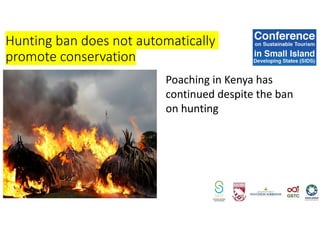
Poaching in Kenya has
continued despite the ban
on hunting
Hunting ban does not automatically
promote conservation
Trophy hunting as a conservation tool
Revenues from trophy hunting have resulted in improved attitudes
towards wildlife among local communities, increased involvement of
communities in CBO programs, requests to have land included in wildlife
management projects, and in some cases increasing wildlife populations
Financial incentives for conservation
• Photo-tourism is an important contributor to GDP and to conservation
efforts but it is not a PANACEA to rural development and conservation
challenges in Botswana.
Implications - wayforward
• Lindsey (2010) argues that in Sub-Saharan Africa, safari hunting
generates 15% of tourism revenues from only 1% of tourist arrivals,
making it one of the lowest impact forms of tourism in Botswana.
• Lindsey (2010) also notes that safari hunting typically focuses on
male animals and results in the removal of 2-5% of ungulate
populations and generally has minimal impact on the viability of
wildlife populations, indicating that the quotas for most species are
sustainable.
Implications
• Hunting of particular species should be allowed e.g. elephants;
• Surveys and Data on wildlife populations should be carried out annually;
• Human-wildlife Conflicts, poverty and related livelihoods and conservation
issues need stakeholder attention
• Decision making on ecological issues should be informed by science and all
stakeholders should be involved in the process-bottom up approach in DM.
Way forward

Session6 04 Joseph Mbaiwa

  • 1.
    The Hunting Ban& Its Aftermath: Poverty & Biodiversity Joseph E. Mbaiwa, PhD University of Botswana Okavango Research Institute Private Bag 285 Maun, Botswana
  • 2.
    • Global participationin hunting as a tourism activity has been on the decline since the recent past (MacKay & Campbell, 2004). • This is partly because of an increase in opposition to hunting as a legitimate activity and attacks by anti-hunting groups (Baker 1997; MacKay & Campbell 2004). • Opponents of hunting argue that the killing of animals is not only immoral and abhorrent, but also that hunting by tourists will result in the extinction of even more animal species (Baker, 1997). Burning Issue
  • 3.
    • Animal rightsand welfare groups also oppose hunting due to a fundamental rejection of the concept of “killing animals for sport” (Finch, 2004). • Conversely, proponents of hunting argue that hunting is controlled, has more financial benefits than photographic tourism, and that selective hunting of overpopulated herds is a form of culling that is imperative to biodiversity conservation (Baker, 1997). • The discussion concerning trophy hunting is polarized, with animal rights groups and protectionists on one side, and hunters and pragmatic conservationists on the other (Hutton & Leader-Williams, 2003; Loveridge et al., 2006). Burning Issue
  • 4.
    • This polarizationis exacerbated by a lack of reliable data on the impact of trophy hunting on wildlife conservation. • Most of the information on trophy hunting especially in Africa occurs in unpublished grey literature. The discussion of hunting in the popular media is sometimes emotive than based on any scientific data. • Negative articles about hunting include: ‘‘Lions face new threat: They’re rich, Americans and they’ve got guns’’ (The Guardian [UK], November 2001), ‘‘Slaughter on safari’’ (Mail on Sunday [UK], 2 April 2006) and ‘‘Clamp down on eco-thugs’’ (Mail & Guardian [South Africa] May 2006). Burning Issue
  • 5.
    • Likewise, somepro-hunting activists make sweeping statements concerning the positive role of hunting in conservation such as the suggestion that ‘‘without hunting wildlife would disappear’’ without providing genuine contributions to conservation (Baldus & Cauldwell, 2004). • There is a lack of consensus among conservation NGOs and some African governments (notably Kenya) over the acceptability and effectiveness of “hunting as a conservation tool” (Wilkie & Carpenter, 1999; Mayaka et al., 2004). • Botswana is one of the few African countries still endowed with a variety of natural resources, of which wildlife are a major component. Burning Issue
  • 6.
    • Has wildlifepopulations increased in Botswana after Hunting Ban? • How are livelihoods of communities who relied on hunting impacted/changed? “What are the Implications of the hunting ban to sustainable tourism ” Burning issue
  • 7.
    • Descriptive paper
 •Secondary sources and ethnographic work Joseph E. Mbaiwa (2017): Effects of the safari hunting tourism ban on rural livelihoods and wildlife conservation in Northern Botswana, South African Geographical Journal, DOI: 10.1080/03736245.2017.1299639 Methodology
  • 8.
    “Hunting ban caused200 job losses”…. The recent hunting ban of January 2014 by the MEWT has left community trusts in the Ngamiland district bankrupt. According to officials Trusts have already lost money amounting to P7 million in the last twelve months because of the hunting ban. They also explain that close to 200 jobs have been lost as a result of the ban, and there are fears that more retrenchments could come. Findings …. The Weekendpost..22 Dec 2014
  • 9.
    • A reportprepared by the Ngamiland trusts indicate that: Mababe Zokotsama Community Development Trust had an income drop from P3.5 million to P500 000 - and shedding around 30 jobs; Sankoyo Tshwaragano Management Trust’s income dropped from P3.5 million to P1.8 million, experiencing 35 job losses; Okavango Kopano Mokoro Community Trust’s income fell from P4.8 million to P2.5 million and about 40 people lost their jobs. Seronga/Gudigwa, Phuduhudu and Xaixai experienced job losses totaling to about 80 jobs. Findings – CBNRM Forum (2014)
  • 10.
    Ecosurv (2014) reportsthat in the Boteti are, the following resulted: a) social: 4800 livelihoods affected; loss of meat supply from hunting and photographic in marginal areas has not replaced lost jobs; b) Economic: in excess of P40 million lost annually (over 6 months) by communities; in excess of 600 jobs lost; Findings - Ecosurv (2014)
  • 11.
    Findings – Revenue& Job Looses Ngamiland CBNRM Forum reports: “a total of P7 million and 200 jobs were lost due to the hunting ban”. NAME OF CBO VILLAGES INVOLVED REVENUE GENERATED PEOPLE EMPLOYED 2013 2014 2015 2013 2014 2015 Sankuyo Tshwaragano Management Trust Sankuyo 2,046,629.00 669,639.00 128,422.00 55 64 47 Khwai Development Trust Khwai 5,967,824.00 6,083,734.00 2,619,287.50 102 81 104 Mababe Zokotsama Comm. Development Trust Mababe 3,546,939.00 658,713.34 790,995.00 54 23 34 Okavango Kopano Mokoro Community Trust Ditshiping, Xaxaba, Xuoxao, Daunara, Boro, Xharaxao 4,685,712.85 2,621,603.00 1,924,668.00 135 41 95 Okavango Community Trust Seronga, Gunutsoga, Eretsha, Beetsha, Gudigwa 4,127,508.00 4,396,381.00 4,866,855.00 207 178 178
  • 12.
    • DWNP reportsthat “Problem Animal control conflicts recorded nationwide rose to 6,770 in 2014 from 4,361 in 2012” • Local communities even in some CBNRM communities are developing negative attitudes towards conservation . • Resource conflicts added to resource degradation since local people felt not obliged to conserve resources which they do not derive any benefits from. Findings – Increased Conflicts
  • 13.
    DWNP reports that“poaching incidents increased to 323 in 2014 from 309 in 2012”. Findings – Poaching reports increased
  • 14.
    - CSO (2008)indicates that poverty headcount in western Okavango stands at 50-60%. - While Ngamiland is known for its rich biodiversity, poverty is reportedly being high in the wetland (NWDC, 2003; Kgathi et al 2004; Fidzani et al 1999: CSO 2008: SB: 2013). - Human poverty creates insecurity in livelihoods and leads to over utilisation of resources e.g. Wildlife decline caused by hunting (Albertson, 1998, Ringrose & Perkins 1996). Poverty – High in tourism destinations
  • 15.
    • Chambers (1986)notes that poverty is…………is also an enemy of the environment. • Chambers argues that in many parts of the world, growing numbers of poor people have inevitably led to the degradation of the environment each day just to make ends meet. • Poverty thus result in a constant conflict between local people & government over natural resources – this leads to resource degradation. • It is unlikely, therefore, that people living in poverty to promote conservation…………..!!! • ……..identity…sense of place….and personal history are important for any people…….. • Hunting defines the lives of people in that particular area…. Implications – environmental degradation
  • 16.
    • The lastsurvey of elephants in Botswana took place in August-October 2012. • It is estimated that there are 207 545 (+/- 10%) elephants in Botswana. • The elephant population in Botswana is growing at around 5% per annum • Elephant management Plan recommends 50,000 elephants in Botswana Considerations – Some species popn high Selective hunting
  • 17.
    At Kumaga, a91 year old man noted: “since that devil called elephant came to our land no one has ever harvested here in Kumaga…we are dying of hunger because of elephants crop raiding, we have grown without that creature on our land since it came we are always on fear and scared of walking on our own land”. At Gudigwa, an old lady remarked: “we plough, elephants harvest” A 36 year old woman at Kumaga noted, “how can I like something that is not created by God. God cannot create something of that kind. Elephant was made by Satan” Implications – Crop damage
  • 18.
    • Kenya bannedhunting in 1977. Between 1977 and 1996, Kenya experienced a 40% decline in wildlife populations, both within and outside of its national parks (Scott, 2013). • Kenya's wildlife numbers have continued to fall with wildlife numbers today being less than half of that which existed before the ban (Scott, 2013). • Likewise, the 2001–2003 ban on safari hunting in Zambia resulted in an upsurge in poaching due to the removal of incentives for conservation (Lewis & Jackson, 2005). • Therefore, a ban on safari hunting does not necessarily halt decline in wildlife populations, instead it can escalate it. Contribution : Hunting ban is not necessarily a sustainable management tool
  • 19.
    Poaching in Kenyahas continued despite the ban on hunting Hunting ban does not automatically promote conservation
  • 20.
    Trophy hunting asa conservation tool Revenues from trophy hunting have resulted in improved attitudes towards wildlife among local communities, increased involvement of communities in CBO programs, requests to have land included in wildlife management projects, and in some cases increasing wildlife populations Financial incentives for conservation • Photo-tourism is an important contributor to GDP and to conservation efforts but it is not a PANACEA to rural development and conservation challenges in Botswana. Implications - wayforward
  • 21.
    • Lindsey (2010)argues that in Sub-Saharan Africa, safari hunting generates 15% of tourism revenues from only 1% of tourist arrivals, making it one of the lowest impact forms of tourism in Botswana. • Lindsey (2010) also notes that safari hunting typically focuses on male animals and results in the removal of 2-5% of ungulate populations and generally has minimal impact on the viability of wildlife populations, indicating that the quotas for most species are sustainable. Implications
  • 22.
    • Hunting ofparticular species should be allowed e.g. elephants; • Surveys and Data on wildlife populations should be carried out annually; • Human-wildlife Conflicts, poverty and related livelihoods and conservation issues need stakeholder attention • Decision making on ecological issues should be informed by science and all stakeholders should be involved in the process-bottom up approach in DM. Way forward