Write Great Web Content: Plain Language in Action Session 1: September 8, 2011
Agenda for Session 1 Part 1: Course overview Part 2: Plain language overview  Part 3: Review pre-course assignment Part 4: Write task-oriented web content Part 5: Session 1 wrap-up Part 6: Session 1 homework – writing assignment and reading assignment
Course Objectives for Session 1 In this session, you will learn: What plain language is and how agencies should respond to the Plain Writing Act of 2010 How to write task-oriented web content
Agenda for Session 1 Part 1: Course overview Part 2: Plain language overview  Part 3: Review pre-course assignment Part 4: Write task-oriented web content Part 5: Session 1 wrap-up Part 6: Session 1 homework – writing assignment and reading assignment
Part 1: Course overview Four online course meetings (live webinars) on September 8, 15, 22, and 29 Pre-course writing assignment Brief web writing practices during the online course meetings Remember to print the PPT and other files before each meeting Readings and web writing homework after each course meeting Course text:  Letting Go of the Words , by Ginny Redish
Agenda for Session 1 Part 1: Course overview Part 2: Plain language overview  Part 3: Review pre-course assignment Part 4: Write task-oriented web content Part 5: Session 1 wrap-up Part 6: Session 1 homework – writing assignment and reading assignment
What is plain language?
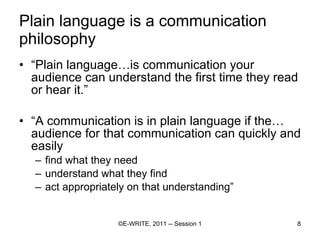
Plain language is a communication philosophy “ Plain language…is communication your audience can understand the first time they read or hear it.” “ A communication is in plain language if the…audience for that communication can quickly and easily  find what they need  understand what they find  act appropriately on that understanding”
Plain language is a community Organizations Plain Language Action and Information Network (PLAIN) Center for Plain Language Clarity Federal agencies  Designated senior official Plain language program  Plain language awards  Center for Plain Language’s ClearMark Award Legal Writing Institute’s Golden Pen Award NIH’s Plain Language/Clear Communication Award
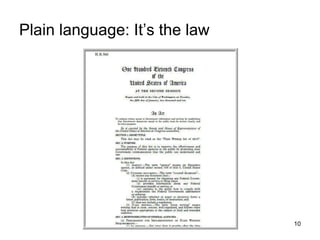
Plain language: It’s the law
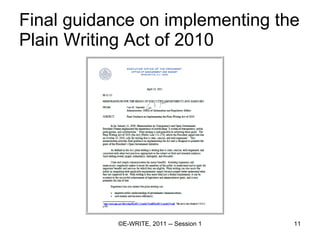
Final guidance on implementing the Plain Writing Act of 2010
Plain language shapes writers’ decisions at every stage of the writing process Planning stage Does this content meet an actual need? Have the writers anticipated readers’ questions? Does it have a clear message? Will it enable readers to take action? Drafting stage Is the content broken into logical units or chunks? Does the content offer the right amount and type of information; does it answer readers’ questions? Does it include headings that will enable readers to scan? Reviewing stage Is the writing concise? Is the wording concrete? Will readers understand the jargon or acronyms? Are the sentences written in active voice?
Plain language:  We know it when we see it
Not plain language Local Veterans Employment Representatives conduct outreach to employers to engage in advocacy efforts with hiring executives to increase employment opportunities for veterans, encourage the hiring of disabled veterans and generally assist veterans to gain and retain employment.
Why is this not plain? Local Veterans Employment Representatives  conduct outreach  to employers to  engage in advocacy efforts  with  hiring executives  to increase employment opportunities for veterans, encourage the hiring of disabled veterans and  generally assist  veterans to  gain and retain  employment.
Plain language rewrite Local Veterans Employment Representatives  contact employers  to  encourage them  to hire veterans, including disabled veterans, and generally assist veterans in  finding and keeping  jobs.
Does plain language = web writing?
Course topics for Session 1 Part 1: Course overview Part 2: Plain language overview  Part 3: Review pre-course assignment Part 4: Write task-oriented web content Part 5: Session 1 wrap-up Part 6: Session 1 homework – writing assignment and reading assignment
Part 3: Review pre-course writing assignment and look at course text
Course topics for Session 1 Part 1: Course overview Part 2: Plain language overview  Part 3: Review pre-course assignment Part 4: Write task-oriented web content Part 5: Session 1 wrap-up Part 6: Session 1 homework – writing assignment and reading assignment
Part 4: Write task-oriented web content Helping people  do things online  (complete tasks) is web content’s highest calling Some web writing helps people  know Some web writing helps people  do Best practice: focus on top tasks
Six guidelines for writing task-oriented web content Name the task clearly and provide an overview.  Identify the outcome of the task. Make the task scannable as users may bookmark it and return frequently. Provide an example, illustration, or screenshot when necessary. Link to background info instead of including it in the task. Make the web content substantive; don’t lock all the info about the task into the PDF form.
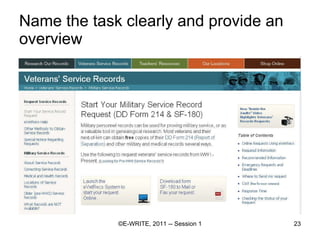
Name the task clearly and provide an overview
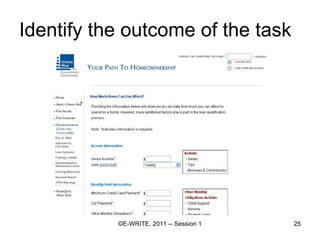
Identify the outcome of the task
Make the task scannable
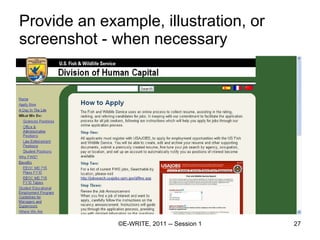
Provide an example, illustration, or screenshot - when necessary
Link to background info instead of including it in the task
Make the web content substantive;  Don’t lock all the info in a PDF
Course topics for Session 1 Part 1: Course overview Part 2: Plain language overview  Part 3: Review pre-course assignment Part 4: Write task-oriented web content Part 5: Session 1 wrap-up Part 6: Session 1 homework – writing assignment and reading assignment
Part 5: Session 1 wrap-up Questions? Web pages to look at again? Plain language writing practices to review? Guidelines for writing task-oriented web content to review?
Course topics for Session 1 Part 1: Course overview Part 2: Plain language overview  Part 3: Review pre-course assignment Part 4: Write task-oriented web content Part 5: Session 1 wrap-up Part 6: Session 1 homework – writing assignment and reading assignment
Part 6: Writing and reading homework for Session 1 By Tuesday, September 13: Rewrite a task page Read  Chapter 2, “People! People! People!”
Resource
Evaluation

Session1 pl online_course_8_september2011

  • 1.
    Write Great WebContent: Plain Language in Action Session 1: September 8, 2011
  • 2.
    Agenda for Session1 Part 1: Course overview Part 2: Plain language overview Part 3: Review pre-course assignment Part 4: Write task-oriented web content Part 5: Session 1 wrap-up Part 6: Session 1 homework – writing assignment and reading assignment
  • 3.
    Course Objectives forSession 1 In this session, you will learn: What plain language is and how agencies should respond to the Plain Writing Act of 2010 How to write task-oriented web content
  • 4.
    Agenda for Session1 Part 1: Course overview Part 2: Plain language overview Part 3: Review pre-course assignment Part 4: Write task-oriented web content Part 5: Session 1 wrap-up Part 6: Session 1 homework – writing assignment and reading assignment
  • 5.
    Part 1: Courseoverview Four online course meetings (live webinars) on September 8, 15, 22, and 29 Pre-course writing assignment Brief web writing practices during the online course meetings Remember to print the PPT and other files before each meeting Readings and web writing homework after each course meeting Course text: Letting Go of the Words , by Ginny Redish
  • 6.
    Agenda for Session1 Part 1: Course overview Part 2: Plain language overview Part 3: Review pre-course assignment Part 4: Write task-oriented web content Part 5: Session 1 wrap-up Part 6: Session 1 homework – writing assignment and reading assignment
  • 7.
    What is plainlanguage?
  • 8.
    Plain language isa communication philosophy “ Plain language…is communication your audience can understand the first time they read or hear it.” “ A communication is in plain language if the…audience for that communication can quickly and easily find what they need understand what they find act appropriately on that understanding”
  • 9.
    Plain language isa community Organizations Plain Language Action and Information Network (PLAIN) Center for Plain Language Clarity Federal agencies Designated senior official Plain language program Plain language awards Center for Plain Language’s ClearMark Award Legal Writing Institute’s Golden Pen Award NIH’s Plain Language/Clear Communication Award
  • 10.
  • 11.
    Final guidance onimplementing the Plain Writing Act of 2010
  • 12.
    Plain language shapeswriters’ decisions at every stage of the writing process Planning stage Does this content meet an actual need? Have the writers anticipated readers’ questions? Does it have a clear message? Will it enable readers to take action? Drafting stage Is the content broken into logical units or chunks? Does the content offer the right amount and type of information; does it answer readers’ questions? Does it include headings that will enable readers to scan? Reviewing stage Is the writing concise? Is the wording concrete? Will readers understand the jargon or acronyms? Are the sentences written in active voice?
  • 13.
    Plain language: We know it when we see it
  • 14.
    Not plain languageLocal Veterans Employment Representatives conduct outreach to employers to engage in advocacy efforts with hiring executives to increase employment opportunities for veterans, encourage the hiring of disabled veterans and generally assist veterans to gain and retain employment.
  • 15.
    Why is thisnot plain? Local Veterans Employment Representatives conduct outreach to employers to engage in advocacy efforts with hiring executives to increase employment opportunities for veterans, encourage the hiring of disabled veterans and generally assist veterans to gain and retain employment.
  • 16.
    Plain language rewriteLocal Veterans Employment Representatives contact employers to encourage them to hire veterans, including disabled veterans, and generally assist veterans in finding and keeping jobs.
  • 17.
    Does plain language= web writing?
  • 18.
    Course topics forSession 1 Part 1: Course overview Part 2: Plain language overview Part 3: Review pre-course assignment Part 4: Write task-oriented web content Part 5: Session 1 wrap-up Part 6: Session 1 homework – writing assignment and reading assignment
  • 19.
    Part 3: Reviewpre-course writing assignment and look at course text
  • 20.
    Course topics forSession 1 Part 1: Course overview Part 2: Plain language overview Part 3: Review pre-course assignment Part 4: Write task-oriented web content Part 5: Session 1 wrap-up Part 6: Session 1 homework – writing assignment and reading assignment
  • 21.
    Part 4: Writetask-oriented web content Helping people do things online (complete tasks) is web content’s highest calling Some web writing helps people know Some web writing helps people do Best practice: focus on top tasks
  • 22.
    Six guidelines forwriting task-oriented web content Name the task clearly and provide an overview. Identify the outcome of the task. Make the task scannable as users may bookmark it and return frequently. Provide an example, illustration, or screenshot when necessary. Link to background info instead of including it in the task. Make the web content substantive; don’t lock all the info about the task into the PDF form.
  • 23.
    Name the taskclearly and provide an overview
  • 24.
  • 25.
  • 26.
    Make the taskscannable
  • 27.
    Provide an example,illustration, or screenshot - when necessary
  • 28.
    Link to backgroundinfo instead of including it in the task
  • 29.
    Make the webcontent substantive; Don’t lock all the info in a PDF
  • 30.
    Course topics forSession 1 Part 1: Course overview Part 2: Plain language overview Part 3: Review pre-course assignment Part 4: Write task-oriented web content Part 5: Session 1 wrap-up Part 6: Session 1 homework – writing assignment and reading assignment
  • 31.
    Part 5: Session1 wrap-up Questions? Web pages to look at again? Plain language writing practices to review? Guidelines for writing task-oriented web content to review?
  • 32.
    Course topics forSession 1 Part 1: Course overview Part 2: Plain language overview Part 3: Review pre-course assignment Part 4: Write task-oriented web content Part 5: Session 1 wrap-up Part 6: Session 1 homework – writing assignment and reading assignment
  • 33.
    Part 6: Writingand reading homework for Session 1 By Tuesday, September 13: Rewrite a task page Read Chapter 2, “People! People! People!”
  • 34.
  • 35.

Editor's Notes

  • #9 http://www.plainlanguage.gov/whatisPL/index.cfm http://www.centerforplainlanguage.org/
  • #10 Organizations: -- http://centerforplainlanguage.org/ -- http://www.plainlanguage.gov/ -- http://www.clarity-international.net/ Federal agency programs and contacts -- http://www.plainlanguage.gov/plLaw/fedGovt/index.cfm Awards -- http://centerforplainlanguage.org/awards/clearmark2011/ -- http://www.nih.gov/clearcommunication/plainlanguage.htm -- http://www.lwionline.org/golden_pen_award.html
  • #11 http://frwebgate.access.gpo.gov/cgi-bin/getdoc.cgi?dbname=111_cong_bills&docid=f:h946enr.txt.pdf
  • #12 http://www.whitehouse.gov/sites/default/files/omb/memoranda/2011/m11-15.pdf
  • #15 http://www.dol.gov/vets/programs/empserv/employment_services_fs.htm
  • #24 http://www.archives.gov/veterans/military-service-records/
  • #25 http://iafdb.travel.state.gov/
  • #26 http://www.ginniemae.gov/2_prequal/intro_questions.asp?section=YPTH
  • #27 http://www.irs.gov/privacy/article/0,,id=183505,00.html
  • #28 http://www.fws.gov/jobs/howtoapply.html
  • #29 http://www.benefits.va.gov/homeloans/eligibility.asp
  • #30 http://buprenorphine.samhsa.gov/howto.html
  • #35 http://www.usa.gov/webcontent/managing_content/focusing_top_tasks.shtml