DR. GHANSHYAM PATIDAR
ASSOCIATE PROFESSOR
JNCN BHOPAL
MINI MENTAL STATUS
EXAMINATION
INTRODUCTION…
⚫MMSE OR FOLSTIEN TEST
⚫The mini mental state
examination is a cognitive test
used to screen for the
presence of cognitive
impairment.
USES OF MSE…
⚫It provides measures of
orientation, registration & short-
term memory, attention, voluntary
movement & language functioning.
⚫The shortened version of the
minimental state examination is an
accurate predictor of dementia.
SCORING…
⚫It is a reliable test, with score of 25-
30 considered normal, 18-24
indicative of mild to moderate, scores
of 17 or less correlate with
substantial impairment in activities of
daily living.
⚫Social background, educational
level & verbal ability can influence
results & should be taken into
account in their interpretation.
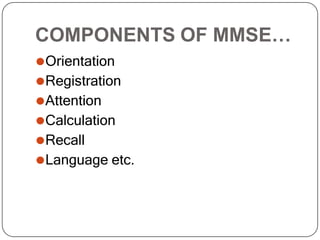
COMPONENTS OF MMSE…
⚫Orientation
⚫Registration
⚫Attention
⚫Calculation
⚫Recall
⚫Language etc.
FORMAT
OF
MINI MENTAL
STATUS
EXAMINATION
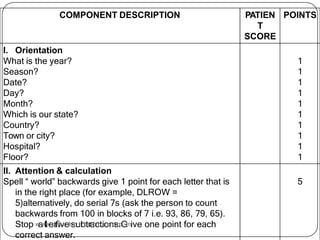
COMPONENT DESCRIPTION PATIEN
T
SCORE
POINTS
I. Orientation
What is the year?
Season?
Date?
Day?
Month?
Which is our state?
Country?
Town or city?
Hospital?
Floor?
1
1
1
1
1
1
1
1
1
1
5
II. Attention & calculation
Spell “ world” backwards give 1 point for each letter that is
in the right place (for example, DLROW =
5)alternatively, do serial 7s (ask the person to count
backwards from 100 in blocks of 7 i.e. 93, 86, 79, 65).
Stop w
aw
ftw
e.
d
rr
j
fa
iy
ve
es
h
sp
ua
t
bi
d
ta
rr
a.
b
cl
o
tg
is
op
no
t
s.
c
.o
Gmive one point for each
correct answer.
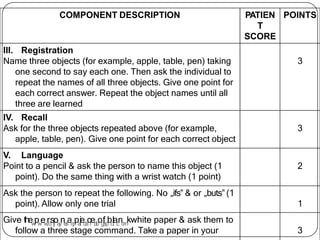
COMPONENT DESCRIPTION PATIEN
T
SCORE
POINTS
III. Registration
Name three objects (for example, apple, table, pen) taking
one second to say each one. Then ask the individual to
repeat the names of all three objects. Give one point for
each correct answer. Repeat the object names until all
three are learned
3
IV. Recall
Ask for the three objects repeated above (for example,
apple, table, pen). Give one point for each correct object
3
V. Language
Point to a pencil & ask the person to name this object (1
point). Do the same thing with a wrist watch (1 point)
2
Ask the person to repeat the following. No „ifs‟ & or „buts‟ (1
point). Allow only one trial 1
3
Give thew
pw
ew
.
rd
sr
j
oa
y
ne
s
ah
p
pa
t
ii
ed
a
cr
e.
b
l
o
og
fs
p
bo
lt
a.
c
no
m
kwhite paper & ask them to
follow a three stage command. Take a paper in your
COMPONENT DESCRIPTION PATIEN
T
SCORE
POINTS
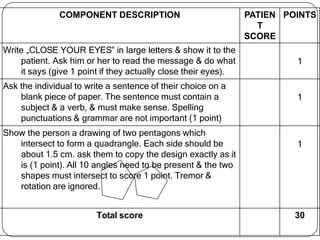
Write „CLOSE YOUR EYES‟ in large letters & show it to the
patient. Ask him or her to read the message & do what
it says (give 1 point if they actually close their eyes).
1
Ask the individual to write a sentence of their choice on a
blank piece of paper. The sentence must contain a
subject & a verb, & must make sense. Spelling
punctuations & grammar are not important (1 point)
1
Show the person a drawing of two pentagons which
intersect to form a quadrangle. Each side should be
about 1.5 cm. ask them to copy the design exactly as it
is (1 point). All 10 angles need to be present & the two
shapes must intersect to score 1 point. Tremor &
rotation are ignored.
1
Total score 30
DR. GHANSHYAM PATIDAR

mmse

  • 1.
    DR. GHANSHYAM PATIDAR ASSOCIATEPROFESSOR JNCN BHOPAL MINI MENTAL STATUS EXAMINATION
  • 2.
    INTRODUCTION… ⚫MMSE OR FOLSTIENTEST ⚫The mini mental state examination is a cognitive test used to screen for the presence of cognitive impairment.
  • 3.
    USES OF MSE… ⚫Itprovides measures of orientation, registration & short- term memory, attention, voluntary movement & language functioning. ⚫The shortened version of the minimental state examination is an accurate predictor of dementia.
  • 4.
    SCORING… ⚫It is areliable test, with score of 25- 30 considered normal, 18-24 indicative of mild to moderate, scores of 17 or less correlate with substantial impairment in activities of daily living. ⚫Social background, educational level & verbal ability can influence results & should be taken into account in their interpretation.
  • 5.
  • 6.
  • 7.
    COMPONENT DESCRIPTION PATIEN T SCORE POINTS I.Orientation What is the year? Season? Date? Day? Month? Which is our state? Country? Town or city? Hospital? Floor? 1 1 1 1 1 1 1 1 1 1 5 II. Attention & calculation Spell “ world” backwards give 1 point for each letter that is in the right place (for example, DLROW = 5)alternatively, do serial 7s (ask the person to count backwards from 100 in blocks of 7 i.e. 93, 86, 79, 65). Stop w aw ftw e. d rr j fa iy ve es h sp ua t bi d ta rr a. b cl o tg is op no t s. c .o Gmive one point for each correct answer.
  • 8.
    COMPONENT DESCRIPTION PATIEN T SCORE POINTS III.Registration Name three objects (for example, apple, table, pen) taking one second to say each one. Then ask the individual to repeat the names of all three objects. Give one point for each correct answer. Repeat the object names until all three are learned 3 IV. Recall Ask for the three objects repeated above (for example, apple, table, pen). Give one point for each correct object 3 V. Language Point to a pencil & ask the person to name this object (1 point). Do the same thing with a wrist watch (1 point) 2 Ask the person to repeat the following. No „ifs‟ & or „buts‟ (1 point). Allow only one trial 1 3 Give thew pw ew . rd sr j oa y ne s ah p pa t ii ed a cr e. b l o og fs p bo lt a. c no m kwhite paper & ask them to follow a three stage command. Take a paper in your
  • 9.
    COMPONENT DESCRIPTION PATIEN T SCORE POINTS Write„CLOSE YOUR EYES‟ in large letters & show it to the patient. Ask him or her to read the message & do what it says (give 1 point if they actually close their eyes). 1 Ask the individual to write a sentence of their choice on a blank piece of paper. The sentence must contain a subject & a verb, & must make sense. Spelling punctuations & grammar are not important (1 point) 1 Show the person a drawing of two pentagons which intersect to form a quadrangle. Each side should be about 1.5 cm. ask them to copy the design exactly as it is (1 point). All 10 angles need to be present & the two shapes must intersect to score 1 point. Tremor & rotation are ignored. 1 Total score 30
  • 10.