CNS examination - higher
mental
function,Sensorium,speech
By Gauri Chikhalkar
Higher Mental Function
CONSCIOUSNESS
• Consciousness Level of consciousness is the patient’s relative state of
awareness of the self and the environment, and ranges from fully awake to
comatose.
• Sleep is a state of physical and mental inactivity from which patient can
be aroused to normal consciousness
• Catatonia is a state during which rigid plastic postures of limbs for long
hours are assumed .
• Akinetic Mutism- state during which patient remains immobile , making
no sound , follows movement slowly with his eyes and allow himself to be
fed and nursed.
• Drowsiness is a pathological state that resembles normal sleep. Patient
can be aroused with an external stimulus , but reverts back to drowsy state
on withdrawal of the stimulus
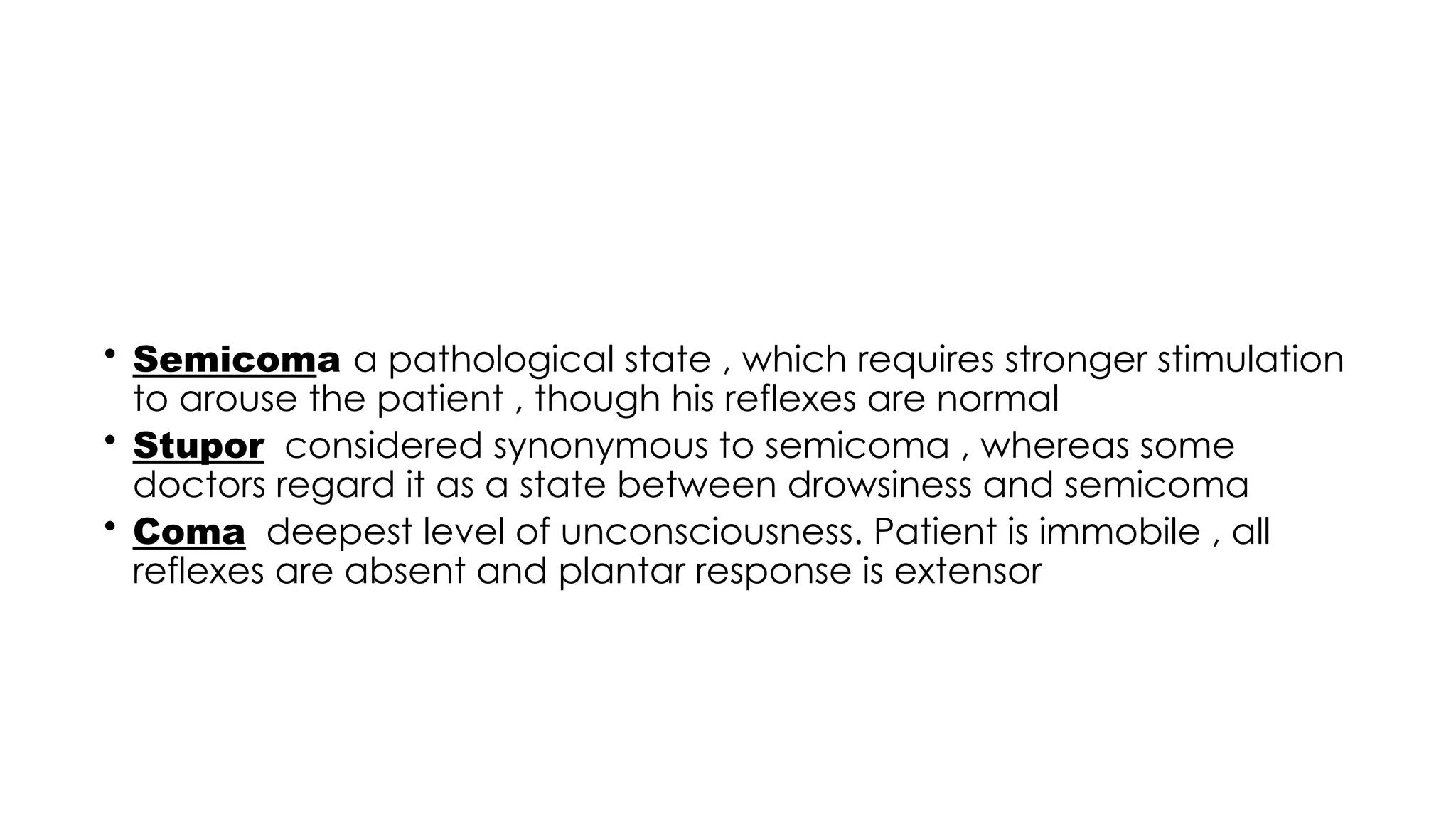
• Semicoma a pathological state , which requires stronger stimulation
to arouse the patient , though his reflexes are normal
• Stupor considered synonymous to semicoma , whereas some
doctors regard it as a state between drowsiness and semicoma
• Coma deepest level of unconsciousness. Patient is immobile , all
reflexes are absent and plantar response is extensor
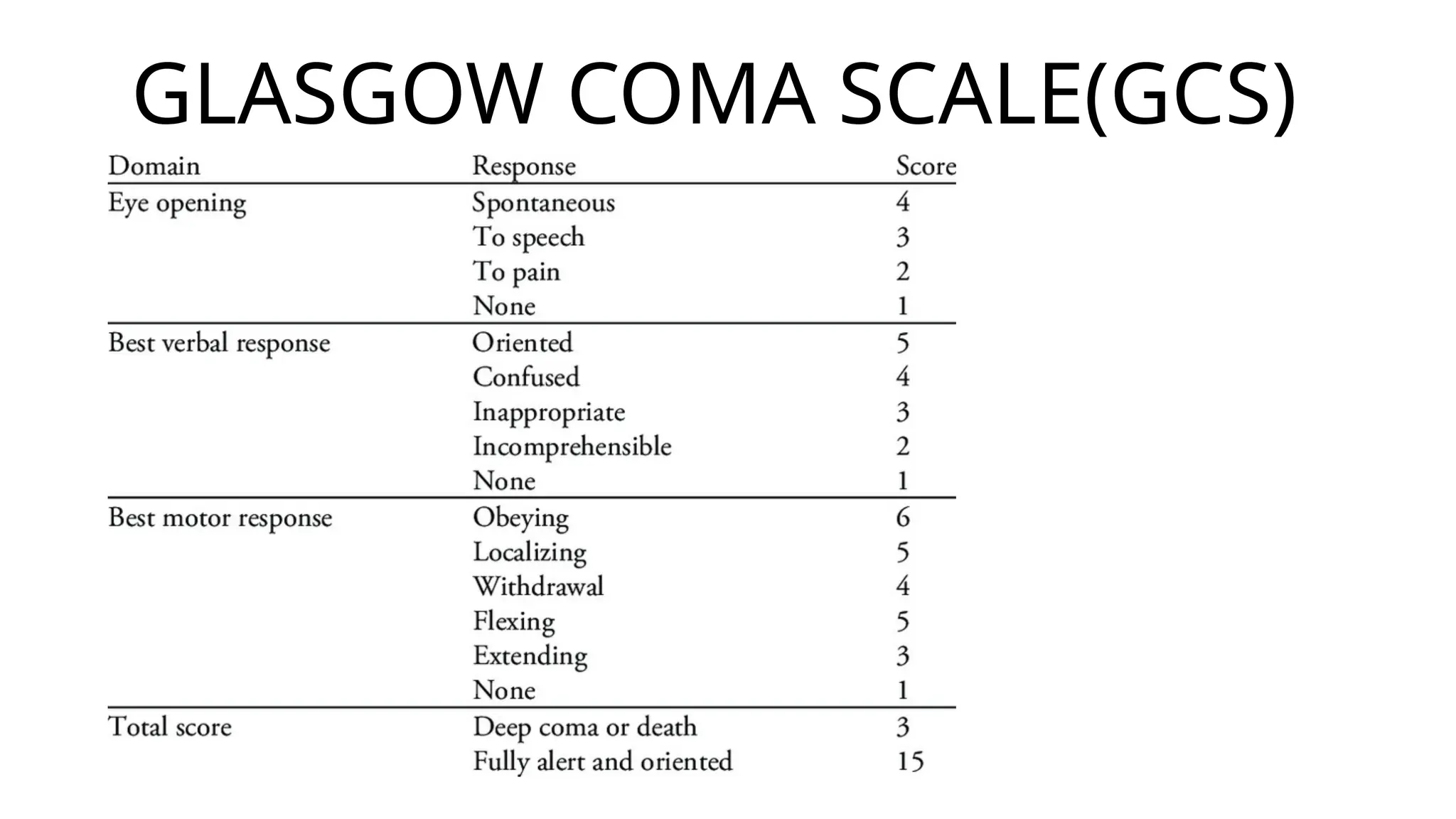
GLASGOW COMA SCALE(GCS)
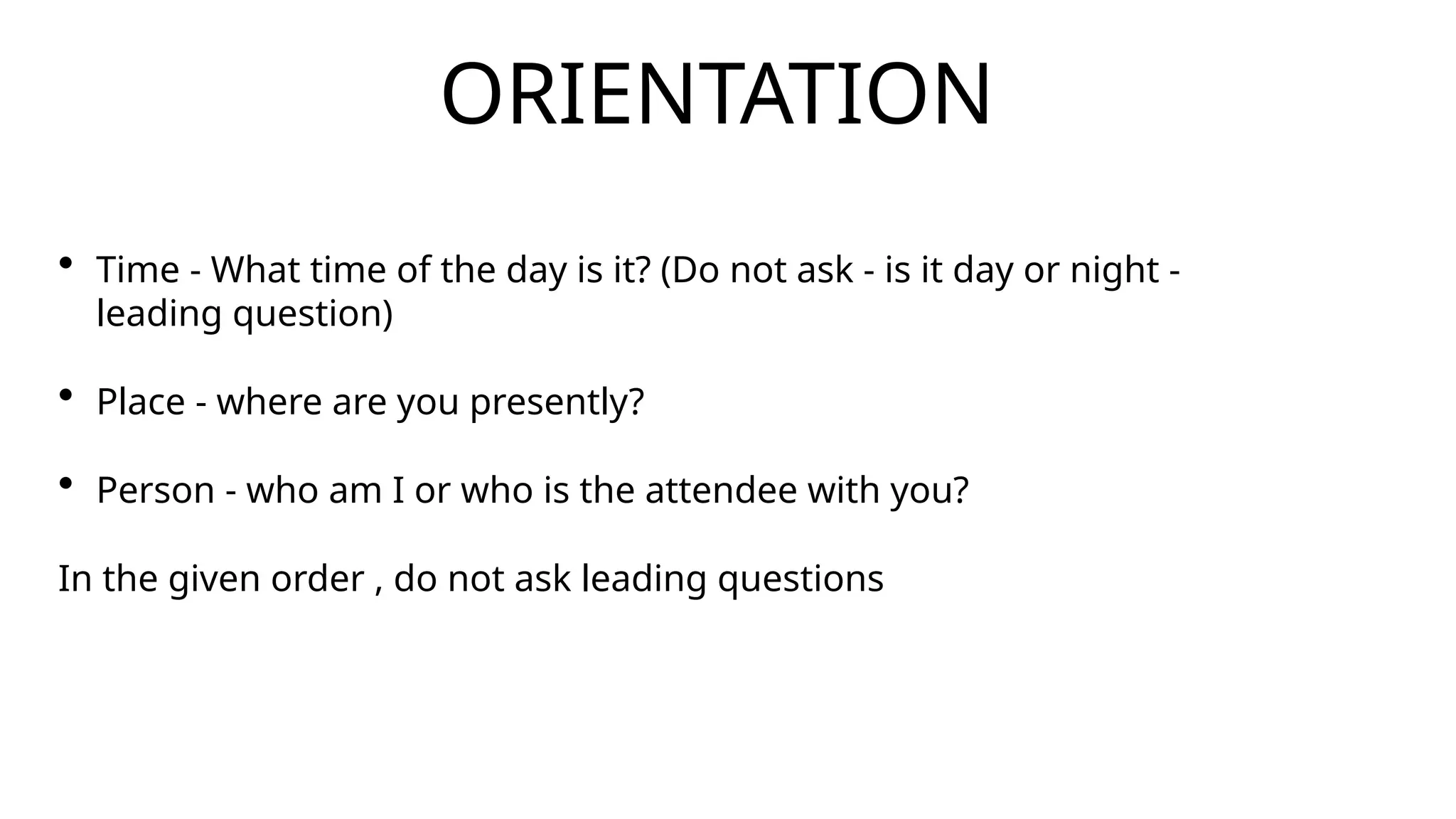
ORIENTATION
• Time - What time of the day is it? (Do not ask - is it day or night -
leading question)
• Place - where are you presently?
• Person - who am I or who is the attendee with you?
In the given order , do not ask leading questions
DELIRIUM
• defined as a relatively acute decline in cognition that fluctuates over
hours or days
• 2 subtypes- hypoactive and hyperactive
• Reversibility of dementia
• Assess mental status , fluctuation “sundowning”
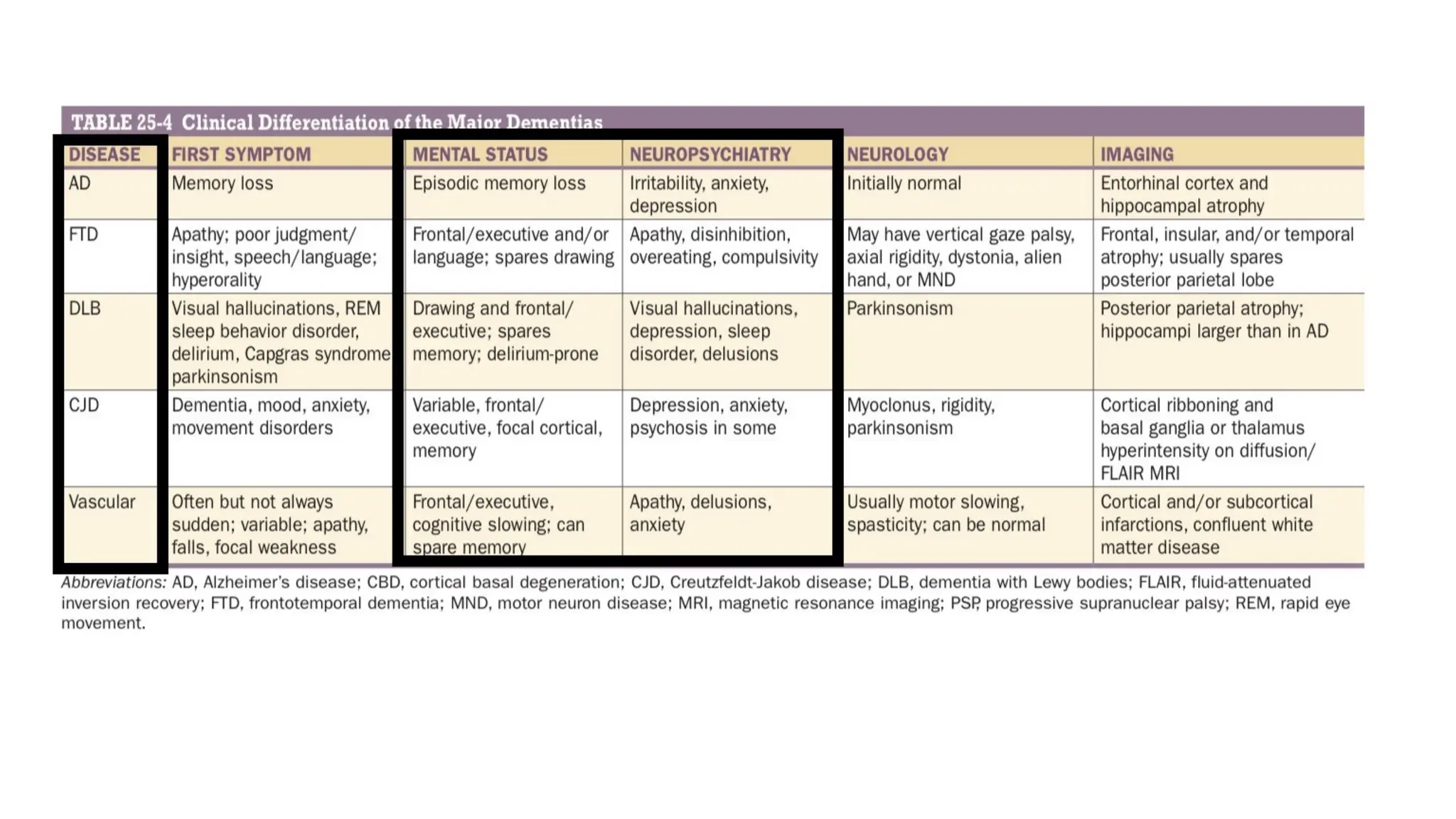
DEMENTIA
• defined as an acquired deterioration in cognitive abilities that impairs
the successful performance of activities of daily living.
• Episodic memory, the ability to recall events specific in time and place,
is the cognitive function most commonly lost.
• MMSE - MINI MENTAL STATE EXAMINATION
Score<21 in educated person=severe dementia
for screening and progress of dementia
Total score= 30
Score<21 in educated person=severe dementia.
MEMORY
analyzed according to three main time scales:
(1) immediate memory is assessed by saying a list of three items and
having the patient repeat the list immediately
(2) short-term memory is tested by asking the patient to recall the same
three items 5 and15 mins later
(3) long-term memory is evaluated by determining how well the patient is
able to provide a coherent chronologic history of his or her illness or
personal events.
INTELLIGENCE
• Abnormalities of insight and judgment detected during the patient
interview; a more detailed assessment can be elicited by asking the
patient to describe how he or she would respond to situations having a
variety of potential outcomes (e.g., “What would you do if you found a
wallet on the sidewalk?”).
• Abstract thought can be tested by asking the patient to describe
similarities between various objects or concepts (e.g. apple and orange)
or to list items having the same attributes (e.g. a list of four-legged
animals).
• Calculation ability is assessed by having the patient carry out a
computation that is appropriate to the patient’s age and education (e.g.,
serial subtraction of 7 from 100 or 3 from 20; or word problems involving
simple arithmetic).
NEURO-PSYCHIATRIC EXAMINATION
• Delusion
• Emotional status
Speech
• APHASIA - is an impairment,affecting production or
comprehension of speech and the ability to read and write
Testing for Aphasia
• Establish if the patient is right or left handed
• Discover the patients first language
COMPREHENSION
ASSESS UNDERSTANDING
Ask the patient a simple question -
• What is your name/address?
• What is your job?
• Where do you come from?
UNDERSTANDING
• Ask questions with yes /no answers
• Give a simple command
• If successful try more complicated command
NAMING
Show an object to patient, ask him to name it.
NAMING DEFICITS
• TWO WAY(semantic)-cannot name even on clues
• ONE WAY(Retrieval based)- can point to the right object
• Circumlution - Patient fails to come up with the appropriate word ,may provide a circumlutious
description of the object(eg - tells the function of the object - pen shown to patient and asked to
name it - patient says it is used for writing )
PARAPHASIA - patient offers incorrect but related word
2 types:
• Semantic- pt knows function of the object , tells a related word eg- pencil
shown-pt calls it “pen”
• Phonemic - pt is phonetically incorrect eg-pencil shown -PT calls it “pentil”
REPETITION
• Asking PT to repeat single words ,short sentences,or string of words
such as ‘No ifs,ands,or buts’
• Test of repetition with tongue twisters such as “hippopotamus”
provides a better assessment of dysarthria.
FLUENCY
Talk with the patient about a familiar topic preferably in patient’s first
language
For spontaneous speech:
• Fluent -if it maintains appropriate output volume,phrase length
• Non-fluent -if it is sparse and halting and average utterance length is
below four words
The examiner also should note the integrity of grammar as manifested
by word order (syntax), tenses, suffixes, prefixes, plurals, and
possessives
Other important higher mental
functions
• APRAXIA - inability to do skilled motor activity.
Eg- ask or to uncap and again cap the pen and keep it back .
1. Ideational
2. Constructive
3. Dressing
4. Ideomotor
5. Speech
• AGNOSIA- inability to recognise an object in spite of normal
sensory ,motor and cerebellar function
1. Auditory
2. Tactile
3. Visual
PROFORMA
Higher functions are normal with MMSE
Score of ___/30, well oriented to time,
place , person, normal behavior, memory,
intelligence, unaffected speech, and no
perceptual or emotional abnormality .

CNS Examination ppt for mbbs ug students

  • 1.
    CNS examination -higher mental function,Sensorium,speech By Gauri Chikhalkar
  • 2.
  • 3.
    CONSCIOUSNESS • Consciousness Levelof consciousness is the patient’s relative state of awareness of the self and the environment, and ranges from fully awake to comatose. • Sleep is a state of physical and mental inactivity from which patient can be aroused to normal consciousness • Catatonia is a state during which rigid plastic postures of limbs for long hours are assumed . • Akinetic Mutism- state during which patient remains immobile , making no sound , follows movement slowly with his eyes and allow himself to be fed and nursed. • Drowsiness is a pathological state that resembles normal sleep. Patient can be aroused with an external stimulus , but reverts back to drowsy state on withdrawal of the stimulus
  • 4.
    • Semicoma apathological state , which requires stronger stimulation to arouse the patient , though his reflexes are normal • Stupor considered synonymous to semicoma , whereas some doctors regard it as a state between drowsiness and semicoma • Coma deepest level of unconsciousness. Patient is immobile , all reflexes are absent and plantar response is extensor
  • 5.
  • 6.
    ORIENTATION • Time -What time of the day is it? (Do not ask - is it day or night - leading question) • Place - where are you presently? • Person - who am I or who is the attendee with you? In the given order , do not ask leading questions
  • 7.
    DELIRIUM • defined asa relatively acute decline in cognition that fluctuates over hours or days • 2 subtypes- hypoactive and hyperactive • Reversibility of dementia • Assess mental status , fluctuation “sundowning”
  • 9.
    DEMENTIA • defined asan acquired deterioration in cognitive abilities that impairs the successful performance of activities of daily living. • Episodic memory, the ability to recall events specific in time and place, is the cognitive function most commonly lost.
  • 11.
    • MMSE -MINI MENTAL STATE EXAMINATION Score<21 in educated person=severe dementia for screening and progress of dementia Total score= 30 Score<21 in educated person=severe dementia.
  • 12.
    MEMORY analyzed according tothree main time scales: (1) immediate memory is assessed by saying a list of three items and having the patient repeat the list immediately (2) short-term memory is tested by asking the patient to recall the same three items 5 and15 mins later (3) long-term memory is evaluated by determining how well the patient is able to provide a coherent chronologic history of his or her illness or personal events.
  • 13.
    INTELLIGENCE • Abnormalities ofinsight and judgment detected during the patient interview; a more detailed assessment can be elicited by asking the patient to describe how he or she would respond to situations having a variety of potential outcomes (e.g., “What would you do if you found a wallet on the sidewalk?”). • Abstract thought can be tested by asking the patient to describe similarities between various objects or concepts (e.g. apple and orange) or to list items having the same attributes (e.g. a list of four-legged animals). • Calculation ability is assessed by having the patient carry out a computation that is appropriate to the patient’s age and education (e.g., serial subtraction of 7 from 100 or 3 from 20; or word problems involving simple arithmetic).
  • 14.
  • 15.
    Speech • APHASIA -is an impairment,affecting production or comprehension of speech and the ability to read and write
  • 16.
    Testing for Aphasia •Establish if the patient is right or left handed • Discover the patients first language
  • 17.
    COMPREHENSION ASSESS UNDERSTANDING Ask thepatient a simple question - • What is your name/address? • What is your job? • Where do you come from?
  • 18.
    UNDERSTANDING • Ask questionswith yes /no answers • Give a simple command • If successful try more complicated command
  • 19.
    NAMING Show an objectto patient, ask him to name it. NAMING DEFICITS • TWO WAY(semantic)-cannot name even on clues • ONE WAY(Retrieval based)- can point to the right object • Circumlution - Patient fails to come up with the appropriate word ,may provide a circumlutious description of the object(eg - tells the function of the object - pen shown to patient and asked to name it - patient says it is used for writing )
  • 20.
    PARAPHASIA - patientoffers incorrect but related word 2 types: • Semantic- pt knows function of the object , tells a related word eg- pencil shown-pt calls it “pen” • Phonemic - pt is phonetically incorrect eg-pencil shown -PT calls it “pentil”
  • 21.
    REPETITION • Asking PTto repeat single words ,short sentences,or string of words such as ‘No ifs,ands,or buts’ • Test of repetition with tongue twisters such as “hippopotamus” provides a better assessment of dysarthria.
  • 22.
    FLUENCY Talk with thepatient about a familiar topic preferably in patient’s first language For spontaneous speech: • Fluent -if it maintains appropriate output volume,phrase length • Non-fluent -if it is sparse and halting and average utterance length is below four words The examiner also should note the integrity of grammar as manifested by word order (syntax), tenses, suffixes, prefixes, plurals, and possessives
  • 27.
    Other important highermental functions • APRAXIA - inability to do skilled motor activity. Eg- ask or to uncap and again cap the pen and keep it back . 1. Ideational 2. Constructive 3. Dressing 4. Ideomotor 5. Speech
  • 28.
    • AGNOSIA- inabilityto recognise an object in spite of normal sensory ,motor and cerebellar function 1. Auditory 2. Tactile 3. Visual
  • 29.
    PROFORMA Higher functions arenormal with MMSE Score of ___/30, well oriented to time, place , person, normal behavior, memory, intelligence, unaffected speech, and no perceptual or emotional abnormality .