www.challenginghorizon.com Page 1
Double Loop Learning in Organizations
Why are employees’ hesitant to reveal to the top authorities that one of their organization's
product/service is a "failure" or why can't the VPs of an organization uncover to the
President the absence of accomplishment of one of the organization's divisions? The
powerlessness to reveal mistakes and other obnoxious facts emerges from flawed
hierarchical learning, says the author of ‘The Big 100 Business Tools for Success’. Such
propensities and states of mind, which enable an organization to conceal its issues, prompt
unbending nature and crumbling. The author portrays how this procedure can be turned
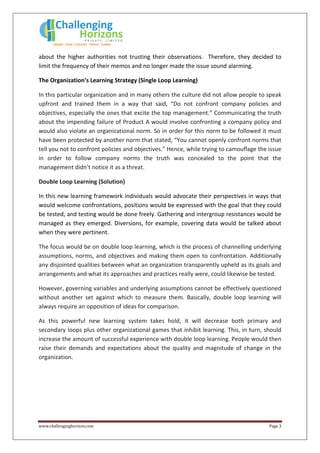
around by a technique he calls double loop learning.
Explanation
The management of a multi-billion dollar company chose that product ‘A’ was a
disappointment and ought to be dropped. The misfortunes included surpassed $100 million.
No less than five individuals realized that product A was stuck in an unfortunate situation six
years before the organization chose to quit manufacturing it. Three were plant managers
who dealt with the production issues every day. The two others were marketing authorities,
who saw that the production issues couldn't be tackled without raising the cost of the
product to the point where it wouldn’t be competitive in the current market.
www.challenginghorizon.com Page 2
There are many reasons why this piece of information did not reach the higher authorities
at the right time. Firstly, those working at the bottom rank trusted that their diligent efforts
would transform the blunders into progress. But the more they battled the more they
understood the hugeness of their mistake. The next step was to communicate this awful
news to the higher management. They realized that, in their organization, terrible news
would not be generally welcomed at the upper levels in the event that it was not joined by
recommendations for positive activity. They also realized that the top-management was
excitedly portraying the product as a pioneer in its field. Hence, they invested a lot of time
and efforts to communicate this news while also softening the blow.
The middle managers were the ones who had conducted production and marketing studies
which lead to the decision of producing product ‘A’. Hence, when they received the memos
they wanted to double check it since it would raise fingers at their analysis. Once they were
convinced about the predictions they began to release the news in small doses, making sure
they were covered in case the management got terribly upset. In order to do so, they cut
down and reduced the detailed memos to the point where it was just a summary of
findings. They said that this was necessary because the management hated receiving
unnecessarily long memos. As a result of this, the management received a memo which
didn’t indicate the severity of the issue.
The top management instructed the middle managers to take necessary corrective actions
but still continue the production. The lower managers became confused and were upset
www.challenginghorizon.com Page 3
about the higher authorities not trusting their observations. Therefore, they decided to
limit the frequency of their memos and no longer made the issue sound alarming.
The Organization’s Learning Strategy (Single Loop Learning)
In this particular organization and in many others the culture did not allow people to speak
upfront and trained them in a way that said, “Do not confront company policies and
objectives, especially the ones that excite the top management.” Communicating the truth
about the impending failure of Product A would involve confronting a company policy and
would also violate an organizational norm. So in order for this norm to be followed it must
have been protected by another norm that stated, “You cannot openly confront norms that
tell you not to confront policies and objectives.” Hence, while trying to camouflage the issue
in order to follow company norms the truth was concealed to the point that the
management didn’t notice it as a threat.
Double Loop Learning (Solution)
In this new learning framework individuals would advocate their perspectives in ways that
would welcome confrontations, positions would be expressed with the goal that they could
be tested, and testing would be done freely. Gathering and intergroup resistances would be
managed as they emerged. Diversions, for example, covering data would be talked about
when they were pertinent.
The focus would be on double loop learning, which is the process of channelling underlying
assumptions, norms, and objectives and making them open to confrontation. Additionally
any disjointed qualities between what an organization transparently upheld as its goals and
arrangements and what its approaches and practices really were, could likewise be tested.
However, governing variables and underlying assumptions cannot be effectively questioned
without another set against which to measure them. Basically, double loop learning will
always require an opposition of ideas for comparison.
As this powerful new learning system takes hold, it will decrease both primary and
secondary loops plus other organizational games that inhibit learning. This, in turn, should
increase the amount of successful experience with double loop learning. People would then
raise their demands and expectations about the quality and magnitude of change in the
organization.

Double Loop Learning in Organizations

  • 1.
    www.challenginghorizon.com Page 1 DoubleLoop Learning in Organizations Why are employees’ hesitant to reveal to the top authorities that one of their organization's product/service is a "failure" or why can't the VPs of an organization uncover to the President the absence of accomplishment of one of the organization's divisions? The powerlessness to reveal mistakes and other obnoxious facts emerges from flawed hierarchical learning, says the author of ‘The Big 100 Business Tools for Success’. Such propensities and states of mind, which enable an organization to conceal its issues, prompt unbending nature and crumbling. The author portrays how this procedure can be turned around by a technique he calls double loop learning. Explanation The management of a multi-billion dollar company chose that product ‘A’ was a disappointment and ought to be dropped. The misfortunes included surpassed $100 million. No less than five individuals realized that product A was stuck in an unfortunate situation six years before the organization chose to quit manufacturing it. Three were plant managers who dealt with the production issues every day. The two others were marketing authorities, who saw that the production issues couldn't be tackled without raising the cost of the product to the point where it wouldn’t be competitive in the current market.
  • 2.
    www.challenginghorizon.com Page 2 Thereare many reasons why this piece of information did not reach the higher authorities at the right time. Firstly, those working at the bottom rank trusted that their diligent efforts would transform the blunders into progress. But the more they battled the more they understood the hugeness of their mistake. The next step was to communicate this awful news to the higher management. They realized that, in their organization, terrible news would not be generally welcomed at the upper levels in the event that it was not joined by recommendations for positive activity. They also realized that the top-management was excitedly portraying the product as a pioneer in its field. Hence, they invested a lot of time and efforts to communicate this news while also softening the blow. The middle managers were the ones who had conducted production and marketing studies which lead to the decision of producing product ‘A’. Hence, when they received the memos they wanted to double check it since it would raise fingers at their analysis. Once they were convinced about the predictions they began to release the news in small doses, making sure they were covered in case the management got terribly upset. In order to do so, they cut down and reduced the detailed memos to the point where it was just a summary of findings. They said that this was necessary because the management hated receiving unnecessarily long memos. As a result of this, the management received a memo which didn’t indicate the severity of the issue. The top management instructed the middle managers to take necessary corrective actions but still continue the production. The lower managers became confused and were upset
  • 3.
    www.challenginghorizon.com Page 3 aboutthe higher authorities not trusting their observations. Therefore, they decided to limit the frequency of their memos and no longer made the issue sound alarming. The Organization’s Learning Strategy (Single Loop Learning) In this particular organization and in many others the culture did not allow people to speak upfront and trained them in a way that said, “Do not confront company policies and objectives, especially the ones that excite the top management.” Communicating the truth about the impending failure of Product A would involve confronting a company policy and would also violate an organizational norm. So in order for this norm to be followed it must have been protected by another norm that stated, “You cannot openly confront norms that tell you not to confront policies and objectives.” Hence, while trying to camouflage the issue in order to follow company norms the truth was concealed to the point that the management didn’t notice it as a threat. Double Loop Learning (Solution) In this new learning framework individuals would advocate their perspectives in ways that would welcome confrontations, positions would be expressed with the goal that they could be tested, and testing would be done freely. Gathering and intergroup resistances would be managed as they emerged. Diversions, for example, covering data would be talked about when they were pertinent. The focus would be on double loop learning, which is the process of channelling underlying assumptions, norms, and objectives and making them open to confrontation. Additionally any disjointed qualities between what an organization transparently upheld as its goals and arrangements and what its approaches and practices really were, could likewise be tested. However, governing variables and underlying assumptions cannot be effectively questioned without another set against which to measure them. Basically, double loop learning will always require an opposition of ideas for comparison. As this powerful new learning system takes hold, it will decrease both primary and secondary loops plus other organizational games that inhibit learning. This, in turn, should increase the amount of successful experience with double loop learning. People would then raise their demands and expectations about the quality and magnitude of change in the organization.