Ethics
Introduction to Ethics
• Our care for patients should be based on sound judgement and evidence-
based practices.
• Some of this judgement is about having a strong sense of what is right and
wrong
• Ethics is having a strong sense of what we should be doing and shouldn’t
be doing as clinicians
• Ethics is having a strong sense of what our priorities ought to be
What is an ‘ethical issue’?
• When you have to judge what is right or wrong
• Choosing between options
• Deciding whether to do something or do nothing
• Should I or shouldn’t I?
• Weighing up the potential impact of your decisions or actions
• A dilemma – making a difficult choice
Ethical Issues in Health Care
• We usually think of the ‘big’ issues e.g. definition of life,
what is a person, quality of life, prolonging life, ending life,
human rights.
• But day-to-day ethical issues can involve:
Respecting people
Treating people with dignity
Treating people fairly
Supporting patient’s choices
There are 4 Key Ethical Principles
•Autonomy
•Beneficence
•Non-maleficence
•Justice
Autonomy
• Respects a person’s right to make their own decisions
• Teaches people to be able to make their own choices
• Supports people in their individual choices
• Does not force or coerce people to do things
• ‘Informed Consent’ is an important outcome of this principle
Beneficence (to do good)
• Our actions must aim to ‘benefit’ people – health, welfare, comfort, well-being,
improve a person’s potential, improve quality of life
• ‘Benefit’ should be defined by the person themselves. It’s not what we think that
is important.
• Act on behalf of ‘vulnerable’ people to protect their rights
• Prevent harm
• Create a safe and supportive environment
• Help people in crises
Non – Maleficence (to do no harm)
• Do not to inflict harm on people
• Do not cause pain or suffering
• Do not incapacitate
• Do not cause offence
• Do not deprive people
• Do not kill
Justice
• Treating people fairly
• Not favoring some individuals/groups over others
• Acting in a non–discriminatory / non-prejudicial way
• Respect for people’s rights
• Respect for the law
Justice
• Distributive Justice – sharing the scarce resources in society in a fair and just manner
(e.g. health services, professional time)
How should we share out healthcare resources?
How do we share out our time with patients?
Deciding how to do this raises some difficult questions
• Patients should get….
an equal share ?
just enough to meet their needs ?
what they deserve ?
what they can pay for ?
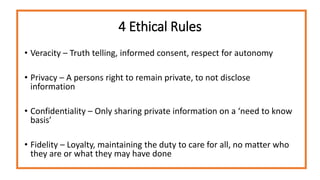
4 Ethical Rules
• Veracity – Truth telling, informed consent, respect for autonomy
• Privacy – A persons right to remain private, to not disclose
information
• Confidentiality – Only sharing private information on a ‘need to know
basis’
• Fidelity – Loyalty, maintaining the duty to care for all, no matter who
they are or what they may have done
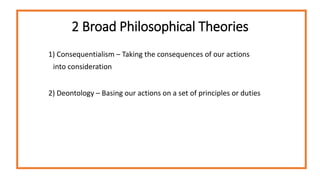
2 Broad Philosophical Theories
1) Consequentialism – Taking the consequences of our actions
into consideration
2) Deontology – Basing our actions on a set of principles or duties
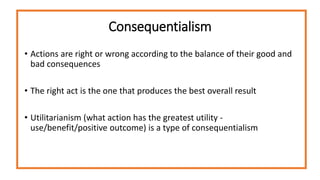
Consequentialism
• Actions are right or wrong according to the balance of their good and
bad consequences
• The right act is the one that produces the best overall result
• Utilitarianism (what action has the greatest utility -
use/benefit/positive outcome) is a type of consequentialism
Utilitarianism
• Most prominent consequence-based theory
• Based on the principle of utility
• Actions ought to produce the maximal balance of positive value (e.g.
happiness) over disvalue (e.g. harm)
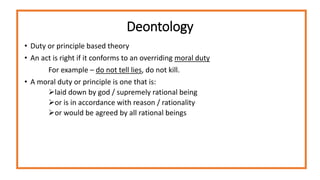
Deontology
• Duty or principle based theory
• An act is right if it conforms to an overriding moral duty
For example – do not tell lies, do not kill.
• A moral duty or principle is one that is:
laid down by god / supremely rational being
or is in accordance with reason / rationality
or would be agreed by all rational beings
The Agency recognizes that ethical issues related to the consumer, the
agency, and the provision of services, may develop.
It is the policy of the agency to provide care within an ethical framework
established by the professional disciplines provided by the agency,
established by the agency policy and procedures and as established by the
law and standards of care.
The agency recognizes that from time to time, staff member’s personal
values and beliefs influence their ability to provide care.
When the situations arise for care that conflicts with staff values and beliefs,
the agency will find an alternative method of care. Staff may refuse to
provide care based upon personal values and beliefs but the agency will
make every effort not to disrupt the consumers care.
Individual performance evaluations will appropriately reflect the manager’s
considerations of motives related to participate based upon cultural values
or religious beliefs.

4 ethics

  • 1.
  • 2.
    Introduction to Ethics •Our care for patients should be based on sound judgement and evidence- based practices. • Some of this judgement is about having a strong sense of what is right and wrong • Ethics is having a strong sense of what we should be doing and shouldn’t be doing as clinicians • Ethics is having a strong sense of what our priorities ought to be
  • 3.
    What is an‘ethical issue’? • When you have to judge what is right or wrong • Choosing between options • Deciding whether to do something or do nothing • Should I or shouldn’t I? • Weighing up the potential impact of your decisions or actions • A dilemma – making a difficult choice
  • 4.
    Ethical Issues inHealth Care • We usually think of the ‘big’ issues e.g. definition of life, what is a person, quality of life, prolonging life, ending life, human rights. • But day-to-day ethical issues can involve: Respecting people Treating people with dignity Treating people fairly Supporting patient’s choices
  • 5.
    There are 4Key Ethical Principles •Autonomy •Beneficence •Non-maleficence •Justice
  • 6.
    Autonomy • Respects aperson’s right to make their own decisions • Teaches people to be able to make their own choices • Supports people in their individual choices • Does not force or coerce people to do things • ‘Informed Consent’ is an important outcome of this principle
  • 7.
    Beneficence (to dogood) • Our actions must aim to ‘benefit’ people – health, welfare, comfort, well-being, improve a person’s potential, improve quality of life • ‘Benefit’ should be defined by the person themselves. It’s not what we think that is important. • Act on behalf of ‘vulnerable’ people to protect their rights • Prevent harm • Create a safe and supportive environment • Help people in crises
  • 8.
    Non – Maleficence(to do no harm) • Do not to inflict harm on people • Do not cause pain or suffering • Do not incapacitate • Do not cause offence • Do not deprive people • Do not kill
  • 9.
    Justice • Treating peoplefairly • Not favoring some individuals/groups over others • Acting in a non–discriminatory / non-prejudicial way • Respect for people’s rights • Respect for the law
  • 10.
    Justice • Distributive Justice– sharing the scarce resources in society in a fair and just manner (e.g. health services, professional time) How should we share out healthcare resources? How do we share out our time with patients? Deciding how to do this raises some difficult questions • Patients should get…. an equal share ? just enough to meet their needs ? what they deserve ? what they can pay for ?
  • 11.
    4 Ethical Rules •Veracity – Truth telling, informed consent, respect for autonomy • Privacy – A persons right to remain private, to not disclose information • Confidentiality – Only sharing private information on a ‘need to know basis’ • Fidelity – Loyalty, maintaining the duty to care for all, no matter who they are or what they may have done
  • 12.
    2 Broad PhilosophicalTheories 1) Consequentialism – Taking the consequences of our actions into consideration 2) Deontology – Basing our actions on a set of principles or duties
  • 13.
    Consequentialism • Actions areright or wrong according to the balance of their good and bad consequences • The right act is the one that produces the best overall result • Utilitarianism (what action has the greatest utility - use/benefit/positive outcome) is a type of consequentialism
  • 14.
    Utilitarianism • Most prominentconsequence-based theory • Based on the principle of utility • Actions ought to produce the maximal balance of positive value (e.g. happiness) over disvalue (e.g. harm)
  • 15.
    Deontology • Duty orprinciple based theory • An act is right if it conforms to an overriding moral duty For example – do not tell lies, do not kill. • A moral duty or principle is one that is: laid down by god / supremely rational being or is in accordance with reason / rationality or would be agreed by all rational beings
  • 16.
    The Agency recognizesthat ethical issues related to the consumer, the agency, and the provision of services, may develop. It is the policy of the agency to provide care within an ethical framework established by the professional disciplines provided by the agency, established by the agency policy and procedures and as established by the law and standards of care. The agency recognizes that from time to time, staff member’s personal values and beliefs influence their ability to provide care. When the situations arise for care that conflicts with staff values and beliefs, the agency will find an alternative method of care. Staff may refuse to provide care based upon personal values and beliefs but the agency will make every effort not to disrupt the consumers care. Individual performance evaluations will appropriately reflect the manager’s considerations of motives related to participate based upon cultural values or religious beliefs.