Which Fiscal Union for EMU?
Marco BUTI
Director-General
European Commission, DG Economic and Financial Affairs
ADEMU conference: "How much of a Fiscal Union for the EMU?"
Madrid, 19 May 2017
2
Outline
1. Fiscal policy in EMU: changes since the crisis
2. Which Fiscal Union for a sustainable EMU
3. Concluding remarks
3
Fiscal policy in EMU: an evolving view
• Rules to tame deficit bias in absence of national
exchange rate policy
• Automatic stabilisers: let them play
• Risk of debt monetisation dominates monetary-
fiscal relations
• Low spillovers because of offsetting monetary
policy reaction
Revising the role of
fiscal policy in EMU
– post crisis
"Augustinian
view"
• Discretionary fiscal policy needed in case of
large shocks
• High multipliers and spillovers when monetary
policy is constrained
• Aggregate fiscal stance and differentiated fiscal
space matter
• Sovereign-banks nexus
• Institutions vs. rules
• Links fiscal policies/ structural reforms
Conventional view
on fiscal policies in
EMU – pre crisis
"Put your house
in order"
4
What has been done since the crisis?
6-Pack
Fiscal
Compact
2-Pack
Five
Presidents
Report
Blueprint
Four
Presidents
Report
Reflection
Paper on
EMU
MayDec Jan MayNov JunDec Sep
ESM
Sep
SRM
Jan
SSM
Nov
2012 2013 2014 2015 2016 2017
White
Paper on
the future
of Europe
Mar
2011
CRISIS POST-CRISIS
Communi-
cation on
fiscal stance
Nov
Communi-
cation on SGP
flexibility
Feb
Political economy:
More fiscal discipline allows crisis response
Political economy:
Better articulation of national/EA fiscal policies
Capital
Markets
Union
5
Far-reaching institutional changes
since 2011
Stronger
SGP
• Introduction of expenditure rule, debt benchmark (6-P) and
balanced budget rule (TSCG) • Possibility of imposing earlier/
more gradual sanctions (6-P) • Surveillance of DBPs (2-P)
• European Stability Mechanism (ESM)
Breaking
sovereign/banks
nexus
• Banking Union
• Capital Markets Union
Crisis resolution
mechanism
Challenge
Measure taken
to address the
challenge
Measure in greater detail
National fiscal
frameworks
• Mandatory min. requirements at the national level) (6-P)
• Prevention/correction of macroeconomic imbalances via the
introduction of the new Macroeconomic Imbalance Procedure
(MIP) (6-P)
Macro
surveillance
Conventional
view on
fiscal policies
in EMU –
pre crisis
Revising the
role of fiscal
policy in EMU
– post crisis
Appli-
cation


being
imple-
mented

to be
completed
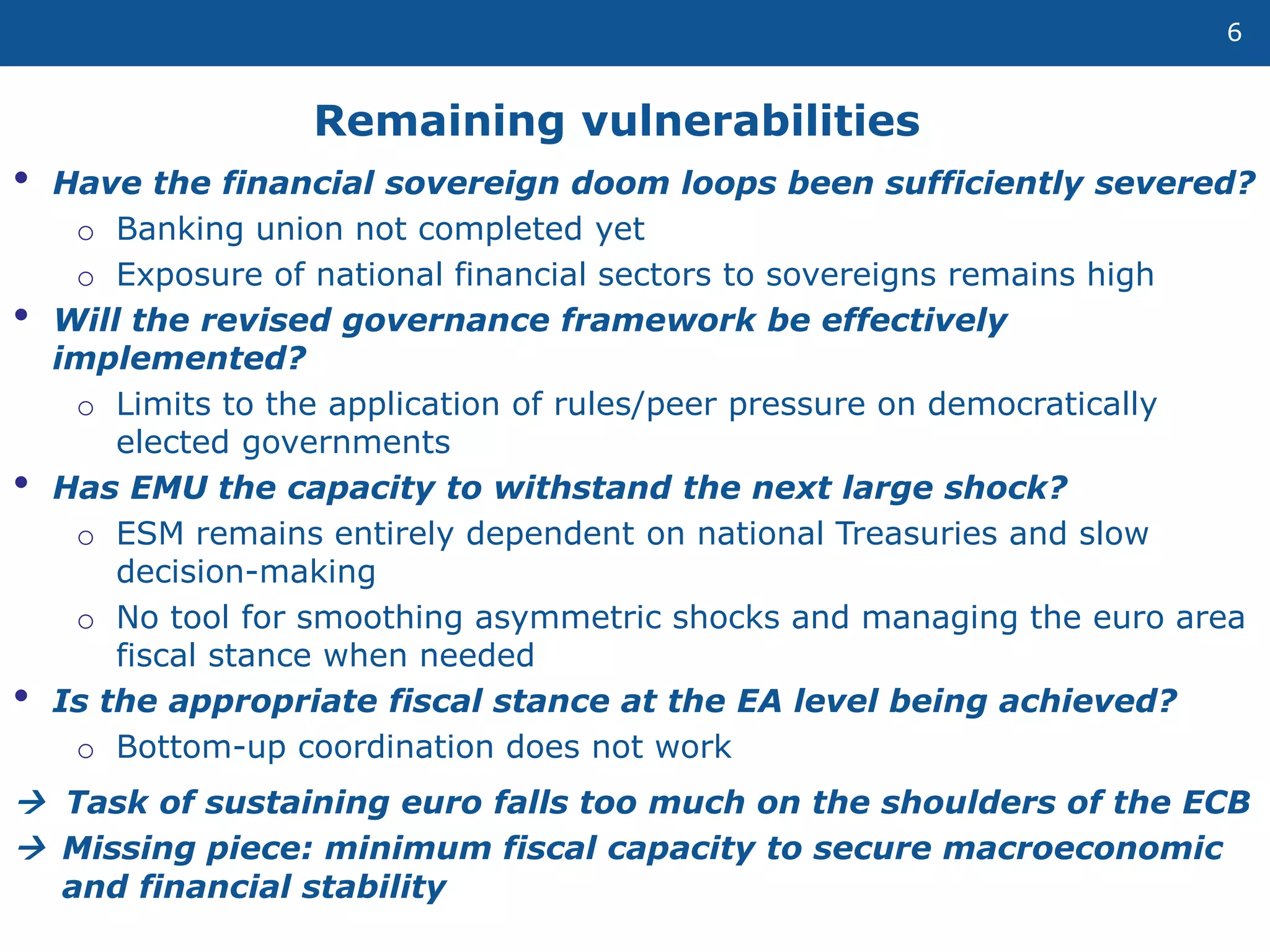
Remaining vulnerabilities
6
• Have the financial sovereign doom loops been sufficiently severed?
o Banking union not completed yet
o Exposure of national financial sectors to sovereigns remains high
• Will the revised governance framework be effectively
implemented?
o Limits to the application of rules/peer pressure on democratically
elected governments
• Has EMU the capacity to withstand the next large shock?
o ESM remains entirely dependent on national Treasuries and slow
decision-making
o No tool for smoothing asymmetric shocks and managing the euro area
fiscal stance when needed
• Is the appropriate fiscal stance at the EA level being achieved?
o Bottom-up coordination does not work
 Task of sustaining euro falls too much on the shoulders of the ECB
 Missing piece: minimum fiscal capacity to secure macroeconomic
and financial stability
7
Which framing conditions for a Fiscal Union?
• Three classic functions of public finance (Musgrave, …):
o Allocation function
o Distribution function
o Stabilisation function
• Interaction of Fiscal Union with national public finances
o All three functions to remain primarily at national level
o Pre-existence of significant national budgets tends to exclude
allocative or distributive functions at euro area level
o Euro area stabilisation function as complement to national
stabilisation
-> Fiscal Union sui generis
8
• Primary rationale
o Improve counter-cyclical stabilisers
o Address remaining sovereign bank loops
o Improve market discipline
• What a Fiscal Union cannot be:
o Redistributive mechanism with permanent transfers
o Issuance of (large-scale) Eurobonds
o Fully fledged allocative function or controlling MS expenditure
and revenues
=> Fiscal Union would be a one of its kind construction: the
minimum fiscal arm of the monetary union
Politically-feasible Fiscal Union
9
Fiscal Union
- quasi-minimum requirements -
Empêcher et corriger
les déséquilibres
macroéconomiques
Accent sur les
évolutions de la dette
Risk
reduction • Enforce fiscal rules
• Improve market
discipline
• Backstop for
Banking Union
• Crisis management
• Provision of safe
asset
Risk
sharing
Growth
support Global
governance
• External
representation
• Set overall fiscal
stance
• Stabilisation
capacity
• Investment
capacity
10
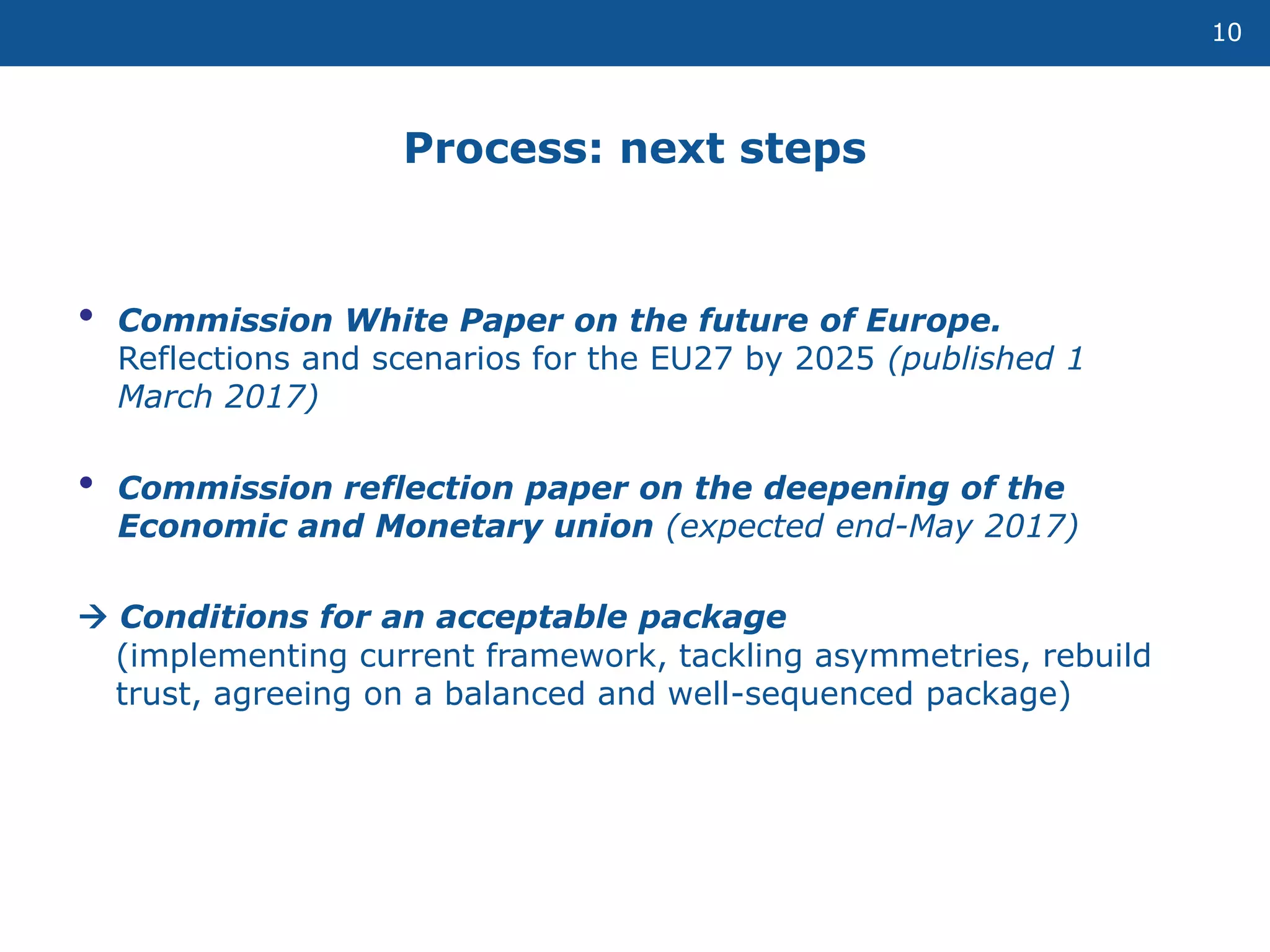
• Commission White Paper on the future of Europe.
Reflections and scenarios for the EU27 by 2025 (published 1
March 2017)
• Commission reflection paper on the deepening of the
Economic and Monetary union (expected end-May 2017)
 Conditions for an acceptable package
(implementing current framework, tackling asymmetries, rebuild
trust, agreeing on a balanced and well-sequenced package)
Process: next steps
11
In sum
• Crisis revealed fault lines in original EMU design and steps
have been taken to breach those
• The present set-up remains vulnerable to shocks and leaves
too heavy responsibilities on the ECB
• There has been an evolution on the view of fiscal policy in
EMU
• A large EU budget is not in the cards
• Fiscal Union should be based on minimum conditions
12
Thank you very much for your attention
13
Background slides
14
• Why? Stabilise large country-specific shocks and/or common
shocks? Limited to unusual circumstances?
• How? Different concepts floating in public and among pundits
(not mutually exclusive)
o Stabilisation function based on unemployment
o Investment capacity
o Provision of public goods (e.g. security-related)
• Key challenges?
o No permanent transfers
o Beware moral hazard – ensure fiscal discipline
o Respect subsidiarity principle
o What degree of automaticity and conditionality?
Setting up a stabilisation function
15
Options for a stabilisation instrument
Stabilisation
instrument
Option 1
General payments to
budgets
Option 2
Earmarked payments
e.g. investments,
unemployment benefits …
Whatever option, need for 'active stabilisation' against large shocks
- A 10% cyclical variation of a 2% of GDP budget brings only 0.2% of
GDP stabilisation
- But contributing 0.2% every year allows active stabilisation of 2% of
GDP every 10 years
16
Stabilisation
Fund
Country A
High and
increasing
unemployment
Country B
Neither
condition
applies
Country C
Low and falling
unemployment
Fund
payment
Country
contribution
- High U = higher than past 15 years average. Low U = the opposite
- Increasing U = higher than previous year. Falling U = the opposite
Note: Carnot, Kizior, Mourre, forthcoming
Example trigger for active stabilisation:
Double condition
17
Similar fiscal adjustment in the US and EA,
but timing was different
Change in structural balances EA vs. US
(in % of GDP)
Functioning of automatic stabilisers
EU vs. US (in %)
Source: Dolls et al. 2012: Automatic stabilizers and
economic crisis: US vs. Europe, Journal of Public
Economics, 96, 279-294.
Source: Own calculations based on IMF World Economic
Outlook, October 2016.
Region
Type of
shock
Stabilisation of …
Income Demand
EU
Income 37.8 22.1
Unemployment 46.9 29.7
US
Income 32.2 17.4
Unemployment 33.7 19.7
-3
-2
-1
0
1
2
3
4
5
2004-08 2009-16 2009-11 2012-16
EA-19
US
Post crisis
sub-periods
18
Limited fiscal buffers to cope with shocks
Gross debt general government
(in % of GDP)
Fiscal adjustment required to reach a
60% public debt-to-GDP ratio by 2030
(in % of GDP)
Source: Commission services. 2016 Stability and
Convergence Programmes (SCP).
Note: Red line shows the Maastricht reference value.
Source: European Commission winter forecast 2017.
0
20
40
60
80
100
120
140
EA-19 ES IE PT IT
2007 2009 2012 2013 2014 2015 2017
-6
-4
-2
0
2
4
6
PT
IT
FR
BE
ES
SI
FI
EA
CY
IE
AT
LT
NL
DE
MT
SK
LV
EE
LU
COM baseline spring 2016 scenario SCP scenario
(1) (2) (3) (4) (5) (6) (7)
Dependent variable: Δ SB DFE DFE Δ SB Δ SB Δ SB Δ SB
Dummy: EDP
IMF
programme
EDP if
Δ OG > 0
Publ. exp. <
potential gr
Data: real time ex post ex post real time real time real time real time
Measure for econ. cycle: Δ OG Δ OG level OG Δ OG Δ OG Δ OG Δ OG
Econ. cycle (t-1) -0.27*** -0.39*** 0.09 -0.18** -0.28*** -0.23* -0.31***
(-3.64) (-3.39) (0.73) (-2.33) (-2.99) (-1.86) (-3.84)
Debt (t-1) 0.04*** 0.01*** 0.030*** 0.04*** 0.04*** 0.02** 0.04***
(4.92) (2.94) (3.57) (5.10) (4.41) (2.03) (5.03)
Econ. cycle x dummy (t-1) -0.36*** -0.25** -0.12 0.09
(-3.35) (2.13) (-0.66) (0.85)
Dummy (t-1) 0.16 -0.33 0.13 -0.11
(0.80) (-0.68) (0.44) (-0.53)
Obs. 367 168 168 367 367 191 367
# countries 28 28 28 28 28 28 28
R-squared 0.39 0.39 0.52 0.41 0.39 0.25 0.39
Econ. cycle|dummy = 1 -0.54*** -0.53*** -0.34** -0.22***
19
Procyclical fiscal policies
Source: Own calculations.
Note: The table shows panel regression results using the following specification: ∆𝑺𝑩𝒊,𝒕= 𝜷 𝟏 ∆𝒐𝒖𝒕𝒑𝒖𝒕 𝒈𝒂𝒑 𝒊,𝒕 + 𝜷 𝟐 𝒅𝒆𝒃𝒕 𝒊,𝒕−𝟏 + 𝜷 𝟑 𝒅𝒖𝒎𝒎𝒚 𝒊,𝒕−𝟏 ∙
∆𝒐𝒖𝒕𝒑𝒖𝒕 𝒈𝒂𝒑𝒊,𝒕 + 𝜷 𝟒 𝒅𝒖𝒎𝒎𝒚 𝒊,𝒕−𝟏 + 𝜽 𝒕 + 𝝑𝒊 + 𝒖𝒊,𝒕. The sample includes 28 EU countries covering the period 2000-16. Data for regressions
using "ex post" data come from the Commission autumn forecast 2016. "Real time" indicates outturns in period t reported in period t+1.
All estimations include time and country dummies and a constant, which are not shown due to space constraints. Estimation approach:
least square dummy variable estimator (LSDV) using heteroskedasticity-robust Huber-White standard errors. Regressions using the
System GMM estimator yield similar results. t-statistics in parentheses. ***, ** and * denote respectively statistical significance at 1, 5
and 10%.
additional
impact if
dummy is 1
marginal
impact if
dummy is 1
pro-cyclical
if < 0
reduces
pro-cyclicality
amplifies
pro-cyclicality
20
Procyclical fiscal policies (not only in the EU)
Source: Commission calculations based on (ex post) data from the OECD Economic Outlook 2006 (ex post).
Note: Data for the EA-19 are averages of the changes in cyclically-adjusted balances weighted by potential GDP. EA-19 shown
(instead of EU-28) for data availability reasons. Good (bad) times correspond to periods with positive (negative) changes in/levels
of output gaps.
• Average change in cyclically-adjusted balance
• (in % of potential GDP)
Countercyclical Acyclical ProcyclicalLegend:
1992-98 1999-07 2008-16 1992-98 1999-07 2008-16
Good times Bad times
Δ OG >= 0 Δ OG < 0
Mean 0.5 0.1 0.2 0.9 -0.4 0.2
(Obs) (102) (132) (107) (31) (39) (64)
Mean 0.4 0.0 0.3 0.8 -1.5 -0.2
(Obs) (5) (6) (5) (2) (3) (4)
level OG >= 0 level OG < 0
Mean 0.6 0.0 0.0 0.5 0.0 0.3
(Obs) (72) (128) (69) (61) (43) (102)
Mean 0.7 0.0 NA 0.5 -2.2 0.1
(Obs) (1) (7) (0) (6) (2) (9)
US
EA-19
US
EA-19
21
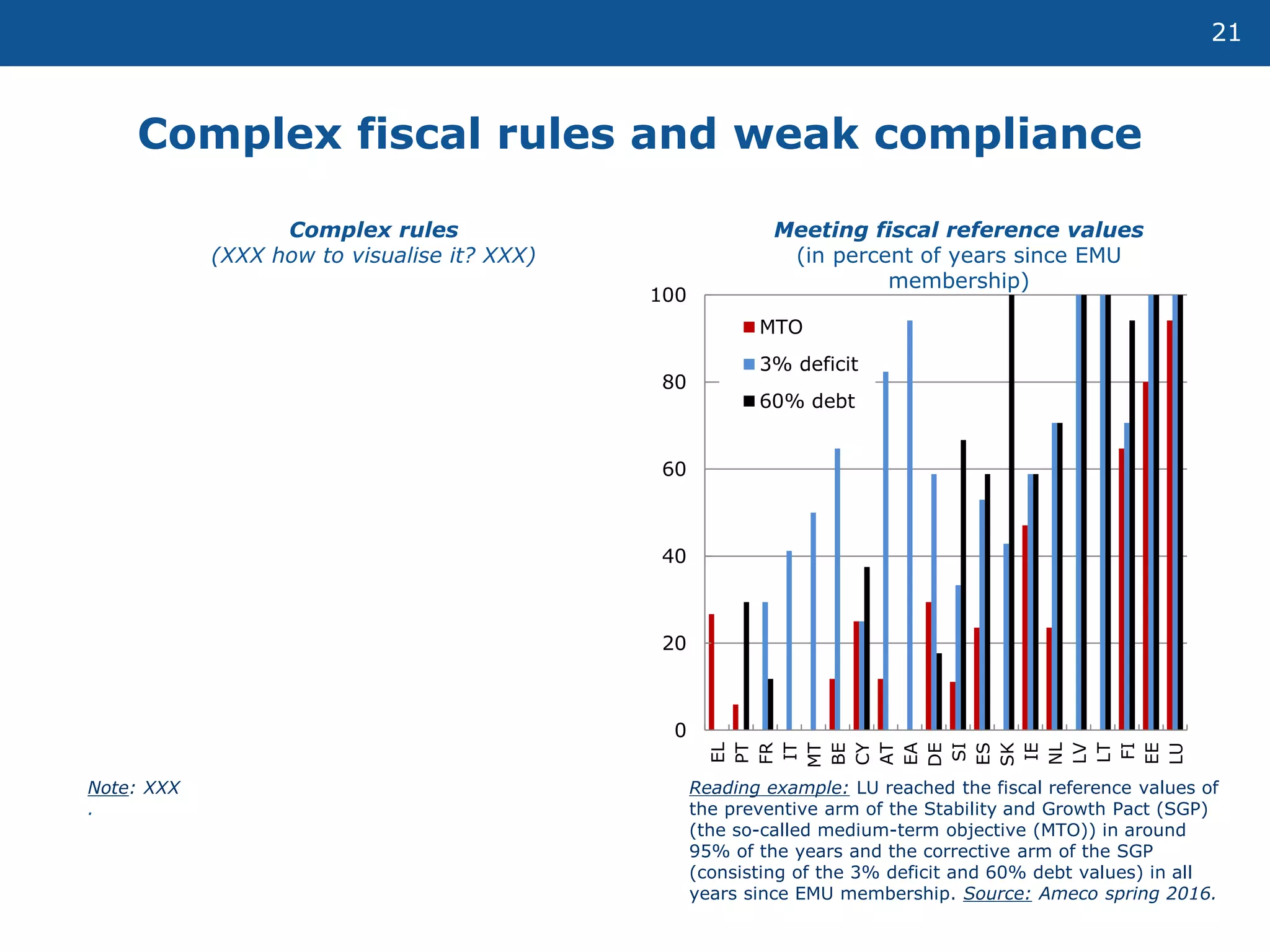
Complex fiscal rules and weak compliance
• Complex rules
(XXX how to visualise it? XXX)
• Meeting fiscal reference values
(in percent of years since EMU
membership)
Note: XXX
.
Reading example: LU reached the fiscal reference values of
the preventive arm of the Stability and Growth Pact (SGP)
(the so-called medium-term objective (MTO)) in around
95% of the years and the corrective arm of the SGP
(consisting of the 3% deficit and 60% debt values) in all
years since EMU membership. Source: Ameco spring 2016.
0
20
40
60
80
100
EL
PT
FR
IT
MT
BE
CY
AT
EA
DE
SI
ES
SK
IE
NL
LV
LT
FI
EE
LU
MTO
3% deficit
60% debt
22
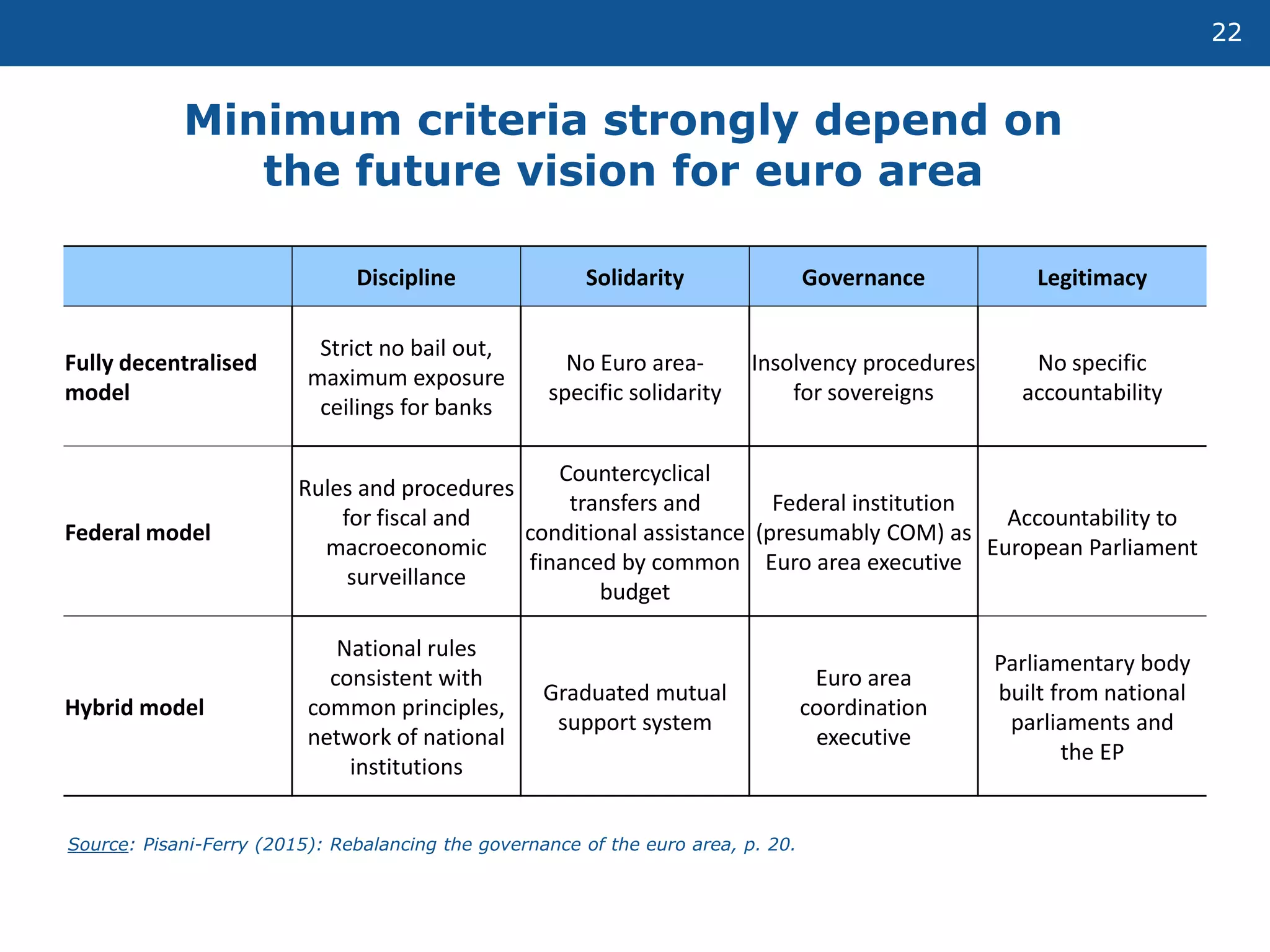
Minimum criteria strongly depend on
the future vision for euro area
Discipline Solidarity Governance Legitimacy
Fully decentralised
model
Strict no bail out,
maximum exposure
ceilings for banks
No Euro area-
specific solidarity
Insolvency procedures
for sovereigns
No specific
accountability
Federal model
Rules and procedures
for fiscal and
macroeconomic
surveillance
Countercyclical
transfers and
conditional assistance
financed by common
budget
Federal institution
(presumably COM) as
Euro area executive
Accountability to
European Parliament
Hybrid model
National rules
consistent with
common principles,
network of national
institutions
Graduated mutual
support system
Euro area
coordination
executive
Parliamentary body
built from national
parliaments and
the EP
Source: Pisani-Ferry (2015): Rebalancing the governance of the euro area, p. 20.
2
3
Low insurance against income shocks in EMU
Source: Buti et al. (2016): Smoothing economic shocks in the Eurozone: The untapped potential of the financial
union, voxeu.org, August 2016.
0%
20%
40%
60%
80%
100%
Euro area US
Cross-border risk sharing through different channels
in % of total asymmetric shock to output
Unsmoothed Cross-border borrowing
Cross-border fiscal transfers Cross-border capital market and labour income
24
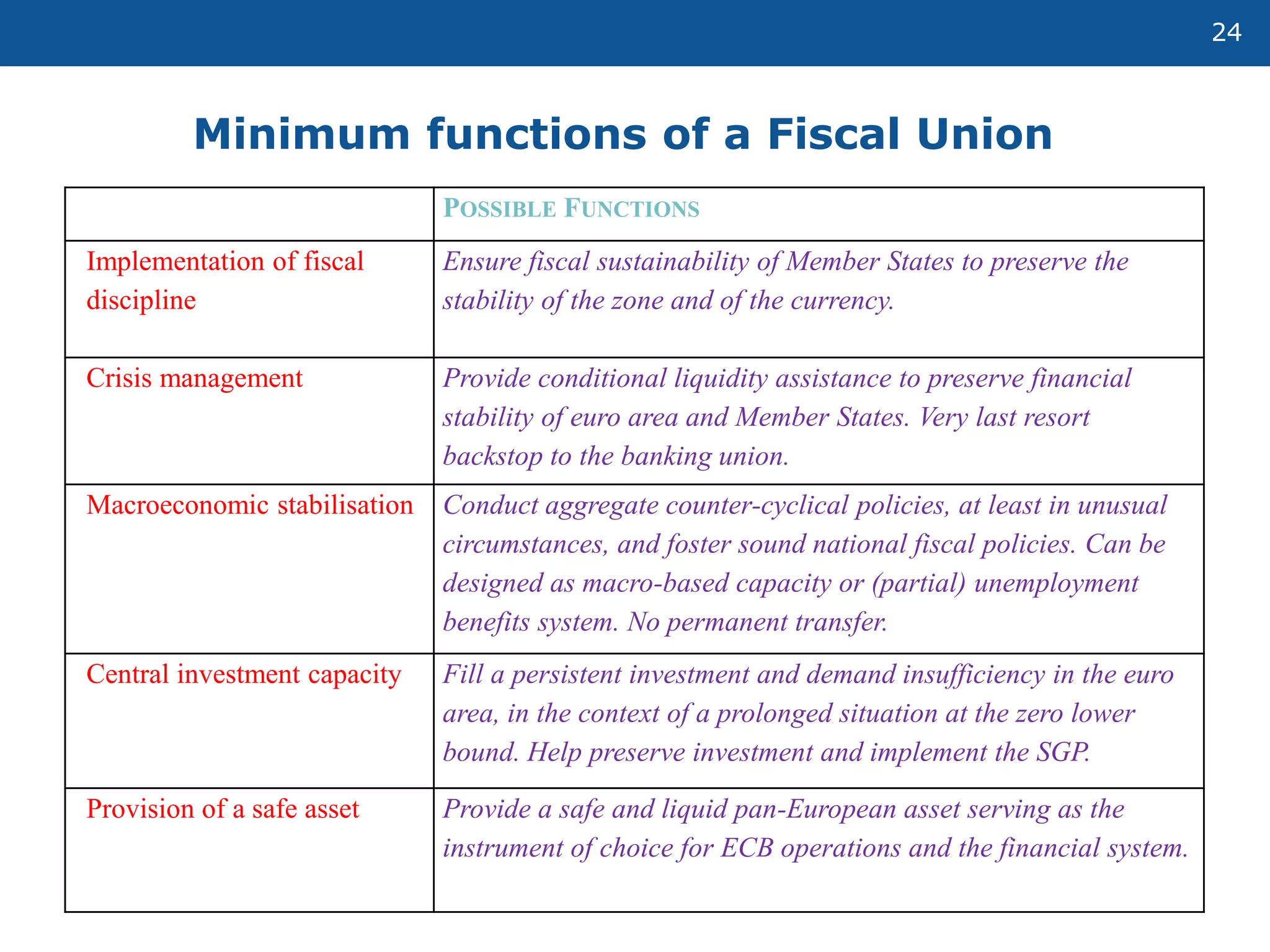
Minimum functions of a Fiscal Union
POSSIBLE FUNCTIONS
Implementation of fiscal
discipline
Ensure fiscal sustainability of Member States to preserve the
stability of the zone and of the currency.
Crisis management Provide conditional liquidity assistance to preserve financial
stability of euro area and Member States. Very last resort
backstop to the banking union.
Macroeconomic stabilisation Conduct aggregate counter-cyclical policies, at least in unusual
circumstances, and foster sound national fiscal policies. Can be
designed as macro-based capacity or (partial) unemployment
benefits system. No permanent transfer.
Central investment capacity Fill a persistent investment and demand insufficiency in the euro
area, in the context of a prolonged situation at the zero lower
bound. Help preserve investment and implement the SGP.
Provision of a safe asset Provide a safe and liquid pan-European asset serving as the
instrument of choice for ECB operations and the financial system.
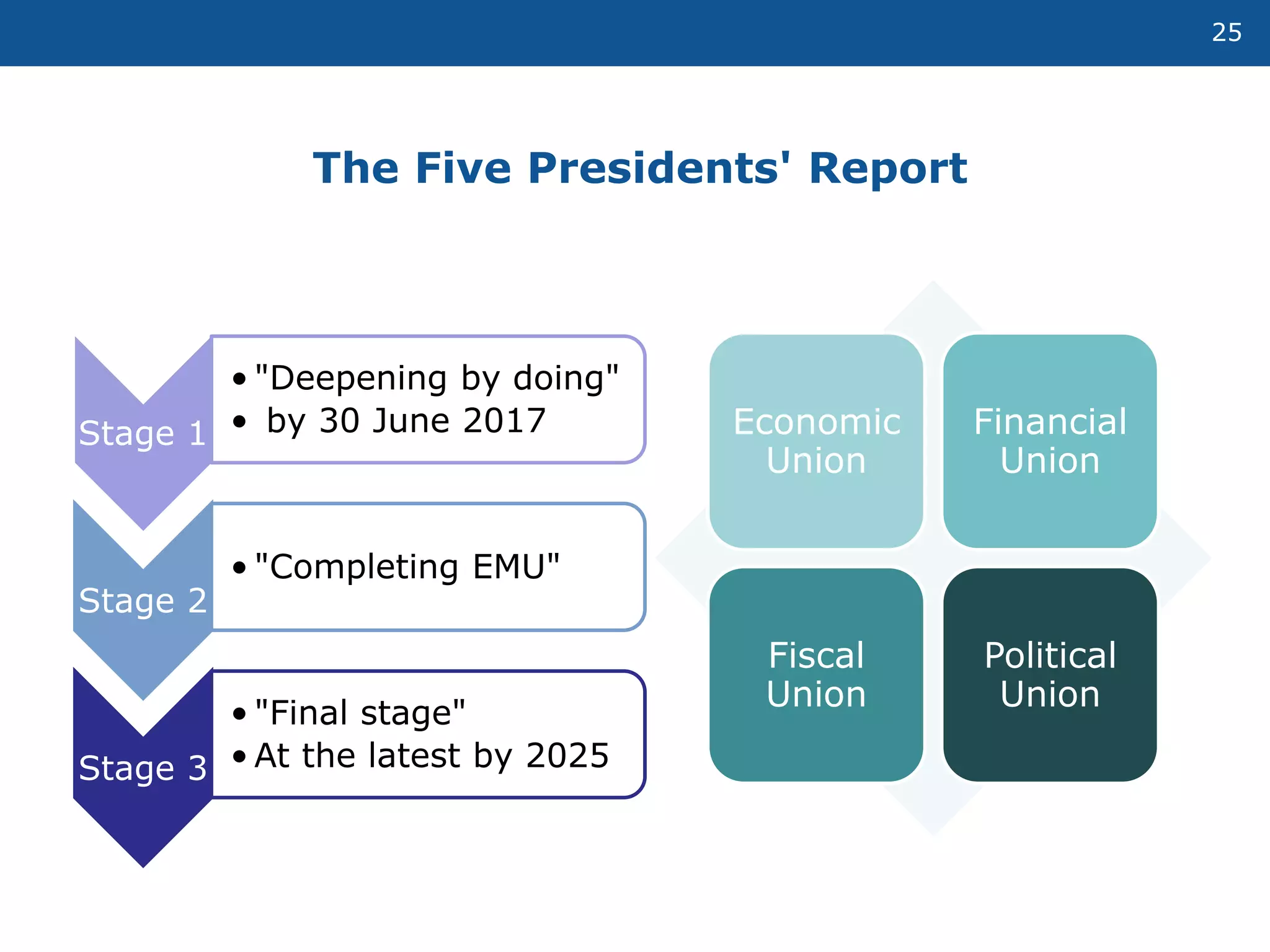
The Five Presidents' Report
25
Economic
Union
Financial
Union
Fiscal
Union
Political
Union
Stage 1
• "Deepening by doing"
• by 30 June 2017
Stage 2
• "Completing EMU"
Stage 3
• "Final stage"
• At the latest by 2025
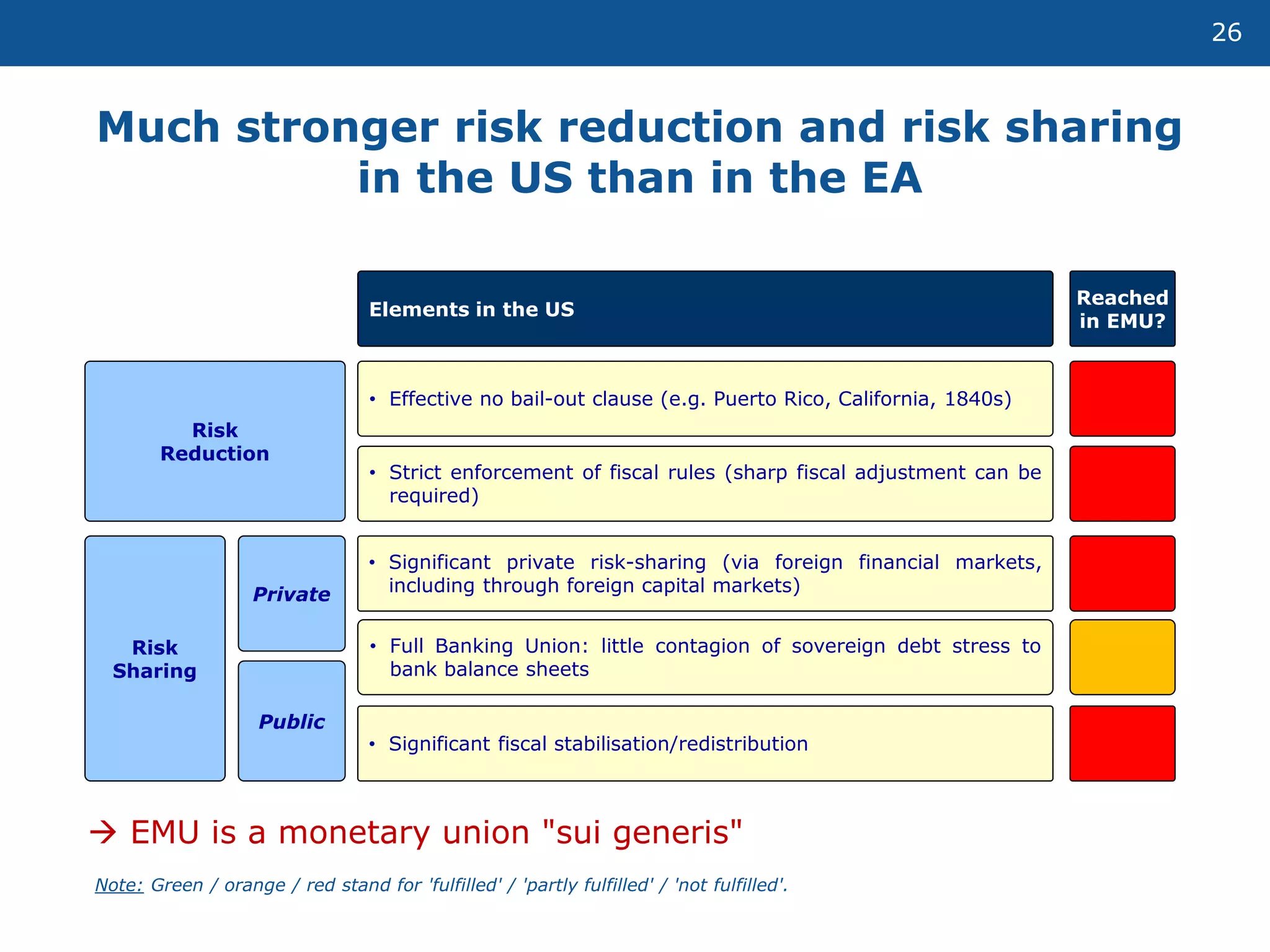
26
Much stronger risk reduction and risk sharing
in the US than in the EA
• Effective no bail-out clause (e.g. Puerto Rico, California, 1840s)
• Strict enforcement of fiscal rules (sharp fiscal adjustment can be
required)
• Significant private risk-sharing (via foreign financial markets,
including through foreign capital markets)
• Significant fiscal stabilisation/redistribution
• Full Banking Union: little contagion of sovereign debt stress to
bank balance sheets
Risk
Sharing
Risk
Reduction
Reached
in EMU?
Elements in the US
Private
Public
 EMU is a monetary union "sui generis"
Note: Green / orange / red stand for 'fulfilled' / 'partly fulfilled' / 'not fulfilled'.
The White Paper on the future of Europe –
EMU implications
27

Marco Buti: which fiscal union for EMU?

  • 1.
    Which Fiscal Unionfor EMU? Marco BUTI Director-General European Commission, DG Economic and Financial Affairs ADEMU conference: "How much of a Fiscal Union for the EMU?" Madrid, 19 May 2017
  • 2.
    2 Outline 1. Fiscal policyin EMU: changes since the crisis 2. Which Fiscal Union for a sustainable EMU 3. Concluding remarks
  • 3.
    3 Fiscal policy inEMU: an evolving view • Rules to tame deficit bias in absence of national exchange rate policy • Automatic stabilisers: let them play • Risk of debt monetisation dominates monetary- fiscal relations • Low spillovers because of offsetting monetary policy reaction Revising the role of fiscal policy in EMU – post crisis "Augustinian view" • Discretionary fiscal policy needed in case of large shocks • High multipliers and spillovers when monetary policy is constrained • Aggregate fiscal stance and differentiated fiscal space matter • Sovereign-banks nexus • Institutions vs. rules • Links fiscal policies/ structural reforms Conventional view on fiscal policies in EMU – pre crisis "Put your house in order"
  • 4.
    4 What has beendone since the crisis? 6-Pack Fiscal Compact 2-Pack Five Presidents Report Blueprint Four Presidents Report Reflection Paper on EMU MayDec Jan MayNov JunDec Sep ESM Sep SRM Jan SSM Nov 2012 2013 2014 2015 2016 2017 White Paper on the future of Europe Mar 2011 CRISIS POST-CRISIS Communi- cation on fiscal stance Nov Communi- cation on SGP flexibility Feb Political economy: More fiscal discipline allows crisis response Political economy: Better articulation of national/EA fiscal policies Capital Markets Union
  • 5.
    5 Far-reaching institutional changes since2011 Stronger SGP • Introduction of expenditure rule, debt benchmark (6-P) and balanced budget rule (TSCG) • Possibility of imposing earlier/ more gradual sanctions (6-P) • Surveillance of DBPs (2-P) • European Stability Mechanism (ESM) Breaking sovereign/banks nexus • Banking Union • Capital Markets Union Crisis resolution mechanism Challenge Measure taken to address the challenge Measure in greater detail National fiscal frameworks • Mandatory min. requirements at the national level) (6-P) • Prevention/correction of macroeconomic imbalances via the introduction of the new Macroeconomic Imbalance Procedure (MIP) (6-P) Macro surveillance Conventional view on fiscal policies in EMU – pre crisis Revising the role of fiscal policy in EMU – post crisis Appli- cation   being imple- mented  to be completed
  • 6.
    Remaining vulnerabilities 6 • Havethe financial sovereign doom loops been sufficiently severed? o Banking union not completed yet o Exposure of national financial sectors to sovereigns remains high • Will the revised governance framework be effectively implemented? o Limits to the application of rules/peer pressure on democratically elected governments • Has EMU the capacity to withstand the next large shock? o ESM remains entirely dependent on national Treasuries and slow decision-making o No tool for smoothing asymmetric shocks and managing the euro area fiscal stance when needed • Is the appropriate fiscal stance at the EA level being achieved? o Bottom-up coordination does not work  Task of sustaining euro falls too much on the shoulders of the ECB  Missing piece: minimum fiscal capacity to secure macroeconomic and financial stability
  • 7.
    7 Which framing conditionsfor a Fiscal Union? • Three classic functions of public finance (Musgrave, …): o Allocation function o Distribution function o Stabilisation function • Interaction of Fiscal Union with national public finances o All three functions to remain primarily at national level o Pre-existence of significant national budgets tends to exclude allocative or distributive functions at euro area level o Euro area stabilisation function as complement to national stabilisation -> Fiscal Union sui generis
  • 8.
    8 • Primary rationale oImprove counter-cyclical stabilisers o Address remaining sovereign bank loops o Improve market discipline • What a Fiscal Union cannot be: o Redistributive mechanism with permanent transfers o Issuance of (large-scale) Eurobonds o Fully fledged allocative function or controlling MS expenditure and revenues => Fiscal Union would be a one of its kind construction: the minimum fiscal arm of the monetary union Politically-feasible Fiscal Union
  • 9.
    9 Fiscal Union - quasi-minimumrequirements - Empêcher et corriger les déséquilibres macroéconomiques Accent sur les évolutions de la dette Risk reduction • Enforce fiscal rules • Improve market discipline • Backstop for Banking Union • Crisis management • Provision of safe asset Risk sharing Growth support Global governance • External representation • Set overall fiscal stance • Stabilisation capacity • Investment capacity
  • 10.
    10 • Commission WhitePaper on the future of Europe. Reflections and scenarios for the EU27 by 2025 (published 1 March 2017) • Commission reflection paper on the deepening of the Economic and Monetary union (expected end-May 2017)  Conditions for an acceptable package (implementing current framework, tackling asymmetries, rebuild trust, agreeing on a balanced and well-sequenced package) Process: next steps
  • 11.
    11 In sum • Crisisrevealed fault lines in original EMU design and steps have been taken to breach those • The present set-up remains vulnerable to shocks and leaves too heavy responsibilities on the ECB • There has been an evolution on the view of fiscal policy in EMU • A large EU budget is not in the cards • Fiscal Union should be based on minimum conditions
  • 12.
    12 Thank you verymuch for your attention
  • 13.
  • 14.
    14 • Why? Stabiliselarge country-specific shocks and/or common shocks? Limited to unusual circumstances? • How? Different concepts floating in public and among pundits (not mutually exclusive) o Stabilisation function based on unemployment o Investment capacity o Provision of public goods (e.g. security-related) • Key challenges? o No permanent transfers o Beware moral hazard – ensure fiscal discipline o Respect subsidiarity principle o What degree of automaticity and conditionality? Setting up a stabilisation function
  • 15.
    15 Options for astabilisation instrument Stabilisation instrument Option 1 General payments to budgets Option 2 Earmarked payments e.g. investments, unemployment benefits … Whatever option, need for 'active stabilisation' against large shocks - A 10% cyclical variation of a 2% of GDP budget brings only 0.2% of GDP stabilisation - But contributing 0.2% every year allows active stabilisation of 2% of GDP every 10 years
  • 16.
    16 Stabilisation Fund Country A High and increasing unemployment CountryB Neither condition applies Country C Low and falling unemployment Fund payment Country contribution - High U = higher than past 15 years average. Low U = the opposite - Increasing U = higher than previous year. Falling U = the opposite Note: Carnot, Kizior, Mourre, forthcoming Example trigger for active stabilisation: Double condition
  • 17.
    17 Similar fiscal adjustmentin the US and EA, but timing was different Change in structural balances EA vs. US (in % of GDP) Functioning of automatic stabilisers EU vs. US (in %) Source: Dolls et al. 2012: Automatic stabilizers and economic crisis: US vs. Europe, Journal of Public Economics, 96, 279-294. Source: Own calculations based on IMF World Economic Outlook, October 2016. Region Type of shock Stabilisation of … Income Demand EU Income 37.8 22.1 Unemployment 46.9 29.7 US Income 32.2 17.4 Unemployment 33.7 19.7 -3 -2 -1 0 1 2 3 4 5 2004-08 2009-16 2009-11 2012-16 EA-19 US Post crisis sub-periods
  • 18.
    18 Limited fiscal buffersto cope with shocks Gross debt general government (in % of GDP) Fiscal adjustment required to reach a 60% public debt-to-GDP ratio by 2030 (in % of GDP) Source: Commission services. 2016 Stability and Convergence Programmes (SCP). Note: Red line shows the Maastricht reference value. Source: European Commission winter forecast 2017. 0 20 40 60 80 100 120 140 EA-19 ES IE PT IT 2007 2009 2012 2013 2014 2015 2017 -6 -4 -2 0 2 4 6 PT IT FR BE ES SI FI EA CY IE AT LT NL DE MT SK LV EE LU COM baseline spring 2016 scenario SCP scenario
  • 19.
    (1) (2) (3)(4) (5) (6) (7) Dependent variable: Δ SB DFE DFE Δ SB Δ SB Δ SB Δ SB Dummy: EDP IMF programme EDP if Δ OG > 0 Publ. exp. < potential gr Data: real time ex post ex post real time real time real time real time Measure for econ. cycle: Δ OG Δ OG level OG Δ OG Δ OG Δ OG Δ OG Econ. cycle (t-1) -0.27*** -0.39*** 0.09 -0.18** -0.28*** -0.23* -0.31*** (-3.64) (-3.39) (0.73) (-2.33) (-2.99) (-1.86) (-3.84) Debt (t-1) 0.04*** 0.01*** 0.030*** 0.04*** 0.04*** 0.02** 0.04*** (4.92) (2.94) (3.57) (5.10) (4.41) (2.03) (5.03) Econ. cycle x dummy (t-1) -0.36*** -0.25** -0.12 0.09 (-3.35) (2.13) (-0.66) (0.85) Dummy (t-1) 0.16 -0.33 0.13 -0.11 (0.80) (-0.68) (0.44) (-0.53) Obs. 367 168 168 367 367 191 367 # countries 28 28 28 28 28 28 28 R-squared 0.39 0.39 0.52 0.41 0.39 0.25 0.39 Econ. cycle|dummy = 1 -0.54*** -0.53*** -0.34** -0.22*** 19 Procyclical fiscal policies Source: Own calculations. Note: The table shows panel regression results using the following specification: ∆𝑺𝑩𝒊,𝒕= 𝜷 𝟏 ∆𝒐𝒖𝒕𝒑𝒖𝒕 𝒈𝒂𝒑 𝒊,𝒕 + 𝜷 𝟐 𝒅𝒆𝒃𝒕 𝒊,𝒕−𝟏 + 𝜷 𝟑 𝒅𝒖𝒎𝒎𝒚 𝒊,𝒕−𝟏 ∙ ∆𝒐𝒖𝒕𝒑𝒖𝒕 𝒈𝒂𝒑𝒊,𝒕 + 𝜷 𝟒 𝒅𝒖𝒎𝒎𝒚 𝒊,𝒕−𝟏 + 𝜽 𝒕 + 𝝑𝒊 + 𝒖𝒊,𝒕. The sample includes 28 EU countries covering the period 2000-16. Data for regressions using "ex post" data come from the Commission autumn forecast 2016. "Real time" indicates outturns in period t reported in period t+1. All estimations include time and country dummies and a constant, which are not shown due to space constraints. Estimation approach: least square dummy variable estimator (LSDV) using heteroskedasticity-robust Huber-White standard errors. Regressions using the System GMM estimator yield similar results. t-statistics in parentheses. ***, ** and * denote respectively statistical significance at 1, 5 and 10%. additional impact if dummy is 1 marginal impact if dummy is 1 pro-cyclical if < 0 reduces pro-cyclicality amplifies pro-cyclicality
  • 20.
    20 Procyclical fiscal policies(not only in the EU) Source: Commission calculations based on (ex post) data from the OECD Economic Outlook 2006 (ex post). Note: Data for the EA-19 are averages of the changes in cyclically-adjusted balances weighted by potential GDP. EA-19 shown (instead of EU-28) for data availability reasons. Good (bad) times correspond to periods with positive (negative) changes in/levels of output gaps. • Average change in cyclically-adjusted balance • (in % of potential GDP) Countercyclical Acyclical ProcyclicalLegend: 1992-98 1999-07 2008-16 1992-98 1999-07 2008-16 Good times Bad times Δ OG >= 0 Δ OG < 0 Mean 0.5 0.1 0.2 0.9 -0.4 0.2 (Obs) (102) (132) (107) (31) (39) (64) Mean 0.4 0.0 0.3 0.8 -1.5 -0.2 (Obs) (5) (6) (5) (2) (3) (4) level OG >= 0 level OG < 0 Mean 0.6 0.0 0.0 0.5 0.0 0.3 (Obs) (72) (128) (69) (61) (43) (102) Mean 0.7 0.0 NA 0.5 -2.2 0.1 (Obs) (1) (7) (0) (6) (2) (9) US EA-19 US EA-19
  • 21.
    21 Complex fiscal rulesand weak compliance • Complex rules (XXX how to visualise it? XXX) • Meeting fiscal reference values (in percent of years since EMU membership) Note: XXX . Reading example: LU reached the fiscal reference values of the preventive arm of the Stability and Growth Pact (SGP) (the so-called medium-term objective (MTO)) in around 95% of the years and the corrective arm of the SGP (consisting of the 3% deficit and 60% debt values) in all years since EMU membership. Source: Ameco spring 2016. 0 20 40 60 80 100 EL PT FR IT MT BE CY AT EA DE SI ES SK IE NL LV LT FI EE LU MTO 3% deficit 60% debt
  • 22.
    22 Minimum criteria stronglydepend on the future vision for euro area Discipline Solidarity Governance Legitimacy Fully decentralised model Strict no bail out, maximum exposure ceilings for banks No Euro area- specific solidarity Insolvency procedures for sovereigns No specific accountability Federal model Rules and procedures for fiscal and macroeconomic surveillance Countercyclical transfers and conditional assistance financed by common budget Federal institution (presumably COM) as Euro area executive Accountability to European Parliament Hybrid model National rules consistent with common principles, network of national institutions Graduated mutual support system Euro area coordination executive Parliamentary body built from national parliaments and the EP Source: Pisani-Ferry (2015): Rebalancing the governance of the euro area, p. 20.
  • 23.
    2 3 Low insurance againstincome shocks in EMU Source: Buti et al. (2016): Smoothing economic shocks in the Eurozone: The untapped potential of the financial union, voxeu.org, August 2016. 0% 20% 40% 60% 80% 100% Euro area US Cross-border risk sharing through different channels in % of total asymmetric shock to output Unsmoothed Cross-border borrowing Cross-border fiscal transfers Cross-border capital market and labour income
  • 24.
    24 Minimum functions ofa Fiscal Union POSSIBLE FUNCTIONS Implementation of fiscal discipline Ensure fiscal sustainability of Member States to preserve the stability of the zone and of the currency. Crisis management Provide conditional liquidity assistance to preserve financial stability of euro area and Member States. Very last resort backstop to the banking union. Macroeconomic stabilisation Conduct aggregate counter-cyclical policies, at least in unusual circumstances, and foster sound national fiscal policies. Can be designed as macro-based capacity or (partial) unemployment benefits system. No permanent transfer. Central investment capacity Fill a persistent investment and demand insufficiency in the euro area, in the context of a prolonged situation at the zero lower bound. Help preserve investment and implement the SGP. Provision of a safe asset Provide a safe and liquid pan-European asset serving as the instrument of choice for ECB operations and the financial system.
  • 25.
    The Five Presidents'Report 25 Economic Union Financial Union Fiscal Union Political Union Stage 1 • "Deepening by doing" • by 30 June 2017 Stage 2 • "Completing EMU" Stage 3 • "Final stage" • At the latest by 2025
  • 26.
    26 Much stronger riskreduction and risk sharing in the US than in the EA • Effective no bail-out clause (e.g. Puerto Rico, California, 1840s) • Strict enforcement of fiscal rules (sharp fiscal adjustment can be required) • Significant private risk-sharing (via foreign financial markets, including through foreign capital markets) • Significant fiscal stabilisation/redistribution • Full Banking Union: little contagion of sovereign debt stress to bank balance sheets Risk Sharing Risk Reduction Reached in EMU? Elements in the US Private Public  EMU is a monetary union "sui generis" Note: Green / orange / red stand for 'fulfilled' / 'partly fulfilled' / 'not fulfilled'.
  • 27.
    The White Paperon the future of Europe – EMU implications 27