Partnership To Advance Clean Energy-Deployment (PACE-D)
Technical Assistance Program
Presented by
USAID PACE-D TA Program
Apr-18
Solar PV Rooftop Training Program For Entrepreneurs
Session:
Solar PV Modules
Contents
Types of Solar PV modules
Standard test conditions and module peak watt (Wp)
Module I-V characteristics
Module power characteristics
Contents
Factors affecting the performance of Solar PV modules
Module electrical protection
Standards and safety of solar PV modules
PV module specification in data sheet
Components of Solar PV Rooftop System – PV
Arrays
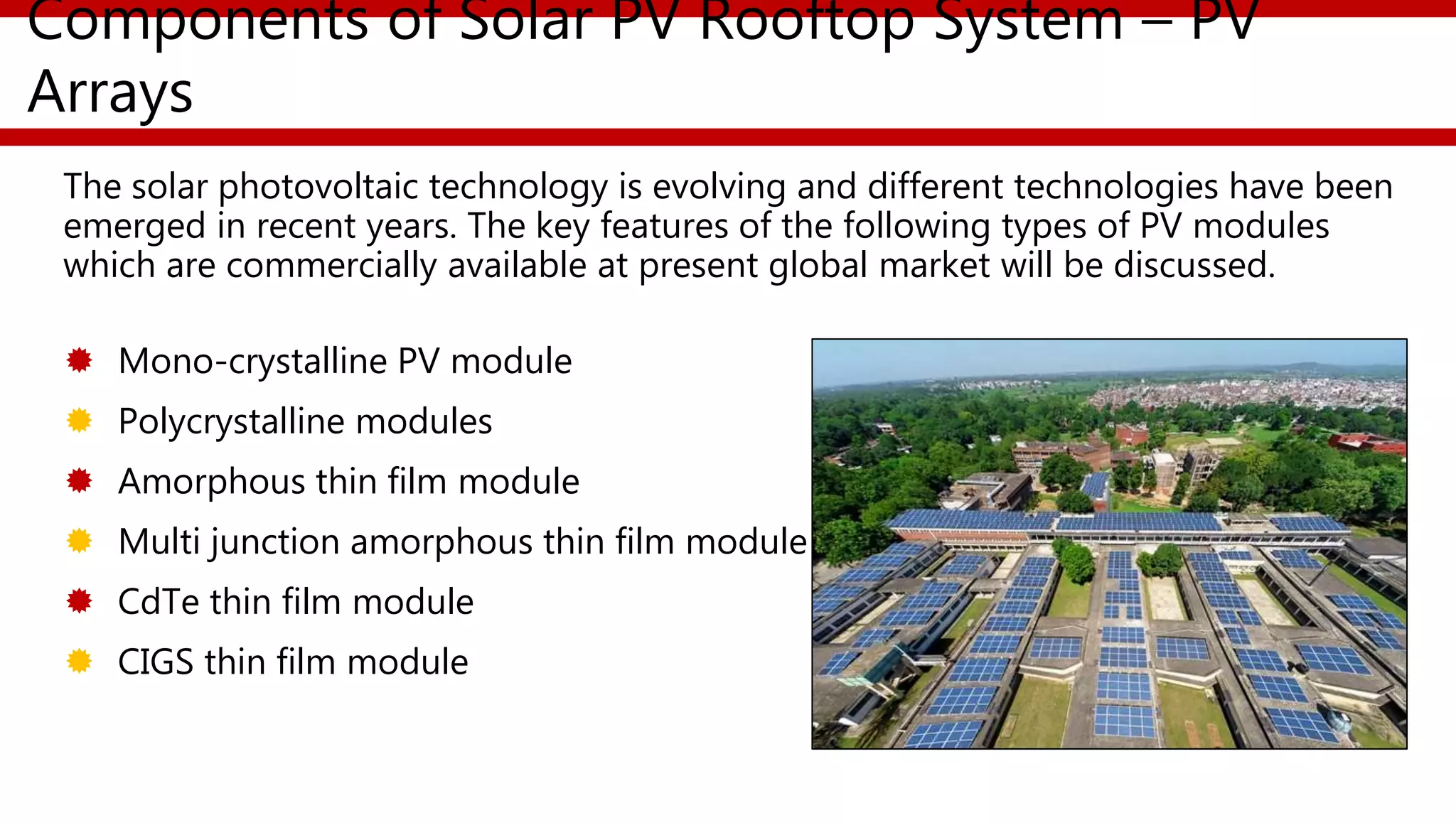
The solar photovoltaic technology is evolving and different technologies have been
emerged in recent years. The key features of the following types of PV modules
which are commercially available at present global market will be discussed.
 Mono-crystalline PV module
 Polycrystalline modules
 Amorphous thin film module
 Multi junction amorphous thin film module
 CdTe thin film module
 CIGS thin film module
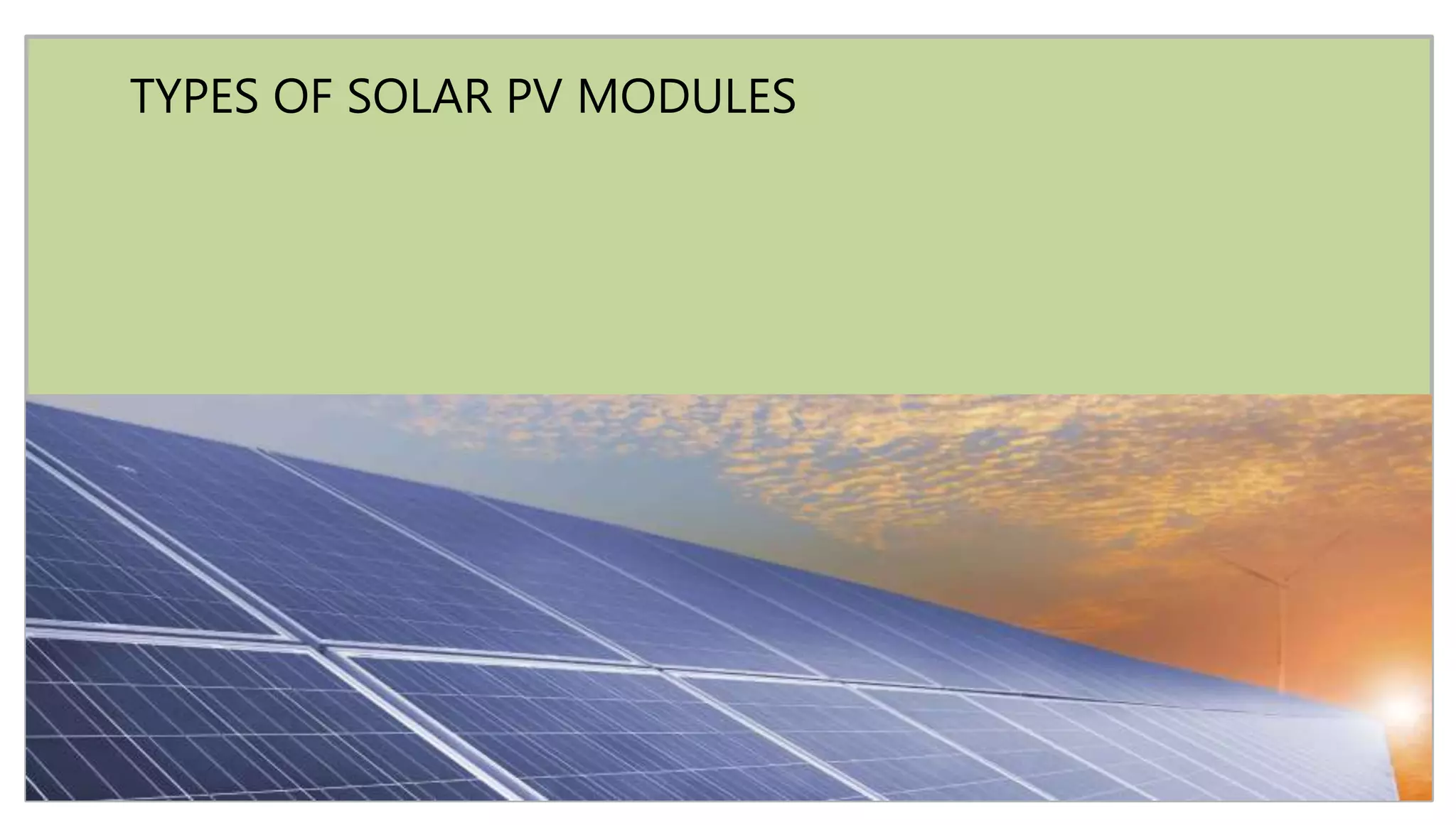
TYPES OF SOLAR PV MODULES
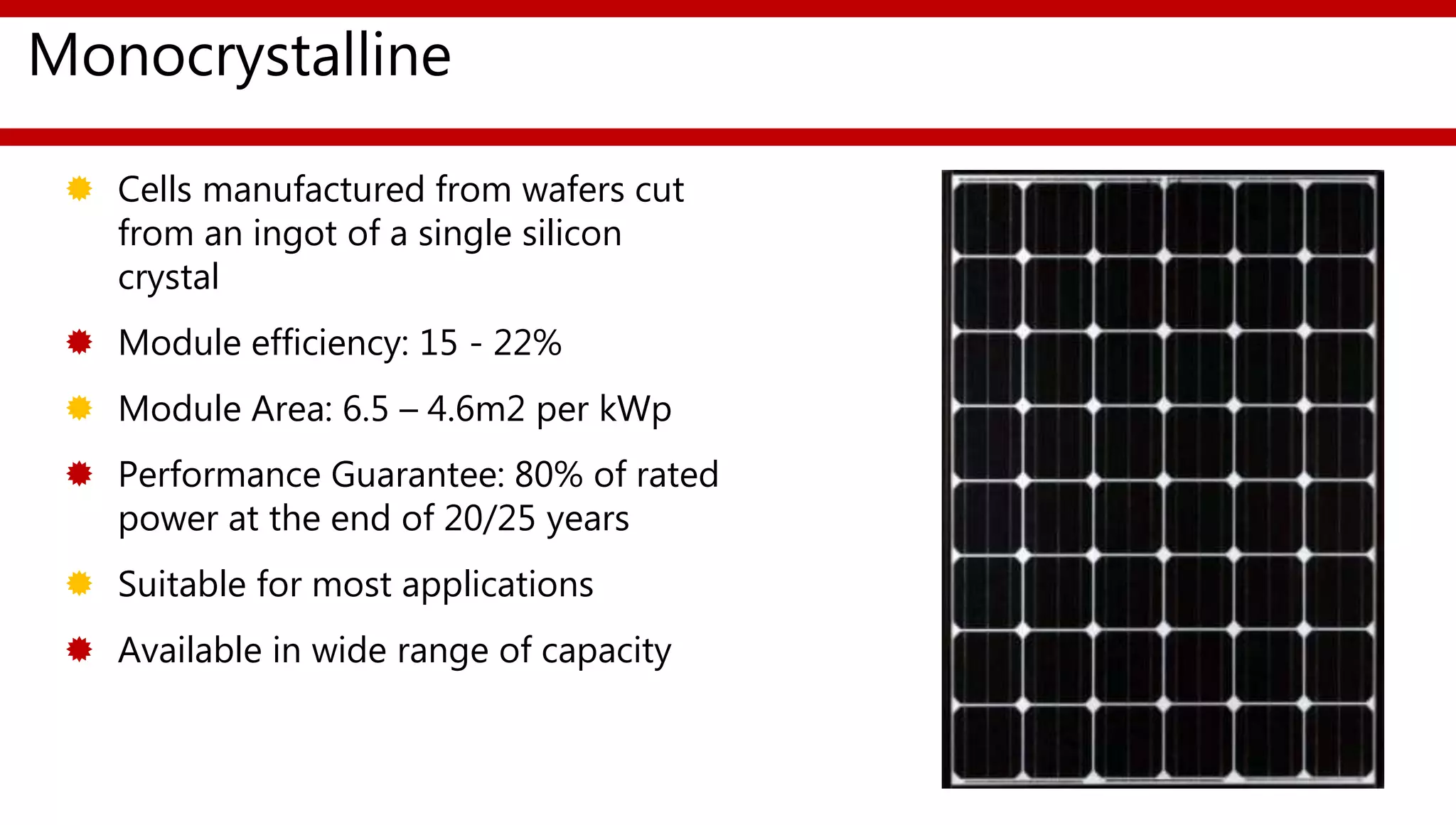
Monocrystalline
 Cells manufactured from wafers cut
from an ingot of a single silicon
crystal
 Module efficiency: 15 - 22%
 Module Area: 6.5 – 4.6m2 per kWp
 Performance Guarantee: 80% of rated
power at the end of 20/25 years
 Suitable for most applications
 Available in wide range of capacity
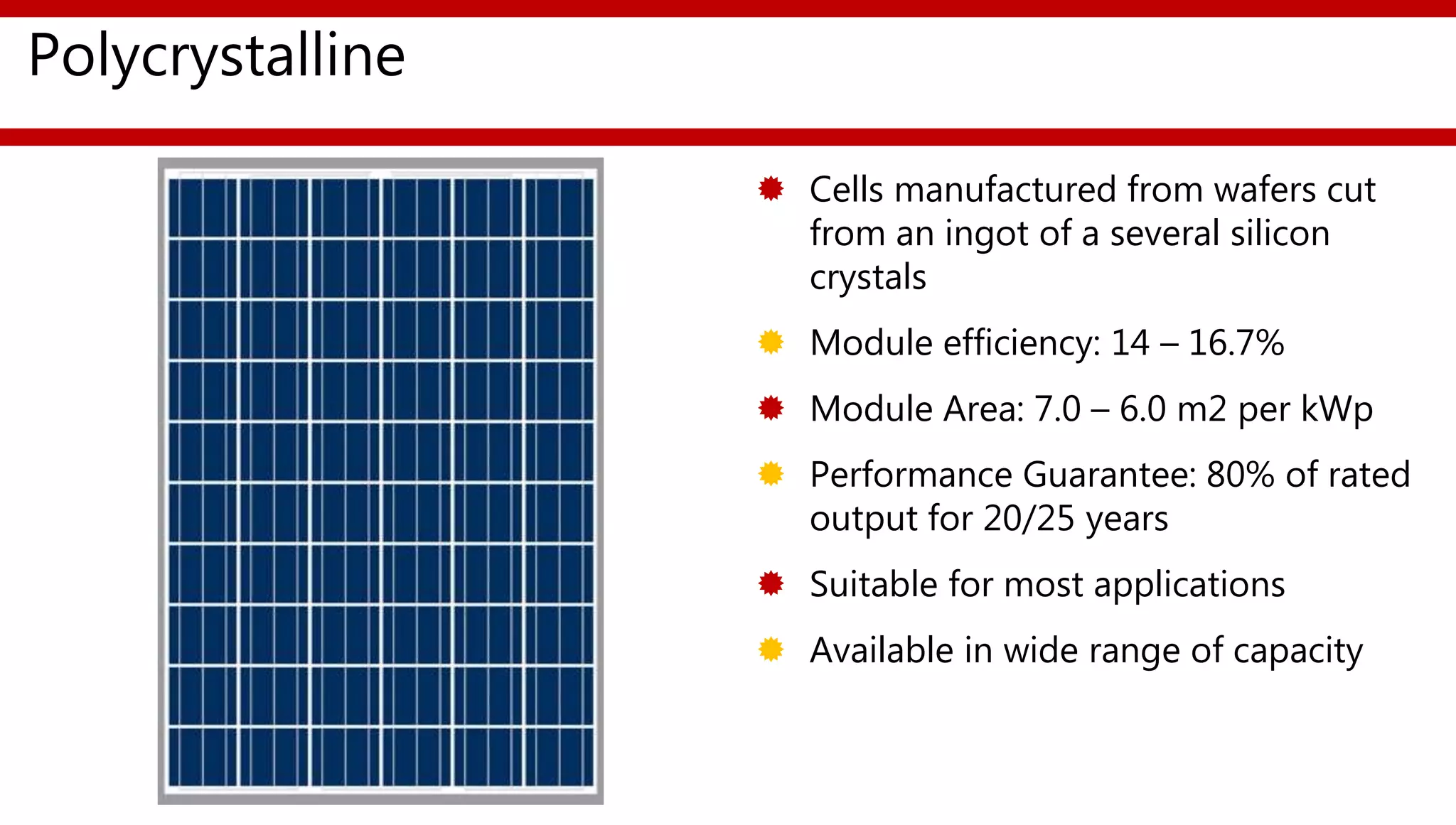
Polycrystalline
 Cells manufactured from wafers cut
from an ingot of a several silicon
crystals
 Module efficiency: 14 – 16.7%
 Module Area: 7.0 – 6.0 m2 per kWp
 Performance Guarantee: 80% of rated
output for 20/25 years
 Suitable for most applications
 Available in wide range of capacity
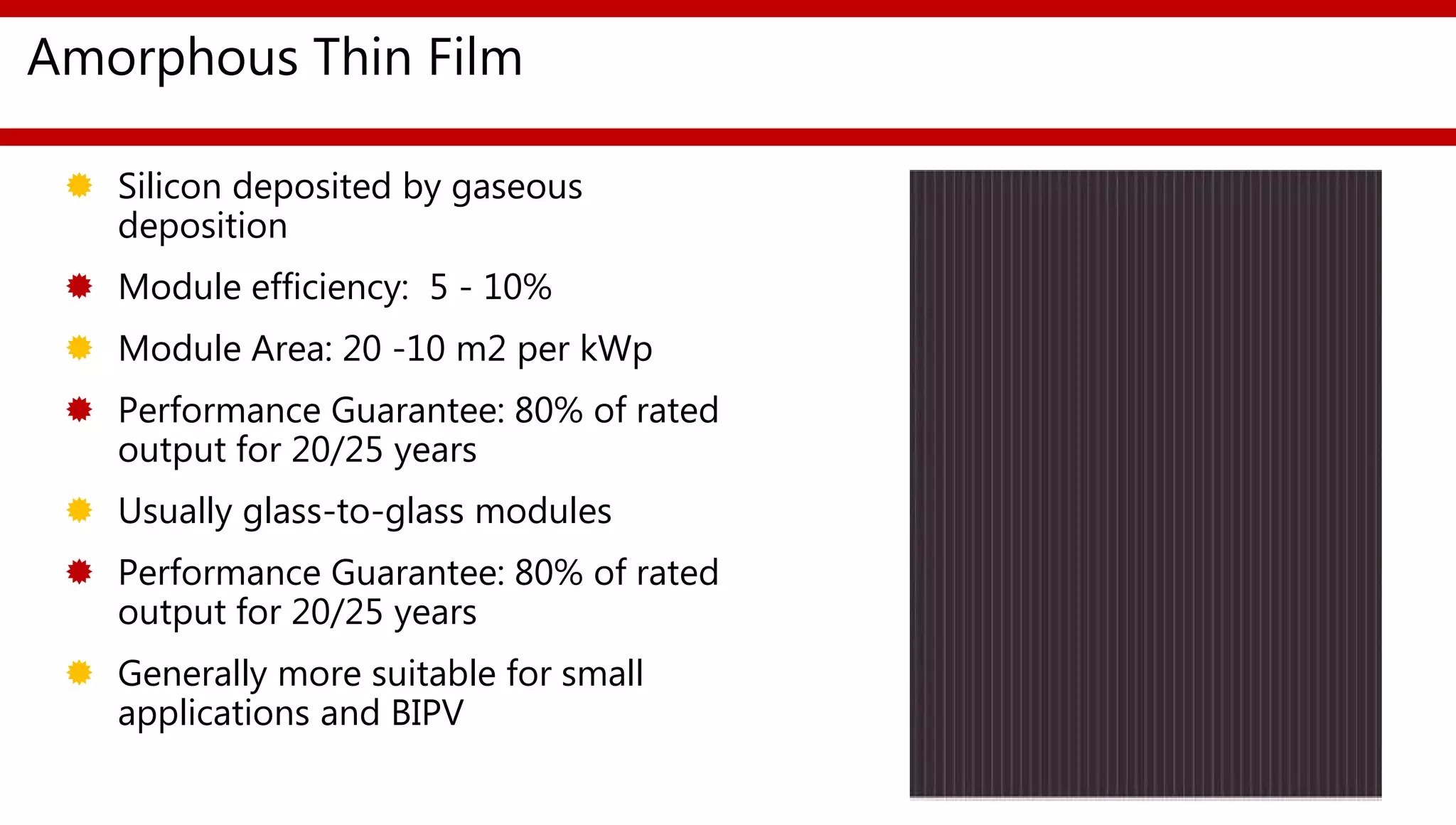
Amorphous Thin Film
 Silicon deposited by gaseous
deposition
 Module efficiency: 5 - 10%
 Module Area: 20 -10 m2 per kWp
 Performance Guarantee: 80% of rated
output for 20/25 years
 Usually glass-to-glass modules
 Performance Guarantee: 80% of rated
output for 20/25 years
 Generally more suitable for small
applications and BIPV
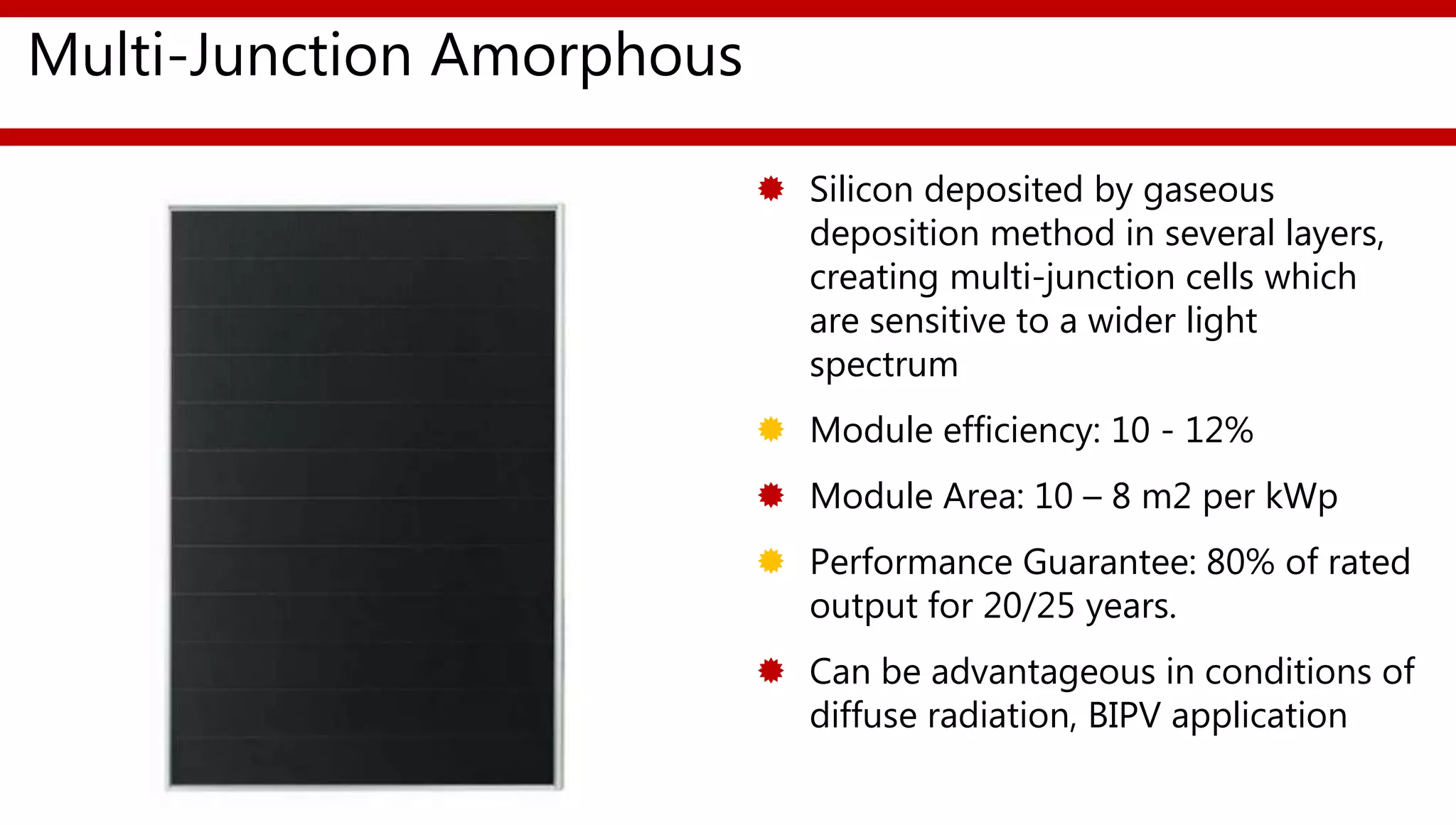
Multi-Junction Amorphous
 Silicon deposited by gaseous
deposition method in several layers,
creating multi-junction cells which
are sensitive to a wider light
spectrum
 Module efficiency: 10 - 12%
 Module Area: 10 – 8 m2 per kWp
 Performance Guarantee: 80% of rated
output for 20/25 years.
 Can be advantageous in conditions of
diffuse radiation, BIPV application
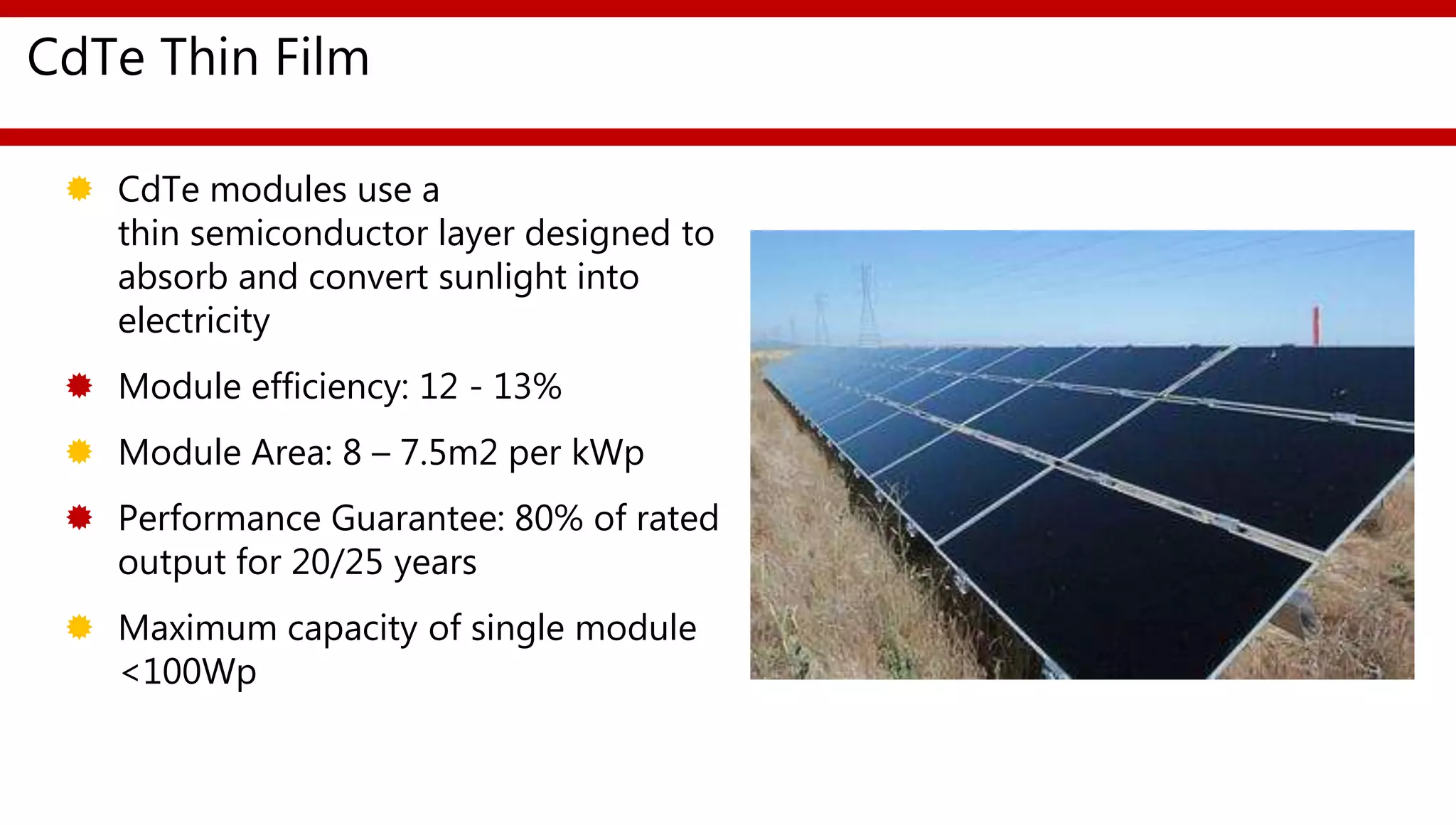
CdTe Thin Film
 CdTe modules use a
thin semiconductor layer designed to
absorb and convert sunlight into
electricity
 Module efficiency: 12 - 13%
 Module Area: 8 – 7.5m2 per kWp
 Performance Guarantee: 80% of rated
output for 20/25 years
 Maximum capacity of single module
<100Wp
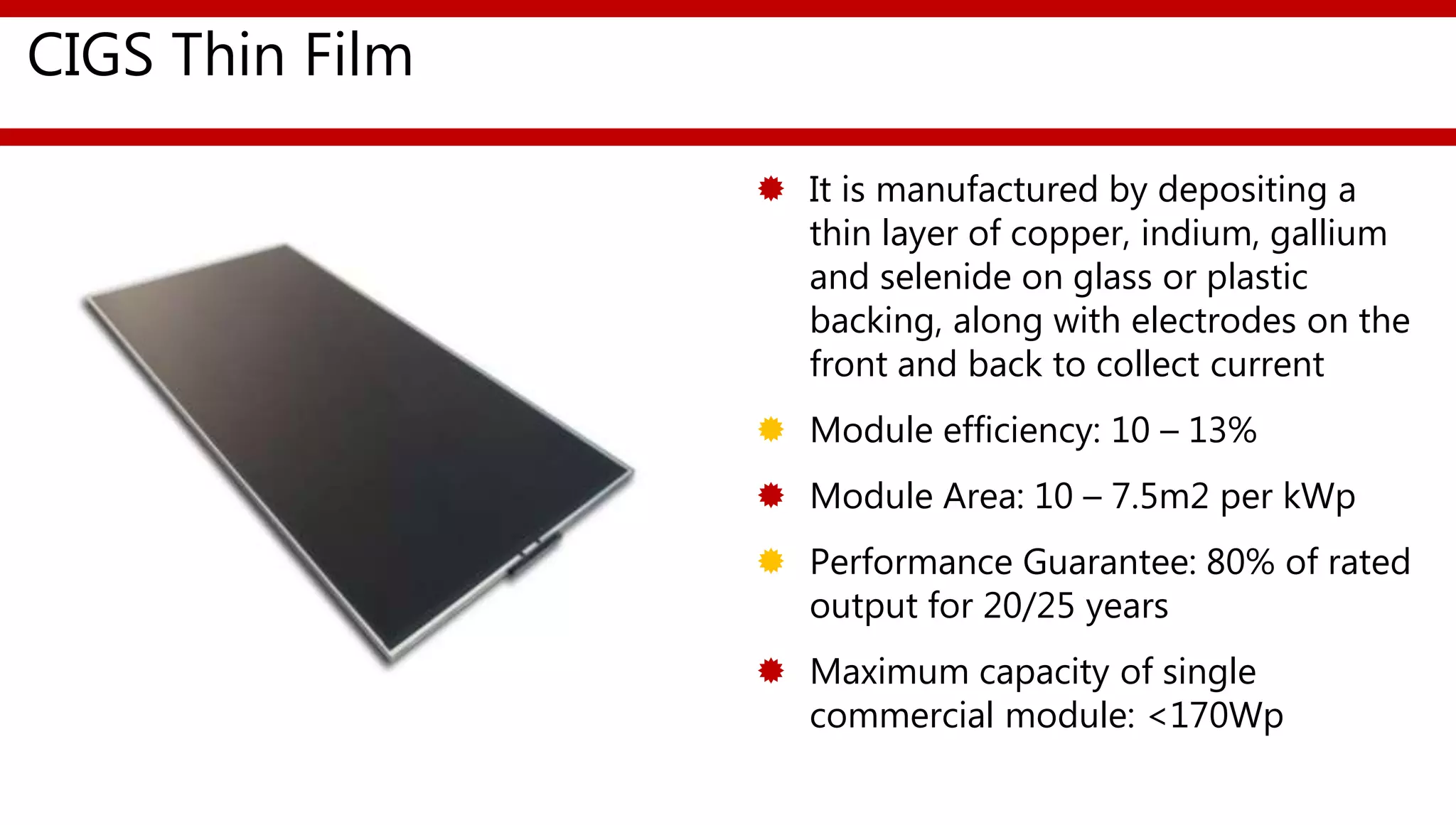
CIGS Thin Film
 It is manufactured by depositing a
thin layer of copper, indium, gallium
and selenide on glass or plastic
backing, along with electrodes on the
front and back to collect current
 Module efficiency: 10 – 13%
 Module Area: 10 – 7.5m2 per kWp
 Performance Guarantee: 80% of rated
output for 20/25 years
 Maximum capacity of single
commercial module: <170Wp
Standard Test Conditions (STC) & Module Peak
Watt
 Photovoltaic modules are rated in Peak Watts (Wp)
 The peak wattage of a solar module is determined under the following standard
test conditions (STC)
– Cell temperature 25˚C
– Irradiance of 1000W/m2
– Air mass of 1.5
 Approximate Cell temperature (Tcell) = Tair + 25ºC
Normal Operating Cell Temperature (NOCT)
Normal Operating Cell Temperature (NOCT) has the following reference conditions:
 Ambient air temperature 20˚C
 Irradiance of 800W/m2
 Wind speed 1m/s
 Electrically open circuit
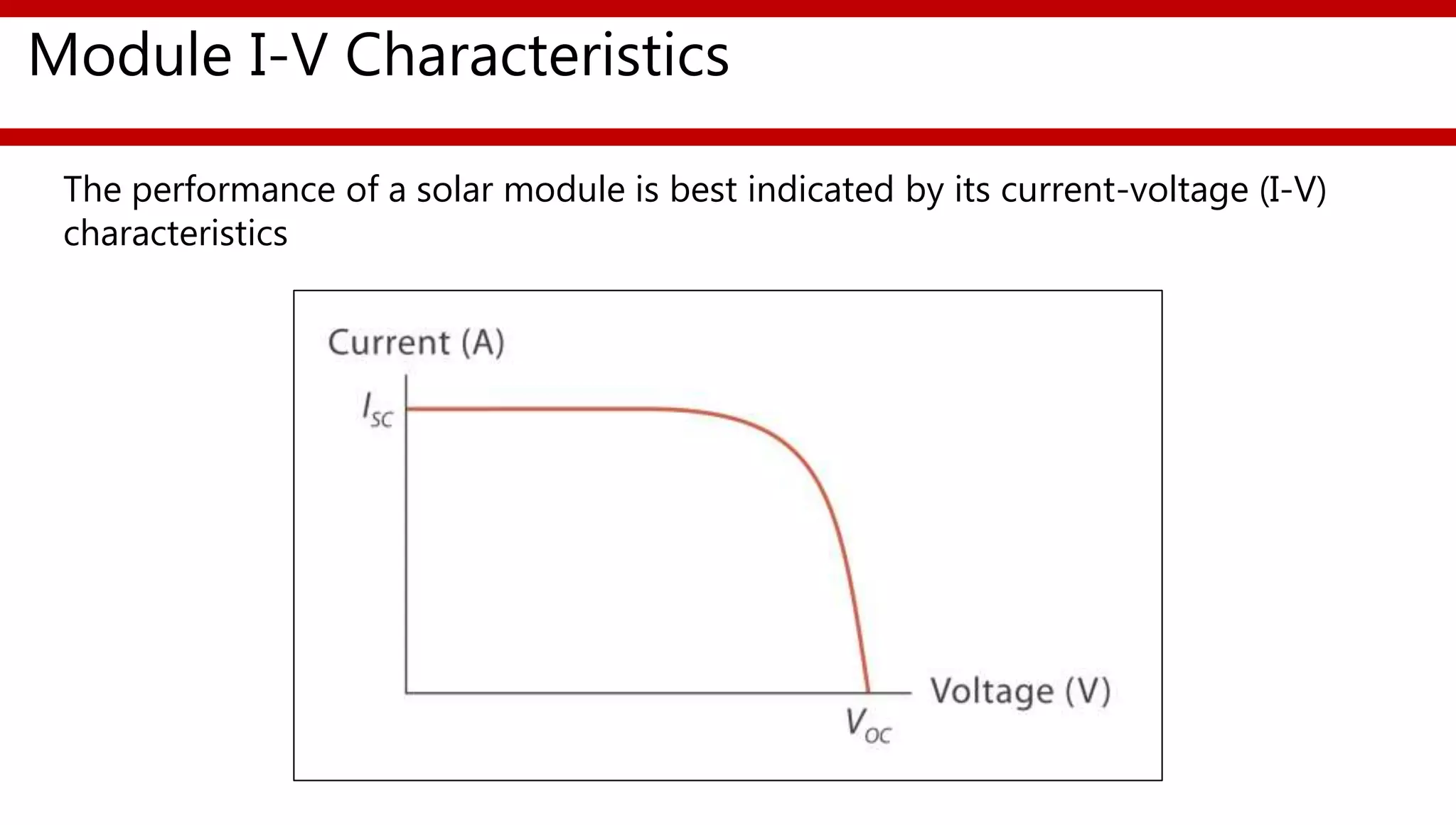
Module I-V Characteristics
The performance of a solar module is best indicated by its current-voltage (I-V)
characteristics
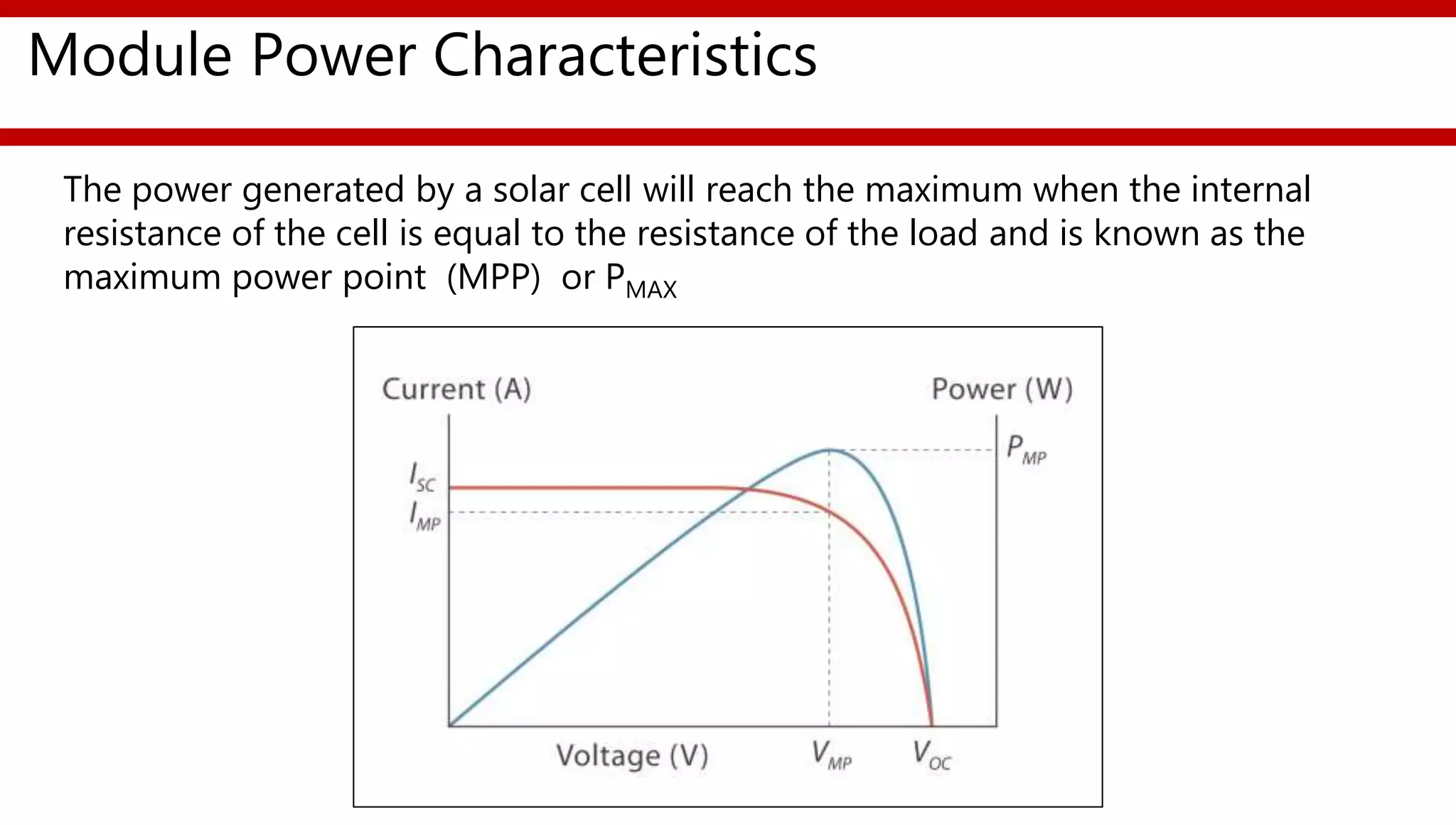
Module Power Characteristics
The power generated by a solar cell will reach the maximum when the internal
resistance of the cell is equal to the resistance of the load and is known as the
maximum power point (MPP) or PMAX
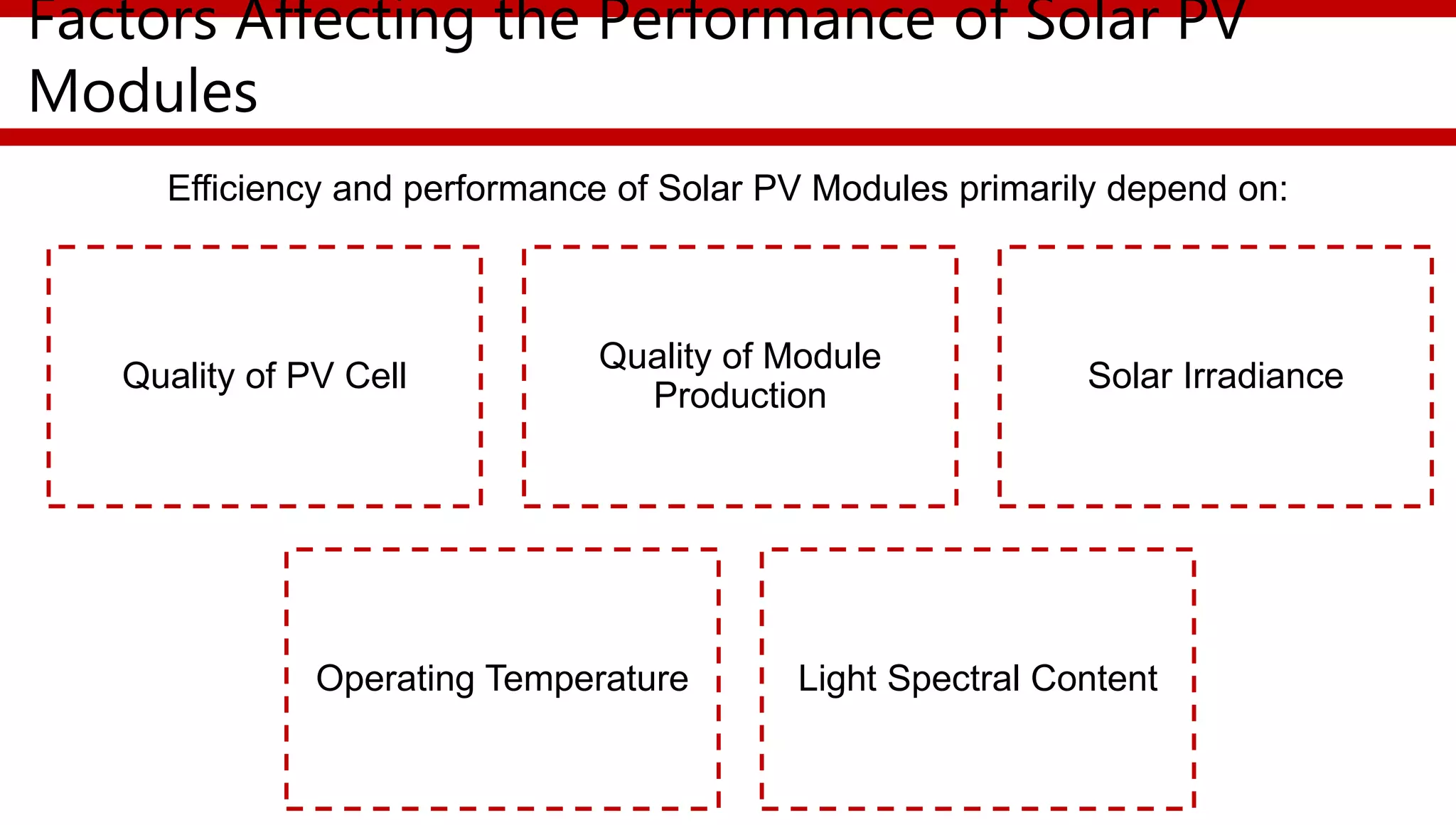
FACTORS AFFECTING THE PERFORMANCE OF SOLAR PV MODULES
Factors Affecting the Performance of Solar PV
Modules
Quality of PV Cell
Quality of Module
Production
Solar Irradiance
Operating Temperature Light Spectral Content
Efficiency and performance of Solar PV Modules primarily depend on:
Factors Affecting the Performance of Solar PV
Modules
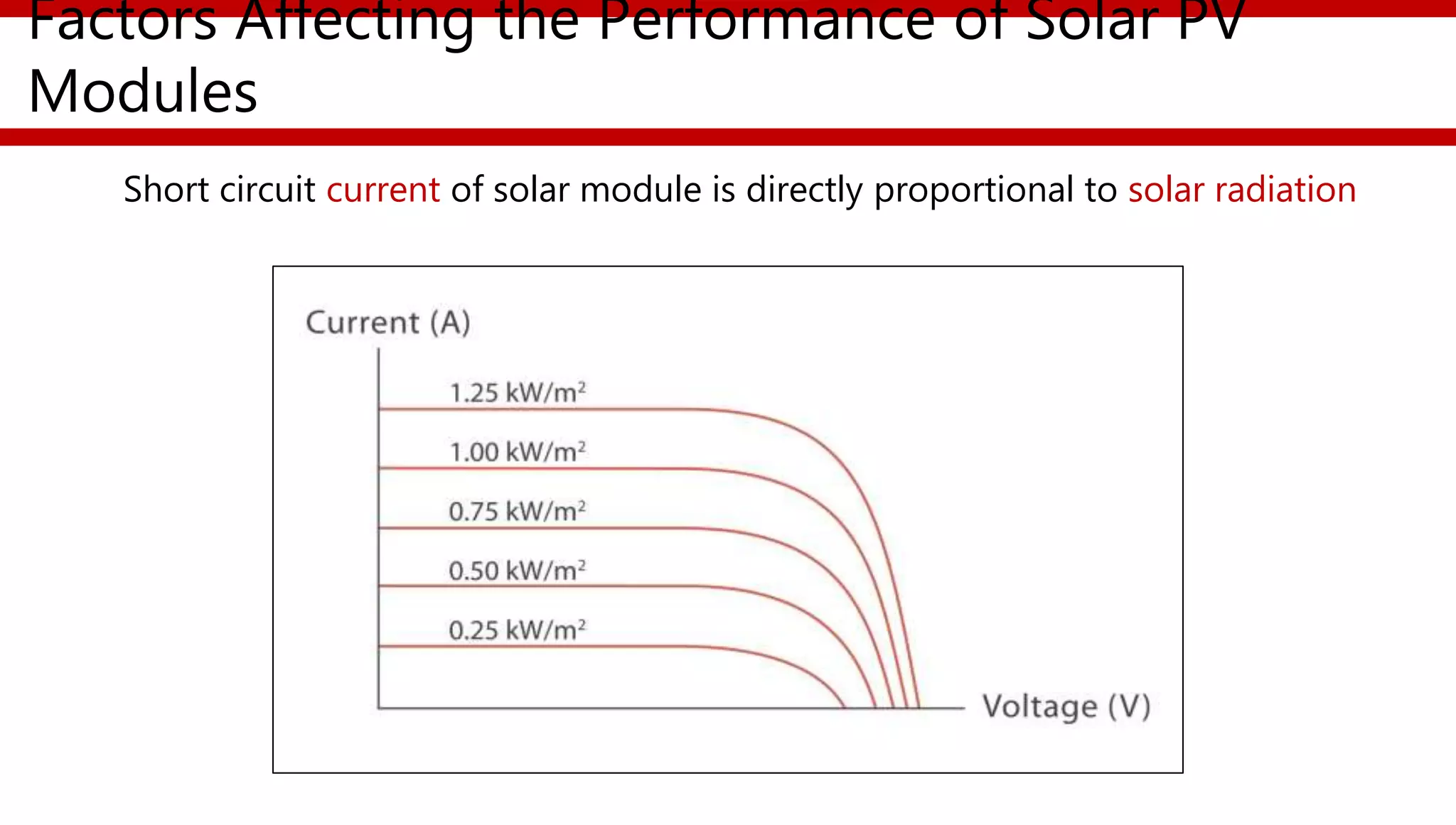
Short circuit current of solar module is directly proportional to solar radiation
Factors Affecting the Performance of Solar PV
Modules
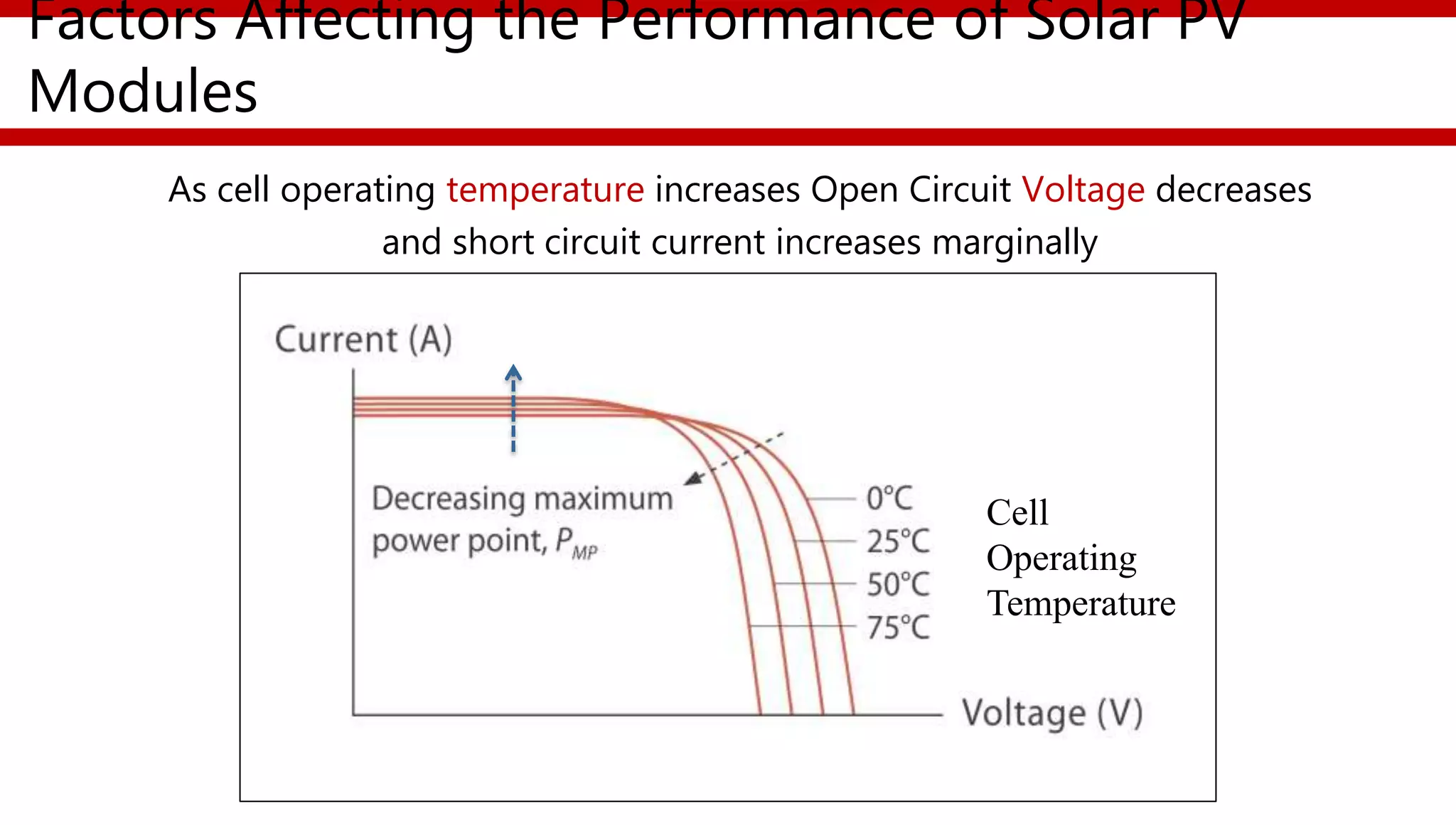
As cell operating temperature increases Open Circuit Voltage decreases
and short circuit current increases marginally
Cell
Operating
Temperature
Module Electrical Protection – Use of Bypass Diode
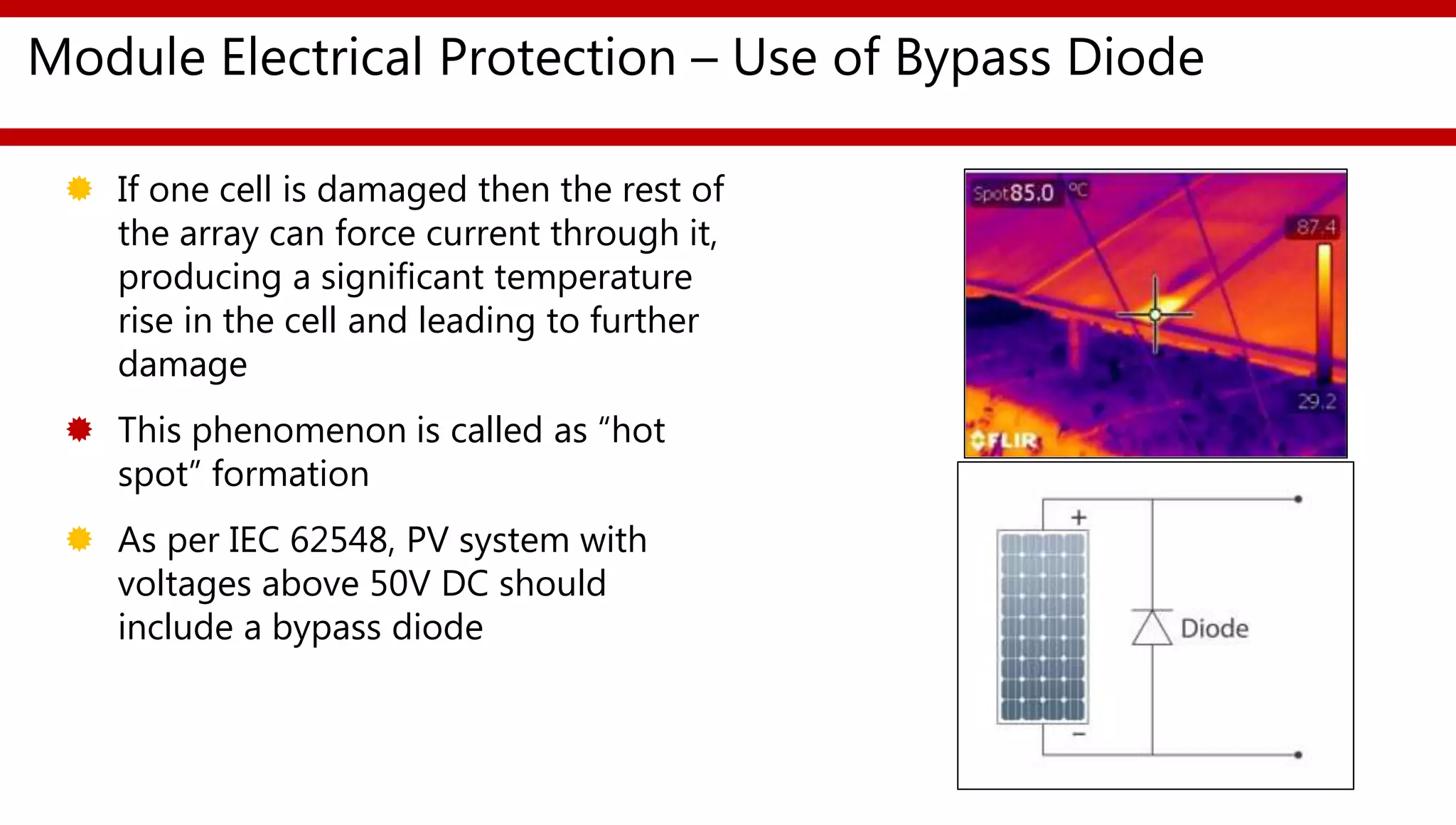
 If one cell is damaged then the rest of
the array can force current through it,
producing a significant temperature
rise in the cell and leading to further
damage
 This phenomenon is called as “hot
spot” formation
 As per IEC 62548, PV system with
voltages above 50V DC should
include a bypass diode
Module Electrical Protection – Use of Blocking
Diode
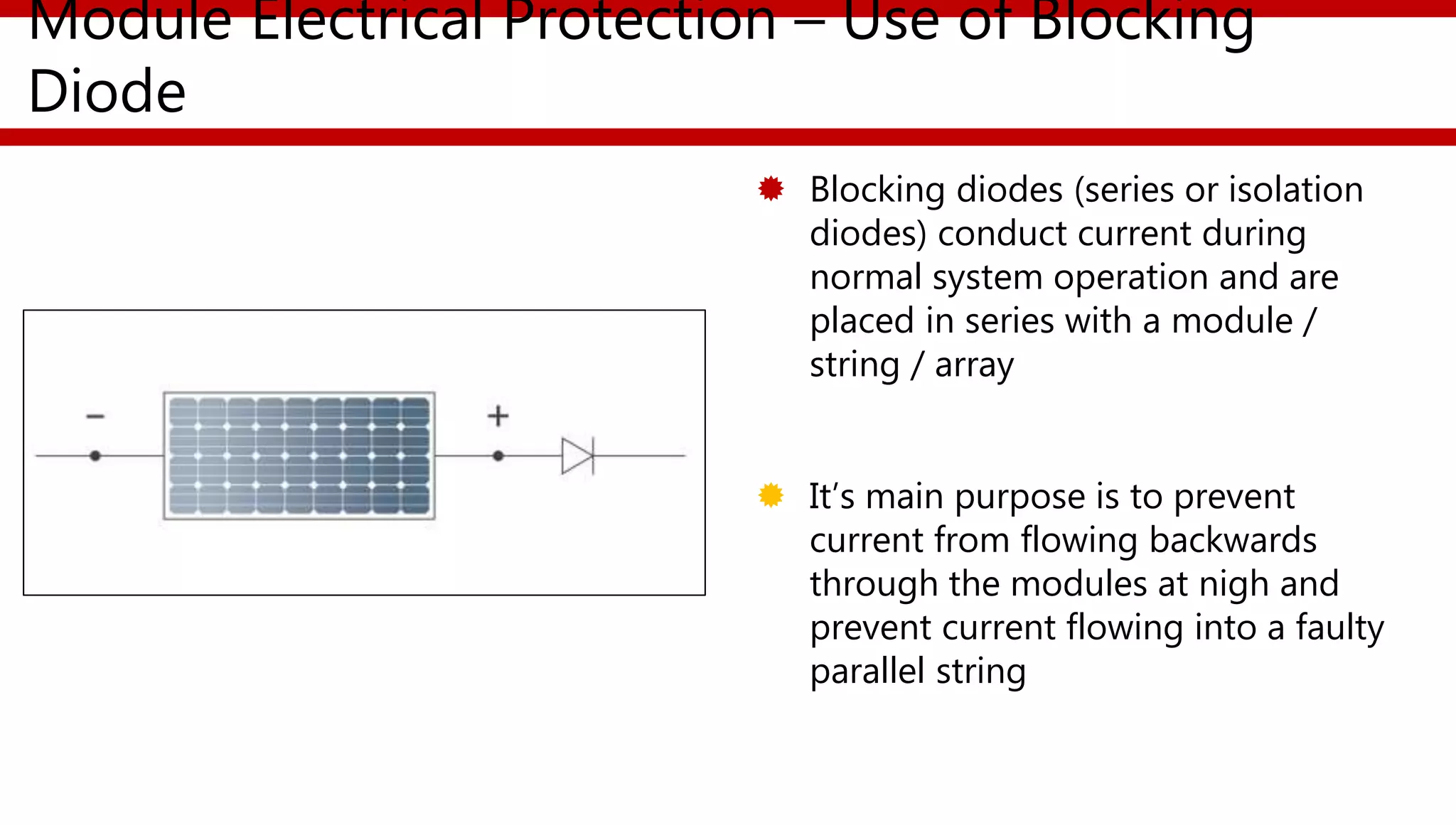
 Blocking diodes (series or isolation
diodes) conduct current during
normal system operation and are
placed in series with a module /
string / array
 It’s main purpose is to prevent
current from flowing backwards
through the modules at nigh and
prevent current flowing into a faulty
parallel string
IEC 62548: Photovoltaic (PV) array design requirements specify that
 Crystalline silicon PV modules shall comply with IEC 61215
 Thin film PV modules shall comply with IEC 61646
 Systems with voltages above 50 V DC should include bypass diodes
 Class A modules according to IEC 61730-1 shall be used where system voltages exceed
DVC-A (Refer Table E1 at Annex E of IEC 62548)
 Class C modules according to IEC 61730-1 may be used where voltages are in the
DVC-A range (Refer Table E1 at Annex E of IEC 62548)
 Class B Modules shall not be used in grid connected PV systems
Standards and Safety Class of Solar PV Modules
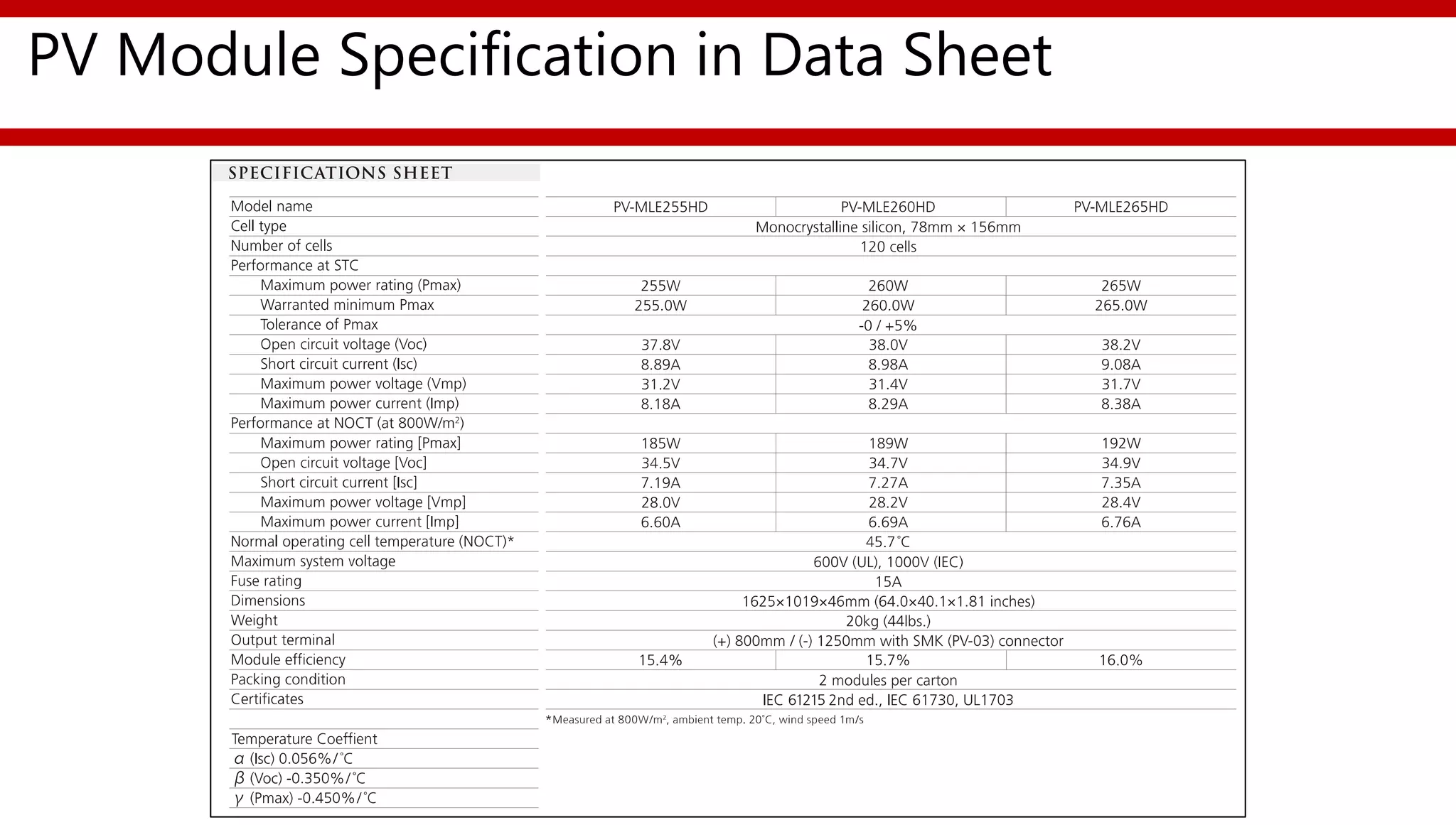
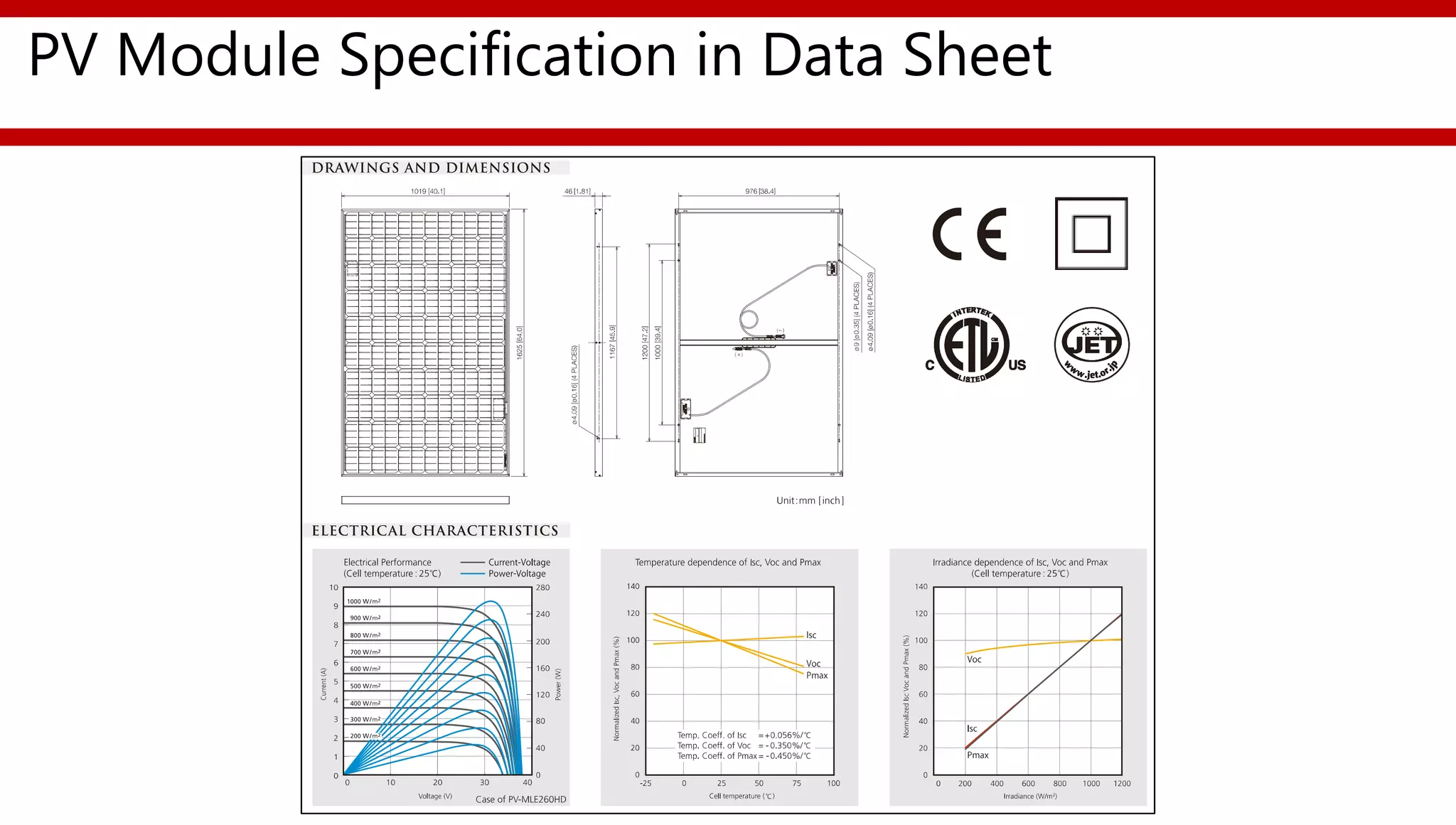
PV Module Specification in Data Sheet
25
Anurag Mishra
Senior Clean Energy Specialist
USAID/India
Email: amishra@usaid.gov
Disclaimer:
This training material is made possible by the support of the American
People through the United States Agency for International
Development (USAID). The contents of this material are the sole
responsibility of Nexant, Inc. and do not necessarily reflect the views of
USAID or the United States Government. This material was prepared
under Contract Number AID-386-C-12-00001.

Session 04 solar pv modules

  • 1.
    Partnership To AdvanceClean Energy-Deployment (PACE-D) Technical Assistance Program Presented by USAID PACE-D TA Program Apr-18 Solar PV Rooftop Training Program For Entrepreneurs Session: Solar PV Modules
  • 2.
    Contents Types of SolarPV modules Standard test conditions and module peak watt (Wp) Module I-V characteristics Module power characteristics
  • 3.
    Contents Factors affecting theperformance of Solar PV modules Module electrical protection Standards and safety of solar PV modules PV module specification in data sheet
  • 4.
    Components of SolarPV Rooftop System – PV Arrays The solar photovoltaic technology is evolving and different technologies have been emerged in recent years. The key features of the following types of PV modules which are commercially available at present global market will be discussed.  Mono-crystalline PV module  Polycrystalline modules  Amorphous thin film module  Multi junction amorphous thin film module  CdTe thin film module  CIGS thin film module
  • 5.
    TYPES OF SOLARPV MODULES
  • 6.
    Monocrystalline  Cells manufacturedfrom wafers cut from an ingot of a single silicon crystal  Module efficiency: 15 - 22%  Module Area: 6.5 – 4.6m2 per kWp  Performance Guarantee: 80% of rated power at the end of 20/25 years  Suitable for most applications  Available in wide range of capacity
  • 7.
    Polycrystalline  Cells manufacturedfrom wafers cut from an ingot of a several silicon crystals  Module efficiency: 14 – 16.7%  Module Area: 7.0 – 6.0 m2 per kWp  Performance Guarantee: 80% of rated output for 20/25 years  Suitable for most applications  Available in wide range of capacity
  • 8.
    Amorphous Thin Film Silicon deposited by gaseous deposition  Module efficiency: 5 - 10%  Module Area: 20 -10 m2 per kWp  Performance Guarantee: 80% of rated output for 20/25 years  Usually glass-to-glass modules  Performance Guarantee: 80% of rated output for 20/25 years  Generally more suitable for small applications and BIPV
  • 9.
    Multi-Junction Amorphous  Silicondeposited by gaseous deposition method in several layers, creating multi-junction cells which are sensitive to a wider light spectrum  Module efficiency: 10 - 12%  Module Area: 10 – 8 m2 per kWp  Performance Guarantee: 80% of rated output for 20/25 years.  Can be advantageous in conditions of diffuse radiation, BIPV application
  • 10.
    CdTe Thin Film CdTe modules use a thin semiconductor layer designed to absorb and convert sunlight into electricity  Module efficiency: 12 - 13%  Module Area: 8 – 7.5m2 per kWp  Performance Guarantee: 80% of rated output for 20/25 years  Maximum capacity of single module <100Wp
  • 11.
    CIGS Thin Film It is manufactured by depositing a thin layer of copper, indium, gallium and selenide on glass or plastic backing, along with electrodes on the front and back to collect current  Module efficiency: 10 – 13%  Module Area: 10 – 7.5m2 per kWp  Performance Guarantee: 80% of rated output for 20/25 years  Maximum capacity of single commercial module: <170Wp
  • 12.
    Standard Test Conditions(STC) & Module Peak Watt  Photovoltaic modules are rated in Peak Watts (Wp)  The peak wattage of a solar module is determined under the following standard test conditions (STC) – Cell temperature 25˚C – Irradiance of 1000W/m2 – Air mass of 1.5  Approximate Cell temperature (Tcell) = Tair + 25ºC
  • 13.
    Normal Operating CellTemperature (NOCT) Normal Operating Cell Temperature (NOCT) has the following reference conditions:  Ambient air temperature 20˚C  Irradiance of 800W/m2  Wind speed 1m/s  Electrically open circuit
  • 14.
    Module I-V Characteristics Theperformance of a solar module is best indicated by its current-voltage (I-V) characteristics
  • 15.
    Module Power Characteristics Thepower generated by a solar cell will reach the maximum when the internal resistance of the cell is equal to the resistance of the load and is known as the maximum power point (MPP) or PMAX
  • 16.
    FACTORS AFFECTING THEPERFORMANCE OF SOLAR PV MODULES
  • 17.
    Factors Affecting thePerformance of Solar PV Modules Quality of PV Cell Quality of Module Production Solar Irradiance Operating Temperature Light Spectral Content Efficiency and performance of Solar PV Modules primarily depend on:
  • 18.
    Factors Affecting thePerformance of Solar PV Modules Short circuit current of solar module is directly proportional to solar radiation
  • 19.
    Factors Affecting thePerformance of Solar PV Modules As cell operating temperature increases Open Circuit Voltage decreases and short circuit current increases marginally Cell Operating Temperature
  • 20.
    Module Electrical Protection– Use of Bypass Diode  If one cell is damaged then the rest of the array can force current through it, producing a significant temperature rise in the cell and leading to further damage  This phenomenon is called as “hot spot” formation  As per IEC 62548, PV system with voltages above 50V DC should include a bypass diode
  • 21.
    Module Electrical Protection– Use of Blocking Diode  Blocking diodes (series or isolation diodes) conduct current during normal system operation and are placed in series with a module / string / array  It’s main purpose is to prevent current from flowing backwards through the modules at nigh and prevent current flowing into a faulty parallel string
  • 22.
    IEC 62548: Photovoltaic(PV) array design requirements specify that  Crystalline silicon PV modules shall comply with IEC 61215  Thin film PV modules shall comply with IEC 61646  Systems with voltages above 50 V DC should include bypass diodes  Class A modules according to IEC 61730-1 shall be used where system voltages exceed DVC-A (Refer Table E1 at Annex E of IEC 62548)  Class C modules according to IEC 61730-1 may be used where voltages are in the DVC-A range (Refer Table E1 at Annex E of IEC 62548)  Class B Modules shall not be used in grid connected PV systems Standards and Safety Class of Solar PV Modules
  • 23.
  • 24.
  • 25.
    25 Anurag Mishra Senior CleanEnergy Specialist USAID/India Email: amishra@usaid.gov Disclaimer: This training material is made possible by the support of the American People through the United States Agency for International Development (USAID). The contents of this material are the sole responsibility of Nexant, Inc. and do not necessarily reflect the views of USAID or the United States Government. This material was prepared under Contract Number AID-386-C-12-00001.