4
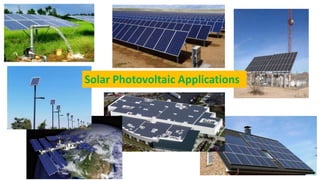
Solar Photovoltaic Applications
The Solar Cell
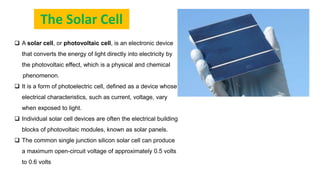
 A solar cell, or photovoltaic cell, is an electronic device
that converts the energy of light directly into electricity by
the photovoltaic effect, which is a physical and chemical
phenomenon.
 It is a form of photoelectric cell, defined as a device whose
electrical characteristics, such as current, voltage, vary
when exposed to light.
 Individual solar cell devices are often the electrical building
blocks of photovoltaic modules, known as solar panels.
 The common single junction silicon solar cell can produce
a maximum open-circuit voltage of approximately 0.5 volts
to 0.6 volts
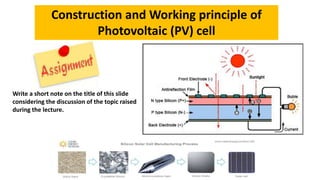
Construction and Working principle of
Photovoltaic (PV) cell
Write a short note on the title of this slide
considering the discussion of the topic raised
during the lecture.
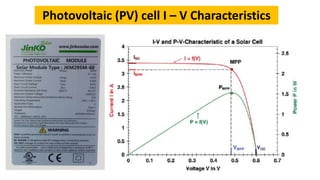
Photovoltaic (PV) cell I – V Characteristics
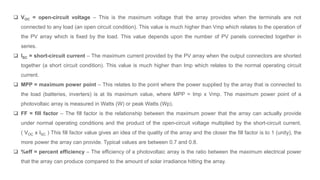
 VOC = open-circuit voltage – This is the maximum voltage that the array provides when the terminals are not
connected to any load (an open circuit condition). This value is much higher than Vmp which relates to the operation of
the PV array which is fixed by the load. This value depends upon the number of PV panels connected together in
series.
 ISC = short-circuit current – The maximum current provided by the PV array when the output connectors are shorted
together (a short circuit condition). This value is much higher than Imp which relates to the normal operating circuit
current.
 MPP = maximum power point – This relates to the point where the power supplied by the array that is connected to
the load (batteries, inverters) is at its maximum value, where MPP = Imp x Vmp. The maximum power point of a
photovoltaic array is measured in Watts (W) or peak Watts (Wp).
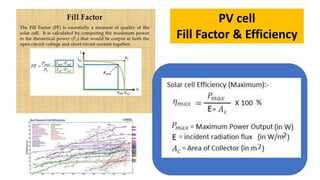
 FF = fill factor – The fill factor is the relationship between the maximum power that the array can actually provide
under normal operating conditions and the product of the open-circuit voltage multiplied by the short-circuit current,
( VOC x ISC ) This fill factor value gives an idea of the quality of the array and the closer the fill factor is to 1 (unity), the
more power the array can provide. Typical values are between 0.7 and 0.8.
 %eff = percent efficiency – The efficiency of a photovoltaic array is the ratio between the maximum electrical power
that the array can produce compared to the amount of solar irradiance hitting the array.
PV cell
Fill Factor & Efficiency
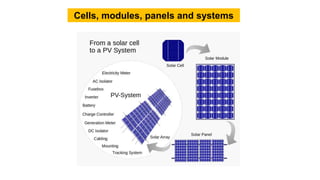
Cells, modules, panels and systems
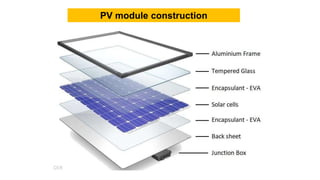
PV module construction
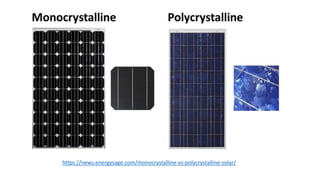
https://news.energysage.com/monocrystalline-vs-polycrystalline-solar/
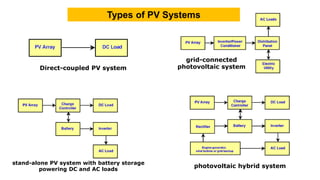
Types of PV Systems
grid-connected
photovoltaic system
Direct-coupled PV system
stand-alone PV system with battery storage
powering DC and AC loads
photovoltaic hybrid system
Design of PV Systems
https://www.leonics.com/support/article2_12j/articles2_12j_en.php
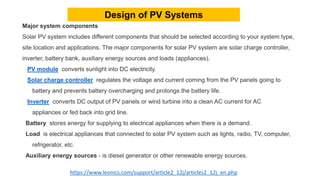
Major system components
Solar PV system includes different components that should be selected according to your system type,
site location and applications. The major components for solar PV system are solar charge controller,
inverter, battery bank, auxiliary energy sources and loads (appliances).
PV module converts sunlight into DC electricity.
Solar charge controller regulates the voltage and current coming from the PV panels going to
battery and prevents battery overcharging and prolongs the battery life.
Inverter converts DC output of PV panels or wind turbine into a clean AC current for AC
appliances or fed back into grid line.
Battery stores energy for supplying to electrical appliances when there is a demand.
Load is electrical appliances that connected to solar PV system such as lights, radio, TV, computer,
refrigerator, etc.
Auxiliary energy sources - is diesel generator or other renewable energy sources.
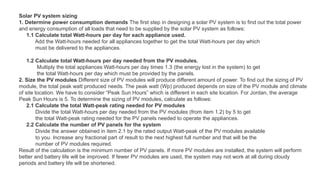
Solar PV system sizing
1. Determine power consumption demands The first step in designing a solar PV system is to find out the total power
and energy consumption of all loads that need to be supplied by the solar PV system as follows:
1.1 Calculate total Watt-hours per day for each appliance used.
Add the Watt-hours needed for all appliances together to get the total Watt-hours per day which
must be delivered to the appliances.
1.2 Calculate total Watt-hours per day needed from the PV modules.
Multiply the total appliances Watt-hours per day times 1.3 (the energy lost in the system) to get
the total Watt-hours per day which must be provided by the panels.
2. Size the PV modules Different size of PV modules will produce different amount of power. To find out the sizing of PV
module, the total peak watt produced needs. The peak watt (Wp) produced depends on size of the PV module and climate
of site location. We have to consider “Peak Sun Hours” which is different in each site location. For Jordan, the average
Peak Sun Hours is 5. To determine the sizing of PV modules, calculate as follows:
2.1 Calculate the total Watt-peak rating needed for PV modules
Divide the total Watt-hours per day needed from the PV modules (from item 1.2) by 5 to get
the total Watt-peak rating needed for the PV panels needed to operate the appliances.
2.2 Calculate the number of PV panels for the system
Divide the answer obtained in item 2.1 by the rated output Watt-peak of the PV modules available
to you. Increase any fractional part of result to the next highest full number and that will be the
number of PV modules required.
Result of the calculation is the minimum number of PV panels. If more PV modules are installed, the system will perform
better and battery life will be improved. If fewer PV modules are used, the system may not work at all during cloudy
periods and battery life will be shortened.
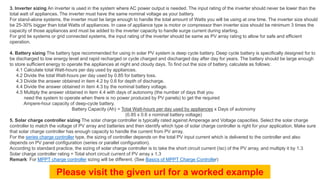
3. Inverter sizing An inverter is used in the system where AC power output is needed. The input rating of the inverter should never be lower than the
total watt of appliances. The inverter must have the same nominal voltage as your battery.
For stand-alone systems, the inverter must be large enough to handle the total amount of Watts you will be using at one time. The inverter size should
be 25-30% bigger than total Watts of appliances. In case of appliance type is motor or compressor then inverter size should be minimum 3 times the
capacity of those appliances and must be added to the inverter capacity to handle surge current during starting.
For grid tie systems or grid connected systems, the input rating of the inverter should be same as PV array rating to allow for safe and efficient
operation.
4. Battery sizing The battery type recommended for using in solar PV system is deep cycle battery. Deep cycle battery is specifically designed for to
be discharged to low energy level and rapid recharged or cycle charged and discharged day after day for years. The battery should be large enough
to store sufficient energy to operate the appliances at night and cloudy days. To find out the size of battery, calculate as follows:
4.1 Calculate total Watt-hours per day used by appliances.
4.2 Divide the total Watt-hours per day used by 0.85 for battery loss.
4.3 Divide the answer obtained in item 4.2 by 0.6 for depth of discharge.
4.4 Divide the answer obtained in item 4.3 by the nominal battery voltage.
4.5 Multiply the answer obtained in item 4.4 with days of autonomy (the number of days that you
need the system to operate when there is no power produced by PV panels) to get the required
Ampere-hour capacity of deep-cycle battery.
Battery Capacity (Ah) = Total Watt-hours per day used by appliances x Days of autonomy
(0.85 x 0.6 x nominal battery voltage)
5. Solar charge controller sizing The solar charge controller is typically rated against Amperage and Voltage capacities. Select the solar charge
controller to match the voltage of PV array and batteries and then identify which type of solar charge controller is right for your application. Make sure
that solar charge controller has enough capacity to handle the current from PV array.
For the series charge controller type, the sizing of controller depends on the total PV input current which is delivered to the controller and also
depends on PV panel configuration (series or parallel configuration).
According to standard practice, the sizing of solar charge controller is to take the short circuit current (Isc) of the PV array, and multiply it by 1.3
Solar charge controller rating = Total short circuit current of PV array x 1.3
Remark: For MPPT charge controller sizing will be different. (See Basics of MPPT Charge Controller)
Please visit the given url for a worked example
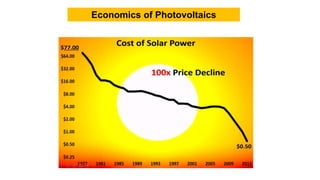
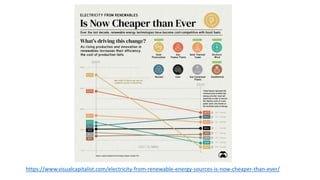
Economics of Photovoltaics
https://www.visualcapitalist.com/electricity-from-renewable-energy-sources-is-now-cheaper-than-ever/
CH4 Photovoltaics.pptx

CH4 Photovoltaics.pptx

  • 2.
  • 3.
  • 4.
    The Solar Cell A solar cell, or photovoltaic cell, is an electronic device that converts the energy of light directly into electricity by the photovoltaic effect, which is a physical and chemical phenomenon.  It is a form of photoelectric cell, defined as a device whose electrical characteristics, such as current, voltage, vary when exposed to light.  Individual solar cell devices are often the electrical building blocks of photovoltaic modules, known as solar panels.  The common single junction silicon solar cell can produce a maximum open-circuit voltage of approximately 0.5 volts to 0.6 volts
  • 5.
    Construction and Workingprinciple of Photovoltaic (PV) cell Write a short note on the title of this slide considering the discussion of the topic raised during the lecture.
  • 6.
    Photovoltaic (PV) cellI – V Characteristics
  • 7.
     VOC =open-circuit voltage – This is the maximum voltage that the array provides when the terminals are not connected to any load (an open circuit condition). This value is much higher than Vmp which relates to the operation of the PV array which is fixed by the load. This value depends upon the number of PV panels connected together in series.  ISC = short-circuit current – The maximum current provided by the PV array when the output connectors are shorted together (a short circuit condition). This value is much higher than Imp which relates to the normal operating circuit current.  MPP = maximum power point – This relates to the point where the power supplied by the array that is connected to the load (batteries, inverters) is at its maximum value, where MPP = Imp x Vmp. The maximum power point of a photovoltaic array is measured in Watts (W) or peak Watts (Wp).  FF = fill factor – The fill factor is the relationship between the maximum power that the array can actually provide under normal operating conditions and the product of the open-circuit voltage multiplied by the short-circuit current, ( VOC x ISC ) This fill factor value gives an idea of the quality of the array and the closer the fill factor is to 1 (unity), the more power the array can provide. Typical values are between 0.7 and 0.8.  %eff = percent efficiency – The efficiency of a photovoltaic array is the ratio between the maximum electrical power that the array can produce compared to the amount of solar irradiance hitting the array.
  • 8.
    PV cell Fill Factor& Efficiency
  • 10.
  • 11.
  • 12.
  • 13.
    Types of PVSystems grid-connected photovoltaic system Direct-coupled PV system stand-alone PV system with battery storage powering DC and AC loads photovoltaic hybrid system
  • 14.
    Design of PVSystems https://www.leonics.com/support/article2_12j/articles2_12j_en.php Major system components Solar PV system includes different components that should be selected according to your system type, site location and applications. The major components for solar PV system are solar charge controller, inverter, battery bank, auxiliary energy sources and loads (appliances). PV module converts sunlight into DC electricity. Solar charge controller regulates the voltage and current coming from the PV panels going to battery and prevents battery overcharging and prolongs the battery life. Inverter converts DC output of PV panels or wind turbine into a clean AC current for AC appliances or fed back into grid line. Battery stores energy for supplying to electrical appliances when there is a demand. Load is electrical appliances that connected to solar PV system such as lights, radio, TV, computer, refrigerator, etc. Auxiliary energy sources - is diesel generator or other renewable energy sources.
  • 15.
    Solar PV systemsizing 1. Determine power consumption demands The first step in designing a solar PV system is to find out the total power and energy consumption of all loads that need to be supplied by the solar PV system as follows: 1.1 Calculate total Watt-hours per day for each appliance used. Add the Watt-hours needed for all appliances together to get the total Watt-hours per day which must be delivered to the appliances. 1.2 Calculate total Watt-hours per day needed from the PV modules. Multiply the total appliances Watt-hours per day times 1.3 (the energy lost in the system) to get the total Watt-hours per day which must be provided by the panels. 2. Size the PV modules Different size of PV modules will produce different amount of power. To find out the sizing of PV module, the total peak watt produced needs. The peak watt (Wp) produced depends on size of the PV module and climate of site location. We have to consider “Peak Sun Hours” which is different in each site location. For Jordan, the average Peak Sun Hours is 5. To determine the sizing of PV modules, calculate as follows: 2.1 Calculate the total Watt-peak rating needed for PV modules Divide the total Watt-hours per day needed from the PV modules (from item 1.2) by 5 to get the total Watt-peak rating needed for the PV panels needed to operate the appliances. 2.2 Calculate the number of PV panels for the system Divide the answer obtained in item 2.1 by the rated output Watt-peak of the PV modules available to you. Increase any fractional part of result to the next highest full number and that will be the number of PV modules required. Result of the calculation is the minimum number of PV panels. If more PV modules are installed, the system will perform better and battery life will be improved. If fewer PV modules are used, the system may not work at all during cloudy periods and battery life will be shortened.
  • 16.
    3. Inverter sizingAn inverter is used in the system where AC power output is needed. The input rating of the inverter should never be lower than the total watt of appliances. The inverter must have the same nominal voltage as your battery. For stand-alone systems, the inverter must be large enough to handle the total amount of Watts you will be using at one time. The inverter size should be 25-30% bigger than total Watts of appliances. In case of appliance type is motor or compressor then inverter size should be minimum 3 times the capacity of those appliances and must be added to the inverter capacity to handle surge current during starting. For grid tie systems or grid connected systems, the input rating of the inverter should be same as PV array rating to allow for safe and efficient operation. 4. Battery sizing The battery type recommended for using in solar PV system is deep cycle battery. Deep cycle battery is specifically designed for to be discharged to low energy level and rapid recharged or cycle charged and discharged day after day for years. The battery should be large enough to store sufficient energy to operate the appliances at night and cloudy days. To find out the size of battery, calculate as follows: 4.1 Calculate total Watt-hours per day used by appliances. 4.2 Divide the total Watt-hours per day used by 0.85 for battery loss. 4.3 Divide the answer obtained in item 4.2 by 0.6 for depth of discharge. 4.4 Divide the answer obtained in item 4.3 by the nominal battery voltage. 4.5 Multiply the answer obtained in item 4.4 with days of autonomy (the number of days that you need the system to operate when there is no power produced by PV panels) to get the required Ampere-hour capacity of deep-cycle battery. Battery Capacity (Ah) = Total Watt-hours per day used by appliances x Days of autonomy (0.85 x 0.6 x nominal battery voltage) 5. Solar charge controller sizing The solar charge controller is typically rated against Amperage and Voltage capacities. Select the solar charge controller to match the voltage of PV array and batteries and then identify which type of solar charge controller is right for your application. Make sure that solar charge controller has enough capacity to handle the current from PV array. For the series charge controller type, the sizing of controller depends on the total PV input current which is delivered to the controller and also depends on PV panel configuration (series or parallel configuration). According to standard practice, the sizing of solar charge controller is to take the short circuit current (Isc) of the PV array, and multiply it by 1.3 Solar charge controller rating = Total short circuit current of PV array x 1.3 Remark: For MPPT charge controller sizing will be different. (See Basics of MPPT Charge Controller) Please visit the given url for a worked example
  • 17.
  • 18.

Editor's Notes