KNOWLEDGE AUDIT
Jay Liebowitz
R.W. Deutsch Distinguished
Professor of Information Systems,
UMBC; (LIEBOWIT@UMBC.EDU)
2
What Do You Hope to Learn?
 Further background on KM processes
and the role of the CKO in the
organization
 Knowledge management methodology
 Knowledge audit process
 Practical advice about knowledge audits
3
Knowledge Management
Process
 Developing new knowledge
 Securing new and existing knowledge
 Distributing knowledge
 Combining available knowledge
 Important element -- Connectivity
4
“What is a CKO?” (Earl and
Scott, Sloan Mgt. Review,
Winter 1999)
 Studied 20 CKOs in
North America and
Europe
 Usually appointed by
the CEO (gut feeling)
 Primary task is to
articulate a KM program
 CKOs spend a lot of
time “walking around
the organization”
 CKOs are conceptual
designers
 Concentrate on tapping
tacit knowledge
 Self-starter; not single
career-track people
 Highly motivated
(driven)
 Most have small staffs
(3-12 persons)
 High level sponsorship
5
A SMART Methodology for
Knowledge Management
(Liebowitz et al., UMBC)
 S=Strategize
 M=Model
 A=Act
 R=Revise
 T=Transfer
6
Operational/Implementation Steps for
the Knowledge Leveraging Model
 Conceptualize and Strategize:
Define Problem (why are we doing this; what should be the
end result?)
Assess Cultural Readiness, Technology Needs &
Resources
Conduct a Knowledge Audit (Knowledge Gap Analysis)
Analyze and Develop an Overall KM Strategic Plan (Should
Relate to the Center’s Strategic Plan; Define Leadership
Role, KM Implementation Infrastructure, and Technology
Needs)
 Knowledge Acquisition:
Identify and Apply Methods to Capture Expertise (e.g.,
structured/unstructured interviews, verbal walkthroughs,
observation, simulation, questionnaires, etc.)
7
Knowledge Codification/Storage/Organization:
Develop a Knowledge Taxonomy for Standardization
Represent and Convert the Acquired Knowledge into rules, cases, best/worst
practices, lessons learned, etc.
Encode the Knowledge into Software
Test and Refine the Knowledge Base
Knowledge Distribution:
Release the KM System to the User Community
Evaluate the KM System
Knowledge Use and Application:
Perform On-going Use and Maintenance
Create New Knowledge
8
Enabling Mechanisms for Creating a Learning/Sharing
Environment:
Create an Organizational Culture that Supports the Value of Sharing Knowledge (e.g.,
trust; the ability to communicate clearly and with enough bandwidth to transfer
meaning; a common context or language; a reason or goal for sharing; the space to
think and reflect; the ability to interact with others in a nonpurposeful way; the
autonomy to share; awareness that knowledge may be local; a flexible organizational
structure that supports knowledge sharing; the infrastructure to support knowledge
and information sharing [David Coleman, Collaborative Strategies Inc.]
Strengthen and Create Communities of Practice (part of increased knowledge sharing)
9
Knowledge Audit
(ONLINX Research Inc.)
 A knowledge audit is a review of the firm’s
knowledge assets and associated knowledge
management systems
 A systematic and dispassionate review of the
adequacy and integrity of important organizational
assets and systems
10
Knowledge Audit (Dataware,
Liebowitz)
 In order to solve the targeted problem,
what knowledge do we have, what
knowledge is missing, who needs this
knowledge, and how will we use the
knowledge?
11
Knowledge Audit (Seeley,
Warner-Lambert)
 What information exists in my organization, and
where is it located?
 What expertise resides in my organization--who
knows what?
 What relevant expertise resides outside my
organization, where does this expertise exist, and
how do I gain access to it?
 What are the best sources of relevant internal and
external information and knowledge?
12
Value of a Knowledge Audit
(Peter Smith, ONLINX Research Inc.)
 Demonstrates exactly where value is being created through
human and structural capital
 Highlights where leverage can best be applied through improved
knowledge sharing and organizational learning
 Helps prioritize projects for improving knowledge management
practice
 Demonstrates firm capabilities to shareholders and other
stakeholders
 Is a key component to strategic planning for any knowledge-
based enterprise
 Is a key adjunct to due diligence and business planning in
mergers, acquisitions, strategic alliances, venture capital, and
new company formation
13
Why Audit?
 Looking for knowledge-based opportunities in
the markets?
 Is your focus knowledge flows, stores, and
sinks in the organization?
 Is the audit to check compliance with SOPs?
 Are you searching for ways to leverage
internal processes using knowledge?
 Will you focus on knowledge objects or are
you interested in cultural barriers?
14
Why Audit? (cont.)
 Is the audit strictly for gathering baseline data
(descriptive) or is there a prescriptive
element?
 Is the audit part of a larger BPR project?
 Does the mandate include all stakeholders,
suppliers, customers, stockholders, etc.?
 Where does the learning take place that
generates the knowledge?
 How fast is the learning?
 What are the key leverage points in the
learning process?
15
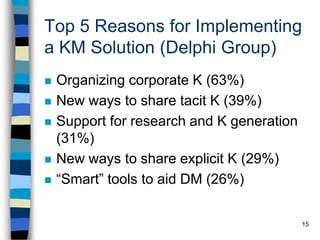
Top 5 Reasons for Implementing
a KM Solution (Delphi Group)
 Organizing corporate K (63%)
 New ways to share tacit K (39%)
 Support for research and K generation
(31%)
 New ways to share explicit K (29%)
 “Smart” tools to aid DM (26%)
16
Knowledge Reuse
 Provides for the capture and reapplication of
knowledge artifacts (episodes in memory, stories,
relationships, experiences, rules of thumb, and other
forms of knowledge acquired by individuals or
groups)
 Relies as much on the use of negative experiences,
flawed reasoning, or wrong answers as on correct
results
 Failure and Lessons Learned in Information
Technology Management: An International Journal
(Jay Liebowitz, Editor-in-Chief; Publisher: Cognizant
Communications Corp., NY; cogcomm@aol.com)
17
Information Audits (TFPL)
 Identify the information needs of the
organization, the business units, and
individuals
 Identify the information created and assess its
value
 Identify the expertise and knowledge assets
 Identify the information gaps
 Review the current use of external and
internal information sources
18
Information Audits (TFPL)
(cont.)
 Map information flows and bottlenecks within
those flows
 Develop a knowledge map of the organization
indicating appropriate connections and
collections
These tasks will enable the design of content
maps for intranets, knowledge management
strategies, and information strategies
19
Knowledge Management at
Monsanto Co.
 Developed a Knowledge Management Architecture
(KMA) -- Director of Knowledge Management
 Includes a learning map that identifies questions
answered and resulting decisions made
 Information map that specifies the kind of information
that users need
 Knowledge map that explains what users do with
specific information (conversion of information to
insight or knowledge)
20
Audit (TFPL)
 Independent team
 Mix of interviews, questionnaires, discussion
groups, and focus groups
 Number of people in “central” positions are
interviewed
 Detailed questionnaire to all staff
 Do post-audits periodically
21
Perform a “knowledge audit” first! If you’re a manufacturer,
you inventory your physical assets before you change your
manufacturing plans and processes. Should we do less
with knowledge resources? Consider such factors as:
 What information do people need to do their jobs?
 What is the function of the information?
 Who holds that knowledge now? Who needs it? When?
 How can that information be made substantially more effective?
 What connection should you make between documents and
“work flow”?
 Do you really want “document management” tied to work flow,
processes, and “business process reengineering”?
 What precisely, is the nature of knowledge resources?
22
Teltech’s Audit Process
 Begins at the top, identifying the client’s
key decision making areas and tasks,
and drills down to evaluate the types,
level, and location of info and K required
to support those decisions
 Gap analysis identifies information/K
weak areas
23
Teltech’s (cont.)
 Teltech’s knowledge audit takes 3-4
weeks at one location with 200-600
employees
 Assesses knowledge-related behavior
(e.g., how receptive is a client’s culture
to accessing information electronically?)
24
Knowledge Audits & Related
Projects (Liebowitz et al.,
UMBC)
 BRI/PAC core competency process at
the Social Security Administration (2
surveys, follow-up interviews)
 Knowledge management strategy for the
FCC
 Knowledge mapping for ASID
 Web-based expert system for HCFA
 Agent-based system for the Navy
 Other work at our Lab for KM
25
Knowledge Organization
 Invest in education and training of the firm’s human
capital
 Develop knowledge repositories for preserving,
sharing, and distributing K
 Provide incentives to encourage employees and
management to contribute to the organization’s
knowledge repositories and use this knowledge
 Consider evaluating annually each member of the
firm on the quality and quantity of knowledge
contributed to the firm’s knowledge bases as well as
the organizational knowledge used by that firm
member
26
Knowledge Organization
(cont.)
 Develop methodologies for managing and structuring
the knowledge in the knowledge repositories
 Provide an infrastructure of individuals whose main
job is to manage the creation, development, and
maintenance of knowledge repositories
 Place the Chief Knowledge Officer (CKO) in either a
staff position directly under the CEO or in a line
position equivalent to a VP
 Adapt to the changing competitive environment by
forming project teams based on the employee
knowledge profiles
27
CGIAR KM Survey Results
 Most Centers don’t measure
the value of the IC
 People are the most
important knowledge carriers
 Most of the Centers’
strategic goals don’t include
KM explicitly
 KM objective: facilitate the
re-use & consolidation of K
 Sharing of K: intranets,
documentation--Center level
 Unit-level: intranets, cross-
functional teams, training
 Creation of K: lessons
learned analysis
 Storing K: manuals and
handbooks
 “Some” understanding and
support for KM
 Mixed reaction on motivating
and rewarding for KM
 No formal Webmaster
function in most Centers
 Email & videoconferencing:
intranet to support KM
 No tracking of new K
generation

Knowledgeaudit

  • 1.
    KNOWLEDGE AUDIT Jay Liebowitz R.W.Deutsch Distinguished Professor of Information Systems, UMBC; (LIEBOWIT@UMBC.EDU)
  • 2.
    2 What Do YouHope to Learn?  Further background on KM processes and the role of the CKO in the organization  Knowledge management methodology  Knowledge audit process  Practical advice about knowledge audits
  • 3.
    3 Knowledge Management Process  Developingnew knowledge  Securing new and existing knowledge  Distributing knowledge  Combining available knowledge  Important element -- Connectivity
  • 4.
    4 “What is aCKO?” (Earl and Scott, Sloan Mgt. Review, Winter 1999)  Studied 20 CKOs in North America and Europe  Usually appointed by the CEO (gut feeling)  Primary task is to articulate a KM program  CKOs spend a lot of time “walking around the organization”  CKOs are conceptual designers  Concentrate on tapping tacit knowledge  Self-starter; not single career-track people  Highly motivated (driven)  Most have small staffs (3-12 persons)  High level sponsorship
  • 5.
    5 A SMART Methodologyfor Knowledge Management (Liebowitz et al., UMBC)  S=Strategize  M=Model  A=Act  R=Revise  T=Transfer
  • 6.
    6 Operational/Implementation Steps for theKnowledge Leveraging Model  Conceptualize and Strategize: Define Problem (why are we doing this; what should be the end result?) Assess Cultural Readiness, Technology Needs & Resources Conduct a Knowledge Audit (Knowledge Gap Analysis) Analyze and Develop an Overall KM Strategic Plan (Should Relate to the Center’s Strategic Plan; Define Leadership Role, KM Implementation Infrastructure, and Technology Needs)  Knowledge Acquisition: Identify and Apply Methods to Capture Expertise (e.g., structured/unstructured interviews, verbal walkthroughs, observation, simulation, questionnaires, etc.)
  • 7.
    7 Knowledge Codification/Storage/Organization: Develop aKnowledge Taxonomy for Standardization Represent and Convert the Acquired Knowledge into rules, cases, best/worst practices, lessons learned, etc. Encode the Knowledge into Software Test and Refine the Knowledge Base Knowledge Distribution: Release the KM System to the User Community Evaluate the KM System Knowledge Use and Application: Perform On-going Use and Maintenance Create New Knowledge
  • 8.
    8 Enabling Mechanisms forCreating a Learning/Sharing Environment: Create an Organizational Culture that Supports the Value of Sharing Knowledge (e.g., trust; the ability to communicate clearly and with enough bandwidth to transfer meaning; a common context or language; a reason or goal for sharing; the space to think and reflect; the ability to interact with others in a nonpurposeful way; the autonomy to share; awareness that knowledge may be local; a flexible organizational structure that supports knowledge sharing; the infrastructure to support knowledge and information sharing [David Coleman, Collaborative Strategies Inc.] Strengthen and Create Communities of Practice (part of increased knowledge sharing)
  • 9.
    9 Knowledge Audit (ONLINX ResearchInc.)  A knowledge audit is a review of the firm’s knowledge assets and associated knowledge management systems  A systematic and dispassionate review of the adequacy and integrity of important organizational assets and systems
  • 10.
    10 Knowledge Audit (Dataware, Liebowitz) In order to solve the targeted problem, what knowledge do we have, what knowledge is missing, who needs this knowledge, and how will we use the knowledge?
  • 11.
    11 Knowledge Audit (Seeley, Warner-Lambert) What information exists in my organization, and where is it located?  What expertise resides in my organization--who knows what?  What relevant expertise resides outside my organization, where does this expertise exist, and how do I gain access to it?  What are the best sources of relevant internal and external information and knowledge?
  • 12.
    12 Value of aKnowledge Audit (Peter Smith, ONLINX Research Inc.)  Demonstrates exactly where value is being created through human and structural capital  Highlights where leverage can best be applied through improved knowledge sharing and organizational learning  Helps prioritize projects for improving knowledge management practice  Demonstrates firm capabilities to shareholders and other stakeholders  Is a key component to strategic planning for any knowledge- based enterprise  Is a key adjunct to due diligence and business planning in mergers, acquisitions, strategic alliances, venture capital, and new company formation
  • 13.
    13 Why Audit?  Lookingfor knowledge-based opportunities in the markets?  Is your focus knowledge flows, stores, and sinks in the organization?  Is the audit to check compliance with SOPs?  Are you searching for ways to leverage internal processes using knowledge?  Will you focus on knowledge objects or are you interested in cultural barriers?
  • 14.
    14 Why Audit? (cont.) Is the audit strictly for gathering baseline data (descriptive) or is there a prescriptive element?  Is the audit part of a larger BPR project?  Does the mandate include all stakeholders, suppliers, customers, stockholders, etc.?  Where does the learning take place that generates the knowledge?  How fast is the learning?  What are the key leverage points in the learning process?
  • 15.
    15 Top 5 Reasonsfor Implementing a KM Solution (Delphi Group)  Organizing corporate K (63%)  New ways to share tacit K (39%)  Support for research and K generation (31%)  New ways to share explicit K (29%)  “Smart” tools to aid DM (26%)
  • 16.
    16 Knowledge Reuse  Providesfor the capture and reapplication of knowledge artifacts (episodes in memory, stories, relationships, experiences, rules of thumb, and other forms of knowledge acquired by individuals or groups)  Relies as much on the use of negative experiences, flawed reasoning, or wrong answers as on correct results  Failure and Lessons Learned in Information Technology Management: An International Journal (Jay Liebowitz, Editor-in-Chief; Publisher: Cognizant Communications Corp., NY; cogcomm@aol.com)
  • 17.
    17 Information Audits (TFPL) Identify the information needs of the organization, the business units, and individuals  Identify the information created and assess its value  Identify the expertise and knowledge assets  Identify the information gaps  Review the current use of external and internal information sources
  • 18.
    18 Information Audits (TFPL) (cont.) Map information flows and bottlenecks within those flows  Develop a knowledge map of the organization indicating appropriate connections and collections These tasks will enable the design of content maps for intranets, knowledge management strategies, and information strategies
  • 19.
    19 Knowledge Management at MonsantoCo.  Developed a Knowledge Management Architecture (KMA) -- Director of Knowledge Management  Includes a learning map that identifies questions answered and resulting decisions made  Information map that specifies the kind of information that users need  Knowledge map that explains what users do with specific information (conversion of information to insight or knowledge)
  • 20.
    20 Audit (TFPL)  Independentteam  Mix of interviews, questionnaires, discussion groups, and focus groups  Number of people in “central” positions are interviewed  Detailed questionnaire to all staff  Do post-audits periodically
  • 21.
    21 Perform a “knowledgeaudit” first! If you’re a manufacturer, you inventory your physical assets before you change your manufacturing plans and processes. Should we do less with knowledge resources? Consider such factors as:  What information do people need to do their jobs?  What is the function of the information?  Who holds that knowledge now? Who needs it? When?  How can that information be made substantially more effective?  What connection should you make between documents and “work flow”?  Do you really want “document management” tied to work flow, processes, and “business process reengineering”?  What precisely, is the nature of knowledge resources?
  • 22.
    22 Teltech’s Audit Process Begins at the top, identifying the client’s key decision making areas and tasks, and drills down to evaluate the types, level, and location of info and K required to support those decisions  Gap analysis identifies information/K weak areas
  • 23.
    23 Teltech’s (cont.)  Teltech’sknowledge audit takes 3-4 weeks at one location with 200-600 employees  Assesses knowledge-related behavior (e.g., how receptive is a client’s culture to accessing information electronically?)
  • 24.
    24 Knowledge Audits &Related Projects (Liebowitz et al., UMBC)  BRI/PAC core competency process at the Social Security Administration (2 surveys, follow-up interviews)  Knowledge management strategy for the FCC  Knowledge mapping for ASID  Web-based expert system for HCFA  Agent-based system for the Navy  Other work at our Lab for KM
  • 25.
    25 Knowledge Organization  Investin education and training of the firm’s human capital  Develop knowledge repositories for preserving, sharing, and distributing K  Provide incentives to encourage employees and management to contribute to the organization’s knowledge repositories and use this knowledge  Consider evaluating annually each member of the firm on the quality and quantity of knowledge contributed to the firm’s knowledge bases as well as the organizational knowledge used by that firm member
  • 26.
    26 Knowledge Organization (cont.)  Developmethodologies for managing and structuring the knowledge in the knowledge repositories  Provide an infrastructure of individuals whose main job is to manage the creation, development, and maintenance of knowledge repositories  Place the Chief Knowledge Officer (CKO) in either a staff position directly under the CEO or in a line position equivalent to a VP  Adapt to the changing competitive environment by forming project teams based on the employee knowledge profiles
  • 27.
    27 CGIAR KM SurveyResults  Most Centers don’t measure the value of the IC  People are the most important knowledge carriers  Most of the Centers’ strategic goals don’t include KM explicitly  KM objective: facilitate the re-use & consolidation of K  Sharing of K: intranets, documentation--Center level  Unit-level: intranets, cross- functional teams, training  Creation of K: lessons learned analysis  Storing K: manuals and handbooks  “Some” understanding and support for KM  Mixed reaction on motivating and rewarding for KM  No formal Webmaster function in most Centers  Email & videoconferencing: intranet to support KM  No tracking of new K generation