Torque Calculation
1/R
T
T
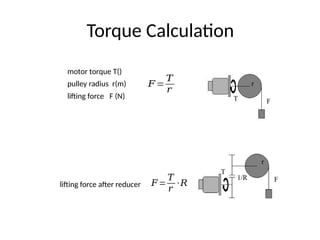
motor torque T()
pulley radius r(m)
lifting force F (N)
lifting force after reducer
F
F
r
r
𝐹=
𝑇
𝑟
𝐹=
𝑇
𝑟
∙𝑅
Torque Calculation
F
1/R
PB
F
PB
T
T
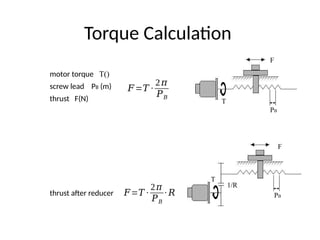
motor torque T()
screw lead PB (m)
thrust F(N)
thrust after reducer
𝐹=𝑇 ∙
2𝜋
𝑃𝐵
𝐹=𝑇 ∙
2𝜋
𝑃𝐵
∙ 𝑅
Inertia Calculation
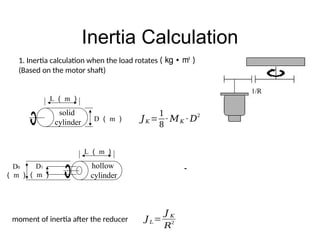
1. Inertia calculation when the load rotates ( ㎏ • ㎡ )
(Based on the motor shaft)
solid
cylinder
hollow
cylinder
L ( m )
D ( m )
L ( m )
D1
( m )
moment of inertia after the reducer
1/R
D0
( m )
𝐽𝐾 =
1
8
∙ 𝑀𝐾 ∙ 𝐷
2
-
𝐽𝐿=
𝐽 𝐾
𝑅
2
Inertia Calculation
M
1/R
PB
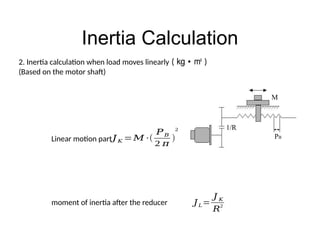
Linear motion part
moment of inertia after the reducer
2. Inertia calculation when load moves linearly ( ㎏ • ㎡ )
(Based on the motor shaft)
𝐽𝐾 =𝑀 ∙(
𝑃𝐵
2 𝜋
)
2
𝐽𝐿=
𝐽 𝐾
𝑅
2
Inertia Calculation
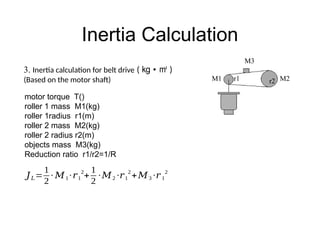
3. Inertia calculation for belt drive ( ㎏ • ㎡ )
(Based on the motor shaft)
M3
M2
M1 r1 r2
motor torque T()
roller 1 mass M1(kg)
roller 1radius r1(m)
roller 2 mass M2(kg)
roller 2 radius r2(m)
objects mass M3(kg)
Reduction ratio r1/r2=1/R
𝐽𝐿=
1
2
∙ 𝑀1∙𝑟1
2
+
1
2
∙𝑀2 ∙𝑟1
2
+𝑀3 ∙𝑟 1
2
Servo Selection Principle
• continuous working torque < servo motor rated torque
• instantaneous maximum torque < servo motor maximum torque (at acceleration)
• load inertia < 3 times motor rotor inertia
• continuous working speed < motor rated speed
Example calculation 1
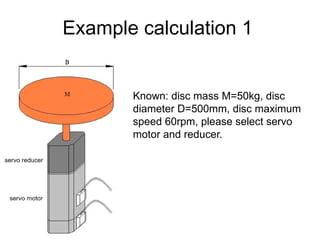
Known: disc mass M=50kg, disc
diameter D=500mm, disc maximum
speed 60rpm, please select servo
motor and reducer.
Example calculation 1
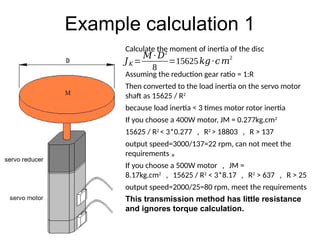
Calculate the moment of inertia of the disc
Assuming the reduction gear ratio = 1:R
Then converted to the load inertia on the servo motor
shaft as 15625 / R2
because load inertia < 3 times motor rotor inertia
If you choose a 400W motor, JM = 0.277kg.cm2
15625 / R2
< 3*0.277 , R2
> 18803 , R > 137
output speed=3000/137=22 rpm, can not meet the
requirements 。
If you choose a 500W motor , JM =
8.17kg.cm2
, 15625 / R2
< 3*8.17 , R2
> 637 , R > 25
output speed=2000/25=80 rpm, meet the requirements
This transmission method has little resistance
and ignores torque calculation.
𝐽𝐾 =
𝑀 ∙ 𝐷2
8
=15625𝑘𝑔∙𝑐𝑚
2
Example calculation 2
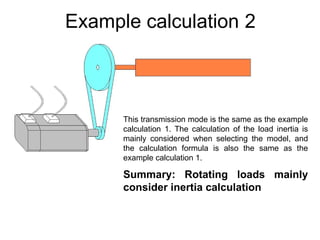
This transmission mode is the same as the example
calculation 1. The calculation of the load inertia is
mainly considered when selecting the model, and
the calculation formula is also the same as the
example calculation 1.
Summary: Rotating loads mainly
consider inertia calculation
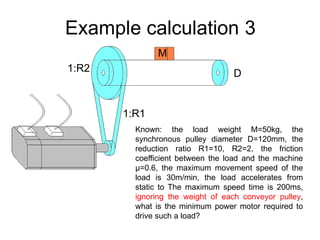
Example calculation 3
M
1:R1
Known: the load weight M=50kg, the
synchronous pulley diameter D=120mm, the
reduction ratio R1=10, R2=2, the friction
coefficient between the load and the machine
µ=0.6, the maximum movement speed of the
load is 30m/min, the load accelerates from
static to The maximum speed time is 200ms,
ignoring the weight of each conveyor pulley,
what is the minimum power motor required to
drive such a load?
D
1:R2
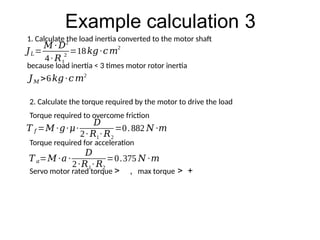
Example calculation 3
1. Calculate the load inertia converted to the motor shaft
because load inertia < 3 times motor rotor inertia
2. Calculate the torque required by the motor to drive the load
Torque required to overcome friction
Torque required for acceleration
Servo motor rated torque > , max torque > +
𝐽𝐿=
𝑀 ∙ 𝐷2
4∙ 𝑅1
2
=18𝑘𝑔∙𝑐𝑚2
𝐽𝑀 >6𝑘𝑔∙𝑐𝑚2
𝑇 𝑓 =𝑀 ∙𝑔∙𝜇∙
𝐷
2∙ 𝑅1∙ 𝑅2
=0.882 𝑁 ∙𝑚
𝑇 𝑎=𝑀 ∙𝑎 ∙
𝐷
2∙𝑅1∙ 𝑅2
=0.375 𝑁 ∙𝑚
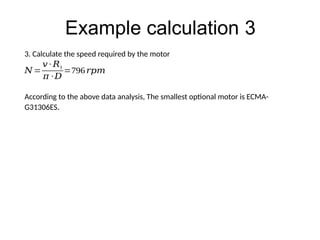
Example calculation 3
3. Calculate the speed required by the motor
According to the above data analysis, The smallest optional motor is ECMA-
G31306ES.
𝑁=
𝑣∙ 𝑅1
𝜋 ∙𝐷
=796𝑟𝑝𝑚
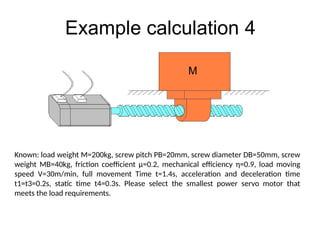
Example calculation 4
Known: load weight M=200kg, screw pitch PB=20mm, screw diameter DB=50mm, screw
weight MB=40kg, friction coefficient µ=0.2, mechanical efficiency η=0.9, load moving
speed V=30m/min, full movement Time t=1.4s, acceleration and deceleration time
t1=t3=0.2s, static time t4=0.3s. Please select the smallest power servo motor that
meets the load requirements.
M
Example calculation 4
1. Calculate the load inertia converted to the motor shaft
The moment of inertia converted from the weight to the motor shaft
Screw moment of inertia
total load inertia
2. Calculate the motor speed
Motor required speed
𝐽 𝑊 =𝑀 ∙¿
𝐽𝐵=
𝑀𝐵 ∙𝐷𝐵
2
8
=125𝑘𝑔∙𝑐 𝑚
2
𝐽𝐿= 𝐽𝑊 + 𝐽 𝐵=145.29𝑘𝑔∙𝑐𝑚2
𝑁=
𝑉
𝑃𝐵
=1500𝑟𝑝𝑚
Example calculation 4
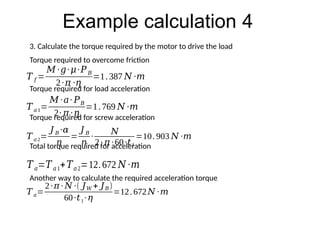
3. Calculate the torque required by the motor to drive the load
Torque required to overcome friction
Torque required for load acceleration
Torque required for screw acceleration
Total torque required for acceleration
𝑇 𝑓 =
𝑀 ∙𝑔∙𝜇∙𝑃𝐵
2∙𝜋 ∙𝜂
=1.387 𝑁 ∙𝑚
𝑇𝑎1=
𝑀 ∙𝑎∙ 𝑃𝐵
2∙ 𝜋 ∙𝜂
=1.769 𝑁 ∙𝑚
𝑇 𝑎2=
𝐽 𝐵 ∙𝛼
𝜂
=
𝐽 𝐵
𝜂
∙
𝑁
2∙ 𝜋 ∙60∙𝑡1
=10.903 𝑁 ∙𝑚
𝑇𝑎=𝑇𝑎1+𝑇𝑎2=12.672 𝑁 ∙𝑚
Another way to calculate the required acceleration torque
𝑇 𝑎=
2∙𝜋 ∙ 𝑁 ∙( 𝐽𝑊 + 𝐽𝐵)
60∙𝑡1∙𝜂
=12.672𝑁 ∙𝑚
Example calculation 4
Calculate the instantaneous maximum torque :
acceleration torque
uniform torque
deceleration torque
effective torque
𝑇 𝐴=𝑇𝑎+𝑇 𝑓 =14 .059 𝑁 ∙𝑚
𝑇𝑏=𝑇𝑓 =1.387 𝑁 ∙𝑚
𝑇𝑐=𝑇𝑎−𝑇𝑓 =11.285 𝑁 ∙𝑚
𝑇𝑟𝑚𝑠=
√(𝑇 ¿¿ 𝐴¿¿2∙𝑡1+𝑇𝑏
2
∙𝑡2+𝑇𝑐
2
∙𝑡3)
(𝑡1+𝑡2+𝑡3)
=6.914 𝑁∙𝑚¿¿
Example calculation 4
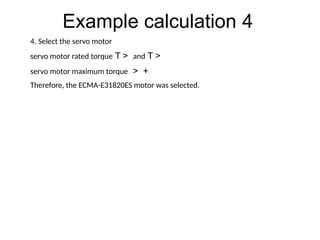
4. Select the servo motor
servo motor rated torque T > and T >
servo motor maximum torque > +
Therefore, the ECMA-E31820ES motor was selected.
Factors that Determine the Servo Motor
transfer method
load weight
weight of transmission parts such as pulley/ball screw
reduction ratio
pulley Diameter / Ball Screw Pitch
acceleration and deceleration characteristics
running speed
friction coefficient
mechanical efficiency

Servo motor selection calculation indus.pptx

  • 1.
    Torque Calculation 1/R T T motor torqueT() pulley radius r(m) lifting force F (N) lifting force after reducer F F r r 𝐹= 𝑇 𝑟 𝐹= 𝑇 𝑟 ∙𝑅
  • 2.
    Torque Calculation F 1/R PB F PB T T motor torqueT() screw lead PB (m) thrust F(N) thrust after reducer 𝐹=𝑇 ∙ 2𝜋 𝑃𝐵 𝐹=𝑇 ∙ 2𝜋 𝑃𝐵 ∙ 𝑅
  • 3.
    Inertia Calculation 1. Inertiacalculation when the load rotates ( ㎏ • ㎡ ) (Based on the motor shaft) solid cylinder hollow cylinder L ( m ) D ( m ) L ( m ) D1 ( m ) moment of inertia after the reducer 1/R D0 ( m ) 𝐽𝐾 = 1 8 ∙ 𝑀𝐾 ∙ 𝐷 2 - 𝐽𝐿= 𝐽 𝐾 𝑅 2
  • 4.
    Inertia Calculation M 1/R PB Linear motionpart moment of inertia after the reducer 2. Inertia calculation when load moves linearly ( ㎏ • ㎡ ) (Based on the motor shaft) 𝐽𝐾 =𝑀 ∙( 𝑃𝐵 2 𝜋 ) 2 𝐽𝐿= 𝐽 𝐾 𝑅 2
  • 5.
    Inertia Calculation 3. Inertiacalculation for belt drive ( ㎏ • ㎡ ) (Based on the motor shaft) M3 M2 M1 r1 r2 motor torque T() roller 1 mass M1(kg) roller 1radius r1(m) roller 2 mass M2(kg) roller 2 radius r2(m) objects mass M3(kg) Reduction ratio r1/r2=1/R 𝐽𝐿= 1 2 ∙ 𝑀1∙𝑟1 2 + 1 2 ∙𝑀2 ∙𝑟1 2 +𝑀3 ∙𝑟 1 2
  • 6.
    Servo Selection Principle •continuous working torque < servo motor rated torque • instantaneous maximum torque < servo motor maximum torque (at acceleration) • load inertia < 3 times motor rotor inertia • continuous working speed < motor rated speed
  • 7.
    Example calculation 1 Known:disc mass M=50kg, disc diameter D=500mm, disc maximum speed 60rpm, please select servo motor and reducer.
  • 8.
    Example calculation 1 Calculatethe moment of inertia of the disc Assuming the reduction gear ratio = 1:R Then converted to the load inertia on the servo motor shaft as 15625 / R2 because load inertia < 3 times motor rotor inertia If you choose a 400W motor, JM = 0.277kg.cm2 15625 / R2 < 3*0.277 , R2 > 18803 , R > 137 output speed=3000/137=22 rpm, can not meet the requirements 。 If you choose a 500W motor , JM = 8.17kg.cm2 , 15625 / R2 < 3*8.17 , R2 > 637 , R > 25 output speed=2000/25=80 rpm, meet the requirements This transmission method has little resistance and ignores torque calculation. 𝐽𝐾 = 𝑀 ∙ 𝐷2 8 =15625𝑘𝑔∙𝑐𝑚 2
  • 9.
    Example calculation 2 Thistransmission mode is the same as the example calculation 1. The calculation of the load inertia is mainly considered when selecting the model, and the calculation formula is also the same as the example calculation 1. Summary: Rotating loads mainly consider inertia calculation
  • 10.
    Example calculation 3 M 1:R1 Known:the load weight M=50kg, the synchronous pulley diameter D=120mm, the reduction ratio R1=10, R2=2, the friction coefficient between the load and the machine µ=0.6, the maximum movement speed of the load is 30m/min, the load accelerates from static to The maximum speed time is 200ms, ignoring the weight of each conveyor pulley, what is the minimum power motor required to drive such a load? D 1:R2
  • 11.
    Example calculation 3 1.Calculate the load inertia converted to the motor shaft because load inertia < 3 times motor rotor inertia 2. Calculate the torque required by the motor to drive the load Torque required to overcome friction Torque required for acceleration Servo motor rated torque > , max torque > + 𝐽𝐿= 𝑀 ∙ 𝐷2 4∙ 𝑅1 2 =18𝑘𝑔∙𝑐𝑚2 𝐽𝑀 >6𝑘𝑔∙𝑐𝑚2 𝑇 𝑓 =𝑀 ∙𝑔∙𝜇∙ 𝐷 2∙ 𝑅1∙ 𝑅2 =0.882 𝑁 ∙𝑚 𝑇 𝑎=𝑀 ∙𝑎 ∙ 𝐷 2∙𝑅1∙ 𝑅2 =0.375 𝑁 ∙𝑚
  • 12.
    Example calculation 3 3.Calculate the speed required by the motor According to the above data analysis, The smallest optional motor is ECMA- G31306ES. 𝑁= 𝑣∙ 𝑅1 𝜋 ∙𝐷 =796𝑟𝑝𝑚
  • 13.
    Example calculation 4 Known:load weight M=200kg, screw pitch PB=20mm, screw diameter DB=50mm, screw weight MB=40kg, friction coefficient µ=0.2, mechanical efficiency η=0.9, load moving speed V=30m/min, full movement Time t=1.4s, acceleration and deceleration time t1=t3=0.2s, static time t4=0.3s. Please select the smallest power servo motor that meets the load requirements. M
  • 14.
    Example calculation 4 1.Calculate the load inertia converted to the motor shaft The moment of inertia converted from the weight to the motor shaft Screw moment of inertia total load inertia 2. Calculate the motor speed Motor required speed 𝐽 𝑊 =𝑀 ∙¿ 𝐽𝐵= 𝑀𝐵 ∙𝐷𝐵 2 8 =125𝑘𝑔∙𝑐 𝑚 2 𝐽𝐿= 𝐽𝑊 + 𝐽 𝐵=145.29𝑘𝑔∙𝑐𝑚2 𝑁= 𝑉 𝑃𝐵 =1500𝑟𝑝𝑚
  • 15.
    Example calculation 4 3.Calculate the torque required by the motor to drive the load Torque required to overcome friction Torque required for load acceleration Torque required for screw acceleration Total torque required for acceleration 𝑇 𝑓 = 𝑀 ∙𝑔∙𝜇∙𝑃𝐵 2∙𝜋 ∙𝜂 =1.387 𝑁 ∙𝑚 𝑇𝑎1= 𝑀 ∙𝑎∙ 𝑃𝐵 2∙ 𝜋 ∙𝜂 =1.769 𝑁 ∙𝑚 𝑇 𝑎2= 𝐽 𝐵 ∙𝛼 𝜂 = 𝐽 𝐵 𝜂 ∙ 𝑁 2∙ 𝜋 ∙60∙𝑡1 =10.903 𝑁 ∙𝑚 𝑇𝑎=𝑇𝑎1+𝑇𝑎2=12.672 𝑁 ∙𝑚 Another way to calculate the required acceleration torque 𝑇 𝑎= 2∙𝜋 ∙ 𝑁 ∙( 𝐽𝑊 + 𝐽𝐵) 60∙𝑡1∙𝜂 =12.672𝑁 ∙𝑚
  • 16.
    Example calculation 4 Calculatethe instantaneous maximum torque : acceleration torque uniform torque deceleration torque effective torque 𝑇 𝐴=𝑇𝑎+𝑇 𝑓 =14 .059 𝑁 ∙𝑚 𝑇𝑏=𝑇𝑓 =1.387 𝑁 ∙𝑚 𝑇𝑐=𝑇𝑎−𝑇𝑓 =11.285 𝑁 ∙𝑚 𝑇𝑟𝑚𝑠= √(𝑇 ¿¿ 𝐴¿¿2∙𝑡1+𝑇𝑏 2 ∙𝑡2+𝑇𝑐 2 ∙𝑡3) (𝑡1+𝑡2+𝑡3) =6.914 𝑁∙𝑚¿¿
  • 17.
    Example calculation 4 4.Select the servo motor servo motor rated torque T > and T > servo motor maximum torque > + Therefore, the ECMA-E31820ES motor was selected.
  • 18.
    Factors that Determinethe Servo Motor transfer method load weight weight of transmission parts such as pulley/ball screw reduction ratio pulley Diameter / Ball Screw Pitch acceleration and deceleration characteristics running speed friction coefficient mechanical efficiency