Servers are computers that are explicitly set-up to provide services to other computers on the network.  Therefore server administration is the task of managing, upgrading and maintaining these servers and making sure that all systems are humming along.
We need to know other discipline to administer a server...
Network Basics
t he logical structure and operating principle of a network system and defines the communication protocols required for real-world data exchange It determines “hierarchical structures” according to each classification and specifies protocols and interfaces between layers of the hierarchical structure.
within the network architecture, all the network's physical elements are modeled and structured and treated as a logical network Main components are:  node i.e. hardware such as computers and communication equipment link i.e. communication lines process i.e. application programs
If the architecture is the same, a system can be built by adjusting the interfaces even when products from different manufacturers are combined Employing a system compliant with standard interfaces makes it easy to develop, expand and maintain the system Even independently developed systems can be easily integrated The entire network can be treated locally
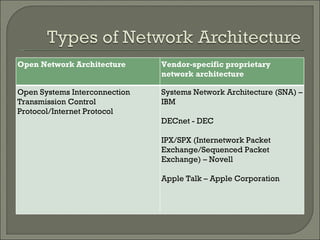
Open Network Architecture Vendor-specific proprietary network architecture Open Systems Interconnection Transmission Control Protocol/Internet Protocol Systems Network Architecture (SNA) – IBM DECnet - DEC  IPX/SPX (Internetwork Packet Exchange/Sequenced Packet Exchange) – Novell Apple Talk – Apple Corporation
Network Topology
 
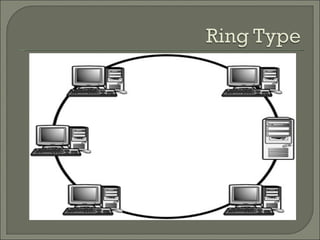
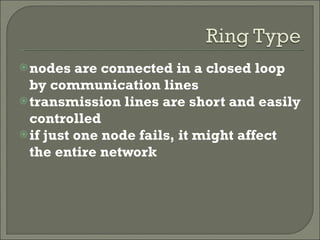
nodes are connected in a closed loop by communication lines transmission lines are short and easily controlled if just one node fails, it might affect the entire network
 
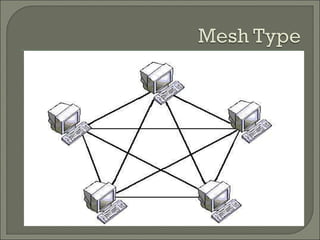
two or more paths lead to each node so that that the overall structure becomes that of a mesh even if a node fails, that node can be bypassed by routing meaning that the reliability of this type of network is high
 
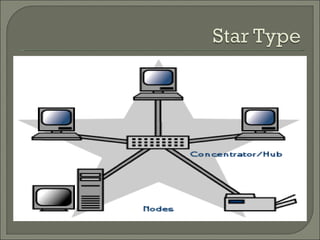
each node is connected to a central node in star shaped configuration even if one node fails, this will have no effect on the overall systems but if the central node fails, the entire network will no longer be functional
 
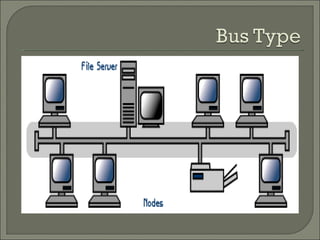
all nodes are connected to a common communication line makes it easy to add or remove nodes without affecting the overall system and at the same time it is economical when there are many nodes and the traffic load increases data collision may occur on the common communication line and the transmission efficiency may deteriorate
 
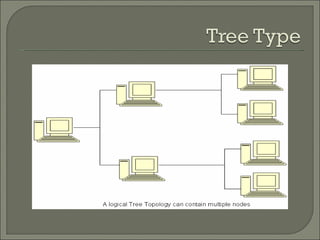
several child nodes are connected to a parent node also called cascade connection
There are three typical connection methods that are used in accordance with what best suits the communication distance and data load, etc. These are:  Point-to-point connection Multipoint connection Switched connection
 
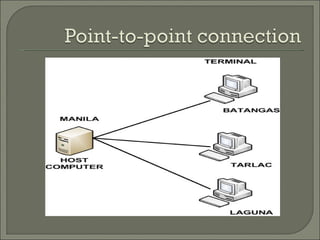
the computer is connected one-to-one to each terminal through a leased line communication lines appropriate if heavy traffic between two points is required
 
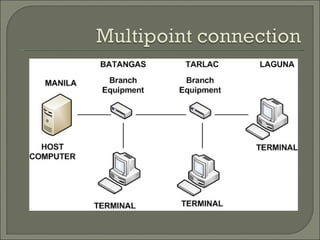
multiple branching devices are connected sequentially to the same communication line This configuration allows construction of a network that is cheaper than using the point-to-point configuration when the communication distance is long and the data traffic is light. Since the main communication line is shared, other terminals have to wait while one is transmitting data
 
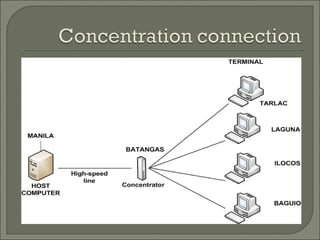
the lines from several terminals are connected to a concentrator, which is connected to the host computer through a high-speed line
No matter what kind of software is running on a network and regardless of what kind of data is transmitted, problem-free data communication will be possible on the OSI complaint network.
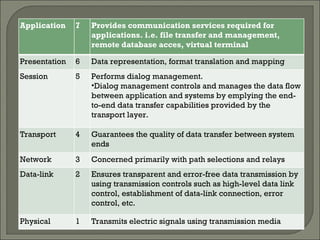
Application 7 Provides communication services required for applications. i.e. file transfer and management, remote database acces, virtual terminal Presentation 6 Data representation, format translation and mapping Session 5 Performs dialog management.  Dialog management controls and manages the data flow between application and systems by emplying the end-to-end data transfer capabilities provided by the transport layer. Transport  4 Guarantees the quality of data transfer between system ends Network 3 Concerned primarily with path selections and relays Data-link 2 Ensures transparent and error-free data transmission by using transmission controls such as high-level data link control, establishment of data-link connection, error control, etc. Physical  1 Transmits electric signals using transmission media

Server administration

  • 1.
  • 2.
    Servers are computersthat are explicitly set-up to provide services to other computers on the network. Therefore server administration is the task of managing, upgrading and maintaining these servers and making sure that all systems are humming along.
  • 3.
    We need toknow other discipline to administer a server...
  • 4.
  • 5.
    t he logicalstructure and operating principle of a network system and defines the communication protocols required for real-world data exchange It determines “hierarchical structures” according to each classification and specifies protocols and interfaces between layers of the hierarchical structure.
  • 6.
    within the networkarchitecture, all the network's physical elements are modeled and structured and treated as a logical network Main components are: node i.e. hardware such as computers and communication equipment link i.e. communication lines process i.e. application programs
  • 7.
    If the architectureis the same, a system can be built by adjusting the interfaces even when products from different manufacturers are combined Employing a system compliant with standard interfaces makes it easy to develop, expand and maintain the system Even independently developed systems can be easily integrated The entire network can be treated locally
  • 8.
    Open Network ArchitectureVendor-specific proprietary network architecture Open Systems Interconnection Transmission Control Protocol/Internet Protocol Systems Network Architecture (SNA) – IBM DECnet - DEC IPX/SPX (Internetwork Packet Exchange/Sequenced Packet Exchange) – Novell Apple Talk – Apple Corporation
  • 9.
  • 10.
  • 11.
    nodes are connectedin a closed loop by communication lines transmission lines are short and easily controlled if just one node fails, it might affect the entire network
  • 12.
  • 13.
    two or morepaths lead to each node so that that the overall structure becomes that of a mesh even if a node fails, that node can be bypassed by routing meaning that the reliability of this type of network is high
  • 14.
  • 15.
    each node isconnected to a central node in star shaped configuration even if one node fails, this will have no effect on the overall systems but if the central node fails, the entire network will no longer be functional
  • 16.
  • 17.
    all nodes areconnected to a common communication line makes it easy to add or remove nodes without affecting the overall system and at the same time it is economical when there are many nodes and the traffic load increases data collision may occur on the common communication line and the transmission efficiency may deteriorate
  • 18.
  • 19.
    several child nodesare connected to a parent node also called cascade connection
  • 20.
    There are threetypical connection methods that are used in accordance with what best suits the communication distance and data load, etc. These are: Point-to-point connection Multipoint connection Switched connection
  • 21.
  • 22.
    the computer isconnected one-to-one to each terminal through a leased line communication lines appropriate if heavy traffic between two points is required
  • 23.
  • 24.
    multiple branching devicesare connected sequentially to the same communication line This configuration allows construction of a network that is cheaper than using the point-to-point configuration when the communication distance is long and the data traffic is light. Since the main communication line is shared, other terminals have to wait while one is transmitting data
  • 25.
  • 26.
    the lines fromseveral terminals are connected to a concentrator, which is connected to the host computer through a high-speed line
  • 27.
    No matter whatkind of software is running on a network and regardless of what kind of data is transmitted, problem-free data communication will be possible on the OSI complaint network.
  • 28.
    Application 7 Providescommunication services required for applications. i.e. file transfer and management, remote database acces, virtual terminal Presentation 6 Data representation, format translation and mapping Session 5 Performs dialog management. Dialog management controls and manages the data flow between application and systems by emplying the end-to-end data transfer capabilities provided by the transport layer. Transport 4 Guarantees the quality of data transfer between system ends Network 3 Concerned primarily with path selections and relays Data-link 2 Ensures transparent and error-free data transmission by using transmission controls such as high-level data link control, establishment of data-link connection, error control, etc. Physical 1 Transmits electric signals using transmission media