Causative organism  :  Mycobacterium tuberculosis  Classification : Primary tuberculosis of the skin  Miliary  tuberculosis of the skin  Lupus vulgaris  Scrofuloderma  Tuberculosis verrucosa cutis  Tuberculosis cutis orificialis  Tuberculide : Tuberculosis of skin
Vary rare condition It consist of : 1. Tuberculous chancre  2. regional lymph node Tuberculous chancre is asymptomatic ulcerated nodule covered by crust  The ulcer has the characteristic of tuberculous ulcer .  Primary tuberculosis of the skin
Primary inoculation tuberculosis   A large, ulcerated nodule at the site of  M.tuberculosis  inoculation on the right thigh associated with inguinal lymphadenopathy. The  erythematous papules on the left forearm occurred at the site of tuberculin testing.
It is rare haematogenous dissemnated of tuberculosis . The very rare skin eruption consist of generalized erythematous papules and pustule in an immuno-suppressed person  Miliary  tuberculosis of the skin
Occur as an exogenous inculation of bacilli in a person with high degree of immunity . Age : usually children and also in adult  Site  :  Site of trauma  Extremities and buttocks  Morphology: A verrucous indurated plaque with fissure and active inflammatory border .  Tuberculosis verrucosa cutis
Tuberculosis verrucosa cutis  Crusted and hyperkeratotic plaque arising at the site of inoculation in an individual previously infected with  M. tuberculosis . There is no associated lymphadenopathy
The most common form of skin tuberculosis  Site : head and neck  especially around the nose . Morphology :  - patches :  reddish brown  well demarcated  contained deep seated nodules  positive diascopy  Scarring  is evident and could be mutilating  Course : chronic with healing of center by scarring and extension of the lesion at the periphery .  Lupus vulgaris
Lupus vulgaris   Reddish-brown plaque, which on diascopy exhibits the diagnostic yellow-brown apple-jelly color
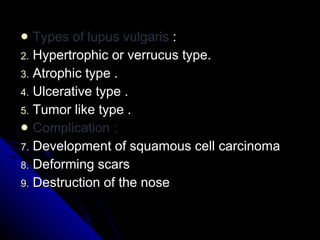
Types of lupus vulgaris  : Hypertrophic or verrucus type. Atrophic type . Ulcerative type . Tumor like type . Complication :  Development of squamous cell carcinoma  Deforming scars  Destruction of the nose
Lupus vulgaris
Scrofuloderma Scrofuloderma represent a direct extension from underlying focus (bone or LN) to the skin. Site :  _ Neck  _Chest Morphology : -An asymptomatic reddish swelling which breaks down to form sinuses, fistulate or tuberculuos ulcers. -Characteristic caseous materil discharges from lesions.
Tuberculosis Cutis Orificialis Tuberculoisis cutis orificialis occurs on or around orifices of patients with low immunity and internal tuberculosis. Site: -On and around orifices (mouth,anus,…) Morphology: -Tuberculous ulcer with a granulating base.
Papulonecrotic Tuberculide Site: widely distributed. Morphology: papules with central necrosis. Response to anti-tuberculous therapy: good.
Lichen Scrofulosorum Site: TRUNK Morphology: Lichenoid papules. Follicular. Skin-colored. Response to anti- tuberculosis therapy: good.
Erythema Induratum ofBazin Age&sex: young adult woman Site: lower leg( posterior aspect). Morphology: -Deep-seated subcutaneous nodule. -Usually ulcerates. -Heals with atrophic scar.
Histopathology of Cutaneous Tuberculosis -Dermal tuberculous tubercles formed of central caseation ( may be absent) and surrounded by epithelioid cells , giant cells, monocytes and lymphocytes .
Treatment of Tuberculosis General: Good nutrition . Search for underlying focus Medical Treatment: Combination of more than one anti-tuberculous drug e.g: 1.  Rifampicin :  20 mg /kg/day(adult dose:600 mg/day). Isoniazid (INH) : 6 mg /kg/ day (adult dose:300 mg/day). Ethambutol: 15mg/kg/day. Pyrazinamide: 1.5-2.5 gm/day. III. Surgical excision of small lesions.

Serofuloderma

  • 1.
    Causative organism : Mycobacterium tuberculosis Classification : Primary tuberculosis of the skin Miliary tuberculosis of the skin Lupus vulgaris Scrofuloderma Tuberculosis verrucosa cutis Tuberculosis cutis orificialis Tuberculide : Tuberculosis of skin
  • 2.
    Vary rare conditionIt consist of : 1. Tuberculous chancre 2. regional lymph node Tuberculous chancre is asymptomatic ulcerated nodule covered by crust The ulcer has the characteristic of tuberculous ulcer . Primary tuberculosis of the skin
  • 3.
    Primary inoculation tuberculosis A large, ulcerated nodule at the site of M.tuberculosis inoculation on the right thigh associated with inguinal lymphadenopathy. The erythematous papules on the left forearm occurred at the site of tuberculin testing.
  • 4.
    It is rarehaematogenous dissemnated of tuberculosis . The very rare skin eruption consist of generalized erythematous papules and pustule in an immuno-suppressed person Miliary tuberculosis of the skin
  • 5.
    Occur as anexogenous inculation of bacilli in a person with high degree of immunity . Age : usually children and also in adult Site : Site of trauma Extremities and buttocks Morphology: A verrucous indurated plaque with fissure and active inflammatory border . Tuberculosis verrucosa cutis
  • 6.
    Tuberculosis verrucosa cutis Crusted and hyperkeratotic plaque arising at the site of inoculation in an individual previously infected with M. tuberculosis . There is no associated lymphadenopathy
  • 7.
    The most commonform of skin tuberculosis Site : head and neck especially around the nose . Morphology : - patches : reddish brown well demarcated contained deep seated nodules positive diascopy Scarring is evident and could be mutilating Course : chronic with healing of center by scarring and extension of the lesion at the periphery . Lupus vulgaris
  • 8.
    Lupus vulgaris Reddish-brown plaque, which on diascopy exhibits the diagnostic yellow-brown apple-jelly color
  • 9.
    Types of lupusvulgaris : Hypertrophic or verrucus type. Atrophic type . Ulcerative type . Tumor like type . Complication : Development of squamous cell carcinoma Deforming scars Destruction of the nose
  • 10.
  • 11.
    Scrofuloderma Scrofuloderma representa direct extension from underlying focus (bone or LN) to the skin. Site : _ Neck _Chest Morphology : -An asymptomatic reddish swelling which breaks down to form sinuses, fistulate or tuberculuos ulcers. -Characteristic caseous materil discharges from lesions.
  • 12.
    Tuberculosis Cutis OrificialisTuberculoisis cutis orificialis occurs on or around orifices of patients with low immunity and internal tuberculosis. Site: -On and around orifices (mouth,anus,…) Morphology: -Tuberculous ulcer with a granulating base.
  • 13.
    Papulonecrotic Tuberculide Site:widely distributed. Morphology: papules with central necrosis. Response to anti-tuberculous therapy: good.
  • 14.
    Lichen Scrofulosorum Site:TRUNK Morphology: Lichenoid papules. Follicular. Skin-colored. Response to anti- tuberculosis therapy: good.
  • 15.
    Erythema Induratum ofBazinAge&sex: young adult woman Site: lower leg( posterior aspect). Morphology: -Deep-seated subcutaneous nodule. -Usually ulcerates. -Heals with atrophic scar.
  • 16.
    Histopathology of CutaneousTuberculosis -Dermal tuberculous tubercles formed of central caseation ( may be absent) and surrounded by epithelioid cells , giant cells, monocytes and lymphocytes .
  • 17.
    Treatment of TuberculosisGeneral: Good nutrition . Search for underlying focus Medical Treatment: Combination of more than one anti-tuberculous drug e.g: 1. Rifampicin : 20 mg /kg/day(adult dose:600 mg/day). Isoniazid (INH) : 6 mg /kg/ day (adult dose:300 mg/day). Ethambutol: 15mg/kg/day. Pyrazinamide: 1.5-2.5 gm/day. III. Surgical excision of small lesions.