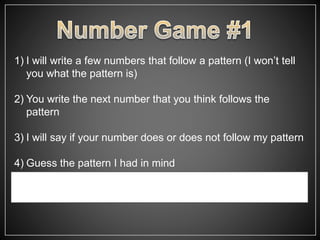
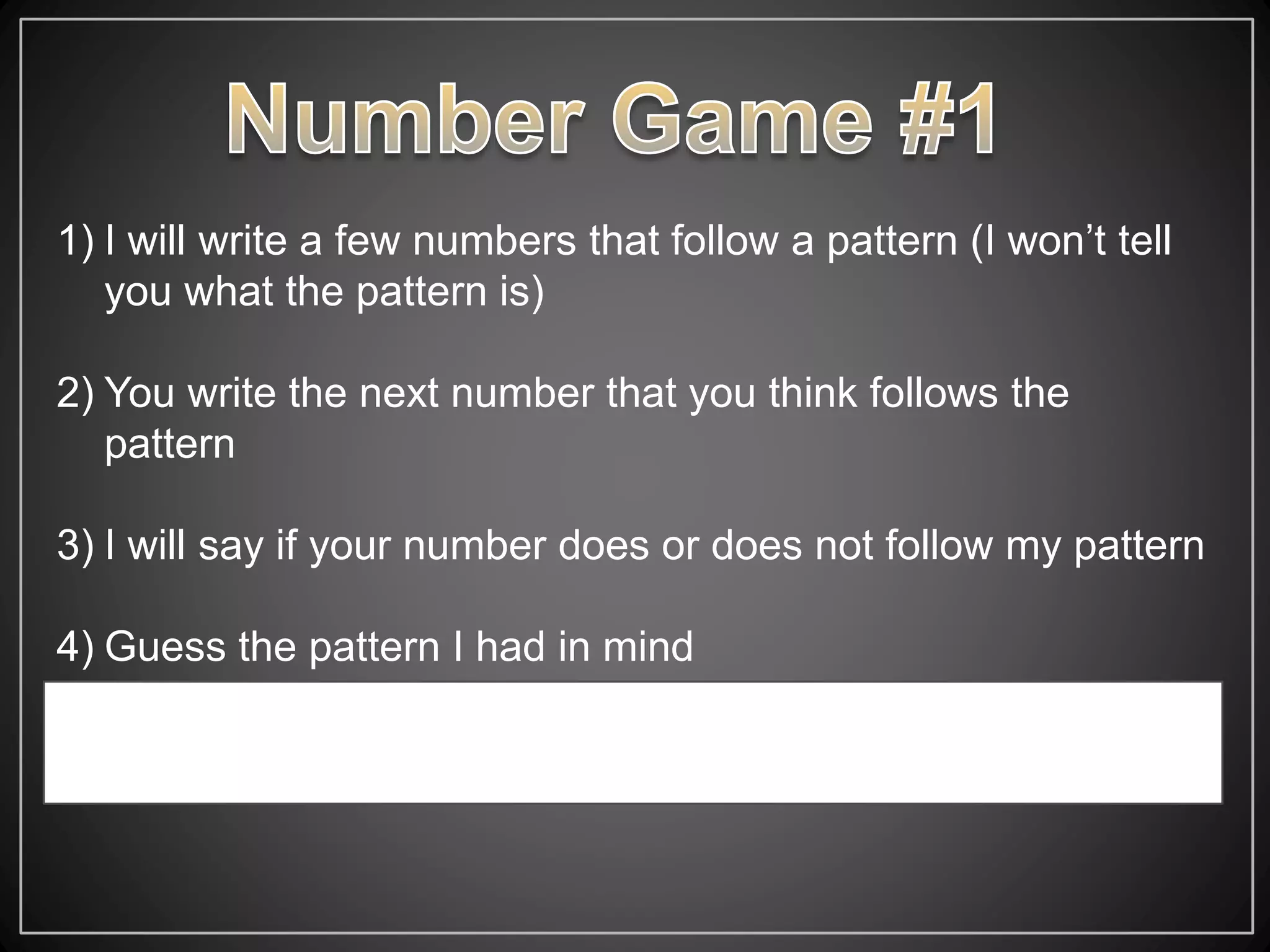
1) I will write a few numbers that follow a pattern (I won’t tell
you what the pattern is)
2) You write the next number that you think follows the
pattern
3) I will say if your number does or does not follow my pattern
4) Guess the pattern I had in mind
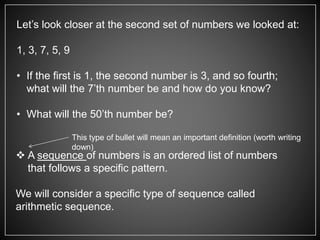
Let’s look closer at the second set of numbers we looked at:
1, 3, 7, 5, 9
• If the first is 1, the second number is 3, and so fourth;
what will the 7’th number be and how do you know?
• What will the 50’th number be?
 A sequence of numbers is an ordered list of numbers
that follows a specific pattern.
We will consider a specific type of sequence called
arithmetic sequence.
This type of bullet will mean an important definition (worth writing
down)
 Arithmetic Sequences – have a common difference, d,
such that each term in the sequence is the sum of the
previous term and d.
 An arithmetic sequence is always a ‘plus’ or ‘minus’
sequence.
Example:
3, 5, 7, 9,…
 The common difference, d, is +2 because the numbers
increase by 2.
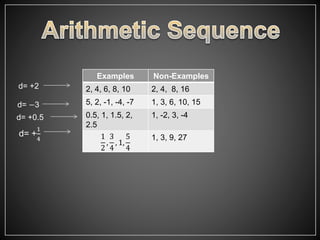
Examples Non-Examples
2, 4, 6, 8, 10 2, 4, 8, 16
5, 2, -1, -4, -7 1, 3, 6, 10, 15
0.5, 1, 1.5, 2,
2.5
1, -2, 3, -4
1
2
,
3
4
, 1,
5
4
1, 3, 9, 27
d= +2
d= −3
d= +0.5
d= +
1
4
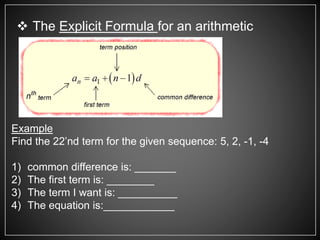
 The Explicit Formula for an arithmetic
sequence is:
Example
Find the 22’nd term for the given sequence: 5, 2, -1, -4
1) common difference is: _______
2) The first term is: ________
3) The term I want is: __________
4) The equation is:____________
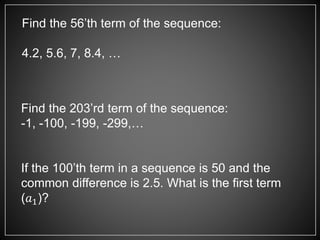
Find the 56’th term of the sequence:
4.2, 5.6, 7, 8.4, …
Find the 203’rd term of the sequence:
-1, -100, -199, -299,…
If the 100’th term in a sequence is 50 and the
common difference is 2.5. What is the first term
(𝑎1)?
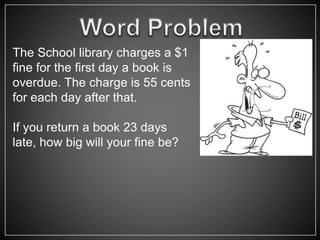
The School library charges a $1
fine for the first day a book is
overdue. The charge is 55 cents
for each day after that.
If you return a book 23 days
late, how big will your fine be?

Sequences student version

  • 1.
    1) I willwrite a few numbers that follow a pattern (I won’t tell you what the pattern is) 2) You write the next number that you think follows the pattern 3) I will say if your number does or does not follow my pattern 4) Guess the pattern I had in mind
  • 2.
    Let’s look closerat the second set of numbers we looked at: 1, 3, 7, 5, 9 • If the first is 1, the second number is 3, and so fourth; what will the 7’th number be and how do you know? • What will the 50’th number be?  A sequence of numbers is an ordered list of numbers that follows a specific pattern. We will consider a specific type of sequence called arithmetic sequence. This type of bullet will mean an important definition (worth writing down)
  • 3.
     Arithmetic Sequences– have a common difference, d, such that each term in the sequence is the sum of the previous term and d.  An arithmetic sequence is always a ‘plus’ or ‘minus’ sequence. Example: 3, 5, 7, 9,…  The common difference, d, is +2 because the numbers increase by 2.
  • 4.
    Examples Non-Examples 2, 4,6, 8, 10 2, 4, 8, 16 5, 2, -1, -4, -7 1, 3, 6, 10, 15 0.5, 1, 1.5, 2, 2.5 1, -2, 3, -4 1 2 , 3 4 , 1, 5 4 1, 3, 9, 27 d= +2 d= −3 d= +0.5 d= + 1 4
  • 5.
     The ExplicitFormula for an arithmetic sequence is: Example Find the 22’nd term for the given sequence: 5, 2, -1, -4 1) common difference is: _______ 2) The first term is: ________ 3) The term I want is: __________ 4) The equation is:____________
  • 6.
    Find the 56’thterm of the sequence: 4.2, 5.6, 7, 8.4, … Find the 203’rd term of the sequence: -1, -100, -199, -299,… If the 100’th term in a sequence is 50 and the common difference is 2.5. What is the first term (𝑎1)?
  • 7.
    The School librarycharges a $1 fine for the first day a book is overdue. The charge is 55 cents for each day after that. If you return a book 23 days late, how big will your fine be?