Part 1: The process/ procedure
Part 2: The application
The human population (over a limited data range, of course), can be modeled by an exponential growth equation of
the form:
𝑓 𝑥 = 𝑎 𝑏 𝑥
𝑎 = 𝑜𝑟𝑖𝑔𝑖𝑛𝑎𝑙 𝑝𝑜𝑝𝑢𝑙𝑎𝑡𝑖𝑜𝑛
𝑏 = 𝑔𝑟𝑜𝑤𝑡ℎ 𝑟𝑎𝑡𝑒
𝑥 = 𝑇𝑖𝑚𝑒 𝑖𝑛 𝑦𝑒𝑎𝑟𝑠
In an earlier lesson, we did a trial and error approach to
find the time it will take to hit a given population,
Using logs, we now have a strategy for getting an exact
answer.
Just like with any equation we want to get x by itself:
Once we isolate the exponent, we can multiply both
Sides by ‘log’ to solve for the exponent:
Apply the product rule of logs:
Divide both sides to get x by itself:
Simplify:
Check:
Since the quantity in parenthesis is multiplied by 5, we
can divide both sides by 5:
Multiply both sided by log and apply the product
property of log:
Divide both sides by log6 and simplify:
(You do) Solve for x and plug into the original equation
to check
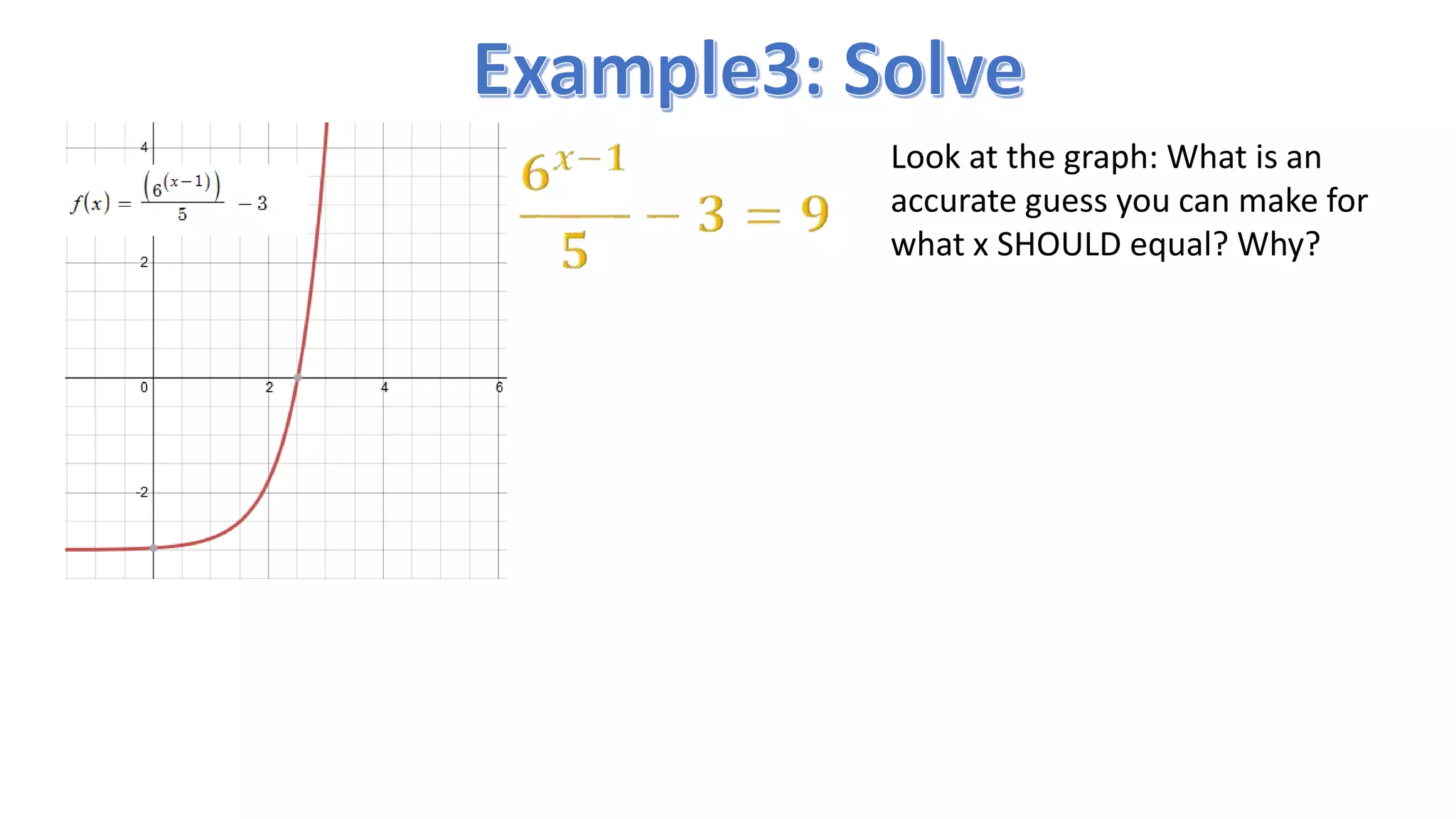
Look at the graph: What is an
accurate guess you can make for
what x SHOULD equal? Why?
Two option:
1) Find someone who
got the answer and
work with them to
make sure you can
get it as well
2) Find someone who
DID not get the
answer and work
with them to make
sure they can get it.
0 dB → Threshold of hearing
20 dB → Whispering
60 dB → Normal Conversation
80 dB → Vacuum Cleaner
110dB → Front row at a rock concert
130 dB → Threshold of pain
160 dB → Bursting eardrums
Two properties of a sound wave:
1) Intensity measures how much energy is in the
wave
2) Decibel level measures how loud we hear the
sound and is related to the intensity of the wave.
Two sound-related equations we will use:
1) 𝐼 =
𝑃
4π𝑟
• I = Intensity of sound measured in 𝑤/𝑚2
• P = Power of sound source measured in watts
• r = radius from the sound source measured in meters
2) 𝑑𝐵 = 10 log(1012
∗ 𝐼)
You bought a 500 watt speaker for your car and play your favorite Justin Bieber CD on it while
sitting at a distance of 1 meter away from the speaker. Will it cause permanent hearing damage
(ignoring the fact it’s a Justin Bieber CD)?
1) Find the intensity of the sound wave:
500
4π(1)
≈ 𝟑𝟗𝟐. 𝟕𝒘/𝒎 𝟐
2) Substitute the intensity into the equation:
𝑑𝐵 = 10 log(1012
∗ 𝟑𝟗𝟐. 𝟕)
≈146 dB
So, long exposure to it will cause hearing loss but it won’t burst your eardrums (which
happens at 160dB)
If a 500 watt speaker is not enough, how powerful of a speaker will you need to
have in order to burst your eardrums?
Goal: Solve for P when dB =160 (loud enough for eardrums to burst)
Note: Since in the equation 𝐼 =
𝑃
4π𝑟
you don’t know ‘P’ or ‘I’ you can’t use it YET.
However, you can use the dB level equation to find I:
160= 10 log(1012 ∗ 𝐼)
Divide → 16 = log(1012 ∗ 𝐼)
Use the properties of logs → 16 = log 1012 + logI
log 1012 = 12 → 16 = 12 + log𝐼
Subtract → 4 = log𝐼
Rewrite in exponential form:
104
= 𝐼 = 10000
Solve for P:
10000=
𝑃
4π(1)
P ≈ 125,663 Watt speaker you
would need to produce a sound
at 160dB.
How loud does a 150 watt speaker sound from 100 meters away?
Know:
• Power = 150 W
• r = 100 m
Need to know: sound Intensity (I) and sound level (dB)
• Which equation should be used first:
𝐼 =
𝑃
4π𝑟
because we know P and r and want to find I
The current world population is 7.41 Billion people. Suppose the table below is accurate and the population grows
at 1.13% per year. If now it is 2016, what year will the population:
1) Reach 8 Billion
2) Reach 10 billion
Exponential growth function:
𝒇 𝒕 = 𝒂 𝒃 𝒕
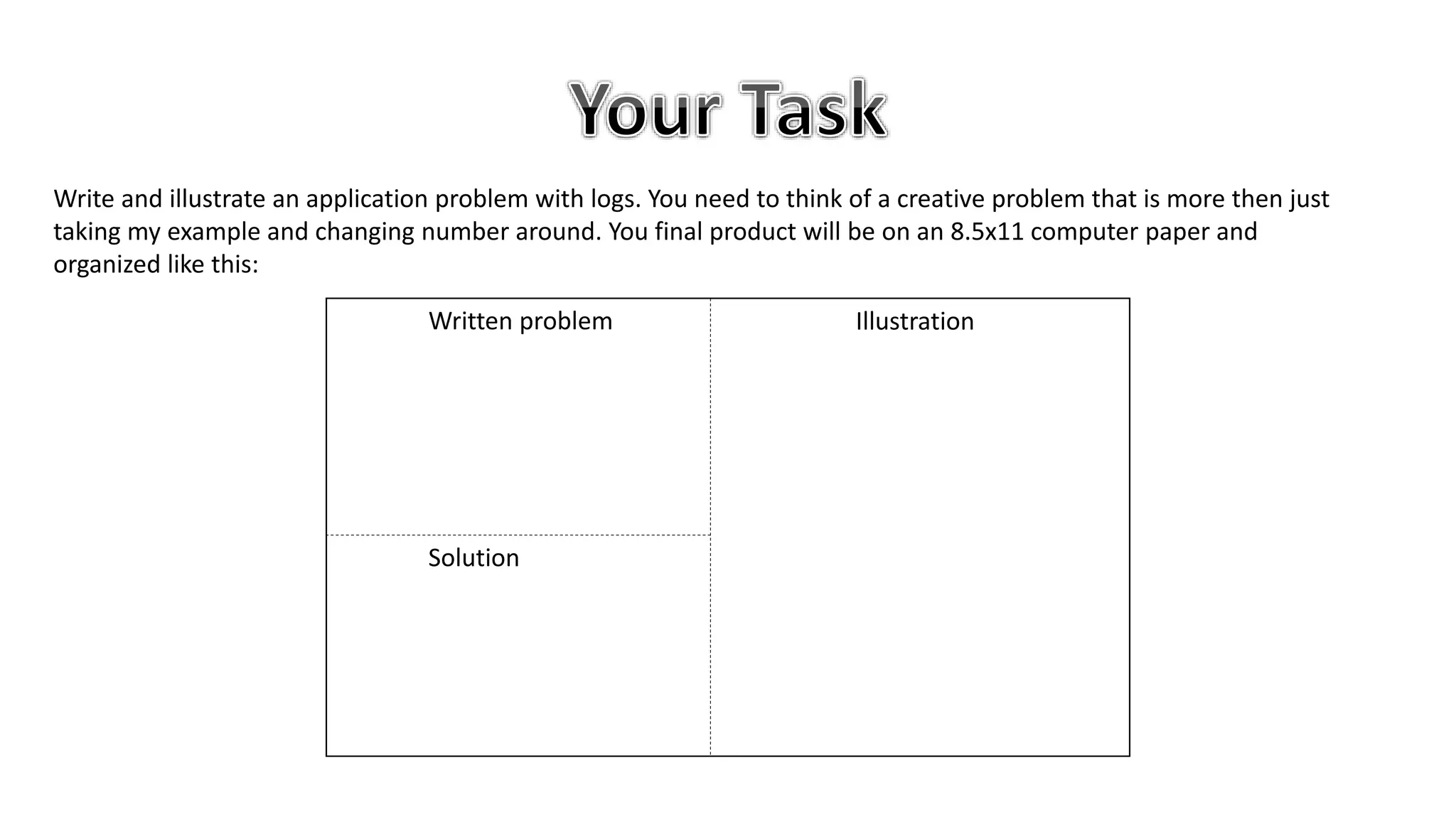
Write and illustrate an application problem with logs. You need to think of a creative problem that is more then just
taking my example and changing number around. You final product will be on an 8.5x11 computer paper and
organized like this:
Written problem
Solution
Illustration

Equation with logs

  • 1.
    Part 1: Theprocess/ procedure Part 2: The application
  • 2.
    The human population(over a limited data range, of course), can be modeled by an exponential growth equation of the form: 𝑓 𝑥 = 𝑎 𝑏 𝑥 𝑎 = 𝑜𝑟𝑖𝑔𝑖𝑛𝑎𝑙 𝑝𝑜𝑝𝑢𝑙𝑎𝑡𝑖𝑜𝑛 𝑏 = 𝑔𝑟𝑜𝑤𝑡ℎ 𝑟𝑎𝑡𝑒 𝑥 = 𝑇𝑖𝑚𝑒 𝑖𝑛 𝑦𝑒𝑎𝑟𝑠 In an earlier lesson, we did a trial and error approach to find the time it will take to hit a given population, Using logs, we now have a strategy for getting an exact answer.
  • 3.
    Just like withany equation we want to get x by itself: Once we isolate the exponent, we can multiply both Sides by ‘log’ to solve for the exponent: Apply the product rule of logs: Divide both sides to get x by itself: Simplify: Check:
  • 4.
    Since the quantityin parenthesis is multiplied by 5, we can divide both sides by 5: Multiply both sided by log and apply the product property of log: Divide both sides by log6 and simplify: (You do) Solve for x and plug into the original equation to check
  • 5.
    Look at thegraph: What is an accurate guess you can make for what x SHOULD equal? Why?
  • 6.
    Two option: 1) Findsomeone who got the answer and work with them to make sure you can get it as well 2) Find someone who DID not get the answer and work with them to make sure they can get it.
  • 10.
    0 dB →Threshold of hearing 20 dB → Whispering 60 dB → Normal Conversation 80 dB → Vacuum Cleaner 110dB → Front row at a rock concert 130 dB → Threshold of pain 160 dB → Bursting eardrums Two properties of a sound wave: 1) Intensity measures how much energy is in the wave 2) Decibel level measures how loud we hear the sound and is related to the intensity of the wave.
  • 11.
    Two sound-related equationswe will use: 1) 𝐼 = 𝑃 4π𝑟 • I = Intensity of sound measured in 𝑤/𝑚2 • P = Power of sound source measured in watts • r = radius from the sound source measured in meters 2) 𝑑𝐵 = 10 log(1012 ∗ 𝐼)
  • 12.
    You bought a500 watt speaker for your car and play your favorite Justin Bieber CD on it while sitting at a distance of 1 meter away from the speaker. Will it cause permanent hearing damage (ignoring the fact it’s a Justin Bieber CD)? 1) Find the intensity of the sound wave: 500 4π(1) ≈ 𝟑𝟗𝟐. 𝟕𝒘/𝒎 𝟐 2) Substitute the intensity into the equation: 𝑑𝐵 = 10 log(1012 ∗ 𝟑𝟗𝟐. 𝟕) ≈146 dB So, long exposure to it will cause hearing loss but it won’t burst your eardrums (which happens at 160dB)
  • 13.
    If a 500watt speaker is not enough, how powerful of a speaker will you need to have in order to burst your eardrums? Goal: Solve for P when dB =160 (loud enough for eardrums to burst) Note: Since in the equation 𝐼 = 𝑃 4π𝑟 you don’t know ‘P’ or ‘I’ you can’t use it YET. However, you can use the dB level equation to find I: 160= 10 log(1012 ∗ 𝐼) Divide → 16 = log(1012 ∗ 𝐼) Use the properties of logs → 16 = log 1012 + logI log 1012 = 12 → 16 = 12 + log𝐼 Subtract → 4 = log𝐼 Rewrite in exponential form: 104 = 𝐼 = 10000 Solve for P: 10000= 𝑃 4π(1) P ≈ 125,663 Watt speaker you would need to produce a sound at 160dB.
  • 14.
    How loud doesa 150 watt speaker sound from 100 meters away? Know: • Power = 150 W • r = 100 m Need to know: sound Intensity (I) and sound level (dB) • Which equation should be used first: 𝐼 = 𝑃 4π𝑟 because we know P and r and want to find I
  • 15.
    The current worldpopulation is 7.41 Billion people. Suppose the table below is accurate and the population grows at 1.13% per year. If now it is 2016, what year will the population: 1) Reach 8 Billion 2) Reach 10 billion Exponential growth function: 𝒇 𝒕 = 𝒂 𝒃 𝒕
  • 16.
    Write and illustratean application problem with logs. You need to think of a creative problem that is more then just taking my example and changing number around. You final product will be on an 8.5x11 computer paper and organized like this: Written problem Solution Illustration