SEPSIS EVALUATION &
ITS OUTCOME
MODULE ON
OBJECTIVES
After completing this module, learner should able
to understand:
 Sepsis and septic shock.
 Over all incidence of sepsis.
 How to assess level of risk in patients.
 Which investigations to perform in a patients
with possible sepsis.
 Treatment modalities and supportive therapies.
 Preventive mesure
INTRODUCTION
 Sepsis is a potentially life-threatening
condition caused by the body's response to
an infection.
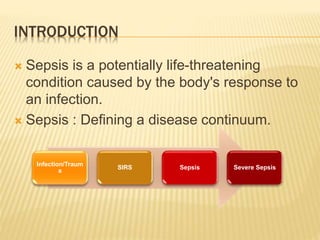
 Sepsis : Defining a disease continuum.
Infection/Traum
a
SIRS Sepsis Severe Sepsis
SEPSIS
SIRS
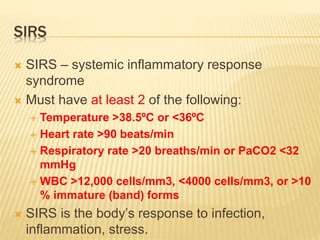
 SIRS – systemic inflammatory response
syndrome
 Must have at least 2 of the following:
 Temperature >38.5ºC or <36ºC
 Heart rate >90 beats/min
 Respiratory rate >20 breaths/min or PaCO2 <32
mmHg
 WBC >12,000 cells/mm3, <4000 cells/mm3, or >10
% immature (band) forms
 SIRS is the body’s response to infection,
inflammation, stress.
CASUES
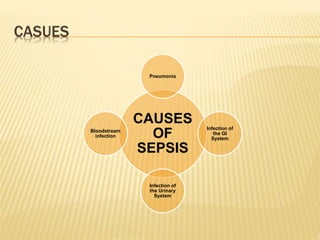
CAUSES
OF
SEPSIS
Pneumonia
Infection of
the GI
System
Infection of
the Urinary
System
Bloodstream
infection
 a fever above 101ºF (38ºC) or a temperature
below 96.8ºF (36ºC)
 heart rate higher than 90 beats per minute
 breathing rate higher than 20 breaths per
minute
 probable or confirmed infection
SEVERE SEPSIS
 patches of discolored skin
 decreased urination
 changes in mental ability
 low platelet (blood clotting cells) count
 problems breathing
 abnormal heart functions
 chills due to fall in body temperature
 unconsciousness
RISK FACTORS
 Older adults
 Pregnant women
 Are very young or very old
 Have a compromised immune system
 Have diabetes or cirrhosis
 Are already very sick, often in a hospital intensive
care unit
 Have wounds or injuries, such as burns
 Have invasive devices, such as intravenous catheters
or breathing tubes
 Have previously received antibiotics or corticosteroids
SIGN AND SYMPTOMS
 Change in mental status
 A first (upper) number in a blood pressure
reading — also called the systolic pressure
— that's less than or equal to 100 millimeters
of mercury (mm Hg)
 Respiratory rate higher than or equal to 22
breaths a minute
DIAGNOSIS
 Urine. If your doctor suspects that you have a urinary tract infection, he or she may want to
check your urine for signs of bacteria.
 Wound secretions. If you have a wound that appears infected, testing a sample of the wound's
secretions can help show what type of antibiotic might work best.
 Respiratory secretions. If you are coughing up mucus (sputum), it may be tested to determine
what type of germ is causing the infection.
 Imaging tests
 If the site of infection is not obvious, your doctor may order one or more of the following imaging
tests:
 X-ray. X-rays are good for visualizing problems in your lungs.
 Computerized tomography (CT). Infections in your appendix or pancreas are easier to see on
CT scans. This technology takes X-rays from a variety of angles and combines them to depict
cross-sectional slices of your body's internal structures.
 Ultrasound. This technology uses sound waves to produce real-time images on a video monitor.
Ultrasound may be particularly useful to check for infections in your gallbladder or ovaries.
 Magnetic resonance imaging (MRI). MRIs may be helpful in identifying soft tissue infections.
This technology uses radio waves and a strong magnet to produce cross-sectional images of the
internal structures of your body.
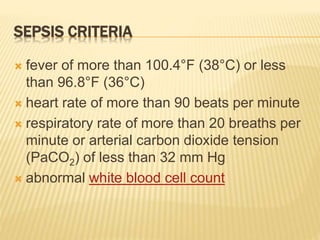
SEPSIS CRITERIA
 fever of more than 100.4°F (38°C) or less
than 96.8°F (36°C)
 heart rate of more than 90 beats per minute
 respiratory rate of more than 20 breaths per
minute or arterial carbon dioxide tension
(PaCO2) of less than 32 mm Hg
 abnormal white blood cell count
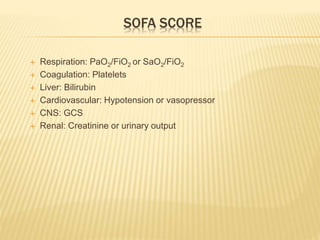
SOFA SCORE
 Respiration: PaO2/FiO2 or SaO2/FiO2
 Coagulation: Platelets
 Liver: Bilirubin
 Cardiovascular: Hypotension or vasopressor
 CNS: GCS
 Renal: Creatinine or urinary output
QUICK SEQUENTIAL ORGAN FAILURE
ASSESSMENT (QSOFA).
 It uses the results of three criteria:
 low blood pressure.
 high respiratory rate (greater than 22 breaths
per minute)
 Glasgow coma scale score of less than 15
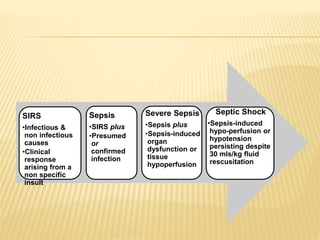
SIRS
•Infectious &
non infectious
causes
•Clinical
response
arising from a
non specific
insult
Sepsis
•SIRS plus
•Presumed
or
confirmed
infection
Severe Sepsis
•Sepsis plus
•Sepsis-induced
organ
dysfunction or
tissue
hypoperfusion
Septic Shock
•Sepsis-induced
hypo-perfusion or
hypotension
persisting despite
30 mls/kg fluid
rescusitation
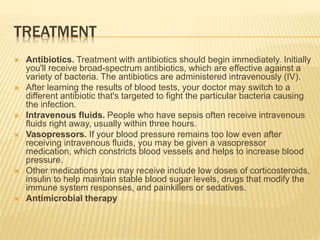
TREATMENT
 Antibiotics. Treatment with antibiotics should begin immediately. Initially
you'll receive broad-spectrum antibiotics, which are effective against a
variety of bacteria. The antibiotics are administered intravenously (IV).
 After learning the results of blood tests, your doctor may switch to a
different antibiotic that's targeted to fight the particular bacteria causing
the infection.
 Intravenous fluids. People who have sepsis often receive intravenous
fluids right away, usually within three hours.
 Vasopressors. If your blood pressure remains too low even after
receiving intravenous fluids, you may be given a vasopressor
medication, which constricts blood vessels and helps to increase blood
pressure.
 Other medications you may receive include low doses of corticosteroids,
insulin to help maintain stable blood sugar levels, drugs that modify the
immune system responses, and painkillers or sedatives.
 Antimicrobial therapy
NEW MODALITIES
 Fibrates (fenofibrates) are used anti-
inflammatory activities through peroxisome
proliferator-activated receptor alpha
activation.
 Levosimendan.
 salbutamol, aliskiren, amiodarone, lithium,
montelukast, alpha-lipoic acid, and sildenafil
PREVENTIVE MEASURES
 Vaccinations.
 Early enteral or oral nutrition should be taken
 Immunonutrition (arginine, omega-3 fatty acids,
nucleotides)
 Insulin therapy
 Get medical care immdiately.
 Oral antiseptics for mouth care
 Caring for wounds
 Coated vascular catheters
 Treating infections
 Hand washing
 Proper care during chronic infection.
SUPPORTIVE THERAPY
 Hemodynamic stabilization
 Renal replacement therapy
 Airway management and ventilation
 Adjunctive therapy
 Recombinant activated protein C (rhAPC)
 Antithrombin
 Immunoglobulins
 Selenium.
OTHER SUPPORTIVE THERAPIES
 Deep venous thrombosis (DVT) prophylaxis
 Nutrition and metabolic control
 Enteral vs. parenteral nutrition
 Glutamine
 Ulcer prophylaxis
 Use of bicarbonate in lactic acidosis
 Blood products
 Erythropoietin

SEPSIS PPT.pptx

  • 2.
    SEPSIS EVALUATION & ITSOUTCOME MODULE ON
  • 3.
    OBJECTIVES After completing thismodule, learner should able to understand:  Sepsis and septic shock.  Over all incidence of sepsis.  How to assess level of risk in patients.  Which investigations to perform in a patients with possible sepsis.  Treatment modalities and supportive therapies.  Preventive mesure
  • 4.
    INTRODUCTION  Sepsis isa potentially life-threatening condition caused by the body's response to an infection.  Sepsis : Defining a disease continuum. Infection/Traum a SIRS Sepsis Severe Sepsis
  • 5.
  • 6.
    SIRS  SIRS –systemic inflammatory response syndrome  Must have at least 2 of the following:  Temperature >38.5ºC or <36ºC  Heart rate >90 beats/min  Respiratory rate >20 breaths/min or PaCO2 <32 mmHg  WBC >12,000 cells/mm3, <4000 cells/mm3, or >10 % immature (band) forms  SIRS is the body’s response to infection, inflammation, stress.
  • 7.
  • 8.
     a feverabove 101ºF (38ºC) or a temperature below 96.8ºF (36ºC)  heart rate higher than 90 beats per minute  breathing rate higher than 20 breaths per minute  probable or confirmed infection
  • 9.
    SEVERE SEPSIS  patchesof discolored skin  decreased urination  changes in mental ability  low platelet (blood clotting cells) count  problems breathing  abnormal heart functions  chills due to fall in body temperature  unconsciousness
  • 10.
    RISK FACTORS  Olderadults  Pregnant women  Are very young or very old  Have a compromised immune system  Have diabetes or cirrhosis  Are already very sick, often in a hospital intensive care unit  Have wounds or injuries, such as burns  Have invasive devices, such as intravenous catheters or breathing tubes  Have previously received antibiotics or corticosteroids
  • 11.
    SIGN AND SYMPTOMS Change in mental status  A first (upper) number in a blood pressure reading — also called the systolic pressure — that's less than or equal to 100 millimeters of mercury (mm Hg)  Respiratory rate higher than or equal to 22 breaths a minute
  • 12.
    DIAGNOSIS  Urine. Ifyour doctor suspects that you have a urinary tract infection, he or she may want to check your urine for signs of bacteria.  Wound secretions. If you have a wound that appears infected, testing a sample of the wound's secretions can help show what type of antibiotic might work best.  Respiratory secretions. If you are coughing up mucus (sputum), it may be tested to determine what type of germ is causing the infection.  Imaging tests  If the site of infection is not obvious, your doctor may order one or more of the following imaging tests:  X-ray. X-rays are good for visualizing problems in your lungs.  Computerized tomography (CT). Infections in your appendix or pancreas are easier to see on CT scans. This technology takes X-rays from a variety of angles and combines them to depict cross-sectional slices of your body's internal structures.  Ultrasound. This technology uses sound waves to produce real-time images on a video monitor. Ultrasound may be particularly useful to check for infections in your gallbladder or ovaries.  Magnetic resonance imaging (MRI). MRIs may be helpful in identifying soft tissue infections. This technology uses radio waves and a strong magnet to produce cross-sectional images of the internal structures of your body.
  • 13.
    SEPSIS CRITERIA  feverof more than 100.4°F (38°C) or less than 96.8°F (36°C)  heart rate of more than 90 beats per minute  respiratory rate of more than 20 breaths per minute or arterial carbon dioxide tension (PaCO2) of less than 32 mm Hg  abnormal white blood cell count
  • 14.
    SOFA SCORE  Respiration:PaO2/FiO2 or SaO2/FiO2  Coagulation: Platelets  Liver: Bilirubin  Cardiovascular: Hypotension or vasopressor  CNS: GCS  Renal: Creatinine or urinary output
  • 15.
    QUICK SEQUENTIAL ORGANFAILURE ASSESSMENT (QSOFA).  It uses the results of three criteria:  low blood pressure.  high respiratory rate (greater than 22 breaths per minute)  Glasgow coma scale score of less than 15
  • 16.
    SIRS •Infectious & non infectious causes •Clinical response arisingfrom a non specific insult Sepsis •SIRS plus •Presumed or confirmed infection Severe Sepsis •Sepsis plus •Sepsis-induced organ dysfunction or tissue hypoperfusion Septic Shock •Sepsis-induced hypo-perfusion or hypotension persisting despite 30 mls/kg fluid rescusitation
  • 17.
    TREATMENT  Antibiotics. Treatmentwith antibiotics should begin immediately. Initially you'll receive broad-spectrum antibiotics, which are effective against a variety of bacteria. The antibiotics are administered intravenously (IV).  After learning the results of blood tests, your doctor may switch to a different antibiotic that's targeted to fight the particular bacteria causing the infection.  Intravenous fluids. People who have sepsis often receive intravenous fluids right away, usually within three hours.  Vasopressors. If your blood pressure remains too low even after receiving intravenous fluids, you may be given a vasopressor medication, which constricts blood vessels and helps to increase blood pressure.  Other medications you may receive include low doses of corticosteroids, insulin to help maintain stable blood sugar levels, drugs that modify the immune system responses, and painkillers or sedatives.  Antimicrobial therapy
  • 18.
    NEW MODALITIES  Fibrates(fenofibrates) are used anti- inflammatory activities through peroxisome proliferator-activated receptor alpha activation.  Levosimendan.  salbutamol, aliskiren, amiodarone, lithium, montelukast, alpha-lipoic acid, and sildenafil
  • 19.
    PREVENTIVE MEASURES  Vaccinations. Early enteral or oral nutrition should be taken  Immunonutrition (arginine, omega-3 fatty acids, nucleotides)  Insulin therapy  Get medical care immdiately.  Oral antiseptics for mouth care  Caring for wounds  Coated vascular catheters  Treating infections  Hand washing  Proper care during chronic infection.
  • 20.
    SUPPORTIVE THERAPY  Hemodynamicstabilization  Renal replacement therapy  Airway management and ventilation  Adjunctive therapy  Recombinant activated protein C (rhAPC)  Antithrombin  Immunoglobulins  Selenium.
  • 21.
    OTHER SUPPORTIVE THERAPIES Deep venous thrombosis (DVT) prophylaxis  Nutrition and metabolic control  Enteral vs. parenteral nutrition  Glutamine  Ulcer prophylaxis  Use of bicarbonate in lactic acidosis  Blood products  Erythropoietin