
Sentence
Transformation
Part - 4
By Anil Kumar
Active and Passive
Sentences
Active Sentence means the
subject of the sentence is the
doer of the action.
Example:
He (subject: doer) plays
football.
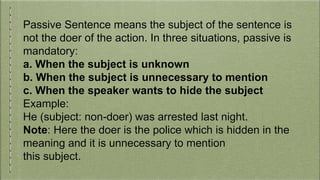
Passive Sentence means the subject of the sentence is
not the doer of the action. In three situations, passive is
mandatory:
a. When the subject is unknown
b. When the subject is unnecessary to mention
c. When the speaker wants to hide the subject
Example:
He (subject: non-doer) was arrested last night.
Note: Here the doer is the police which is hidden in the
meaning and it is unnecessary to mention
this subject.
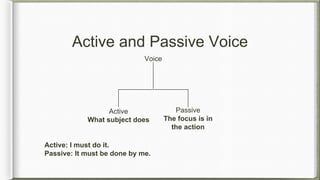
Active and Passive Voice
Voice
Active
What subject does
Passive
The focus is in
the action
Active: I must do it.
Passive: It must be done by me.
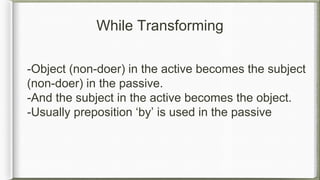
-Object (non-doer) in the active becomes the subject
(non-doer) in the passive.
-And the subject in the active becomes the object.
-Usually preposition ‘by’ is used in the passive
While Transforming
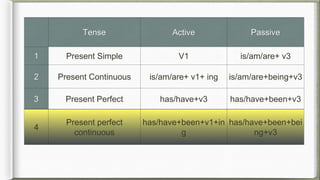
Tense Active Passive
1 Present Simple V1 is/am/are+ v3
2 Present Continuous is/am/are+ v1+ ing is/am/are+being+v3
3 Present Perfect has/have+v3 has/have+been+v3
4
Present perfect
continuous
has/have+been+v1+in
g
has/have+been+bei
ng+v3
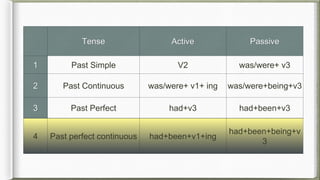
Tense Active Passive
1 Past Simple V2 was/were+ v3
2 Past Continuous was/were+ v1+ ing was/were+being+v3
3 Past Perfect had+v3 had+been+v3
4 Past perfect continuous had+been+v1+ing
had+been+being+v
3
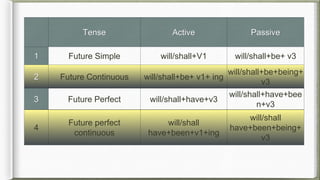
Tense Active Passive
1 Future Simple will/shall+V1 will/shall+be+ v3
2 Future Continuous will/shall+be+ v1+ ing
will/shall+be+being+
v3
3 Future Perfect will/shall+have+v3
will/shall+have+bee
n+v3
4
Future perfect
continuous
will/shall
have+been+v1+ing
will/shall
have+been+being+
v3
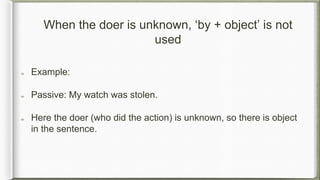
When the doer is unknown, ‘by + object’ is not
used
Example:
Passive: My watch was stolen.
Here the doer (who did the action) is unknown, so there is object
in the sentence.
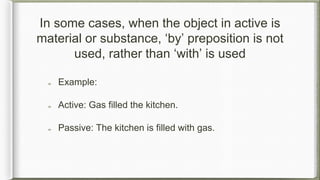
In some cases, when the object in active is
material or substance, ‘by’ preposition is not
used, rather than ‘with’ is used
Example:
Active: Gas filled the kitchen.
Passive: The kitchen is filled with gas.
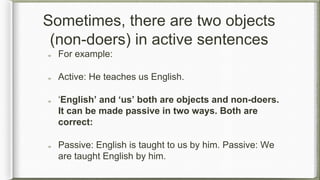
Sometimes, there are two objects
(non-doers) in active sentences
For example:
Active: He teaches us English.
‘English’ and ‘us’ both are objects and non-doers.
It can be made passive in two ways. Both are
correct:
Passive: English is taught to us by him. Passive: We
are taught English by him.
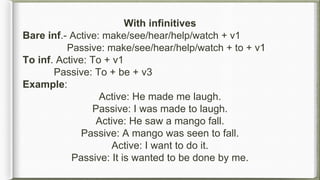
With infinitives
Bare inf.- Active: make/see/hear/help/watch + v1
Passive: make/see/hear/help/watch + to + v1
To inf. Active: To + v1
Passive: To + be + v3
Example:
Active: He made me laugh.
Passive: I was made to laugh.
Active: He saw a mango fall.
Passive: A mango was seen to fall.
Active: I want to do it.
Passive: It is wanted to be done by me.
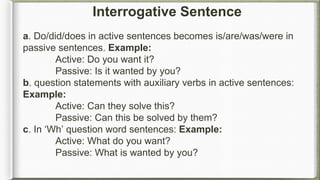
a. Do/did/does in active sentences becomes is/are/was/were in
passive sentences. Example:
Active: Do you want it?
Passive: Is it wanted by you?
b. question statements with auxiliary verbs in active sentences:
Example:
Active: Can they solve this?
Passive: Can this be solved by them?
c. In ‘Wh’ question word sentences: Example:
Active: What do you want?
Passive: What is wanted by you?
Interrogative Sentence
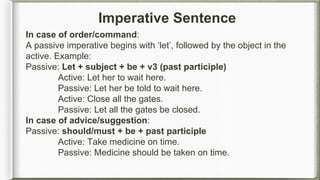
In case of order/command:
A passive imperative begins with ‘let’, followed by the object in the
active. Example:
Passive: Let + subject + be + v3 (past participle)
Active: Let her to wait here.
Passive: Let her be told to wait here.
Active: Close all the gates.
Passive: Let all the gates be closed.
In case of advice/suggestion:
Passive: should/must + be + past participle
Active: Take medicine on time.
Passive: Medicine should be taken on time.
Imperative Sentence
Multiple Clauses
Example:
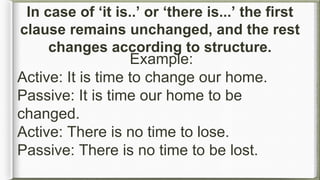
Active: It is time to change our home.
Passive: It is time our home to be
changed.
Active: There is no time to lose.
Passive: There is no time to be lost.
In case of ‘it is..’ or ‘there is...’ the first
clause remains unchanged, and the rest
changes according to structure.
Example:
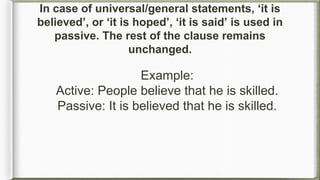
Active: People believe that he is skilled.
Passive: It is believed that he is skilled.
In case of universal/general statements, ‘it is
believed’, or ‘it is hoped’, ‘it is said’ is used in
passive. The rest of the clause remains
unchanged.
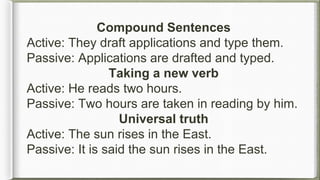
Compound Sentences
Active: They draft applications and type them.
Passive: Applications are drafted and typed.
Taking a new verb
Active: He reads two hours.
Passive: Two hours are taken in reading by him.
Universal truth
Active: The sun rises in the East.
Passive: It is said the sun rises in the East.
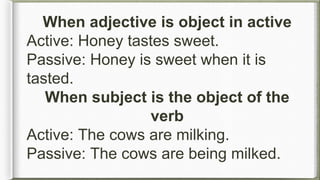
When adjective is object in active
Active: Honey tastes sweet.
Passive: Honey is sweet when it is
tasted.
When subject is the object of the
verb
Active: The cows are milking.
Passive: The cows are being milked.
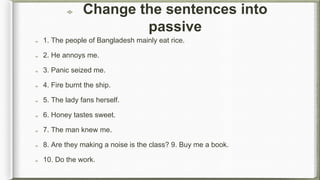
Change the sentences into
passive
1. The people of Bangladesh mainly eat rice.
2. He annoys me.
3. Panic seized me.
4. Fire burnt the ship.
5. The lady fans herself.
6. Honey tastes sweet.
7. The man knew me.
8. Are they making a noise is the class? 9. Buy me a book.
10. Do the work.
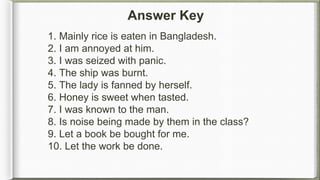
1. Mainly rice is eaten in Bangladesh.
2. I am annoyed at him.
3. I was seized with panic.
4. The ship was burnt.
5. The lady is fanned by herself.
6. Honey is sweet when tasted.
7. I was known to the man.
8. Is noise being made by them in the class?
9. Let a book be bought for me.
10. Let the work be done.
Answer Key
We shall continue in the next
presentation for part - 5
Thank you

Sentence transformation part 4

  • 1.
  • 2.
  • 3.
    Active Sentence meansthe subject of the sentence is the doer of the action. Example: He (subject: doer) plays football.
  • 4.
    Passive Sentence meansthe subject of the sentence is not the doer of the action. In three situations, passive is mandatory: a. When the subject is unknown b. When the subject is unnecessary to mention c. When the speaker wants to hide the subject Example: He (subject: non-doer) was arrested last night. Note: Here the doer is the police which is hidden in the meaning and it is unnecessary to mention this subject.
  • 5.
    Active and PassiveVoice Voice Active What subject does Passive The focus is in the action Active: I must do it. Passive: It must be done by me.
  • 6.
    -Object (non-doer) inthe active becomes the subject (non-doer) in the passive. -And the subject in the active becomes the object. -Usually preposition ‘by’ is used in the passive While Transforming
  • 7.
    Tense Active Passive 1Present Simple V1 is/am/are+ v3 2 Present Continuous is/am/are+ v1+ ing is/am/are+being+v3 3 Present Perfect has/have+v3 has/have+been+v3 4 Present perfect continuous has/have+been+v1+in g has/have+been+bei ng+v3
  • 8.
    Tense Active Passive 1Past Simple V2 was/were+ v3 2 Past Continuous was/were+ v1+ ing was/were+being+v3 3 Past Perfect had+v3 had+been+v3 4 Past perfect continuous had+been+v1+ing had+been+being+v 3
  • 9.
    Tense Active Passive 1Future Simple will/shall+V1 will/shall+be+ v3 2 Future Continuous will/shall+be+ v1+ ing will/shall+be+being+ v3 3 Future Perfect will/shall+have+v3 will/shall+have+bee n+v3 4 Future perfect continuous will/shall have+been+v1+ing will/shall have+been+being+ v3
  • 10.
    When the doeris unknown, ‘by + object’ is not used Example: Passive: My watch was stolen. Here the doer (who did the action) is unknown, so there is object in the sentence.
  • 11.
    In some cases,when the object in active is material or substance, ‘by’ preposition is not used, rather than ‘with’ is used Example: Active: Gas filled the kitchen. Passive: The kitchen is filled with gas.
  • 12.
    Sometimes, there aretwo objects (non-doers) in active sentences For example: Active: He teaches us English. ‘English’ and ‘us’ both are objects and non-doers. It can be made passive in two ways. Both are correct: Passive: English is taught to us by him. Passive: We are taught English by him.
  • 13.
    With infinitives Bare inf.-Active: make/see/hear/help/watch + v1 Passive: make/see/hear/help/watch + to + v1 To inf. Active: To + v1 Passive: To + be + v3 Example: Active: He made me laugh. Passive: I was made to laugh. Active: He saw a mango fall. Passive: A mango was seen to fall. Active: I want to do it. Passive: It is wanted to be done by me.
  • 14.
    a. Do/did/does inactive sentences becomes is/are/was/were in passive sentences. Example: Active: Do you want it? Passive: Is it wanted by you? b. question statements with auxiliary verbs in active sentences: Example: Active: Can they solve this? Passive: Can this be solved by them? c. In ‘Wh’ question word sentences: Example: Active: What do you want? Passive: What is wanted by you? Interrogative Sentence
  • 15.
    In case oforder/command: A passive imperative begins with ‘let’, followed by the object in the active. Example: Passive: Let + subject + be + v3 (past participle) Active: Let her to wait here. Passive: Let her be told to wait here. Active: Close all the gates. Passive: Let all the gates be closed. In case of advice/suggestion: Passive: should/must + be + past participle Active: Take medicine on time. Passive: Medicine should be taken on time. Imperative Sentence
  • 16.
  • 17.
    Example: Active: It istime to change our home. Passive: It is time our home to be changed. Active: There is no time to lose. Passive: There is no time to be lost. In case of ‘it is..’ or ‘there is...’ the first clause remains unchanged, and the rest changes according to structure.
  • 18.
    Example: Active: People believethat he is skilled. Passive: It is believed that he is skilled. In case of universal/general statements, ‘it is believed’, or ‘it is hoped’, ‘it is said’ is used in passive. The rest of the clause remains unchanged.
  • 19.
    Compound Sentences Active: Theydraft applications and type them. Passive: Applications are drafted and typed. Taking a new verb Active: He reads two hours. Passive: Two hours are taken in reading by him. Universal truth Active: The sun rises in the East. Passive: It is said the sun rises in the East.
  • 20.
    When adjective isobject in active Active: Honey tastes sweet. Passive: Honey is sweet when it is tasted. When subject is the object of the verb Active: The cows are milking. Passive: The cows are being milked.
  • 21.
    Change the sentencesinto passive 1. The people of Bangladesh mainly eat rice. 2. He annoys me. 3. Panic seized me. 4. Fire burnt the ship. 5. The lady fans herself. 6. Honey tastes sweet. 7. The man knew me. 8. Are they making a noise is the class? 9. Buy me a book. 10. Do the work.
  • 22.
    1. Mainly riceis eaten in Bangladesh. 2. I am annoyed at him. 3. I was seized with panic. 4. The ship was burnt. 5. The lady is fanned by herself. 6. Honey is sweet when tasted. 7. I was known to the man. 8. Is noise being made by them in the class? 9. Let a book be bought for me. 10. Let the work be done. Answer Key
  • 23.
    We shall continuein the next presentation for part - 5 Thank you