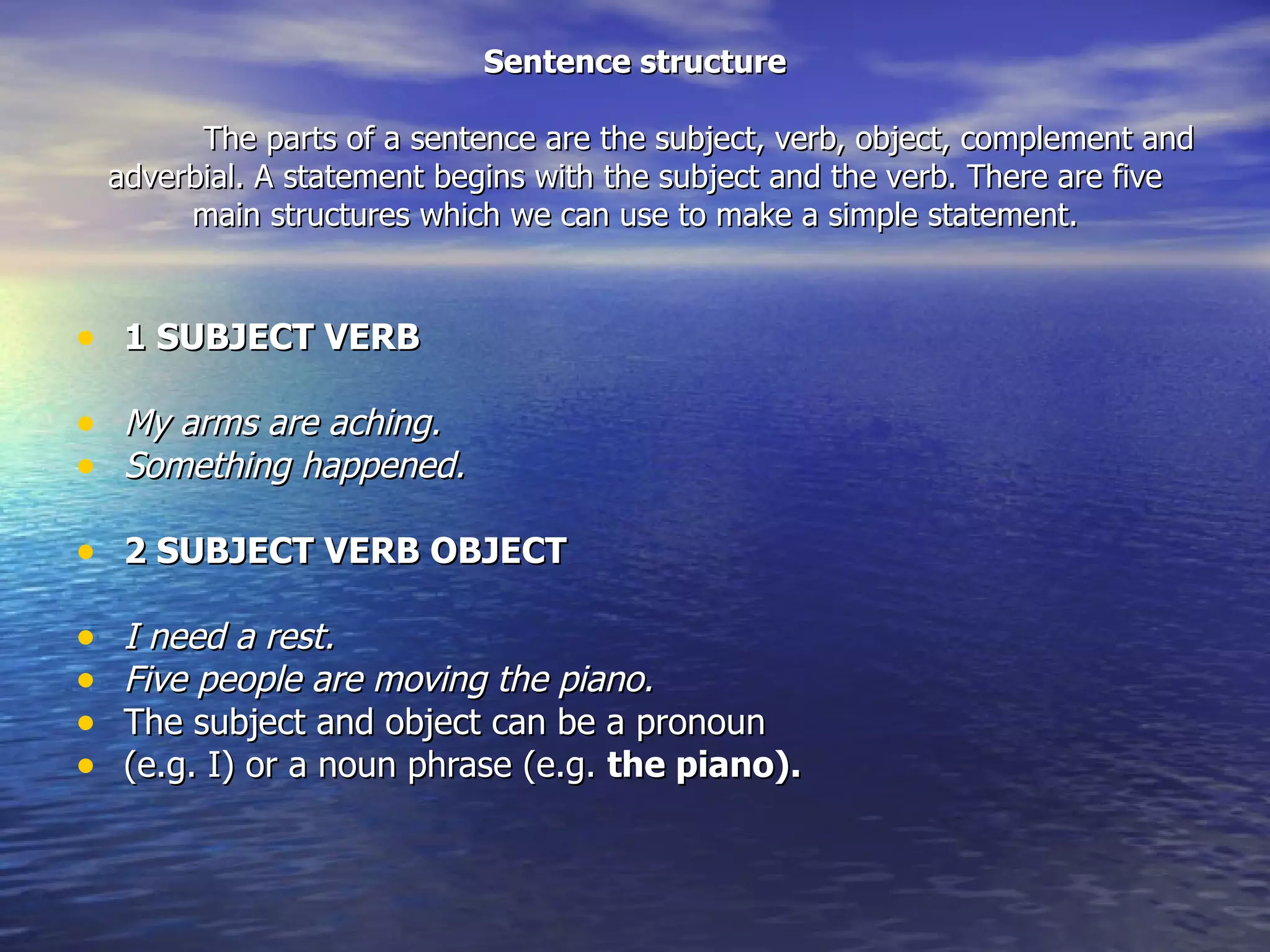
Sentence structure The parts of a sentence are the subject, verb, object, complement and adverbial. A statement begins with the subject and the verb. There are five main structures which we can use to make a simple statement. 1 SUBJECT VERB My arms are aching. Something happened. 2 SUBJECT VERB OBJECT I need a rest. Five people are moving the piano. The subject and object can be a pronoun (e.g. I) or a noun phrase (e.g.  the piano).
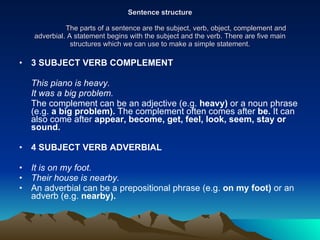
Sentence structure The parts of a sentence are the subject, verb, object, complement and adverbial. A statement begins with the subject and the verb. There are five main structures which we can use to make a simple statement. 3 SUBJECT VERB COMPLEMENT This piano is heavy. It was a big problem. The complement can be an adjective (e.g.  heavy)  or a noun phrase (e.g.  a big problem).  The complement often comes after  be.  It can also come after  appear, become, get, feel, look, seem, stay or sound. 4 SUBJECT VERB ADVERBIAL It is on my foot. Their house is nearby. An adverbial can be a prepositional phrase (e.g.  on my foot)  or an adverb (e.g.  nearby).
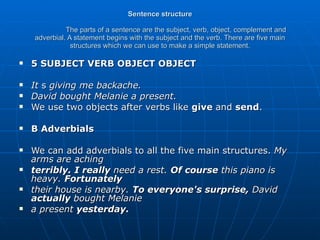
Sentence structure The parts of a sentence are the subject, verb, object, complement and adverbial. A statement begins with the subject and the verb. There are five main structures which we can use to make a simple statement. 5 SUBJECT VERB OBJECT OBJECT It  s  giving me backache. David bought Melanie a present. We use two objects after verbs like  give  and  send . B Adverbials We can add adverbials to all the five main structures.  My arms are aching terribly. I really  need a rest.  Of course  this piano is heavy.  Fortunately their house is nearby.  To everyone's surprise,  David  actually  bought Melanie a present  yesterday.

Sentence structure

  • 1.
    Sentence structure Theparts of a sentence are the subject, verb, object, complement and adverbial. A statement begins with the subject and the verb. There are five main structures which we can use to make a simple statement. 1 SUBJECT VERB My arms are aching. Something happened. 2 SUBJECT VERB OBJECT I need a rest. Five people are moving the piano. The subject and object can be a pronoun (e.g. I) or a noun phrase (e.g. the piano).
  • 2.
    Sentence structure Theparts of a sentence are the subject, verb, object, complement and adverbial. A statement begins with the subject and the verb. There are five main structures which we can use to make a simple statement. 3 SUBJECT VERB COMPLEMENT This piano is heavy. It was a big problem. The complement can be an adjective (e.g. heavy) or a noun phrase (e.g. a big problem). The complement often comes after be. It can also come after appear, become, get, feel, look, seem, stay or sound. 4 SUBJECT VERB ADVERBIAL It is on my foot. Their house is nearby. An adverbial can be a prepositional phrase (e.g. on my foot) or an adverb (e.g. nearby).
  • 3.
    Sentence structure Theparts of a sentence are the subject, verb, object, complement and adverbial. A statement begins with the subject and the verb. There are five main structures which we can use to make a simple statement. 5 SUBJECT VERB OBJECT OBJECT It s giving me backache. David bought Melanie a present. We use two objects after verbs like give and send . B Adverbials We can add adverbials to all the five main structures. My arms are aching terribly. I really need a rest. Of course this piano is heavy. Fortunately their house is nearby. To everyone's surprise, David actually bought Melanie a present yesterday.