20 RULES
SUBJECT – VERB AGREEMENT
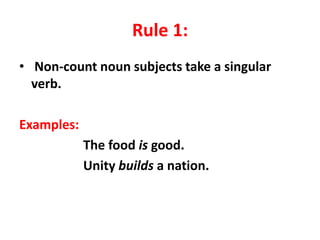
Rule 1:
• Non-count noun subjects take a singular
verb.
Examples:
The food is good.
Unity builds a nation.
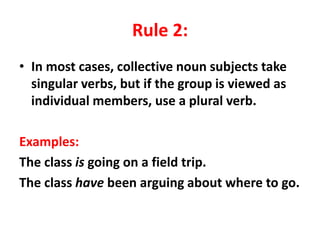
Rule 2:
• In most cases, collective noun subjects take
singular verbs, but if the group is viewed as
individual members, use a plural verb.
Examples:
The class is going on a field trip.
The class have been arguing about where to go.
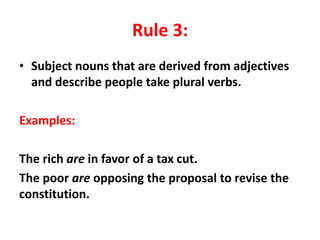
Rule 3:
• Subject nouns that are derived from adjectives
and describe people take plural verbs.
Examples:
The rich are in favor of a tax cut.
The poor are opposing the proposal to revise the
constitution.
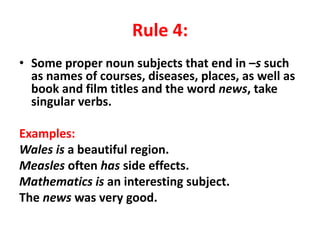
Rule 4:
• Some proper noun subjects that end in –s such
as names of courses, diseases, places, as well as
book and film titles and the word news, take
singular verbs.
Examples:
Wales is a beautiful region.
Measles often has side effects.
Mathematics is an interesting subject.
The news was very good.
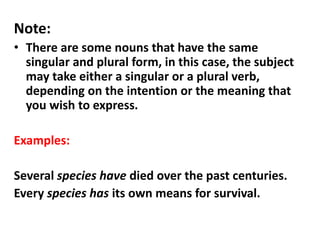
Note:
• There are some nouns that have the same
singular and plural form, in this case, the subject
may take either a singular or a plural verb,
depending on the intention or the meaning that
you wish to express.
Examples:
Several species have died over the past centuries.
Every species has its own means for survival.
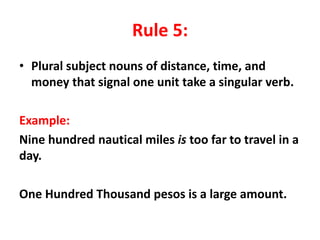
Rule 5:
• Plural subject nouns of distance, time, and
money that signal one unit take a singular verb.
Example:
Nine hundred nautical miles is too far to travel in a
day.
One Hundred Thousand pesos is a large amount.
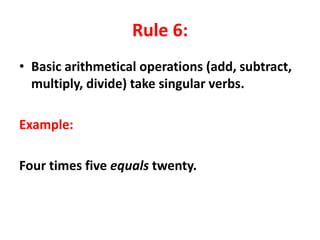
Rule 6:
• Basic arithmetical operations (add, subtract,
multiply, divide) take singular verbs.
Example:
Four times five equals twenty.
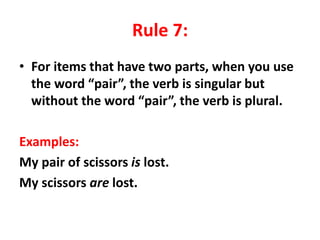
Rule 7:
• For items that have two parts, when you use
the word “pair”, the verb is singular but
without the word “pair”, the verb is plural.
Examples:
My pair of scissors is lost.
My scissors are lost.
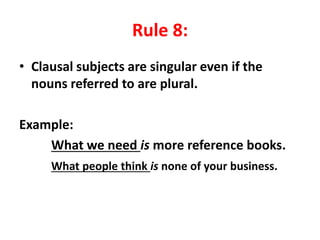
Rule 8:
• Clausal subjects are singular even if the
nouns referred to are plural.
Example:
What we need is more reference books.
What people think is none of your business.
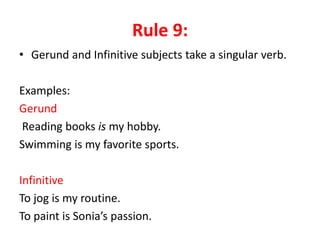
Rule 9:
• Gerund and Infinitive subjects take a singular verb.
Examples:
Gerund
Reading books is my hobby.
Swimming is my favorite sports.
Infinitive
To jog is my routine.
To paint is Sonia’s passion.
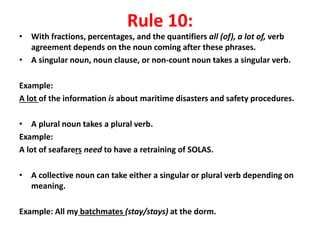
Rule 10:
• With fractions, percentages, and the quantifiers all (of), a lot of, verb
agreement depends on the noun coming after these phrases.
• A singular noun, noun clause, or non-count noun takes a singular verb.
Example:
A lot of the information is about maritime disasters and safety procedures.
• A plural noun takes a plural verb.
Example:
A lot of seafarers need to have a retraining of SOLAS.
• A collective noun can take either a singular or plural verb depending on
meaning.
Example: All my batchmates (stay/stays) at the dorm.
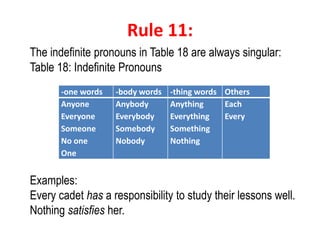
Rule 11:
-one words -body words -thing words Others
Anyone
Everyone
Someone
No one
One
Anybody
Everybody
Somebody
Nobody
Anything
Everything
Something
Nothing
Each
Every
The indefinite pronouns in Table 18 are always singular:
Table 18: Indefinite Pronouns
Examples:
Every cadet has a responsibility to study their lessons well.
Nothing satisfies her.
Note:
• Indefinite pronouns such as: all, any, a lot of, none,
most, and some can be singular or plural. They are
singular when they refer to a singular or non-count
noun or pronoun. They are plural when they refer to
a plural noun or pronoun.]
Examples:
Some of the books are imported.
Some of the snow has melted.
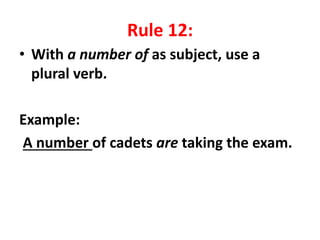
Rule 12:
• With a number of as subject, use a
plural verb.
Example:
A number of cadets are taking the exam.
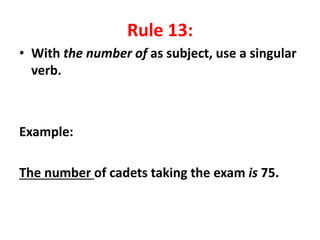
Rule 13:
• With the number of as subject, use a singular
verb.
Example:
The number of cadets taking the exam is 75.
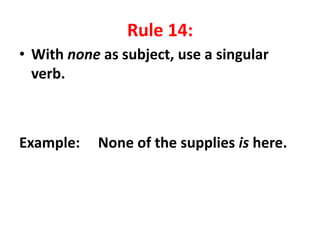
Rule 14:
• With none as subject, use a singular
verb.
Example: None of the supplies is here.
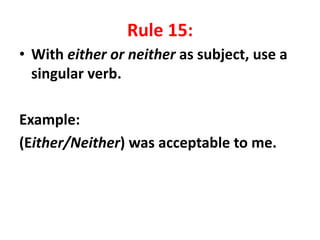
Rule 15:
• With either or neither as subject, use a
singular verb.
Example:
(Either/Neither) was acceptable to me.
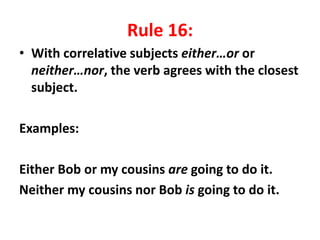
Rule 16:
• With correlative subjects either…or or
neither…nor, the verb agrees with the closest
subject.
Examples:
Either Bob or my cousins are going to do it.
Neither my cousins nor Bob is going to do it.
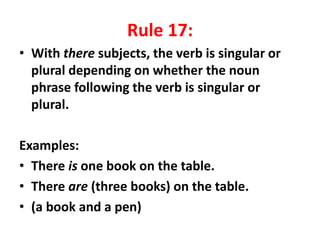
Rule 17:
• With there subjects, the verb is singular or
plural depending on whether the noun
phrase following the verb is singular or
plural.
Examples:
• There is one book on the table.
• There are (three books) on the table.
• (a book and a pen)
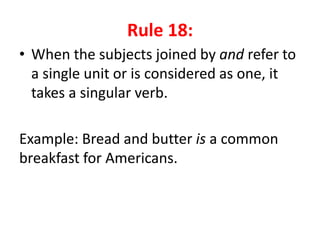
Rule 18:
• When the subjects joined by and refer to
a single unit or is considered as one, it
takes a singular verb.
Example: Bread and butter is a common
breakfast for Americans.
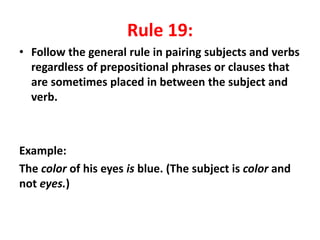
Rule 19:
• Follow the general rule in pairing subjects and verbs
regardless of prepositional phrases or clauses that
are sometimes placed in between the subject and
verb.
Example:
The color of his eyes is blue. (The subject is color and
not eyes.)
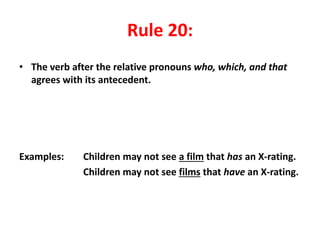
Rule 20:
• The verb after the relative pronouns who, which, and that
agrees with its antecedent.
Examples: Children may not see a film that has an X-rating.
Children may not see films that have an X-rating.

S v 20 rules

  • 1.
    20 RULES SUBJECT –VERB AGREEMENT
  • 2.
    Rule 1: • Non-countnoun subjects take a singular verb. Examples: The food is good. Unity builds a nation.
  • 3.
    Rule 2: • Inmost cases, collective noun subjects take singular verbs, but if the group is viewed as individual members, use a plural verb. Examples: The class is going on a field trip. The class have been arguing about where to go.
  • 4.
    Rule 3: • Subjectnouns that are derived from adjectives and describe people take plural verbs. Examples: The rich are in favor of a tax cut. The poor are opposing the proposal to revise the constitution.
  • 5.
    Rule 4: • Someproper noun subjects that end in –s such as names of courses, diseases, places, as well as book and film titles and the word news, take singular verbs. Examples: Wales is a beautiful region. Measles often has side effects. Mathematics is an interesting subject. The news was very good.
  • 6.
    Note: • There aresome nouns that have the same singular and plural form, in this case, the subject may take either a singular or a plural verb, depending on the intention or the meaning that you wish to express. Examples: Several species have died over the past centuries. Every species has its own means for survival.
  • 7.
    Rule 5: • Pluralsubject nouns of distance, time, and money that signal one unit take a singular verb. Example: Nine hundred nautical miles is too far to travel in a day. One Hundred Thousand pesos is a large amount.
  • 8.
    Rule 6: • Basicarithmetical operations (add, subtract, multiply, divide) take singular verbs. Example: Four times five equals twenty.
  • 9.
    Rule 7: • Foritems that have two parts, when you use the word “pair”, the verb is singular but without the word “pair”, the verb is plural. Examples: My pair of scissors is lost. My scissors are lost.
  • 10.
    Rule 8: • Clausalsubjects are singular even if the nouns referred to are plural. Example: What we need is more reference books. What people think is none of your business.
  • 11.
    Rule 9: • Gerundand Infinitive subjects take a singular verb. Examples: Gerund Reading books is my hobby. Swimming is my favorite sports. Infinitive To jog is my routine. To paint is Sonia’s passion.
  • 12.
    Rule 10: • Withfractions, percentages, and the quantifiers all (of), a lot of, verb agreement depends on the noun coming after these phrases. • A singular noun, noun clause, or non-count noun takes a singular verb. Example: A lot of the information is about maritime disasters and safety procedures. • A plural noun takes a plural verb. Example: A lot of seafarers need to have a retraining of SOLAS. • A collective noun can take either a singular or plural verb depending on meaning. Example: All my batchmates (stay/stays) at the dorm.
  • 13.
    Rule 11: -one words-body words -thing words Others Anyone Everyone Someone No one One Anybody Everybody Somebody Nobody Anything Everything Something Nothing Each Every The indefinite pronouns in Table 18 are always singular: Table 18: Indefinite Pronouns Examples: Every cadet has a responsibility to study their lessons well. Nothing satisfies her.
  • 14.
    Note: • Indefinite pronounssuch as: all, any, a lot of, none, most, and some can be singular or plural. They are singular when they refer to a singular or non-count noun or pronoun. They are plural when they refer to a plural noun or pronoun.] Examples: Some of the books are imported. Some of the snow has melted.
  • 15.
    Rule 12: • Witha number of as subject, use a plural verb. Example: A number of cadets are taking the exam.
  • 16.
    Rule 13: • Withthe number of as subject, use a singular verb. Example: The number of cadets taking the exam is 75.
  • 17.
    Rule 14: • Withnone as subject, use a singular verb. Example: None of the supplies is here.
  • 18.
    Rule 15: • Witheither or neither as subject, use a singular verb. Example: (Either/Neither) was acceptable to me.
  • 19.
    Rule 16: • Withcorrelative subjects either…or or neither…nor, the verb agrees with the closest subject. Examples: Either Bob or my cousins are going to do it. Neither my cousins nor Bob is going to do it.
  • 20.
    Rule 17: • Withthere subjects, the verb is singular or plural depending on whether the noun phrase following the verb is singular or plural. Examples: • There is one book on the table. • There are (three books) on the table. • (a book and a pen)
  • 21.
    Rule 18: • Whenthe subjects joined by and refer to a single unit or is considered as one, it takes a singular verb. Example: Bread and butter is a common breakfast for Americans.
  • 22.
    Rule 19: • Followthe general rule in pairing subjects and verbs regardless of prepositional phrases or clauses that are sometimes placed in between the subject and verb. Example: The color of his eyes is blue. (The subject is color and not eyes.)
  • 23.
    Rule 20: • Theverb after the relative pronouns who, which, and that agrees with its antecedent. Examples: Children may not see a film that has an X-rating. Children may not see films that have an X-rating.