Maligayang araw!
THE ELEMENTS OF
SENTENCE
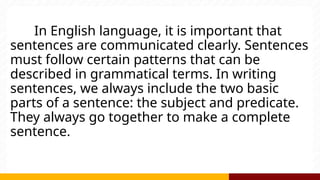
In English language, it is important that
sentences are communicated clearly. Sentences
must follow certain patterns that can be
described in grammatical terms. In writing
sentences, we always include the two basic
parts of a sentence: the subject and predicate.
They always go together to make a complete
sentence.
SUBJECTS
SUBJECTS
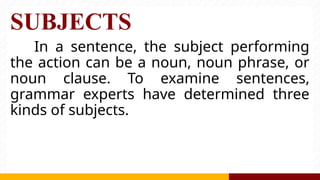
In a sentence, the subject performing
the action can be a noun, noun phrase, or
noun clause. To examine sentences,
grammar experts have determined three
kinds of subjects.
COMPLETE SUBJECTS
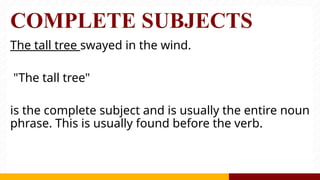
The tall tree swayed in the wind.
"The tall tree"
is the complete subject and is usually the entire noun
phrase. This is usually found before the verb.
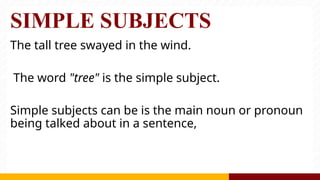
SIMPLE SUBJECTS
The tall tree swayed in the wind.
The word "tree" is the simple subject.
Simple subjects can be is the main noun or pronoun
being talked about in a sentence,
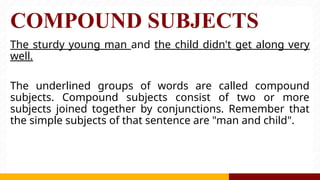
COMPOUND SUBJECTS
The sturdy young man and the child didn't get along very
well.
The underlined groups of words are called compound
subjects. Compound subjects consist of two or more
subjects joined together by conjunctions. Remember that
the simple subjects of that sentence are "man and child".
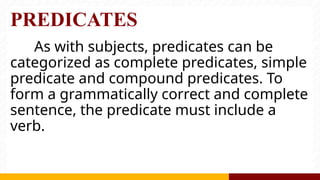
PREDICATES
PREDICATES
As with subjects, predicates can be
categorized as complete predicates, simple
predicate and compound predicates. To
form a grammatically correct and complete
sentence, the predicate must include a
verb.
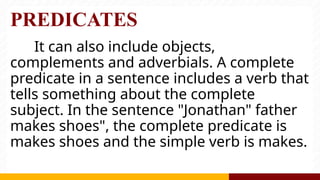
PREDICATES
It can also include objects,
complements and adverbials. A complete
predicate in a sentence includes a verb that
tells something about the complete
subject. In the sentence "Jonathan" father
makes shoes", the complete predicate is
makes shoes and the simple verb is makes.
OBJECTS
OBJECTS
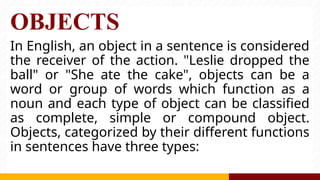
In English, an object in a sentence is considered
the receiver of the action. "Leslie dropped the
ball" or "She ate the cake", objects can be a
word or group of words which function as a
noun and each type of object can be classified
as complete, simple or compound object.
Objects, categorized by their different functions
in sentences have three types:
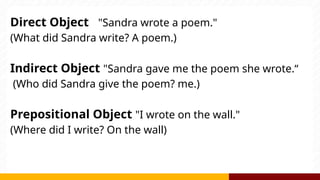
Direct Object "Sandra wrote a poem."
(What did Sandra write? A poem.)
Indirect Object "Sandra gave me the poem she wrote.“
(Who did Sandra give the poem? me.)
Prepositional Object "I wrote on the wall."
(Where did I write? On the wall)
COMPLEMENTS
COMPLEMENTS
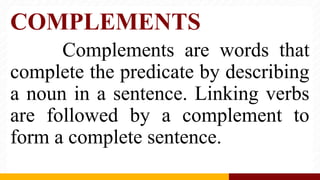
Complements are words that
complete the predicate by describing
a noun in a sentence. Linking verbs
are followed by a complement to
form a complete sentence.
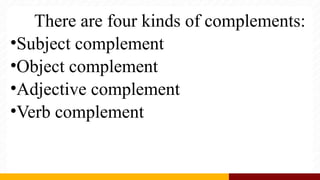
There are four kinds of complements:
•Subject complement
•Object complement
•Adjective complement
•Verb complement
Subject Complement
Functions as a noun, pronoun or
adjective. It comes with a linking
verb and tells something about
the subject of the sentence.
Three kinds of subject
complement:
The predicative nominative
-which appears with a linking verb and renames,
identifies or explains the subject of the sentence.
Ex. The new president of the company will be
Dana.
Dana renames the president.
The predicate adjective
-is an adjective that appears with a linking
verb and describes the subject of the sentence.
Ex. The spread of the virus seems
uncontrollable.
The uncontrollable describes spread.
The adverbial adjective
-is an adverb with a linking verb and tells
something of a place.
Ex. Nelson is in the market.
Market tells the adverb of place
Object complement
A word found only with direct object. It usually
comes after a direct object to rename it or tell what
it has become.
Ex. I colored my drawing yellow.
It is the object complement which modifies the
direct object, either by describing it or renaming it.
Adjective complement
Functional part of a sentence that completes or
complements the adjective. It can be a noun clause or a
prepositional phrase.
Ex. I was happy the she was chosen.
(that she was chosen) is a noun clause
I am very worried of the situation.
(of the situation) is a prepositional phrase
Kinds of Sentence
According to
Use/Function
Writing involves different kinds of sentence.
These are the declarative sentence, imperative
sentence, interrogative sentence and
exclamatory sentence.
These sentences have different function
depending on their purposes.
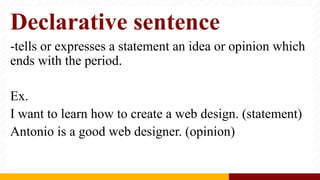
Declarative sentence
-tells or expresses a statement an idea or opinion which
ends with the period.
Ex.
I want to learn how to create a web design. (statement)
Antonio is a good web designer. (opinion)
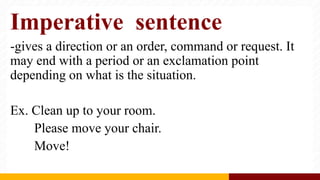
Imperative sentence
-gives a direction or an order, command or request. It
may end with a period or an exclamation point
depending on what is the situation.
Ex. Clean up to your room.
Please move your chair.
Move!
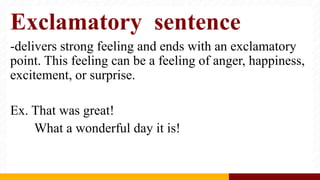
Exclamatory sentence
-delivers strong feeling and ends with an exclamatory
point. This feeling can be a feeling of anger, happiness,
excitement, or surprise.
Ex. That was great!
What a wonderful day it is!
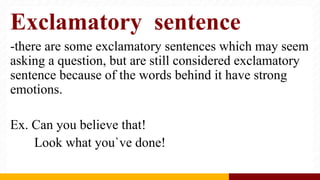
Exclamatory sentence
-there are some exclamatory sentences which may seem
asking a question, but are still considered exclamatory
sentence because of the words behind it have strong
emotions.
Ex. Can you believe that!
Look what you`ve done!
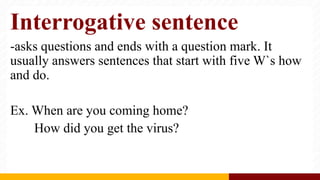
Interrogative sentence
-asks questions and ends with a question mark. It
usually answers sentences that start with five W`s how
and do.
Ex. When are you coming home?
How did you get the virus?
Kinds of Sentences
According to Structure
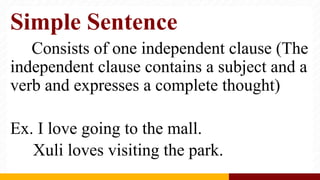
Simple Sentence
Consists of one independent clause (The
independent clause contains a subject and a
verb and expresses a complete thought)
Ex. I love going to the mall.
Xuli loves visiting the park.
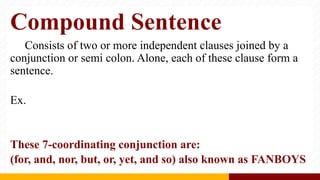
Compound Sentence
Consists of two or more independent clauses joined by a
conjunction or semi colon. Alone, each of these clause form a
sentence.
Ex.
These 7-coordinating conjunction are:
(for, and, nor, but, or, yet, and so) also known as FANBOYS
Complex Sentence
Comprises the independent clause and a dependent clause.
The dependent clause starts with a subordinate conjunction or a
relative pronoun and consists of a subject and a verb, but does not
have a complete thought.
Independent clause – subordinate conjunction-dependent clause
Ex. She failed the course because she didn`t show up in class.
My dog hid under the table when he heard the noise from the
firecrackers.
Some of the subordinating conjunctions are:
*although*once
*because *than
*that *when
*how *before
*till *where
*as*if while
*after *whether
*since*though
*until
The five relative pronouns are:
*that
*which
*who
*whom
*whose
Compound-Complex Sentence
It consist of at least two independent clause and one or more
dependent clauses.
Independent clause – subordinate conjunction-dependent clause- coordinating
conjunction – independent clause
Ex. Sheryl didn`t appear in the show she was so sick so the
people were disappointed.
I left in a hurry when I got an emergency call but I came
back in the afternoon.
PREPARED BY:
MENDOZA, JERICK
LOPEZ, ALYSSA
MAGBUJOS, CHRISTINE JOY
MARALIT, POL VINCENT
MENDOZA, DEVY MICH
RAZON, SOFIA

SOE-G2-REPORT-SENTENCE.pptxdsdasdasdasdasdasd

  • 1.
  • 2.
  • 3.
    In English language,it is important that sentences are communicated clearly. Sentences must follow certain patterns that can be described in grammatical terms. In writing sentences, we always include the two basic parts of a sentence: the subject and predicate. They always go together to make a complete sentence.
  • 4.
  • 5.
    SUBJECTS In a sentence,the subject performing the action can be a noun, noun phrase, or noun clause. To examine sentences, grammar experts have determined three kinds of subjects.
  • 6.
    COMPLETE SUBJECTS The talltree swayed in the wind. "The tall tree" is the complete subject and is usually the entire noun phrase. This is usually found before the verb.
  • 7.
    SIMPLE SUBJECTS The talltree swayed in the wind. The word "tree" is the simple subject. Simple subjects can be is the main noun or pronoun being talked about in a sentence,
  • 8.
    COMPOUND SUBJECTS The sturdyyoung man and the child didn't get along very well. The underlined groups of words are called compound subjects. Compound subjects consist of two or more subjects joined together by conjunctions. Remember that the simple subjects of that sentence are "man and child".
  • 9.
  • 10.
    PREDICATES As with subjects,predicates can be categorized as complete predicates, simple predicate and compound predicates. To form a grammatically correct and complete sentence, the predicate must include a verb.
  • 11.
    PREDICATES It can alsoinclude objects, complements and adverbials. A complete predicate in a sentence includes a verb that tells something about the complete subject. In the sentence "Jonathan" father makes shoes", the complete predicate is makes shoes and the simple verb is makes.
  • 12.
  • 13.
    OBJECTS In English, anobject in a sentence is considered the receiver of the action. "Leslie dropped the ball" or "She ate the cake", objects can be a word or group of words which function as a noun and each type of object can be classified as complete, simple or compound object. Objects, categorized by their different functions in sentences have three types:
  • 14.
    Direct Object "Sandrawrote a poem." (What did Sandra write? A poem.) Indirect Object "Sandra gave me the poem she wrote.“ (Who did Sandra give the poem? me.) Prepositional Object "I wrote on the wall." (Where did I write? On the wall)
  • 15.
  • 16.
    COMPLEMENTS Complements are wordsthat complete the predicate by describing a noun in a sentence. Linking verbs are followed by a complement to form a complete sentence.
  • 17.
    There are fourkinds of complements: •Subject complement •Object complement •Adjective complement •Verb complement
  • 18.
    Subject Complement Functions asa noun, pronoun or adjective. It comes with a linking verb and tells something about the subject of the sentence.
  • 19.
    Three kinds ofsubject complement:
  • 20.
    The predicative nominative -whichappears with a linking verb and renames, identifies or explains the subject of the sentence. Ex. The new president of the company will be Dana. Dana renames the president.
  • 21.
    The predicate adjective -isan adjective that appears with a linking verb and describes the subject of the sentence. Ex. The spread of the virus seems uncontrollable. The uncontrollable describes spread.
  • 22.
    The adverbial adjective -isan adverb with a linking verb and tells something of a place. Ex. Nelson is in the market. Market tells the adverb of place
  • 23.
    Object complement A wordfound only with direct object. It usually comes after a direct object to rename it or tell what it has become. Ex. I colored my drawing yellow. It is the object complement which modifies the direct object, either by describing it or renaming it.
  • 24.
    Adjective complement Functional partof a sentence that completes or complements the adjective. It can be a noun clause or a prepositional phrase. Ex. I was happy the she was chosen. (that she was chosen) is a noun clause I am very worried of the situation. (of the situation) is a prepositional phrase
  • 25.
  • 26.
    Writing involves differentkinds of sentence. These are the declarative sentence, imperative sentence, interrogative sentence and exclamatory sentence. These sentences have different function depending on their purposes.
  • 27.
    Declarative sentence -tells orexpresses a statement an idea or opinion which ends with the period. Ex. I want to learn how to create a web design. (statement) Antonio is a good web designer. (opinion)
  • 28.
    Imperative sentence -gives adirection or an order, command or request. It may end with a period or an exclamation point depending on what is the situation. Ex. Clean up to your room. Please move your chair. Move!
  • 29.
    Exclamatory sentence -delivers strongfeeling and ends with an exclamatory point. This feeling can be a feeling of anger, happiness, excitement, or surprise. Ex. That was great! What a wonderful day it is!
  • 30.
    Exclamatory sentence -there aresome exclamatory sentences which may seem asking a question, but are still considered exclamatory sentence because of the words behind it have strong emotions. Ex. Can you believe that! Look what you`ve done!
  • 31.
    Interrogative sentence -asks questionsand ends with a question mark. It usually answers sentences that start with five W`s how and do. Ex. When are you coming home? How did you get the virus?
  • 32.
  • 33.
    Simple Sentence Consists ofone independent clause (The independent clause contains a subject and a verb and expresses a complete thought) Ex. I love going to the mall. Xuli loves visiting the park.
  • 34.
    Compound Sentence Consists oftwo or more independent clauses joined by a conjunction or semi colon. Alone, each of these clause form a sentence. Ex. These 7-coordinating conjunction are: (for, and, nor, but, or, yet, and so) also known as FANBOYS
  • 35.
    Complex Sentence Comprises theindependent clause and a dependent clause. The dependent clause starts with a subordinate conjunction or a relative pronoun and consists of a subject and a verb, but does not have a complete thought. Independent clause – subordinate conjunction-dependent clause Ex. She failed the course because she didn`t show up in class. My dog hid under the table when he heard the noise from the firecrackers.
  • 36.
    Some of thesubordinating conjunctions are: *although*once *because *than *that *when *how *before *till *where *as*if while *after *whether *since*though *until
  • 37.
    The five relativepronouns are: *that *which *who *whom *whose
  • 38.
    Compound-Complex Sentence It consistof at least two independent clause and one or more dependent clauses. Independent clause – subordinate conjunction-dependent clause- coordinating conjunction – independent clause Ex. Sheryl didn`t appear in the show she was so sick so the people were disappointed. I left in a hurry when I got an emergency call but I came back in the afternoon.
  • 39.
    PREPARED BY: MENDOZA, JERICK LOPEZ,ALYSSA MAGBUJOS, CHRISTINE JOY MARALIT, POL VINCENT MENDOZA, DEVY MICH RAZON, SOFIA