“SENSOTRONIC BRAKE CONTROL”
Presented By,
Mr. Siddhesh Sakarekar
DEPARTMENT OF MECHANICAL ENGINEERING,
SAVITRIBAI PHULE PUNE UNIVERSITY, PUNE.
(2018-2019)
CONTENT
• INTRODUCTION OF BRAKES
• TYPES OF BRAKES
• WHAT IS SENSOTRONIC BRAKE CONTROL?
• WHY SENSOTONIC BRAKE?
• SBC COMPONENTS
• FEATURES OF SBC
• ELECTRONIC SENSORS USED IN SBC
• FUTURE APPLICATIONS
• DEMERITS OF SBC
• CONCLUSION
• REFERENCES
INTRODUCTION OF BRAKES
• Brakes are mechanical devices used for retarding the
motion of a vehicle.
• Brakes are also used to stop the vehicle quickly
within a short distance.
• Brakes are also used to hold the vehicle at rest on an
inclined road against the pull of gravity.
TYPES OF BRAKES
• Drum brakes
• Disk brakes
• Vacuum brakes
• Air brakes
• Hydraulic brakes
• Railway brakes
WHAT IS SENSOTRONIC BRAKE CONTROL?
• Sensotronic Brake Control is an innovative electronically
controlled brake system that is faster and more precise
than the conventional braking system.
• Sensotronic Brake Control (SBC) is an electro-hydraulic
brake system.
• Mercedes-Benz first introduced the Sensotronic
Brake Control (SBC)system on their SL-Class sports
car.
• Superb directional stability and optimally assured
brake distance are the result of SBC.
• SBC allows precise braking and increased vehicle
stability.
WHY SENSOTRONIC BRAKES?
• Brake pedal: Electronics instead of a vacuum
• Control unit: Pressure modulators for each
wheel
• Faster and more precisely
BRAKE PEDAL
• In the Sensotronic Brake Control, a large number of
mechanical components are simply replaced by
electronics.
• Sensors gauge the pressure inside the master brake
cylinder as well as the speed with which the brake
pedal is operated, and pass these data to the SBC
computer in the form of electric impulses
CONTROL UNIT
• The central control unit under the bonnet is the
centerpiece of the electro-hydraulic brake.
• The microcomputer, software, sensors, valves and
electric pump work together and allow totally novel,
highly dynamic brake management.
• In addition to the data relating to the brake pedal
actuation,the SBC computer also receives the sensor
signals from the other electronic assistance systems.
For example, ESP which makes available the data
from its steering angle and turning rate.
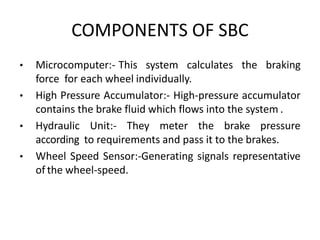
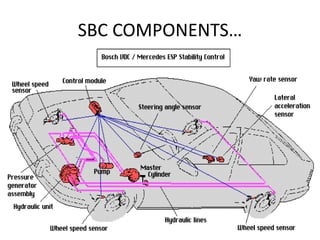
COMPONENTS OF SBC
• Microcomputer:- This system calculates the braking
force for each wheel individually.
• High Pressure Accumulator:- High-pressure accumulator
contains the brake fluid which flows into the system .
• Hydraulic Unit:- They meter the brake pressure
according to requirements and pass it to the brakes.
• Wheel Speed Sensor:-Generating signals representative
of the wheel-speed.
SBC COMPONENTS…
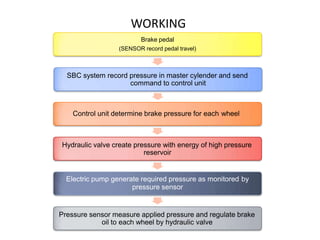
WORKING
Brake pedal
(SENSOR record pedal travel)
SBC system record pressure in master cylender and send
command to control unit
Control unit determine brake pressure for each wheel
Hydraulic valve create pressure with energy of high pressure
reservoir
Electric pump generate required pressure as monitored by
pressure sensor
Pressure sensor measure applied pressure and regulate brake
oil to each wheel by hydraulic valve
FEATURES OF SENSOTRONIC BRAKE CONTROL SYSTEM
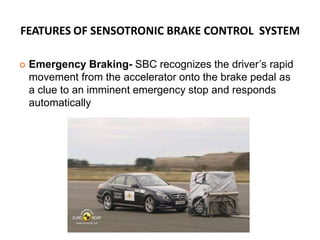
 Emergency Braking- SBC recognizes the driver’s rapid
movement from the accelerator onto the brake pedal as
a clue to an imminent emergency stop and responds
automatically
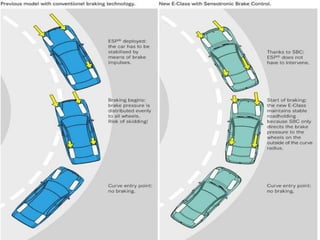
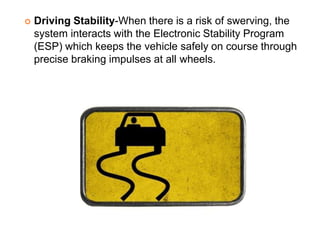
 Driving Stability-When there is a risk of swerving, the
system interacts with the Electronic Stability Program
(ESP) which keeps the vehicle safely on course through
precise braking impulses at all wheels.
 Comfort- SBC serve to
increase brake comfort
particularly during sharp
deceleration.
 Soft-Stop-The Soft-Stop
function of the SBC
software ensures
particularly gentle and
smooth stopping during
heavy traffic jams.
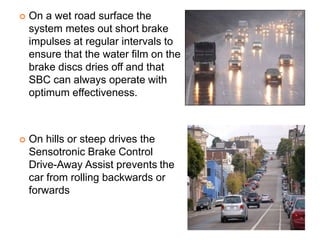
 On a wet road surface the
system metes out short brake
impulses at regular intervals to
ensure that the water film on the
brake discs dries off and that
SBC can always operate with
optimum effectiveness.
 On hills or steep drives the
Sensotronic Brake Control
Drive-Away Assist prevents the
car from rolling backwards or
forwards
ELECTRONIC SENSORS USED IN SBC
• Pedal Travel Sensor (Situated At BrakePedal)
• Steering Angle Sensor (Situated AtSteering)
• Wheel Speed Sensor (Situated At EveryWheel)
• Hydraulic Unit Sensor (Situated At Wheels)
DEMERITS OF SBC
• COST: Increases due to electronic components.
• ASSEMBLING: Slight complex assembling.
• DIFFICULT FOR MAINTAINANCE: Prone to environment
conditions.
FUTURE APPLICATIONS
• The advent of electronics in brake technology opens up
new and promising opportunities in the disciplines of
safety and comfort. By means of SBC we have also
moved a considerable way closer to the realization of
long-term objective, namely to be able to automatically
guide the cars of the future along the roads with the aid
of video cameras, proximity radar and advanced
telematics. For such autonomous vehicle guidance, the
experts need a computer-controlled brake system which
automatically acts on the instructions of an electronic
autopilot and stops the car safely.
CONCLUSION
• With reference to the advantages and disadvantages
it is concluded that the SBC system may take the
place of a conventional brake system in the future.
• One of the most important disadvantage that is its
higher cost due to the electronic components will
get reduced after the adaptation of this system by
all automobile companies. Also the maintenance of
the electronic component will be easy when we
shall get familiar with this system.
REFRENCES
• www.google.com
• Wikipedia.org
• Mercedes cancels by-wire brake system; decision a
blow to technology's future: AutoWeek Magazine".
Autoweek.com. 2014-01-02
• International Journal of Engineering Research &
Management Technology , Volume 2
THANK YOU!

Sensotronic Brake Control

  • 1.
    “SENSOTRONIC BRAKE CONTROL” PresentedBy, Mr. Siddhesh Sakarekar DEPARTMENT OF MECHANICAL ENGINEERING, SAVITRIBAI PHULE PUNE UNIVERSITY, PUNE. (2018-2019)
  • 2.
    CONTENT • INTRODUCTION OFBRAKES • TYPES OF BRAKES • WHAT IS SENSOTRONIC BRAKE CONTROL? • WHY SENSOTONIC BRAKE? • SBC COMPONENTS • FEATURES OF SBC • ELECTRONIC SENSORS USED IN SBC • FUTURE APPLICATIONS • DEMERITS OF SBC • CONCLUSION • REFERENCES
  • 3.
    INTRODUCTION OF BRAKES •Brakes are mechanical devices used for retarding the motion of a vehicle. • Brakes are also used to stop the vehicle quickly within a short distance. • Brakes are also used to hold the vehicle at rest on an inclined road against the pull of gravity.
  • 4.
    TYPES OF BRAKES •Drum brakes • Disk brakes • Vacuum brakes • Air brakes • Hydraulic brakes • Railway brakes
  • 5.
    WHAT IS SENSOTRONICBRAKE CONTROL? • Sensotronic Brake Control is an innovative electronically controlled brake system that is faster and more precise than the conventional braking system. • Sensotronic Brake Control (SBC) is an electro-hydraulic brake system. • Mercedes-Benz first introduced the Sensotronic Brake Control (SBC)system on their SL-Class sports car. • Superb directional stability and optimally assured brake distance are the result of SBC. • SBC allows precise braking and increased vehicle stability.
  • 6.
    WHY SENSOTRONIC BRAKES? •Brake pedal: Electronics instead of a vacuum • Control unit: Pressure modulators for each wheel • Faster and more precisely
  • 7.
    BRAKE PEDAL • Inthe Sensotronic Brake Control, a large number of mechanical components are simply replaced by electronics. • Sensors gauge the pressure inside the master brake cylinder as well as the speed with which the brake pedal is operated, and pass these data to the SBC computer in the form of electric impulses
  • 8.
    CONTROL UNIT • Thecentral control unit under the bonnet is the centerpiece of the electro-hydraulic brake. • The microcomputer, software, sensors, valves and electric pump work together and allow totally novel, highly dynamic brake management. • In addition to the data relating to the brake pedal actuation,the SBC computer also receives the sensor signals from the other electronic assistance systems. For example, ESP which makes available the data from its steering angle and turning rate.
  • 10.
    COMPONENTS OF SBC •Microcomputer:- This system calculates the braking force for each wheel individually. • High Pressure Accumulator:- High-pressure accumulator contains the brake fluid which flows into the system . • Hydraulic Unit:- They meter the brake pressure according to requirements and pass it to the brakes. • Wheel Speed Sensor:-Generating signals representative of the wheel-speed.
  • 11.
  • 12.
    WORKING Brake pedal (SENSOR recordpedal travel) SBC system record pressure in master cylender and send command to control unit Control unit determine brake pressure for each wheel Hydraulic valve create pressure with energy of high pressure reservoir Electric pump generate required pressure as monitored by pressure sensor Pressure sensor measure applied pressure and regulate brake oil to each wheel by hydraulic valve
  • 13.
    FEATURES OF SENSOTRONICBRAKE CONTROL SYSTEM  Emergency Braking- SBC recognizes the driver’s rapid movement from the accelerator onto the brake pedal as a clue to an imminent emergency stop and responds automatically
  • 14.
     Driving Stability-Whenthere is a risk of swerving, the system interacts with the Electronic Stability Program (ESP) which keeps the vehicle safely on course through precise braking impulses at all wheels.
  • 15.
     Comfort- SBCserve to increase brake comfort particularly during sharp deceleration.  Soft-Stop-The Soft-Stop function of the SBC software ensures particularly gentle and smooth stopping during heavy traffic jams.
  • 16.
     On awet road surface the system metes out short brake impulses at regular intervals to ensure that the water film on the brake discs dries off and that SBC can always operate with optimum effectiveness.  On hills or steep drives the Sensotronic Brake Control Drive-Away Assist prevents the car from rolling backwards or forwards
  • 17.
    ELECTRONIC SENSORS USEDIN SBC • Pedal Travel Sensor (Situated At BrakePedal) • Steering Angle Sensor (Situated AtSteering) • Wheel Speed Sensor (Situated At EveryWheel) • Hydraulic Unit Sensor (Situated At Wheels)
  • 18.
    DEMERITS OF SBC •COST: Increases due to electronic components. • ASSEMBLING: Slight complex assembling. • DIFFICULT FOR MAINTAINANCE: Prone to environment conditions.
  • 19.
    FUTURE APPLICATIONS • Theadvent of electronics in brake technology opens up new and promising opportunities in the disciplines of safety and comfort. By means of SBC we have also moved a considerable way closer to the realization of long-term objective, namely to be able to automatically guide the cars of the future along the roads with the aid of video cameras, proximity radar and advanced telematics. For such autonomous vehicle guidance, the experts need a computer-controlled brake system which automatically acts on the instructions of an electronic autopilot and stops the car safely.
  • 20.
    CONCLUSION • With referenceto the advantages and disadvantages it is concluded that the SBC system may take the place of a conventional brake system in the future. • One of the most important disadvantage that is its higher cost due to the electronic components will get reduced after the adaptation of this system by all automobile companies. Also the maintenance of the electronic component will be easy when we shall get familiar with this system.
  • 21.
    REFRENCES • www.google.com • Wikipedia.org •Mercedes cancels by-wire brake system; decision a blow to technology's future: AutoWeek Magazine". Autoweek.com. 2014-01-02 • International Journal of Engineering Research & Management Technology , Volume 2
  • 22.