Sensory Storytime
Programs for Children
Presented by
Jennifer Roy
Poll - What is your experience with sensory storytime?
I have no experience with sensory storytime.
I have some experience with sensory storytime.
I have been presenting sensory storytime regularly, but I’m looking for
fresh ideas.
I am an expert on sensory storytime, ready to share my knowledge!
Prepare
Implement
Evaluate
Sensory storytime is an alternative to traditional
storytime that combines books, music, movement and
therapeutic activities to stimulate the senses and
enhance learning in a non-judgmental environment.
Other alternatives…
Incorporate adapted
stories and activities into
traditional storytime. Visit special needs
classrooms at local
elementary schools on a
regular basis to deliver
storytime including
adapted stories and
music.
Create adapted storytime
kits to lend to teachers,
therapists and parents for
children who find the
traditional storytime
experience overwhelming.
Sensory-Friendly
Outreach
Materials & Support
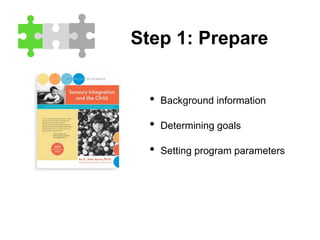
Step 1: Prepare
• Background information
• Determining goals
• Setting program parameters
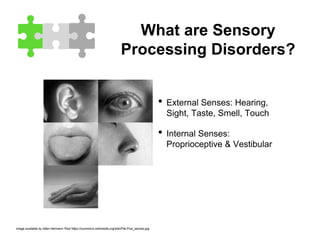
What are Sensory
Processing Disorders?
• External Senses: Hearing,
Sight, Taste, Smell, Touch
• Internal Senses:
Proprioceptive & Vestibular
image available by Allan-Hermann Pool https://commons.wikimedia.org/wiki/File:Five_senses.jpg
All behavior is communication.
For each sense, children may be…
Over-responsive: use avoiding behaviors
Under-responsive: use seeking behaviors
Learning about
Autism
Neurological disorder identified by:
• impaired social interaction
• impaired communication
• sensory processing disorders
image available https://commons.wikimedia.org/wiki/File:Autism_Awareness_Ribbon.png#file
Not all children with
autism are the same.
All children want to
belong and feel
included.
“There is no need to be an expert,
nor do anything heroic to include
someone. We just need to be there.”
-Carina Morillo, Autism Advocate
• Empathy
• Patience
• Kindness
• Compassion
image available: by Tim Schramm [CC BY-SA 4.0 (https://creativecommons.org/licenses/by-sa/4.0)], from Wikimedia Commons
Poll: yes/no
Have you ever made an accommodation
during traditional storytime?
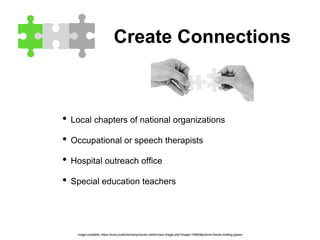
Create Connections
• Local chapters of national organizations
• Occupational or speech therapists
• Hospital outreach office
• Special education teachers
image available: https://www.publicdomainpictures.net/en/view-image.php?image=19960&picture=hands-holding-jigsaw
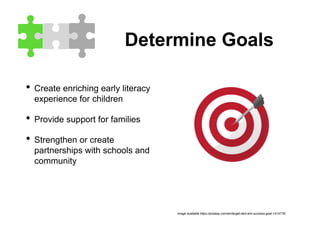
Determine Goals
• Create enriching early literacy
experience for children
• Provide support for families
• Strengthen or create
partnerships with schools and
community
image available https://pixabay.com/en/target-dart-aim-success-goal-1414775/
What do you need?
• Staff
• Materials
• Funding
• Support
image available: https://pixabay.com/en/notebook-pencil-blank-office-308849/
Scheduling
• Frequency?
• Time of day?
• Duration?
• Registration?
Image available: http://www.publicdomainfiles.com/show_file.php?id=13533948618158
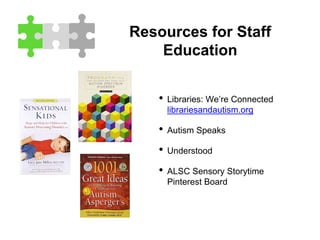
Resources for Staff
Education
• Libraries: We’re Connected
librariesandautism.org
• Autism Speaks
• Understood
• ALSC Sensory Storytime
Pinterest Board
Step 2: Implementation
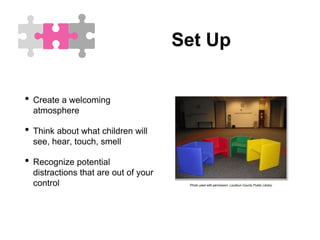
Set Up
• Create a welcoming
atmosphere
• Think about what children will
see, hear, touch, smell
• Recognize potential
distractions that are out of your
control Photo used with permission: Loudoun County Public Library
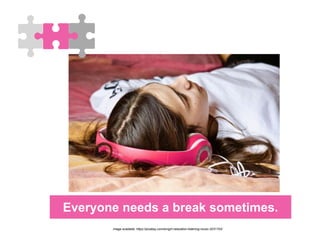
Everyone needs a break sometimes.
image available: https://pixabay.com/en/girl-relaxation-listening-music-3231703/
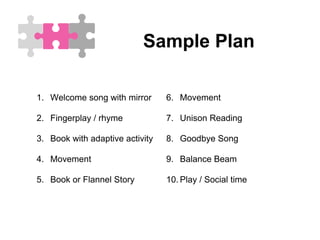
Sample Plan
1. Welcome song with mirror
2. Fingerplay / rhyme
3. Book with adaptive activity
4. Movement
5. Book or Flannel Story
6. Movement
7. Unison Reading
8. Goodbye Song
9. Balance Beam
10. Play / Social time
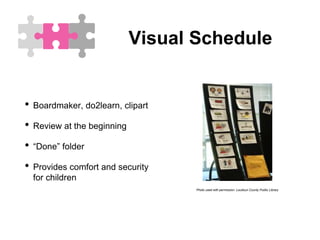
Visual Schedule
• Boardmaker, do2learn, clipart
• Review at the beginning
• “Done” folder
• Provides comfort and security
for children
Photo used with permission: Loudoun County Public Library
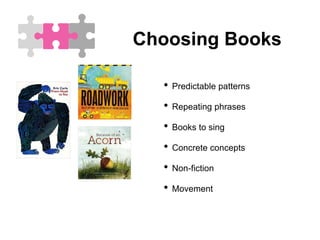
Choosing Books
• Predictable patterns
• Repeating phrases
• Books to sing
• Concrete concepts
• Non-fiction
• Movement
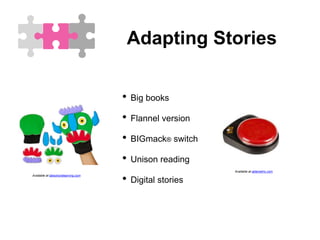
Adapting Stories
• Big books
• Flannel version
• BIGmack® switch
• Unison reading
• Digital stories
Available at lakeshorelearning.com
Available at ablenetinc.com
Music
Artists:
• Kathy Reid-Naiman
• Hap Palmer
• Laurie Berkner
• Simple Instructions
• Clear tempo & rhythm
• Enhance movement with
props
• Cue transitions
Image available: http://www.publicdomainfiles.com/show_file.php?id=13939431023664
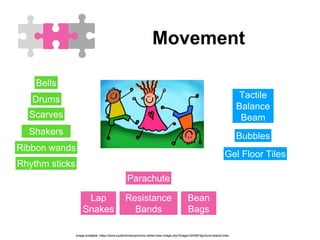
Movement
Resistance
Bands
Tactile
Balance
Beam
Bean
Bags
Scarves
Lap
Snakes
Ribbon wands
Shakers
Parachute
Bubbles
Gel Floor Tiles
Drums
Bells
Rhythm sticks
Image available: https://www.publicdomainpictures.net/en/view-image.php?image=204591&picture=playful-kids
Transitions
• Signal
• Stretch
• Breathing exercises
• Fidgets
• Get children involved in clean up
image available: https://www.publicdomainpictures.net/en/view-image.php?image=42378&picture=woman-exercising-clipart
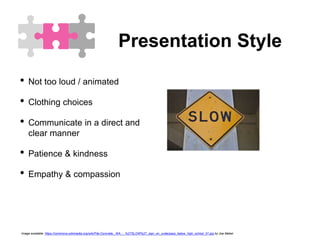
Presentation Style
• Not too loud / animated
• Clothing choices
• Communicate in a direct and
clear manner
• Patience & kindness
• Empathy & compassion
Image available: https://commons.wikimedia.org/wiki/File:Concrete,_WA_-_%27SLOW%27_sign_on_underpass_below_high_school_01.jpg by Joe Mabel
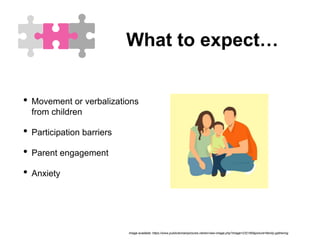
What to expect…
• Movement or verbalizations
from children
• Participation barriers
• Parent engagement
• Anxiety
Image available: https://www.publicdomainpictures.net/en/view-image.php?image=232185&picture=family-gathering
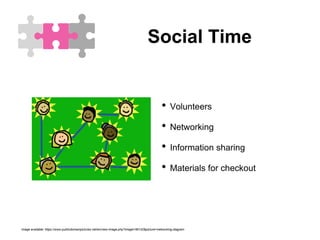
Social Time
• Volunteers
• Networking
• Information sharing
• Materials for checkout
image available: https://www.publicdomainpictures.net/en/view-image.php?image=56142&picture=networking-diagram
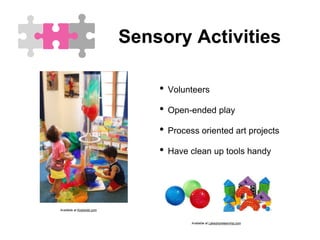
Sensory Activities
• Volunteers
• Open-ended play
• Process oriented art projects
• Have clean up tools handy
Available at Lakeshorelearning.com
Available at Kodokids.com
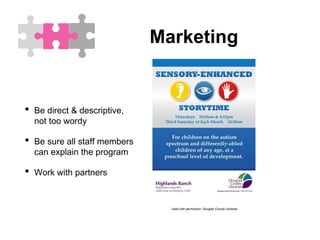
• Be direct & descriptive,
not too wordy
• Be sure all staff members
can explain the program
• Work with partners
Marketing
Used with permission: Douglas County Libraries
Spreading the Word
• movie theaters
• dance studios
• gyms
• performing arts
• aquatic centers
• children’s museums
• restaurants
Images available: https://pixabay.com/
Working with schools
• Individualized Education Plans (IEPs)
• Community Based Instruction (CBI visit)
• Public & Private Schools
• Create a Social Story
image available: https://pixabay.com/en/school-bus-bus-yellow-coach-3337446/
Step 3: Evaluation
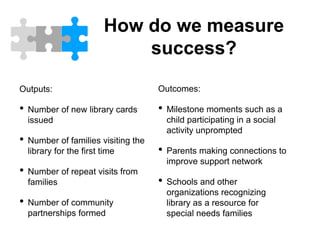
How do we measure
success?
Outputs:
• Number of new library cards
issued
• Number of families visiting the
library for the first time
• Number of repeat visits from
families
• Number of community
partnerships formed
Outcomes:
• Milestone moments such as a
child participating in a social
activity unprompted
• Parents making connections to
improve support network
• Schools and other
organizations recognizing
library as a resource for
special needs families
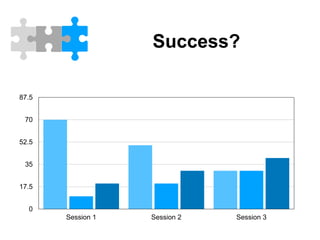
Success?
0
17.5
35
52.5
70
87.5
Session 1 Session 2 Session 3
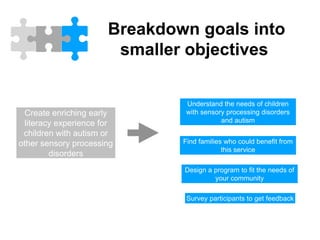
Breakdown goals into
smaller objectives
Create enriching early
literacy experience for
children with autism or
other sensory processing
disorders
Design a program to fit the needs of
your community
Understand the needs of children
with sensory processing disorders
and autism
Find families who could benefit from
this service
Survey participants to get feedback
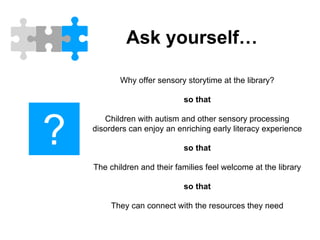
Ask yourself…
Why offer sensory storytime at the library?
so that
Children with autism and other sensory processing
disorders can enjoy an enriching early literacy experience
so that
The children and their families feel welcome at the library
so that
They can connect with the resources they need
?
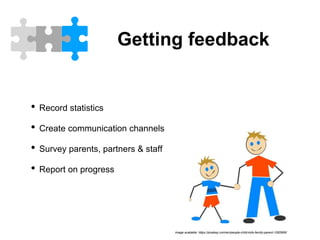
Getting feedback
• Record statistics
• Create communication channels
• Survey parents, partners & staff
• Report on progress
image available: https://pixabay.com/en/people-child-kids-family-parent-1082906/
Be patient with yourself.
Image available: https://www.goodfreephotos.com/albums/other-landscapes/sunset-water-ripples-landscape.jpg
• You do not have to be an expert.
• Success is not one size fits all.
• The rewards are worth it.
Call to Action
• What ideas can you put into practice immediately to better
serve children on the autistic spectrum and sensory
processing disorders in your library?
• What can you do to build support to make sensory
storytime a success for your library?
Questions?
JenniferRoy8@gmail.com
Sensory
Storytime
Programs for
Children

Sensory Storytime Programs (July 2018)

  • 1.
    Sensory Storytime Programs forChildren Presented by Jennifer Roy
  • 2.
    Poll - Whatis your experience with sensory storytime? I have no experience with sensory storytime. I have some experience with sensory storytime. I have been presenting sensory storytime regularly, but I’m looking for fresh ideas. I am an expert on sensory storytime, ready to share my knowledge!
  • 3.
  • 4.
    Sensory storytime isan alternative to traditional storytime that combines books, music, movement and therapeutic activities to stimulate the senses and enhance learning in a non-judgmental environment.
  • 5.
    Other alternatives… Incorporate adapted storiesand activities into traditional storytime. Visit special needs classrooms at local elementary schools on a regular basis to deliver storytime including adapted stories and music. Create adapted storytime kits to lend to teachers, therapists and parents for children who find the traditional storytime experience overwhelming. Sensory-Friendly Outreach Materials & Support
  • 6.
    Step 1: Prepare •Background information • Determining goals • Setting program parameters
  • 7.
    What are Sensory ProcessingDisorders? • External Senses: Hearing, Sight, Taste, Smell, Touch • Internal Senses: Proprioceptive & Vestibular image available by Allan-Hermann Pool https://commons.wikimedia.org/wiki/File:Five_senses.jpg
  • 8.
    All behavior iscommunication. For each sense, children may be… Over-responsive: use avoiding behaviors Under-responsive: use seeking behaviors
  • 9.
    Learning about Autism Neurological disorderidentified by: • impaired social interaction • impaired communication • sensory processing disorders image available https://commons.wikimedia.org/wiki/File:Autism_Awareness_Ribbon.png#file
  • 10.
    Not all childrenwith autism are the same. All children want to belong and feel included.
  • 11.
    “There is noneed to be an expert, nor do anything heroic to include someone. We just need to be there.” -Carina Morillo, Autism Advocate
  • 12.
    • Empathy • Patience •Kindness • Compassion image available: by Tim Schramm [CC BY-SA 4.0 (https://creativecommons.org/licenses/by-sa/4.0)], from Wikimedia Commons
  • 13.
    Poll: yes/no Have youever made an accommodation during traditional storytime?
  • 14.
    Create Connections • Localchapters of national organizations • Occupational or speech therapists • Hospital outreach office • Special education teachers image available: https://www.publicdomainpictures.net/en/view-image.php?image=19960&picture=hands-holding-jigsaw
  • 15.
    Determine Goals • Createenriching early literacy experience for children • Provide support for families • Strengthen or create partnerships with schools and community image available https://pixabay.com/en/target-dart-aim-success-goal-1414775/
  • 16.
    What do youneed? • Staff • Materials • Funding • Support image available: https://pixabay.com/en/notebook-pencil-blank-office-308849/
  • 17.
    Scheduling • Frequency? • Timeof day? • Duration? • Registration? Image available: http://www.publicdomainfiles.com/show_file.php?id=13533948618158
  • 18.
    Resources for Staff Education •Libraries: We’re Connected librariesandautism.org • Autism Speaks • Understood • ALSC Sensory Storytime Pinterest Board
  • 19.
  • 20.
    Set Up • Createa welcoming atmosphere • Think about what children will see, hear, touch, smell • Recognize potential distractions that are out of your control Photo used with permission: Loudoun County Public Library
  • 21.
    Everyone needs abreak sometimes. image available: https://pixabay.com/en/girl-relaxation-listening-music-3231703/
  • 22.
    Sample Plan 1. Welcomesong with mirror 2. Fingerplay / rhyme 3. Book with adaptive activity 4. Movement 5. Book or Flannel Story 6. Movement 7. Unison Reading 8. Goodbye Song 9. Balance Beam 10. Play / Social time
  • 23.
    Visual Schedule • Boardmaker,do2learn, clipart • Review at the beginning • “Done” folder • Provides comfort and security for children Photo used with permission: Loudoun County Public Library
  • 24.
    Choosing Books • Predictablepatterns • Repeating phrases • Books to sing • Concrete concepts • Non-fiction • Movement
  • 25.
    Adapting Stories • Bigbooks • Flannel version • BIGmack® switch • Unison reading • Digital stories Available at lakeshorelearning.com Available at ablenetinc.com
  • 26.
    Music Artists: • Kathy Reid-Naiman •Hap Palmer • Laurie Berkner • Simple Instructions • Clear tempo & rhythm • Enhance movement with props • Cue transitions Image available: http://www.publicdomainfiles.com/show_file.php?id=13939431023664
  • 27.
    Movement Resistance Bands Tactile Balance Beam Bean Bags Scarves Lap Snakes Ribbon wands Shakers Parachute Bubbles Gel FloorTiles Drums Bells Rhythm sticks Image available: https://www.publicdomainpictures.net/en/view-image.php?image=204591&picture=playful-kids
  • 28.
    Transitions • Signal • Stretch •Breathing exercises • Fidgets • Get children involved in clean up image available: https://www.publicdomainpictures.net/en/view-image.php?image=42378&picture=woman-exercising-clipart
  • 29.
    Presentation Style • Nottoo loud / animated • Clothing choices • Communicate in a direct and clear manner • Patience & kindness • Empathy & compassion Image available: https://commons.wikimedia.org/wiki/File:Concrete,_WA_-_%27SLOW%27_sign_on_underpass_below_high_school_01.jpg by Joe Mabel
  • 30.
    What to expect… •Movement or verbalizations from children • Participation barriers • Parent engagement • Anxiety Image available: https://www.publicdomainpictures.net/en/view-image.php?image=232185&picture=family-gathering
  • 31.
    Social Time • Volunteers •Networking • Information sharing • Materials for checkout image available: https://www.publicdomainpictures.net/en/view-image.php?image=56142&picture=networking-diagram
  • 32.
    Sensory Activities • Volunteers •Open-ended play • Process oriented art projects • Have clean up tools handy Available at Lakeshorelearning.com Available at Kodokids.com
  • 33.
    • Be direct& descriptive, not too wordy • Be sure all staff members can explain the program • Work with partners Marketing Used with permission: Douglas County Libraries
  • 34.
    Spreading the Word •movie theaters • dance studios • gyms • performing arts • aquatic centers • children’s museums • restaurants Images available: https://pixabay.com/
  • 35.
    Working with schools •Individualized Education Plans (IEPs) • Community Based Instruction (CBI visit) • Public & Private Schools • Create a Social Story image available: https://pixabay.com/en/school-bus-bus-yellow-coach-3337446/
  • 36.
  • 37.
    How do wemeasure success? Outputs: • Number of new library cards issued • Number of families visiting the library for the first time • Number of repeat visits from families • Number of community partnerships formed Outcomes: • Milestone moments such as a child participating in a social activity unprompted • Parents making connections to improve support network • Schools and other organizations recognizing library as a resource for special needs families
  • 38.
  • 39.
    Breakdown goals into smallerobjectives Create enriching early literacy experience for children with autism or other sensory processing disorders Design a program to fit the needs of your community Understand the needs of children with sensory processing disorders and autism Find families who could benefit from this service Survey participants to get feedback
  • 40.
    Ask yourself… Why offersensory storytime at the library? so that Children with autism and other sensory processing disorders can enjoy an enriching early literacy experience so that The children and their families feel welcome at the library so that They can connect with the resources they need ?
  • 41.
    Getting feedback • Recordstatistics • Create communication channels • Survey parents, partners & staff • Report on progress image available: https://pixabay.com/en/people-child-kids-family-parent-1082906/
  • 42.
    Be patient withyourself. Image available: https://www.goodfreephotos.com/albums/other-landscapes/sunset-water-ripples-landscape.jpg
  • 43.
    • You donot have to be an expert. • Success is not one size fits all. • The rewards are worth it.
  • 44.
    Call to Action •What ideas can you put into practice immediately to better serve children on the autistic spectrum and sensory processing disorders in your library? • What can you do to build support to make sensory storytime a success for your library?
  • 45.