Sensornets and Global Change Invited Talk Greenovation Forum: Sensing and Sustainability [email_address] December 2, 2009 Dr. Larry Smarr Director, California Institute for Telecommunications and Information Technology Harry E. Gruber Professor,  Dept. of Computer Science and Engineering Jacobs School of Engineering, UCSD Follow me on Twitter: http://twitter.com/lsmarr
San Diego Examples of  Sensornets for Sustainability  Building Sensing Wildfire Sensing What is a Sensornet? Coastal Sensing
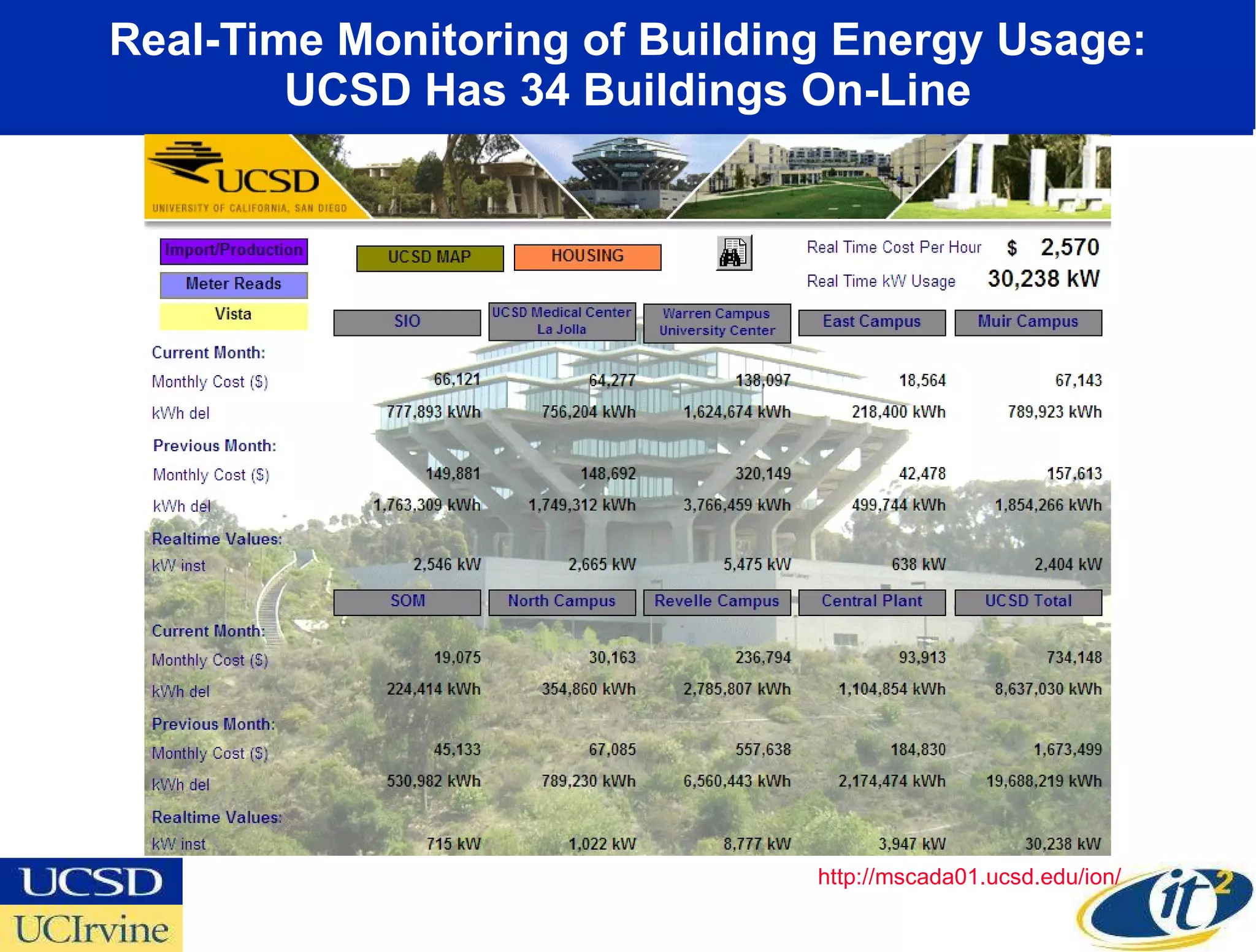
Real-Time Monitoring of Building Energy Usage: UCSD Has 34 Buildings On-Line http://mscada01.ucsd.edu/ion/
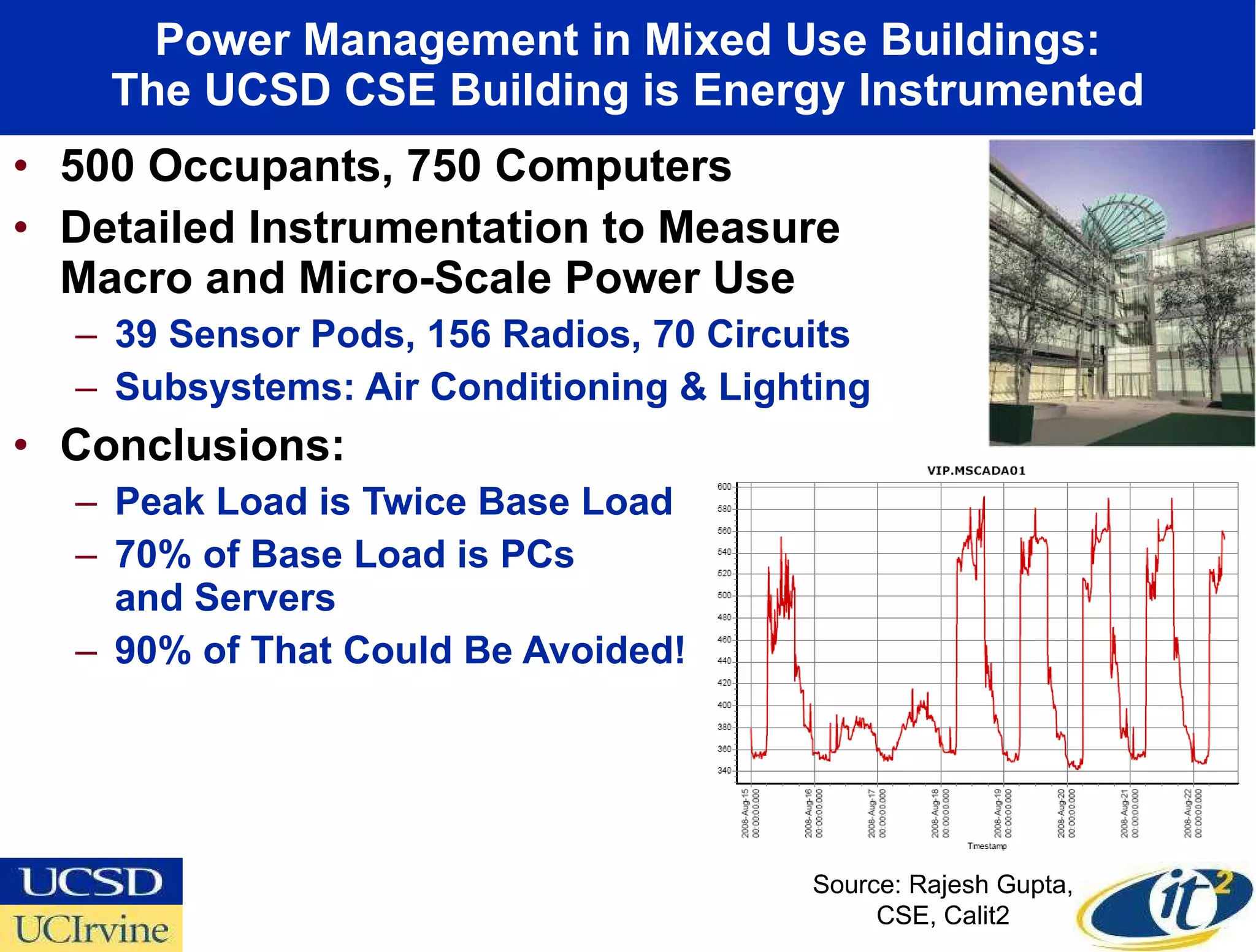
Power Management in Mixed Use Buildings: The UCSD CSE Building is Energy Instrumented 500 Occupants, 750 Computers Detailed Instrumentation to Measure Macro and Micro-Scale Power Use  39 Sensor Pods, 156 Radios, 70 Circuits Subsystems: Air Conditioning & Lighting Conclusions: Peak Load is Twice Base Load 70% of Base Load is PCs  and Servers 90% of That Could Be Avoided! Source: Rajesh Gupta, CSE, Calit2
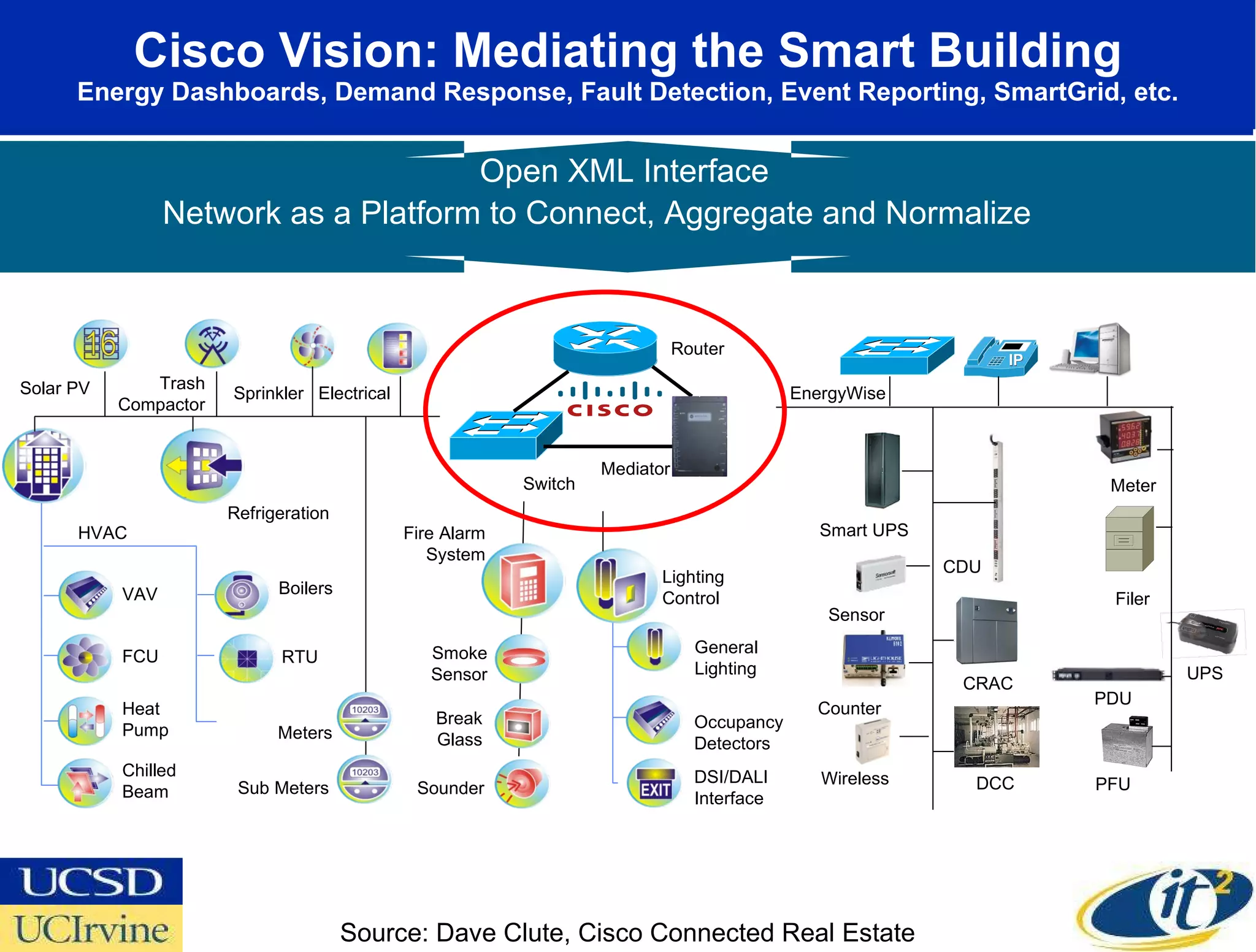
Cisco Vision: Mediating the Smart Building Energy Dashboards, Demand Response, Fault Detection, Event Reporting, SmartGrid, etc. Source: Dave Clute, Cisco Connected Real Estate Network as a Platform to Connect, Aggregate and Normalize Open XML Interface Mediator Switch Router Occupancy Detectors VAV FCU Heat Pump Chilled Beam Boilers RTU HVAC Meters Sub Meters Refrigeration Solar PV Trash Compactor Sprinkler Fire Alarm System Smoke Sensor Sounder Break Glass Lighting Control General Lighting DSI/DALI Interface Electrical EnergyWise Filer UPS PDU PFU Sensor CDU Smart UPS CRAC Counter DCC Wireless Meter
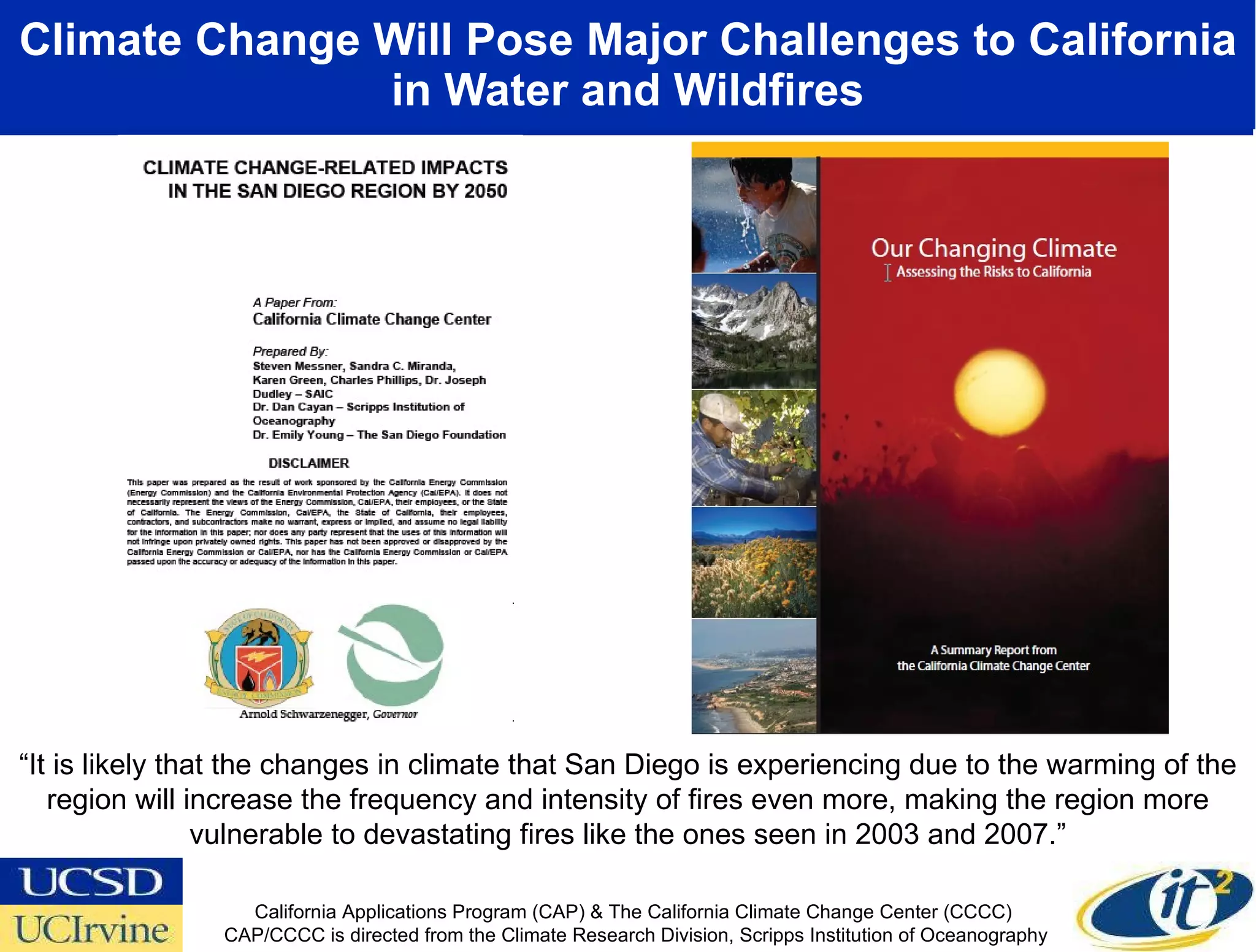
Climate Change Will Pose Major Challenges to California in Water and Wildfires “ It is likely that the changes in climate that San Diego is experiencing due to the warming of the region will increase the frequency and intensity of fires even more, making the region more vulnerable to devastating fires like the ones seen in 2003 and 2007.” California Applications Program (CAP) & The California Climate Change Center (CCCC)  CAP/CCCC is directed from the Climate Research Division, Scripps Institution of Oceanography
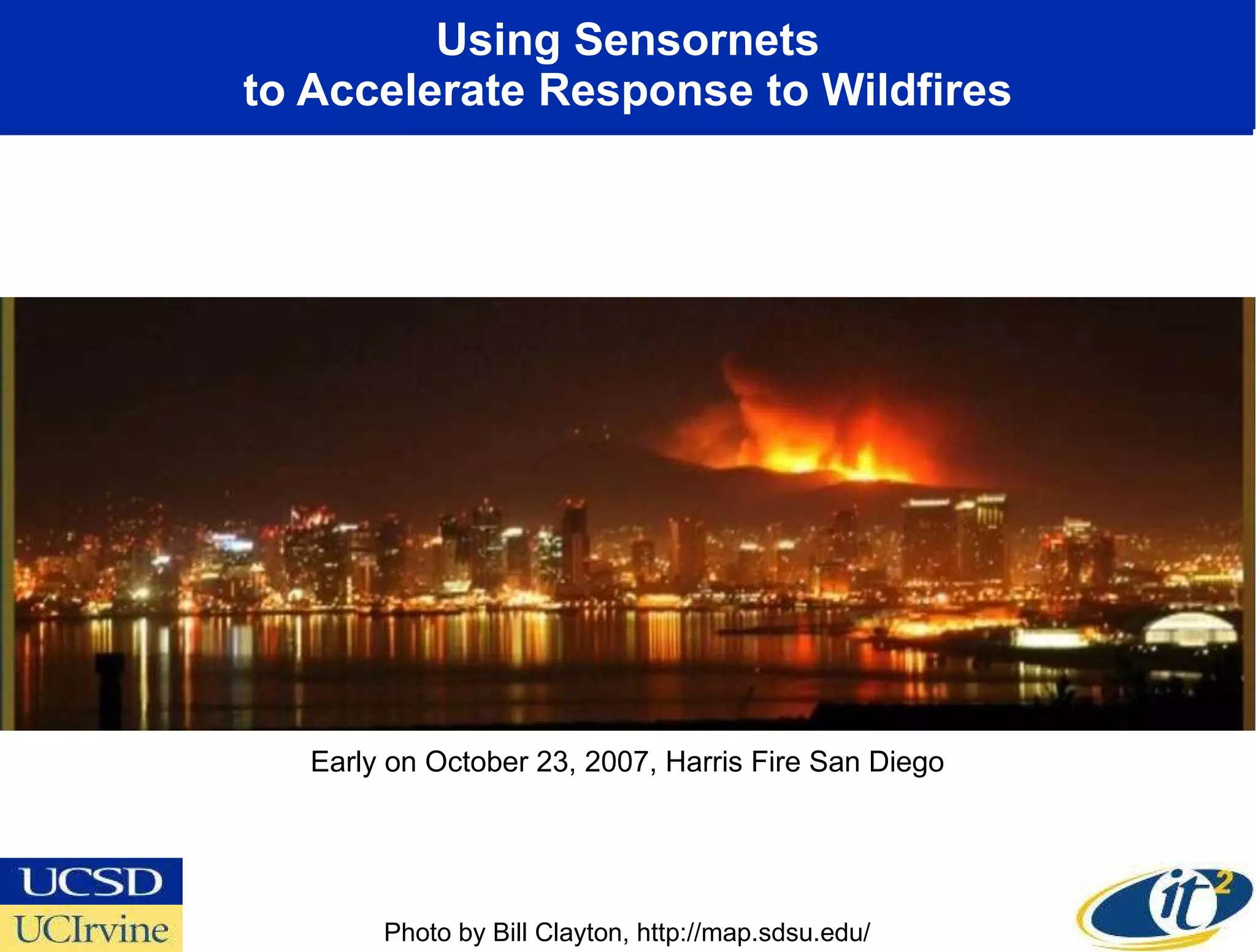
Using Sensornets to Accelerate Response to Wildfires Early on October 23, 2007, Harris Fire San Diego Photo by Bill Clayton, http://map.sdsu.edu/
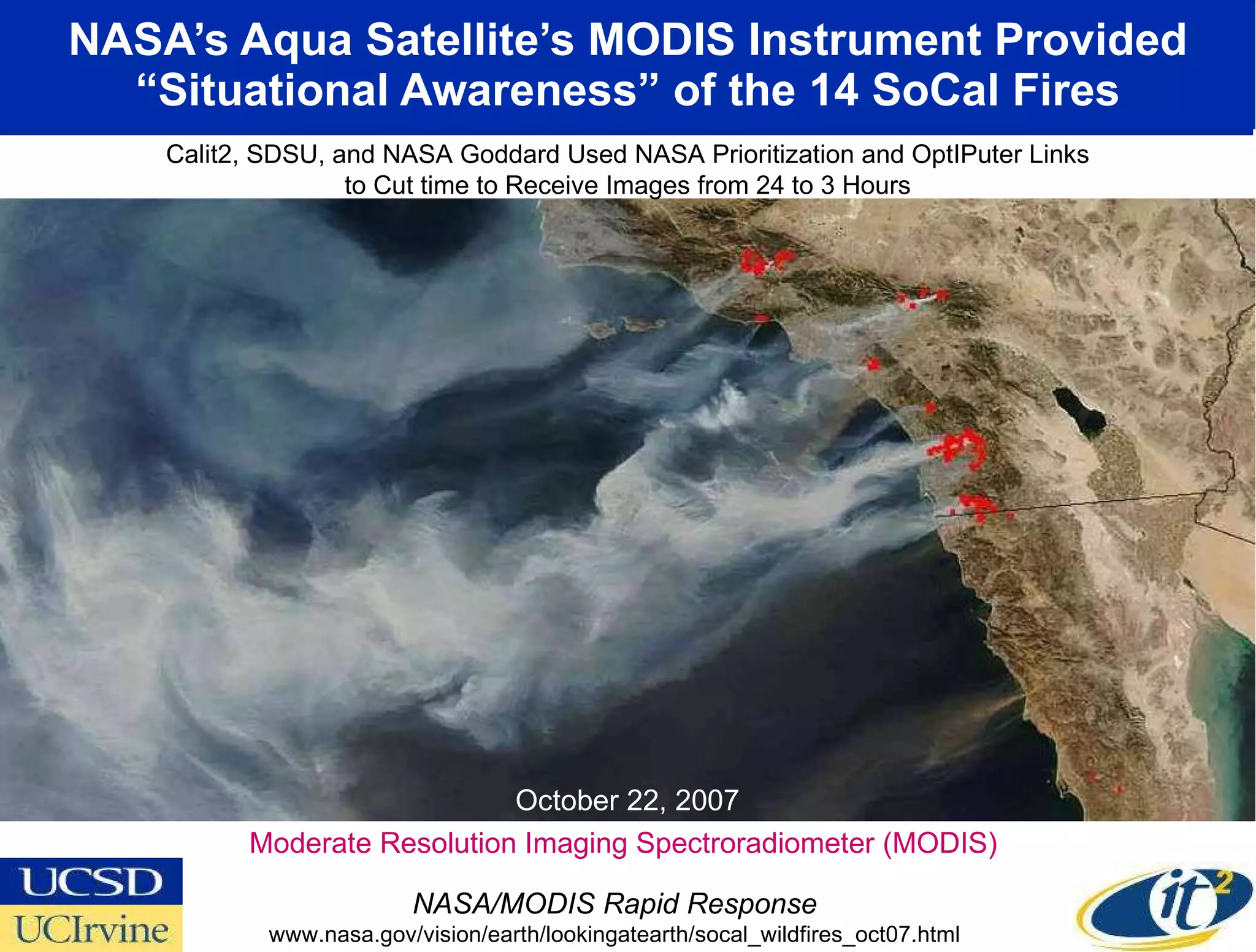
NASA’s Aqua Satellite’s MODIS Instrument Provided “Situational Awareness” of the 14 SoCal Fires NASA/MODIS Rapid Response www.nasa.gov/vision/earth/lookingatearth/socal_wildfires_oct07.html October 22, 2007 Moderate Resolution Imaging Spectroradiometer (MODIS)  Calit2, SDSU, and NASA Goddard Used NASA Prioritization and OptIPuter Links to Cut time to Receive Images from 24 to 3 Hours
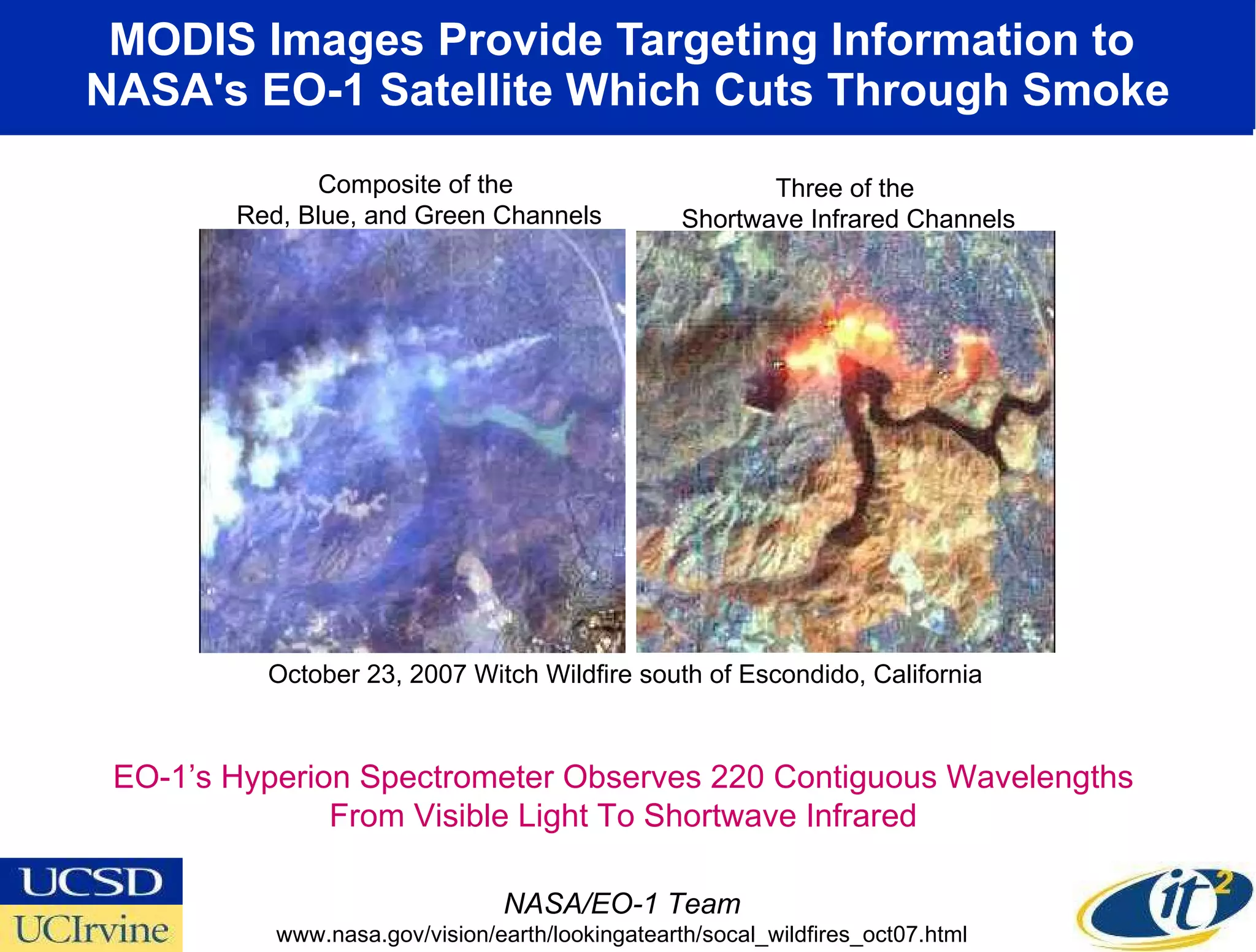
MODIS Images Provide Targeting Information to  NASA's EO-1 Satellite Which Cuts Through Smoke EO-1’s Hyperion Spectrometer Observes 220 Contiguous Wavelengths  From Visible Light To Shortwave Infrared  October 23, 2007 Witch Wildfire south of Escondido, California  Composite of the  Red, Blue, and Green Channels Three of the  Shortwave Infrared Channels NASA/EO-1 Team www.nasa.gov/vision/earth/lookingatearth/socal_wildfires_oct07.html
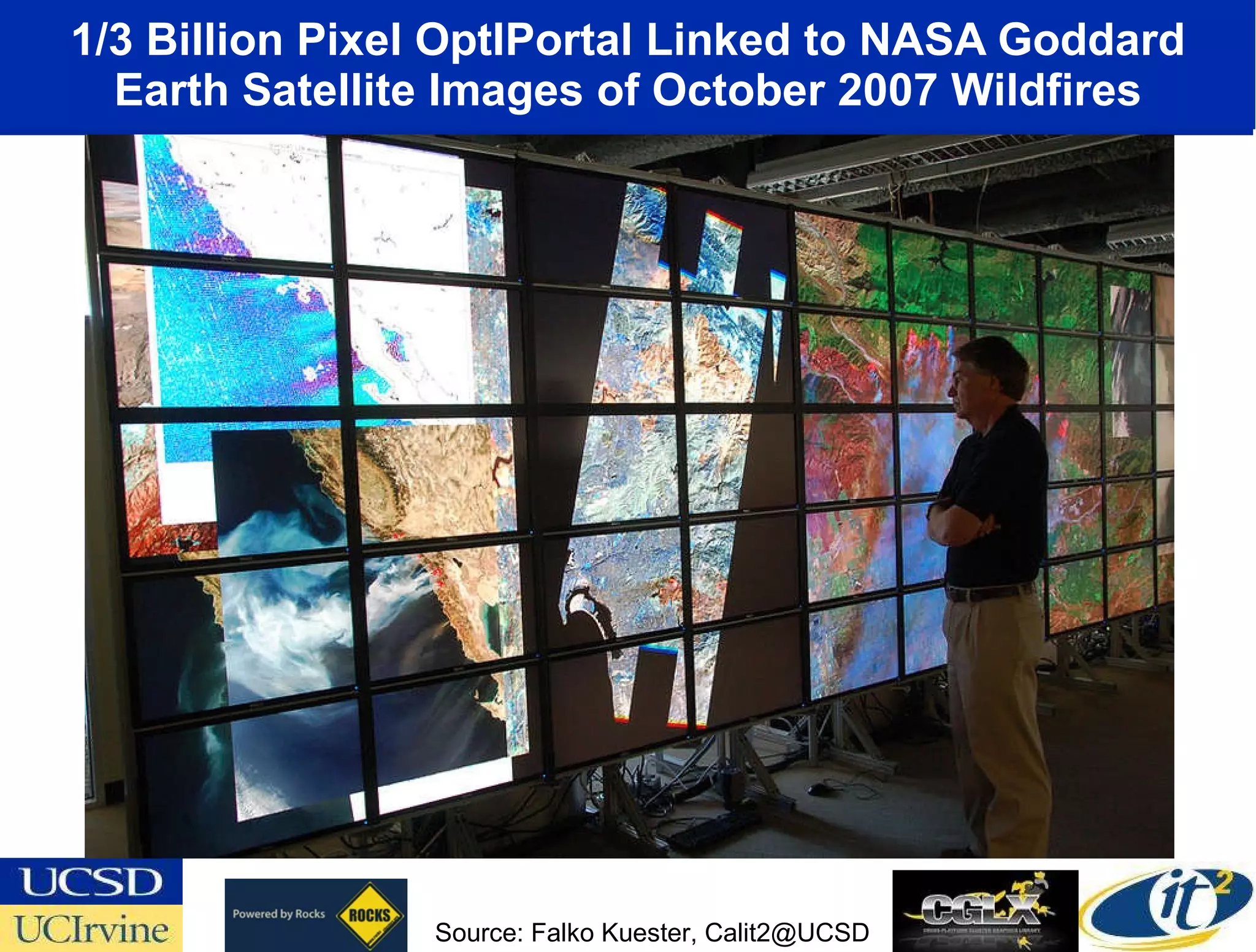
1/3 Billion Pixel OptIPortal Linked to NASA Goddard Earth Satellite Images of October 2007 Wildfires Source: Falko Kuester, Calit2@UCSD
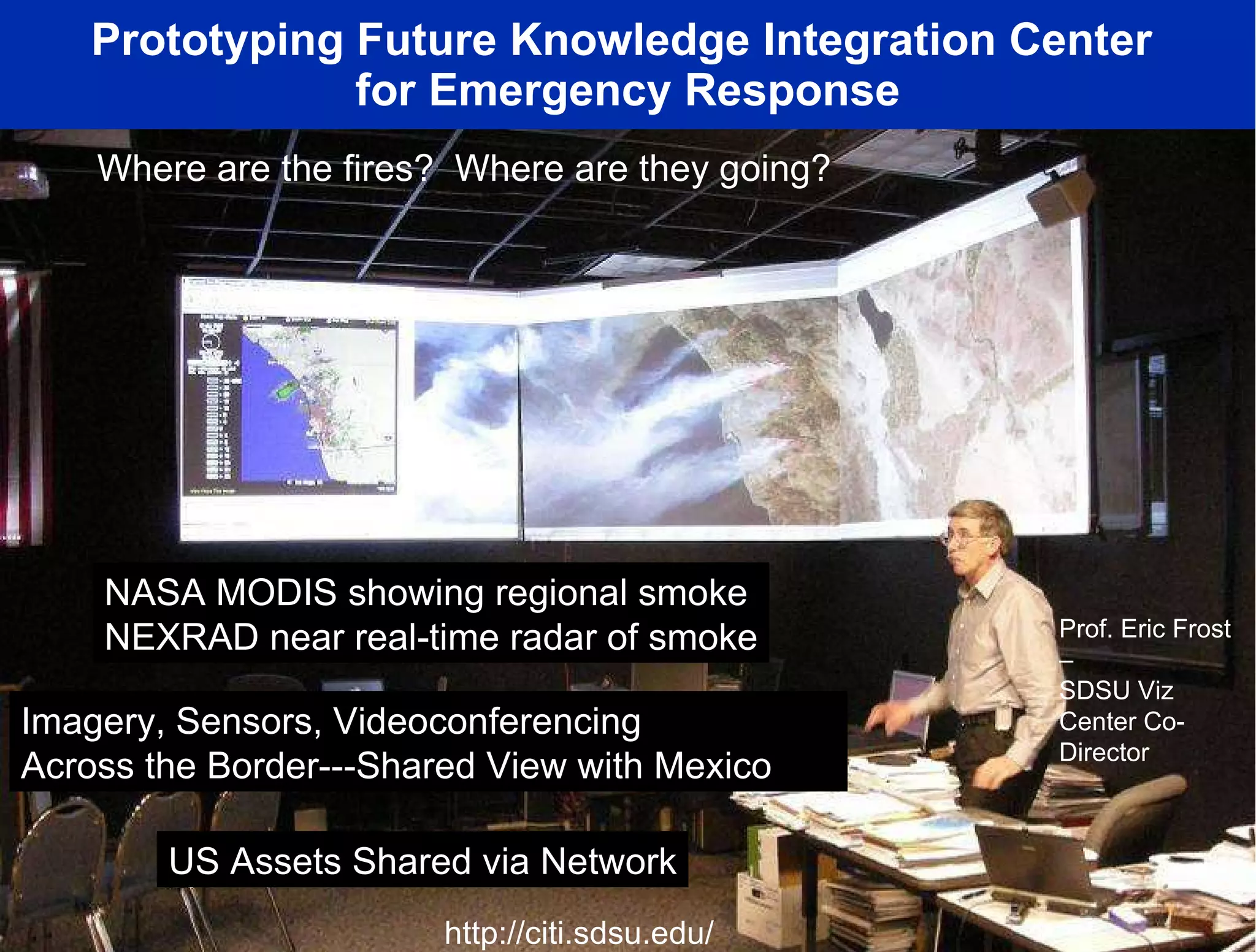
Prototyping Future Knowledge Integration Center  for Emergency Response NASA MODIS showing regional smoke NEXRAD near real-time radar of smoke Where are the fires?  Where are they going? Imagery, Sensors, Videoconferencing Across the Border---Shared View with Mexico US Assets Shared via Network Prof. Eric Frost –  SDSU Viz Center Co-Director http://citi.sdsu.edu/
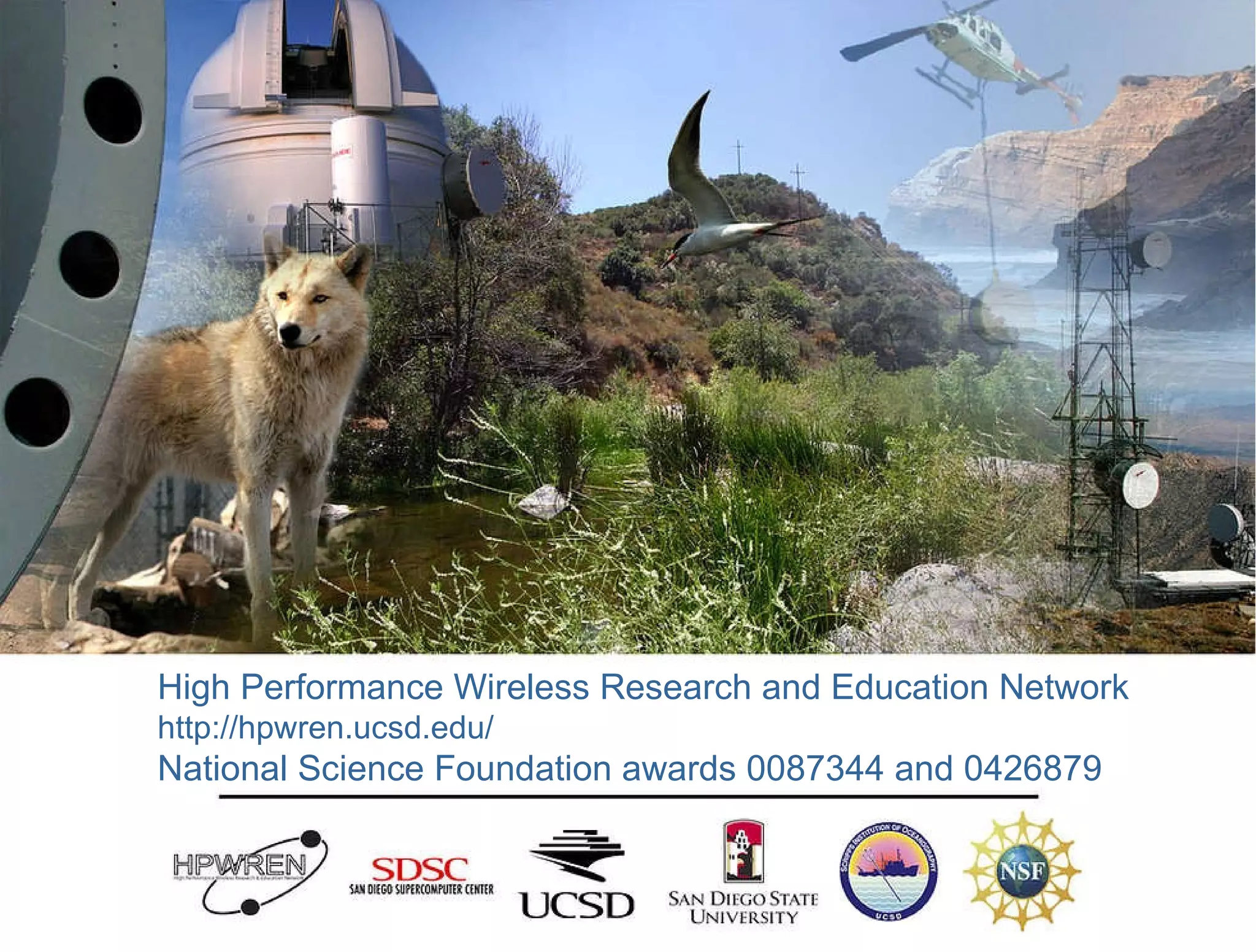
High Performance Wireless Research and Education Network http://hpwren.ucsd.edu/ National Science Foundation awards 0087344 and 0426879
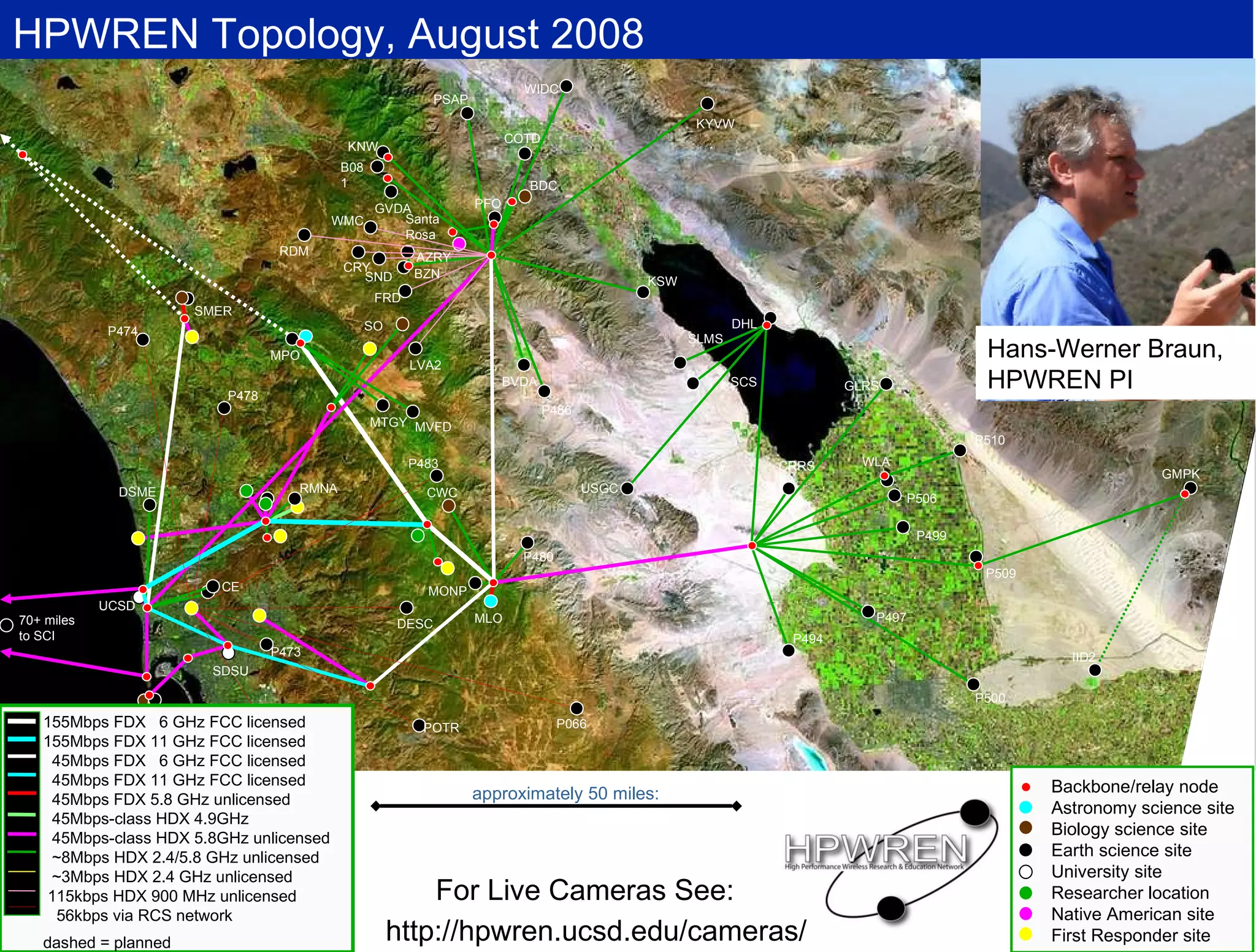
HPWREN Topology, August 2008 approximately 50 miles: MVFD MTGY MPO SMER CNM UCSD to CI and PEMEX 70+ miles to SCI PL MLO MONP CWC P480 USGC SO LVA2 BVDA RMNA Santa Rosa GVDA KNW WMC RDM CRY SND BZN AZRY FRD PSAP WIDC KYVW COTD PFO BDC KSW DHL SLMS SCS CRRS GLRS DSME WLA P506 P510 P499 GMPK IID2 P509 P500 P494 P497 B081 P486 NSSS SDSU P474 P478 DESC P473 POTR P066 P483 CE 155Mbps FDX  6 GHz FCC licensed 155Mbps FDX 11 GHz FCC licensed 45Mbps FDX  6 GHz FCC licensed 45Mbps FDX 11 GHz FCC licensed 45Mbps FDX 5.8 GHz unlicensed 45Mbps-class HDX 4.9GHz 45Mbps-class HDX 5.8GHz unlicensed ~8Mbps HDX 2.4/5.8 GHz unlicensed ~3Mbps HDX 2.4 GHz unlicensed 115kbps HDX 900 MHz unlicensed 56kbps via RCS network dashed = planned Hans-Werner Braun, HPWREN PI http://hpwren.ucsd.edu/cameras/ For Live Cameras See: Backbone/relay node Astronomy science site Biology science site Earth science site University site Researcher location Native American site First Responder site
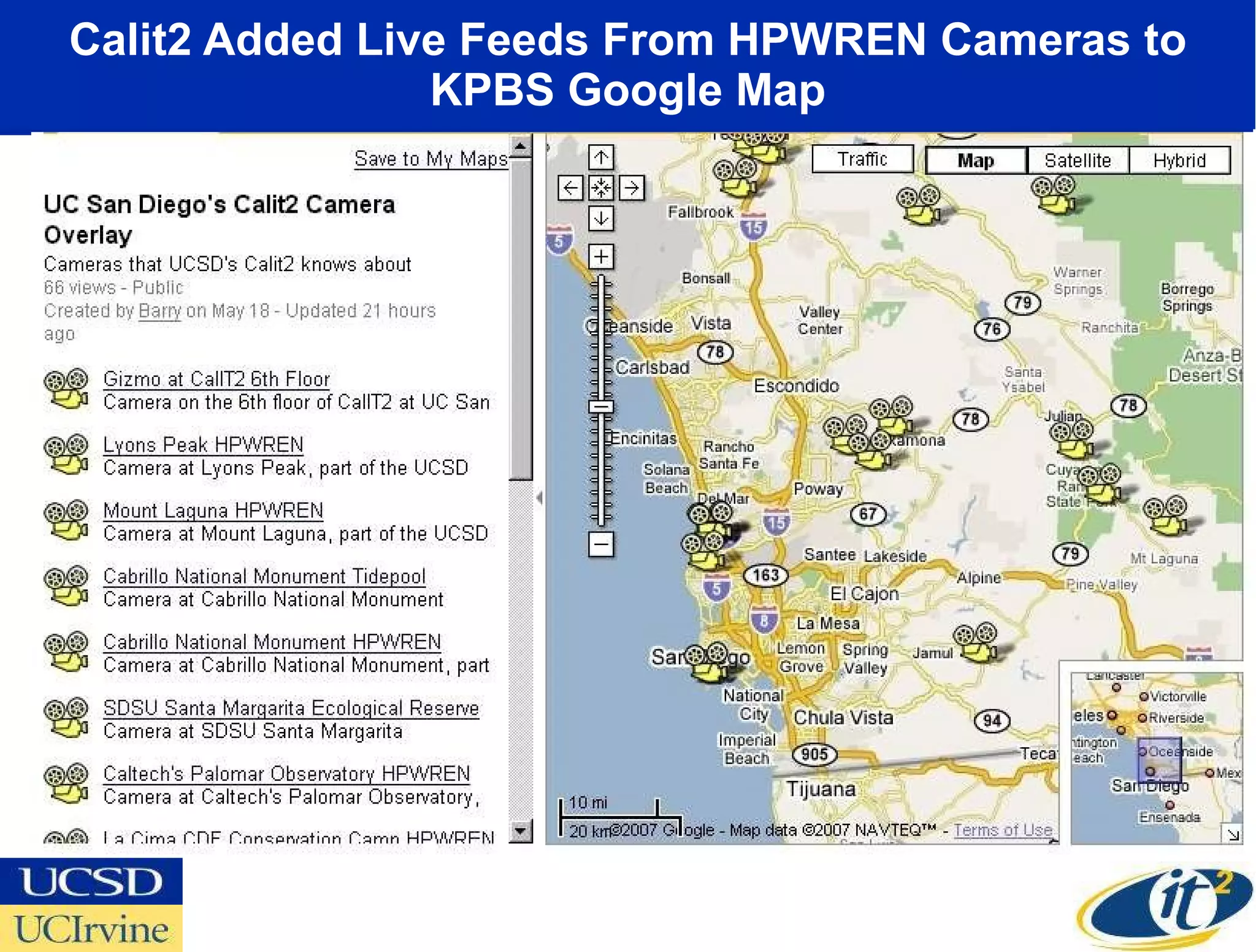
Calit2 Added Live Feeds From HPWREN Cameras to KPBS Google Map
What is a SensorNet? Sensors  Physical, Chemical, Biological, Imaging,… Sensor Platform Computing, Power, Storage, Radios, … Telecommunications Infrastructure Wired, Wireless, Internet, … Sensor Arrays Homogeneous, Inhomogeneous, Ad Hoc, … Backend Data Systems Storage, Compute, Analysis, Visualization
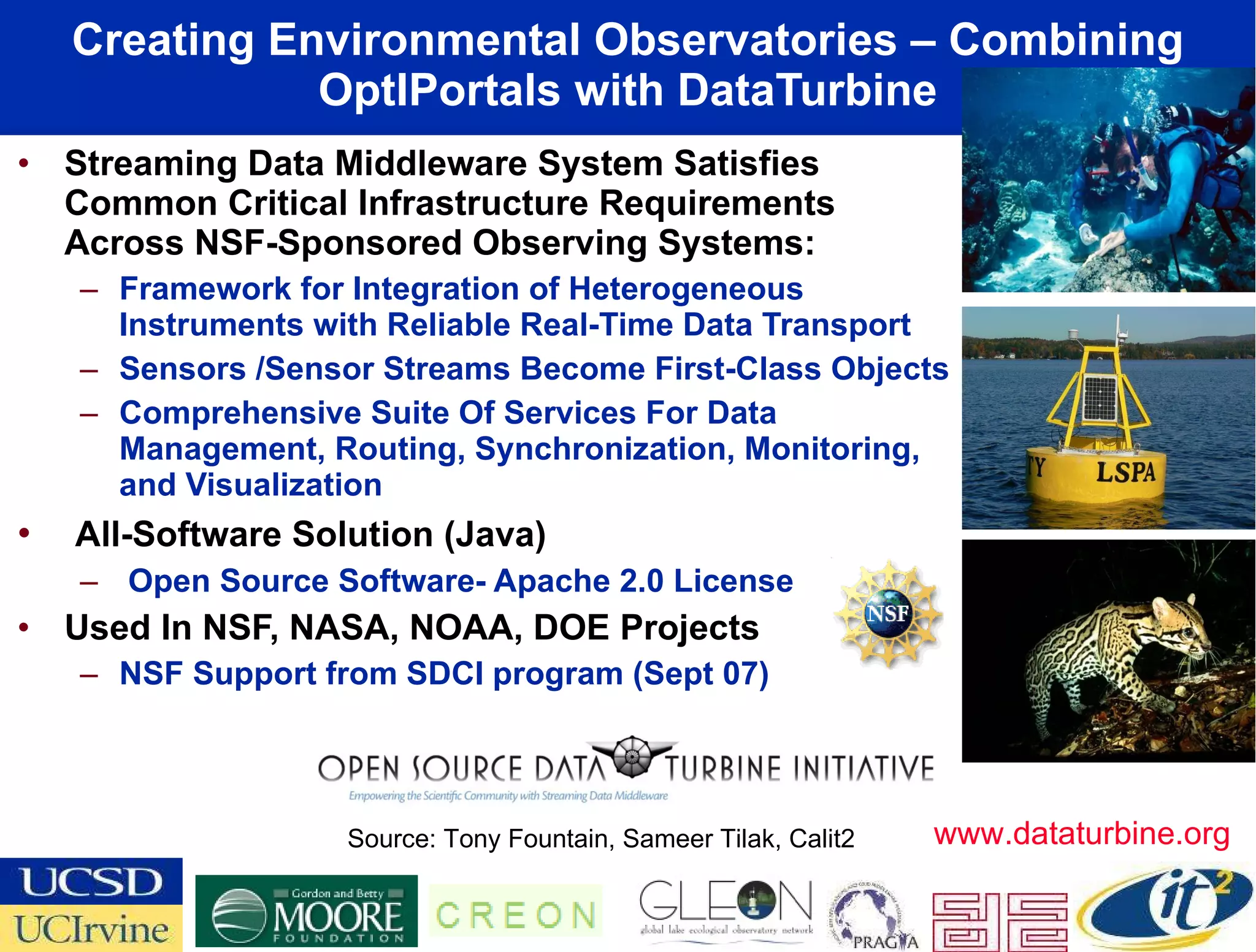
Creating Environmental Observatories – Combining OptIPortals with DataTurbine Streaming Data Middleware System Satisfies Common Critical Infrastructure Requirements Across NSF-Sponsored Observing Systems:  Framework for Integration of Heterogeneous Instruments with Reliable Real-Time Data Transport Sensors /Sensor Streams Become First-Class Objects Comprehensive Suite Of Services For Data Management, Routing, Synchronization, Monitoring, and Visualization  All-Software Solution (Java) Open Source Software- Apache 2.0 License Used In NSF, NASA, NOAA, DOE Projects NSF Support from SDCI program (Sept 07) Source: Tony Fountain, Sameer Tilak, Calit2 www.dataturbine.org
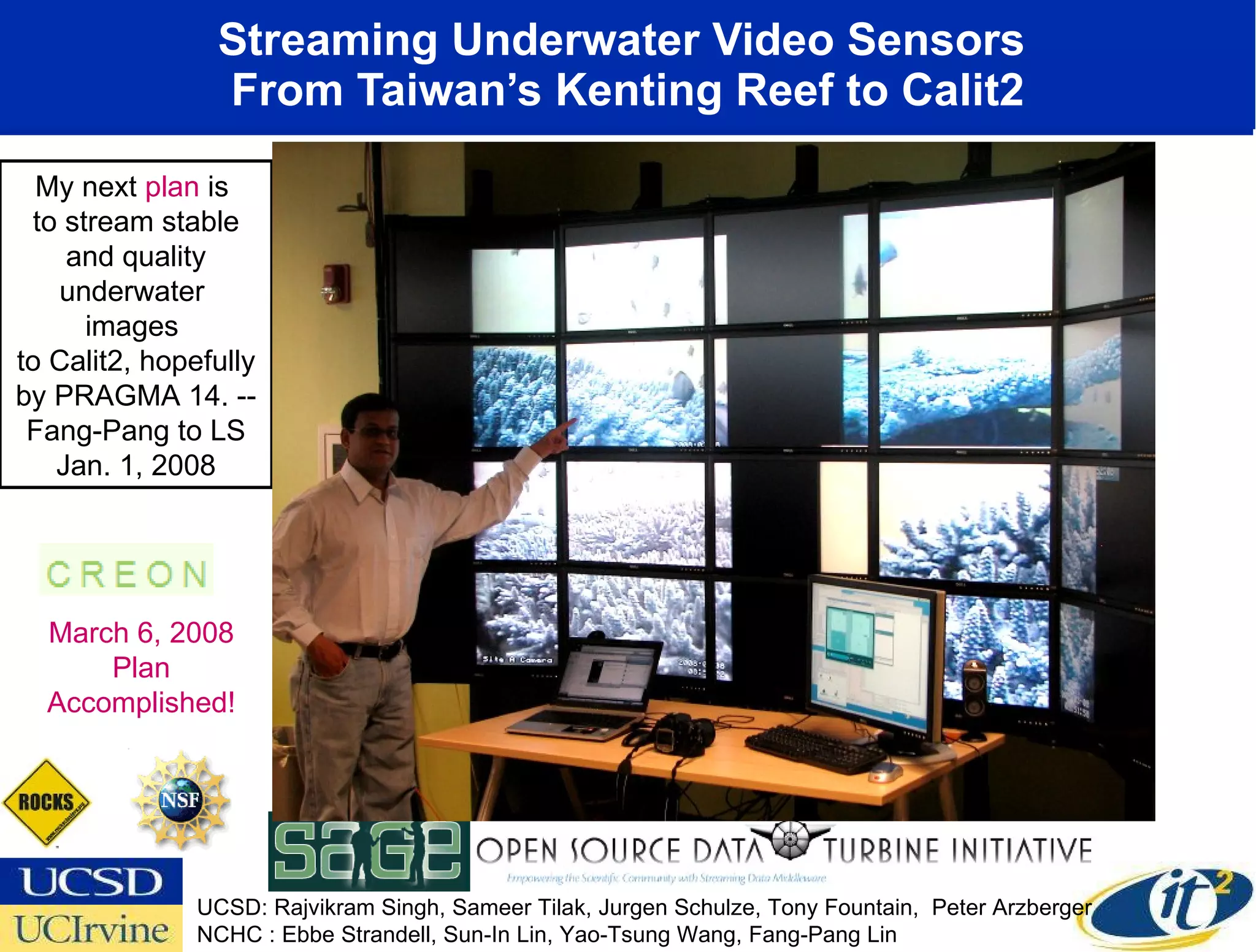
Streaming Underwater Video Sensors  From Taiwan’s Kenting Reef to Calit2 UCSD: Rajvikram Singh, Sameer Tilak, Jurgen Schulze, Tony Fountain,  Peter Arzberger NCHC : Ebbe Strandell, Sun-In Lin, Yao-Tsung Wang, Fang-Pang Lin My next  plan  is  to stream stable and quality underwater  images  to Calit2, hopefully by PRAGMA 14. --Fang-Pang to LS Jan. 1, 2008 March 6, 2008 Plan Accomplished!
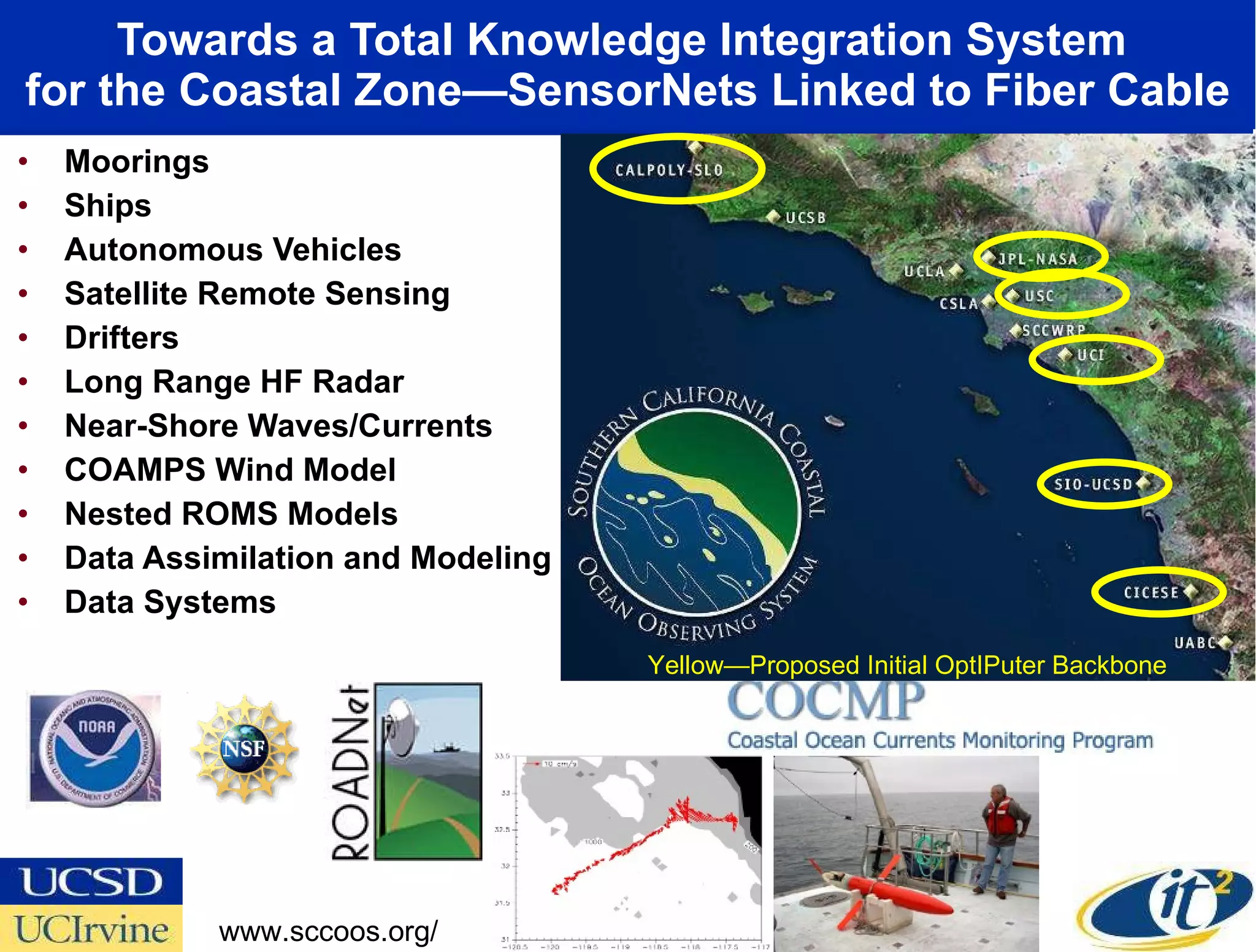
Towards a Total Knowledge Integration System  for the Coastal Zone—SensorNets Linked to Fiber Cable Moorings Ships Autonomous Vehicles  Satellite Remote Sensing Drifters Long Range HF Radar  Near-Shore Waves/Currents COAMPS Wind Model Nested ROMS Models Data Assimilation and Modeling Data Systems Pilot Project Components www.sccoos.org/ Yellow—Proposed Initial OptIPuter Backbone
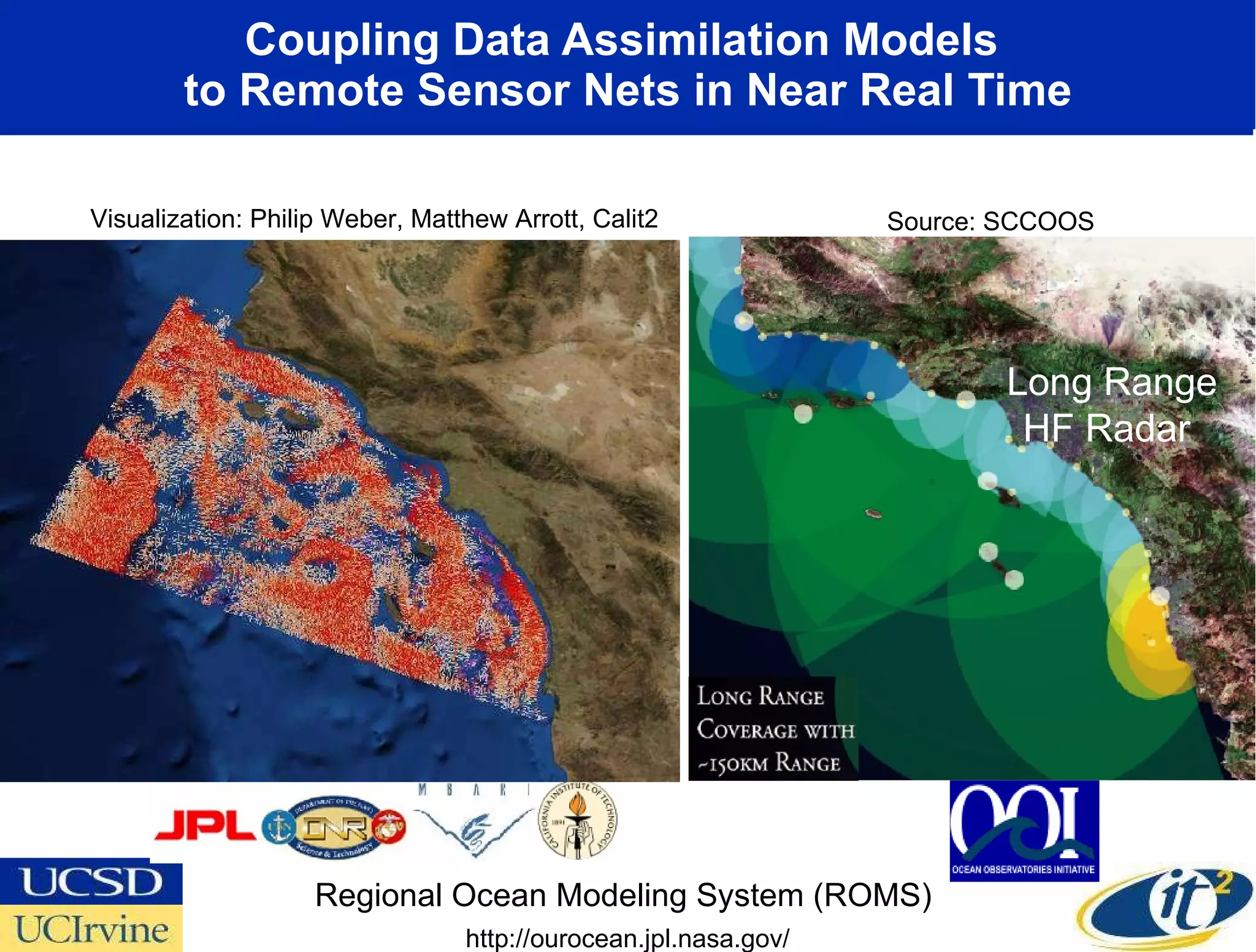
Coupling Data Assimilation Models  to Remote Sensor Nets in Near Real Time Regional Ocean Modeling System (ROMS)  http://ourocean.jpl.nasa.gov/ Long Range HF Radar  Visualization: Philip Weber, Matthew Arrott, Calit2 Source: SCCOOS
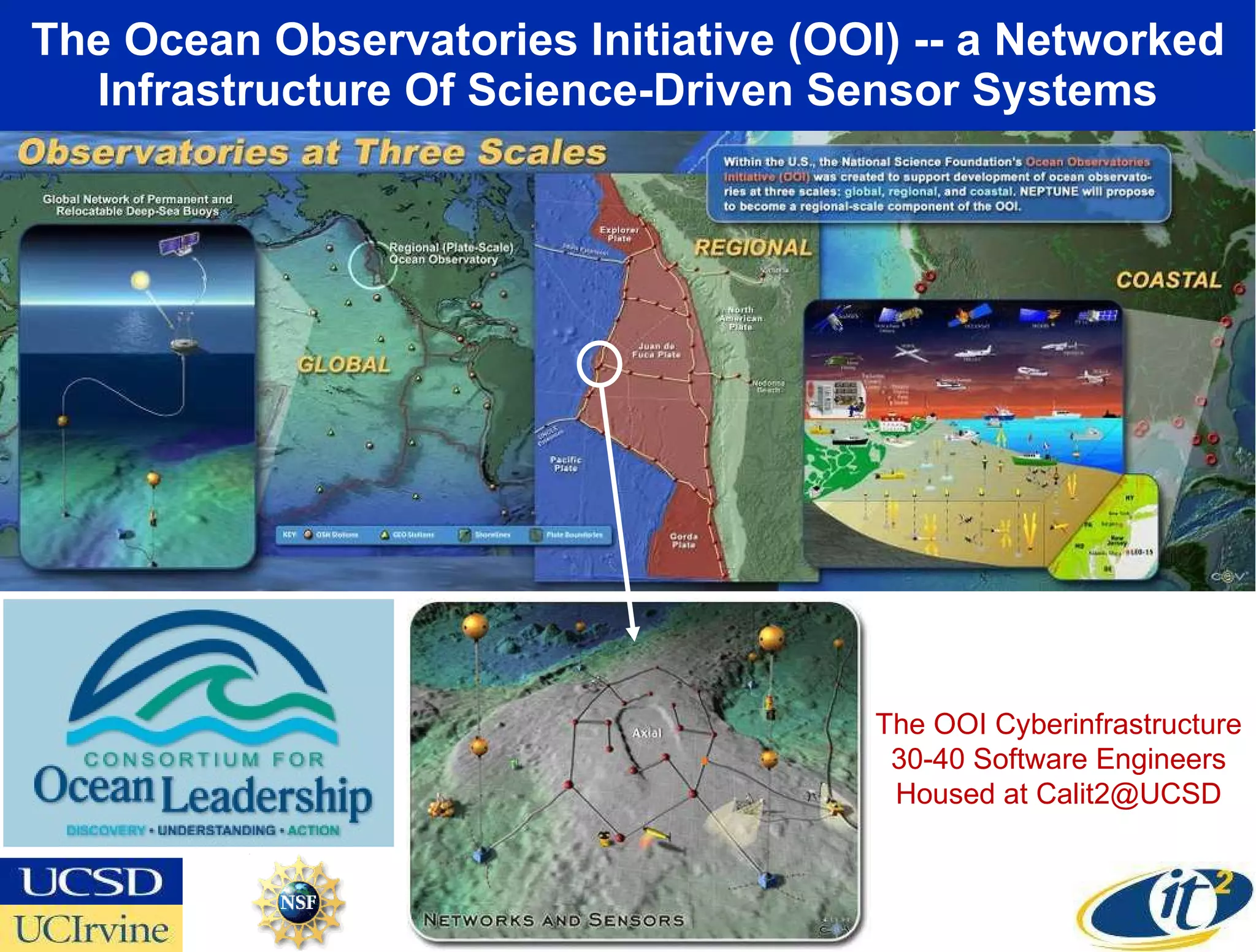
The Ocean Observatories Initiative (OOI) -- a Networked Infrastructure Of Science-Driven Sensor Systems The OOI Cyberinfrastructure 30-40 Software Engineers Housed at Calit2@UCSD
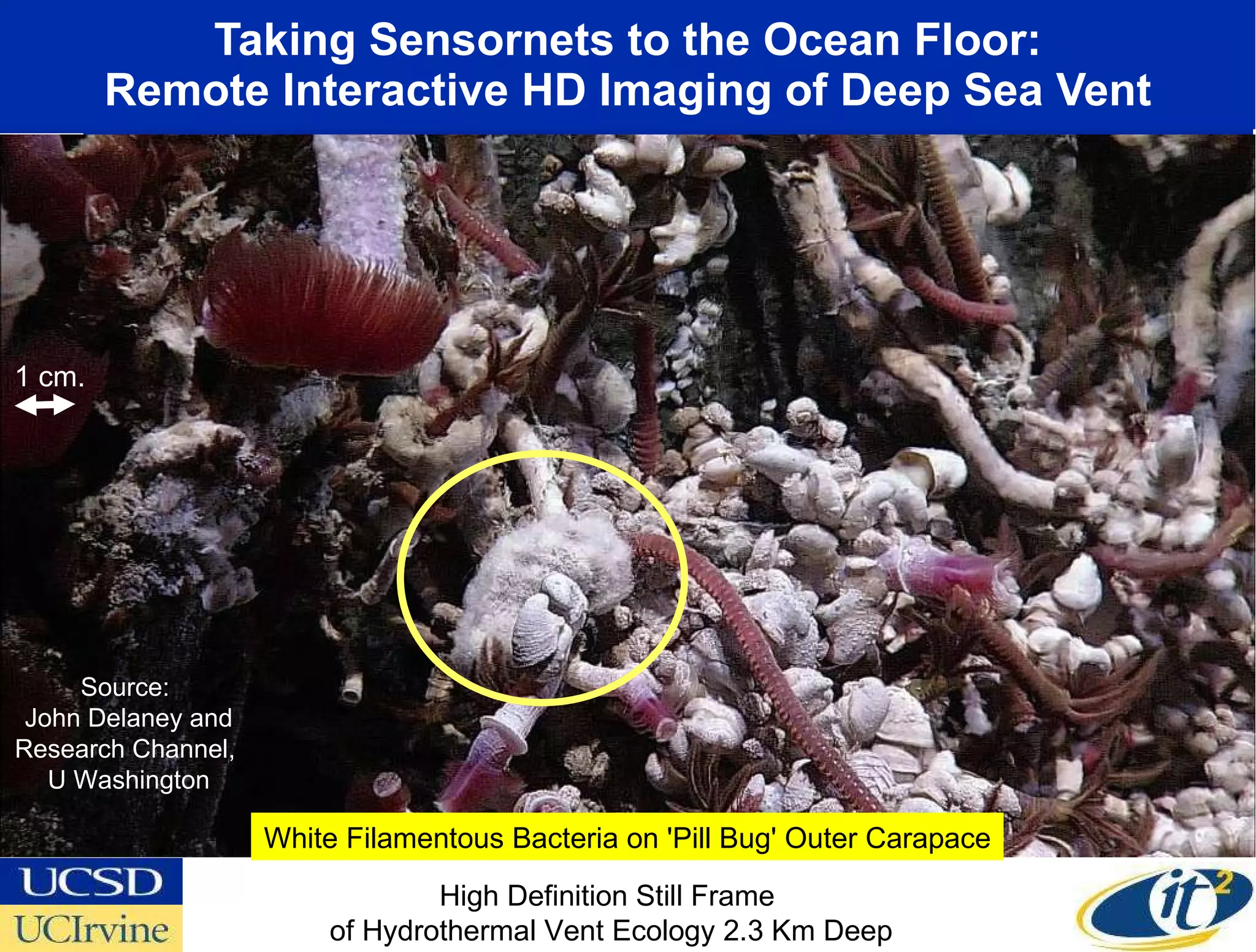
Taking Sensornets to the Ocean Floor: Remote Interactive HD Imaging of Deep Sea Vent Canadian-U.S. Collaboration High Definition Still Frame  of Hydrothermal Vent Ecology 2.3 Km Deep Source:  John Delaney and Research Channel,  U Washington 1 cm. White Filamentous Bacteria on 'Pill Bug' Outer Carapace

Sensornets and Global Change

  • 1.
    Sensornets and GlobalChange Invited Talk Greenovation Forum: Sensing and Sustainability [email_address] December 2, 2009 Dr. Larry Smarr Director, California Institute for Telecommunications and Information Technology Harry E. Gruber Professor, Dept. of Computer Science and Engineering Jacobs School of Engineering, UCSD Follow me on Twitter: http://twitter.com/lsmarr
  • 2.
    San Diego Examplesof Sensornets for Sustainability Building Sensing Wildfire Sensing What is a Sensornet? Coastal Sensing
  • 3.
    Real-Time Monitoring ofBuilding Energy Usage: UCSD Has 34 Buildings On-Line http://mscada01.ucsd.edu/ion/
  • 4.
    Power Management inMixed Use Buildings: The UCSD CSE Building is Energy Instrumented 500 Occupants, 750 Computers Detailed Instrumentation to Measure Macro and Micro-Scale Power Use 39 Sensor Pods, 156 Radios, 70 Circuits Subsystems: Air Conditioning & Lighting Conclusions: Peak Load is Twice Base Load 70% of Base Load is PCs and Servers 90% of That Could Be Avoided! Source: Rajesh Gupta, CSE, Calit2
  • 5.
    Cisco Vision: Mediatingthe Smart Building Energy Dashboards, Demand Response, Fault Detection, Event Reporting, SmartGrid, etc. Source: Dave Clute, Cisco Connected Real Estate Network as a Platform to Connect, Aggregate and Normalize Open XML Interface Mediator Switch Router Occupancy Detectors VAV FCU Heat Pump Chilled Beam Boilers RTU HVAC Meters Sub Meters Refrigeration Solar PV Trash Compactor Sprinkler Fire Alarm System Smoke Sensor Sounder Break Glass Lighting Control General Lighting DSI/DALI Interface Electrical EnergyWise Filer UPS PDU PFU Sensor CDU Smart UPS CRAC Counter DCC Wireless Meter
  • 6.
    Climate Change WillPose Major Challenges to California in Water and Wildfires “ It is likely that the changes in climate that San Diego is experiencing due to the warming of the region will increase the frequency and intensity of fires even more, making the region more vulnerable to devastating fires like the ones seen in 2003 and 2007.” California Applications Program (CAP) & The California Climate Change Center (CCCC) CAP/CCCC is directed from the Climate Research Division, Scripps Institution of Oceanography
  • 7.
    Using Sensornets toAccelerate Response to Wildfires Early on October 23, 2007, Harris Fire San Diego Photo by Bill Clayton, http://map.sdsu.edu/
  • 8.
    NASA’s Aqua Satellite’sMODIS Instrument Provided “Situational Awareness” of the 14 SoCal Fires NASA/MODIS Rapid Response www.nasa.gov/vision/earth/lookingatearth/socal_wildfires_oct07.html October 22, 2007 Moderate Resolution Imaging Spectroradiometer (MODIS) Calit2, SDSU, and NASA Goddard Used NASA Prioritization and OptIPuter Links to Cut time to Receive Images from 24 to 3 Hours
  • 9.
    MODIS Images ProvideTargeting Information to NASA's EO-1 Satellite Which Cuts Through Smoke EO-1’s Hyperion Spectrometer Observes 220 Contiguous Wavelengths From Visible Light To Shortwave Infrared October 23, 2007 Witch Wildfire south of Escondido, California Composite of the Red, Blue, and Green Channels Three of the Shortwave Infrared Channels NASA/EO-1 Team www.nasa.gov/vision/earth/lookingatearth/socal_wildfires_oct07.html
  • 10.
    1/3 Billion PixelOptIPortal Linked to NASA Goddard Earth Satellite Images of October 2007 Wildfires Source: Falko Kuester, Calit2@UCSD
  • 11.
    Prototyping Future KnowledgeIntegration Center for Emergency Response NASA MODIS showing regional smoke NEXRAD near real-time radar of smoke Where are the fires? Where are they going? Imagery, Sensors, Videoconferencing Across the Border---Shared View with Mexico US Assets Shared via Network Prof. Eric Frost – SDSU Viz Center Co-Director http://citi.sdsu.edu/
  • 12.
    High Performance WirelessResearch and Education Network http://hpwren.ucsd.edu/ National Science Foundation awards 0087344 and 0426879
  • 13.
    HPWREN Topology, August2008 approximately 50 miles: MVFD MTGY MPO SMER CNM UCSD to CI and PEMEX 70+ miles to SCI PL MLO MONP CWC P480 USGC SO LVA2 BVDA RMNA Santa Rosa GVDA KNW WMC RDM CRY SND BZN AZRY FRD PSAP WIDC KYVW COTD PFO BDC KSW DHL SLMS SCS CRRS GLRS DSME WLA P506 P510 P499 GMPK IID2 P509 P500 P494 P497 B081 P486 NSSS SDSU P474 P478 DESC P473 POTR P066 P483 CE 155Mbps FDX 6 GHz FCC licensed 155Mbps FDX 11 GHz FCC licensed 45Mbps FDX 6 GHz FCC licensed 45Mbps FDX 11 GHz FCC licensed 45Mbps FDX 5.8 GHz unlicensed 45Mbps-class HDX 4.9GHz 45Mbps-class HDX 5.8GHz unlicensed ~8Mbps HDX 2.4/5.8 GHz unlicensed ~3Mbps HDX 2.4 GHz unlicensed 115kbps HDX 900 MHz unlicensed 56kbps via RCS network dashed = planned Hans-Werner Braun, HPWREN PI http://hpwren.ucsd.edu/cameras/ For Live Cameras See: Backbone/relay node Astronomy science site Biology science site Earth science site University site Researcher location Native American site First Responder site
  • 14.
    Calit2 Added LiveFeeds From HPWREN Cameras to KPBS Google Map
  • 15.
    What is aSensorNet? Sensors Physical, Chemical, Biological, Imaging,… Sensor Platform Computing, Power, Storage, Radios, … Telecommunications Infrastructure Wired, Wireless, Internet, … Sensor Arrays Homogeneous, Inhomogeneous, Ad Hoc, … Backend Data Systems Storage, Compute, Analysis, Visualization
  • 16.
    Creating Environmental Observatories– Combining OptIPortals with DataTurbine Streaming Data Middleware System Satisfies Common Critical Infrastructure Requirements Across NSF-Sponsored Observing Systems: Framework for Integration of Heterogeneous Instruments with Reliable Real-Time Data Transport Sensors /Sensor Streams Become First-Class Objects Comprehensive Suite Of Services For Data Management, Routing, Synchronization, Monitoring, and Visualization All-Software Solution (Java) Open Source Software- Apache 2.0 License Used In NSF, NASA, NOAA, DOE Projects NSF Support from SDCI program (Sept 07) Source: Tony Fountain, Sameer Tilak, Calit2 www.dataturbine.org
  • 17.
    Streaming Underwater VideoSensors From Taiwan’s Kenting Reef to Calit2 UCSD: Rajvikram Singh, Sameer Tilak, Jurgen Schulze, Tony Fountain, Peter Arzberger NCHC : Ebbe Strandell, Sun-In Lin, Yao-Tsung Wang, Fang-Pang Lin My next plan is to stream stable and quality underwater  images to Calit2, hopefully by PRAGMA 14. --Fang-Pang to LS Jan. 1, 2008 March 6, 2008 Plan Accomplished!
  • 18.
    Towards a TotalKnowledge Integration System for the Coastal Zone—SensorNets Linked to Fiber Cable Moorings Ships Autonomous Vehicles Satellite Remote Sensing Drifters Long Range HF Radar Near-Shore Waves/Currents COAMPS Wind Model Nested ROMS Models Data Assimilation and Modeling Data Systems Pilot Project Components www.sccoos.org/ Yellow—Proposed Initial OptIPuter Backbone
  • 19.
    Coupling Data AssimilationModels to Remote Sensor Nets in Near Real Time Regional Ocean Modeling System (ROMS) http://ourocean.jpl.nasa.gov/ Long Range HF Radar Visualization: Philip Weber, Matthew Arrott, Calit2 Source: SCCOOS
  • 20.
    The Ocean ObservatoriesInitiative (OOI) -- a Networked Infrastructure Of Science-Driven Sensor Systems The OOI Cyberinfrastructure 30-40 Software Engineers Housed at Calit2@UCSD
  • 21.
    Taking Sensornets tothe Ocean Floor: Remote Interactive HD Imaging of Deep Sea Vent Canadian-U.S. Collaboration High Definition Still Frame of Hydrothermal Vent Ecology 2.3 Km Deep Source: John Delaney and Research Channel, U Washington 1 cm. White Filamentous Bacteria on 'Pill Bug' Outer Carapace